
Most business leaders don’t start the week thinking about identity policies, backup failures, payroll bottlenecks, or whether their customer data is clean enough for reporting. They start with sales targets, hiring plans, delivery deadlines, and cash flow. Then technology problems take over the calendar.
A founder gets pulled into a cloud billing issue. A finance lead spends hours fixing inconsistent invoice records. A CTO loses two days to access control gaps and endpoint alerts. An operations manager is stuck chasing routine admin work that should’ve been automated or delegated months ago. None of this feels strategic, but all of it affects growth.
That’s where consulting and it services become useful. Not as a vague “digital transformation” label, but as a practical way to bring order to systems, decisions, and execution. Good partners help a business stop reacting to every technical problem and start building a more stable operating model.
The scale of the market shows why this matters. The global IT services market was valued at USD 1.61 trillion in 2025 and is projected to reach USD 3.17 trillion by 2035, growing at a 7.01% CAGR, according to Precedence Research’s IT services market analysis. Businesses aren’t buying these services because they’re fashionable. They’re buying them because modern operations depend on them.
Navigating the Digital Maze with Consulting and IT Services
A common pattern shows up in growing companies. The business moves fast at first because everyone does a bit of everything. Then complexity arrives all at once. New software gets added. Security expectations rise. Reporting becomes harder. Remote teams need tighter access control. Customers expect faster response times. Finance wants cleaner data. Leadership still wants speed.
That’s when internal teams start patching problems instead of solving them. One person becomes the unofficial system owner for five unrelated platforms. Another manually reconciles records because the data doesn’t line up. Small incidents keep stacking up until they become an operating model.
Consulting and it services help break that cycle. Consulting gives leaders a clearer way to make technology decisions. IT services turn those decisions into working systems, support processes, and day-to-day reliability. One addresses direction. The other handles execution.
What business leaders are really buying
Most companies aren’t buying code, cloud seats, or support tickets. They’re buying three things:
- Clarity: Which systems to keep, replace, secure, or integrate
- Capacity: Extra hands and specialized skills without long hiring cycles
- Continuity: A more reliable operation when key people are overloaded or unavailable
Practical rule: If your senior team is spending too much time coordinating tools, fixing process gaps, or chasing avoidable outages, the issue usually isn’t effort. It’s operating design.
The decision also isn’t only about cost. In many cases, the better question is whether your current setup lets experienced employees spend time on high-value work. If your finance lead is still correcting spreadsheets and your product lead is still managing support escalations tied to poor systems, the business is paying a hidden tax every week.
From technical noise to business traction
The right partnership changes the rhythm of a company. Instead of debating every software problem internally, leaders get a path: assess, prioritize, implement, support, improve. That path matters most for SMEs and startups, because they rarely have the luxury of building a fully staffed internal function for every need.
Good consulting and it services don’t just reduce chaos. They create room for better planning, cleaner execution, and steadier growth.
What Are Consulting and IT Services Really?

Businesses often use the phrase “consulting and it services” as if it means one thing. It doesn’t. These are closely connected functions, but they solve different parts of the same business problem.
A simple way to understand the difference is this. Consulting is the architecture. IT services are the build and maintenance. If you were constructing an office, you’d want someone to design the plan, sequence the work, and make sure the structure fits the business need. You’d also need a crew to build it, wire it, secure it, and keep it operating.
Consulting is the blueprint
Consulting starts with questions, not tools. What’s slowing the business down? Which systems are creating risk? Where are teams duplicating effort? What should be automated, standardized, or outsourced?
A capable consultant helps leadership make decisions such as:
- System direction: Whether to modernize a legacy setup or replace it
- Process design: How finance, operations, customer support, and product teams should hand work off cleanly
- Risk planning: Which controls need attention first in cloud, endpoint, access, and data workflows
- Capacity planning: What work belongs in-house and what should be delivered through a partner
This is why strategy matters before implementation. A company can deploy new tools and still end up with the same mess if the workflow itself is broken.
For readers interested in the broader mechanics of the industry, this overview of understanding the consulting sector is useful background because it frames consulting as a business function, not just an advisory title.
IT services are the operational engine
IT services handle the practical work that keeps systems usable and reliable. That includes setup, migration, support, integration, access management, endpoint protection, software development, administration, and ongoing maintenance.
These teams do the work that turns a plan into business capability. Examples include:
- Provisioning and support: Setting up accounts, permissions, devices, and routine support processes
- Cloud execution: Moving workloads, configuring environments, and supporting performance and uptime
- Application work: Building or maintaining business software and integrations
- Security operations: Enforcing policies, monitoring endpoints, and tightening access workflows
Consulting tells you what should exist and why. IT services make sure it actually exists and works on a Tuesday afternoon when your team needs it.
Why the combination matters
Companies get into trouble when they buy only one side. Strategy without execution becomes slide decks and deferred decisions. Execution without strategy creates tool sprawl, rushed purchases, and support debt.
The strongest outcomes usually come from a partner that can connect business intent to technical delivery. That matters even more when IT work intersects with back-office operations, because bookkeeping, payroll, customer service, and data handling often touch the same systems leaders are trying to modernize.
Your Guide to Core Consulting and IT Service Offerings

When business leaders ask what a partner can do, the answer should be concrete. Not “drive innovation.” Not “enable transformation.” The answer is a set of services that remove operational friction, improve control, and increase execution capacity.
Custom software development
Custom software is useful when the business process is too specific for an off-the-shelf workflow or when teams are stitching together too many manual steps. This often shows up in internal dashboards, customer portals, workflow automations, approval systems, and reporting layers.
What works is starting with process pain, not features. If a company asks for a new internal platform before mapping who enters data, who approves it, and who consumes the output, the project usually gets expensive fast. The better approach is to define the business event, the handoff, the exception, and the ownership model first.
A good build should answer practical questions:
- Who uses it daily
- What manual work disappears
- Where data enters the system
- Which reports become easier to trust
- What support burden remains after launch
Cloud computing and migration
Cloud work is often sold as a simple technical upgrade. In practice, it’s an operating model shift. The value comes from flexibility, resilience, and better resource allocation, but only if the migration is planned properly.
A structured cloud migration process includes assessment, design, staging, and integration. According to Data Networks’ overview of IT professional services, that approach can accelerate ROI by 2 to 3 times. The same source notes that post-migration environments often achieve 50% faster app deployment, 25% reduced downtime, and 40% to 60% lower resource costs when the setup is optimized.
That sounds attractive, but the trade-off is discipline. Cloud projects fail when teams lift old inefficiencies into a new environment. If nobody cleans up idle workloads, poor permissions, or weak ownership, the cloud just becomes a more expensive version of the old problem.
The cloud doesn’t fix disorder. It exposes it faster.
Microsoft 365 and workplace productivity
Many companies already pay for workplace tools but use only a fraction of what’s available. The issue usually isn’t licensing. It’s configuration, governance, onboarding, and user adoption.
This category of service often includes identity setup, collaboration controls, document access policies, endpoint alignment, and ongoing administration. Done well, it reduces friction in basic work. Teams know where files live, who can access what, and how approvals and communications move across departments.
This is one of the clearest areas where a US-based outsourcing partner helps. Communication is tighter, training is easier to schedule, and policy decisions often move faster when the provider understands the same business context, documentation standards, and compliance expectations as the client team.
Cybersecurity and endpoint protection
Cybersecurity should be treated as business hygiene, not a side project. Leaders often focus first on dramatic threats, but many costly problems come from routine failures: weak access processes, inconsistent endpoint controls, stale permissions, and unclear escalation paths.
A practical security service usually includes policy enforcement, access reviews, endpoint protection, account controls, user support, and response coordination. It should also match the business reality. A ten-person startup doesn’t need the same process overhead as a large enterprise, but it does need clear ownership and consistency.
The mistake is assuming a tool equals protection. Tools help. Process keeps people safe.
BPO and KPO support
For many SMEs, these solutions provide the most immediate relief. Business process outsourcing and knowledge process outsourcing take repeatable, non-core work off internal teams so they can focus on revenue, delivery, and strategy.
Common examples include:
- Bookkeeping and invoicing: Reducing backlog and improving routine financial processing
- Payroll and tax preparation support: Creating a steadier, documented workflow for recurring obligations
- Customer service administration: Giving operations a reliable frontline for common requests
- Data entry and back-office support: Cleaning handoffs between departments so errors don’t multiply
- Virtual assistants: Handling coordination work that keeps leadership trapped in low-impact tasks
The important distinction is that good BPO support shouldn’t operate in isolation. It should connect to the broader technology environment, reporting logic, and internal controls.
Data management and reporting readiness
Bad data undermines decision-making. Teams lose time reconciling records, arguing over reports, and rebuilding confidence in numbers they should already trust.
A disciplined data management engagement usually includes standardized input rules, legacy cleanup, validation checks, and clearer reporting outputs. The process matters because analytics quality depends on the quality of the data entering the system. In many businesses, the issue isn’t lack of dashboards. It’s unreliable inputs.
That’s why consulting and it services are often most valuable here when they combine process redesign with technical enforcement.
Generative AI in day-to-day operations
Generative AI gets the most attention when people talk about customer chat or content generation. For smaller businesses, the more practical use case is usually operational support. Think drafting routine responses, organizing internal knowledge, accelerating bookkeeping workflows, or assisting service teams with repetitive tasks.
This category works best when the foundation is stable. If process rules are unclear and data quality is poor, AI will amplify inconsistency. If the workflows are defined and access controls are clean, AI can reduce repetitive effort and help teams work faster without adding headcount in the same proportion.
A provider such as NineArchs LLC can support this blend of software, cloud, Microsoft 365, endpoint security, and BPO-oriented execution for organizations that need both technical delivery and operational support.
How Partnerships and Pricing Models Work
The way a service is delivered matters almost as much as the service itself. A strong scope under the wrong engagement model can still create frustration. Leaders need to know whether they’re buying a result, a capability, or added capacity.
Three common engagement models
Project-based work fits a defined outcome. A migration, application build, security assessment, or workflow redesign usually belongs here. This model works when the business can describe the objective clearly and can make timely decisions during delivery.
Managed services fit ongoing responsibility. This is the right model when the business wants a partner to run support, maintenance, administration, monitoring, or routine back-office execution over time. It creates continuity, but only if service boundaries are clear.
Staff augmentation fits capability gaps. This model works when internal leadership and process are already in place, but the team needs more hands or specialized expertise. If you’re weighing that choice, this breakdown of staff augmentation vs outsourcing is a practical reference because the distinction affects control, speed, and management effort.
If your team knows what to do but lacks bandwidth, augmentation can work well. If your team is still defining what good looks like, a managed or consultative model is usually safer.
Comparison of IT Service Pricing Models
| Model | Description | Pros | Cons | Best For |
|---|---|---|---|---|
| Fixed-Price | A defined scope delivered for an agreed amount | Predictable budget, clear deliverables, easier approvals | Less flexible if requirements change, can create change-order friction | Well-defined projects with stable requirements |
| Time & Materials | Billing based on actual time and work performed | Flexible, suits evolving needs, allows discovery during delivery | Budget can move, requires active oversight | Product work, modernization, ambiguous or changing scopes |
| Retainer | Ongoing reserved capacity or advisory support for a recurring fee | Steady access, easier planning, strong for continuous support | Unused capacity can feel inefficient if priorities are unclear | Leadership advisory, recurring support, long-term operational help |
Matching pricing to the real risk
Leaders often choose pricing based on what feels safest on paper. That can backfire. A fixed-price model looks clean, but if the business hasn’t clarified requirements, the contract becomes a battlefield over assumptions. Time and materials can feel open-ended, but it’s often the more honest model for evolving work.
Security work is a good example. If you’re budgeting for a scoped assessment, it helps to understand common market framing before buying. This guide to the average cost of penetration testing is useful context because it shows why price alone doesn’t tell you much without scope clarity.
What works best is aligning the commercial model with decision speed, internal maturity, and operational risk. That’s a business judgment, not just a procurement exercise.
The Ultimate Checklist for Choosing a Vendor
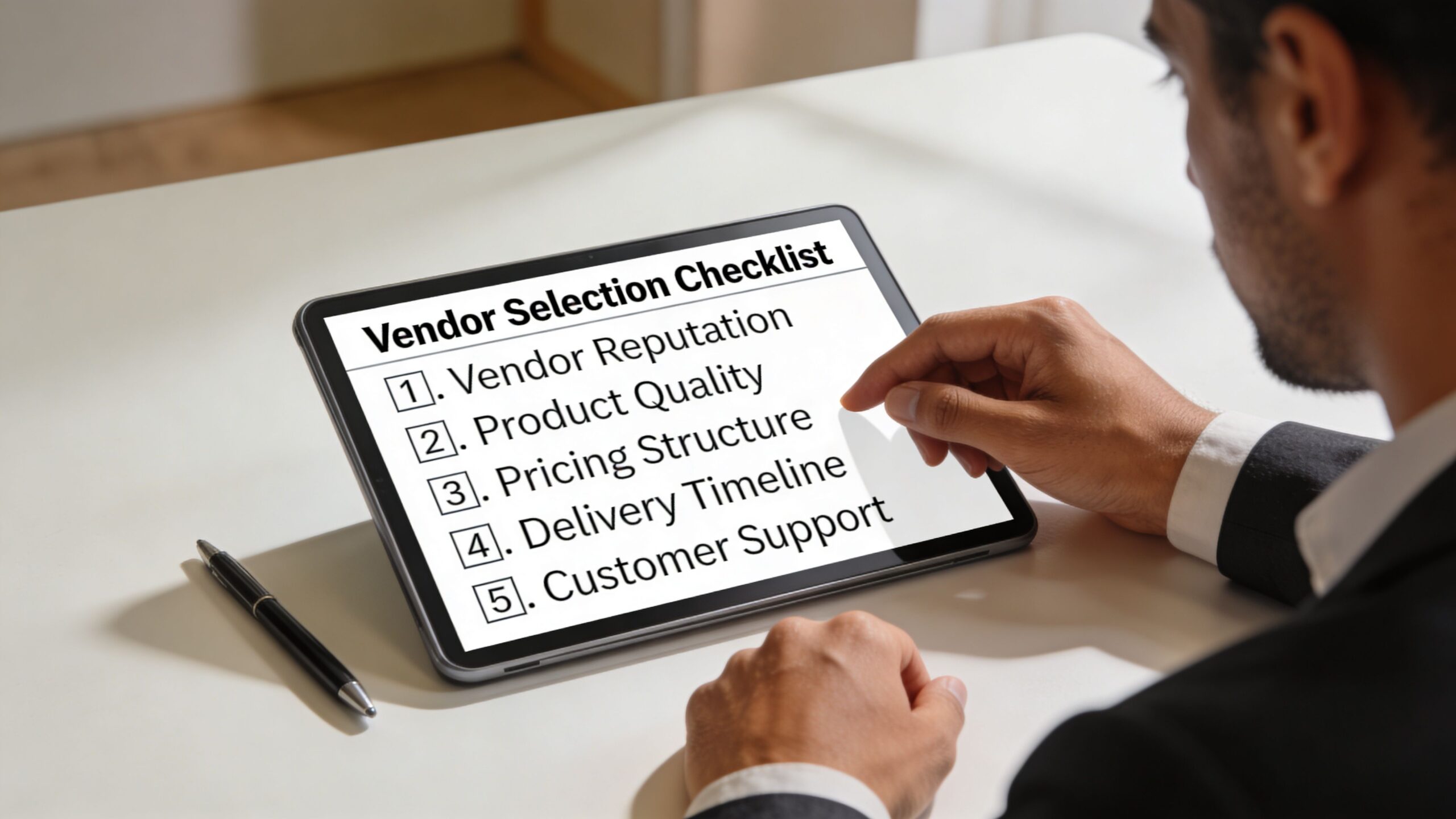
Most vendor selection mistakes happen before the contract is signed. A leadership team gets impressed by credentials, speed, or pricing, but doesn’t test how the provider works under pressure. The result is avoidable confusion later: unclear ownership, slow decisions, weak communication, and support gaps.
One overlooked factor is cultural fit. Recent analyses indicate that 35% of outsourcing failures stem from poor cultural alignment in distributed teams, not only technical gaps, as noted in this Umbrex resource on consulting for underserved communities. That’s a useful reminder that vendor quality isn’t just about certifications or technical resumes.
The shortlist test
When evaluating providers, use a checklist that forces practical answers.
- Technical fit: Can the team explain how it handles your specific environment, not just generic service categories?
- Operational maturity: Do they have a clear intake process, escalation path, documentation style, and ownership model?
- Business understanding: Can they connect technical decisions to finance, operations, customer service, and delivery outcomes?
- Security discipline: Do they describe access control, data handling, and incident response in plain language?
- Scalability: Can the engagement expand or contract without forcing a full reset?
- Communication style: Are meetings, updates, and decisions structured in a way your internal team can absorb?
A helpful supporting reference for smaller organizations is this overview of outsourced IT services for small business, particularly because it reflects the operational questions that usually surface after the sales process ends.
Questions worth asking in live conversations
A strong vendor should answer these without jargon:
- What will you need from our team each week to keep this moving?
- How do you handle changes in scope or shifting priorities?
- Who owns decisions when something breaks across departments?
- What does handoff look like if a key person on your side becomes unavailable?
- How do you document recurring work so we aren’t dependent on one individual?
A reliable partner lowers key-person risk. An unreliable one becomes a new version of it.
The USA partner advantage
For SMEs and startups, using an outsourcing partner from the USA offers practical benefits that don’t always show up in a proposal. Communication tends to be more direct. Scheduling is easier. Business norms are often more aligned. Legal expectations around contracts, privacy, and IP are usually clearer to the client team.
Those advantages matter most when work crosses both IT and operations. A payroll issue, access problem, or urgent customer service workflow often can’t wait for an elongated communication loop. A US-based partner can reduce that lag and make decision-making feel more like an extension of the internal team.
This doesn’t mean geography alone guarantees success. It means proximity in language, accountability expectations, documentation habits, and business context often improves execution quality.
Signs to walk away
Some warning signs are consistent:
- Vague ownership: Nobody can tell you who is accountable for outcomes
- Tool-first selling: The conversation stays on platforms and features instead of workflows and decisions
- Weak discovery: The provider gives recommendations before understanding your operating reality
- No escalation clarity: Support exists, but there’s no clear route when issues become urgent
- Overpromising: Everything sounds fast and easy, but nobody discusses trade-offs
The best partnerships feel steady, not theatrical.
Why NineArchs Is the Right Partner for Growth
Many SMEs and startups don’t have a clean separation between technology work and operational work. The same company that needs cloud support may also need help with bookkeeping workflows, invoicing, payroll coordination, customer service administration, or virtual assistant capacity. Treating those as disconnected problems usually creates more handoffs and less accountability.
That’s why the blended model matters. A partner that can support both IT execution and BPO operations is often a better fit for businesses trying to grow without building several separate internal teams.
Where this model fits
This approach is useful when a business is dealing with conditions like these:
- Leadership overload: Founders and department heads are still coordinating too much routine work
- Fragmented systems: Teams rely on disconnected workflows across operations and technology
- Scaling pressure: The business needs more output before it can justify full-time internal hires in every function
- Inconsistent support: Technical and administrative issues keep bouncing between people with no clear owner
The underserved opportunity is especially clear around AI. As noted in this Pivot Co discussion of consulting impact areas, a key gap in the market is helping SMEs integrate generative AI with BPO operations, where firms can achieve 30% to 50% efficiency gains in finance ops without absorbing the cost structure of large enterprise solutions.
What practical partnership looks like
In real engagements, that often means pairing strategic guidance with execution in places such as:
- Finance operations support: Cleaner invoicing, bookkeeping, payroll workflows, and handoffs
- Technology modernization: Better cloud structure, software support, and workplace administration
- Operational delegation: Virtual assistant and back-office support that follows documented processes
- AI-assisted workflows: Using generative AI where it reduces repetitive effort instead of adding confusion
Many businesses don’t need “more technology.” They need fewer broken handoffs, fewer manual repeats, and a better system for routine work.
The right partner doesn’t just complete tasks. They reduce the number of tasks your senior team should still be touching.
Why this is different for growth-stage companies
Growth-stage businesses usually need flexibility more than ceremony. They need support that can expand when demand rises and tighten when priorities shift. They also need a provider that understands that speed without discipline creates future cleanup work.
A practical partner should be able to move between advisory work and delivery work without forcing the client to coordinate multiple outside firms. That’s especially useful when a business wants one accountable relationship across software, support, cloud, security, and operations-heavy tasks.
For a founder, that means less time translating between providers. For a finance leader, it means tighter workflow control. For a CTO, it means more capacity without losing visibility into how work gets done.
Taking the Next Step Toward Digital Transformation
Most companies don’t need more digital noise. They need systems that are easier to run, teams that can focus on high-value work, and a partner that can connect strategy to delivery without creating extra friction.
That is the value of consulting and it services. Done well, they turn technology from a recurring interruption into a working part of the business model. They also create room for smarter operational design across finance, support, data, and day-to-day execution.
If your roadmap includes ERP or business process modernization, it also helps to review examples of a successful Microsoft Dynamics 365 implementation so you can see how planning, adoption, and execution need to stay connected. For a broader view of advisory-led modernization, this guide to digital transformation consulting services is also a useful reference.
If you’re ready to stop managing technology problems one at a time and start building a more scalable operating model, contact NineArchs at (310)800-1398 / (949) 861-1804 or info@ninearchs.com to schedule a consultation.
Common Questions About Consulting and IT Services
Is consulting the same as outsourcing
No. Consulting helps you decide what should change, why it should change, and how to sequence that change. Outsourcing is one delivery method. You can outsource support, back-office tasks, software work, or technical administration. In many cases, consulting comes first so the business doesn’t outsource a broken process.
Are consulting and it services only for large enterprises
Not at all. SMEs and startups often benefit earlier because they have less room for operational waste. A smaller company may not need a large internal IT department or a dedicated operations team for every function, but it still needs stable systems, clear workflows, and dependable support. That’s where right-sized external support helps.
How should a business measure success
Start with business friction, not vanity metrics. Good indicators include fewer recurring manual tasks, cleaner handoffs between teams, more reliable support coverage, clearer ownership, and better leadership focus. If key employees spend less time fixing avoidable issues and more time on growth, the partnership is working.
What usually goes wrong in these engagements
The biggest issues are unclear scope, poor communication, weak internal ownership, and unrealistic expectations. Some businesses want a provider to “take over” without giving access, context, or decision authority. Some providers promise speed without discussing trade-offs. Success usually comes from shared accountability, written processes, and regular review.
When should a company choose managed services instead of staff augmentation
Choose managed services when you want an outside team to own an ongoing function. Choose staff augmentation when your internal leaders already know what needs to happen and need more delivery capacity. The choice depends on whether you need ownership, execution capacity, or both.
What’s the best way to start
Start small, but start with a real business problem. Pick one area where the cost of disorder is visible, such as support overload, cloud confusion, reporting issues, finance admin backlog, or inconsistent access management. Then define what better looks like in operational terms before discussing tools.
Why does a US-based partner matter
For many organizations, a US-based outsourcing partner improves responsiveness, communication flow, and business alignment. That becomes especially valuable when work touches compliance, IP-sensitive material, finance workflows, or executive decision-making. It’s often easier to build trust when the partner works within a similar communication and accountability framework.
If your business needs a partner that combines consulting, IT delivery, and operational support, NineArchs LLC can help you build a more reliable path to growth. Call (310)800-1398 / (949) 861-1804 or email info@ninearchs.com to start the conversation.