

Growth creates a strange kind of pressure. Revenue improves, demand rises, and the team that got you this far suddenly can’t carry what comes next. Hiring gets urgent. Managers start making people decisions on instinct. Key roles stay open too long, or get filled too fast. Your strongest employees absorb the gaps until they burn out.
That’s usually when leaders start looking for help and run into a vague phrase: talent management consultant. It sounds strategic, but the key question is practical. Can this person help you stop losing time, stop making reactive hires, and build a team that can scale without breaking?
For founders, CTOs, and operations leaders, that’s the only question that matters. A talent management consultant is valuable when they connect workforce strategy to execution. Not just who to hire, but how roles should be designed, how leaders should be developed, how performance should be measured, and when outsourced or distributed talent makes more sense than another full-time headcount.
The Growing Pains of a Scaling Business
A scaling business rarely says, “We have a talent strategy problem.” It says something messier.
The product roadmap is slipping because one engineering manager is covering hiring, onboarding, and delivery. Customer support is drowning after a new client win. Finance is spending too much time on payroll coordination and not enough time on forecasting. Your team looks busy all the time, but output feels uneven.
That tension is common in growth-stage companies because hiring pressure rises before management systems catch up. The broader consulting market reflected that shift. The industry saw record growth in 2021, including a 14% increase in headcounts and a 51% surge in hiring for young talent, showing how quickly firms were adapting to higher client demand and specialized work, according to Mindbench’s review of management consulting talent growth.
What the bottleneck looks like in real life
Leaders usually notice symptoms before they name the cause:
- Reactive hiring: A role opens only after a team is already overloaded.
- Manager strain: Strong individual contributors get promoted, but nobody teaches them how to lead.
- Talent mismatch: The business needs flexible capacity, but every staffing discussion defaults to full-time hiring.
- Culture drift: New employees join faster than expectations, accountability, and communication habits are clarified.
The expensive part isn’t always the unfilled role. It’s the work your senior people stop doing while they compensate for the gap.
A recruiter can help fill seats. That matters. But if your org keeps creating the same pressure points, the problem isn’t just sourcing candidates. It’s that nobody has designed the people system behind growth.
Why old hiring habits stop working
Early-stage companies often get away with informal talent decisions. Founders hire through networks. Team leads interview for skill and hope culture fits. Training happens by osmosis. That works for a while.
Then the company hits a scale where every weak people process compounds. One poor hire slows a team. One unclear role creates conflict. One burned-out manager triggers turnover in the layer below them. At that stage, a talent management consultant becomes useful because they treat talent as operating infrastructure, not an HR side project.
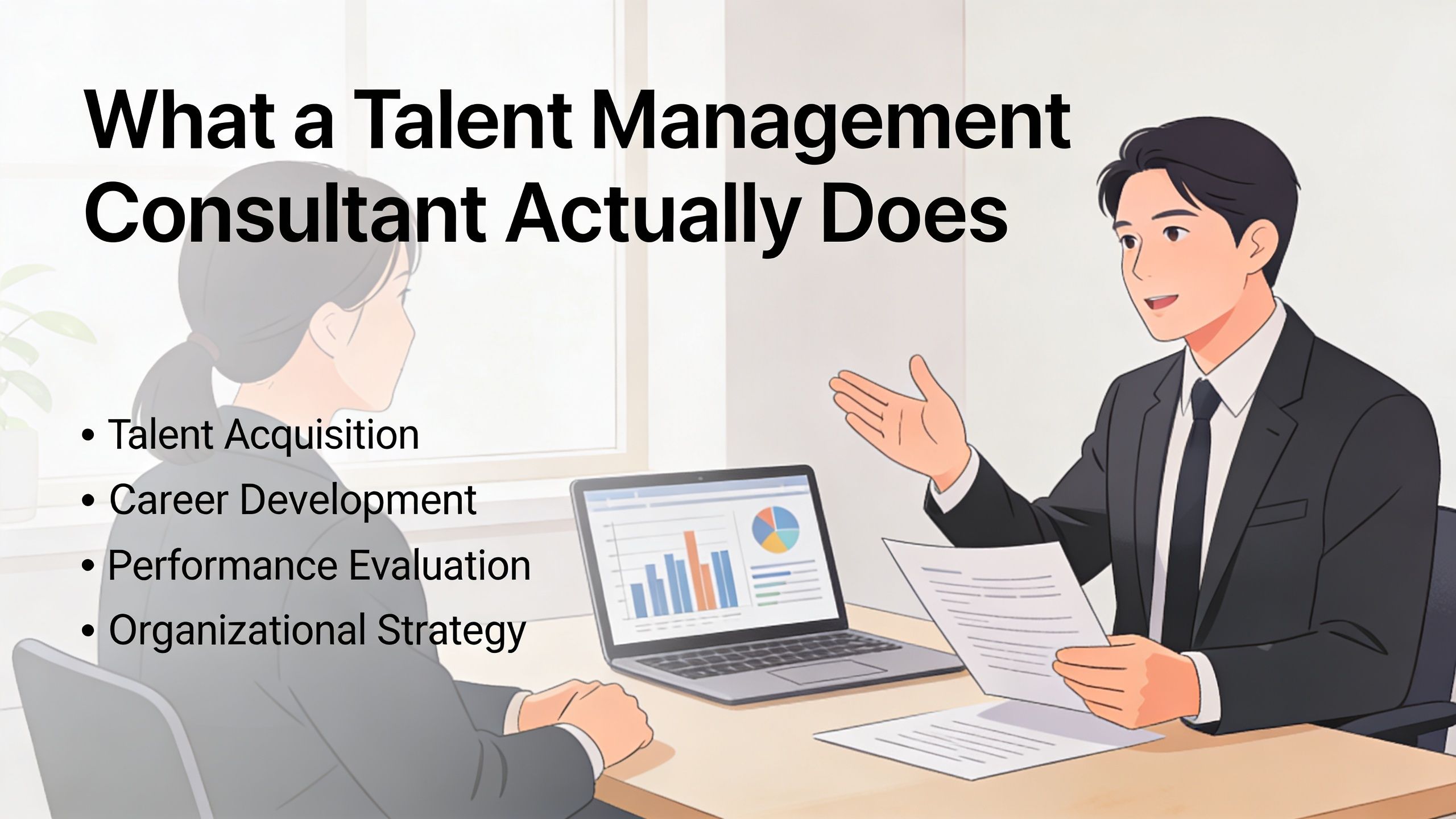
What a Talent Management Consultant Actually Does
A talent management consultant is the architect of your people system. A recruiter places talent into an opening. A consultant steps back and asks whether the role, structure, reporting line, development path, and retention model make sense in the first place.
That distinction matters because many companies don’t have a hiring problem. They have a design problem.
They diagnose before they prescribe
A good consultant starts with evidence, not templates. They look at where work stalls, where managers spend too much time, where top performers get frustrated, and where business goals depend on skills the company doesn’t reliably have.
That’s why data matters. According to McKinsey’s work on increasing return on talent, organizations using data-driven dashboards and people analytics can assess their employee value proposition more effectively. The same research supports building 3-dimensional leadership profiles that combine performance metrics and engagement data to reduce productivity loss and improve talent ROI.
In practice, that means the consultant should be able to answer questions like:
- Which roles are critical to growth, even if they aren’t the most senior?
- Where are managers losing time because responsibilities are poorly allocated?
- Which employees are carrying hidden institutional knowledge?
- Where does the business need capability, and where does it only need capacity?
They build systems, not isolated fixes
A solid engagement usually touches four areas.
Talent acquisition design
This isn’t only about job ads or interviews. It includes role definition, competency criteria, scorecards, hiring workflows, and the decision rules for when to use permanent staff, contract talent, or outsourced support.
Performance and development
Many companies say they want stronger teams but don’t define what strong performance looks like by role. Consultants build clearer expectations, manager rhythms, and development paths so employees know how to improve and leaders know how to coach.
Retention and engagement
Retention work is rarely solved by perks. Most turnover comes from poor management, weak role clarity, stalled growth, or workload imbalance. A consultant looks for those root causes.
Practical rule: If your answer to retention is “we need to keep people happier,” you’re still too vague. Focus on manager quality, role fit, progression, and workload design.
Leadership and succession
As the company grows, founder-led decision making becomes a bottleneck. A talent management consultant helps define leadership expectations, identify internal talent with stretch potential, and create succession plans so growth doesn’t depend on a few overextended people.
What they should leave behind
The best consultants don’t create dependency. They leave behind operating tools your team can keep using: hiring frameworks, role architecture, manager playbooks, succession criteria, and reporting rhythms. If the engagement ends and all you have is a slide deck, the work wasn’t operational enough.
Choosing Your Talent Partner A Strategic Comparison
The confusion usually starts here. Leaders know they need help, but the type of help isn’t obvious. Internal HR, staffing support, recruitment process outsourcing, and a talent management consultant can all sound similar until the business problem gets specific.
Talent Partner Comparison
| Partner Type | Primary Focus | Scope | Best For |
|---|---|---|---|
| Internal HR | Employee administration and people operations | Ongoing internal support across policy, compliance, employee relations, and core HR processes | Companies that need day-to-day people management consistency |
| Staffing agency | Filling open roles quickly | Candidate sourcing for defined openings | Urgent hiring when the role is already clear |
| RPO | Managing recruiting process at scale | Recruitment operations, workflow management, and hiring coordination | Businesses with sustained hiring volume |
| Talent management consultant | Workforce strategy tied to business execution | Role design, leadership planning, retention strategy, capability building, org structure, and workforce planning | Companies facing repeated talent friction, scale challenges, or operating model changes |
Where each option helps and where it falls short
If your issue is compliance, onboarding paperwork, employee relations, or policy consistency, internal HR is the right backbone. But internal HR teams are often stretched thin. They may not have the time or mandate to redesign how talent supports growth.
If you need five people in seats fast, a staffing agency can be the practical choice. The trade-off is that agencies typically work from the requisition you give them. They won’t usually challenge whether the role is scoped correctly or whether a blended staffing model would solve the problem better.
RPO support makes sense when the challenge is recruiting volume. If hiring demand is steady and process-heavy, outsourcing the recruiting workflow can create order. It still doesn’t replace strategic work on retention, leadership depth, or workforce design.
A talent management consultant is the better fit when the same business pain keeps resurfacing. The engineering team keeps needing “one more hire.” Managers are losing people they can’t afford to lose. A new market expansion changes the skill mix. A merger creates overlapping roles and unclear accountability.
For leaders exploring a more flexible operating model, this perspective aligns well with a strategic workforce model for scaling SMEs, especially when growth requires a mix of internal talent and external delivery capacity.
A simple decision test
Ask one question: Do you need more recruiting, or do you need better talent decisions?
If the issue is transaction speed, choose transactional help. If the issue is repeated friction across hiring, development, and retention, choose strategic help.
That’s why some growing companies use more than one partner category at the same time. The consultant defines the system. Another function may execute parts of it. The mistake is expecting a seat-filling service to solve an organizational design problem.
When to Hire a Talent Management Consultant
Most companies wait too long. They call for help after missed deadlines, failed hires, and leadership fatigue have already become expensive. A stronger move is to bring in a talent management consultant when the operating model starts changing faster than the team structure.
Five moments that justify the investment
The first trigger is rapid growth with visible strain. Revenue may be moving in the right direction while execution gets harder. Teams are adding people, but managers don’t have consistent ways to onboard, coach, or evaluate them. Culture starts becoming local to each manager instead of shared across the company.
The second is persistent turnover in important roles. If the same roles keep opening, the problem usually isn’t only candidate quality. It may be role design, manager capability, workload, or a weak employee value proposition.
The third is leadership dependency. Founders and senior operators often become the unofficial approval layer for everything. Hiring, escalation, decision making, and client rescue work all flow through a small group of people. That isn’t scale. That’s organizational debt.
When growth depends on a few heroic employees, the business hasn’t built capacity. It has borrowed it.
Distributed work changed the timing
The old signal used to be headcount growth alone. Today, another trigger is more structural. The company needs capability in multiple places, across different time zones, or on project-based timelines that don’t justify another permanent local hire.
That’s where traditional advice often falls short. The rise of fractional and distributed work has created a real gap in older consulting models. This discussion of Accenture’s research on fluid work allocation and specialized teams in developing markets supports a more flexible view of workforce design, where companies need guidance on blending permanent and fractional global talent instead of defaulting to local full-time roles.
Common scenarios where timing is right
- New market entry: You need capability before you have full local infrastructure.
- Post-acquisition integration: Two teams are doing similar work with different expectations and reporting lines.
- Specialized delivery pressure: Product, cloud, finance ops, or support work requires skills that are hard to hire for quickly.
- Operational overload: Senior employees are spending too much time on tasks that could be handled by outsourced specialists or support functions.
This is also where execution matters. A consultant should help determine which work belongs in-house, which needs embedded contractors, and which can move to an outsourced team without losing control. That’s especially useful for companies building distributed engineering, BPO, finance support, or back-office capacity.
How to Select the Right Consultant for Your Business
A founder usually feels the talent problem before it shows up on an org chart. Product deadlines slip because key roles stay open. Managers spend their week interviewing people who cannot do the work. A consultant can help fix that, or add cost and complexity if the fit is wrong.

The selection standard should be simple. Choose someone who can diagnose the primary constraint, make practical decisions about role design and staffing, and stay involved long enough to help your team execute.
What to ask before you sign
Start with operating questions.
- How do you diagnose the issue? A serious consultant will ask about business goals, delivery bottlenecks, reporting lines, manager load, and the work itself before recommending a hiring plan.
- What do you leave behind? Good work produces hiring scorecards, decision rules, manager routines, workforce plans, and documentation your team can keep using after the engagement ends.
- How involved are you in execution? Some advisors hand over slides. Others help implement interview processes, clarify role scope, support workforce transitions, and build the reporting cadence that keeps changes on track.
- What if the answer is not a full-time employee? This question matters for scaling companies. You want a consultant who can sort work into the right model: core in-house roles, embedded contractors, outsourced functions, or project-based specialists.
That last point is often the difference between useful advice and expensive theory. A consultant who understands skills-based hiring for future-ready teams is better equipped to build around actual capability needs instead of default job titles and standard resumes.
Red flags that show up early
Weak consultants usually reveal themselves in the proposal stage.
Generic methodology
If every engagement starts with the same maturity model, the same workshop sequence, and the same recommendations, expect a solution shaped around their process instead of your business. A scaling SaaS company, a services firm, and an operations-heavy business do not have the same hiring problem.
Thin operating context
Talent decisions sit inside the operating model. The consultant should understand how you make money, where execution breaks down, which managers are overloaded, and what work cannot be delayed. If they stay at the level of culture language and abstract org design, the advice will not hold up under pressure.
No path from strategy to staffing
This matters more than many leaders expect. A strategy deck may identify gaps accurately, but you still need someone who can help convert that plan into headcount priorities, sourcing channels, interview criteria, and, where appropriate, outsourced or distributed team options. If execution depends entirely on your already stretched leadership team, the work will stall.
A simple test helps. Ask yourself whether your managers could use the consultant's output next Monday without another month of interpretation.
Choose for range, not just insight
The strongest talent partners do more than advise on org charts and hiring plans. They help you decide how work should be staffed in practice.
For a growing company, that usually means comparing several paths at once. Should this capability sit with a permanent internal hire? Would an embedded specialist solve the problem faster? Can part of the workload move to an outsourced team without creating quality risk or management drag? The right consultant can make those trade-offs clear and help put the answer in place.
That operational range matters if you are hiring across time zones, filling hard-to-source roles, or trying to protect leadership bandwidth while the business grows. Strategy helps. Execution changes outcomes.
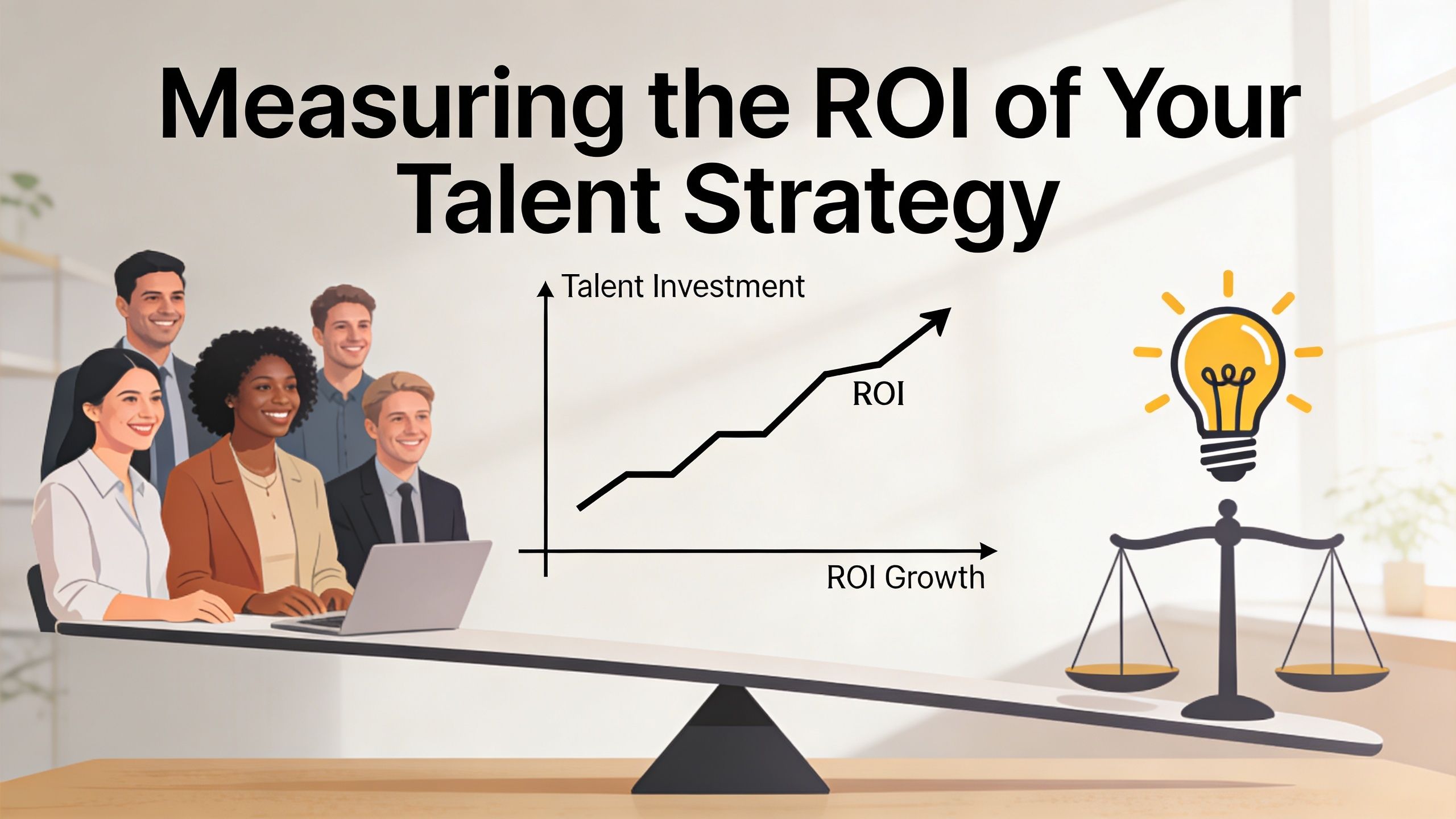
Measuring the ROI of Your Talent Strategy
Talent strategy only sounds soft when it’s measured poorly. In practice, leaders can track whether a talent management consultant improved execution, reduced friction, and helped the business use labor more effectively.
Start with business-facing metrics
The most useful metrics are the ones your leadership team already cares about. Delivery speed. Manager capacity. Ramp time. Stability in key roles. Productivity per person.
In consulting environments, those links are explicit. Deltek’s consulting talent KPI analysis notes an industry turnover rate of 13.6%, while top-performing firms grow headcount at 9.7% versus the 4.1% industry average. The same source reports average revenue per consultant at $204K, with top-tier firms reaching $270K per consultant. Those figures show why talent management isn’t just an HR concern. It affects growth capacity and economic output.
Track leading indicators and lagging indicators
A balanced dashboard matters because results lag behind decisions.
Leading indicators
These show whether the talent system is improving before financial outcomes are fully visible.
- Time to productivity: How long it takes a new hire or outsourced team member to contribute effectively.
- Manager load: Whether leaders have a realistic span of control and enough time for coaching.
- Role clarity: Whether employees know the expected outcomes, decision rights, and growth path tied to their role.
- Critical skill coverage: Whether the business has dependable access to the capabilities its roadmap requires.
Lagging indicators
These confirm whether the strategy produced durable results.
- Turnover in key roles
- Internal promotion readiness
- Project delivery consistency
- Revenue contribution per employee or consultant
- Reduction in leadership bottlenecks
What strong ROI conversations look like
A good consultant should help you define baseline conditions before any intervention. If your team can’t describe current hiring friction, manager overload, or capability gaps in concrete terms, it will be hard to prove what improved.
One practical model is to review talent ROI in three lenses:
| Lens | What to examine | Why it matters |
|---|---|---|
| Capacity | Output per team, manager bandwidth, ability to absorb demand | Shows whether the organization can scale without overload |
| Quality | Hiring fit, onboarding effectiveness, role performance | Reveals whether talent decisions are improving execution |
| Stability | Retention, leadership bench, continuity in key functions | Protects the business from repeated disruption |
The point isn’t to build a huge HR dashboard. It’s to make sure your people strategy can be defended in the same language you use for every other investment.
Build Your Strategic Talent Advantage
A familiar scaling problem looks like this. Sales closes faster than hiring can keep up, engineering managers spend their week interviewing instead of shipping, and a few high performers carry work that should sit across a broader team. The opportunity is real. The operating model is not ready for it.
A strong talent management consultant helps fix that gap. The role is not limited to advising on org charts or writing hiring plans. The right partner helps execute. That includes deciding which capabilities should stay in-house, where contract or outsourced talent can add capacity without creating management drag, and how to build a skills-based staffing model that supports delivery across time zones and growth stages.
Founders and CTOs usually feel the pressure in one question: can this team absorb more demand without breaking? That question sits underneath hiring, retention, succession, and manager effectiveness. If you are still understanding talent management approaches, start there, then connect that thinking to practical retention work such as retaining talent and preventing brain drain in smaller and mid-sized firms.
The businesses that scale cleanly treat talent like operating infrastructure. They define the work first, then choose the workforce model that fits it. Some roles need long-term ownership, context, and internal leadership paths. Other work benefits from flexible talent, outsourced support, or specialist capacity that can be added faster than a full-time hire.
That shift changes the quality of your decisions.
Instead of asking how to fill the next req, ask which roles protect execution, where managers are overloaded, which skills are missing from the roadmap, and what mix of full-time, fractional, and outsourced support gives the business enough control without slowing growth.
If you need a practical partner to align talent strategy with delivery capacity, NineArchs LLC can help evaluate your workforce model, identify where outsourcing or skills-based staffing makes sense, and build scalable support across IT, BPO, and operational functions. Call (310)800-1398 / (949) 861-1804 or email info@ninearchs.com to start the conversation.