

Your office doesn't need another week where the internet drops during payroll, someone can't access a shared file before a client meeting, and a business application breaks because nobody caught a failed update. For many small and midsize businesses, that's what “managing IT” turns into. A stream of interruptions, one-off fixes, and risky workarounds held together by whoever happens to be available.
That's usually the point where owners realize the underlying issue isn't one bad server, one weak laptop, or one missed patch. The issue is that the business depends on technology every hour of the day, but the technology stack was never designed or managed like a core business function. It grew piecemeal. One system was added to solve one problem. Another vendor handled email. Someone in-house became the accidental IT lead.
Good IT infrastructure solutions fix that. Not by piling on more hardware, but by turning infrastructure into a managed, reliable service that supports software development, remote work, security, and daily operations without constant firefighting.
Your Business Runs on IT So Who Runs Your IT
A familiar pattern shows up in growing companies. The team starts with a simple setup. A few laptops, shared drives, off-the-shelf software, and maybe one server in a back room or one cloud account nobody documented properly. Then the business expands. More staff join. More apps get connected. More customer data flows through the environment. The original setup stays in place long after the company has outgrown it.

That's where chaos starts to feel normal. The accounting system slows down at the wrong time. Remote employees lose access to critical files. Software updates get delayed because nobody wants to risk downtime during business hours. Support requests pile up, but nobody has enough context to fix root causes.
Infrastructure is a business system
IBM defines IT infrastructure as the hardware, software, and networking components enterprises rely on to run their IT environments, and IBM says the market is projected to grow at a 10.5% CAGR over seven years, from USD 120 billion to USD 241 billion in its overview of IT infrastructure growth and business reliance. That matters because it confirms what business owners already feel on the ground. Infrastructure is no longer background plumbing. It supports automation, cloud computing, and application delivery across the company.
Practical rule: If operations stop when one person is out sick or one machine fails, you don't have an IT strategy. You have dependency risk.
The shift many companies need is simple in concept but hard in practice. Stop treating IT as a collection of devices. Start treating it as an operating layer. That means uptime, access control, software reliability, user support, and capacity planning all need ownership.
The real question
When owners ask whether they need better IT infrastructure solutions, the answer is usually yes. But the better question is who should run that infrastructure well enough to support growth without burying the business in cost and complexity.
For most SMEs, the answer isn't building a larger internal IT department from scratch. It's working with an outsourcing partner that can design, support, and improve the environment as the business changes.
The Three Pillars of Modern IT Infrastructure
A modern infrastructure setup isn't just racks, licenses, and internet circuits. Those matter, but they're the base layer. The business value sits higher up, where systems support work, customer service, and product delivery.
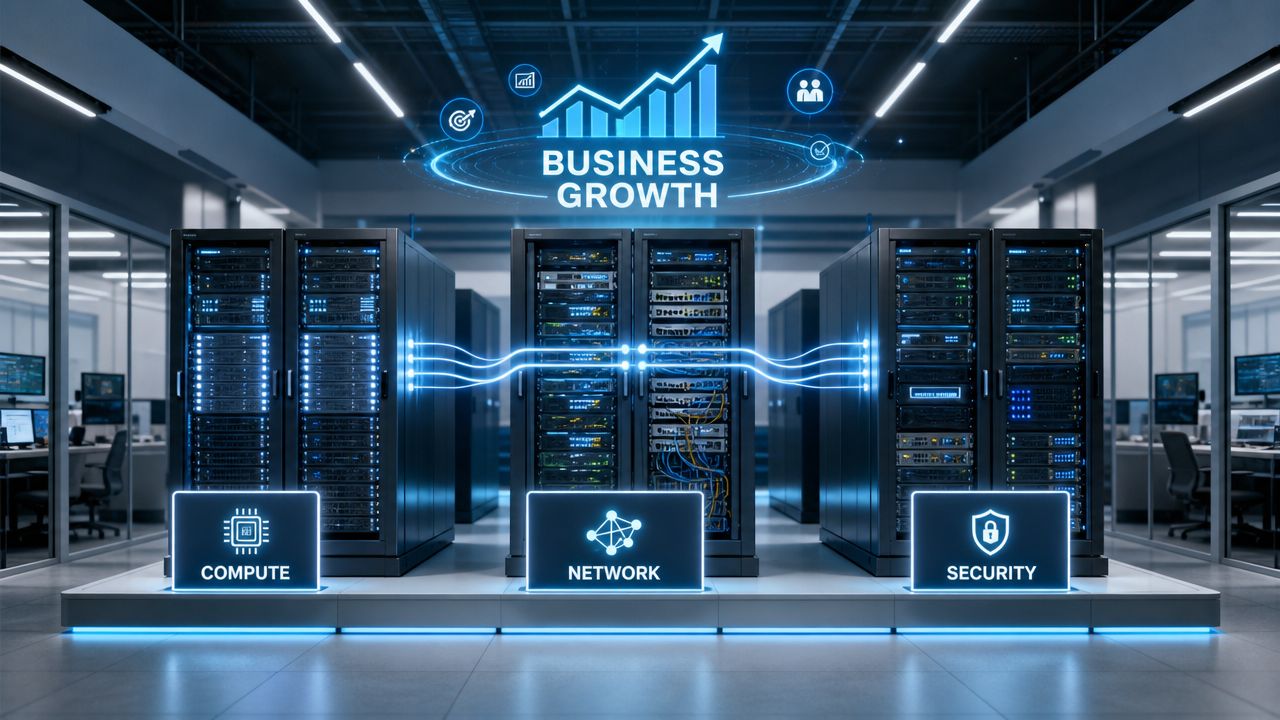
Three pillars usually determine whether infrastructure helps a business scale or holds it back.
Software development that fits the operation
Businesses often outgrow generic workflows before they realize it. Teams start exporting data between disconnected systems, entering the same information twice, or relying on spreadsheets to bridge process gaps. That's not a people problem. It's an infrastructure problem expressed through software.
Custom software development belongs inside the infrastructure conversation because applications are how your team experiences the system. A stable environment with badly designed workflows still wastes time and creates errors.
Effective software development in an infrastructure context usually focuses on:
- Workflow alignment: Applications should match how the business operates, not force staff into awkward workarounds.
- Integration discipline: Systems need clean connections between finance, operations, customer service, and reporting.
- Scalability planning: New features, heavier usage, and more users shouldn't force a rebuild every few months.
When companies outsource both infrastructure oversight and software development, they avoid the common split where developers build fast while operations teams scramble to support unstable deployments.
Remote IT support that keeps people working
Remote support is where infrastructure becomes visible to employees. If onboarding is slow, access requests sit for days, or device issues drag on, productivity drops even if the core systems are technically online.
Good remote support covers more than password resets. It includes endpoint management, account provisioning, software patching, user permissions, device standards, and help desk processes that don't lose track of recurring issues.
A practical starting point is to formalize how risk gets identified before it turns into downtime. Businesses that need a clearer framework can review an IT security risk assessment process to understand how infrastructure, user access, and operational exposure connect.
Support quality is often the difference between “our systems are fine” and “our team can actually do its job.”
Strategic outsourcing as the management layer
The third pillar is the one many businesses postpone too long. They buy tools. They hire one technician. They upgrade pieces of the stack. But they never assign strategic ownership across the whole environment.
That's what outsourcing solves when it's done properly. An outsourcing partner doesn't just respond to tickets. The partner helps standardize environments, document systems, guide upgrades, support remote users, and connect software decisions to infrastructure reality.
In practical terms, this layer should answer questions like these:
- What should stay in-house: Sensitive approvals, business leadership, and internal priorities.
- What should be outsourced: Monitoring, remote support, patching, cloud administration, routine maintenance, and specialized engineering.
- What needs shared governance: Security policy, software roadmap decisions, and budget planning.
That's where IT infrastructure solutions become a business function instead of a loose pile of technology purchases.
Why Smart Businesses Outsource Their Infrastructure
Owners usually hesitate for three reasons. They worry outsourcing will cost too much, reduce control, or create security problems. In practice, those are often the reasons outsourcing makes sense.
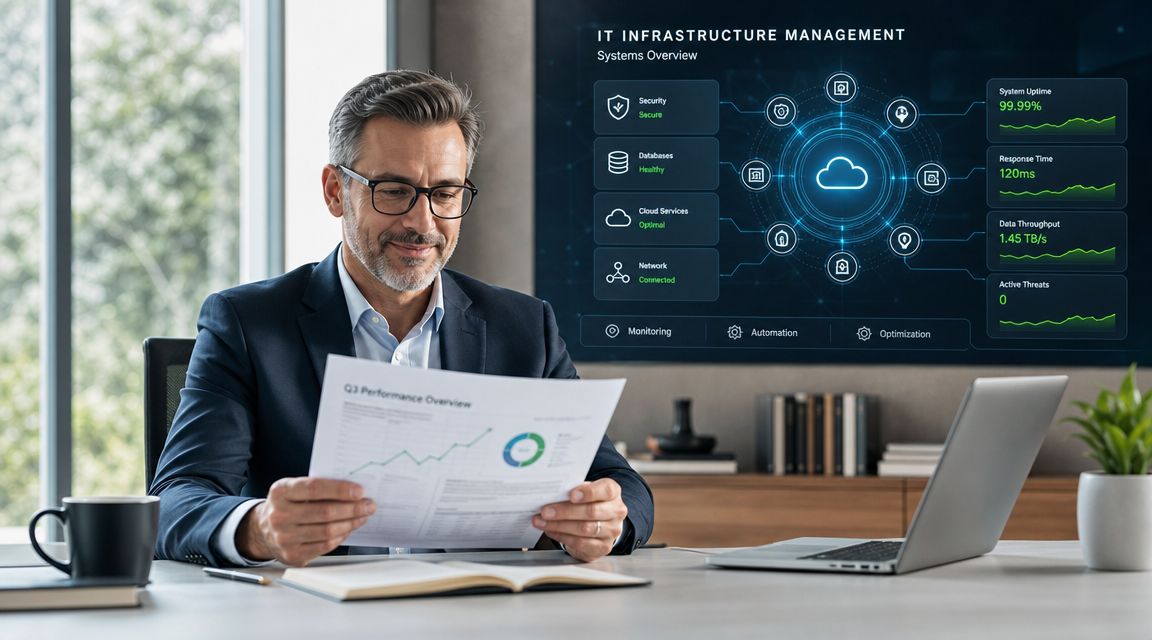
Cost becomes more predictable
Running everything in-house sounds cheaper until you add up the actual expense. Internal staff time gets pulled into support work. Projects stall because nobody has specialized expertise. Emergency fixes cost more because they happen under pressure. Equipment and software decisions get made reactively instead of according to a plan.
Outsourcing changes the operating model. Instead of treating IT as a string of surprise costs, companies move toward a managed service structure with clearer responsibilities, defined support coverage, and planned improvement cycles.
For smaller organizations, that often means paying for capability without carrying the full burden of recruiting and retaining every role internally. The logic is similar to utilities. You don't build your own power plant because electricity matters. You buy reliable access to it.
Expertise is available on demand
The broader market is moving in this direction. Market Research Future projects the global IT infrastructure services market will grow at an 11.2% CAGR and reach USD 247.11 billion by 2035, with growth tied explicitly to cloud adoption, digital transformation, and cybersecurity needs in its IT infrastructure services market outlook.
That projection matters because modern infrastructure requires overlapping skills. A business may need cloud administration, endpoint security, remote support, application deployment discipline, and user access governance at the same time. Most SMEs can't justify a full in-house team for all of that.
A single internal generalist can be valuable. A structured outsourced team gives you coverage, depth, and continuity.
One practical overview of the small-business case appears in this discussion of IT outsourcing for small business, especially for firms that need support without building a full internal department.
Control doesn't disappear. It gets formalized
Poorly run in-house IT often feels controlled because it's nearby. But proximity isn't the same as governance. If no one has current documentation, no one reviews permissions, and no one tracks recurring incidents, the business doesn't have control. It has familiarity.
A strong outsourcing model usually improves control because roles are clearer. Approval paths get defined. Change management is documented. Escalation becomes explicit. Service expectations become easier to measure.
Why a USA-based outsourcing partner matters
For companies operating in the United States, a USA-based outsourcing partner offers practical advantages that don't show up on a generic checklist.
- Business-hour alignment: Your support and planning conversations happen when your leadership team is available.
- Clearer communication: Fewer delays, fewer misunderstandings, and less rework during implementation.
- Regulatory familiarity: A partner working in the same market usually understands the compliance expectations and operating norms your team deals with.
- Stronger working rhythm: Projects move faster when the partner shares your pace for approvals, meetings, and issue resolution.
That's especially important when outsourcing includes software development and remote IT support, where frequent communication and operational context matter as much as technical execution.
Choosing Your IT Outsourcing Model
Not every business should outsource in the same way. The right model depends on how much internal capacity you have, how complex your environment is, and whether your immediate need is a one-time build or ongoing operational support.
Three models cover most situations.
Project-based work
This is the cleanest option when the goal is narrow and time-bound. You need a portal built, a system migrated, remote support workflows set up, or a cloud environment cleaned up. The work starts, delivers against a defined scope, and ends.
Project-based outsourcing works well when leadership already knows the outcome it wants. It works poorly when the underlying environment is undocumented and the business expects the provider to “figure it out as we go” without discovery time.
Dedicated team staffing
Some companies already have internal leadership but lack enough hands or the right specialization. In that case, a dedicated outsourced team fills specific gaps. That may include software developers, cloud support engineers, remote help desk staff, or infrastructure specialists.
This model gives the business more day-to-day direction while still avoiding the delays of full internal hiring. It's often a good fit when growth is outpacing current capacity or when internal teams need reinforcement for a defined period.
A useful way to think through that decision is this comparison of staff augmentation vs outsourcing, especially for teams deciding how much control and delivery responsibility they want to retain internally.
Fully managed services
This is the most complete model. The outsourcing partner handles the ongoing operation of the environment, including support, maintenance, monitoring, administrative tasks, and infrastructure improvement planning. The client focuses on business priorities and governance rather than technical execution.
Fully managed services are the strongest fit when internal IT is overloaded, fragmented, or not mature enough to support business growth consistently.
If your team spends more time reacting to issues than improving systems, managed services usually solve the right problem.
Comparison of IT Outsourcing Models
| Model | Best For | Cost Structure | Level of Control |
|---|---|---|---|
| Project-Based Engagement | A defined initiative such as a migration, custom software build, or infrastructure cleanup | Fixed scope or milestone-based | High client control over objective, moderate provider control over delivery |
| Dedicated Team Staffing | Companies with in-house leadership that need extra software, support, or infrastructure capacity | Ongoing team or role-based engagement | High client control over priorities and daily direction |
| Fully Managed Services | Businesses that want an external partner to run day-to-day IT operations | Recurring service-based arrangement | Shared governance, lower operational burden on the client |
How to choose without overcomplicating it
Ask three direct questions.
- Do you know exactly what you need built or fixed: If yes, start with a project.
- Do you have strong internal technical leadership already: If yes, dedicated staffing may be the better fit.
- Do you want fewer daily IT decisions on your plate: If yes, managed services are usually the right path.
One more point matters. Don't choose a model based only on short-term price. The cheaper structure can become expensive if it leaves ownership gaps, creates handoff problems, or pushes strategic decisions back onto a team that's already overloaded.
The Roadmap to a Successful Transition
The transition from scattered in-house IT to an outsourced model doesn't need to be disruptive. It does need structure. Businesses that rush into migration without understanding what they already have usually carry old problems into the new setup.
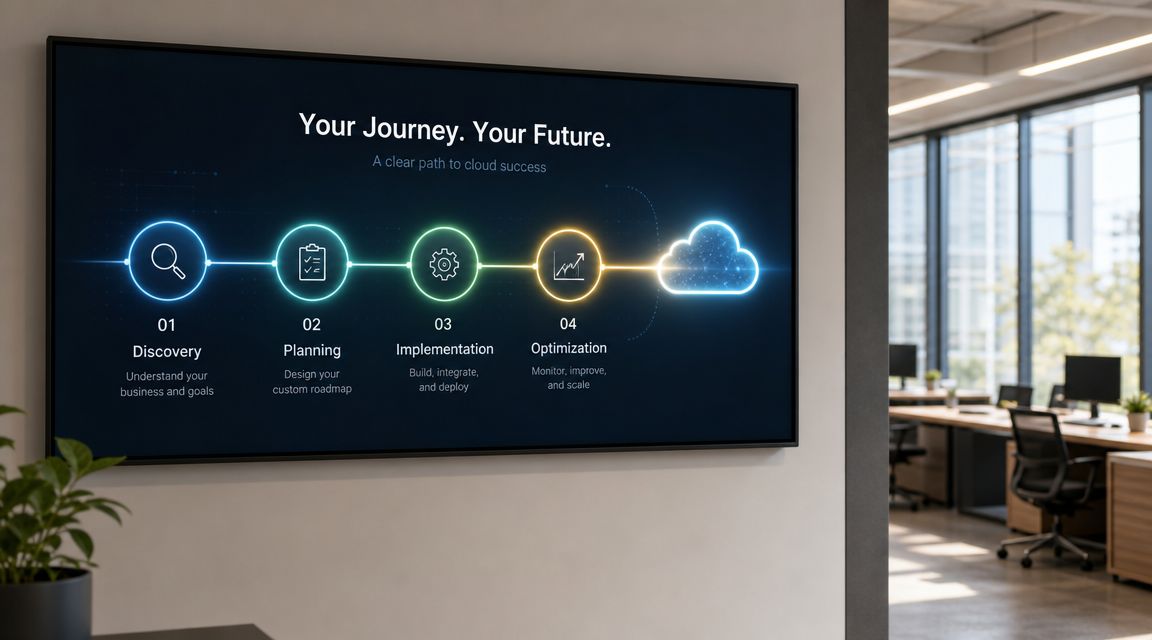
Start with a real assessment
The most impactful step in infrastructure planning is a full-stack assessment of hardware, software, network, and security to expose bottlenecks before redesigning the environment, according to this guidance on full-stack infrastructure planning.
That assessment should inventory what exists, how it's connected, who depends on it, and where the weak points are. Many businesses skip this because they're eager to “just move to the cloud” or “just outsource support.” That usually backfires.
Common pitfall: undocumented systems that only one employee understands.
Define the target state before moving anything
Once the current environment is clear, define what the business needs from the future setup. Faster user onboarding. Better remote support. Cleaner software deployment. Tighter security controls. More reliable access for distributed teams.
This is also the stage where automation and process redesign should be discussed. If the business is exploring workflow modernization, operational planning support such as strategic AI execution assistance can help leaders think more clearly about implementation sequencing and readiness.
Choose the partner on fit, not just price
A low bid is not a strategy. The partner has to communicate well, document thoroughly, understand your operating model, and handle both technical work and service management with discipline.
Look for signs of maturity:
- Discovery discipline: They ask detailed questions before proposing changes.
- Operational clarity: They define support boundaries, escalation paths, and responsibilities.
- Documentation habits: They care about runbooks, asset visibility, and process consistency.
- Business awareness: They understand how downtime, poor access control, or software friction affects revenue and staff productivity.
Migrate in phases
A phased transition reduces risk. Start with lower-impact systems or support functions, stabilize them, and then move deeper into core applications and infrastructure responsibilities.
This usually means separating the work into manageable waves:
- Baseline support and documentation
- Access, endpoint, and security cleanup
- Infrastructure consolidation or cloud migration
- Application and workflow improvements
- Ongoing monitoring and optimization
Good transitions aren't built on speed alone. They're built on sequence.
Keep optimizing after go-live
Go-live isn't the finish line. It's the point where the environment becomes manageable enough to improve continuously. Ticket patterns should guide process fixes. User complaints should inform software changes. Capacity issues should trigger planning, not panic.
This is also where a provider such as NineArchs LLC can fit as one practical option for organizations that need managed IT services, software development, cloud support, Microsoft 365 administration, and endpoint security under one operating model. The key isn't choosing a flashy provider. It's choosing one that can run the basics well, communicate clearly, and adapt as the business changes.
Building Your Future-Proof Infrastructure Today
Businesses don't outgrow IT problems by buying more technology. They outgrow them by putting the right operating model around technology. That's the value behind modern IT infrastructure solutions. Reliability, support, software delivery, security, and user access all need steady ownership.
When outsourcing is done well, it removes noise from the business. Leaders spend less time chasing issues. Employees get support faster. Software projects stop colliding with infrastructure limits. Remote teams work in a system built for consistency instead of guesswork.
Future-proof doesn't mean overbuilt
A lot of infrastructure advice leans toward the most advanced stack possible. In practice, the better architecture is the one your people can use consistently. The Mobile Citizen perspective on digital access highlights an important issue in its discussion of real-world connectivity constraints and digital access. The last-mile problem is real. If employees, customers, or field teams have weak connectivity, limited devices, or uneven digital readiness, elegant architecture on paper can still fail in daily use.
That matters for software development and remote support. Centralized systems can simplify management. Cloud-based tools can improve flexibility. But if access assumptions are wrong, the business ends up with support friction instead of operational gains.
The best infrastructure is the one that stays usable under real working conditions, not the one that looks most sophisticated in a diagram.
Why the partner choice shapes the outcome
A USA-based outsourcing partner adds practical value here. Teams can meet during normal business hours, escalate issues quickly, and make implementation decisions without losing days to scheduling gaps. That rhythm matters more than many owners expect, especially when software, support, and business operations are tightly connected.
For technical leaders refining cloud design skills internally, a structured guide for Azure IT professionals can be a useful learning reference alongside outsourced execution. And if your organization is still defining the right service model, this overview of IT infrastructure consulting gives a practical lens on how outside guidance can support planning decisions.
The core point is simple. Infrastructure is no longer just equipment you own. It's a service capability your business depends on every day. If your current setup is chaotic, fragile, or too dependent on a few overextended people, outsourcing isn't a compromise. It's often the cleanest path to a more stable operation.
If your business is ready to move from reactive IT fixes to a more optimized and scalable model, NineArchs LLC can help you evaluate the next step. Whether you need outsourced software development, remote IT support, or a managed infrastructure approach, start the conversation at (310)800-1398 / (949) 861-1804 or Email: info@ninearchs.com.