
Your team already knows the symptom. A shipment is moving, the purchase order says everything is fine, and the dashboard still looks green. Then someone notices a temperature-monitoring gap, a batch status mismatch, or a wholesaler allocation issue that didn't sync across systems fast enough. Now the problem isn't logistics. It's data, system design, and operational discipline.
That's the state of the supply chain in the pharmaceutical industry. If you run a pharma SME, you're not losing sleep over trucks. You're losing sleep over fragmented systems, brittle integrations, compliance exposure, and the fact that one IT failure can turn inventory into waste.
The Modern Pharmaceutical Supply Chain Challenge
A lot of pharma operators still talk about supply chain as if it's a warehouse and transportation problem. It isn't. It's an orchestration problem across suppliers, manufacturers, quality teams, distributors, wholesalers, and internal systems that rarely speak cleanly to each other.
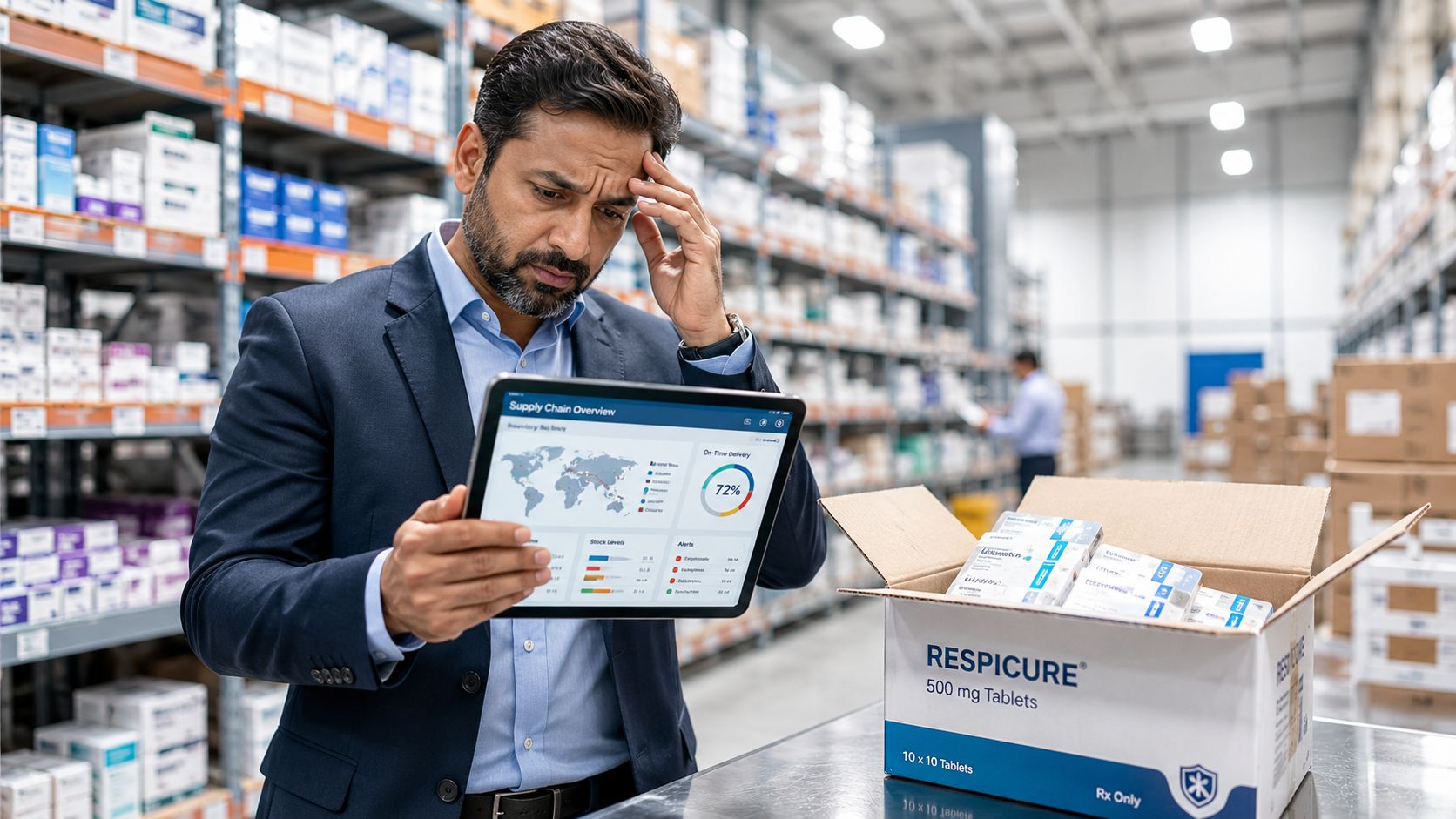
In the U.S., over 50% of drugs are manufactured abroad, and about 92% of prescription drugs are distributed through wholesalers, which makes the system efficient but fragile according to this pharmaceutical supply chain management analysis. That means your product may cross multiple borders, pass through several custody points, and depend on intermediaries before it ever reaches a patient.
Where SMEs get squeezed
Large enterprises can bury process inefficiencies under layers of staff and software. SMEs can't. If your planning team works in spreadsheets, your warehouse works in a separate system, and your support team learns about exceptions from email chains, you don't have a resilient supply chain. You have a delayed reaction machine.
Common failure patterns look like this:
- Data lag between systems: Inventory says available, quality says hold, and customer service promises release anyway.
- Cold-chain blind spots: Shipment data exists, but nobody sees an exception soon enough to act.
- Weak facility-process alignment: Storage design, handling flow, and digital controls don't match operational risk. That's why resources on compliant healthcare warehouse design matter. Layout and compliance design directly affect data accuracy and inventory control.
- No unified control layer: Teams react locally instead of managing globally. A digital control tower approach for supply chain operations helps consolidate events, alerts, and decisions in one place.
Practical rule: If your team needs three calls and two spreadsheets to confirm the status of one batch, your supply chain is under-digitized.
The real fix
You don't solve this with more manual oversight. You solve it with better software architecture, tighter process ownership, and support coverage that matches a global operating model. Resilience comes from clean data flows, dependable integrations, and clearly defined exception handling.
That's why the future of the supply chain in pharmaceutical industry operations belongs to firms that treat technology as core infrastructure, not back-office support.
Digital Integrity in a Regulated Environment
Pharma supply chains often fail subtly at first. A forecast is wrong. A lead time assumption is stale. Inventory targets drift from reality. Then the business sees the visible result: shortages, delays, compliance risk, and customer friction.

A systematic review found that inaccurate forecasting, long lead times, and lack of optimal inventory are the most critical recurring pharmaceutical supply-chain problems, and it also notes the market for managing this complexity is projected to reach $5,289.53 million by 2032 in this review on pharmaceutical supply-chain challenges.
Why generic IT setups break down
A standard business system might track orders and stock. That's not enough in pharma. You need systems that preserve traceability, document changes, support controlled workflows, and maintain trustworthy records across regulated processes.
The hard part isn't collecting data. It's protecting its integrity from the moment it's created to the moment someone uses it in a decision.
Here's where many teams get exposed:
- Forecasting without operational context: Demand plans don't reflect regulatory holds, batch release timing, or constrained supply windows.
- Disconnected quality and logistics records: Product can appear movable in one system and blocked in another.
- Weak access control: Too many users can edit too much, and audit confidence drops.
- Poor exception visibility: Teams discover discrepancies after shipment, not before.
- Compliance fragmentation: Security, privacy, and operational integrity are treated as separate projects instead of one architecture problem.
If your leadership team includes security ownership, this guide for CISOs on HIPAA compliance is a useful reminder that compliance automation has to align with operational reality, not sit beside it.
What digital integrity actually requires
Pharma leaders should stop asking whether they have data and start asking whether they have usable, defensible, synchronized data.
That means your stack should support:
- End-to-end traceability so teams can track batch movement, status, and exceptions without manual reconciliation.
- Controlled workflows that define who can create, approve, release, or modify records.
- Reliable integration between purchasing, inventory, quality, distribution, and support systems.
- Exception-first visibility so teams see what changed, what failed, and what needs intervention now.
- Security by design with role-based access, monitored activity, and strong record discipline.
The supply chain in pharmaceutical industry operations is a data-governance problem wearing a logistics uniform.
When firms miss this, they buy software but keep the same operational chaos. When they get it right, they reduce decision latency, improve traceability, and stop relying on heroics.
Building Resilience with Custom Software Development
Off-the-shelf software gets you started. It rarely gets you control. That matters in pharma, where your workflows, approvals, storage requirements, release rules, and partner interactions don't fit generic templates.
A major structural issue is concentration risk. U.S. data showed 323 drugs in short supply in Q1 2024, and analysis points to supplier concentration, manufacturing problems, and structural fragility. That same analysis supports the case that custom software improves visibility across multi-tier supply networks and helps teams make smarter sourcing decisions in this discussion of pharmaceutical disruption patterns.
What custom software should solve
Custom development isn't about building flashy dashboards. It's about removing dangerous gaps between planning, quality, inventory, and execution.
The right system should let your team answer questions like:
- Where is this batch right now?
- Who changed its status?
- Which suppliers create concentration risk?
- What inventory is technically available versus blocked?
- Which orders are threatened by delay or storage exceptions?
- What should procurement do next?
A good automation model usually combines planning logic, operational workflow, and alerting in one environment, enabling a supply chain automation strategy to become practical rather than theoretical.
The custom modules that matter
Pharma SMEs usually benefit from a focused build, not a giant transformation project. Start with the modules that directly reduce risk.
| Custom capability | What it fixes |
|---|---|
| Batch and lot traceability | Stops status confusion across teams |
| Integrated inventory visibility | Separates available, quarantined, reserved, and released stock |
| Supplier-risk views | Exposes concentration and sourcing dependencies |
| Exception alerting | Flags shipment, temperature, or release issues fast |
| Forecasting workflows | Links demand planning to real operational constraints |
| Audit-ready activity logs | Improves accountability and compliance posture |
Build for exception handling first. Routine transactions rarely hurt you. Delayed visibility does.
Why this beats patching spreadsheets
Spreadsheets are flexible, but they don't enforce process. Email threads communicate, but they don't create system truth. Shared drives store files, but they don't create synchronized decisions.
A software development partner can map your actual operating model and turn it into workflows that people follow because the system makes the right action easier. That's the point. Software should shape behavior, not just document it.
One example is NineArchs LLC, which provides software development, cloud services, security support, and business process capabilities that can be applied to supply chain management tasks such as inventory tracking and order fulfillment. For pharma SMEs, that kind of support is useful when internal teams need customized systems without building an oversized in-house engineering operation.
The Strategic Advantage of IT and Process Outsourcing
Most pharma SMEs should not build a large internal IT and operations support function for supply chain technology. That's not where your competitive value sits. Your value sits in science, product execution, regulatory discipline, customer relationships, and patient outcomes.
Outsource the parts that require constant technical depth, operational coverage, and process standardization.
Why in-house often underperforms
An internal team can work well if you already have mature architecture, deep security leadership, experienced support management, and enough scale to justify specialized roles. Many SMEs don't.
The usual result is familiar. One or two overloaded generalists handle infrastructure, user support, vendor coordination, reporting fixes, and emergency troubleshooting. Strategic work gets delayed because operational noise never stops.
A mature partner changes that. Research on pharma supply chains in developing countries highlights recurring failures tied to weak data systems, poor storage conditions, counterfeit infiltration, weak distribution networks, and insufficient data systems, while also pointing to stronger supplier evaluation, advanced data management, and tighter quality assurance as practical responses in this systematic review of pharmaceutical supply chains.
In-House vs. Outsourced IT for Pharma Supply Chains
| Consideration | In-House Management | Outsourcing to a Specialized Partner (e.g., USA-based) |
|---|---|---|
| Talent coverage | Usually limited to the people you can hire and retain | Access to broader skills across software, support, cloud, security, and process operations |
| Support continuity | Vulnerable to absence, turnover, and after-hours gaps | Easier to maintain consistent coverage and escalation paths |
| Compliance alignment | Often fragmented across teams and tools | Can be standardized through documented workflows and managed controls |
| Scalability | Hiring takes time and carries fixed overhead | Capacity can expand or contract with project and support demand |
| Process maturity | Often depends on a few individuals | More likely to use repeatable operating procedures and service routines |
| Cost structure | High fixed burden for specialized roles | More flexible operating model for SMEs |
| Regulatory communication | Internal knowledge may vary by hire | A USA-based partner offers stronger alignment with U.S. business hours, communication expectations, and the broader FDA-centered operating context |
A USA-based outsourcing partner is especially useful when your business serves U.S. manufacturers, distributors, providers, or wholesalers. You get tighter communication, less delay in issue resolution, and better alignment with the documentation standards your customers expect.
There's also a practical benefit that owners often underestimate. When your outsourced team shares your business day, support decisions move faster. Incidents don't sit overnight waiting for overlap.
For companies also evaluating broader process support, business process outsourcing solutions can complement IT outsourcing by reducing back-office friction around data entry, order processing, and operations support.
Outsourcing works when you outsource process ownership with service discipline, not just labor.
Ensuring Uptime with 24/7 Remote IT Support
If your supply chain relies on real-time monitoring, connected devices, cloud applications, and site-to-site data flow, remote IT support isn't optional. It's part of operational continuity.

That's even more important as biologics and advanced therapies expand. Industry guidance and review work point out that these products require temperature-controlled distribution, real-time monitoring, advanced analytics, IoT visibility, and strong IT support to manage spoilage risk and compliance across borders in this review of strategic pharmaceutical supply-chain solutions.
What specialized remote support actually does
Generic helpdesk support resets passwords and closes tickets. Pharma supply-chain support needs to do more.
A serious remote IT support function should cover:
- Monitoring critical systems: Cold-chain dashboards, sensor connectivity, integration jobs, alerts, and reporting pipelines.
- Rapid triage: Determine whether the issue is device failure, network interruption, application logic, or bad data.
- Escalation discipline: Route issues to the right owner fast, with business context attached.
- Recovery support: Restore visibility, validate data flow, and confirm that downstream teams can act.
- Preventive maintenance: Catch recurring faults, unstable connections, and weak integrations before they create operational damage.
The 3 a.m. problem
This is the scenario that exposes weak support models. A shipment event fails overnight. Sensor data stops updating. The dashboard still shows the last successful reading. Morning staff arrives to uncertainty, not facts.
The difference between disruption and controlled recovery is simple. Someone must already be watching, know what “normal” looks like, and have authority to intervene.
A strong remote support team should work from a clear playbook:
- Detect the failure early
- Confirm business impact
- Restore data flow or isolate the issue
- Notify the right stakeholders
- Document the event for review and prevention
That support model protects revenue, compliance posture, and customer trust at the same time.
Your Roadmap to a More Resilient Supply Chain
If you want a stronger supply chain in pharmaceutical industry operations, stop treating software, support, and outsourcing as separate conversations. They're one operating model.
Start with a hard audit
Review where your current process depends on manual coordination, spreadsheet reconciliation, delayed visibility, or tribal knowledge. Don't just map systems. Map failure points.
Look closely at:
- Batch visibility
- Inventory status accuracy
- Supplier and sourcing transparency
- Cold-chain monitoring continuity
- After-hours support coverage
- User access and change control
- Exception response times
If one issue requires multiple teams to reconstruct the truth, that area needs redesign.
Choose what to build and what to outsource
Don't outsource your judgment. Outsource the technical execution and service layers that are expensive to build internally.
A practical model usually looks like this:
- Keep strategic oversight, quality ownership, and regulatory accountability inside the business.
- Outsource software development for the workflows and integrations unique to your operation.
- Outsource remote IT support for continuity, monitoring, and incident response.
- Outsource repeatable process tasks that consume time but don't create differentiation.
Many SMEs finally gain an advantage. Internal leaders define the business rules. External specialists build and support the machinery.
Move in controlled phases
Don't launch a giant transformation. Fix the most expensive blind spots first.
A sensible sequence is:
- Stabilize visibility with system integration and exception dashboards.
- Harden controls around access, audit trails, and workflow approvals.
- Improve resilience with outsourced support coverage and documented response routines.
- Expand automation into planning, inventory, and supplier coordination.
That approach turns supply chain from a recurring source of surprises into a managed operating capability.
You don't need more software for its own sake. You need software that matches pharma reality, outsourcing that reduces operational drag, and support that keeps critical systems running when your team is offline.
If your organization needs a practical technology plan for the supply chain in pharmaceutical industry operations, contact NineArchs LLC. They can support software development, outsourcing, and remote IT support initiatives that help pharma SMEs improve visibility, strengthen process control, and reduce operational risk. Call (310)800-1398 / (949) 861-1804 or email info@ninearchs.com.