

Your calendar is full, the incident queue is moving, and a budget decision is due before the next leadership meeting. You know the organization needs to prepare for changes in technology, customer expectations, and workload, but the urgent work keeps winning. That tension is where strategic thinking becomes a daily leadership practice, not a line in a plan.
For technology and operations leaders, the challenge isn't choosing between strategy and execution. It's making room to question assumptions while still keeping commitments. A short pause, a better question, or a team exercise can change what you notice before you allocate people and money.
Why Strategic Thinking Matters for Leaders Today
A packed week can leave a leader managing every immediate issue while postponing the questions that determine what the organization should become. Strategic thinking means testing long-term direction against changing markets, technologies, and customer expectations instead of merely executing within existing assumptions. Operational management keeps current work reliable. Strategic thinking asks whether the current work, priorities, and capabilities will still serve the organization as conditions change.

Both modes matter. A technology leader needs operational discipline to keep systems dependable, but also needs to consider whether the current architecture and team capabilities can support future needs. An operations leader must deliver today's service while questioning whether existing workflows can handle new customer expectations. In finance, outsourcing, and transformation work, leaders face the same trade-off: protect current performance without treating current assumptions as permanent.
The distinction has a history. Strategic leadership took shape as a distinct research field in the early 1980s, when scholars began linking it to the chief executive's responsibility for setting long-term organizational direction. A literature review identifies 1982 as the earliest known strategic-leadership study, and research activity expanded through the 1990s, establishing the area as a recognized field of management inquiry (review of strategic leadership research). The shift reframed leadership as more than supervising current operations. It put future position, capabilities, resource choices, and adaptation at the center.
A useful weekly test: If your calendar is dominated by keeping existing work moving, you're spending most of your leadership time operationally. That may be necessary, but it leaves less room to test whether the work still points in the right direction.
The point isn't to chase abstract strategy at the expense of delivery. It's to create a deliberate rhythm for checking direction and then translating choices into execution. Leaders looking to connect strategic intent with follow-through can explore improving strategy execution in scale-ups for practical context on linking priorities to organizational work.
Diagnosing How You Think Before You Plan
Before changing a strategy, examine how you reach decisions. Leaders often inherit routines that feel efficient because they're familiar. Familiarity can also narrow attention: last year's solution becomes the default, a trusted team's confidence substitutes for evidence, and unwelcome information gets softened or left out of the meeting.
Start with a short audit. Write down your answers rather than relying on what you think you usually do.
- Assumptions: Which belief about customers, workload, technology, or capacity have you revisited recently? What evidence would make you change it?
- External signals: Can you name the forces most likely to reshape your work, and explain how each might affect your priorities?
- Default decisions: Which calls do you make because “that's how we do it,” rather than because you compared options?
- Meeting behavior: When someone brings bad news, do you explore its implications or quickly explain why it won't matter?
Give each question a simple personal rating: rarely, sometimes, or consistently. The point isn't to produce a scientific score. It's to identify where your attention tends to close down.
Pause before a consequential call
A reflective pause can help you notice the difference between a considered judgment and a reflex. Before a major decision, put away the immediate task for a moment. Sit in stillness, breathe at a natural pace, and notice the first conclusion your mind reaches without acting on it.
Then ask: What am I assuming? What evidence am I avoiding? What would someone affected by this decision see that I might miss? The pause doesn't provide the answer. It creates room to choose how to respond rather than defending the first idea.
Strategic judgment also grows through accumulated experience. A study of senior executives found that expertise in strategic thinking typically emerged from personal, interpersonal, organizational, and external experiences accumulated over 10 or more years (MIT Sloan Management Review on strategic thinking at the top). That doesn't mean waiting a decade before developing the skill. It means examining which experiences have shaped your judgment and deliberately seeking the ones you lack.
List the projects, customer conversations, incidents, and organizational changes that have challenged your assumptions. Where have you had little exposure? Record your answers as a baseline, then revisit the same questions in three months. Look for changes in how often you challenge a default, seek dissenting views, and change your mind when evidence warrants it.
Mental Models and Routines for Long-Range Thinking
A useful planning meeting needs more than a list of priorities. It needs a way to separate the time horizons in play, understand how choices affect one another, and keep analysis from becoming false certainty. Three lightweight models can do that work without turning the discussion into a formal planning exercise.
Separate work by horizon
Put current operations, emerging opportunities, and future options in distinct categories. Current operations protect today's service and reliability. Emerging opportunities are plausible improvements or changes that need evidence. Future options are choices worth keeping open, even if they're not ready for investment.
Give each category an owner and a review rhythm appropriate to the decision. If one leader owns every horizon, urgent delivery will usually crowd out exploration. The point isn't to create three committees. It's to make visible which work is maintaining performance, which is testing possibilities, and which is preserving flexibility.
Map the system, not just the symptom
When a team proposes a hiring freeze, trace what could follow beyond the immediate cost reduction. Fewer people may slow delivery; slower delivery may increase support requests; rising support demand may affect the customer experience and renewals. These connections can be sketched on a whiteboard with arrows, plus signs for reinforcing effects, and minus signs for balancing effects.
Ask the group to follow one decision through several consequences. Where does pressure build? What could reduce it? A causal loop sketch won't capture every variable, but it can expose a cost that a department-by-department view misses.
AI-assisted analysis can help organize information and surface possible patterns, but a precise-looking forecast can still rest on poor inputs. Recent research treats human–AI collaboration, ethical governance, and organizational adaptation as central leadership concerns, with final decisions remaining with human leaders (research on AI-supported strategic leadership).
Decision protocol: Define the decision and risk tolerance, check the input data, test alternatives, record the human rationale, and set conditions that will trigger a review.
These models answer different questions. Horizon thinking asks when the organization needs to act. Systems mapping asks how a decision may ripple across teams and outcomes. AI-assisted analysis asks what the evidence can and cannot support. Used together, they help leaders see more than the immediate task without pretending uncertainty has disappeared.

Stress-Testing Decisions With Scenario Planning
A decision can look sensible under one forecast and fragile under another. Scenario planning gives a leadership team a repeatable way to test choices before committing resources. It doesn't tell you what the future will be. It shows where a strategy depends on assumptions that may not hold.
Consider an operations leader deciding whether to keep bookkeeping and data entry outsourced or bring the work in-house. The decision has a clear time horizon, but two uncertainties matter: how client volume will change and how wage pressure will develop. The team chooses those as independent factors and draws a 2×2 matrix, with high or low client-volume growth on one axis and high or low wage pressure on the other.
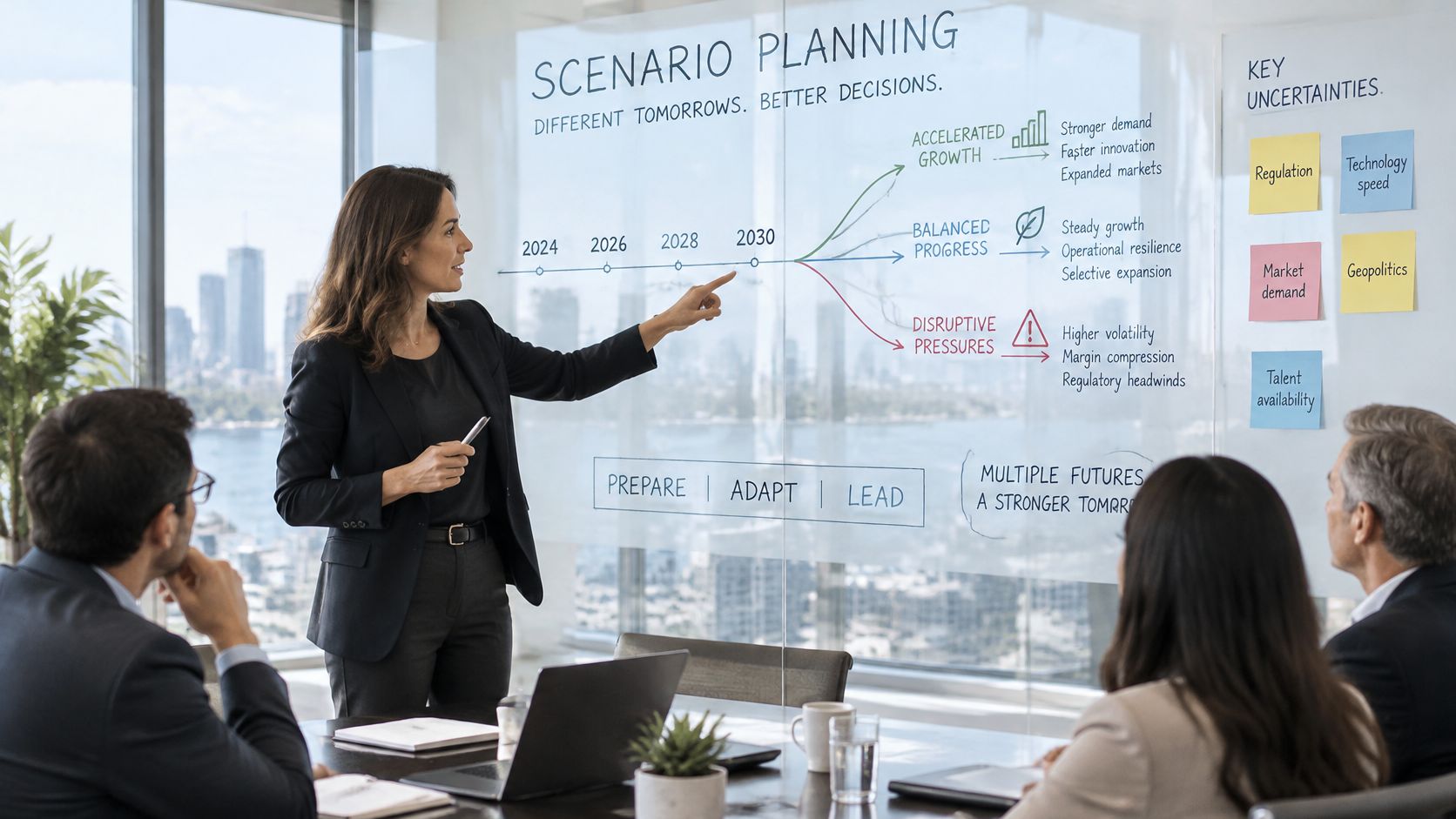
Now the team builds a coherent account of each possible future. High volume with high wage pressure may make flexible external capacity attractive. High volume with lower wage pressure could strengthen the case for building an internal team. If volume stays low, the organization may want to avoid fixed staffing costs, whatever happens to wages. These are not predictions. They're working conditions against which the team can test its options.
The discussion often exposes disagreement. Finance may favor predictable costs, while operations may worry about turnaround time and process knowledge. Instead of settling the argument through seniority or instinct, test each option in every scenario. Identify what would have to be true for the option to work, which leading indicators would reveal a change, and what trigger would prompt a different response.
Run the routine as a team
Use a workshop to move from uncertainty to action:
- Define the decision and its time horizon.
- List critical uncertainties, then choose two that are both high-impact and independent.
- Build a small set of internally coherent future states.
- Test each strategic option against every state.
- Set leading indicators, trigger points, and responses that leaders can approve in advance.
- Schedule when the team will review those indicators.
Research involving approximately 90 managers and executives found that scenario planning changed decision-making styles. Collaborative workshops also helped participants notice environmental factors they missed when working alone (research on scenario planning and decision-making). That's why the workshop should include people who see the decision from different functions, rather than leaving the analysis to one executive.
A session can start with the decision, move into uncertainty mapping, and finish with indicators and contingent actions. For a related perspective on using scenarios to protect cash flow, consider how operational choices and financial resilience intersect. Keep the team focused on observable signals, not on arguing which scenario is “most likely.”
Building Strategic Thinking in Individuals and Teams
Strategic capability develops when leaders repeatedly confront different contexts, examine their judgment, and learn from results. A title or planning workshop can't substitute for that practice. Build routines that make reflection part of work, then give people assignments that broaden their view of the organization.
Individual practices
- Weekly horizon review: Reserve a focused half-hour to ask what has changed in customer needs, technology, workload, or risk. Write down one assumption that may need testing.
- Decision journal: For each consequential call, record the choice, the assumption behind it, the alternatives considered, and what evidence would change your mind. Revisit the entry after the outcome is clearer.
- Pre-mortem: Before a launch, write a short account of how the initiative failed. Identify the plausible causes, then change the plan or establish safeguards before the work begins.
Each exercise counters a different weakness. The horizon review redirects attention beyond today's queue. The journal makes reasoning visible. The pre-mortem makes it safer to raise risks before a team has invested too much in the plan.
Team routines and coaching
Ask one group to argue for the strategy opposite to the one leadership currently favors. The goal isn't to win the debate. It's to surface the evidence and assumptions that the preferred plan may have skipped. For a customer walk-through, have people from different functions follow one service request from intake through resolution, noting handoffs and hidden delays. An assumption audit can then bring the team together to review which beliefs still support current priorities and which need new evidence.
Rotate people across projects, customer interactions, and incidents on purpose. A team member who has only seen the work from one function may miss how a decision affects another group. Exposure creates a richer basis for judgment and gives managers more than one perspective when a problem arises.
A practical four-week rhythm can begin with individual baseline notes, move to a team red-team discussion, then a cross-functional customer walk-through, and finish with an assumption audit and review of what changed. Keep the work small enough to fit around delivery.
Prompts to use in a one-to-one: “What would have to be true for this plan to fail?” “Which trade-off are we avoiding?” “What did you learn that changes the next step?”
These questions invite direct disagreement without making it personal. They also give a manager a chance to coach the reasoning, not just approve or reject the answer.
Comparing Development Approaches and Where Outside Support Fits
A finance director spends eleven hours a week on reporting cycles and has no room left to think past the quarter. A product manager has the time but keeps approving the first plan that sounds reasonable. A founder thinks clearly alone but gets vague the moment the exec team pushes back. Three different constraints, three different fixes. Matching the development approach to the actual gap matters more than picking the most rigorous option on paper.
| Approach | Time and speed to first results | Outside perspective | Best fit |
|---|---|---|---|
| Self-directed reflection and reading | Requires protected individual time; can start immediately | Limited unless the leader seeks candid feedback | A leader who wants to examine assumptions and build a personal routine |
| Leader-run team routines | Needs recurring meeting time and preparation; can reveal team friction as it occurs | Comes from different functions and roles | A product or operations leader whose decisions cross teams |
| External coaching or mentoring | Requires scheduled conversations; pace depends on the issue and working relationship | Adds an informed perspective beyond the immediate team | A leader who needs support challenging habits or handling a consequential transition |
Start with the lightest option that addresses the constraint. A founder without a planning cadence can begin with a weekly horizon review and one recurring leadership conversation. A product manager facing competing demands needs a team routine that makes capacity and trade-offs explicit. The finance leader probably needs to redistribute routine work before another reflection exercise will stick.
Sometimes the constraint is workload, and no amount of discipline fixes that on its own. Delegating is the honest answer. Kushan Business Solutions LLC provides IT and BPO support, flexible engineering and virtual assistant capacity, productivity-platform support, cloud engineering, and security solutions, along with outsourced bookkeeping, payroll, and data entry. Handing off recurring operational tasks frees hours for customer exposure, scenario reviews, and team reflection.
The trade-off to accept: outside support buys you time, not judgment. Leadership stays accountable for priorities, risk tolerance, and the choices those freed-up hours produce.
Two cautions from experience. Delegating tasks while delegating the thinking produces a leader who is informed and still uninvolved. And adding an executive coach while the calendar stays broken just creates one more appointment to cancel.

Measuring Progress and Taking Your First Step
Counting meetings or pages in a strategy document won't tell you whether the organization is making better decisions. Measure the quality of the decision process and whether leaders can act when evidence changes. The most useful indicators reveal whether teams considered alternatives, challenged assumptions, named observable signals, and can move resources when conditions warrant it.
A study of 74 initiatives across 17 municipalities found that 51% of projects were completed. Among completed projects, 58% were delivered on time and 84% within budget. The same evidence found that linking a strategic plan to performance management increased success by 16% (municipal strategic-plan implementation findings). The practical lesson is to connect strategic choices to owners, resources, and review mechanisms rather than treating the plan as a document that sits apart from daily management.
Track decision quality
Use the following measures to review whether the team is improving how it thinks and acts. Set a baseline first; the value comes from seeing whether decisions become more deliberate and easier to adjust.
| Metric | What It Shows | Review Cadence |
|---|---|---|
| Strategic options considered per major decision | Whether the team tested alternatives rather than defaulting to the first proposal | At each major decision |
| Assumptions explicitly challenged | Whether leaders surfaced beliefs that could weaken the choice | During decision reviews |
| Trigger metrics defined | Whether the team can recognize when conditions require attention or a response | When approving a decision, then during scheduled reviews |
| Time needed to reallocate resources | Whether the organization can act when evidence changes | Monthly portfolio review |
Score each initiative for strategic value, complexity, accountable ownership, funding, stakeholder support, and a measurable outcome. Then review the portfolio monthly. An initiative with high strategic value but no clear owner or funding needs a different conversation from a complex project with strong sponsorship but no agreed outcome. Stop, revise, or resource work based on evidence of progress, not the discomfort of admitting that an assumption changed.
Start this week: Complete your diagnostic baseline, schedule a 60-minute session with your leadership team, and choose one routine to run for the next four weeks.
Use that first session to name one consequential decision, surface the assumptions beneath it, and agree how the team will notice if those assumptions stop holding. That's a concrete beginning for strategic thinking as a leadership habit.
Choose one upcoming decision and put that session on the calendar this week. Give the team permission to challenge assumptions, record what it learns, and return to the decision with clearer evidence.