
A successful migration of data center assets is built on one thing: a clear-eyed, exhaustive initial assessment. I’m not just talking about cataloging servers. This is about deeply understanding the intricate web of applications, data flows, and business processes that your entire company relies on.
Without this foundational knowledge, a migration project can go off the rails. Fast.
Starting Your Migration Without Getting Overwhelmed

Kicking off a data center migration can feel monumental. I’ve seen teams get paralyzed before they even begin. The key is to break that initial discovery and assessment phase into manageable, bite-sized steps. Think of this stage less as moving hardware and more as gathering intelligence to prevent expensive surprises down the road.
The pressure to get these projects right is only growing. As companies push deeper into digital transformation and AI, global data center demand is exploding. We saw capital spending on data centers hit an estimated $430 billion in 2024, and that’s projected to jump another 25.8% to $598 billion in 2025.
This massive investment wave highlights just how critical it is to modernize and migrate infrastructure to keep up.
Uncovering Your Complete IT Estate
Your first real step is to build a comprehensive inventory of your entire IT estate. And I mean everything. This goes way beyond a simple spreadsheet of servers and storage arrays. The goal here is to map every single piece of the puzzle, especially the forgotten components that love to cause chaos during cutover.
Your discovery process needs to document:
- Hardware Assets: Every server, storage device, switch, router, and even the power distribution units.
- Software and Applications: All applications, their specific versions, and the operating systems they live on.
- Dependencies: This is the big one. How do applications and servers talk to each other? What are the internal and external data flows?
- Performance Metrics: Get a baseline of current CPU, memory, storage, and network usage. You’ll need this to properly size the new environment.
This deep dive is where you’ll often unearth “shadow IT”—those services and apps set up by departments without any official IT blessing. Finding them now saves you from a world of hurt and unexpected service outages later.
A thorough discovery phase is the single most important factor in a successful data center migration. I can’t stress this enough: what you don’t know will absolutely hurt you during the execution phase.
Engaging Stakeholders and Assessing Readiness
Technology is only half the battle. A smooth migration needs buy-in from across the whole organization. You have to get stakeholders from finance, operations, marketing, and legal in a room to understand their critical processes and dependencies on your IT systems.
It’s also never too early to think about the end of the old environment’s life. As you plan the move-in, consult a complete IT playbook for data center decommissioning to understand what’s required for the move-out. Thinking ahead about things like data sanitization and asset disposal ensures no critical detail gets missed.
The Advantage of a USA-Based Outsourcing Partner
For many companies, the sheer scale of a data center migration can quickly overwhelm internal teams. This is where partnering with an experienced outsourcing firm based in the USA gives you a major strategic edge. A domestic partner operates in your time zone, which means clear communication and immediate support when you need it most. They get the nuances of U.S. business practices and regulatory landscapes, which radically simplifies compliance and cuts down on risk. By letting a specialized team handle the heavy lifting of discovery, planning, and execution, your internal IT staff can stay focused on core business objectives and driving innovation.
For expert guidance on your data center migration journey, call us at +1 (310)800-1398.
Choosing The Right Migration Path With The 6 Rs
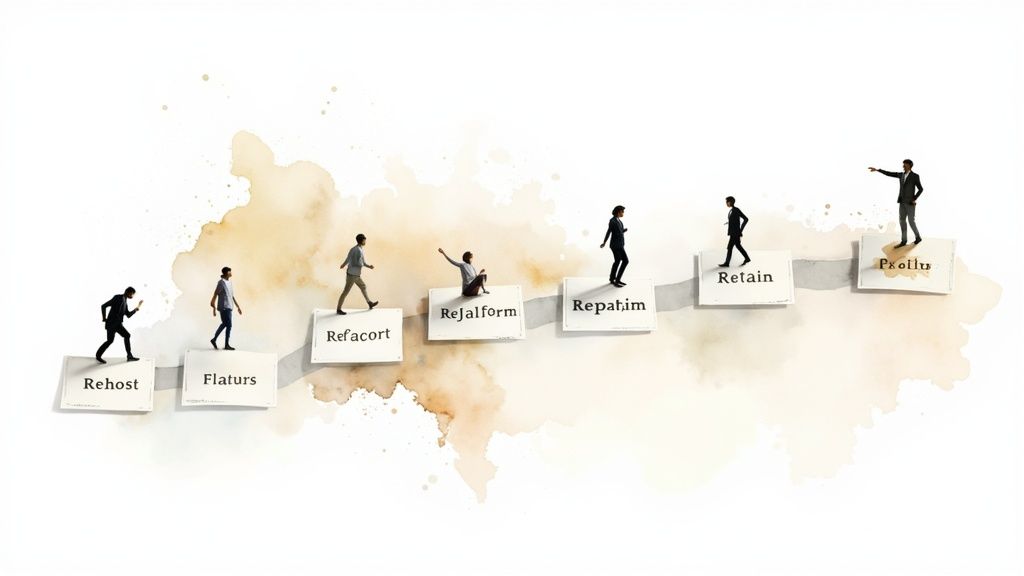
Alright, you’ve mapped your IT estate. Now comes the real chess match: deciding how each piece moves. Let me be blunt—a one-size-fits-all approach to the migration of data center assets is a recipe for failure. It just doesn’t work.
Every single application in your portfolio has its own history, its own business purpose, and its own technical baggage. Forcing everything down the same migration path is like trying to fit a square peg in a round hole. You’ll waste a ton of money and burn out your team.
This is exactly where the “6 Rs” framework comes in. It’s a battle-tested model for categorizing your applications and assigning each one the smartest, most cost-effective migration strategy. For a deeper dive, I highly recommend reviewing these application modernization approaches like the 6 Rs to get a firm grasp on the concepts.
To help visualize the options, think of it this way:
Comparing The 6 R Migration Strategies
The “6 Rs” give you a clear framework for deciding the fate of every application in your portfolio. This table breaks down what each strategy entails, the effort involved, and where it makes the most sense.
| Strategy | Description | Effort & Cost | Risk Level | Best For |
|---|---|---|---|---|
| Rehost | “Lift-and-shift.” Move the application as-is to a new environment (e.g., IaaS). | Low | Low | Legacy systems, large-scale migrations where speed is critical. |
| Replatform | “Tweak-and-shift.” Make minor optimizations to leverage cloud benefits without a full rewrite. | Low to Medium | Low to Medium | Migrating databases to managed services; getting quick cloud wins. |
| Refactor | “Rearchitect.” Substantially modify the app to become cloud-native. | High | High | Core business applications needing scalability and new features. |
| Repurchase | “Drop and shop.” Move to a different product, usually a SaaS solution. | Varies | Medium | Replacing on-premise software (like a CRM) with a cloud alternative. |
| Retire | Decommission applications that are no longer providing business value. | Very Low | Very Low | Obsolete, redundant, or unused applications discovered during assessment. |
| Retain | Keep the application in its current environment. | None | None | Applications with strict compliance, latency, or dependency issues. |
Ultimately, your migration plan will likely be a mix of these strategies. The key is to analyze each application individually rather than applying a blanket approach.
Rehost (Lift-and-Shift)
The most straightforward path is Rehosting, which everyone in the industry calls “lift-and-shift.” You’re essentially picking up an application from your on-premise servers and dropping it into a new environment—like an IaaS platform—with almost no changes.
This approach is fast. It’s relatively low-risk. I’ve seen it work wonders for legacy systems that are too brittle to modify or for massive migrations where the C-suite is demanding speed above all else. The trade-off? You don’t get to use cool cloud-native features, and you’re likely carrying over old performance issues.
Replatform (Tweak-and-Shift)
Replatforming is a smart step up from a simple rehost. You’re not just moving the application; you’re making a few targeted optimizations to take advantage of the new environment. The core architecture stays the same.
A classic real-world example is migrating an on-premise database to a managed cloud database service. You instantly get benefits like automated backups and easy scalability, but the development effort is a fraction of what a full rewrite would cost. It’s a fantastic middle ground for scoring some quick, tangible wins.
Refactor or Rearchitect
Now we’re talking about a serious overhaul. Refactoring means fundamentally changing an application’s architecture to become truly cloud-native. It’s the most expensive and time-consuming path, but the long-term payoff can be huge in terms of performance, scalability, and the ability to innovate.
This is the right move for your mission-critical business applications—the ones that need to handle unpredictable traffic or require rapid feature development. We’re seeing a huge push for this kind of modernization, especially with the explosion of AI. In fact, AI workloads could drive around 40% of the growth in data center demand by 2030, and old-school architectures just can’t handle that.
Choosing to refactor an application is a major business decision, not just a technical one. The investment must be justified by a clear return on agility, scalability, or market competitiveness.
Repurchase, Retire, and Retain
The last three Rs are all about simplifying your IT portfolio and being realistic.
- Repurchase: Sometimes the best move is to switch to a different product entirely, usually a Software-as-a-Service (SaaS) solution. Think about ditching your clunky, on-premise CRM for a platform like Salesforce.
- Retire: You will absolutely find applications during discovery that nobody uses anymore. The smartest thing to do is decommission them. It cuts complexity, saves money, and reduces your security footprint.
- Retain: Not everything has to move. Some applications might need to stay put due to strict regulatory rules, latency concerns, or complex dependencies. Retaining is a perfectly valid strategy for systems that just aren’t ready for a move.
Making The Right Choice With An Outsourcing Partner In The USA
Deciding which “R” to apply to each application requires a mix of deep technical knowledge and sharp business acumen. This is where bringing in an experienced outsourcing partner based in the USA can be a game-changer. They’ve done this hundreds of times and can quickly see the best path for every component in your IT estate. Working with a domestic team means no communication barriers and a shared understanding of the U.S. business landscape, which informs every decision. This kind of partnership can dramatically speed up your planning phase and help you build a migration roadmap that actually aligns with your company’s goals. If you need expert help creating your migration strategy, give us a call at +1 (310)800-1398.
Leaning on that experience helps you sidestep common mistakes and ensures your money is spent where it will deliver real impact. You can also explore how cloud-based decision-making benefits startups and established businesses in our related guide.
Assembling Your Migration Dream Team

Let’s get one thing straight: a migration of data center assets is fundamentally a human endeavor. Technology doesn’t move itself; people do. Your project’s success hinges just as much on the team you build and the ground rules you set as it does on the tools you use.
Building the right team means bringing together a cross-functional group of experts who know exactly what they’re responsible for. Without this clarity, accountability blurs, decisions stall, and the entire project can grind to a halt over minor disagreements.
Defining Your Key Players
A high-performing migration team needs voices from across the business, not just IT. Each role brings a unique and necessary perspective to the table. Think of it like assembling a crew for a high-stakes mission—everyone needs to know their job inside and out.
Here are the non-negotiable roles you need to fill:
- Executive Sponsor: This is your champion in the C-suite. They secure the budget, smash through organizational roadblocks, and sell the project’s business value to other leaders.
- Project Manager: The conductor of the orchestra. This person owns the project plan, keeps the timeline on track, flags risks, and makes sure everyone is talking to each other.
- Technical Lead/Architect: Your big-picture thinker on the tech side. They’re responsible for the overall design of the new environment and ensuring the migration strategy is sound from the get-go.
- Application Owners: These are the experts who know their apps inside and out. Their input is absolutely critical for mapping dependencies, building test plans, and giving the final thumbs-up.
- Infrastructure Specialists: Your hands-on experts for networks, storage, and servers. They handle the nitty-gritty of setting up the target environment and executing the actual moves.
A classic mistake is treating a migration as a pure “IT project.” When you leave business and application owners out of the early planning, you risk discovering critical requirements way too late. That leads to painful rework and delays nobody wants.
Building a Strong Governance Framework
A great team needs a great game plan. A solid governance framework is the rulebook that keeps your project on track, especially when things go sideways. This isn’t about creating red tape; it’s about enabling quick, smart decisions when you need them most.
Your framework should include a few key pieces:
- A Solid Communication Plan: This defines who gets what information, when, and how. It keeps everyone aligned, from the project team right up to the executive suite.
- Change Management Process: Things will go wrong. It’s a guarantee. A formal process for managing changes prevents scope creep and ensures any detours from the plan are properly vetted and approved. You can find more on this in our practical guides to effective change management.
- Risk Register: This is a living document where you track potential problems, their likelihood, their impact, and your plan to deal with each one.
The Advantage of a USA-Based Outsourcing Partner
Let’s be honest—assembling this dream team can be a huge challenge, especially for organizations with lean IT departments. This is exactly where bringing in an experienced outsourcing partner from the USA can make all the difference. A US-based partner comes with a ready-made team of seasoned project managers, architects, and engineers who have been through countless complex migrations. They’re in your time zone, which cuts out the communication friction that can drag down projects with offshore teams. More importantly, they have a deep, practical understanding of US business culture and regulatory hurdles, ensuring your project stays compliant and aligned with what the domestic market expects. Partnering with an expert team lets you fill critical skill gaps instantly, without the long and painful hiring process. This frees up your internal staff to focus on their day jobs, keeping business running smoothly while the experts handle the intricate details of the migration.
For help building your migration team and strategy, call us today at +1 (310)800-1398.
Navigating the Move From Pilot to Go-Live

All the planning is done. The strategy is locked in, the team is prepped, and now it’s time for the moment of truth: executing the actual migration of data center assets. This is where theory meets reality, and it’s also where the biggest risks live if you don’t manage the process with absolute precision.
But here’s the thing: turning this high-stakes process into a predictable, well-orchestrated event is completely possible. The trick is to stop thinking of it as one giant “go-live” event and start seeing it as a series of controlled, manageable steps. This approach takes the fear out of the cutover and gives your team the confidence to execute flawlessly.
The Power of a Pilot Migration
Before you even dream of touching a mission-critical application, you absolutely must run a pilot migration. I can’t stress this enough. A pilot is your full dress rehearsal—your chance to test every single assumption, tool, and process on a low-risk, non-production application.
This isn’t just about checking if a server boots up in the new environment. The real goal of a pilot is to validate your entire playbook from start to finish.
- Process Validation: Does your communication plan actually work when things get real?
- Tooling Checks: Do the data synchronization tools perform exactly as you expect under load?
- Team Readiness: Does every single person on the team understand their role and what’s expected of them during the cutover window?
Running a small-scale pilot will always uncover problems you didn’t see coming. Finding those issues here, on a system with zero business impact, is a project-saving gift. It lets you fine-tune your procedures and runbooks before the stakes get infinitely higher.
Crafting Bulletproof Runbooks
For every application or group of applications you move—what we call a “migration wave”—you need a detailed runbook. This is not a high-level to-do list. A proper runbook is a granular, minute-by-minute script that documents every single action, command, and verification check needed for a successful move.
A solid runbook must include:
- Pre-Migration Checks: A complete list of all tasks to get done before the maintenance window even opens, like final data backups and notifying stakeholders.
- Step-by-Step Cutover Actions: The exact sequence of events, clearly stating who is responsible for each action and how long it should take.
- Post-Migration Validation: A clear set of tests to confirm the application is 100% functional in its new home. This should include both technical checks and user acceptance testing (UAT).
Think of your runbook as the sheet music for your migration orchestra. Every player knows their part, when to come in, and what it should sound like. The result is a harmonious execution, not a chaotic scramble.
One of the biggest mistakes I see teams make is creating runbooks that are too vague. A good runbook is so detailed that a knowledgeable engineer who has never seen the application before could execute the migration successfully just by following the script.
Your Essential Safety Net: The Rollback Plan
No matter how perfect your plan is, you must have a rollback plan. This is your non-negotiable safety net. It’s the documented, tested procedure for hitting the “undo” button and reverting to the original state if the migration hits a critical, unresolvable snag.
A rollback plan isn’t a sign of pessimism; it’s the mark of a professional. It clearly defines the triggers for initiating a rollback (e.g., a key validation test failing repeatedly) and the exact steps to get the source environment back online with minimal disruption. Having this plan ready means you can make a clear-headed go/no-go decision during the cutover window without panicking.
The Strategic Value of a USA-Based Partner
Executing a flawless migration requires immense focus and an experienced hand that can be tough to find internally. This is the perfect time to bring in an outsourcing partner from the USA. A domestic partner provides a team of specialists who have orchestrated hundreds of these go-live events. Their value is immense. They bring battle-tested runbook templates, proven rollback procedures, and the calm, steady leadership of experience to your cutover weekend. Because they operate in your time zone, communication delays during critical moments are eliminated, ensuring decisions are made quickly and accurately. By entrusting the execution to a specialized US team, you free up your internal staff to focus on what they do best: business-side validation and stakeholder communication.
If you need an expert partner to ensure your go-live is a success, call us at +1 (310)800-1398 for a consultation.
Why a US-Based Partner Can Be Your Secret Weapon
Let’s be honest. A data center migration is a beast of a project. It demands an incredible amount of focus and expertise, and your internal IT team is already stretched thin just keeping the lights on. The daily fires don’t pause just because you’ve decided to move your digital infrastructure.
This is where bringing in a specialized US-based partner stops being a luxury and becomes a game-changing strategic move. This isn’t just about handing off a to-do list. It’s about bringing in a team with proven playbooks, powerful automation, and a deep bench of certified engineers who have been through this hundreds of times. They’ve seen it all, and they hit the ground running from day one.
No More Middle-of-the-Night Calls
One of the most immediate perks of working with a US-based team? The communication just works. When you’re in a tight cutover window and a critical decision needs to be made right now, you can’t afford to wait for a team on the other side of the planet to start their day.
A domestic partner means you have direct access to experts in your own time zone. This creates a natural, real-time flow of information. Problems get solved as they happen, not 12 hours later. There’s also a shared understanding of American business culture that smooths out every interaction, from the initial planning sessions to the final sign-off.
Mastering the American Compliance Maze
The US regulatory landscape can feel like a tangled web of acronyms and requirements, and a single misstep can completely derail your migration. A US-based partner doesn’t just know about these regulations; they live and breathe them every single day.
An experienced domestic partner doesn’t just check compliance boxes; they build compliance into the migration from the ground up. This is absolutely critical for avoiding eye-watering fines and serious damage to your reputation.
They are experts in navigating the specific demands of regulations crucial to US businesses, including:
- HIPAA: Keeping sensitive patient health information locked down.
- SOC 2: Guaranteeing security, availability, and processing integrity.
- PCI-DSS: Securing credit card and payment data against threats.
Having this expertise baked into the project from the start gives you incredible peace of mind and frees up your internal teams from a massive compliance headache.
Focus on Your Business, Not Just Your Boxes
By letting a specialized team handle the heavy lifting of the migration, you free up your most valuable asset—your people—to do what they do best. Instead of getting tangled in the weeds of server moves and data replication, your team can stay focused on driving the business forward and innovating.
This is more important now than ever. The global demand for data center capacity is fierce and constantly changing. For instance, in Europe’s top markets, vacancy rates recently hit a record low of 7.4% thanks to the explosion in hyperscale and AI projects. Meanwhile, the Asia-Pacific region has a higher vacancy rate overall, but critical markets like Singapore remain incredibly tight with only 2% vacancy. You can read more about these global data center trends to get a sense of the competitive pressures.
An expert partner helps you navigate this complex market, allowing your team to look toward the future instead of just managing the present. For expert guidance on your migration, give us a call at +1 (310)800-1398.
What Happens After the Move? Optimizing Your New Environment
Getting the final server live isn’t the finish line—it’s the starting pistol for the next race. Sure, successfully moving your assets is a massive accomplishment, and your team deserves to celebrate. But the real business value, the stuff that shows up on the P&L, is unlocked in the weeks and months that follow. This is where you pivot from a project mindset to one of continuous improvement.
That transition starts with methodically and securely shutting down your old data center. Don’t rush this. This process is just as critical as the migration itself, involving everything from data sanitization and asset disposal to terminating old leases and service contracts. A clean shutdown prevents lingering security risks and stops you from paying for ghost infrastructure.
At the same time, get your migration team in a room for a proper lessons-learned session. What went brilliantly? Where did you hit roadblocks? Documenting these insights creates an invaluable internal playbook that will make every future project run that much smoother.
From Migration to Modernization
With the move behind you, your focus has to shift immediately to optimization. Your new environment, whether it’s on-premises or in the cloud, is a fresh slate. It’s your golden opportunity to right-size resources and make sure you’re only paying for what you actually use—a massive challenge, especially after a “lift-and-shift” migration where old habits (and bloated VMs) tend to follow you.
Your post-migration plan for the first 90 days should be aggressive and targeted:
- Establish New Baselines: Your old performance benchmarks are irrelevant. It’s time to establish new ones to monitor application health and, more importantly, the end-user experience.
- Scrutinize Every Dollar: Dive deep into your cloud bills or new operational expenses. Hunt down and eliminate idle or over-provisioned resources with a vengeance.
- Harden Your Security: The new environment needs a full security audit. Fine-tune access controls, review firewall rules, and sharpen your threat detection policies for the new landscape.
- Automate Everything You Can: Look for any routine maintenance, patching, or backup procedures that are still being done manually. Automate them. Free up your team for work that actually moves the needle.
Don’t let your shiny new environment become a more expensive version of your old one. Post-migration optimization is where you realize the true ROI of this entire project, by trimming waste and dramatically improving how you operate.
The Long-Term Advantage of a US-Based Partner
This optimization phase is another place where having an outsourcing partner from the USA really pays off. Their job doesn’t stop at the cutover. A domestic partner can slide right into providing ongoing managed services, proactively monitoring your new environment to pinpoint optimization opportunities and potential issues before they ever impact your business. Because they have a deep, practical understanding of the US business cycle and your specific operational pressures, their recommendations are grounded in reality and aligned with your goals. They’re in your time zone, ready to provide continuous support and strategic guidance as you settle in. This kind of relationship transforms a one-time project into a long-term strategy for operational excellence.
For expert help optimizing your new data center environment, call us at +1 (310)800-1398.
Answering Your Top Data Center Migration Questions
Even with the world’s best playbook, every data center migration project runs into its own unique set of questions and “what ifs.” You’re not alone. Getting straight answers to these common hurdles can be the difference between a project that builds confidence and one that spirals into chaos.
Let’s cut right to the chase and tackle some of the most frequent questions we hear from teams in the trenches.
Why Do So Many Migrations Fail?
If there’s one single reason data center migrations go off the rails, it’s a failure to do the upfront work. Teams consistently, almost universally, underestimate the tangled web of application dependencies.
When you don’t map every single data flow, every handshake between servers, and every ancient, undocumented connection beforehand, you’re setting yourself up for a world of pain. It’s a near-guarantee you’ll face unexpected outages, data loss, and massive delays when it’s time to make the final cutover.
How Long Does a Data Center Migration Take?
This is the classic “how long is a piece of string?” question. The timeline swings wildly depending on the scale and complexity of what you’re moving.
A small business shifting a few dozen servers might get the whole thing done in 3-6 months. On the other end of the spectrum, a large enterprise moving thousands of applications into a hybrid cloud environment is easily looking at an 18-36 month journey.
Here’s the critical takeaway: The discovery and planning phase alone will eat up 30-40% of that entire timeline. Rushing this stage isn’t saving time; it’s borrowing it from the future, with heavy interest.
Physical vs. Logical Migrations: What’s the Difference?
Getting a handle on this distinction is fundamental to picking the right strategy for your assets.
- Physical Migration: This is what most people picture—the classic “lift-and-shift.” You’re literally unplugging server hardware from one location and physically moving it to another.
- Logical Migration: This is far more common today. You’re moving the workloads—the applications and their data—from old hardware in one place to entirely new hardware in the target location, whether that’s another on-prem site or the cloud.
Most projects these days are logical migrations. It’s the perfect opportunity to ditch aging equipment and modernize your infrastructure as part of the move. You get all the benefits of new, faster hardware and cloud services without being chained to the limitations of your old gear.
Is a USA-Based Outsourcing Partner Really an Advantage?
For any in-house team, navigating the complexities of a migration is a heavy lift. This is where leaning on an experienced partner, especially one based in the USA, can be a game-changer. A domestic partner brings a team to the table that has seen it all before. They’ve answered these questions hundreds of times and have proven, battle-tested solutions ready to go. Crucially, they operate in your time zone, which means no late-night calls or communication delays. They also bring a deep, intrinsic understanding of the US business landscape and its specific regulatory hurdles. It just makes everything smoother.
At NineArchs LLC, we provide the expert guidance and hands-on support to make your data center migration a success. Contact us at +1 (310)800-1398 to discuss your project.