
Cloud governance is the rulebook—the collection of policies, roles, and procedures—that dictates how your organization uses and manages its cloud resources. It’s the strategic blueprint that keeps your cloud operations secure, compliant, and cost-effective, preventing chaos before it even starts.
What Is Cloud Governance and Why It Matters

Think of your cloud environment as a bustling new city. Without traffic lights, zoning laws, or a police force, you’d have gridlock, accidents, and uncontrolled sprawl in no time. Good governance in the cloud provides these essential rules of the road for your digital infrastructure.
It’s so much more than a list of restrictions. It’s an enabling framework that allows your teams to grow safely, efficiently, and at scale. A solid governance strategy is what turns a potential liability into a powerful business asset.
The True Cost of No Governance
Without a plan, organizations stumble into the same predictable traps. Developers might spin up expensive resources for a short-term project and forget to shut them down, blowing the budget. Different teams create inconsistent security configurations, accidentally opening up vulnerabilities that expose sensitive data.
This lack of control quickly spirals into serious risks:
- Financial Waste: Unmonitored cloud usage leads to “cloud sprawl,” where orphaned or underutilized resources drive up costs relentlessly. Studies show that up to 30% of cloud spend is simply wasted due to a lack of oversight.
- Security Gaps: When every team sets its own rules, security becomes a patchwork of disconnected policies. This creates the perfect openings for unauthorized access, data breaches, and painful compliance violations.
- Operational Inefficiency: Without standard processes for deploying and managing services, teams end up working in silos. This slows down innovation and makes it incredibly difficult to maintain a stable, reliable infrastructure for everyone.
Cloud governance isn’t about limiting what your teams can do; it’s about empowering them to innovate quickly and safely within a well-defined and secure framework.
From Chaos to Control
Implementing governance in the cloud brings order and predictability to the table. It establishes clear, repeatable policies for how resources are provisioned, managed, and eventually retired. This control allows businesses to confidently scale their operations while keeping risks locked down. A well-defined strategy ensures every action taken in the cloud aligns with your bigger business goals—from maintaining compliance with regulations like GDPR to hitting your financial targets.
Getting this right requires a specific kind of expertise. Working with an outsourcing partner from the USA gives you access to seasoned cloud architects who understand domestic compliance standards and operate in your time zone. This collaboration ensures your governance framework is built correctly from the start, saving time and preventing costly mistakes. For expert guidance, give us a call at +1 (310)800-1398 to discuss your strategy.
Understanding the Five Pillars of Cloud Governance

Solid cloud governance isn’t a single switch you flip. It’s a balanced strategy built on five interconnected pillars, much like the support columns holding up a strong building. If one pillar is weak, the whole structure becomes unstable. But when managed together, they create a tough framework that helps you hit business goals while keeping risks in check.
Each pillar covers a specific part of your cloud operations, but they don’t work in isolation—they’re deeply connected. For example, a strong identity management policy directly boosts your security, which in turn helps you meet compliance rules and dodge expensive fines.
Let’s break down each pillar and see how it works in the real world.
Cost Management and Financial Governance
Without clear guardrails, cloud spending can spiral out of control. The very ease of spinning up new resources is a double-edged sword, often leading to “cloud waste”—paying for services that are oversized, abandoned, or just plain forgotten. The cost management pillar is all about bringing financial accountability into the picture.
This means going way beyond just scanning the monthly bill. It’s about being proactive to control and optimize what you spend.
- Resource Tagging: This is non-negotiable. Implement a mandatory tagging policy so every resource (like a virtual machine or storage bucket) is labeled with details like the project, department, and owner. This lets you track spending accurately and assign costs where they belong.
- Budget Alerts: Set up automated alerts that ping your finance and IT teams when spending for a project is getting close to its limit. No more surprise overages.
- Rightsizing and Automation: Use cloud-native tools to spot underused resources. You can then automate scripts to shut down non-production environments after hours or resize servers to match their actual workload, cutting waste without hurting performance.
Security and Compliance
Security is arguably the most critical pillar of them all. It’s about defining and enforcing policies that protect your data, apps, and infrastructure from threats. Just as important is compliance, which makes sure your organization follows industry regulations and legal standards like GDPR, HIPAA, or PCI DSS.
A solid security and compliance posture isn’t a “set it and forget it” task. It demands constant monitoring and enforcement.
A well-governed cloud environment automates compliance. Instead of manually checking configurations, policies can be set to automatically block deployments that don’t meet security standards, such as launching a server with an unencrypted storage volume.
For instance, you can create a policy that stops a developer from storing sensitive data in a public bucket. If someone tries, the system can automatically block the action and log the event for review. This flips security from being a reactive cleanup job to a proactive, built-in part of how you operate.
Operations and Performance Management
This pillar is all about making sure your cloud environment runs smoothly, reliably, and efficiently. It’s about creating standard procedures for how resources are provisioned, managed, and monitored so they meet the performance expectations of your business and, more importantly, your customers.
Key operational activities include:
- Standardized Deployments: Using Infrastructure as Code (IaC) templates to ensure every new environment is built consistently and follows best practices.
- Performance Monitoring: Setting up dashboards and alerts to track vital metrics like CPU usage, network latency, and application response times.
- Backup and Disaster Recovery: Establishing automated backup schedules and actually testing your disaster recovery plans to ensure business continuity when things go wrong.
Identity and Access Management
The final pillar, Identity and Access Management (IAM), is the gatekeeper of your cloud environment. It answers three fundamental questions: Who can access what resources? What can they do with that access? And how is their access verified?
Effective IAM is built on the principle of least privilege, meaning users only get the bare-minimum permissions needed to do their jobs. For example, a data analyst might have read-only access to a database, while a database administrator has the permissions to actually modify it. To better understand one of the critical pillars, such as data governance, explore essential data governance best practices for cloud success.
Putting these pillars in place requires deep expertise. An outsourcing partner from the USA provides access to certified professionals who can design and implement a framework that aligns with domestic compliance standards and business hours. For a consultation on building your governance strategy, call us at +1 (310)800-1398.
How to Build Your Cloud Governance Framework

Alright, let’s move from theory to action. This is where a solid governance in the cloud strategy really starts to pay off. Building a framework isn’t a one-and-done project; it’s a journey. You’re essentially evolving from a reactive state—putting out fires as they pop up—to a proactive, automated system that prevents those fires in the first place.
This process follows a pretty clear roadmap. It kicks off with a hard look at what you’ve actually got running in the cloud, then gradually layers on the rules, tools, and oversight needed to get things under control. The goal here is to build something that actually helps the business, not a bureaucratic mess that slows everyone down.
Step 1: Discover and Assess Your Current Footprint
Let’s be honest: you can’t govern what you can’t see. The very first step, the one you absolutely cannot skip, is a thorough discovery of your entire cloud footprint. It’s amazing what turns up—forgotten servers, orphaned storage buckets, and shadow IT projects humming away that nobody is tracking.
Your mission here is to create a complete inventory of every single asset across all your cloud providers. We’re talking virtual machines, databases, serverless functions, the whole nine yards. Just as important, you need to document who owns each resource and what its purpose is. That context is gold when it comes time to make decisions.
Once you have that catalog, you can benchmark your current state against your business goals. For example, are your most critical applications running on infrastructure that’s secure and properly sized? This initial reality check gives you the visibility you need to build a governance plan that actually means something.
Step 2: Define Policies and Controls
With a clear map of your environment, you can start writing the rules of the road. These policies and controls can’t exist in a vacuum; they must tie directly back to your business objectives. Maybe that’s cutting costs by 15% next quarter or locking down your data to meet HIPAA requirements.
Don’t try to boil the ocean. Start with the high-impact areas where you can get the biggest wins first.
- Cost Management Policies: Lay down the law on resource tagging. Set up departmental budgets with automated alerts so there are no surprises at the end of the month. Create a simple policy to automatically shut down non-production dev servers outside of business hours—it’s an easy win.
- Security Policies: Establish baseline security configurations for anything new that gets deployed. This could be as straightforward as enforcing encryption on all storage and restricting public access to sensitive ports by default.
- Access Control Policies: Implement Role-Based Access Control (RBAC) to enforce the principle of least privilege. Define clear roles for your developers, admins, and finance teams with permissions tailored only to what they need to do their jobs.
The best governance policies are never created in an IT silo. They’re built with input from everyone involved—IT, security, finance, and development. This collaboration ensures the rules are practical and actually help the people who have to follow them.
Step 3: Implement Tools and Automation
Policies on a document are just good intentions. They only become powerful when they’re enforced consistently. Manually checking every single deployment for compliance is a recipe for failure, especially as you scale. This is where tools and automation become your best friends.
Your cloud provider’s native tools are the perfect place to start implementing your governance in the cloud strategy. For example, you can use AWS Budgets to fire off alerts when spending gets close to a threshold. As you get more sophisticated, you can use services like AWS Lambda to run scripts that automatically right-size instances that are barely being used.
The key is to automate enforcement wherever you can. It reduces human error and ensures your policies are applied to everything, every time.
Step 4: Monitor Continuously and Optimize
Cloud governance is definitely not a “set it and forget it” task. Your cloud environment is alive; new services are spun up and old ones are retired daily. Continuous monitoring is the only way to ensure your framework stays effective over the long haul.
This means setting up dashboards to track key metrics for cost, security, and compliance. Get in the habit of reviewing these metrics regularly to spot trends, identify new risks, and find more opportunities to optimize. This continuous feedback loop is what allows you to refine your policies and automation, making sure your governance framework evolves right alongside your business.
Navigating these steps takes real expertise. Partnering with a USA-based outsourcing provider gives you a direct line to certified cloud experts who can accelerate this entire process. They’ve seen it all before and can help you implement best practices, sidestep common pitfalls, and make sure your framework is aligned with domestic regulations. For expert guidance on building your cloud governance framework, give us a call at +1 (310)800-1398.
Essential Cloud Governance Controls and Best Practices
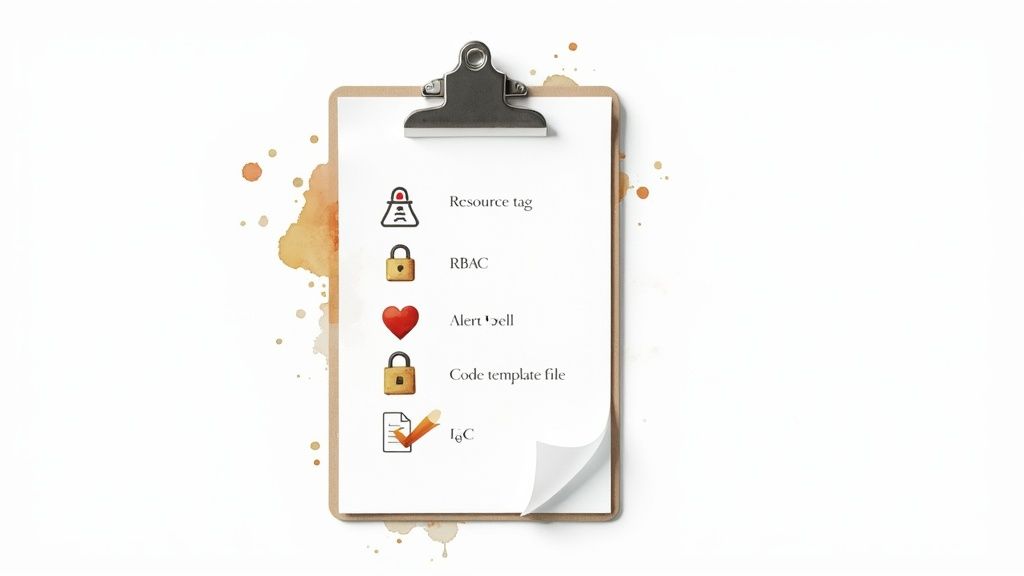
Once you have a framework, it’s time to bring your policies to life with specific, high-impact controls. These are the practical, hands-on techniques that form the backbone of strong governance in the cloud. Think of this section as your actionable checklist for making immediate, meaningful improvements.
These practices aren’t about adding more bureaucracy. Instead, they’re about embedding smart, automated guardrails directly into your daily operations. Each control is designed to strengthen your posture in a key area—from cost visibility to security enforcement—ensuring your cloud environment remains a well-managed asset.
Mandate Comprehensive Resource Tagging
You can’t govern what you can’t see. If you don’t know who owns a resource or what its purpose is, managing its cost or security is nearly impossible. This is why a mandatory resource tagging policy is the single most important control for achieving clarity.
Tags are simple key-value pairs you attach to cloud resources, but their impact is huge. They allow you to filter reports, track spending, and automate actions based on metadata that actually matters to your business.
A solid tagging strategy should always include:
- Owner: The person or team responsible for the resource.
- Cost Center: The department or business unit to bill for its usage.
- Project: The specific initiative the resource supports.
- Environment: Differentiates between production, staging, development, or testing.
This level of detail transforms your monthly cloud bill from an intimidating lump sum into a clear, actionable report. Suddenly, you know exactly where your money is going.
Implement Strict Role-Based Access Control
The principle of least privilege is a cornerstone of security, and Role-Based Access Control (RBAC) is how you put it into practice. RBAC ensures that users and applications have only the bare-minimum permissions needed to do their jobs, which dramatically reduces your attack surface.
Instead of assigning permissions one by one, you define roles with specific sets of permissions—like “DatabaseAdmin” or “BillingReader”—and then assign those roles to users. This standardized approach prevents accidental misconfigurations and makes audits much simpler. To get this right, it’s crucial to understand the foundational elements discussed in guides on Cloud Security Fundamentals.
A key best practice is to regularly audit your RBAC roles. Over time, users can accumulate permissions they no longer need—a problem known as “privilege creep”—creating security holes that need to be closed.
Use Infrastructure as Code for Standardization
Deploying resources manually is slow, inconsistent, and begging for human error. Infrastructure as Code (IaC) solves this by letting you define your entire cloud environment in template files. Tools like Terraform or AWS CloudFormation use these templates to deploy environments in a predictable, repeatable, and automated way.
This is a governance game-changer. By creating pre-approved IaC templates, you can embed your security and compliance rules directly into the provisioning process itself. This guarantees that every new deployment automatically adheres to your standards for networking, encryption, and tagging from the moment it’s created.
Implementing these controls requires specialized knowledge. Working with a USA-based outsourcing partner gives you direct access to experts who can help configure RBAC, build secure IaC templates, and establish a tagging strategy that fits your business. For hands-on help, call +1 (310)800-1398 today.
Common Cloud Governance Mistakes to Avoid
Navigating governance in the cloud is a lot like steering a ship through tricky waters. Even a tiny miscalculation can send you miles off course. One of the fastest ways to learn the ropes is to study the mistakes others have made. Too many organizations stumble into the same predictable traps, turning a well-intentioned governance strategy into a roadblock for innovation.
By understanding these common pitfalls, you can steer your organization toward a more resilient and effective framework. These mistakes often pop up from a simple misunderstanding of how to balance control with the agility the cloud is supposed to deliver. Let’s break down the most frequent errors and, more importantly, how you can sidestep them.
Creating Overly Restrictive Policies
One of the quickest ways to kill a governance initiative is to make the rules so rigid they bring productivity to a grinding halt. When developers have to wait days for approvals just to spin up a simple test environment, they’ll inevitably look for workarounds. That’s how you end up with the very shadow IT you were trying to prevent. This “what not to do” scenario treats governance as a series of gates instead of guardrails.
The goal should be to empower teams, not restrict them. Give them the freedom to innovate safely within predefined boundaries.
- What Not to Do: Implement a manual, multi-level approval process for every new resource request, creating massive delays and frustration.
- What to Do Instead: Give developers a self-service catalog of pre-approved, automated Infrastructure as Code (IaC) templates. This lets them deploy compliant resources in minutes, not days, without ever sacrificing security or cost controls.
Neglecting Automation and Manual Management
Trying to manually manage a dynamic cloud environment is a battle you will lose every time. The sheer scale and speed of the cloud mean that misconfigurations can happen in seconds, and costs can spiral out of control overnight. Relying on manual checks and spreadsheets for compliance and cost tracking isn’t just inefficient; it’s wide open to human error, leaving dangerous gaps in your oversight.
Without automation, your governance policies are merely suggestions. True enforcement comes from building your rules directly into your operational workflows, making sure they’re applied consistently, every single time.
This mistake is particularly costly. After all, cloud governance is laser-focused on taming explosive spending, as a staggering 82% of cloud leaders grapple with managing their spend. With global public cloud spending projected to hit $723.4 billion, effective governance is non-negotiable. This is especially true since over a third of organizations now spend more than $12 million annually on public cloud services alone. You can explore more of these cloud spending trends and statistics.
Failing to Secure Cross-Functional Buy-In
Governance is not just an IT problem—it’s a business strategy. A classic failure is creating policies in an IT silo without getting input from finance, security, development, and business leaders. When other departments don’t understand the “why” behind the rules, they just see them as arbitrary hurdles. This perception quickly leads to resistance and poor adoption across the board.
The solution is to form a cross-functional Cloud Center of Excellence (CCoE) from the very beginning. This team approach guarantees that all perspectives are heard and that the governance framework aligns with everyone’s goals, from financial accountability to developer agility.
Avoiding these pitfalls requires a strategic approach and seasoned expertise. Partnering with a USA-based outsourcing provider gives you access to professionals who can help you build a balanced, automated governance framework from day one. For expert guidance, call +1 (310)800-1398 to start the conversation.
Need to Move Faster? A USA-Based Partner Can Be Your Accelerator
Let’s be honest: building and maintaining a solid cloud governance framework isn’t a weekend project. It’s a deep, ongoing effort that pulls together specialized skills in security, finance, and cloud architecture. For most companies, trying to build that capability from scratch is a massive drain on resources, pulling your best people away from what they should be doing—driving your business forward.
This is where a strategic partnership can completely change the game. Instead of the slow, expensive route of hiring a dedicated internal team, you can collaborate with an experienced, USA-based partner. This gives you immediate access to certified cloud experts who have been in the trenches, designing and implementing governance strategies for companies across all sorts of industries.
Get Decades of Experience on Day One, Minus the Overhead
The market for certified cloud architects and security specialists is red-hot. The cost of recruiting them, paying their salaries, and keeping them is staggering. An outsourcing partner from the USA gives you a full team of seasoned professionals from the moment you sign on, all for a fraction of the cost of hiring them yourself. You get to skip the painful hiring cycles and start putting best practices into action right away.
Think of a dedicated partner as a strategic accelerator. They’ve already made the common mistakes, so you don’t have to. They bring proven playbooks and ready-to-go templates that can be shaped to fit your business, ensuring you get your governance policies up and running faster and more effectively.
Partnering with an external team isn’t just about handing off tasks. It’s about injecting years of hard-won knowledge and experience directly into your organization, giving you a serious competitive edge.
The Advantage of Seamless Compliance and Collaboration
For any business operating in the United States, working with a domestic partner offers some clear wins for governance in the cloud. A USA-based team just gets it. They have an intrinsic understanding of domestic regulations like HIPAA, CCPA, and all the sector-specific compliance rules you’re up against. This alignment makes building a framework that meets every legal and security standard from the get-go much, much simpler.
But here’s a benefit people often overlook: time-zone alignment. It’s huge. When your governance team is working the same hours you are, communication is instant and fluid. No more late-night calls or waiting a day for an email response on a critical project. This seamless collaboration means your governance strategy can evolve right alongside your business, giving you the agility you need to stay ahead.
A dedicated partner frees you up to focus on your core mission while they handle the complex machinery of cloud management. For expert guidance on implementing your cloud governance framework, give us a call at +1 (310)800-1398.
Common Questions We Hear About Cloud Governance
Even with the best governance plan on paper, questions always pop up when it’s time to put it into practice. As you shift from strategy to the real world, some very practical concerns tend to surface. Let’s tackle a few of the most common ones we see from our clients.
Getting these answers straight helps clear the path forward, ensuring your governance framework is not only effective but makes sense to everyone involved.
What’s the Very First Step in Creating a Cloud Governance Policy?
The journey always starts with discovery. You simply can’t govern what you can’t see, so the first real step is to take inventory of every single cloud asset you have. This catalog gives you a clear, honest baseline of your entire digital footprint.
Once you have that visibility, the next critical move is to get your key stakeholders in the same room. Pull together leaders from IT, finance, security, and development to make sure the policies you create actually support everyone’s goals and operational needs from day one.
How Do You Balance Governance with Developer Agility?
This is a big one. The key is to think in terms of “guardrails, not gates.” Instead of creating frustrating bottlenecks with slow, manual review processes, the real goal is to empower your development teams to move faster, but safely.
You can strike this balance by providing:
- Automated Tools: Give them systems that automatically check for compliance and security issues right inside their development pipeline.
- Pre-approved Templates: Offer a library of Infrastructure as Code (IaC) templates that already have security and cost controls baked in.
- Self-Service Catalogs: Let developers provision the resources they need quickly and independently, choosing from a menu of approved services.
This approach lets your teams innovate at speed, all while staying within the safe boundaries you’ve established.
An effective governance strategy doesn’t slow down innovation; it accelerates it by making the safe path the easiest path for developers to follow.
Can a Small Business Really Benefit from Cloud Governance?
Absolutely. In fact, you could argue it’s even more critical for smaller businesses where every dollar and every resource is under a microscope. You don’t need a massive, complex framework to see the benefits of good governance in the cloud.
Small businesses can get started with simple, high-impact practices that deliver immediate value. A few great starting points include setting firm budget alerts to prevent surprise bills, enforcing multi-factor authentication on all user accounts, and adopting a basic resource tagging strategy to track costs by project or client. These foundational steps give you control and visibility without creating a bunch of unnecessary overhead.
Navigating these questions and implementing a robust governance strategy takes experience. Working with an outsourcing partner from the USA provides immediate access to seasoned cloud professionals who can build a framework that fits your business perfectly. For a consultation on getting started, call us today at +1 (310)800-1398.