

Cloud migration service providers are specialized firms that act as your expert guides for moving applications, data, and infrastructure from on-premise servers into a cloud environment. They’re the ones who manage the entire journey—from strategy and planning to the actual move and beyond—to minimize the risks and get you there faster.
Why Smart Businesses Partner for Cloud Migration
Moving to the cloud is much more than a simple IT project; it’s a fundamental shift in how your business operates, and it’s loaded with complexity. Trying to go it alone is a high-stakes gamble.
Think of it like navigating a treacherous mountain pass without a map or a guide. Sure, you could try to find your own way, but hiring an expert ensures you avoid the hidden dangers, stick to the safest routes, and reach the summit efficiently and without incident.

Cloud migration service providers are those essential guides. They bring specialized expertise, proven methods, and risk-management strategies that an in-house team, no matter how skilled, rarely has. Their experience is built on countless successful migrations across all sorts of industries.
The Value of an Expert Guide
A true partner does more than just move your data from point A to point B. They provide a strategic framework for your entire cloud journey, making sure every decision aligns with your long-term business goals.
The advantages are clear:
- Accelerated Transformation: A seasoned provider has a repeatable process that steers you clear of common pitfalls, dramatically speeding up your project timeline.
- Fortified Security and Compliance: They live and breathe the intricate security protocols and compliance standards (like SOC 2 or HIPAA), building a secure foundation for you from day one.
- Cost Optimization: These pros help you avoid overprovisioning servers and select the most cost-effective services, preventing those nasty, unexpected bills down the road.
By partnering with an expert, you’re not just outsourcing a task; you are investing in a predictable, secure, and successful outcome. This strategic alliance allows your internal team to focus on core business initiatives rather than getting bogged down in the technical minutiae of the migration process.
The demand for these services speaks for itself. The global cloud migration services market is exploding, with projections showing it will surge to USD 35.29 billion by 2032. North America currently leads this market, a testament to the region’s widespread adoption of cloud technologies. You can discover more insights about this growing market and its key trends.
Bringing in a professional partner offers a clear return on investment by mitigating risks and ensuring the migration is done right the first time.
Key Benefits of Using a Cloud Migration Partner
| Benefit | Description |
|---|---|
| Expertise & Experience | Access to a team with specialized skills and a proven track record of successful, complex migrations. |
| Reduced Risk | Professional methodologies minimize the chances of data loss, security breaches, and costly downtime. |
| Faster Time-to-Cloud | An experienced partner accelerates the entire process, allowing you to realize cloud benefits sooner. |
| Cost Control | Experts prevent overspending by right-sizing resources and optimizing for long-term cloud costs. |
| Enhanced Security | Partners build security and compliance into the foundation of your new cloud environment from the start. |
| Focus on Core Business | Frees up your internal IT team to concentrate on strategic initiatives instead of migration logistics. |
Ultimately, hiring a migration partner is about investing in a smooth, secure, and strategically sound transition that sets your business up for future growth.
The Advantage of a USA-Based Partner
For businesses operating in North America, choosing a USA-based outsourcing partner offers distinct benefits that streamline collaboration and bolster security.
Working with a domestic provider means you share time zones and cultural context, which cuts down on communication friction and fosters a more responsive, agile partnership. This naturally leads to faster problem-solving and a much smoother project flow. Additionally, a US-based partner operates under the same robust legal frameworks, providing a clear advantage in data privacy, security, and intellectual property protection.
For a direct consultation on how a US-based team can guide your migration, call +1 (310) 800-1398.
Understanding Your Cloud Migration Playbook
Every business’s journey to the cloud is different, and each one needs a clear, well-defined strategy. Before you can team up with a cloud migration service provider, you first have to get a handle on the fundamental choices. This section breaks down the common migration strategies—often called the “6 Rs”—and turns the technical jargon into straightforward business decisions.
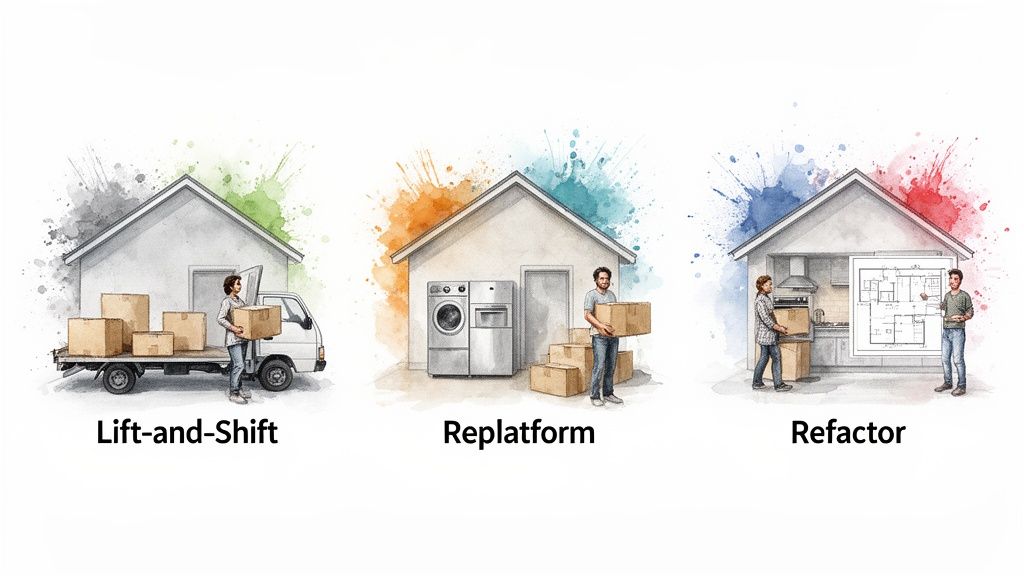
Think of it like deciding how to move your household. Are you just packing everything into boxes and moving it as-is? Or are you taking this as a chance to renovate the kitchen in your new place? Each option has different costs, requires a different level of effort, and leads to a very different outcome. Getting these paths straight is the first step toward a smart conversation with any potential partner.
1. Rehosting: The Lift-and-Shift Model
Rehosting, better known as “lift-and-shift,” is the most direct route. It’s like packing up your entire house and moving it to a new one without changing a single thing. Your applications and data are moved over to the cloud with almost no modifications.
This approach is usually the fastest and has the lowest upfront cost. It’s a great choice for businesses that need to get out of a data center lease quickly or for those with legacy applications that would be a nightmare to rewrite. The main goal here is speed, not modernization.
2. Replatforming: The Lift-and-Tinker Approach
Replatforming takes the lift-and-shift idea one step further. Imagine moving your household but deciding to swap out your old, inefficient stove for a modern one. You’re not remodeling the whole kitchen, just making a few key upgrades along the way.
In a replatforming project, you might move an application to the cloud and, at the same time, switch from a database you manage yourself to a managed cloud database service. This lets you tap into some immediate cloud benefits—like better performance and less maintenance—without the massive effort of a full redesign.
The application’s core architecture stays the same, but you selectively tweak certain components to work better in a cloud environment. It’s a solid balance between the speed of rehosting and the perks of modernization.
As you start shaping your migration strategy, it helps to learn from those who have done it before. Digging into these 10 Cloud Migration Best Practices can give you a much stronger foundation to build on.
3. Refactoring: The Full Remodel
Refactoring is the most intensive strategy of all. This is the full kitchen remodel, where everything is redesigned for peak performance. It involves completely re-architecting your application to be cloud-native, allowing you to take full advantage of features like serverless computing and microservices.
While this path demands the biggest investment in time and money, it also delivers the greatest long-term value. Refactored applications are more scalable, resilient, and cheaper to run down the road. It’s the go-to choice for mission-critical apps where performance and innovation are everything.
4. Repurchasing: Moving to a New Platform
Sometimes, the smartest move isn’t to bring your old software with you at all. Repurchasing means ditching an existing application—often a clunky, on-premise CRM or HR system—and switching to a modern, cloud-based Software-as-a-Service (SaaS) product.
This move completely eliminates the headache of managing the old application. It’s a strategic shift from a custom-built solution to a managed service that simply works better for your business today.
5. Retaining and Retiring: The Final Decisions
Not everything you own has to make the trip to the cloud. Part of any good strategy is deciding what to leave behind.
- Retaining: This means you intentionally keep certain applications on-premise. You might do this because of strict regulatory rules, dependencies that make migration too expensive, or simply because an application is working perfectly fine right where it is.
- Retiring: A cloud migration is the perfect time for some house cleaning. It’s an opportunity to identify and shut down applications that are no longer being used. Retiring obsolete systems cuts down on complexity and frees up resources for projects that actually matter.
Understanding these six strategies gives you the power to define what a successful move looks like for your business. A quality USA-based outsourcing partner can help you comb through your application portfolio and pick the right strategy for each piece of your tech stack. For a direct consultation to build your custom playbook, give us a call at +1 (310) 800-1398.
A Framework for Vetting Cloud Migration Partners
Picking a cloud migration partner is one of the most important calls you’ll make on your journey to the cloud. The right partner becomes a true extension of your team, guiding you through the complexities. The wrong one? That path is paved with blown budgets, security holes, and endless delays.
To see past the slick sales pitches, you need a solid evaluation framework.
Think of it like hiring a general contractor to build your dream home. You wouldn’t just look at a glossy brochure and sign a contract. You’d check their license, visit past projects, and call their former clients. Vetting a cloud partner demands the same level of diligence—a deep look into their technical chops, real-world experience, and operational promises.

Assessing Technical Expertise and Platform Fluency
First things first: does the provider actually know what they’re doing? A top-tier partner needs deep, certified expertise across the major cloud platforms, because each one has its own quirks and strengths. Expertise on platforms like AWS, Azure, and Google Cloud is crucial.
The most common migration strategy, a “lift-and-shift” rehost, makes up 35.4% of all projects. Even this seemingly simple approach requires specialized skills to pull off without a hitch.
Make sure your evaluation confirms the provider has:
- Certified Professionals: Are their people certified? Look for credentials like AWS Certified Solutions Architect or Microsoft Certified Azure Solutions Architect Expert for the platform you’re targeting.
- Proven Methodologies: Ask them to walk you through their migration process. Do they have a structured framework for assessment, planning, execution, and optimization? Or do they just wing it?
- Automation and Tooling: What tools are in their toolbox? The best partners use automation to speed up timelines and cut down on human error.
Verifying Track Record and Industry Experience
Technical skills on paper are one thing; a proven track record is another. The most dependable cloud migration service providers will be an open book, ready to share their success stories and client wins. This is how you separate the seasoned pros from the newcomers.
Ask for detailed case studies and don’t be shy about requesting client testimonials. Zero in on projects that look like yours—similar in size, complexity, and industry. A partner who has navigated dozens of migrations for financial services firms will already be fluent in the strict security and compliance rules of that world. That’s experience you can’t buy.
A provider’s past performance is the best predictor of your future success. Don’t just take their word for it; ask for references and speak directly with past clients to get an unfiltered perspective on their project management, communication, and problem-solving abilities.
For a data-driven look at potential partners, a guide to the best cloud migration companies can provide some valuable comparisons.
Scrutinizing SLAs and Compliance Certifications
Finally, it’s time to get into the weeds of the contract. The service level agreements (SLAs) and compliance certifications are where the promises meet reality. These details define the provider’s accountability and their ability to protect your data.
A Service Level Agreement (SLA) is your safety net. It must clearly define metrics for uptime, performance, and support response times. Read the fine print: What happens if they fail to meet those guarantees? A strong SLA with real penalties shows a provider has skin in the game and is confident they can deliver.
Compliance certifications are equally critical. Depending on your industry, you can’t afford to partner with someone who isn’t compliant. Key certifications to look for include:
- SOC 2: Proves a service organization can securely manage data to protect client privacy and interests.
- HIPAA: A must-have for any organization handling protected health information (PHI) in the healthcare space.
- ISO 27001: The international gold standard for information security management.
Choosing a USA-based outsourcing partner often adds another layer of assurance, providing clear legal recourse and alignment with domestic data privacy standards. This simplifies compliance and strengthens your security posture. For direct consultation on your migration needs, call +1 (310) 800-1398.
Why a US-Based Partner Can Be a Game-Changer
In a global marketplace, it’s easy to think the location of your cloud migration partner doesn’t matter. As long as they have the technical chops, what’s the difference? Well, as it turns out, the difference can be huge. While talent is global, choosing a partner right here in the USA offers some very real, practical advantages that have a direct line to your project’s success, security, and your own peace of mind.
This isn’t about patriotism. It’s about practicality. It’s about partnering with a team that operates under the same business culture, speaks the same language (literally and figuratively), and is governed by the same laws as you are.
Seamless Collaboration and Communication
Let’s start with the most immediate, day-to-day benefit: killing communication friction. When your migration partner is in the same or an adjacent time zone, collaboration just flows. You can say goodbye to late-night calls and waiting a full day for an email response to a critical question.
This alignment means your teams can actually work together in real-time. A problem that pops up in the morning can be on a call and getting solved by the afternoon. This creates a far more agile, responsive project environment and stops the kind of communication lag that can quietly derail a complex migration, pushing your timeline off track.
It goes deeper than just scheduling, though. There’s a shared cultural context that removes all sorts of subtle, yet significant, hurdles. A US-based team gets the nuances of American business etiquette, how we communicate, and what the market expects. That built-in understanding builds a stronger, more intuitive partnership, cutting down on misunderstandings and building trust that much faster.
Robust Security and Legal Protections
When you work with a US-based provider, your data and intellectual property are shielded by one of the most robust legal frameworks in the world. US laws around data privacy, security, and corporate accountability are stringent, giving you a level of assurance that’s often hard to guarantee with an offshore partner.
This means you have clear legal recourse if a dispute or, heaven forbid, a breach ever occurs. Trying to navigate international legal systems can be a costly, complicated nightmare. A US-based contract keeps you on familiar legal ground, which simplifies compliance and shores up your security from day one.
Partnering with a domestic provider places your critical assets under the protection of U.S. law, offering a reliable safeguard for your data and intellectual property throughout the migration process. For businesses in regulated industries, this legal alignment isn’t just a nice-to-have; it’s a must-have.
Access to a Premier Talent Pool
The United States is home to a world-class pool of talent at the absolute forefront of cloud technology. By choosing a domestic partner, you’re plugging into highly skilled architects, engineers, and project managers who have deep, hands-on experience with platforms like AWS, Azure, and Google Cloud.
This top-tier talent brings more than just technical know-how. It brings a culture of quality and accountability. A US-based team is directly accountable for the project’s outcome, fostering a sense of ownership that is critical for success. This blend of elite skills and direct responsibility ensures your migration isn’t just finished, but executed to the highest possible standard.
Think of it as an investment in a smoother, more secure, and ultimately more successful cloud journey. For a direct conversation about how a US-based team can help with your specific migration, give us a call at +1 (310) 800-1398.
Your Vendor Selection Checklist and Project Roadmap
Alright, let’s move from ideas to action. Staring at a long list of cloud migration service providers can feel like you’re lost in a forest. But with the right map, you can turn a complicated decision into a clear, straightforward process.
Think of what follows as your blueprint for finding a partner you can actually trust. You wouldn’t build a house without a detailed plan, right? The same goes for your cloud migration. A solid framework for evaluation and a realistic timeline gets everyone on the same page from day one and keeps expectations grounded in reality.
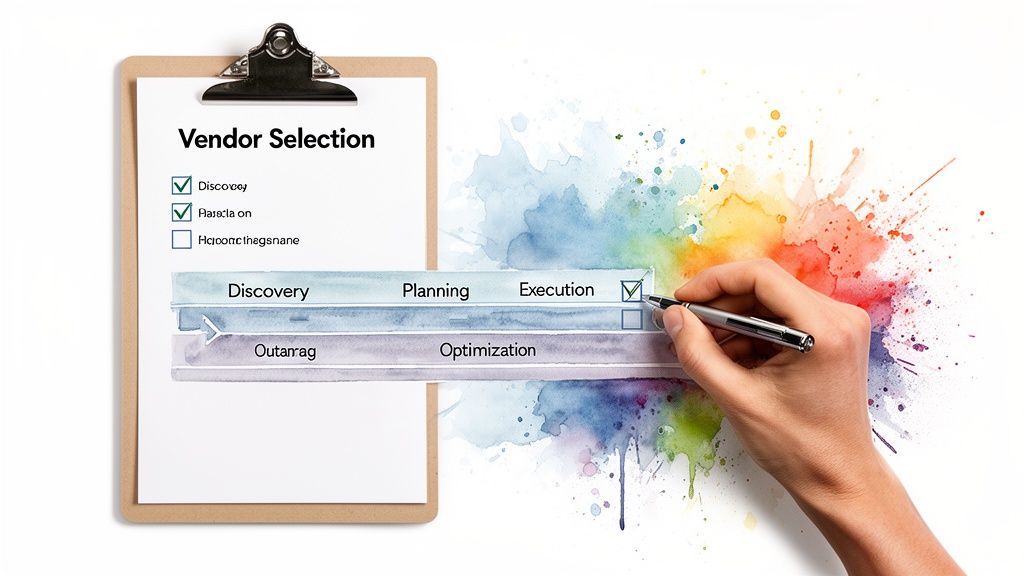
The Vendor Selection Checklist
Use this checklist to cut through the noise and evaluate potential providers methodically. It’ll help you organize your thoughts, ask the right questions, and compare vendors on an even playing field.
1. Define Internal Requirements
- Business Goals: Get specific. What are you trying to achieve? Is it about cutting operational costs, gaining the ability to scale on demand, or tightening up security?
- Technical Needs: What applications are you moving? Map out their dependencies and performance needs. Not everything needs the same white-glove treatment.
- Budget: Set a clear budget range. Remember to account for both the one-time migration costs and the ongoing monthly expenses in the cloud.
2. Initial Research and Shortlisting
- Identify Potential Partners: Cast a wide net initially, then narrow it down to a list of 5-7 promising cloud migration service providers based on their reputation and the services they offer.
- Review Case Studies: Don’t just read the headlines. Dig into case studies from companies in your industry or those who have faced similar technical hurdles. This is where you find the proof.
- Verify Certifications: Make sure they have the right credentials for your chosen cloud platform (AWS, Azure, etc.) and any compliance standards you need to meet, like SOC 2 or HIPAA.
3. Conduct Due Diligence and RFPs
- Submit a Request for Proposal (RFP): Send your shortlisted vendors your requirements document and ask for a detailed proposal. This forces them to show you how they’d solve your problem.
- Ask Probing Questions: Go beyond the sales pitch. Ask about their migration methodology, their project management style, and—most importantly—who from their team would actually be working on your project.
- Check References: Talk to 2-3 of their past clients. This is your chance to get unvarnished feedback on how they communicate, solve problems when things go wrong, and perform under pressure.
The reference check is your most powerful tool. It cuts through the sales pitch and gives you an unfiltered look at what it’s really like to work with the provider. This is where you uncover their real-world capabilities and how they treat customers when the going gets tough.
4. Final Evaluation and Negotiation
- Compare Proposals: Lay the proposals side-by-side. Evaluate them against your requirements, paying close attention to the proposed solution, the timeline, the cost breakdown, and the SLAs.
- Negotiate the Contract: Bring in your legal team. Scrutinize the Master Service Agreement (MSA) and Statement of Work (SOW) to ensure every promise is documented in black and white.
- Final Selection: Choose the partner that aligns best with your technical needs, business goals, and, just as importantly, your company culture. This is a partnership, after all.
A Sample Project Roadmap
Understanding a typical migration timeline helps set realistic expectations for the journey ahead. While every project has its own quirks, most follow a similar path. Here’s a look at what you can generally expect for a small to mid-size business migration.
Sample Cloud Migration Project Timeline
| Phase | Key Activities | Estimated Duration |
|---|---|---|
| 1. Discovery & Assessment | Inventory applications, analyze dependencies, define migration strategy, and establish KPIs. | 2–4 Weeks |
| 2. Planning & Design | Create a detailed migration plan, design the target cloud architecture, and finalize the security and compliance framework. | 3–6 Weeks |
| 3. Execution & Migration | Build the cloud environment, migrate applications and data in waves, and conduct thorough testing. | 4–12 Weeks |
| 4. Optimization & Handover | Monitor performance, optimize for cost and efficiency, train your internal team, and formally hand over operations. | 2–4 Weeks |
This roadmap gives you a solid framework, but the right partner can make all the difference in keeping things on track.
Engaging a USA-based outsourcing partner can often streamline this timeline. Shared time zones and cultural alignment foster quicker communication and decision-making, keeping the project moving forward without delays. To discuss your project roadmap with an expert, call us today at +1 (310) 800-1398.
Your Top Cloud Migration Questions, Answered
Jumping into a cloud migration project always kicks up a lot of questions. It’s a big move, and leaders need straight answers about costs, security, and what it all means for day-to-day operations before signing off. This section cuts through the noise to tackle the most common concerns we hear when people are vetting cloud migration service providers.
What Are the Most Common Hidden Costs in a Cloud Migration Project?
It’s easy to focus on the provider’s fees and the monthly cloud bill, but other expenses can pop up and catch you by surprise. A good partner will be upfront about these from day one, but it pays to have them on your radar.
Keep an eye out for these common “gotchas”:
- Data Egress Fees: These are the tolls you pay to move data out of a cloud. You might not be planning to leave, but if you’re running a hybrid setup or moving data between clouds, these fees can add up.
- Third-Party Software Licensing: That software license you have for your on-premise servers? It might not work the same way in the cloud. You could face unexpected fees or need to buy entirely new, cloud-ready licenses.
- Specialized Security Tools: Your new cloud home might need extra security layers that weren’t in the original budget, like sophisticated threat detection or tools to keep you compliant with industry regulations.
- Post-Migration Optimization: The job isn’t done once you’ve moved. There’s often fine-tuning needed to make sure your new environment is running efficiently and not costing you more than it should.
- Internal Team Training: This is a big one that’s easy to overlook. Your team needs to learn how to manage and operate in this new cloud world, and that training comes with a cost.
A provider worth their salt will bring these potential costs up during the discovery phase. Financial transparency isn’t just a buzzword; it’s a sign of a trustworthy partner who wants to prevent budget blowouts.
How Does a Service Provider Ensure Our Data Is Secure During Migration?
For any reputable cloud migration provider, protecting your data is job number one. They do this with a multi-layered security strategy that shields your information at every single stage of the move.
Think of it like an armored car convoy. Your data isn’t just tossed in the back of a van; it’s protected from every angle, every mile of the journey.
Security isn’t a one-time checklist. It’s a constant process. The best providers use a defense-in-depth approach, combining encryption, secure network connections, strict access controls, and non-stop monitoring to build a fortified tunnel for your data on its way to the cloud.
This process starts by encrypting your data both in transit (while it’s traveling over the network) and at rest (once it’s safely stored in the cloud). They’ll set up secure, private connections—often using VPNs or dedicated lines—to keep it far away from the public internet. Access is then locked down with Identity and Access Management (IAM) policies, making sure only the right people can touch sensitive information. Finally, they’re watching everything with continuous security audits and real-time monitoring to spot and stop threats before they become problems.
How Much Involvement Is Needed from My In-House IT Team?
This really depends on how you want to work with your cloud migration service provider. You have options.
In a fully managed migration, the provider does almost all of the heavy lifting. Your team’s main job is to provide key info about your current systems, explain what the business needs, and give the final thumbs-up at major project milestones.
On the other hand, a co-managed model is more of a partnership. Your IT team works right alongside the provider’s experts. This is a fantastic way to transfer knowledge and upskill your own people, getting them fully prepped to manage the new environment once the migration is complete. A great provider will clearly outline who is responsible for what right at the start to ensure everything runs smoothly. Either way, your team’s knowledge of application dependencies and their role in user acceptance testing (UAT) will be absolutely essential.
How Is Business Downtime Handled During the Migration?
Minimizing—or even eliminating—downtime is a top priority. Providers use several battle-tested strategies to make the transition as seamless as possible without disrupting your business.
While massive enterprises make up 62% of the cloud migration market, it’s the small and mid-size enterprises (SMEs) that are growing the fastest. For an SME, uptime is everything. Outsourcing migrations for business processes like payroll or data entry is a popular way for SMEs to streamline, and in those cases, downtime simply isn’t an option. Learn more about these market trends and their implications for SMEs.
For many applications, a “live migration” is the way to go. This means your data is synced to the cloud in real-time while your on-premise system keeps running as usual. The final cutover is then scheduled for a quiet period, like a weekend or overnight, and often takes just a few minutes. For mission-critical systems that can’t afford a single second of interruption, providers can set up a high-availability or failover environment in the cloud, guaranteeing a zero-disruption switch. This detailed cutover plan is always a core part of the migration strategy you’ll approve before any work starts.
Choosing a USA-based outsourcing partner can add an extra layer of security here. When time zones are aligned, communication is seamless. If anything unexpected happens during that critical cutover window, it can be handled immediately, giving you peace of mind and accountability when you need it most.
Ready to get clear, expert answers to your specific cloud migration questions? The team at NineArchs LLC is here to provide a detailed consultation tailored to your business needs. Call us today at +1 (310) 800-1398 or visit our website to learn more about our services.