
For a small or medium-sized business, “digital marketing” can feel like a vague, intimidating term. Let’s cut through the noise. At its core, it’s about using online channels—like search engines, social media, and email—to find and connect with the right customers in a way that’s both measurable and affordable. It’s how you move beyond just hoping for growth and start building a predictable engine to drive it.
Building Your Digital Marketing Foundation

Jumping into digital marketing without a solid plan is like setting sail without a map. Sure, you’re moving, but are you heading toward your destination or just deeper into the unknown? For SMEs, every dollar and every hour is precious. A documented strategy is non-negotiable; it’s what turns random acts of marketing into a cohesive, goal-oriented system that actually works.
The data doesn’t lie. Marketers with a clear, documented plan are a staggering 397% more likely to report success. Yet, a surprising 42% of businesses are still flying blind, operating without a defined strategy and wondering why they’re struggling to generate traffic and leads. A clear plan makes all the difference.
Define Your Ideal Customer Profile
Before you write a single ad or post, you have to know exactly who you’re talking to. And I mean really know them, far beyond basic demographics like age or location. You need to build an Ideal Customer Profile (ICP) based on what actually drives their buying decisions.
Get granular with these questions:
- What specific problem are you solving for them? Go deeper than the surface. Think about their daily frustrations, their biggest headaches, and their ultimate aspirations.
- Where do they hang out online? Are they scrolling through Instagram, networking on LinkedIn, or geeking out on niche industry blogs? Your marketing needs to meet them where they already are.
- What’s the final push that makes them buy? Is it a specific pain point that finally becomes unbearable? A glowing recommendation from a friend? A seasonal need they can no longer ignore?
Answering these questions is the key to creating messaging that truly connects. It ensures your efforts reach the right people with a message that makes them feel understood.
Set SMART Goals Tied to Revenue
Vague goals like “increase brand awareness” are impossible to measure and a fast track to wasted money. Every single marketing goal you set needs to be SMART: Specific, Measurable, Achievable, Relevant, and Time-bound. More importantly, it must connect directly to your bottom line.
A great marketing goal isn’t just about getting more followers or likes. It’s about acquiring customers who actually grow your revenue. When you tie your efforts to clear financial outcomes, every campaign is held accountable for its performance.
For example, instead of a fuzzy goal like “get more website traffic,” a SMART goal sounds like this: “Increase qualified organic website traffic by 15% in the next quarter, with the aim of boosting demo requests by 10%.” This simple shift frames marketing as a direct contributor to business growth, not just another expense. A cornerstone of making this happen is mastering SEO for small business, which is designed to drive exactly this kind of targeted traffic.
Find Your Unique Space in the Market
Good news: you don’t have to outspend your competition to outperform them. You just have to be smarter. The key is to understand the market landscape and identify where you can provide unique value. This is where you’ll find your opening.
Look for gaps in the market, underserved customer segments, or channels that others have overlooked. This analysis helps you carve out a Unique Selling Proposition (USP) that becomes the heart of your marketing message. By the end of this process, you’ll have a documented roadmap that aligns every single marketing action with your core business objectives.
When your internal team is already stretched thin, trying to build this strategic foundation can feel like one more impossible task. This is where partnering with a US-based outsourcing firm can be a game-changer, providing the specialized expertise to get it right from day one. A US partner ensures seamless communication and a deep understanding of the local market, setting your strategy up for success.
To explore how we can help, call us today at +1 (310) 800-1398.
Choosing the Right Digital Marketing Channels
Alright, you’ve nailed down who you’re talking to. Now, where do you find them? The digital world is packed with channels, and the biggest mistake any small business can make is trying to be everywhere at once.
Spreading your limited resources too thin is a surefire way to make zero impact. You end up with a half-hearted effort on five platforms instead of a winning strategy on one or two.
The goal isn’t universal coverage; it’s a strategic presence. Pick a few key channels where your ideal customers are already hanging out, and go deep. This focus lets you execute flawlessly, get clean data on what’s working, and see a much healthier return on your investment.
SEO and Content: The Long-Term Growth Engine
Think of Search Engine Optimization (SEO) as a core business asset, not just another marketing task. When you optimize your site and create genuinely helpful content that solves your customers’ problems, you start attracting organic traffic from people who are actively looking for what you sell.
It’s a slow burn, for sure. SEO doesn’t deliver results overnight. But the momentum you build is sustainable and incredibly cost-effective in the long run.
A simple, practical content plan for an SME could look like this:
- Pillar Blog Posts: Write comprehensive guides on the big-picture topics your customers are searching for. This builds your authority and gives you a central piece of content to link back to.
- Local SEO Focus: If you’re a local business, your Google Business Profile is your best friend. Optimize it completely to show up for “near me” searches in your area.
- Helpful How-To Articles: Zero in on the common pain points and questions your customers have. Answering them builds trust and positions you as the go-to expert.
The beauty of this approach? A paid ad stops working the second you turn off the budget. A well-ranked blog post can bring you qualified leads for years. It’s the closest thing to an appreciating asset in digital marketing.
PPC: When You Need Immediate Impact
While SEO is your long game, Pay-Per-Click (PPC) advertising is how you get results today. Platforms like Google Ads put your business right in front of potential customers at the precise moment they’re searching for your services. For driving immediate leads and sales, it’s hard to beat.
Imagine a local plumber running a targeted Google Ad campaign. Their business shows up at the very top of the search results the moment someone in their city types “emergency plumbing repair” into their phone. That’s powerful. The trick is to be hyper-specific with your keywords, ad copy, and targeting to make sure you’re paying for qualified clicks, not just random traffic.
Social Media and Email for Building Relationships
Social media isn’t just for mega-brands with huge followings. For a small business, it’s a direct line to your community. But please, don’t try to master every platform. The secret is to find the one or two networks where your ideal customers actually spend their time.
If you’re a B2B service provider, that’s probably LinkedIn. If you sell a highly visual product, Instagram or Pinterest is likely your sweet spot.
Social media success for a small business isn’t about going viral. It’s about consistent, authentic engagement that builds a loyal community and turns followers into advocates.
Once you’ve captured someone’s interest, email marketing is how you nurture that connection. Email is still one of the most powerful tools in the box because it’s a channel you own. For great strategies, check out these B2B email marketing best practices. It’s your personal space to deliver value, share promotions, and guide leads toward becoming loyal buyers.
Juggling SEO, PPC, social media, and email can quickly feel like a three-ring circus for a small team. This is where partnering with a US-based outsourcing firm can be a game-changer. You get access to specialists in each area without the overhead of hiring a full in-house team. A US-based partner gets your market, communicates clearly, and helps you execute a multichannel strategy that actually works.
To see how we can help you build and manage your channel strategy, give us a call at +1 (310) 800-1398.
Using Social Media and AI for Smarter Marketing

Not too long ago, advanced marketing tools felt like they were locked away in a high tower, reserved only for corporations with massive budgets. That’s not the world we live in anymore. Social media and artificial intelligence (AI) have completely changed the game, giving small and medium-sized businesses a powerful arsenal to connect with customers and grow without breaking the bank.
These aren’t just buzzwords to throw around in meetings; they’re foundational parts of modern digital marketing for smes. When you get them right, you can automate the tedious stuff and uncover insights that were once impossible to find, letting your small team make a huge impact. It’s all about working smarter.
Building an Engaging Social Media Presence
A killer social media presence isn’t built on random posts and hoping for the best. It’s built on a plan. The secret weapon here is a content calendar—a simple map of what you’ll share, when you’ll share it, and most importantly, why it matters to your audience. This turns social media from a daily headache into a strategic growth engine.
Your calendar should be a healthy mix of content designed to get people talking, learning, and eventually, buying.
- Educational Posts: Share quick tips, answer common questions, or pull back the curtain on your industry. This shows you know your stuff and builds serious trust.
- Promotional Content: Got a new product or a special offer? Shout it out. Just don’t let salesy posts take over your feed.
- Community Engagement: Ask questions, run polls, and actually respond to comments. This shows there’s a real person behind the brand and helps build a loyal following.
The real magic, though, is in the analytics. Every platform has built-in tools that tell you what’s working—which posts get the most love, when your followers are online, and who they are. Use that data to do more of what works and ditch what doesn’t. If you want to dig deeper, our guide to social media marketing is a great place to start.
Harnessing AI to Amplify Your Efforts
Artificial intelligence sounds intimidating, but for SMEs, it’s become a surprisingly accessible and powerful partner. Affordable AI tools are here to take the time-sucking tasks off your plate, freeing you up to focus on big-picture strategy and building real relationships with your customers.
For example, AI writing assistants can whip up first drafts of blog posts, social media updates, or email campaigns in a matter of minutes. Other tools can dive into your ad campaigns, tweaking bids and targeting on the fly to squeeze more value out of every dollar you spend.
AI isn’t here to replace the human touch in your marketing; it’s here to supercharge it. By handling the heavy lifting of data analysis and content creation, it frees you up to be more creative, strategic, and responsive.
Even your customer service can get an upgrade. Simple chatbots can be set up on your website to answer common questions 24/7. This means your customers get instant help, even at 2 AM, creating a better experience and capturing leads you might have otherwise missed.
The Power of Outsourcing Social Media Management
There’s no denying it: social media is a giant for SME marketing. A staggering 92% of businesses worldwide use it for promotion, and 78% say it’s boosted their brand recognition. What’s really interesting is that 51% of small businesses already outsource some of their social media work—a perfect scenario for BPO firms and virtual assistants who can handle everything from community engagement to data entry. You can see more stats on the growth of social media marketing on MarketingLTB.
When your team is already stretched thin, adding social media management and new AI tools to the to-do list can feel impossible. That’s where bringing in an outsourcing partner can be a game-changer, especially a US-based firm that gets the market, the culture, and communicates seamlessly. They can take over your content calendar, engage with your community, and even help you set up and monitor your AI-driven campaigns.
By outsourcing these functions, you get instant access to specialized skills without the overhead of a full-time hire. This lets you scale your marketing efforts, innovate faster, and keep your focus where it belongs: on growing your business.
To talk about how an outsourcing partner can amplify your social and AI marketing, give us a call at +1 (310) 800-1398.
Measuring What Matters for Your SME
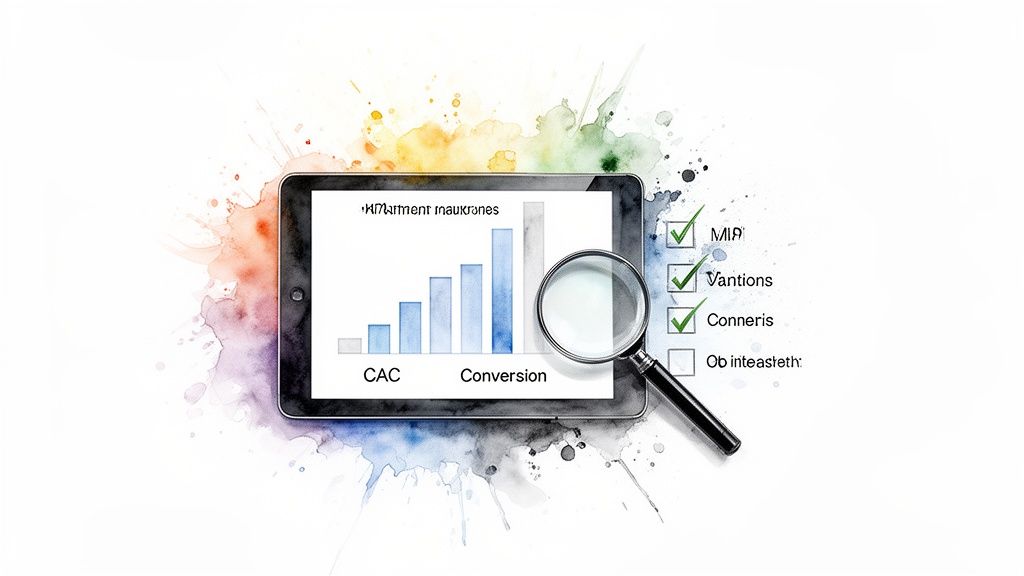
Running a digital marketing campaign without measuring it is like driving with your eyes closed. You might be moving, sure, but you have no idea if you’re heading toward your destination or careening off a cliff. For SMEs, where every dollar has a job to do, guessing isn’t a strategy. It’s time to tune out the noise from vanity metrics and dial in on the numbers that actually grow your business.
So, what are vanity metrics? They’re the numbers that look impressive but don’t actually move the needle—think page likes or total follower counts. It’s nice to have a big audience, but those numbers don’t pay the bills. The real story of success in digital marketing for smes is told by Key Performance Indicators (KPIs) that connect directly to your bottom line.
Setting Up Your Measurement Toolkit
You don’t need a massive, expensive suite of tools to get started. In fact, one of the most powerful platforms out there is completely free. Getting Google Analytics set up is non-negotiable. It’s your first, best step for tracking website traffic, understanding how people behave on your site, and seeing which channels are sending you the most valuable visitors.
Once it’s running, you can see exactly how people find you, what pages they linger on, and where they decide to leave. This data is the foundation for making smart decisions instead of just going with your gut. It’s what separates marketing that works from effort that’s just wasted.
KPIs That Directly Impact Your Bottom Line
To really get a grip on your marketing’s effectiveness, you have to zero in on the metrics tied to revenue and growth. These are the numbers that paint a clear picture of your return on investment.
Here are a few essential KPIs every SME should be tracking:
- Customer Acquisition Cost (CAC): This is your total marketing and sales spend divided by the number of new customers you brought in over a specific period. It answers a simple but vital question: How much does it cost us to win a new customer?
- Conversion Rate: This is the percentage of visitors who take the action you want them to, whether it’s making a purchase, filling out a form, or signing up for your newsletter. A healthy conversion rate means your messaging and website are doing their job turning traffic into tangible results.
- Customer Lifetime Value (CLV): This metric forecasts the total revenue you can expect from a single customer over the entire course of your relationship. Knowing your CLV is critical because it tells you exactly how much you can afford to spend on acquiring new customers while still staying profitable.
Focusing on CAC and CLV forces you to see marketing not as an expense, but as an investment. The goal is simple: ensure the value of a customer (CLV) is significantly higher than the cost to acquire them (CAC).
Adopting a Mindset of Continuous Improvement
Data is only useful if you do something with it. One of the simplest, most powerful ways to act on your insights is through A/B testing. This is where you create two versions of something—an ad, a landing page, an email subject line—with one small difference to see which one performs better. Maybe you test a red “Buy Now” button against a green one. The winner gets rolled out.
This mindset of constant testing and refinement is what turns your marketing budget into a powerful growth engine. Of course, managing analytics, running tests, and interpreting all that data can feel like a full-time job. For many SMEs, this is a perfect area to outsource. A US-based partner brings clear communication and a deep understanding of the market, delivering actionable insights that sharpen your strategy.
To learn how an outsourcing partner can transform your marketing measurement, call us at +1 (310) 800-1398.
Growing Pains? How to Scale Your Marketing with a US-Based Partner
Sooner or later, every growing business hits a wall. You know exactly what needs to be done—more content, smarter ads, a deeper dive into analytics—but your team is already stretched thin. This is the inflection point where scaling becomes less of a buzzword and more of a necessity. But it doesn’t always mean hiring another full-time employee.
Partnering with an outsourcing firm can be the smartest way to punch through that ceiling without the heavy overhead of a bigger in-house team.
The thought of outsourcing can be a bit nerve-wracking, I get it. But finding the right partner changes everything. For most companies I’ve worked with, a US-based partner isn’t just a convenience; it’s a strategic advantage. They operate in your time zone, which kills the frustrating communication lags that can bring a project to a screeching halt.
More importantly, they get it. They have an instinctual grasp of the local market, how American consumers think, and the cultural shorthand that makes or breaks digital marketing for smes. This alignment ensures your message lands perfectly, without anything getting lost in translation.
What to Hand Off for the Biggest Impact
The first real decision is figuring out what to delegate. The goal here is to offload the tasks that are either incredibly time-consuming, require niche skills your team doesn’t have, or can be turned into an efficient, repeatable process. This frees up your core people to focus on big-picture strategy and building customer relationships—the stuff that actually moves the needle.
Here are a few of the marketing functions that are perfect for outsourcing:
- Content Creation and Management: Think blog posts, social media updates, and email newsletters. A good partner can deliver a steady stream of high-quality content that keeps your audience hooked.
- Social Media Management: This goes way beyond just scheduling posts. It’s about engaging with your community, responding to comments, and keeping an eye on brand mentions.
- PPC and Ad Campaign Management: Running paid ad campaigns is a full-time job of monitoring and tweaking. It’s an ideal task to hand over to a specialized team.
- Data Entry and Reporting: This is the unglamorous but critical work of compiling campaign data, keeping the CRM updated, and creating performance reports that give you clear, actionable insights.
By handing off these responsibilities, you essentially get a team of specialists for less than what it costs to hire a single new person. This model gives you the agility to ramp your marketing efforts up or down as needed—a flexible, cost-effective way to grow.
How to Weave a Partner into Your Workflow
Bringing an outside team into your day-to-day requires a clear plan. The secret is to treat your partner not like a vendor, but as a genuine extension of your team. Start by setting up solid communication channels, whether that’s a dedicated Slack channel, regular video check-ins, or a shared project management tool.
Next, get good at writing detailed briefs for every task. A solid brief lays out the goal, the target audience, the key message, and what success looks like. This simple piece of documentation cuts down on endless back-and-forth and gets everyone on the same page from day one. Finally, lock in your Key Performance Indicators (KPIs) and a reporting schedule to track progress and measure what’s working.
Partnering with a US-based firm just makes this whole process smoother. With shared cultural norms and business etiquette, the collaboration feels natural. You can plug them into your workflow with less friction and get to productivity faster.
The modern SME is all about using technology to compete. It’s wild to think that 88% of small businesses are now using AI tools, with 73% saying these tools have made them more competitive. With 91% of SMEs marketing on multiple platforms, outsourcing the complex digital tasks lets them scale their efforts without breaking a sweat, freeing up their internal teams to focus on growth. You can dig into more of this data on how SMEs are using AI to grow on sbecouncil.org. A savvy partner can help you implement and manage these tools to get the most out of them.
Ultimately, outsourcing your digital marketing isn’t about giving up control. It’s about gaining capacity. It’s a strategic play that gives you the specialized skills and horsepower you need to execute a powerful marketing plan, letting you get back to what you do best: running your business.
To see how NineArchs can augment your team and help you scale intelligently, call us at +1 (310) 800-1398 today.
Got Questions? Let’s Clear Things Up.
Stepping into digital marketing can feel like learning a new language. Suddenly, you’re juggling acronyms, weighing channel options, and trying to make sense of it all on a tight budget. It’s no surprise that most small business owners we talk to have the same core questions.
These aren’t just random queries; they’re the real-world hurdles every SME faces when trying to grow. Let’s tackle them head-on and get you some straight answers so you can move forward with confidence.
How Much Should My Small Business Actually Budget for Marketing?
Look, there’s no magic number, but a solid rule of thumb is to earmark 7-10% of your total revenue for marketing. If you’re a newer business trying to carve out your space, you’ll probably need to be more aggressive, pushing that figure closer to 12-15% just to get the engine started.
But here’s what really matters: don’t just pick a percentage and spread it thin across a dozen different ideas. That’s a recipe for disappointment.
Instead, start with a budget that lets you go deep on one or two channels. Focus your firepower. Maybe it’s local SEO and a killer content strategy. Prove you can get a return on that investment, and then scale up. Smart growth is about making focused bets, not sprinkling cash everywhere and hoping for the best.
Which Marketing Channel Gives the Best Bang for My Buck?
This is the million-dollar question, isn’t it? The honest answer is, “it depends.” It depends on your industry, what you’re selling, and most importantly, who you’re selling it to.
That said, some channels just consistently punch above their weight for small businesses.
If you’re playing the long game for sustainable, profitable growth, Search Engine Optimization (SEO) is almost always the winner. Why? Because once you earn those top rankings for your keywords, you get a steady stream of high-intent traffic without paying for every single click. It’s an asset you build over time, and it pays dividends for years.
But what if you need leads right now? If you’re a service business that needs the phone to ring or an e-commerce store launching a new product, targeted Pay-Per-Click (PPC) ads are your best friend. A well-built Google or social media ad campaign puts you directly in front of someone at the exact moment they’re searching for what you offer. It’s immediate and incredibly powerful.
The smartest play is rarely an “either/or” choice. It’s about blending the long-term asset building of SEO with the short-term lead generation of PPC. When they work together, they create a growth engine that’s tough to beat.
When Should I Think About Outsourcing My Digital Marketing?
The tipping point usually looks like one of two things.
First, you’re spending more time trying to be a marketer than you are running your actual business. When marketing tasks start pulling you away from what you do best, it’s time for a change.
Second, you’ve hit the ceiling of your own expertise. You know you need to be running sophisticated ad campaigns or diving deep into technical SEO, but you just don’t have the skillset in-house. That’s the moment to bring in reinforcements.
Outsourcing isn’t admitting defeat; it’s a strategic power-up. You get instant access to a whole team of specialists for less than the cost of hiring one full-time marketing manager. It’s the fastest way to amplify your efforts and get results.
Does It Matter if I Hire a USA-Based Partner?
Absolutely. Choosing a US-based outsourcing firm isn’t just about patriotism; it’s a massive strategic advantage. The most obvious benefit is seamless communication. When your partner is in the same time zone (or a close one), you’re collaborating in real-time. No more waiting 24 hours for a simple answer. They feel like a true extension of your team because, functionally, they are.
Beyond logistics, a US-based partner just gets it. They have an innate understanding of the American market, local consumer behavior, and the cultural nuances that make marketing connect. This isn’t something you can easily teach.
This cultural fluency means your brand’s voice will sound authentic and your campaigns will actually resonate. You avoid the awkward, tone-deaf mistakes that can happen when messaging gets lost in translation. It’s more than convenience—it’s about having a partner who is strategically aligned with your customers.
Ready to scale your marketing without the overhead? NineArchs LLC provides specialized BPO and virtual assistant services to augment your team and drive growth. Let us handle the details so you can focus on your business.
Call us for a consultation at +1 (310) 800-1398 or learn more about our solutions.