

For most entrepreneurs, “IT support” is what you call when something breaks. It’s a line item in the budget, a necessary evil you pay for when things grind to a halt. But this break-fix mindset misses the entire point.
Good IT support isn’t about fixing things. It’s about building the high-performance engine that powers your business forward, keeps you secure, and gives you a strategic advantage. When you treat technology right, it stops being a cost center and becomes your single best strategic investment.
Why Modern IT Support Is Your Growth Engine

Picture your business as a high-performance car. To win the race, that car needs a perfectly tuned engine working in the background, making sure every part runs at peak efficiency. It needs to accelerate past rivals and handle sharp turns without falling apart.
Modern IT support is that engine. Without it, you’re just waiting for the next breakdown—unexpected downtime, infuriating glitches, and security holes that can shut down your entire operation.
Moving Beyond Reactive Fixes
For far too long, small businesses have been trapped in a reactive loop. A laptop dies, a server crashes, or a suspicious email pops up, and only then does someone make a frantic call for help. This isn’t just inefficient; it’s incredibly expensive.
The numbers don’t lie. The global market for Small Business IT Support Services is on track to hit $25.5 million in 2025, and it’s growing fast. Why? Because the stakes are higher than ever. Without professional support, a staggering 43% of small businesses suffer disruptions for more than a week after just one security breach, costing them an average of $25,000 each time.
A proactive IT strategy doesn’t just fix problems—it prevents them. It’s about building a resilient, secure, and efficient foundation that allows you to focus on innovation and customer service instead of technical emergencies.
The Value of a USA-Based Partner
Choosing an IT partner here in the USA gives you more than just technical know-how. A domestic team means no communication barriers, a shared understanding of American business culture, and strict compliance with our data privacy laws. It’s about having a true partner, not just a helpdesk in a distant time zone.
If you’re ready to get ahead, a good place to start is this guide to Managed IT Services for Small Business.
By shifting your mindset, you can turn technology from a liability into the engine that drives your success. Give us a call at +1 (310)800-1398 for a consultation on building yours.
Decoding Your Core IT Support Services
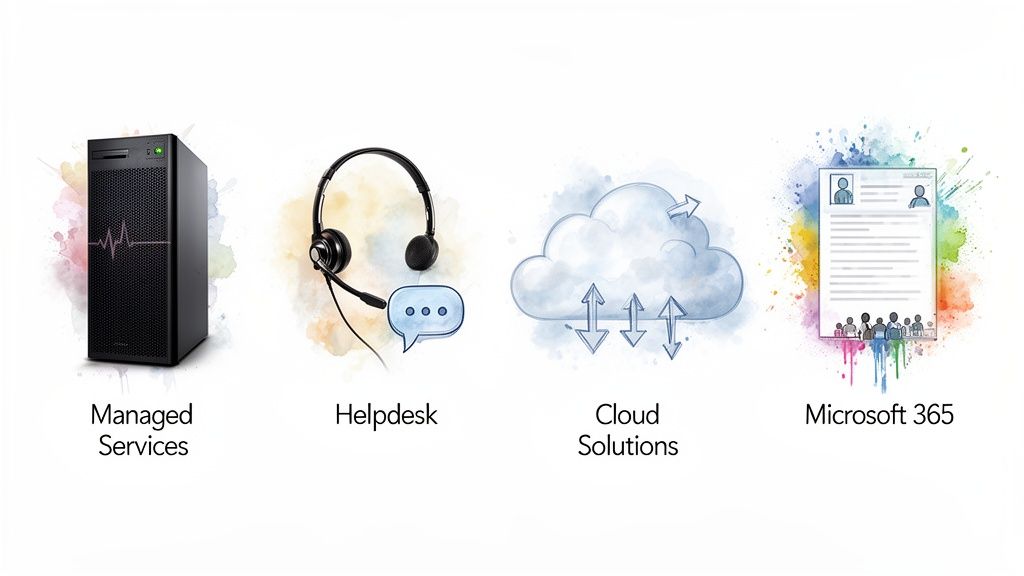
Trying to figure out what’s actually included in an IT support plan for a small business can feel like learning a new language. The brochures are often packed with jargon that obscures what you’re really paying for. But when you strip it all away, a good IT partnership really rests on a handful of core services, each designed to solve specific problems—from keeping the lights on day-to-day to making sure you’re ready for whatever comes next.
Think of your IT partner like a general contractor building a house. They don’t just dump a pile of lumber on your property and wish you luck. They bring in specialized crews for the foundation, the plumbing, and the electrical work. In the same way, your IT provider delivers distinct services that all work together to build a stable, secure, and efficient technology framework for your business.
Let’s break down what those core services actually look like in the real world.
A Breakdown of Core IT Support Services
To give you a clearer picture, here’s a quick summary of the essential services and how they directly help your business run better. Each piece plays a unique role, but they’re most powerful when they work together.
| Service | What It Is | Key Business Benefit |
|---|---|---|
| Managed Services | Proactive, 24/7 monitoring and maintenance of your IT systems. | Prevents problems before they cause downtime, ensuring reliability. |
| Helpdesk Support | On-demand technical assistance for your employees. | Gets your team back to work quickly when tech issues pop up. |
| Cloud Solutions | Managing your servers, storage, and software via the internet. | Gives you the flexibility to scale up or down without buying expensive hardware. |
| Microsoft 365 Mgmt. | Expert setup, security, and optimization of your Microsoft 365 tools. | Ensures your team can collaborate securely and efficiently from anywhere. |
These services form the foundation of modern IT support, turning your technology from a headache into a genuine asset.
Proactive System Health With Managed Services
The biggest change in IT support over the last decade has been the shift from fixing things after they break to preventing them from breaking in the first place. That’s the whole idea behind Managed Services. Instead of you calling in a panic when a server crashes, your IT partner is constantly watching over your systems to stop problems before they ever start.
It’s like the difference between waiting for a heart attack and going for regular check-ups. A managed services provider (MSP) is your system’s doctor, constantly monitoring its vital signs, applying security patches, and performing routine maintenance to keep it healthy. This behind-the-scenes work is what keeps catastrophic failures from happening during a critical sales presentation or a project deadline.
This proactive approach delivers some pretty concrete results:
- Minimized Downtime: When systems are properly maintained, they just don’t fail as often. That means your team stays productive and your customers stay happy.
- Tighter Security: Continuous monitoring and patching closes the security holes that hackers love to exploit before they can even find them.
- Predictable Budgeting: You pay a flat monthly fee for all this oversight. No more surprise invoices for emergency repairs, which makes your financial planning a whole lot easier.
By focusing on prevention instead of repair, managed services turn your technology from a source of unexpected costs into a reliable tool for growth.
Immediate Problem Solving With Helpdesk Support
Even with the best maintenance in the world, things still go wrong. An employee can’t remember their password, a key application won’t launch, or the printer just decides it’s had enough. This is where Helpdesk Support becomes your team’s lifeline. It’s the on-demand, real-person assistance that solves the everyday friction that can grind a workday to a halt.
Think of the helpdesk as your direct line to a team of experts. When something goes sideways, your employees have a single number to call or a chat to open to get a fast, effective solution. This service is absolutely essential for keeping the daily momentum going.
A responsive helpdesk does more than just fix tech glitches; it gives your staff the confidence to focus on their actual jobs, knowing an expert is just a call or a click away. That confidence creates a more efficient and far less frustrated workforce.
Choosing a USA-based partner for this is a big deal. It means your team is talking to professionals in your time zone who get the context of your business, leading to clearer communication and faster fixes.
Flexible Growth With Cloud Solutions
Modern businesses have to be agile, and Cloud Solutions are the engine for that flexibility. In simple terms, the “cloud” is just a way to use computing resources—like servers, storage, and software—over the internet instead of owning and maintaining them in your office. This model lets you scale your tech infrastructure up or down on a dime, without having to sink a ton of cash into physical hardware.
Imagine you’re a retailer and your website traffic explodes during the holidays. With a server humming away in your back office, you’d likely crash and lose sales. With cloud services, your IT partner can instantly add more resources to handle the surge and then scale them right back down when things quiet down. You only pay for what you use.
A good IT partner manages this whole environment for you, making sure your data is secure, consistently backed up, and accessible from anywhere. They take on the complexity of cloud migration and management, so you can enjoy the benefits of scalability and remote work without needing to become a cloud engineer yourself. For immediate help with your cloud strategy, give us a call at +1 (310)800-1398.
Powerful Collaboration With Microsoft 365 Management
Tools like Microsoft 365 (what used to be called Office 365) have become the central nervous system for modern business, giving us email, file sharing, and video conferencing. But just buying the licenses is only the first step. Microsoft 365 Management is the service that ensures you’re actually getting your money’s worth while keeping your company’s data safe.
An expert IT partner handles the critical stuff you might not think about:
- Proper Setup and Configuration: They make sure all the security features are turned on and user permissions are set correctly to stop unauthorized access before it happens.
- User and License Management: They’ll handle adding and removing users as your team changes and make sure you’re not paying for licenses you don’t need.
- Data Backup and Recovery: They implement real backup strategies for your critical data in OneDrive, SharePoint, and Exchange Online, because Microsoft’s built-in recovery options are limited.
Without professional management, you’re leaving yourself open to data breaches, compliance headaches, and just plain inefficient use of the tools you pay for every month. With it, your team can collaborate seamlessly and securely, whether they’re sitting across the office or across the country.
The Critical Role of Cybersecurity

For a small business owner, cybersecurity isn’t some distant, technical problem. It’s about survival. A single successful cyberattack can do more than just crash your network; it can wipe out years of hard work, shatter the trust you’ve built with customers, and even force you to close your doors for good. Treating security as an optional extra is one of the most dangerous gambles you can make.
The hard truth is that small businesses are anything but “too small to target.” In fact, it’s the opposite. Cybercriminals see them as the perfect victims—you hold valuable data, but you likely have fewer defenses than a massive corporation. This makes a proactive, multi-layered security strategy an essential investment, not a luxury.
The Real-World Impact of Cyber Threats
It’s easy to tune out the constant warnings about cyber threats until you picture what it actually looks like. Imagine an employee gets a cleverly disguised email. It looks exactly like an invoice from a trusted vendor. One click, and that’s it. Ransomware locks down every critical file you have: customer lists, financial records, project data.
Your business grinds to a halt. You can’t process orders, you can’t contact clients, you can’t even run payroll. The attackers then demand a huge sum to give you your own data back, leaving you with an impossible choice. This isn’t a scene from a movie; it’s a daily reality for businesses that don’t have the right defenses in place.
The threat landscape is getting worse, fast. A recent survey from Verizon found that 47% of small and medium-sized businesses plan to refresh their security solutions in 2025, a direct response to a staggering 250% rise in ransomware attacks on SMEs since 2020. An attack like that can cost a business an average of $150,000 and forces 60% of victims to shut down within six months.
Proactive Measures a Dedicated IT Partner Implements
Real cybersecurity isn’t about buying a single piece of software and hoping for the best. It’s about building a comprehensive defense system, and this is a core function of professional IT support for small business. A dedicated partner goes way beyond just installing antivirus software to create a layered strategy that protects you from every angle.
Here’s what that looks like in practice:
- Endpoint Protection: This is antivirus on steroids. It secures every single device connected to your network—laptops, desktops, and mobile phones—with advanced threat detection that can spot and neutralize malware before it ever gets a chance to run.
- Continuous Network Monitoring: Think of your IT partner as a 24/7 security guard for your digital operations. They use sophisticated tools to watch your network traffic for anything suspicious, allowing them to spot the signs of a breach in real-time and intervene before real damage is done.
- Employee Security Training: Your team is your first line of defense, but human error is often the weakest link. A good IT partner provides ongoing training to help your staff recognize phishing scams, use strong passwords, and stick to security best practices.
Robust cybersecurity is more than just a defensive shield; it’s a powerful tool for building customer trust. When clients know you take their data protection seriously, it becomes a genuine competitive advantage.
The Benefit of a USA-Based Security Partner
When you’re dealing with something as sensitive as your company’s data, where your IT partner is located matters. A lot. Working with a USA-based provider ensures your security is managed by professionals who operate under and are fully compliant with domestic data privacy laws like CCPA and HIPAA. This alignment reduces compliance headaches and guarantees a shared understanding of American business regulations.
Ready for a security consultation with our US-based experts? Call +1 (310)800-1398 today. You can also learn more about protecting your data in our article on cloud security for small businesses.
Choosing Your IT Engagement Model
Figuring out how to handle IT support is one of those make-or-break decisions for a small business. It’s not just about fixing computers; it’s a choice that directly shapes your budget, your team’s productivity, and your ability to weather a crisis. Get it right, and you have predictable costs and smooth operations. Get it wrong, and you could be staring down a five-figure invoice right when you can least afford it.
At its core, the choice comes down to two completely different philosophies. One treats IT as a reactive cost—something you pay for only when it breaks. The other sees it as a proactive investment, designed to keep things from breaking in the first place. The difference between the two is everything.
The Old Way: Break-Fix Support
The Break-Fix model is the classic “call the computer guy” approach. When a server goes down or a laptop gives up, you pick up the phone and call a technician. You pay an hourly rate for their time, plus the cost of any parts needed to get you back up and running.
On the surface, it sounds like a bargain—why pay for something you aren’t using? But this model has a massive, built-in conflict of interest. Your business succeeds when your technology is working perfectly, but a break-fix provider only gets paid when it fails. Their income is directly tied to your downtime. It’s a model that incentivizes fixing problems, not preventing them.
This reactive approach almost always leads to bigger headaches down the road:
- Unpredictable Costs: A sudden server crash or ransomware attack can generate a shocking bill that blows a hole in your quarterly budget.
- Extended Downtime: You don’t call until something is already broken, which means your team is sitting idle, waiting for a fix. Every minute they wait is money lost.
- Recurring Issues: Break-fix support often puts a band-aid on the symptom rather than curing the disease, meaning the same frustrating problems pop up again and again.
Ultimately, the pay-as-you-go model is a gamble. You’re betting that nothing catastrophic will happen, which is a risky bet when a single hour of downtime can cost a small business thousands of dollars.
The Modern Approach: Managed IT Services
The Managed Services model flips that entire equation on its head. Instead of paying per disaster, you pay a flat, predictable monthly fee to a dedicated IT partner who proactively monitors and maintains your entire tech stack. Their job is to stop problems before they ever start.
Under a managed services agreement, your IT partner is financially motivated to keep your systems running flawlessly. Your uptime is their success, creating a true partnership where both parties are working toward the same objective: business stability and efficiency.
This proactive stance delivers a far better return. You sidestep the sky-high costs of emergency repairs, slash productivity losses from downtime, and build a stronger security defense to prevent expensive breaches. IT transforms from a volatile, unpredictable expense into a stable, manageable operating cost.
Outsourcing to a USA-Based Partner: The Smart Financial Move
For many small businesses, hiring a full-time, in-house IT person feels like the ultimate solution. But when you run the numbers, a different picture emerges. Outsourcing your IT support to a managed services provider—especially one based right here in the USA—is almost always the smarter, more cost-effective move.
Just think about the true annual cost of one in-house IT employee. It’s not just their salary. You have to add benefits, payroll taxes, ongoing training, and the thousands of dollars in specialized software tools they’ll need to do their job. A managed services plan, on the other hand, gives you access to an entire team of experts with a wide range of specialties for a fraction of that cost. You get a deeper well of knowledge without all the overhead. If you’re curious about the financial dynamics, check out our article comparing staff augmentation to outsourcing.
Choosing a USA-based partner makes the deal even sweeter. You get a team that works in your time zone, gets the nuances of American business culture, and knows domestic data privacy laws inside and out. It ensures communication is clear and the partnership is seamless.
Ready to see how a custom plan could prove the ROI for your business? Give us a call at +1 (310) 800-1398.
Using AI and Automation to Punch Above Your Weight

Let’s be clear: artificial intelligence and automation aren’t just for massive corporations anymore. For a small business, they’re the tools that let you level the playing field, punch way above your weight, and build a serious strategic advantage. It’s all about automating the repetitive stuff and using AI for smarter insights, freeing you up to focus on what actually grows your business.
A forward-thinking IT partner is your guide to this new frontier. Their job isn’t just to fix what’s broken; it’s to help you find and implement automation that delivers real, measurable results. Think of it as making your operations smarter, faster, and more cost-effective.
So, What Does This Actually Look Like?
When we talk about automation, we’re targeting the routine, time-sucking tasks that drain your team’s energy. By handing those processes over to smart software, you free up your people for the strategic work that brings in revenue.
Here are a few practical examples of where you can start right now:
- Automated Customer Support: AI-powered chatbots can handle common questions 24/7. Think instant answers on business hours, order status, or basic product info—no human required.
- Streamlined Admin Tasks: Let automation handle invoicing, data entry, and appointment scheduling. This move alone can slash manual errors and save hundreds of hours every year.
- Smarter Marketing Efforts: AI can dig into customer data to help you build highly targeted marketing campaigns or even help write compelling content for your blog and social media.
These aren’t futuristic ideas. They are accessible tools that a skilled IT partner can weave into your daily workflow.
The Real-World Impact on Your Bottom Line
Adopting these tools isn’t just about saving a bit of time; it’s about fundamentally changing how your business runs for the better. The data doesn’t lie. A staggering 88% of small businesses are already using AI tools, and 73% say those tools have made them more competitive in the last year alone.
Firms investing in AI are reporting 25% productivity gains and seeing staffing cost savings between 15-20%. Those are huge numbers when you’re navigating a tough economy.
By embracing automation, you’re not replacing your team—you’re empowering them. You’re removing the tedious, repetitive work so they can focus on creativity, customer relationships, and strategic problem-solving.
Why a USA-Based Partner Matters for This
Putting AI and automation into practice requires more than just buying software. It demands a real strategy and expert execution. A USA-based IT partner brings some key advantages to the table. They provide clear communication, work in your time zone, and have a deep understanding of the US market and its rules.
This ensures the solutions they build are perfectly matched to your business culture and compliance needs. To really get ahead, small businesses should be looking at tools like AI call answering services that can handle inquiries, qualify leads, and offer 24/7 support. It’s a simple way to automate a huge task and free up your team.
Ready to see how AI can be integrated into your operations? Give our US-based experts a call at +1 (310) 800-1398.
Your Checklist for Selecting a USA-Based IT Partner
Choosing the right IT partner for your small business is one of the most critical decisions you’ll make. This isn’t just about hiring someone to fix a broken computer; it’s about trusting a core part of your operation to a team that can help you grow securely. The decision deserves a careful, thoughtful approach to make sure you find a provider who truly gets your long-term vision.
A great partner doesn’t just react to problems—they see them coming. This checklist is designed to help you vet potential providers, with a special focus on the very real advantages of picking a USA-based team. A domestic partner means clear communication, a shared understanding of American business culture, and guaranteed compliance with our nation’s data privacy laws.
Technical Expertise and Scalability
First things first, you have to verify their technical chops. A potential partner absolutely must have proven experience with the specific technologies your business runs on, from cloud platforms to cybersecurity defenses. Ask them for case studies or real-world examples of how they’ve helped businesses similar to yours solve tough technical challenges and hit their goals.
Just as important is their ability to scale. Your business isn’t standing still, and your IT support shouldn’t either. You need to have a frank conversation about how their services can grow with you, whether you’re bringing on five new people or opening up a new location. A true partner has a flexible framework that adapts to your needs as they change, without forcing you to rip up your agreement and start over.
Client References and Onboarding Process
Don’t just take their word for it—ask for client testimonials and, more importantly, references you can actually speak to. Talking with current clients gives you unfiltered insight into their responsiveness, their problem-solving skills, and their overall reliability. Strong, positive feedback is one of the best signs of a healthy, effective partnership.
A transparent and well-documented onboarding process is a sign of a professional organization. It shows they have a clear plan to integrate their services with your business smoothly, minimizing disruption and setting the stage for a successful long-term relationship.
Finally, keep these key evaluation points in mind:
- Service Level Agreements (SLAs): Do they offer clear, guaranteed response times? What happens if they miss them?
- Security First Mindset: How do they approach protecting your most critical data? Is security an afterthought or baked into everything they do?
- Strategic Guidance: Will they act as a strategic advisor, not just a helpdesk? You can learn more about different options for outsourced IT services for small business in our detailed guide.
Choosing the right USA-based IT partner is about finding a team that is genuinely invested in your success. For a personalized consultation to see if we’re the right fit, contact us today at +1 (310) 800-1398.
Frequently Asked Questions
When you’re thinking about IT support, a lot of questions come to mind. It’s a big decision, and getting straight answers is the only way to feel confident you’re making the right move for your company. Here are a few of the most common questions we hear from business owners.
How Much Should a Small Business Budget for IT Support?
Trying to nail down an IT budget can feel like throwing darts in the dark, but it doesn’t have to be. As a rule of thumb, many businesses allocate somewhere between 3% and 6% of their annual revenue, depending on how heavily they lean on technology. Another way to look at it is a per-user cost, which often lands between $75 and $250 per employee each month.
What really drives that number are things like your company’s size, how complex your setup is, and what you need for security. But the real game-changer with a managed services plan is predictability. Instead of getting hit with huge, unexpected bills when something breaks, you have one flat monthly fee. It makes budgeting clean, simple, and reliable.
What Is the Onboarding Process Like with a New IT Partner?
Switching IT providers shouldn’t feel like ripping a band-aid off. It should be a smooth, methodical process where we get to know your business inside and out without disrupting your team.
Our onboarding is a pretty straightforward, four-step process:
- Discovery & Audit: We start by taking a deep dive into your current IT world. We look at everything—hardware, software, security—to see what’s working well and where the weak spots are.
- Strategic Planning: Using what we learned from the audit, we map out a support plan that actually aligns with your business goals and tackles any immediate risks we found.
- Tool Deployment: Next, we carefully install our remote management and security tools on your systems. We do this with a light touch to make sure your team’s workflow isn’t interrupted.
- Team Introduction: We’ll introduce you to your dedicated support team, show you the ropes on how to submit a ticket, and make sure you know all the ways to get in touch.
Our goal is always a disruption-free start so you can start seeing the benefits right away.
Can Outsourced IT Be as Responsive as an In-house Team?
That’s a fair question, but the answer is a definite yes—and in many cases, an outsourced team is actually more responsive. Think about it: a single in-house person can only fix one thing at a time. They also get sick and take vacations. An outsourced provider gives you an entire team of experts.
With today’s remote management tools, a skilled team can often diagnose and fix a problem before an in-house person could even walk over to the desk. Plus, formal Service Level Agreements (SLAs) put response times in writing, giving you a level of accountability you just don’t get with an internal hire.
When you partner with a USA-based provider, you’re not just getting a person; you’re getting a dedicated helpdesk that’s available throughout your business hours. Support is always just a quick call or a click away, delivering faster and more thorough help than one person ever could.
Ready to build a more resilient and efficient business with a trusted IT partner? Contact NineArchs LLC for a personalized consultation. Let us show you how our expert IT and outsourcing solutions can help your business scale. Call us today at +1 (310) 800-1398 or visit us at https://www.ninearchs.com.