

A paralegal sends the third follow-up of the week to a hospital records department. An insurance adjuster waits on claim history that should have arrived days ago. An office manager has a spreadsheet full of request dates, fax confirmations, consent forms, and half-complete notes that only make sense to the person who built it.
That is how record retrieval breaks down inside many organizations. The work looks administrative, but the consequences are operational. Deadlines move. Cases stall. Staff spend skilled hours chasing signatures, re-sending requests, and checking whether the file that arrived is complete.
The true cost is not just delay. It is distraction. Teams that should be analyzing claims, preparing arguments, closing books, or serving customers end up acting like document couriers and compliance clerks.
Professional record retrieval services solve that bottleneck when they are treated as a business process and not a side task. The best providers combine process discipline, secure technology, and visibility. That matters even more for smaller firms and growing businesses that do not have a large back office.
From Document Chaos to Strategic Clarity
The common failure point is not effort. It is fragmentation.
A team member submits a request by email. Another sends an authorization form by fax. Someone else calls the records custodian. Status lives in inboxes, sticky notes, and a shared drive folder with unclear naming conventions. When the file finally arrives, a reviewer still has to sort, rename, scan, redact, and route it to the right person.
Where manual retrieval starts to hurt
Manual retrieval creates four predictable problems:
- Deadline risk: Requests sit in queues, follow-ups get missed, and no one has a clean view of what is pending.
- Error risk: Wrong patient identifiers, incomplete authorizations, duplicate requests, and missing pages can derail downstream work.
- Compliance risk: Sensitive information travels through unsecured channels or lands in the wrong mailbox.
- Labor drag: High-value employees spend hours on repetitive admin instead of judgment-heavy work.
A lot of businesses try to patch this with templates and spreadsheets. That helps for a while, but only up to a point. Once request volume rises, the process starts behaving like a traffic jam.
One practical way to think about the problem is to compare retrieval with data capture. If your team already relies on tools like automated data entry software to reduce manual handling of documents, record retrieval is the upstream version of the same challenge. If the intake is messy, everything after it stays messy.
Tip: If staff members cannot answer “What is pending, with whom, and since when?” in one screen, the process is already too dependent on memory.
What changes with a managed service
A disciplined retrieval partner turns scattered tasks into a controlled workflow. Requests are standardized. Authorizations are checked before they go out. Custodian follow-ups are systematic. Records are delivered in usable formats instead of raw piles of paper or poorly named PDFs.
That shift matters because retrieval is no longer just about getting documents. It becomes a way to protect timelines, reduce rework, and keep sensitive information moving through a secure channel.
For operations leaders, that is the strategic value. Order replaces improvisation. Staff stop chasing paper. The business gets clarity instead of backlog.
What Are Record Retrieval Services
Think of record retrieval services as a specialized courier system for sensitive information. Not a simple messenger service. More like a logistics operation that handles dispatch, permissions, tracking, quality checks, and secure delivery for documents your business cannot afford to mishandle.

The category has grown because the need is real. The global medical records retrieval market reached $1.1 billion in 2024 and is projected to reach $2.8 billion by 2034, with a 10.1% CAGR, driven by legal claims volume and regulatory complexity, according to Get Codes Health.
The service is broader than most buyers assume
Many buyers hear “record retrieval” and think only of medical files for litigation. In practice, the service spans several record classes, each with different workflows, custodians, and compliance requirements.
| Record type | Common business use | What makes it difficult |
|---|---|---|
| Medical records | Personal injury matters, disability reviews, insurance claims | Authorizations, privacy rules, mixed paper and digital formats |
| Legal records | Court filings, discovery support, case documentation | Jurisdiction-specific procedures and deadline pressure |
| Insurance records | Claims history, policy files, supporting documentation | Multiple stakeholders and fragmented archives |
| Public and academic records | Deeds, licenses, transcripts, certifications | Inconsistent access rules and non-standard request channels |
Medical records
Medical retrieval is often the most sensitive category. A law office may need treatment history, imaging reports, billing statements, and physician notes from multiple providers. An insurer may need them to validate a claim or understand chronology.
The challenge is not only obtaining the records. It is obtaining the right records, from the right date range, with valid authorization, and in a format that can be reviewed quickly.
Legal and court records
Court documents sound easier because they are public in many contexts. They are not always easy in practice.
Different courts maintain records differently. Some are digital. Some still require local procedure, clerk interaction, or manual retrieval. A professional service handles those differences without making your internal team become experts in every jurisdiction.
Insurance files
Insurance records often involve cross-checking a claim narrative against policy documentation, loss history, correspondence, or supporting evidence. This work becomes messy when files sit across adjuster inboxes, TPAs, and external systems.
A good retrieval workflow brings those pieces together into one audit-friendly packet rather than a stack of disconnected attachments.
Public and academic records
This category matters more than many businesses realize. Employment verification, licensing validation, corporate due diligence, title-related work, and credential checks often depend on records from schools, agencies, municipalities, or registries.
Key takeaway: Record retrieval services are not just for litigation. They support finance, operations, HR, insurance, compliance, and research teams that depend on reliable documentation.
When buyers understand the scope, they usually stop treating retrieval as clerical overhead. It is an information supply chain. If it runs poorly, every downstream decision gets slower.
The End-to-End Retrieval Process Demystified
Most clients want a simple answer after submitting a request. What happens next?
A mature retrieval workflow is structured. The best providers do not rely on ad hoc follow-ups and inbox searching. They use a repeatable path from intake to delivery.
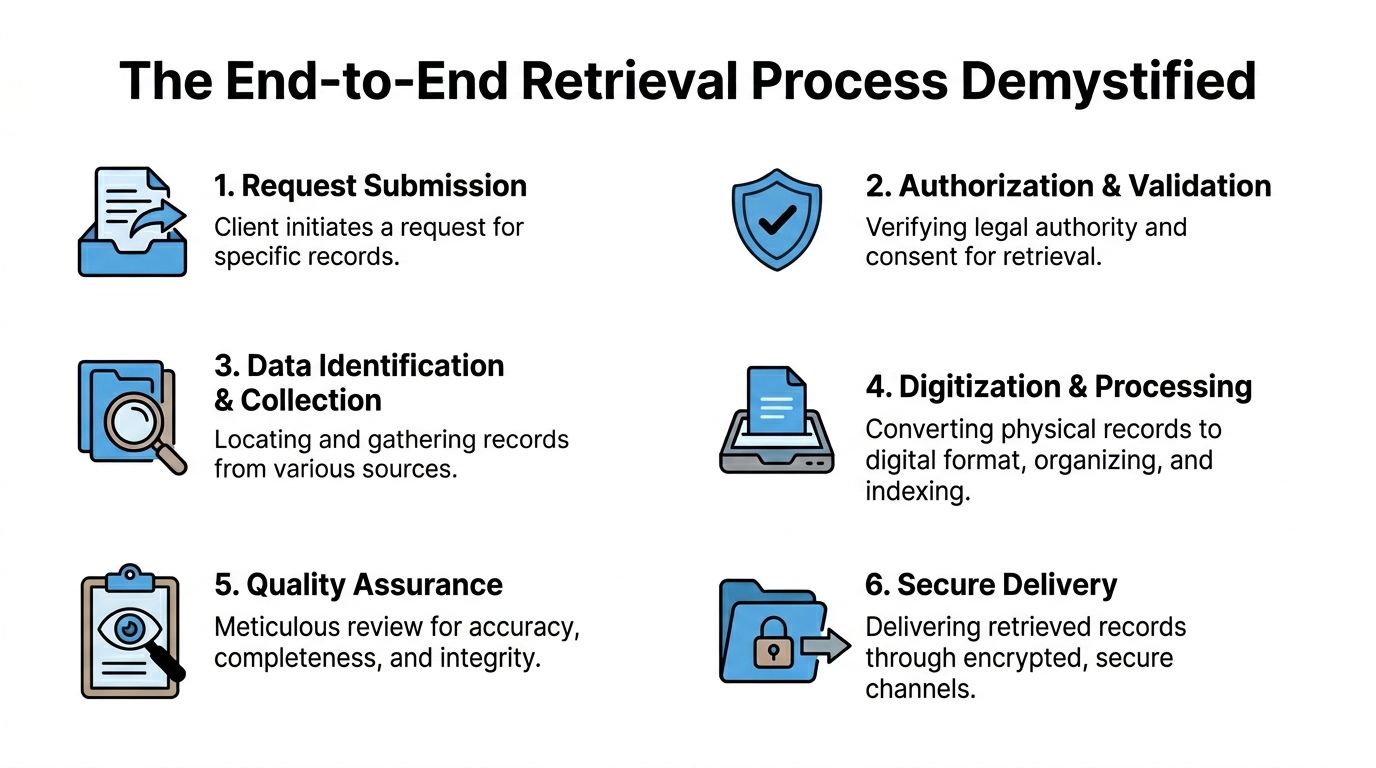
Step one through step three
The process usually begins with a secure intake. The client submits the request, identifies the subject, names the custodian if known, and attaches any required releases or instructions.
Then comes validation. Many internal teams lose time at this stage. A provider checks whether the authorization is complete, whether identifiers match, and whether the request is specific enough to avoid rejection or delay.
After that, the retrieval team identifies the right source and channels the request accordingly. That may involve a hospital records department, a county office, a school registrar, an insurer, or outside counsel.
The operational sequence often looks like this:
- Request submission: The client enters details through a portal or secure workflow.
- Authorization review: Consent, identity details, and legal authority are checked before outreach begins.
- Custodian targeting: The retrieval team confirms who holds the records and what submission method they require.
Automation makes a visible difference in this area. AI-powered record retrieval services use ML and NLP to reduce retrieval times from weeks to milliseconds in key processing tasks, with legal tech benchmarks showing up to 90% faster turnaround than manual processes, as described by RecordRS.
What automation changes in daily operations
AI does not magically make every custodian respond instantly. It improves the parts your provider controls.
That includes:
- Document classification: Incoming files are recognized and sorted without heavy manual handling.
- OCR processing: Scanned pages become searchable, reviewable text.
- Error detection: Missing pages, inconsistent names, or duplicate files are easier to flag early.
- Semantic search: Teams can locate relevant content inside large record sets faster.
For organizations already exploring adjacent workflows such as outsourced data entry services, this will feel familiar. The same principle applies. Standardized inputs plus automation produce cleaner outputs.
The middle of the workflow
After outreach begins, the provider tracks responses, follows up with custodians, resolves rejections, and logs each status change. Professional persistence is particularly important in this stage.
Some custodians need corrected authorization forms. Others require fees, alternate submission formats, or extra identity checks. A weak provider waits. A strong one actively manages the queue and removes blockers.
A well-run process during this stage includes:
| Workflow area | What a strong provider does |
|---|---|
| Follow-up management | Uses scheduled outreach and documented escalation paths |
| Status visibility | Updates clients through a portal rather than scattered emails |
| Exception handling | Resolves denials, missing forms, and format issues quickly |
| File preparation | Organizes, indexes, and names documents consistently |
Tip: Ask how exceptions are handled. Most retrieval delays come from bad authorizations, wrong custodian details, or incomplete responses, not from the initial request itself.
Final delivery and usability
When records arrive, retrieval is not over. Files still need to be checked, organized, and delivered in a format your team can use.
That may mean searchable PDFs, chronological bundles, redacted sets, or indexed folders for internal review. The difference is important. Receiving documents is not the same thing as receiving a usable work product.
A dependable service gives clients three things at the end: the records, the status history, and confidence that the packet is complete enough to move the case or business process forward.
Navigating Compliance and Security in Record Retrieval
Retrieval fails fastest when companies treat security as an afterthought.
Sensitive records move across systems, inboxes, scanners, portals, and storage environments. If any link in that chain is weak, the entire process becomes a liability. That is why compliance is not a box to check after the workflow is built. It is the structure the workflow sits on.

Compliance is operational, not theoretical
When medical or sensitive records are involved, teams usually focus on HIPAA. They should. But practical compliance goes beyond knowing the acronym.
A retrieval provider needs to manage consent, access rights, data handling procedures, transmission safeguards, retention practices, and proof of what happened to a file at every stage. That is the working meaning of compliance in day-to-day operations.
According to Retrev Legal, quality providers achieve 99%+ compliance and accuracy, and digital platforms can cut turnaround times by 50% to 70% through established provider relationships and automated authorizations.
The controls that matter most
A secure retrieval environment should include several critical elements:
- Encryption: Data should be protected at rest and in transit. AES-256 is a common benchmark in serious environments.
- Role-based access: Staff should only access the records they need for their job.
- Audit trails: Every handoff, status change, upload, and download should be logged.
- Secure portals: Files should not depend on ordinary email attachment habits.
- Retention discipline: Records should not sit indefinitely in unmanaged folders or personal drives.
For teams that want a broader operational view, these data security best practices are a useful reference point because retrieval risk rarely exists in isolation. It usually reflects larger habits around access control, endpoint hygiene, and document handling.
Why a USA-based partner matters
A USA-based outsourcing partner brings a practical advantage that buyers should not ignore. Federal rules matter, but so do state-specific requirements, release standards, custody expectations, and industry expectations around privacy handling.
That local regulatory familiarity reduces avoidable mistakes. It also shortens the gap between a legal requirement and an operational action. When a provider already understands the compliance terrain, your internal team spends less time translating rules into workflows.
This matters for SMEs in particular. Smaller organizations often do not have dedicated privacy counsel, a security architect, and a retrieval operations manager all in the same room. A U.S.-aligned partner helps close that gap.
Key takeaway: In record retrieval, security is not just about stopping hackers. It is about preserving trust, proving chain of custody, and ensuring the file you relied on was handled correctly from request to delivery.
What weak security looks like in practice
Most failures do not begin with dramatic events. They begin with ordinary shortcuts.
A coordinator downloads records to a local desktop. A release form gets forwarded across too many inboxes. A scanned packet is stored in a shared folder with broad permissions. No one can later prove who accessed what or when.
That is why businesses should evaluate retrieval vendors as both BPO operators and security partners. If they can retrieve fast but cannot govern access, they are solving one problem while creating another.
Evaluating Service Performance and Pricing Models
Buyers often ask the wrong first question. They ask, “What does it cost?” before asking, “What result are we buying?”
With record retrieval services, the invoice tells only part of the story. The true value sits in speed, accuracy, labor savings, and avoided disruption.
The metrics that matter
Three measures deserve attention during evaluation.
First is turnaround time. Fast retrieval matters because downstream work cannot start until records arrive in usable form. Slow service can be more expensive than a higher fee if it keeps staff idle or delays case movement.
Second is accuracy and completeness. A cheap file that arrives missing key pages is not cheap. It creates second-round requests, duplicate labor, and review confusion.
Third is cost structure. That includes not only vendor fees, but also what your team still has to do after delivery. If records arrive unsorted and unsearchable, your internal processing cost remains high.
Common pricing models
Providers usually package pricing in one of three ways.
| Pricing model | Best fit | Trade-off |
|—|—|
| Per-request | Irregular volume or specialized requests | Costs can vary sharply month to month |
| Per-page | Workloads where page count is the main cost driver | Simple on paper, but hard to predict total spend |
| Subscription or hybrid | Steady volume and ongoing operational use | Better planning, but requires clearer scope upfront |
The numbers matter, but context matters more. According to RecordRS, typical per-page fees are around $1 to $3, and the stronger ROI comes from reducing manual data entry by over 40% and achieving 30% to 50% cost reductions through outsourcing compared with in-house work.
How to think about ROI
A useful ROI discussion should include more than direct retrieval fees.
Consider the internal tasks that disappear or shrink:
- Request preparation: Fewer staff hours spent building and checking submissions.
- Follow-up labor: Less time calling custodians and managing status by hand.
- Document handling: Reduced sorting, naming, indexing, and scanning effort.
- Rework: Fewer cycles spent correcting avoidable mistakes.
- Opportunity cost: Skilled employees return to revenue-generating or judgment-heavy work.
Tip: When comparing vendors, calculate the cost of your current process first. If your baseline excludes staff time, rework, and delay, every vendor quote will look expensive.
What does not work in vendor evaluation
Do not evaluate providers on a single headline promise such as “fast turnaround” or “low pricing.” Those phrases mean little without process detail.
A better approach is to ask for sample outputs, portal visibility, exception handling discipline, and clarity on what happens when a record set arrives incomplete. That is where service quality becomes visible.
In practice, the best buying decision often comes from choosing the provider that lowers total operational friction, not the one with the lowest sticker price.
How to Choose the Right Record Retrieval Partner
A provider can look capable in a sales call and still create serious operational pain after onboarding. The right partner does more than fetch documents. They fit your workflow, security standards, and growth plans.
That matters more now because retrieval sits at the intersection of back-office operations and cyber risk. SMEs feel this sharply. They need outside help, but they also carry more exposure when vendors are loosely controlled.
According to U.S. Legal Support, a 2025 cybersecurity report noted a 28% increase in healthcare data breaches, SMEs were hit hardest, and breach costs averaged $4.88 million per incident. The same source points to the value of a BPO/IT partner that combines endpoint security and generative AI for automated compliance.
What to check before you sign
The strongest selection process uses a practical checklist instead of marketing language.
| Evaluation Criteria | What to Look For | Why It Matters |
|---|---|---|
| Security controls | HIPAA-aware workflows, role-based access, encryption, audit trails | Sensitive records need governed handling, not casual file sharing |
| Compliance knowledge | Familiarity with HITECH, state-specific requirements, authorization rules | Prevents avoidable delays and reduces legal risk |
| Technology stack | OCR, searchable PDFs, workflow automation, secure portal access | Improves usability after records arrive |
| Operational visibility | Real-time status updates, exception tracking, clear ownership | Reduces email chasing and gives teams confidence |
| Integration readiness | API options or structured export formats | Helps records move into your internal systems cleanly |
| Quality assurance | Review for completeness, indexing, chronological ordering | Makes the output useful, not just delivered |
| Support model | Responsive account team and escalation path | Retrieval often depends on timely problem resolution |
| U.S. delivery capability | Familiarity with local compliance expectations and document practices | Important when records involve federal and state obligations |
| Broader BPO and IT capability | Ability to support security, workflow automation, and adjacent admin tasks | Prevents vendor sprawl and strengthens resilience |
The hidden differentiator is integration
Many providers can submit requests. Fewer can fit smoothly into your existing operations.
A retrieval partner becomes far more valuable when records can flow into adjacent functions such as claims review, finance operations, document management, or staffing workflows. That is one reason some buyers look for overlap with adjacent capabilities like insurance services BPO. The point is not to bundle services for its own sake. The point is to reduce handoff failures between teams and systems.
Good fit versus bad fit
A good partner usually shows the following traits early:
- They ask process questions: Not just volume questions.
- They care about authorizations: Because bad intake ruins everything downstream.
- They define exception handling: They can explain what happens when a custodian rejects a request.
- They think like operators: They talk about workflows, logs, access, and outputs.
- They understand security architecture: Not only retrieval administration.
A poor fit often reveals itself in different ways:
- Vague answers on compliance
- No clear portal or audit trail
- Unclear responsibility after records arrive
- Heavy dependence on email as the workflow
- Little ability to support scaling or integration
Key takeaway: The best record retrieval partner is usually not the one promising the most. It is the one that can explain, in practical detail, how requests are governed, tracked, secured, and delivered inside your environment.
Why combined BPO and IT capability matters
This is the angle many buyers miss.
Record retrieval looks administrative on the surface, but the risks and gains are technical. The process touches endpoints, storage, permissions, identity, audit trails, workflow automation, and document usability. A partner with both BPO discipline and IT capability can harden the system around the work, not just the work itself.
That becomes especially useful when your organization is growing. The same provider mindset that supports retrieval can also support cloud workflows, endpoint security, document automation, staffing flexibility, and operational continuity. For SMEs, that is often more valuable than hiring separate vendors for each gap.
Scale Your Operations with a Strategic Partner
Businesses outgrow manual retrieval before they realize they have outgrown it.
The signs are familiar. Staff members spend too much time following up. Sensitive files move through too many hands. Managers lack a reliable view of status. Delays in one records queue ripple into legal, insurance, finance, or compliance work.
The better approach is to treat record retrieval services as a strategic outsourced function. Done well, retrieval gives you more than documents. It gives you cleaner workflows, fewer interruptions, stronger data handling, and a process that can scale without forcing headcount to rise at the same pace.
What strong outsourcing changes
A strong partner helps your organization in ways that are easy to feel day to day:
- Efficiency improves: Requests move through a defined process instead of inbox chaos.
- Security strengthens: Access, storage, and delivery follow policy instead of convenience.
- Scalability becomes real: Volume spikes no longer break the team.
- Internal talent refocuses: Employees spend more time on analysis, service, and decisions.
For firms modernizing legal and compliance workflows, it also helps to stay aware of adjacent technology. This overview of AI tools for legal professionals is a useful companion read because retrieval works best when it connects to stronger review, search, and document-handling practices.
A USA-based outsourcing partner adds another layer of practical value. They understand the compliance environment your records move through, they align more naturally with domestic business expectations, and they reduce the friction that often appears when sensitive workflows are managed without enough regulatory context.
The essential question is whether your current process is secure, visible, and scalable enough to support the business you are trying to build.
NineArchs LLC helps businesses turn record retrieval into a secure, scalable operating process backed by both BPO execution and IT support. If your team needs a USA-based outsourcing partner that can improve efficiency, strengthen data security, and reduce manual back-office strain, contact NineArchs today at (310)800-1398 or (949) 861-1804, or email info@ninearchs.com.