

If you’ve got Appian skills, you’re in a great spot. The market is hungry for developers who can turn business needs into powerful, low-code applications. As more companies lean on platforms like Appian to get ahead of their IT backlogs and push digital projects forward, the demand for Appian developer jobs has exploded.
The Thriving Market for Appian Developer Jobs

Let's be clear: the race to automate and modernize is on, and Appian talent is right in the middle of it. This isn't just a trend; it's a fundamental shift in how businesses operate. Companies are realizing they can build the custom apps they need in a fraction of the time it takes with traditional coding, and that's a game-changer.
From nimble startups to Fortune 500 giants, everyone is on the hunt for people who can translate complex business processes into clean, effective Appian solutions. This has created a vibrant job market packed with opportunities, especially for those looking to find remote jobs that offer flexibility and high-impact work.
To give you a clearer picture, here’s a quick snapshot of what the Appian career landscape looks like in 2026. This table breaks down the key numbers and what they really mean for you, whether you're looking for your next role or trying to hire top talent.
Appian Developer Career At a Glance 2026
| Metric | Statistic | Significance for Job Seekers & Employers |
|---|---|---|
| Median Salary (US) | $102,877 (Based on 2024 H1B Data) | Job Seekers: Confirms strong earning potential. Employers: Highlights the need for competitive compensation to attract talent. |
| Annual H1B Approvals | 57 (for "Appian Developer" in FY24) | Job Seekers: Shows consistent demand, including for international talent. Employers: Indicates a competitive field where speed in hiring is key. |
| Key Driver | Business Process Automation | Job Seekers: Skills in BPA are highly valuable and lead to impactful roles. Employers: Hiring Appian developers directly addresses efficiency goals. |
| Hiring Challenge | High Competition for Talent | Job Seekers: Your skills are in demand; you have negotiating power. Employers: Finding and vetting talent is a major bottleneck. |
| Growth Path | Developer to Architect/Lead | Job Seekers: Offers a clear and lucrative career trajectory. Employers: Provides a path to retain and grow internal talent. |
As you can see, the data points to a robust and rewarding career. The numbers don't lie—this is a field with serious momentum.
A Career With Real Growth and Competitive Pay
The financial upside and career path for Appian developers directly reflect this intense demand. Just look at the H1B visa sponsorship data, which is a great indicator of the need for specialized skills in the US. In fiscal year 2024, there were 57 H1B LCA approvals just for roles with the title "Appian Developer," and the median salary hit $102,877. You can dig into the specifics yourself in this job title data overview.
This trend makes an Appian career a financially solid move. But it's more than just the money. When you can deliver major operational improvements, you create a clear path for yourself to move from a developer role into an architect or leadership position. To really get why these skills are so sought-after, it helps to understand the massive business process automation benefits that companies are chasing.
How Smart Companies Are Winning the Talent War
Of course, for businesses, this red-hot market creates a huge hiring headache. Finding, vetting, and actually landing top Appian talent is a slow, expensive, and frustrating process. It’s a seller's market, and developers with proven skills have their pick of offers.
This is exactly why many companies are getting smart and turning to US-based outsourcing partners to sidestep the hiring bottleneck altogether.
A specialized US partner gives you a direct line to a global pool of pre-vetted, certified developers. You get top-tier talent without the agonizingly long recruitment cycle. A US-based partner eliminates communication barriers and time zone chaos. It’s a cost-effective way to scale your team and keep communication seamless, freeing up your internal people to focus on what they do best.
Ready to build your Appian dream team without the drama? Let’s talk.
Contact us at (310)800-1398 / (949) 861-1804 or shoot an email to info@ninearchs.com.
Essential Skills and Certifications for Appian Success
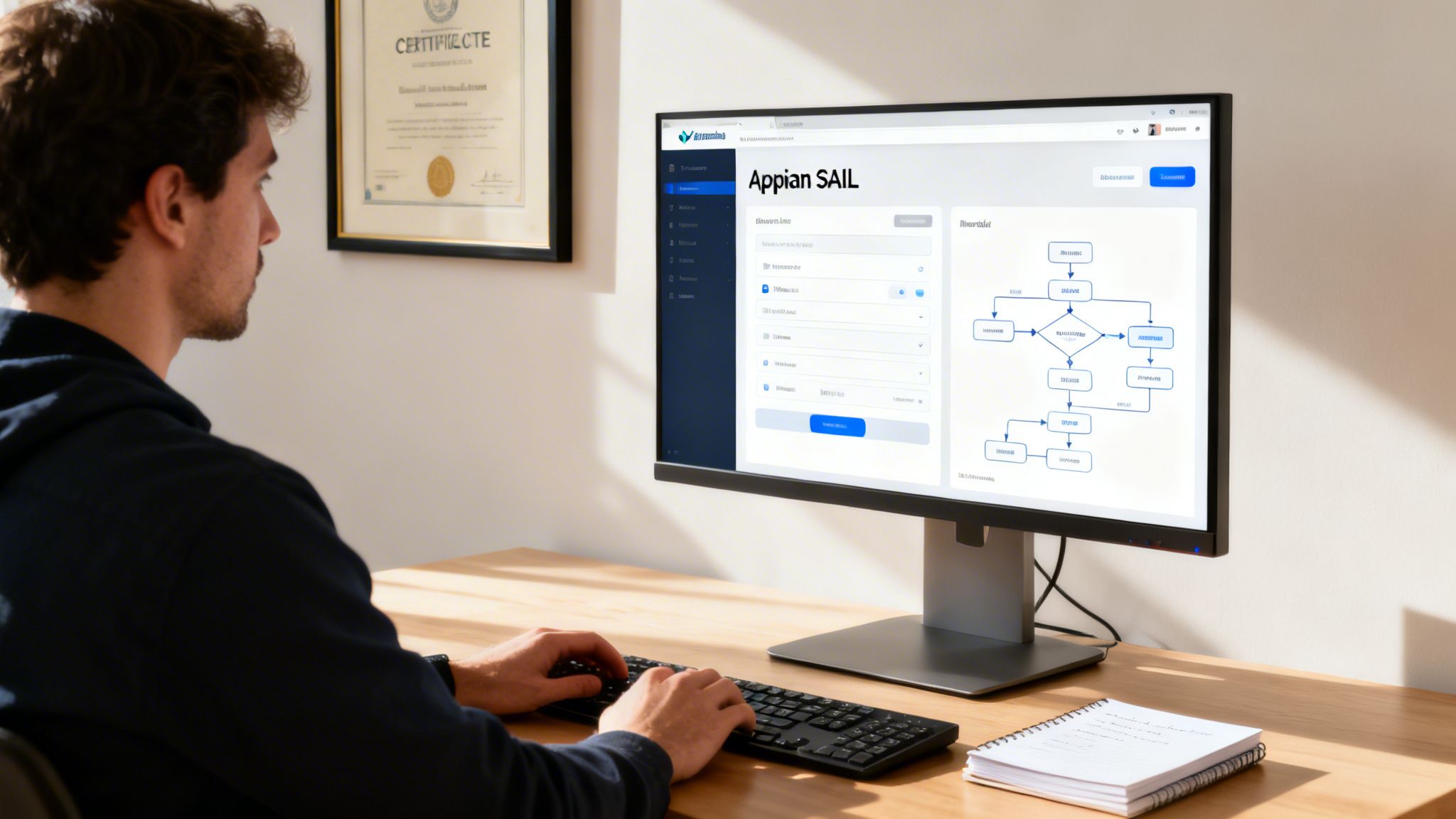
If you want to land one of the top Appian developer jobs, you need to be more than just a platform user. The best employers, and the partners they trust, are searching for a rare mix of technical skill and business insight.
It’s about proving you can do more than just build an app. They need to see you can step into a complex business challenge and architect an elegant, efficient, and scalable solution using Appian's low-code toolkit.
This starts with a non-negotiable mastery of the platform's core. You must be able to demonstrate real, practical expertise in building dynamic, responsive user experiences with SAIL (Self-Assembling Interface Language). Your ability to design forms, dashboards, and reports that people actually want to use is what makes an application succeed or fail.
But a pretty interface is just the beginning. A deep understanding of Process Models is where the magic really happens. This is the engine room—where you map out business logic, dictate how data moves, assign tasks, and automate decisions. The best Appian developers think like business analysts, hunting for bottlenecks and designing workflows that create genuine efficiency.
Core Technical Competencies
Great Appian developers don't just build applications; they build powerful, maintainable solutions that last. That requires a rock-solid foundation in a few key areas.
- Integrations: Modern applications don’t exist in a silo. You have to be skilled at connecting Appian to other enterprise systems using REST and SOAP APIs, connected systems, and integration objects. To dive deeper, check out our guide on the proper integration design pattern.
- Data Design: Your ability to structure data logically has a direct line to application performance and scalability. This means expertise in creating and managing Appian Records and Custom Data Types (CDTs) is absolutely fundamental.
- Expression Rules and Querying: Writing clean, efficient, and readable Appian expressions is truly an art form. This skill is your secret weapon for manipulating data, executing complex business rules, and querying information without slowing the whole system down.
These technical skills are the bedrock of a successful Appian career, but they are only half the picture.
The Power of Soft Skills
Technical chops might get you an interview, but it's the soft skills that land you the job and make you invaluable in the long run. In the world of Appian, communication is everything.
You’ll be in constant conversation with business stakeholders—gathering requirements, demonstrating progress, and translating complex technical concepts into plain, simple English.
Employers consistently tell us that the developers who add the most value are those who can think critically, solve problems creatively, and work as part of a team. They don’t just build what they’re told; they push back, challenge assumptions, and propose better ways to solve the problem.
This powerful combination of skills is why so many developers find this career so rewarding. In fact, a recent report shows that 80% of Appian developers are satisfied with their work, and 73% feel their pay reflects their skills. You can get more insights from the full Appian Developer Report.
Your Certification Roadmap
Appian certifications are the clearest, most direct way to prove your expertise and cut through the noise in the job market. For hiring managers, a certification is a trusted signal that you possess a verified level of skill.
The path is straightforward and builds on itself, typically following three levels:
- Associate Developer: This is your foundation. It confirms you have the essential knowledge to build basic Appian applications.
- Senior Developer: This level shows you can design, build, and deploy production-ready applications that follow established best practices.
- Lead Developer: This is the pinnacle, validating your ability to architect complex, enterprise-grade solutions and lead a team of developers.
Smart companies—and the US-based outsourcing partners they rely on—place a massive premium on certified professionals. It's a simple risk-reduction strategy that ensures projects are built with quality and best practices from day one. If you’re serious about advancing your career in Appian developer jobs, getting certified isn't optional—it's a must.
For assistance finding your next role or sourcing certified talent, call us at (310)800-1398 / (949) 861-1804 or email info@ninearchs.com.
Crafting Your Standout Resume and Portfolio

In the world of Appian developer jobs, your resume and portfolio are more than just documents; they're your personal marketing campaign. A simple list of skills and past roles just won't cut it. Hiring managers are drowning in resumes that all look the same. They're searching for someone who doesn't just complete tasks—they want a developer who solves real business problems.
To get noticed, you have to tell a story of impact. That means shifting your entire mindset from listing what you did to showing what you achieved. It's the difference between a resume that gets a polite nod and one that makes a manager pick up the phone.
Show, Don't Just Tell
Let's get practical. Instead of a generic bullet point like, "Responsible for process automation," you need to reframe it with results. Try this: "Automated a manual finance approval process, saving the team 15 hours per week and slashing errors by 40%." See the difference? The first version is passive and forgettable. The second one screams tangible business value.
Even if you don't have precise metrics from a past project, you can still estimate the impact. Think in business terms. Did you improve user adoption? Shorten a workflow? Make someone's job easier? Frame it that way. For more general tips on this approach, it’s worth learning how to build a standout resume as a software engineer.
The best resumes and portfolios focus on the "so what?" behind every project. It’s not just about what you built; it's about what that solution did for the business. Did it save time? Cut costs? Improve user satisfaction? That’s the story you need to tell.
Building Your Portfolio With or Without Experience
Your portfolio is where your resume’s claims come to life. This is your chance to showcase your work visually and prove you know your stuff.
For seasoned Appian developers, this isn't about showing everything you've ever done. Curate 2-3 of your most impressive projects. For each one, lay out the story clearly:
- The Business Problem: What was the pain point you were hired to solve?
- Your Appian Solution: What did you build? Mention specific components like process models, SAIL interfaces, or complex integrations.
- The Quantifiable Outcome: Circle back to the results. Show the metrics, the time saved, or the revenue gained.
If you’re just starting out and don't have a deep well of professional projects, don't panic. You can build a fantastic portfolio by creating your own solutions. Think about a real-world problem you could solve. Maybe it’s a simple app to track a personal budget or manage a local club's membership.
Document your entire process—your design choices, the challenges you ran into, and how you solved them. This kind of initiative shows passion and a proactive mindset, two qualities that hiring managers absolutely love to see for Appian developer jobs.
Navigating the World of Applicant Tracking Systems
Before a human hiring manager ever sees your resume, it almost certainly has to get past a robot first. These Applicant Tracking Systems (ATS) are programmed to scan for keywords and reject anything that doesn't fit their rigid rules.
To beat the bots, you need to play their game. Scour the job description for specific terms—"SAIL," "Process Models," "Records," and any integration technologies they mention—and make sure those exact phrases are in your resume. Use dead-simple headings like "Work Experience" and "Skills." Now is not the time for fancy tables, columns, or graphics that will only confuse the software.
Of course, for companies looking to hire, sifting through hundreds of resumes to find a candidate who truly understands how to show their value is a massive headache. This is where working with a trusted partner can be a game-changer. A specialized US-based outsourcing firm handles all the screening and vetting, ensuring you only spend your time with candidates who have a proven track record of delivering real impact. A US-based partner ensures seamless communication and aligned business hours, eliminating the common frustrations of working across different time zones.
For hiring assistance, contact us at (310)800-1398 / (949) 861-1804 or email info@ninearchs.com.
Navigating Appian Interviews and Technical Assessments
If you're preparing for an Appian developer interview, know this: it’s not just about what you know. It’s about how you think. The entire hiring process is designed to go beyond your resume and see how you approach real-world business problems on the fly.
You can expect a mix of behavioral questions, deep-dive technical discussions, and almost always, a hands-on assessment.
Behavioral questions are where they try to understand the person behind the keyboard. They want to hear how you’ve navigated messy situations—think difficult stakeholders, shifting project priorities, or that time you had to rally a team around a tough solution. Don’t just talk theory; come with specific stories that show you’re a communicator and a problem-solver.
The technical questioning is where you get to show off your platform expertise. This isn't a pop quiz. It's a peer-to-peer conversation where you should be ready to discuss the trade-offs between different design choices, defend your approach to a data structure, or explain how you build applications that don't crumble under pressure.
Putting Your Skills to the Test: The Technical Assessment
This is the part of the interview where you have to prove it. You’ll likely be handed a business scenario and a time limit, with the expectation that you’ll design and partially build a working solution. This isn't just a coding test. They are watching your entire thought process unfold.
Hiring managers want to see how you deconstruct a vague requirement and translate it into a logical, scalable Appian design. Your ability to explain your choices is just as critical as the code you produce.
Let's say they ask you to mock up an expense approval workflow. Here’s a smart way to handle it:
- Ask Questions First: Before you even think about opening the designer, start asking clarifying questions. Who uses this? What are the approval tiers? What kind of data are we capturing? This shows you think like a business analyst, not just a developer.
- Talk Through Your Plan: Whiteboard it, sketch it on paper, or just talk them through your vision. Explain the process models you’d create, the data types (CDTs) you'd need, and the key SAIL interfaces you plan to build.
- Build and Narrate: As you start building, explain your decisions out loud. “I'm using a record-powered grid here because it’s more performant and easier to maintain long-term.” Or, “For this step, I'd use an integration object to call the finance API, since it gives us better error handling and reusability.”
This methodical approach proves you're strategic and think like an architect—qualities that separate good developers from great ones.
Acing the interview isn't about finding the one "right" answer. It's about showing them how you arrive at an answer. Articulate the "why" behind your design choices and prove you understand the real-world impact of building scalable, high-performance solutions.
The Advantage of Expert Guidance
For many companies, designing an interview process that can truly vet Appian talent is a huge headache. It takes time, resources, and a level of platform expertise that most internal HR or IT teams simply don't have. This is precisely why organizations turn to a specialized, US-based outsourcing partner.
These partners live and breathe Appian. They have finely-tuned, proven processes for screening and testing candidates, which means you only spend time interviewing developers who have already cleared a high technical and problem-solving bar. It saves you countless hours and connects you directly with top-tier talent ready to make an impact from day one. Partnering with a US-based firm also means you benefit from seamless communication and aligned business hours, which is critical for fast-paced project environments.
To access pre-vetted Appian experts or get help building your own high-performing team, let's connect.
Call (310)800-1398 / (949) 861-1804 or email info@ninearchs.com.
A Strategic Approach to Hiring Top Appian Talent

If you’re a hiring manager or CTO, you already know the truth: finding and hiring elite Appian developers can bring your entire project pipeline to a grinding halt. The demand for true experts massively outstrips the supply.
Posting a generic job ad and waiting for the right people to apply is a recipe for long delays and blown deadlines. To secure the talent you need for your Appian developer jobs, your hiring strategy needs to be as sharp and targeted as the solutions you expect them to build.
It all starts with the job description. This isn’t just a list of technical checkboxes; it’s a sales pitch. Top-tier developers aren't just looking for another gig—they’re looking for a compelling challenge. Frame the role around the business problems they will get to solve, the direct impact their work will have, and the real opportunities for growth.
From there, your interview process must be a well-oiled machine designed to separate the truly skilled from the merely certified. A multi-stage process that digs into behavior, technical depth, and practical application isn't just nice to have; it's essential.
Crafting a High-Impact Interview Process
A poorly structured interview is your biggest risk for a bad hire. The goal is to see how a candidate thinks under pressure, collaborates, and solves problems—not just whether they can answer trivia questions.
Your initial screening needs to go beyond keywords on a resume. Focus on tangible project outcomes and the candidate's specific role in them.
During the technical interview, ditch the simple Q&A. Instead, shift to scenario-based discussions. Ask candidates to walk you through a complex project they've completed. What trade-offs did they make? Why? This is where their architectural thinking and real-world experience—or lack thereof—will shine through.
Finally, a hands-on technical assessment is non-negotiable. Give them a concise, real-world business problem and watch how they work. Observe how they deconstruct the challenge, plan a solution, and communicate their thought process. This is where you see their skills in action, not just on paper. As you refine your process, you might find that a skills-based hiring methodology helps sharpen your ability to spot top performers.
The Decisive Advantage of a US-Based Outsourcing Partner
Building a great internal hiring process is a worthy goal, but it’s also slow and burns through internal resources. For companies that need to scale a team and start a project now, that delay is a major competitive disadvantage.
This is where a specialist, US-based outsourcing partner like NineArchs offers a powerful shortcut.
Instead of spending months searching, screening, and interviewing, you gain immediate access to a global talent pool of pre-vetted, certified Appian developers. A US-based partner handles the entire recruitment burden, from technical assessments to background checks, presenting you only with candidates who meet your exact specifications.
This model delivers a few critical benefits:
- Drastic Time Reduction: You can cut your hiring timeline from months down to just a few weeks. Projects start sooner, and you deliver value faster.
- Cost-Effective Scalability: Onboard expert developers for specific projects without the long-term overhead and commitment of full-time employees. You can scale your team up or down as project needs evolve.
- Seamless Communication and Oversight: A US-based partner eliminates communication barriers and time zone chaos. You get the cost benefits of a global team with the reliability and legal security of a domestic contract.
By offloading the recruitment burden to an expert partner, your internal teams can stay focused on what they do best: driving your core business forward. You get the right talent for your Appian developer jobs exactly when you need it, ensuring your digital transformation goals stay on track.
Ready to build your team with elite Appian talent? Contact NineArchs today.
Call: (310)800-1398 / (949) 861-1804 | Email: info@ninearchs.com
Your Appian Career Questions, Answered
Whether you're an aspiring developer trying to break into the field or a hiring manager looking for top talent, the world of Appian developer jobs comes with its own set of questions. Let's cut through the noise and get straight to the answers you need.
What Is the Typical Salary Range for an Appian Developer in 2026?
Let's talk numbers. In 2026, the demand for skilled Appian developers continues to drive strong, competitive salaries. Of course, this varies by location and industry, but here’s a solid baseline of what to expect.
- Entry-Level & Junior Developers: If you're just starting out, you can realistically expect to earn between $80,000 and $95,000 a year.
- Mid-Level Developers: With a solid three to five years of experience under your belt, your earning potential jumps significantly, typically into the $100,000 to $130,000 range.
- Senior & Lead Developers: This is where the real earning power kicks in. Seasoned experts with deep experience, key certifications, and leadership roles can command salaries from $140,000 to over $165,000.
- Contractors & Freelancers: For those who prefer contract work, hourly rates are strong, usually falling between $75 and $125. The rate depends heavily on the project’s complexity and how long you're needed.
The takeaway is clear: investing in your Appian skills pays off.
How Can I Get Appian Experience If I'm New to the Platform?
This is the classic chicken-and-egg problem, but with Appian, there’s a clear path forward. Your first move should be to sign up for the Appian Community Edition. It’s a completely free, personal environment where you can build, experiment, and learn without any pressure.
Next, dive into the official Appian Academy learning paths. These courses are incredibly well-structured and will take you from the basics all the way to advanced development techniques.
To really make your resume stand out, you need a portfolio. Don't just complete the tutorials—build something that solves a real-world problem. Think of a simple task manager, a personal budget tracker, or an event-planning app for a local club. Document your process, the problems you solved, and your design choices. This shows employers not just what you can build, but how you think.
Is Appian Certification Worth the Investment?
Without a doubt, yes. Appian certifications are some of the most valuable credentials in the low-code world. For a job seeker, it immediately signals your expertise and commitment to the platform. We see it all the time: certified developers not only earn more but also get access to the best opportunities.
For employers, hiring certified developers is a smart risk-management move. It’s your assurance that a candidate knows best practices, which translates directly into higher-quality work, faster project timelines, and less time spent on onboarding. In a competitive market, that certification can be the deciding factor.
What Are the Benefits of Hiring Through a US-Based Partner?
If you're a company struggling to fill your Appian developer jobs, a US-based outsourcing partner like NineArchs can be a game-changer. It gives you instant access to a global pool of pre-vetted, certified Appian developers, which slashes your recruitment time and hiring costs.
This model also gives you incredible flexibility. You can scale your team up or down based on project needs, all without the heavy financial and administrative burden of full-time hires.
Most importantly, working with a US-based partner means you get clear communication, aligned business hours, and solid contractual protections. It’s the best of both worlds: the cost-efficiency of a global talent strategy combined with the reliability and oversight of a domestic partnership. This frees up your internal team to focus on what they do best—driving your business forward.
Ready to accelerate your projects with expert Appian talent? At NineArchs, we connect you with the pre-vetted, certified developers you need to succeed.
Call us at (310)800-1398 / (949) 861-1804 or email info@ninearchs.com to learn more about our flexible staffing solutions.