
Business consulting advice is the guidance companies get to tackle specific problems, get better at what they do, and find new ways to grow. Think of it as bringing in a specialist—a strategic partner who gives you a clear roadmap to tune up your operations, tech, or finances so you can hit your goals faster.
What Is Business Consulting Advice Really About?

Let’s imagine your business is a high-performance race car. You know where the finish line is, but a specialized pit crew can fine-tune the engine, perfect the aerodynamics, and manage fuel efficiency to make sure you actually win. That’s the heart of professional business consulting; it’s not just about fixing what’s broken, but about getting the absolute most out of what already works.
This kind of expert advice brings an objective, outside view that internal teams are often too close to see. It helps you spot the blind spots in your day-to-day operations, find hidden inefficiencies, and build a tougher, more adaptable organization.
Unlocking Potential Through Strategic Partnerships
The real goal here is to move past temporary fixes and build sustainable improvements. When you bring in a consulting partner, you’re handing off complex challenges to a dedicated team. This frees up your own people to focus on what they do best and drive the business forward.
This collaborative approach is a powerful tool for any company with ambition, from a startup figuring things out to an established player looking to modernize. A huge plus of working with an outsourcing partner from the USA is the seamless collaboration you get from aligned time zones and a deep feel for the domestic market. For a better sense of what this looks like in practice and how it can drive growth, check out the benefits of strategic IT consulting services for CEOs.
Business consulting is less about having all the answers and more about asking the right questions. It’s a process of discovery that helps leaders see their own company through a new lens, revealing opportunities they never knew were there.
The True Value of Expert Guidance
At the end of the day, the value of consulting advice is all about measurable outcomes. It’s a process that turns abstract goals into concrete, actionable steps with clear ways to track performance. This ensures every piece of advice is tied directly to real business results.
Here’s how it usually unfolds:
- Problem Identification: Consultants dig into your current processes to pinpoint specific pain points or opportunities for a big leap forward.
- Solution Design: They then map out a custom strategy, recommending specific tools, tech, or shifts in how you operate.
- Implementation Support: The best partners don’t just hand you a plan and walk away; they stick around to help you execute it, making sure the transition is smooth and the changes stick.
Whether you need to iron out your workflows, lock down your IT infrastructure, or get your financial operations in order, the right advice acts as a catalyst for growth. Ready to see how a strategy built for your business can help? Call us at +1 (310)800-1398 to talk about your goals.
The Core Frameworks of Modern Business Consulting
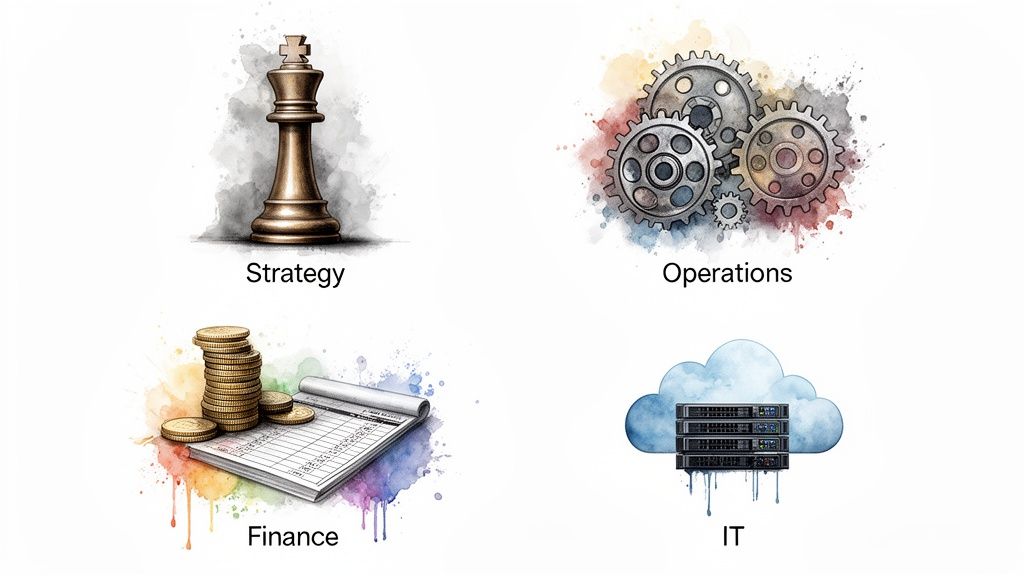
Good business consulting advice isn’t a one-size-fits-all product pulled off a shelf. It’s more like a set of specialized toolkits, each designed to fix a very specific type of problem. You wouldn’t use a hammer to repair a delicate watch, and you wouldn’t use a financial model to redesign a factory floor.
Understanding these core frameworks helps you pinpoint exactly where your business is feeling the most pressure. Once you know the problem, you can find the right expert with the right tools to solve it.
This need for specialized expertise is exactly why the consulting world keeps growing. The global market is expected to hit US$1.06 trillion in 2025 and climb to US$1.32 trillion by 2029. Businesses are voting with their budgets, showing just how much they rely on targeted advice to navigate everything from strategic planning to complex operational snags.
To give you a clearer picture, here’s a quick breakdown of the most common consulting frameworks and what they’re built to do.
Key Consulting Frameworks And Their Business Impact
| Consulting Framework | Core Focus | Typical Business Challenge Solved |
|---|---|---|
| Strategy Consulting | High-level, long-term direction and market positioning. | “We need to enter a new market, but don’t know how.” |
| Operations Consulting | Internal process efficiency, cost reduction, and productivity. | “Our supply chain has too many bottlenecks and it’s killing our margins.” |
| Financial Consulting | Capital management, budgeting, and investment strategy. | “We’re preparing for a funding round and need our financial models to be rock-solid.” |
| IT Consulting | Technology infrastructure, software, and data security. | “We need to move to the cloud to support our remote team, but we’re worried about security.” |
Each of these frameworks addresses a fundamental pillar of your business. Let’s look a little closer at what that means in practice.
Strategic Consulting
This is all about the big picture. Strategic consultants help you answer the toughest questions: Where are we going? How will we win? What big moves should we make over the next five years? Their job is to help you build a clear, durable roadmap for the future. You can also explore our guide on how to develop an effective business strategy that drives your long-term vision.
Operations Consulting
If strategy sets the destination, operations makes sure the engine is running smoothly enough to get you there. This framework is all about the nitty-gritty of your day-to-day—improving the internal processes that make your business tick. The goal is simple: cut waste, lower costs, and get more done with less.
“Operational excellence is not a one-time project; it’s a continuous culture of improvement. The right consulting advice provides the tools and mindset to build that culture from the ground up.”
For many companies, an outsourcing partner based in the USA can be a game-changer for operations. Shared business hours and cultural alignment mean communication is effortless, making collaboration on process improvements far more effective.
Financial and IT Consulting
These two frameworks handle the absolute cornerstones of any modern company: its money and its technology.
- Financial Consulting: This is focused on making sure your capital is working as hard as you are. A financial consultant can help with budgeting, forecasting, managing risk, and allocating funds to the projects that will actually fuel growth. A startup, for instance, might work with one to sharpen its financial models just before heading into a funding round.
- IT Consulting: In today’s world, technology is the engine. IT consulting ensures that engine is tuned perfectly. This could mean anything from implementing new software and securing your network to migrating your entire infrastructure to the cloud. A growing business might use an IT consultant to build a secure cloud setup that allows its team to work from anywhere, securely and efficiently.
Often, these disciplines don’t exist in a vacuum. A major project like a digital overhaul needs a clear strategic vision, streamlined operational processes, a massive IT implementation, and careful financial oversight. This is where many businesses find that Business Process Outsourcing (BPO) becomes a powerful tool.
By outsourcing something like finance and accounting to a dedicated partner, you get expert management of crucial financial tasks while freeing up your team to focus on the core business. To explore how these frameworks could tackle your specific challenges, give us a call at +1 (310)800-1398 for a direct conversation.
How to Put Consulting Advice Into Action
Getting great business consulting advice feels good. It’s the starting line, not the finish. A brilliant strategy is totally useless if it just stays on a whiteboard, collecting dust.
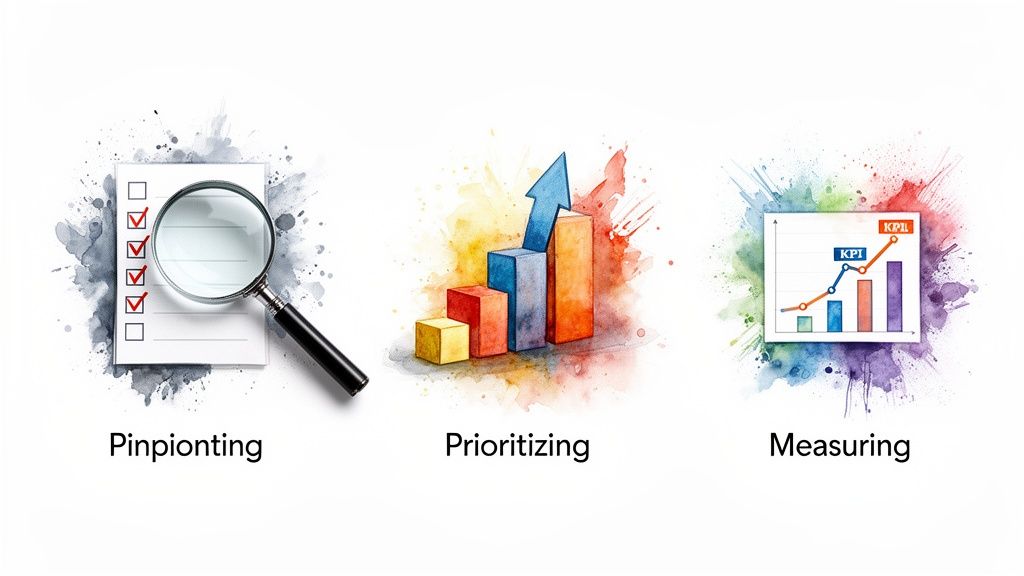
The real challenge is turning those smart recommendations into tangible results. Without a deliberate plan, even the most insightful advice falls flat, leaving your business stuck right where it started. The trick is to move from theory to practice with a structured, three-stage journey: diagnosing your real needs, prioritizing projects for the biggest bang, and then diligently measuring what happens.
This simple framework makes sure every action you take is tied to a specific, valuable outcome.
Pinpointing Your True Needs
Before you can jump on any piece of advice, you have to get brutally honest about your most pressing challenges. This starts with an internal audit. It’s all about looking past the surface-level symptoms—like missed deadlines or customer complaints—to find the root causes of friction and inefficiency.
Start by asking sharp questions across your teams. Where are the biggest bottlenecks in our workflow? What repetitive, soul-crushing tasks are eating up our team’s time? Which outdated systems are actively holding us back? Gathering this intel gives you a clear map of your operational pain points.
This is where an outside perspective can be a game-changer. An external partner can spot the issues your own team is too close to see. For example, working with a USA-based outsourcing partner ensures you’re not fighting language barriers or cultural disconnects, which is critical for an accurate diagnosis of your market.
Prioritizing Projects For Maximum Impact
Once you’ve got a list of potential fixes, the next hurdle is figuring out where to start. Trying to fix everything at once is a classic recipe for chaos and burnout. Smart prioritization means focusing your limited resources—your time, your money, and your team’s energy—on the initiatives that will deliver the greatest return on investment (ROI).
A simple but incredibly powerful tool for this is the impact/effort matrix. It helps you sort projects into four clear buckets:
- High-Impact, Low-Effort: These are your quick wins. Do these first. They build momentum and show everyone that things are improving. Think: automating a manual data entry task.
- High-Impact, High-Effort: These are the big, strategic moves, like a full CRM overhaul. They need serious planning but promise huge long-term rewards.
- Low-Impact, Low-Effort: These are minor tweaks. You can get to them when you have spare time, but they’re not a priority.
- Low-Impact, High-Effort: Steer clear of these. They’re resource drains with almost no payoff.
Prioritization isn’t about finding the perfect project; it’s about finding the right project for right now. The goal is to create a logical sequence of improvements that builds on itself over time, generating compounding value for the business.
Measuring What Truly Matters
The final, crucial step is to measure your results. As the old saying goes, if you can’t measure it, you can’t manage it—or prove its value. This is where Key Performance Indicators (KPIs) become your best friend. Before you kick off any project, you have to define what success looks like in clear, quantifiable terms.
These KPIs must be directly linked to the problem you originally set out to solve.
- For an operational efficiency project: You might track metrics like “reduction in process completion time” or a “decrease in error rate.”
- For a financial outsourcing project: Success could be measured by “cost savings on accounting overhead” or a “reduction in invoice processing time.”
- For an IT upgrade: You could monitor “system downtime reduction” or an “increase in user adoption rate.”
Tracking these KPIs consistently gives you hard evidence of ROI. It validates your investment and helps you make data-driven decisions on what to tackle next. If you need help quantifying the value of an engagement and turning advice into measurable outcomes, give us a call at +1 (310)800-1398.
How to Choose Your Consulting and Outsourcing Partner

Choosing a consulting and outsourcing partner is the single most important decision you’ll make on this journey. Think of it like hiring a C-suite executive—this choice will make or break your initiatives. Your goal isn’t just to hire a vendor to tick off tasks; it’s to find a true extension of your team, someone who gets your vision and is genuinely invested in seeing you win.
This means you have to look beyond a slick brochure or a long list of services. You need a partner whose expertise actually lines up with your problems, whose culture fits with your own, and whose model can flex and grow as your business evolves. Without that synergy, even the most brilliant business consulting advice will get lost in translation.
Your Evaluation Checklist for Potential Partners
Finding the right fit demands a structured approach. A solid checklist is your best friend here, helping you move from a wide-open search to a confident decision while making sure every base is covered. It keeps the process objective, forcing you to focus on what actually matters for a successful, long-term relationship.
Here are the non-negotiables to look for:
- Proven Expertise and Track Record: Does the firm have a documented history of solving the exact kinds of problems you’re facing? Don’t settle for vague success stories. Ask for case studies, client testimonials, and references directly relevant to your industry and project.
- Cultural Fit and Communication: How do they talk? A great partner should feel like they’re part of your team, not a disconnected third party. Pay close attention to their responsiveness, transparency, and problem-solving style during those first few conversations.
- Scalability and Flexibility: Your business needs will change—that’s a guarantee. The right partner offers flexible engagement models that let you scale services up or down as needed, so you’re not locked into a rigid, overpriced contract.
The Strategic Benefit of a USA-Based Partner
When you’re thinking about outsourcing, geography matters more than you might think. Choosing a USA-based partner offers some very real, practical advantages that directly impact everything from collaboration to security. For companies focused on seamless integration and reliability, it’s a powerful strategic move.
A partner isn’t just a vendor executing tasks; they are a co-author of your success story. Their ability to integrate seamlessly into your operations is a direct reflection of their value.
Working with a domestic partner just gets rid of so many common headaches. Time zone alignment means your teams can collaborate in real-time, crushing issues quickly and keeping projects moving without those frustrating overnight delays. Plus, partners operating under US jurisdiction follow strict data security and privacy laws, giving you peace of mind that your sensitive information is safe.
This domestic expertise is a big reason why the United States is home to the world’s largest management consulting market, valued at around $374 billion in 2023. The market is fueled by a growing workforce and high demand, with the average revenue per consultant hitting $212,000 in the same year. This vibrant ecosystem shows the deep understanding of the domestic market that a US-based partner brings to the table. You can learn more about the global consulting industry on Statista.com.
Understanding the Service Level Agreement
The Service Level Agreement (SLA) is the absolute backbone of your partnership. It’s the formal contract that turns verbal promises into written commitments, clearly defining expectations for both sides and creating a framework for accountability. A vague or poorly written SLA is a recipe for disaster.
To protect your interests and ensure everyone is on the same page, your SLA must clearly detail several key components:
- Scope of Services: This section has to spell out exactly what tasks and responsibilities the partner will handle. Any ambiguity here is an invitation for scope creep and unexpected bills.
- Performance Metrics: How will you know if they’re doing a good job? The SLA must define specific Key Performance Indicators (KPIs), like response times, project completion rates, or quality scores.
- Reporting and Communication: The agreement should lock in the frequency and format of progress reports. This keeps you in the loop and allows you to track performance against the agreed-upon metrics.
- Issue Resolution Process: When things go wrong—and they will—you need a clear, predefined process for escalating and resolving problems. This keeps minor hiccups from spiraling into major disputes.
Ultimately, the right consulting partner does more than just give advice or complete tasks—they become a strategic asset. By carefully vetting their expertise, cultural fit, and the fine print in the contract, you can build a relationship that not only solves today’s problems but also fuels sustainable, long-term growth.
Ready to find a partner that acts as a true extension of your team? Call us at +1 (310)800-1398 to discuss a flexible, scalable solution designed for your business.
Real-World Examples of Consulting Success
Theory is a great starting point, but the real value of business consulting advice snaps into focus when you see it translate into measurable results. Abstract strategies are one thing; turning operational bottlenecks and growth obstacles into genuine success stories is another entirely.
The following case studies show how the right consulting and outsourcing partnership solves distinct business problems. Each one breaks down a specific challenge, the solution we put in place, and the concrete outcomes, demonstrating the practical impact of a true strategic partnership.
Case Study 1 The Startup Securing Its Future
A fast-growing tech startup was on the brink of its Series A funding round, but the founders were completely swamped. Instead of refining their product, they were drowning in bookkeeping, payroll, and invoicing. Their financial records were a mess, making it impossible to present a clear, compelling picture to potential investors.
The Challenge: The startup needed to professionalize its entire finance and accounting operation—and fast. Without clean books and a solid financial model, they risked failing to secure the capital they needed to survive, let alone scale.
The Solution: The founders outsourced their complete bookkeeping and finance operations to a dedicated team. This partner immediately took over all the transactional headaches, from accounts payable and receivable to payroll. More importantly, they built a robust financial reporting system that gave everyone clear, real-time insights into the company’s performance. Working with a USA-based partner provided the founders with the confidence that their sensitive financial data was handled under strict domestic privacy laws.
The Measurable Outcomes:
- Within 90 days, the startup had investor-ready financial statements, which directly led to a successful $15 million funding round.
- By outsourcing, the founders clawed back over 40 hours per week, allowing them to get back to focusing on product development and investor relations.
- The move saved an estimated $75,000 annually compared to hiring a full-time, in-house finance team.
Case Study 2 The Manufacturer Launching a Digital Product
An established manufacturing firm saw a huge opportunity to launch a new digital platform for its distributors. The problem? Their internal IT team was already stretched thin just maintaining legacy systems. They lacked the specific full-stack development skills needed to build the new product from scratch, and the project was already falling behind schedule.
The Challenge: The firm needed to quickly bring in specialized development talent to build and launch the digital product and establish a first-mover advantage.
The Solution: The company engaged a technology partner to provide a dedicated team of full-stack developers. This team didn’t just work in a silo; they integrated directly with the in-house staff, adopting their project management tools and communication rhythms. Opting for a USA-based partner was key, as the aligned time zones allowed for seamless daily collaboration and real-time problem-solving, avoiding the frustrating lags often seen with offshore teams.
The right outsourcing partner doesn’t just provide resources; they provide momentum. By embedding expert talent directly into your team, you can overcome skill gaps and accelerate your timeline from concept to launch.
The Measurable Outcomes:
- The project was finished three months ahead of the original schedule, allowing the firm to launch its platform and capture early market share.
- The augmented team boosted development velocity by 60%, as measured by story points completed per sprint.
- The company avoided the high costs and long, drawn-out process of recruiting, hiring, and onboarding several full-time senior developers.
Case Study 3 The Firm Modernizing Remote Work
A professional services company with a distributed workforce was wrestling with outdated collaboration tools. Their on-premise servers were slow, unreliable, and a security nightmare for remote employees. This technology gap was killing productivity and making it a pain to onboard new team members.
The Challenge: The company had to overhaul its entire IT infrastructure by moving to a secure, cloud-based platform that could properly support a fully remote and hybrid workforce.
The Solution: Guided by expert technical support from a USA-based partner, the firm decided to migrate its entire operation to Microsoft 365. The consulting partner handled the whole transition—from planning and data migration to user training and post-launch support. They configured new security protocols, set up SharePoint for document management, and deployed Microsoft Teams to make communication fluid and simple. This domestic partnership ensured that support was always available during core business hours.
The Measurable Outcomes:
- The migration delivered 99.9% uptime, all but eliminating the costly system downtime that had plagued their old servers.
- Employee productivity jumped by 25% in the first quarter post-migration, thanks to faster file access and better collaboration tools.
- IT support tickets related to server issues and remote access problems plummeted by over 70%.
These examples show that the right business advice, paired with expert execution, doesn’t just solve today’s problems—it builds a stronger foundation for tomorrow’s growth. If you’re facing similar challenges, let’s discuss a solution that fits your business. Call us at +1 (310)800-1398.
Your Questions About Business Consulting, Answered
Stepping into the world of consulting can feel a bit like navigating a new city—it’s exciting, but you’ve got questions. As you think about bringing in a partner to help your business grow, it’s completely normal to want a clear map of the process, the value, and what you can expect.
We’ve put together answers to some of the most common questions we hear from leaders. Think of this as your guide to making a smart, informed decision that leads to real, measurable results.
How Do I Know if My Business Is Ready for a Consultant?
A lot of leaders wonder if they’re “big enough” or if their problems are “serious enough” to bring in a consultant. The truth? Readiness has nothing to do with size. It’s about ambition and hitting a wall.
If you’re staring down challenges that your internal team just doesn’t have the time, specific expertise, or bandwidth to solve, you’re probably ready.
Look for these common signs:
- Persistent Bottlenecks: You have that one recurring problem in your operations that slows everything down, and no internal fix has stuck.
- Stalled Growth: Your progress has hit a plateau. You need a fresh pair of eyes to spot new opportunities or break into new markets.
- Skill Gaps: There’s a critical project on the horizon—like a software rollout or a financial audit—but you don’t have the specialized skills in-house.
- Overwhelmed Leadership: You and your key people are so busy putting out daily fires that there’s zero time left for long-term, strategic thinking.
If any of these hit close to home, it’s a strong signal that expert business consulting advice could be a game-changer.
What Is the Difference Between a Consultant and an Outsourced Team?
This is a great question, and the distinction is crucial. While both bring in outside expertise, their roles are fundamentally different. A consultant gives you the “how,” while an outsourced team handles the “do.”
A consultant is like an architect who designs the blueprint for a stronger, more efficient building. An outsourced team is the specialized construction crew that brings that blueprint to life, handling the day-to-day work of building it.
A consultant usually comes in on a project basis to solve a specific, high-level problem. They analyze, strategize, and hand you a roadmap for improvement.
An outsourced team, on the other hand, becomes part of your daily operations to manage an entire function—think bookkeeping, IT support, or customer service. The real magic often happens when you combine them: use a consultant to design a better process, then hand that process to an outsourced team to run it flawlessly. Choosing a USA-based outsourcing partner ensures this operational integration is smooth, thanks to shared cultural context and business hours.
How Is the Cost of Business Consulting Determined?
Consulting fees aren’t one-size-fits-all, because every business challenge is unique. The cost can vary quite a bit, but it’s typically based on a few key factors.
Here are the most common pricing models:
- Project-Based Fees: You agree on a fixed price for a project with a clearly defined scope and deliverables. This is perfect for things like a market analysis or a system audit.
- Hourly or Daily Rates: The consultant charges for their time. This model works well when the scope is a bit more fluid or you need ongoing support.
- Retainer Agreements: You pay a recurring monthly fee for on-demand access to advice and guidance. It’s ideal for businesses that need a continuous strategic partner.
The complexity of your problem, the consultant’s experience level, and how long they’ll be working with you all play a role in the final number. A good partner will be completely transparent about their pricing and help you find a model that fits your budget and goals. For a deeper dive into common queries, you might find answers in these frequently asked questions.
How Do You Measure the ROI of Consulting Services?
This is the most important question of all. Measuring the return on your investment is what validates the entire decision, and it starts before the project even kicks off. You can’t measure what you haven’t defined.
ROI is tracked using Key Performance Indicators (KPIs) tied directly to the problem you wanted to solve.
For example:
- If the goal was to improve efficiency, you’d measure metrics like cost savings, reduced process cycle time, or fewer errors.
- If you were focused on growth, you’d track increased revenue, higher customer acquisition rates, or improved market share.
- For a tech project, you might look at reduced system downtime, lower IT support costs, or increased user adoption.
By setting these benchmarks upfront, you create a crystal-clear, data-backed picture of the value your consulting partner delivered.
At NineArchs LLC, we believe the best business consulting advice is both strategic and immediately actionable. Partnering with a USA-based team means you get clear communication and a deep understanding of your market, turning expert guidance into tangible success.
Ready to get clear answers for your business challenges? Call us today at +1 (310)800-1398 or learn more about our services.