
A business mindset isn’t just another piece of corporate jargon—it’s the compass you use to navigate a ridiculously complex market. Think of it like the strategic awareness a ship’s captain needs. They’re not just steering; they’re constantly reading the weather, checking the charts, and managing the crew to reach their destination. It’s a blend of vision, data, and pure resilience.
Defining the Modern Business Mindset

A genuine business mindset is the ability to see the entire operational picture at once. It’s what connects every moving part—from product and marketing to finance and customer service—into a single, cohesive machine.
This perspective ensures every decision, no matter how small, ladders up to the company’s bigger goals. Without it, departments become isolated silos. They might be working hard, but they’re not working together. The result? Wasted resources, missed opportunities, and growth that just stalls out.
The Shift from Operations to Strategy
Too many leaders get sucked into the daily operational whirlwind. They’re busy completing tasks, putting out fires, and just keeping the lights on. That’s all essential stuff, but it’s an operational mindset, not a business one.
The real strategic shift happens when you start asking “why” instead of just “what.”
- Instead of just launching a new product, you ask, “Why does this product actually matter to our ideal customer?”
- Instead of just hiring another developer, you ask, “Why is this specific role critical to our long-term roadmap?”
- Instead of just cutting costs across the board, you ask, “Why is this particular investment essential for our future scalability?”
A business mindset transforms your role from a manager of tasks into an architect of value. You stop just running a series of processes and start building a sustainable system.
This change in perspective is the single most critical investment any leader can make. It fundamentally changes how you approach everything from technology adoption and strategic partnerships to scaling your operations for the long haul.
Why Mindset Matters for Scalability
Developing a strong business mindset is the bedrock of intelligent scaling. It’s what allows you to clearly identify which functions are core to your company’s unique value and which are just operational necessities that can be optimized or offloaded.
For instance, many growing businesses realize that functions like IT management, bookkeeping, or even customer support—while absolutely vital—are eating up a disproportionate amount of leadership’s time and energy. A strategic leader sees this and starts looking for solutions that build efficiency without sacrificing quality.
This is where partnering with a USA-based outsourcing provider becomes a powerful, strategic move. By delegating key operational tasks to a specialized team in the same time zone, you benefit from seamless communication and cultural alignment. This frees up your internal talent to focus on what they do best: innovation and growth. This isn’t just about getting work off your plate; it’s a deliberate application of the business mindset to build a more resilient and efficient organization.
To learn how we can help align your operations with a growth-focused mindset, give us a call at +1 (310)800-1398.
The Seven Pillars of a Powerful Business Mindset
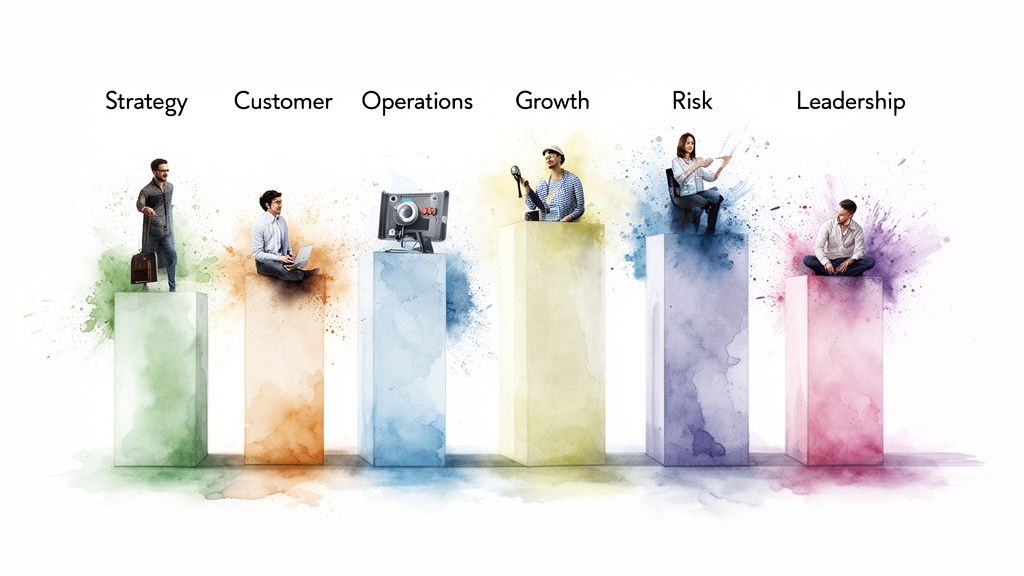
So, what does this “business mindset” actually look like day-to-day? It’s not just some abstract concept. It breaks down into tangible pillars—the foundational columns that hold up a strong, scalable company. Think of these seven components as the load-bearing walls of your business.
Each pillar represents a core focus that, once developed, fundamentally changes how you see problems and make decisions. They aren’t isolated skills; they’re deeply interconnected. Strength in one amplifies the others, creating a powerful momentum that drives real, sustainable progress. Let’s break them down.
1. Strategic Long-Term Thinking
This is about playing chess, not checkers. It’s the ability to look past this quarter’s numbers and see the board three, five, or even ten years from now. Every decision you make today should be a deliberate move toward that future state.
It means having the discipline to resist short-term wins that sabotage long-term goals. For example, a strategic thinker would never slash the R&D budget just to pretty up a quarterly report, because they know innovation is the lifeblood of future relevance. This is about building a legacy, not just hitting a target.
2. Radical Customer Focus
A modern business mindset puts the customer at the absolute center of everything. This isn’t about generic “customer service” slogans on the wall; it’s an obsessive, relentless dedication to understanding their world. You need to know their pain points, anticipate their needs, and build solutions that make their lives undeniably better.
Companies that get this right don’t just sell products; they solve problems. This requires a culture where everyone—from the CEO to the newest intern—feels personally responsible for the customer experience. It means you’re actively seeking feedback and analyzing user behavior, not just waiting for complaints.
3. Disciplined Operational Rigor
Think of operational rigor as the commitment to excellence in execution. It’s not about creating stiff, bureaucratic rules. It’s about building efficient, repeatable, and scalable processes for everything you do, from onboarding a new client to deploying a software update.
This discipline is what minimizes waste, cuts down on errors, and ensures the kind of consistent quality that builds a rock-solid reputation. Businesses with operational rigor run like well-oiled machines, freeing up mental energy for the bigger strategic fights.
A business with operational rigor doesn’t just do things right once; it creates a system that makes it difficult to do things wrong. It’s about embedding quality into the very DNA of your daily operations.
4. An Unrelenting Growth Orientation
A growth orientation is the core belief that skills, intelligence, and talent aren’t fixed—they can be developed. Leaders with this mindset don’t see challenges as roadblocks; they see them as opportunities to learn, adapt, and get better. That perspective quickly infects an entire organization, encouraging experimentation and resilience.
When a product launch doesn’t hit its numbers, a team with a growth mindset asks, “What did we learn?” instead of “Whose fault is it?” This simple shift creates a psychologically safe environment where real innovation can actually happen.
5. Data-Driven Decision Making
Gut feelings have their place, but sustainable success is built on evidence. A data-driven approach means you stop saying “I think” and start saying “The data shows.” It’s about using real metrics and analytics to shape strategy, measure what’s working, and challenge your own assumptions.
This pillar is about identifying the key performance indicators (KPIs) that truly move the needle, getting the right tools to track them, and—most importantly—empowering your team to use that information to make smarter decisions, faster.
6. Proactive Risk Management
Every business faces risk. The difference is whether you deal with it proactively or reactively. A powerful business mindset is always looking around the corner, identifying potential threats—market shifts, cybersecurity vulnerabilities, or regulatory changes—and building contingency plans before they blow up into full-blown crises.
Proactive risk management isn’t about avoiding risk; it’s about taking smart, calculated risks. It gives you the stability and confidence to make bold moves because you know you have guardrails in place.
7. Inspiring and Authentic Leadership
Finally, none of this matters if it isn’t modeled from the top. The business mindset has to be lived and breathed by its leaders. This means communicating a clear, compelling vision, giving teams the autonomy to execute, and demonstrating the behaviors you want to see.
Authenticity is the glue that holds it all together. It builds trust and fosters a culture where people are genuinely motivated to bring their best work to the table.
To help you see where you stand, here’s a look at how a fixed, reactive mindset stacks up against a proactive, strategic one.
Mindset Shift Fixed Operations vs. Strategic Business Mindset
This table contrasts the passive, reactive approach of a fixed mindset with the proactive, growth-oriented approach of a strategic business mindset across key operational areas.
| Pillar | Fixed Operations Mindset (The Old Way) | Strategic Business Mindset (The New Way) |
|---|---|---|
| Strategic Thinking | Focuses on immediate tasks and quarterly targets. | Plans for long-term market position and sustainable growth. |
| Customer Focus | Views customer service as a cost center or a department. | Sees the customer experience as the core driver of value. |
| Operational Rigor | Relies on ad-hoc processes and individual heroics. | Builds scalable, documented systems to ensure consistency. |
| Growth Orientation | Avoids failure and penalizes mistakes. | Embraces experimentation as a necessary part of innovation. |
| Data-Driven Decisions | Relies on gut feelings and anecdotal evidence. | Uses analytics and KPIs to guide strategic choices. |
| Risk Management | Reacts to problems and crises as they appear. | Anticipates potential threats and builds resilience. |
| Leadership | Manages through top-down command and control. | Inspires and empowers teams with a shared vision. |
As you can see, the shift is profound. It’s about moving from a defensive crouch to an offensive, forward-leaning posture in every aspect of your business.
Developing these seven pillars is a continuous journey, but you don’t have to build every capability internally from scratch. Partnering with a skilled outsourcing provider in the USA can accelerate your progress, particularly in areas like operational rigor and risk management. With a US-based partner, you gain the benefit of clear communication and a shared understanding of the business landscape. By delegating key functions, you can import excellence and free your team to focus on strategy and growth. Call +1 (310)800-1398 to discover how.
How Leaders Cultivate Team Alignment and Motivation

A powerful business mindset can’t just live in the executive suite. Its real value is only unlocked when it flows through every level of the organization. The best leaders know they are conduits, responsible for cascading this strategic thinking down to their entire team. It all starts with transparent communication.
When your people understand the “why” behind their work, their whole perspective shifts. Daily tasks stop being just items on a to-do list and become meaningful contributions to a larger, shared mission. That sense of alignment is the real engine behind a motivated, high-performing culture.
From Vision to Daily Execution
First things first: you need a clear and compelling vision. This isn’t some vague corporate slogan; it needs to be a tangible destination that everyone can see and get behind.
But a great vision isn’t enough. Effective leaders connect that big, overarching goal directly to the daily grind of each team member. A software engineer isn’t just writing code; they’re building the feature that will slash customer churn by 15%. A marketing coordinator isn’t just scheduling social media posts; they’re creating the very first touchpoint for the company’s next hundred best customers.
This clarity of purpose draws a straight line from individual effort to company success—and that is a massive motivational force.
The Motivation Gap in Modern Workforces
The difference between an aligned team and a disconnected one is staggering. Research consistently shows a huge gap in drive and optimism, and it’s directly tied to how well leaders communicate the big picture.
According to PwC’s Global Workforce Hopes and Fears Survey, employees who feel aligned with leadership goals are a whopping 78% more motivated than those reporting the least alignment. This is critical, especially since only 53% of workers feel strongly optimistic about their role’s future—revealing a major opportunity for leaders to step in and bridge that gap.
The data paints a clear picture. When people feel like they’re part of the company’s strategic journey, their engagement and productivity go through the roof.
Practical Strategies for Founders and CTOs
Getting everyone on the same page requires deliberate, consistent action. A huge part of leading with a business mindset is cultivating self-awareness and strong interpersonal skills, often wrapped up in the concept of emotional intelligence in leadership.
Here are three actionable strategies you can start using today:
- Hold Regular “State of the Business” Meetings: Go way beyond simple project updates. Share financial context, market trends, and the strategic hurdles you’re facing. Give everyone the full 30,000-foot view.
- Translate Goals into Departmental Missions: Work with your team leads to define exactly how their department’s quarterly objectives directly push the company’s main goals forward. Make it concrete.
- Empower Through Trust: Give your team the autonomy to solve problems their way. This isn’t just about delegation; it shows you trust their expertise and reinforces their ownership over the outcomes. We explore this further in our guide on balancing control and autonomy in leadership.
By embedding a business mindset across your company, you stop being just a group of individuals and become a cohesive, motivated team of strategic thinkers.
Turning Uncertainty Into a Competitive Advantage

When markets get choppy and the economy looks grim, the knee-jerk reaction for most businesses is to go into a defensive crouch. Leaders with a fixed perspective see disruption as a storm to be weathered, slashing costs and hoping to just make it through.
But a true business mindset flips that script entirely. It treats uncertainty not as something to endure, but as a rare chance to gain serious ground while everyone else is retreating.
Instead of pulling back, the sharpest companies see turbulence as the perfect catalyst for change. They actively invest in transforming their product lines, acquire strategic tech, and double down on talent development precisely when others are hitting pause. It’s a calculated, proactive stance that lets them rewire their operations to meet new challenges head-on.
This isn’t just about having a positive outlook; it’s a strategic weapon.
From Survival Mode to Strategic Opportunism
The heart of this mindset is a deliberate shift from a defensive survival posture to one of strategic opportunism. This means you’re not just bracing for impact—you’re actively scanning the horizon for the openings that disruption always creates, from new gaps in the supply chain to sudden shifts in what customers want.
It’s all about being ready to act decisively when the market is in flux.
This perspective is no longer a fringe idea; it’s taking hold at the highest levels. The EY-Parthenon CEO Outlook survey found that while 57% of CEOs expect ongoing uncertainty, a striking 52% plan to increase investments in overhauling their portfolios.
Even more telling, 41% of CEOs on the hunt for acquisitions are specifically targeting companies for their technology or IP. It’s a clear signal that leaders are using instability to get ahead. This data paints a picture of two diverging paths: while some see chaos, others see a once-in-a-generation opportunity to build a stronger, more resilient organization.
Rewiring Your Operations for Agility
Of course, adopting an opportunistic approach requires more than just a change in attitude. It demands a practical rewiring of your company’s operational DNA, making your organization agile enough to respond to new realities fast. For more on this, check out these insights on cultivating resilience and the ability to pivot.
Here are a few ways to start building that muscle:
- Invest in Technology: During a downturn, lean into automation, cloud infrastructure, and data analytics. These aren’t just costs; they are tools that give you the visibility and efficiency needed to make smart pivots when it counts.
- Develop Talent: Slower periods are the perfect time to upskill your team. Training employees in new areas creates a more versatile workforce that’s ready for whatever comes next.
- Strengthen Partnerships: Build deep relationships with suppliers and partners who share your agile mindset. Together, you create a more resilient ecosystem that can weather any storm.
By viewing uncertainty as an accelerant rather than an obstacle, you position your business to not just survive disruptions, but to emerge from them stronger, leaner, and more competitive than ever before.
Gaining an Edge Through Strategic Outsourcing
One of the most effective ways to build this operational agility is by partnering with an expert outsourcing provider in the USA. When you delegate non-core functions like IT management, bookkeeping, or customer support, you free up your internal team to focus entirely on high-value strategic initiatives that drive growth.
This move gives you immediate access to specialized skills and scalable infrastructure without the massive overhead of building it all from scratch.
Working with an American outsourcing partner brings the added benefits of cultural alignment, seamless communication, and a deep understanding of the domestic market. It’s a powerful application of the business mindset in action—using external expertise to build a more flexible and robust operational core. This allows you to scale resources up or down in direct response to market changes, turning uncertainty into a true competitive advantage.
To learn how a strategic partnership can help you navigate volatility, call us at +1 (310)800-1398.
Of all the places a business mindset shows its power, the startup world is the most dramatic. Think of it as a real-world lab, constantly proving how a certain way of thinking is the direct fuel for explosive growth, gutsy resilience, and, ultimately, profit. A startup’s success is almost never luck. It’s the direct result of a mindset that baked efficiency and flexibility into its DNA from day one.
Startups get one thing instinctively: agility is their superpower. The founders who make it are the ones who build for scale from the very beginning. They aren’t building a company for today; they’re building it for where they need to be in two, five, or even ten years. That forward-looking perspective isn’t just wishful thinking—it’s the signature of a potent business mindset.
The Lean and Focused Advantage
So how does this mindset actually play out? It shows up in one key strategy: using distributed teams and strategically outsourcing anything that isn’t the core mission. Instead of sinking precious capital into building massive internal departments for things like bookkeeping, IT support, or customer service, smart founders delegate. This keeps the core team lean, laser-focused, and free to do what they’re truly great at—innovating and winning the market.
You can see this approach working on a global scale. The worldwide startup ecosystem is expanding at an average clip of 21% a year. Even with all the market turbulence we’ve seen, 64% of business owners report that their ventures are profitable. That kind of resilience comes from a mindset obsessed with adaptable solutions. It’s no wonder a staggering 5.2 million new business applications were filed in a single recent year. If you explore more entrepreneur statistics, you’ll see just how deeply this trend is reshaping the economy.
A startup’s competitive edge isn’t just its product. It’s the operational discipline to scale intelligently without getting bogged down by the weight of unnecessary overhead.
Lessons for Established Companies
This agile, lean-and-mean approach is a powerful lesson for established companies. Startups prove every single day that having on-demand access to specialized talent is a game-changer. It lets them pivot on a dime and outmaneuver bigger, slower, more bureaucratic competitors.
For any organization looking to inject some of that startup DNA into its own operations, partnering with a USA-based outsourcing provider is one of the quickest and most effective ways to do it. You get immediate access to skilled professionals and best-in-class processes without the time and cost of building it all yourself. This kind of strategic delegation is how you build a more resilient, scalable, and profitable company.
To see how outsourcing can sharpen your own competitive edge, give us a call at +1 (310) 800-1398 for a consultation.
Your Roadmap to Putting a Business Mindset into Action
Understanding what a business mindset is on paper is one thing. Actually living it is where everything changes. This isn’t about flipping a switch overnight; it’s a deliberate journey to rewire how you and your team see every single challenge and opportunity. The goal is to get from abstract ideas to concrete, daily habits.
Think of this as a clear, step-by-step guide to making that evolution happen. It starts with an honest look in the mirror, moves into targeted action, and ends by building a culture where thinking like a business owner becomes second nature.
Start with a Brutally Honest Self-Assessment
Before you can map out a new direction, you have to know exactly where you’re standing. The first move is a candid self-assessment, measuring your current habits against the seven pillars we’ve covered. Don’t just go with your gut—dig up real evidence from recent decisions.
Look back at the last quarter and ask the hard questions:
- Strategic Thinking: How many of our big decisions were about long-term vision versus just putting out fires?
- Customer Focus: When was the last time we genuinely changed a process because of what a customer told us, not what we assumed?
- Operational Rigor: Where are our biggest operational messes, and what’s the real systemic issue causing them?
- Data-Driven Decisions: What critical questions are we answering with a shrug and a guess instead of actual data?
This isn’t about blaming anyone. It’s about getting a clear-eyed view of your strengths and pinpointing the areas that are holding you back the most.
Find and Prioritize Your Biggest Gaps
Once the assessment is done, you’ll have a map of the gaps between where you are and where you need to be. The temptation is to try and fix everything at once. Don’t. A scattered approach just leads to burnout and a lot of motion with no real progress.
Instead, get focused. Pinpoint the one or two pillars where a little improvement will create the biggest ripple effect across the entire business. For a startup drowning in chaos, that might be operational rigor. For an established company losing ground, it might be a renewed, almost obsessive customer focus.
Shifting your mindset requires focused energy. Prioritize the initiatives that will act as a fulcrum, lifting the entire organization with the least amount of initial effort. Choose the change that will create the most momentum.
Roll Out High-Impact Initiatives
With your priorities locked in, it’s time to act. This is where you turn insights into real-world initiatives that force a mindset shift. These aren’t just new tasks to add to the to-do list; they are fundamentally new ways of working that reinforce the right behaviors.
Here are a few examples of what this looks like in practice:
- To boost Data-Driven Decisions: Set up a simple, visual analytics dashboard and make it a rule that every weekly meeting starts with a review of the key numbers. No story time until the data has spoken.
- To sharpen Customer Focus: Kick off a “Voice of the Customer” program where a small, cross-functional team is empowered to act on feedback immediately, without needing five layers of approval.
- To build Operational Rigor: Take one—just one—critical business process and map it out from start to finish. Find and slash at least three points of friction.
A huge part of this is being honest about what your team should be doing and what they shouldn’t. This is where strategic outsourcing becomes a massive accelerator.
The Role of Strategic Outsourcing
A core principle of the business mindset is using every available resource to sharpen your focus and maximize your impact. Partnering with a skilled USA-based outsourcing firm is a direct application of that principle. It’s about delegating important operational functions—like bookkeeping, IT management, or customer support—to specialists who already live and breathe operational excellence.
This move does more than just free up your calendar. It injects a new level of professionalism and efficiency into your operations, letting your team concentrate on the core work that actually drives growth and innovation. By handing off non-core functions, you’re not just offloading tasks; you’re intentionally designing a leaner, more agile, and more resilient company.
It’s a powerful step on your implementation roadmap. To learn how to align your operations with a growth-focused business mindset, call us at +1 (310)800-1398 for a direct consultation.
Your Questions Answered: Making the Business Mindset Real
As you start weaving this way of thinking into your company’s DNA, questions are bound to pop up. It’s natural. This final section tackles some of the most common ones I hear, aiming to clear up misconceptions and help you navigate the real-world hurdles of building a mindset that sticks.
How Do I Even Measure the ROI of a “Mindset”?
I get this one a lot. You can’t measure a mindset shift like you measure ad spend—there’s no single line item for it. But its impact is absolutely visible if you know where to look. The return is indirect but incredibly powerful.
You’ll see it first in your people. Keep an eye on employee engagement scores; they’re a fantastic barometer for productivity and retention. Then, watch your operational metrics. Are projects getting done faster? Are key workflows smoother? Are fewer customers walking away? These are the early signs.
Over time, those small wins snowball into big financial results. You’ll see it in higher customer lifetime value, healthier profit margins, and smarter resource allocation, all because your team is consistently making decisions with a commercial eye.
What’s the Biggest Mistake Leaders Make When Trying to Implement This?
The classic blunder is treating the business mindset like a one-off training event. A single workshop or a motivational seminar might create a temporary buzz, but it won’t build lasting change. Real habits and deep-seated culture are forged through repetition and daily reinforcement, not a two-hour presentation.
A true business mindset has to be woven into the very fabric of your company. It needs to be part of daily stand-ups, show up in performance reviews, and—most importantly—be modeled by leadership every single day.
The shift falls apart when leaders preach innovation but then punish failed experiments. That contradiction creates a culture of fear that suffocates the very growth they claim to want. This has to be a sustained, genuine commitment from the top down.
Does This Mindset Have to Be Developed Entirely In-House?
The core strategic thinking of your leadership team? Yes, that has to be owned internally. That’s the soul of your company, your unique vision. But you can seriously fast-track the operational side of the mindset by bringing in partners who already live and breathe excellence.
Think about it. Engaging a skilled USA-based outsourcing partner for your tech or back-office functions is like “importing” a high-functioning operational mindset. This move instantly frees your internal team from getting bogged down in routine tasks.
Instead of fighting fires, they can focus 100% on core strategy and innovation. It’s a practical, powerful way to build operational rigor while you cultivate strategic thinking—a combination that truly drives scalable growth.
At NineArchs LLC, we provide the expert IT and BPO support that lets your team focus on what really moves the needle. To see how our skilled US-based partners can help you build operational excellence and accelerate your growth, give us a call at +1 (310)800-1398 or learn more about our services at NineArchs LLC.