
For years, the bank lobby was the center of the customer relationship. It was where you went for everything, from simple deposits to major life decisions. But that world is gone. Today, your bank’s real front door is digital—and for many customers, it’s a chatbot.
Think of it as your most efficient, always-on digital banker. It’s available 24/7, never takes a holiday, and can handle thousands of customer questions at once without a single dip in service quality.
The New Digital Front Door for Modern Banking
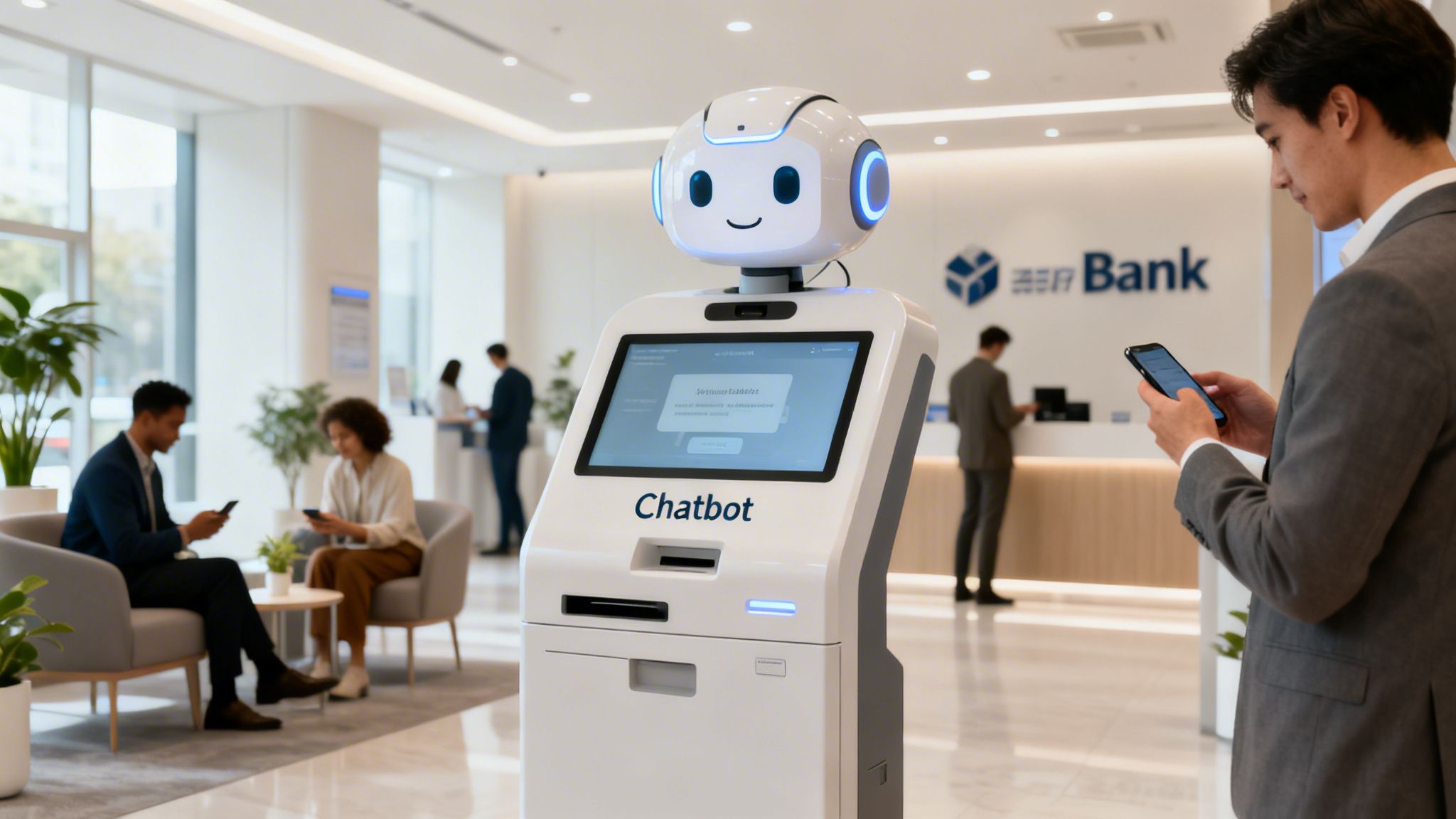
The old 9-to-5 banking model just can't keep up anymore. Your customers expect instant answers, whether they're checking their balance at midnight or questioning a transaction on a Sunday afternoon. This isn't a trend; it's the new standard. For banks, this creates a tough balancing act: how do you deliver scalable, personal service without letting operational costs spiral out of control?
This is where a banking chatbot becomes your best employee. It handles the flood of routine, high-volume questions—like "What's my account balance?" or "Show me my last five transactions"—with perfect accuracy every time. This frees up your human agents to do what they do best: solve complex problems and build real, high-value relationships with customers.
Meeting Modern Customer Demands
Modern customers don’t operate on your schedule; they operate on theirs. A banking chatbot meets them right where they are, whether it's inside your mobile app or on your website, providing immediate help through the channels they already prefer. This kind of accessibility is no longer a nice-to-have. It’s a core part of any competitive customer service strategy.
By automating the simple stuff, banks can boost their service capacity without needing to proportionally increase their headcount. The business advantages are clear and immediate:
- Reduced Support Costs: Automating common queries deflects a huge number of calls that would otherwise go to your more expensive contact centers.
- Enhanced Customer Satisfaction: Instant, 24/7 answers don't just solve problems—they build loyalty and improve the overall customer experience.
- Improved Agent Productivity: When agents aren't bogged down by repetitive questions, they can dedicate their expertise to resolving complex issues and strengthening customer relationships.
The Strategic Value of an Outsourcing Partner
Let's be realistic. Implementing this kind of technology well is a highly specialized skill. It requires deep knowledge of everything from AI development and natural language processing to securely integrating with core banking systems. This is where bringing in a strategic outsourcing partner from the USA becomes a game-changer. A US-based partner ensures seamless project management and clear communication, all while navigating the specific nuances of the domestic market and its strict compliance standards.
Partnering with an expert firm gives banks immediate access to top-tier AI talent and proven development frameworks. This dramatically speeds up your time-to-market while sidestepping the risks and headaches of building it all from scratch.
This approach gives you a cost-effective way to build a powerful and scalable chatbot solution without the massive overhead of sourcing, training, and managing a specialized internal AI team. You can explore more on how this model strengthens service delivery in our guide on connected customer service.
Ready to discuss how a dedicated team can build your bank's new digital front door? Contact us at (310)800-1398 / (949) 861-1804 or email us at [email protected].
Decoding the Technology Behind Banking Chatbots
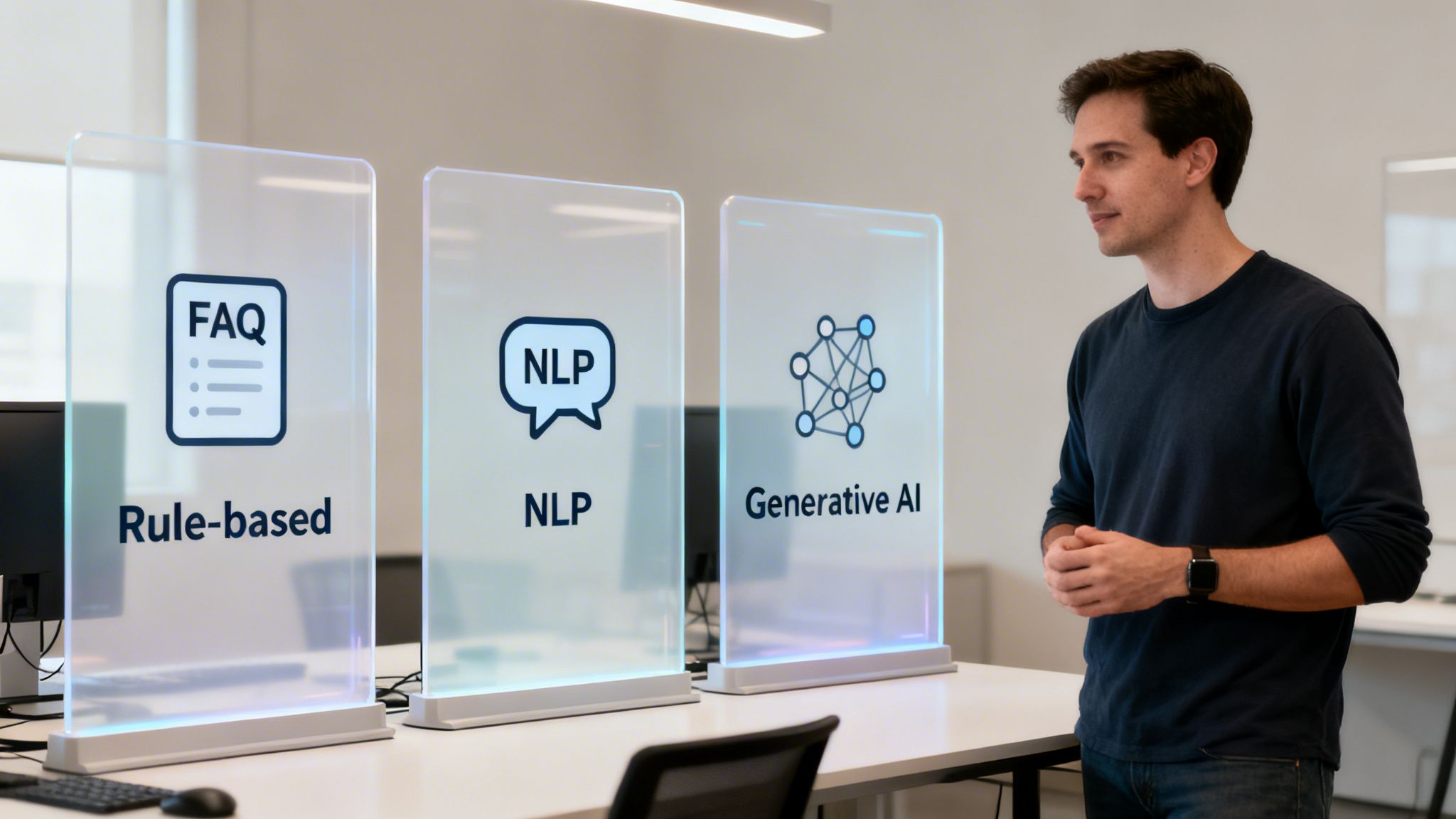
When you’re looking to bring a chatbot for banks into your institution, it’s easy to get lost in the tech-speak. But choosing the right one isn't about chasing buzzwords—it's about understanding the engine under the hood.
Not all chatbots are the same. They fall into a few distinct categories, and picking the right one is the first critical step. Let's break down what really makes them tick.
H3: The Foundation: Rule-Based Chatbots
Think of the most basic chatbot as an interactive, highly structured FAQ page. This is a rule-based chatbot, and it operates on a straightforward "if-then" script. If a customer types a phrase that perfectly matches a pre-written rule, the bot gives a pre-written answer. Simple as that.
They are fantastic for handling a limited set of simple, repetitive questions. Things like "What are your branch hours?" or "What's the bank's routing number?" are perfect for them. They're quick to get up and running and won't break the bank, but they have zero flexibility. If a question is phrased differently or falls outside the script, the bot is stumped.
H3: The Next Step Up: AI-Powered Chatbots
This is where things get intelligent. AI-powered chatbots don't just match keywords; they use Natural Language Processing (NLP) to understand the intent behind what a customer is saying.
This is the difference between a bot that only understands "show my balance" and one that gets "how much money is in my checking account right now?" It can decipher what a person is truly asking, even with slang, typos, or informal language.
These bots are more like a seasoned customer service agent. They can:
- Understand context across a conversation, not just a single message.
- Pull out specific details (like dates, account types, or dollar amounts) from a sentence.
- Hand off complex issues to a human agent, along with the full chat history.
Because they can navigate a much wider range of conversations, these AI bots deliver a far more helpful and satisfying experience. They’re the right choice for handling transaction histories, analyzing spending habits, or explaining detailed account policies.
H3: The Frontier: Generative AI Chatbots
The most advanced chatbots today are powered by generative AI. These models don't just follow rules or recognize intent—they create entirely new, context-aware responses in real-time. This capability opens the door to truly fluid, human-like conversations that can adapt to unexpected turns and complex problems.
A key technique powering many of these advanced bots is Retrieval-Augmented Generation (RAG). RAG allows the AI to pull information from a secure, external knowledge base—like your bank's latest product details or policy documents—to give answers that are both accurate and up-to-date.
With generative AI, a bot can move beyond simple Q&A. It can help a customer explore financial goals, explain the pros and cons of different loan types in simple terms, or even help draft an email to dispute a charge—all right inside the chat window.
To help you visualize the differences, here’s a quick comparison of the three main types of chatbot technology.
Comparison of Banking Chatbot Technologies
| Chatbot Type | Core Technology | Best For | Example Interaction | Complexity |
|---|---|---|---|---|
| Rule-Based | "If-Then" Logic | Static, high-volume FAQs (e.g., branch hours, routing numbers). | User: "What are your hours?" Bot: "Our branches are open 9 AM-5 PM." |
Low |
| NLP/AI | Natural Language Processing | Dynamic Q&A, transaction inquiries, lead qualification. | User: "How much did I spend on groceries last month?" Bot: "You spent $452.31 on groceries in May." |
Medium |
| Generative AI | Large Language Models (LLMs) & RAG | Personalized financial guidance, complex problem-solving, content creation. | User: "Explain the difference between a Roth and a traditional IRA." Bot: "A Roth IRA uses post-tax dollars… [generates a clear, personalized explanation]" |
High |
Choosing the right technology—from a simple rule-based bot for your website to a sophisticated generative AI for personalized banking—is a major strategic decision.
Get Expert Help with a US-Based Partner
An experienced US-based outsourcing partner is invaluable here. They’ve seen what works (and what doesn’t) and can help you match the right technology to your bank's specific goals, customer base, and budget.
Working with a knowledgeable US partner ensures clear communication and a deep understanding of the security and compliance standards that matter in American finance. This expert guidance helps you sidestep common pitfalls and make sure your investment pays off.
To decode your options and build a solution that truly fits your institution, give us a call today at (310)800-1398 / (949) 861-1804 or email us at [email protected].
Real-World Applications of Chatbots in Banking

Let's move past the theory. A chatbot for banks isn't just an interesting tech experiment; it's a workhorse for your daily operations, a direct line to your customers, and an engine for real growth. These digital assistants are already handling millions of conversations, proving their worth where it counts—in the real world.
The most immediate win is in customer support. Think about the flood of repetitive calls that tie up your contact centers. A chatbot gives instant, 24/7 answers to common questions like balance checks, transaction details, and simple fund transfers. This single move frees up your human agents to handle the complex, high-stakes issues where they can truly make a difference.
From Simple Questions to Deeper Financial Relationships
Imagine a customer’s entire interaction unfolding within the chat window. It might start simply. A customer—we’ll call her Sarah—opens your banking app at 10 PM on a Tuesday, wanting to check a recent transaction. The chatbot pulls up her statement in seconds.
She then asks, "How much did I spend on restaurants this month?" The bot doesn’t just give a number; it analyzes her spending and presents a clear breakdown. This kind of seamless, instant service builds trust and keeps her engaged within your bank’s digital home, instead of turning to a third-party budgeting app.
This is where the conversation gets interesting. Based on Sarah’s consistent savings habits, the chatbot could present a pre-qualified offer for a high-yield savings account. Or, noticing her spending patterns, it might suggest a credit card with rewards that actually match her lifestyle. The bot can then walk her through the benefits and even start the application, right there in the chat.
What started as a simple service query has just become a new revenue opportunity.
A great chatbot doesn't just give answers. It guides customers toward financial products that genuinely fit their lives, acting as a personal financial assistant that's always on, day or night.
Expanding the Chatbot's Role Across the Bank
Beyond the front lines of customer service, banking chatbots can drive efficiency in other critical areas. They are versatile tools that you can configure to support not just your customers, but your internal teams as well.
Here are a few advanced applications we've seen deliver huge value:
- Lead Qualification for Loans: A bot can handle the initial Q&A with prospective mortgage or auto loan applicants. It gathers the essential information and hands off a warm, qualified lead to your loan officers, saving everyone time.
- Instant Fraud Alerts: When a suspicious transaction pops up, the chatbot can send an immediate notification directly to the customer. They can confirm or deny the charge in real-time, stopping fraud in its tracks and boosting their confidence in your security.
- Internal Knowledge Base: Your own employees can use an internal chatbot to get fast, accurate answers on complex product rules, compliance procedures, or internal policies. This slashes training time and ensures every customer gets consistent, correct information. When things get more complex, you can also explore how real-time agent assistance complements a chatbot strategy perfectly.
The Value of a US-Based Outsourcing Partner
Bringing these applications to life requires a deep bench of technical expertise—in AI, data security, and the tricky API integrations needed to connect with core banking systems. This is where partnering with a specialized US-based outsourcing firm gives you a serious advantage.
A domestic partner brings more than just coding skills. They bring a critical, built-in understanding of the US regulatory landscape, ensuring every feature is developed with compliance at its core.
This kind of partnership gets you to market faster and gives you access to a dedicated team of experts who own the entire project. You get a secure, scalable, and powerful solution without the immense overhead of building an in-house AI team from the ground up.
To see how these real-world applications could be tailored for your institution, let's talk. Call us at (310)800-1398 / (949) 861-1804 or email [email protected] to start the conversation.
Ensuring Security and Compliance with Banking AI

In banking, trust isn’t just a nice-to-have; it’s the entire business. When you introduce a chatbot for banks to your customer channels, you’re essentially making it a new guardian of that trust. Because of this, security and compliance can't be bolted on at the end. They have to be the bedrock of your AI strategy from day one.
Every conversation and every byte of data passing through that chatbot must be handled with the highest standard of care. There’s no way around the intricate web of financial regulations, from GDPR to local data protection laws. This demands a security-first mindset before a single line of code is written.
Fortifying the Digital Front Door
Think of your chatbot as the digital front door to your bank. Just like you wouldn't leave the main entrance unlocked, your AI assistant needs layers of defense to protect sensitive customer information. Building a secure chatbot for banking isn't about one single feature; it’s about a set of core components working in concert to create a hardened perimeter.
These security measures aren't just best practices; they are table stakes for earning and keeping your customers' confidence. Key components include:
- End-to-End Encryption: All data must be fully encrypted, whether it’s sitting on a server or moving between the customer, the chatbot, and your back-end systems. If data is ever intercepted, it has to be completely unreadable.
- Multi-Factor Authentication (MFA): For any high-stakes action, like accessing account details or authorizing a transaction, the chatbot must initiate an MFA process. This verifies the user's identity through a second channel—like a one-time code sent to their phone—before anything proceeds.
- Secure API Integrations: The connections to your core banking platform and CRM are critical gateways. They must be managed through rigorously secured and authenticated APIs that act as controlled checkpoints, ensuring only authorized data can pass through.
The goal is to weave security so deeply into the chatbot's fabric that customers feel just as confident using it as they do speaking to a teller face-to-face. Security should be an invisible, yet unbreakable, part of the experience.
Maintaining an Unbreakable Audit Trail
Regulators don’t make exceptions for AI. They require clear, comprehensive records of all customer interactions, and bot conversations are no different. Your banking chatbot must maintain immutable audit trails—a permanent, unalterable log of every single conversation and transaction.
This log is your definitive record for regulatory reviews, dispute resolutions, and internal security checks. It provides a concrete answer to "who did what, and when," ensuring total transparency and accountability for every action the chatbot takes. You can learn more about this approach in our guide on how to implement zero-trust security, a framework built on the principle of trusting no one by default.
The Advantage of a US-Based Compliance Expert
Navigating this complex landscape of security and compliance is a highly specialized skill. It’s one of the main reasons financial institutions choose to work with a US-based outsourcing partner. A domestic partner brings an immediate, up-to-date understanding of US financial regulations and data privacy laws.
This isn't expertise you can build overnight. A US-based team bakes compliance into the architecture from the very beginning, heading off risks and ensuring your chatbot meets every single standard. They manage the heavy lifting of secure development and integration, freeing you to focus on your core business while building a powerful and trustworthy AI solution.
Ready to build a secure chatbot your customers can trust? Contact us today to discuss your security and compliance needs at (310)800-1398 / (949) 861-1804 or email [email protected].
Your Implementation Roadmap for a Banking Chatbot
Rolling out a banking chatbot isn't a single, massive project you can knock out in a weekend. It's a journey. And like any journey, a chaotic start will get you lost, erode customer trust, and waste a lot of money. The key is to think of it not as one giant leap but as a series of deliberate, well-planned steps.
Think of it like building a multi-story building. You don't start by picking out furniture for the penthouse. You start by pouring a solid, unshakable foundation. This methodical, phased approach ensures you deliver real value quickly, learn from your users, and sidestep the massive risks that come with a big-bang launch.
Phase 1: The Foundation and Your MVP
This first phase is all about getting the groundwork right. Before you write a single line of conversational dialogue, you have to lay a secure and stable technical foundation. This is where you get brutally honest about your business goals and set the project's true north.
This is also the stage where you build your Minimum Viable Product (MVP). An MVP isn't a watered-down, feature-poor version of your final vision. It's the opposite. It’s a sharp, highly effective tool designed to do one thing exceptionally well: solve your customers' most frequent and frustrating problems. By launching an MVP that handles just the top 3-5 most common queries—like balance checks or transaction history—you prove the concept's value almost overnight and start gathering real-world data.
Key steps in this foundational phase include:
- Defining Business Goals: What’s the number one thing you need this to do? Is it cutting down call center volume? Generating more qualified loan leads? Or boosting your Customer Satisfaction (CSAT) score? A single, clear goal will guide every decision you make from here on out.
- Platform Selection: Choose the technology that fits not just your MVP, but your vision for three years from now. Look at its ability to scale, its security credentials, and how easily it will plug into the systems you already have.
- Building the MVP: Focus relentlessly on the biggest customer pain points. Automating balance inquiries, transaction history requests, and password resets are classic starting points because they deliver immediate relief to both customers and your support team.
Your MVP is the first floor of the building. It’s functional, it provides immediate value, and it proves that your architectural plans are sound. A win here builds the confidence and momentum you need for the rest of the project.
Phase 2: Integration and Training
With the foundation poured and the first floor in place, it’s time to connect the plumbing and electricity. A chatbot that can't access real-time information is little more than a glorified FAQ page. This phase is all about the critical integrations that make your chatbot genuinely helpful.
This means building secure API connections to your core banking software and CRM systems. These are the pipes that allow the chatbot to pull live account data, see transaction histories, and understand customer profiles. It’s what allows the bot to provide truly personal and accurate help. This is also where you train the AI model on your bank's specific data, teaching it the unique language of your products, policies, and the thousand different ways a customer might ask for the same thing.
Phase 3: Expansion and Optimization
Once your MVP is live, stable, and successfully handling those core queries, it’s time to start building upward. This phase isn’t driven by guesswork; it’s driven by data and user feedback. By analyzing your chat logs and performance metrics, you can see exactly where the demand is and what you should build next.
This continuous cycle of improvement could involve:
- Adding new capabilities, like pre-qualifying customers for personal loans or mortgages.
- Expanding the chatbot's knowledge base to answer more complex questions about investment products or business accounts.
- Integrating the chatbot into other places where your customers are, like SMS or social media messaging apps.
This process ensures your chatbot grows with your customers' needs, becoming a more powerful and essential part of how you deliver service.
The Advantage of a US-Based Outsourcing Partner
Executing this roadmap takes a specific mix of technical expertise, disciplined project management, and deep financial industry knowledge. This is where a US-based outsourcing partner can be a game-changer. They don’t just build the bot; they manage the entire process for you, bringing proven frameworks and a team of experts who have done this before.
A partner based in the US inherently understands the domestic market, the regulatory environment, and ensures communication is always clear. They keep the project on track and aligned with your goals. They handle the gritty complexities of secure integrations and AI training, freeing up your team to focus on what they do best: banking.
Ready to start building your roadmap? Contact us to discuss how our team can help you lay the foundation for a successful banking chatbot. Call (310)800-1398 / (949) 861-1804 or email [email protected] today.
Build In-House or Partner with an Expert
Once you’ve mapped out your vision, you arrive at the most critical fork in the road: who will actually build it? This decision—to assemble a team from scratch or to partner with a specialized firm—will shape your project’s timeline, budget, and eventual success more than any other choice you make.
The idea of a bespoke, in-house AI team is seductive. It promises total control. But the reality is that it conceals a mountain of complexity and hidden costs. You're not just hiring developers; you're hunting for a rare blend of AI engineers, NLP experts, security architects, and project managers who live and breathe the nuances of financial services. This talent search can burn months, if not years, piling up overhead and risk before a single line of code is written.
The Strategic Edge of an Expert Partner
Now, consider the alternative. Partnering with a specialized firm gives you immediate access to a proven, full-stack team. It’s like having a world-class AI division on speed dial, ready to bring your vision to life from day one. This route completely bypasses the slow, expensive, and uncertain process of building an internal team, dramatically accelerating your path to launch.
A seasoned partner brings more than just technical horsepower; they bring a battle-tested methodology. They’ve already navigated the pitfalls you haven’t seen yet. They manage the entire lifecycle—from strategy and secure development to deployment, ongoing maintenance, and optimization. This frees up your internal teams to do what they do best: deliver outstanding banking services.
As you weigh your options, take the time to explore specific AI Assistant solutions already on the market. This will give you a concrete benchmark for what a turn-key technology from a specialized vendor can deliver right out of the box.
Why a USA-Based Partner Matters
Choosing a USA-based outsourcing partner isn’t just about location; it’s about operational fluency and trust. A domestic partner provides a layer of assurance that is simply non-negotiable in the financial sector. They operate in your time zones, which means communication is immediate and project management flows seamlessly. There are no late-night calls or delayed responses.
More importantly, a US-based firm has an intrinsic, deeply embedded understanding of the American regulatory landscape. Their expertise ensures your chatbot is built with compliance and security at its very core, perfectly aligned with domestic data privacy laws and financial standards. This alone removes a massive layer of risk and uncertainty from your project.
A US-based outsourcing partner combines global talent access with local accountability. You get the cost and scalability benefits of a distributed team, guided by project leadership that understands your market and your customers.
The industry trend is undeniable. By 2025, it's projected that 73% of banks worldwide will have deployed at least one chatbot, with North American banks leading the charge at 92% adoption. As you can read in this detailed report on banking chatbot adoption, this rapid adoption is fueled by the scalability that outsourcing provides. It allows banks to tap into a global talent pool to build and deploy sophisticated, multilingual chatbots for cross-border services, all while maintaining local oversight.
Ultimately, partnering with an expert is the most direct and reliable path to launching a powerful, secure, and scalable chatbot. To start building your solution with a team that’s ready to go, contact us at (310)800-1398 / (949) 861-1804 or email [email protected].
Frequently Asked Questions About Chatbots for Banks
As you consider bringing a chatbot into your institution, a few key questions always come up. It's natural. Before moving forward, decision-makers need straight answers to address those final, practical concerns. Here are the most common questions we hear from financial leaders, answered directly.
How Long Does It Take to Implement a Chatbot for a Bank?
The timeline really depends on how ambitious you want to be out of the gate. A simple MVP (Minimum Viable Product) chatbot, designed to handle your most common FAQs, can be up and running in as little as 4-6 weeks. This approach is great for a quick win—it proves the concept and starts collecting user data right away.
If you’re aiming for a more advanced AI-powered bot that needs to talk to your core banking systems for personalized answers, the first phase usually takes about 3-6 months. For a full-scale, omnichannel deployment that works across all your customer touchpoints, you should plan for six months or more.
Working with an experienced outsourcing partner from the USA can shorten these timelines dramatically. A seasoned firm doesn't start from scratch; we use proven frameworks and pre-built components to accelerate development and get you to market faster.
How Do You Measure the ROI of a Banking Chatbot?
The return on a banking chatbot isn't just a fuzzy feeling—it's something you can see in the numbers. The trick is to track specific metrics before and after the launch to show a clear financial and operational impact.
You can measure your ROI by tracking:
- Reduced Operational Costs: This is the most direct benefit. Calculate the drop in call volume to your contact centers as the bot deflects routine questions.
- Increased Agent Productivity: Your human agents are a valuable resource. Measure the time they get back by not answering the same questions over and over, allowing them to focus on complex, high-value issues.
- Higher Customer Satisfaction (CSAT): Track your CSAT scores. You'll almost certainly see a lift when customers get instant, 24/7 support.
- Increased Lead Generation: Monitor how many qualified leads the bot generates for products like loans, credit cards, and new accounts.
- Reduced Customer Churn: Keep an eye on customer retention rates. Better, more available service has a direct impact on loyalty.
Can a Chatbot Handle Sensitive Banking Information Securely?
Yes, but only if it's designed with security as the absolute first priority, not an afterthought. A truly secure chatbot for banks is built on a foundation of robust security protocols that protect every single customer interaction.
This means using end-to-end encryption for all data, whether it's in transit or at rest. It means enforcing multi-factor authentication (MFA) for any sensitive action. It also means using data anonymization to mask personally identifiable information (PII). A secure bot should never store sensitive data; it should only access it through secure, authenticated APIs connected to your core systems.
This is where partnering with an expert in financial compliance standards like PCI DSS and SOC 2 becomes non-negotiable. A USA-based partner ensures the entire architecture is built to be secure and trustworthy from day one, mitigating risk and building the confidence your customers demand.
Ready to get answers to your specific questions? The team is here to help you navigate your journey.
Contact us today at (310)800-1398 / (949) 861-1804 or email [email protected] to discuss your project.