
Let's be honest, cloud consulting services aren't just about IT support. Thinking of them that way is like calling a master architect a handyman. You don't hire an architect to just fix a leaky faucet; you hire them to design a skyscraper that’s strong, efficient, and built for the future. That’s what a great cloud partner does for your business.
Why Cloud Consulting Is Your Strategic Blueprint for Growth
Bringing in a cloud consultant isn’t about outsourcing a task. It’s about gaining a strategic partner who can see the forest for the trees, translating complex tech into real-world business wins. They help you move past simply using the cloud to strategically profiting from it.
Their job is to clear a path through the jargon and create a roadmap that modernizes how you work, makes you more agile, and gives you a durable edge. Smart leaders know that before you get lost in the technical weeds, you need someone who can align the technology with your actual business goals.
The Value of an Expert Guide
Think of a cloud consultant as a seasoned navigator for the vast, sometimes treacherous, world of cloud technology. They don't just point you toward a destination; they chart the safest, most efficient route to get there. Their main job is to help you sidestep the costly mistakes and dead ends that sink so many cloud projects.
This guidance is what future-proofs your business. A well-designed cloud strategy isn't just a solution for today. It's a flexible foundation that can grow and adapt as markets shift, customers change, and new opportunities pop up.
A consultant's real value is in their ability to draw up a strategic blueprint that connects your tech infrastructure directly to your core business goals. They turn IT from a cost center into a powerful engine for growth.
The Rush for Cloud Expertise Is On
The race to the cloud isn't just continuing; it's accelerating at an incredible pace. Market research shows the global demand for cloud consulting is set to explode, projected to grow from USD 37.59 billion in 2026 to a staggering USD 143.2 billion by 2035.
This surge is happening for a clear reason: businesses everywhere are scrambling to modernize, with recent studies showing over 68% of companies are speeding up their cloud adoption efforts.

These numbers tell a simple story: trying to navigate the cloud alone is becoming a serious competitive disadvantage. The complexity is real, and the specialized expertise required is often more than an in-house team can handle.
Working with an experienced, USA-based provider adds another layer of security and efficiency. You get seamless communication, shared business hours, and a team that has a deep-seated understanding of the domestic regulatory landscape. It ensures your project moves forward without friction, managed by people who get your market.
Ready to start drafting your own blueprint for growth? Let's begin the conversation.
(310) 800-1398 / (949) 861-1804
Email: info@ninearchs.com
What Does a Cloud Consultant Actually Do? The Core Services Explained
A great cloud consulting partnership is about more than just giving advice; it’s about rolling up sleeves and building the engine that drives your business forward. These services aren't just a list of technical tasks. They are a set of connected disciplines that support you at every stage, from the first "what if?" conversation to keeping everything running smoothly years down the line.
Think of it less like a menu and more like a construction crew. You have the architect, the project manager, the security expert, and the financial planner—all working together. Understanding their roles helps you see how a chaotic idea becomes a strong, efficient, and future-proof digital operation.
Let's break down the essential services that turn a cloud vision into business reality.
Cloud Strategy and Advisory
Before you move a single piece of data, you need a plan. A really good one. This is where strategy and advisory work begins. A consultant’s first job is to listen—to understand your business goals, your operational headaches, and where you want to be in the next five years.
The result isn't a vague document; it's a concrete roadmap. It answers the big questions: Which cloud platform makes sense for us? Should we go all-in on a public cloud, or does a hybrid model fit better? And most importantly, how will we know this investment is actually paying off? This step ensures your tech decisions are driven by business value, not just trends, preventing expensive missteps before they happen.
Cloud Migration and Modernization
With a solid strategy in hand, it’s time to get to work. Cloud migration is the process of moving your digital assets—applications, data, and infrastructure—from your own servers into the cloud. It’s like a carefully orchestrated corporate move, but for your technology. The goal is simple: zero downtime and a system that’s better from day one. Many top-tier services, like those offered by Ollo for secure cloud migrations, focus on making this transition seamless.
A consultant manages the entire complex move, handling critical details like:
- Workload Triage: Digging into your applications to figure out which ones can move as-is, which need a tune-up (modernization), and which are ready for retirement.
- Phased Relocation: Moving systems in smart, logical waves. This minimizes risk and lets the team learn and adapt with each step.
- Day-One Readiness: Once everything is moved, we test, validate, and confirm it all works exactly as it should—no surprise dips in performance or security.
Cloud Architecture and Security
A powerful cloud setup needs a strong blueprint. A consultant designs your cloud infrastructure not just for today's workload, but for tomorrow's growth. It’s about building a resilient, high-performance system that won’t buckle during a traffic spike and can easily adapt as your business evolves.
And security? It's not something bolted on at the end. It's woven directly into the design from the very first line of code. This means setting up strict access controls, locking down network pathways, and making sure every part of your system meets industry compliance standards. For a closer look at what makes a solid IT foundation, check out our guide on IT infrastructure consulting.
Your cloud architecture is the digital skeleton of your company. A good one makes you fast, reliable, and secure. A bad one causes endless performance headaches and leaves you vulnerable.
FinOps and Cost Optimization
One of the biggest promises of the cloud is saving money, but that only happens if you manage your spending actively. Surprise bills are a common and painful lesson for companies that go it alone. This is where FinOps comes in.
Short for Financial Operations, FinOps is all about bringing financial discipline to the cloud’s pay-as-you-go model. A consultant helps you put the right tools and processes in place to track spending in real-time, set intelligent budgets, and hunt down waste. This proactive approach ensures you’re only paying for what you actually use and can forecast your costs with confidence.
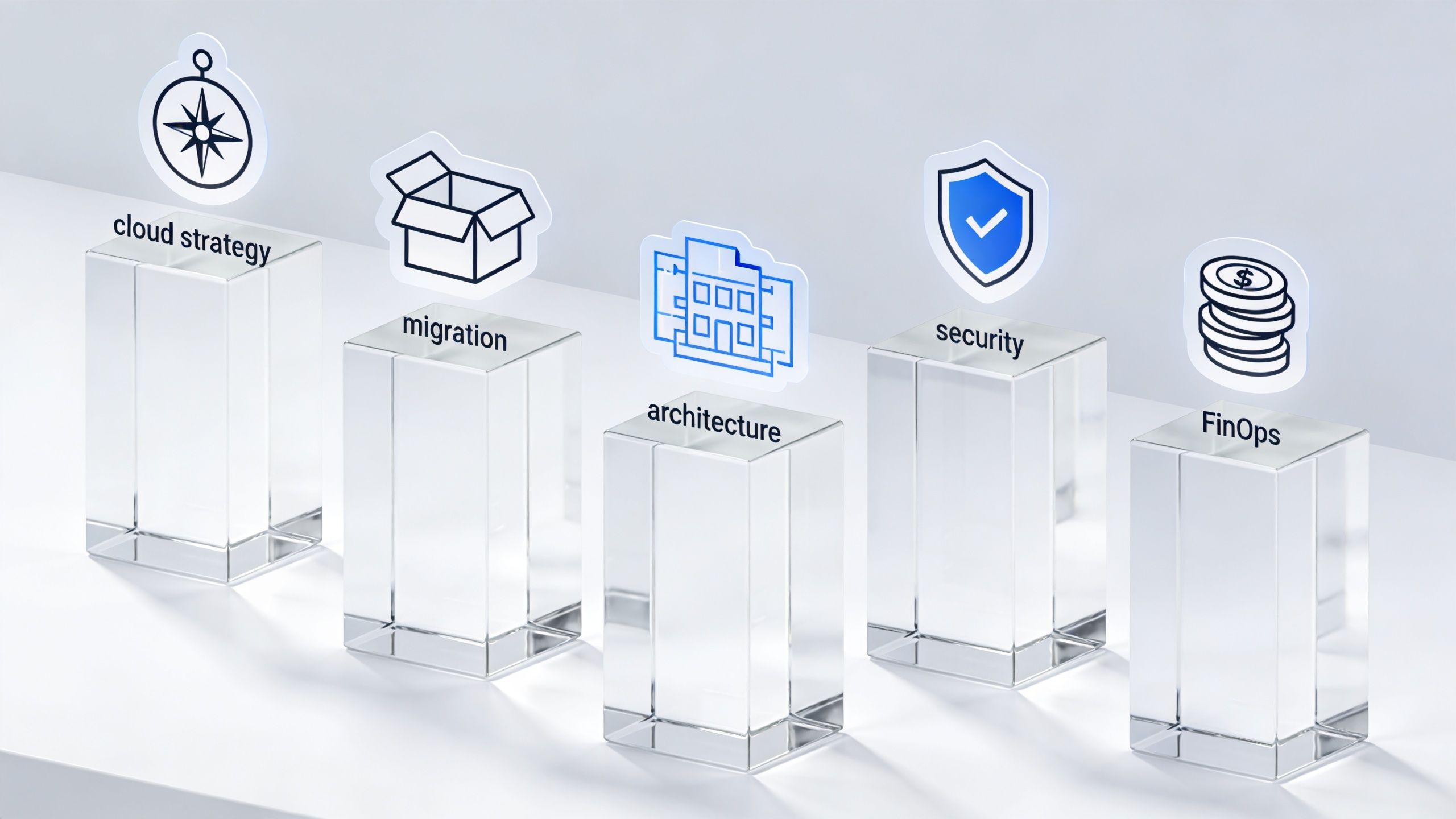
The table below summarizes these core services and the direct business value they bring to the table.
Cloud Consulting Services and Their Business Impact
| Service Offering | Core Business Value |
|---|---|
| Cloud Strategy | Aligns technology investments with long-term business goals, preventing wasted effort and money. |
| Cloud Migration | Moves existing systems to the cloud with minimal disruption, unlocking new capabilities. |
| Cloud Architecture | Creates a reliable, scalable, and high-performance foundation for digital operations. |
| Cloud Security | Protects data, applications, and customer trust by integrating security into every layer. |
| FinOps & Cost Optimization | Provides visibility and control over cloud spending, maximizing return on investment. |
Each of these services builds on the others, creating a complete support system for your digital journey. Ready to map out yours?
Contact us today.
(310) 800-1398 / (949) 861-1804
Email: info@ninearchs.com
The Strategic Edge of a USA-Based Outsourcing Partner
Choosing a partner for your cloud consulting services is a decision that ripples far beyond just technical skills and price tags. While the global talent market is vast, there are quiet, strategic advantages to partnering with a firm right here in the USA that directly feed into your project's success, security, and long-term health. Think of it as an investment in predictability and peace of mind.
When your consulting partner operates on the same clock you do, the friction just disappears. There are no more late-night calls or waiting until tomorrow for an answer that’s holding up your team today. This simple time zone alignment oils the gears of decision-making, tightens feedback loops, and keeps your project moving forward—a critical factor for sensitive cloud migrations and deployments.
Seamless Collaboration and Cultural Understanding
A shared business culture is one of those soft skills that delivers hard results. A US-based team just gets the nuances of the local market, the unwritten rules of communication, and the professional rhythm you expect. This shared language eliminates the small misunderstandings that can quietly derail a project and lead to expensive rework.
This alignment makes the whole partnership feel more intuitive. Your consultants can better anticipate your needs, flag potential challenges before they become problems, and explain complex technical details in a way that makes sense to your business leaders. It makes everything smoother, from the first kickoff meeting to the final handover.
Robust Security and Regulatory Familiarity
In a world where data privacy is no longer optional, working with a domestic partner brings a powerful sense of security. US-based firms live and breathe the intricate network of federal and state regulations, from the California Consumer Privacy Act (CCPA) to other industry-specific compliance rules. This expertise isn't just an add-on; it's woven into their DNA, helping you sidestep serious legal and financial headaches.
Partnering with a domestic provider gives you the security of clear contractual enforcement under US law. This legal and regulatory alignment minimizes risk and provides a straightforward path for accountability, ensuring your data and intellectual property are protected.
Furthermore, a USA-based partner connects you to a premier talent pool known for disciplined project management and advanced technical skills. While many businesses explore global talent strategies to build out their teams, and might even hire LATAM developers to scale their solutions, keeping your core strategic partner domestic is key. It ensures that the project's architectural vision, security governance, and critical decisions remain tightly controlled and perfectly aligned with your primary business goals.
Ultimately, choosing a US-based partner is about making a low-risk, high-reward bet on your company's future. It's a move that ensures your cloud journey is not only technically solid but also strategically secure and built for the long haul. This transforms outsourcing from a simple line-item expense into a genuine competitive advantage.
Ready to build a secure, efficient cloud strategy with a trusted USA-based partner?
Contact us to get started.
(310) 800-1398 / (949) 861-1804
Email: info@ninearchs.com
Your Actionable Cloud Migration Checklist
A cloud migration isn't a single event; it's a carefully managed journey. It can feel overwhelming, with all the technical moving parts and hidden dependencies. But by breaking the entire process down into clear, predictable phases, you turn a massive project into a series of manageable steps.
Think of this checklist as your roadmap. It’s the same structured approach we use with our clients to move them forward with confidence, ensuring that every decision made at the beginning supports your goals for years to come. It’s all about being deliberate, methodical, and strategic.

Phase 1: Assessment and Planning
This is where your success is won or lost. Before you move a single piece of data, you have to know exactly what you’re working with. This means a deep-dive audit of your entire IT environment—every application, database, and server.
The goal here is discovery. We need to map out the tangled web of dependencies between your systems. Which applications talk to which databases? Which services rely on each other to run? If you miss even one of these connections, you’re setting yourself up for major headaches later. This phase gives us a preliminary Total Cost of Ownership (TCO) analysis, giving you a real-world picture of cloud costs versus your current setup.
Phase 2: Design and Architecture
Once you have a full inventory, it’s time to design your new home in the cloud. This isn’t about just lifting and shifting your old setup. This is your chance to build something better—more efficient, more secure, and more resilient.
During this phase, we help you answer the big questions:
- Which Cloud Model Fits Best? Does a public cloud meet all your needs, or would a hybrid model give you better security and performance for certain applications?
- What’s the Right Migration Strategy? Should we move your applications as-is, or does it make more sense to rebuild them as cloud-native to take full advantage of the new environment?
- How Do We Lock Down Security? This is where we build security and compliance rules directly into the architecture, not as an afterthought.
A well-designed cloud architecture is like the foundation of a house. It has to be strong enough to support everything you build on top of it, ensuring stability, security, and the ability to grow without having to tear it all down and start over.
Phase 3: Pilot and Testing
You wouldn't buy a car without a test drive. Before committing to a full-scale migration, we need to validate the plan. A pilot migration involves moving a small, non-critical workload to the cloud using the architecture we just designed. It’s a dress rehearsal that gives us invaluable, real-world feedback.
This controlled test lets you work out any kinks in the process, confirm that performance is what you expect, and get your team comfortable in a low-risk environment. If the pilot uncovers issues—and it often does—we can adjust the plan before they become major problems during the real thing.
Phase 4: Full-Scale Migration
With a successful pilot in the books, it's time for the main event. This is almost never done all at once. Instead, we execute the migration in carefully planned waves, moving applications and data in logical groups.
This phased approach keeps business disruption to a minimum. For example, we might start with internal development and testing environments, then move to less critical business apps, saving your most important, customer-facing systems for last. For smaller companies, the details of this process are especially important. You can find out more in our guide on cloud migration for small business.
Phase 5: Post-Migration Optimization
Your journey doesn't end the day you go live in the cloud. In fact, in many ways, it's just beginning. Once your workloads are running in their new environment, the focus immediately shifts to continuous optimization. This means constantly monitoring performance, security, and—crucially—cost.
Your cloud environment is a living system that should evolve with your business. This final phase involves setting up the right monitoring tools, refining security policies, and actively managing your spending to make sure you’re always getting the best possible value from your investment.
Partnering with a USA-based firm for your migration ensures seamless communication and deep regulatory knowledge every step of the way. Ready to start your journey?
(310) 800-1398 / (949) 861-1804
Email: info@ninearchs.com
Mastering Cloud Costs and Proving Your ROI
Let’s be honest: nothing derails a great cloud strategy faster than a surprise bill. The cloud’s incredible flexibility is its biggest selling point, but without a tight grip on spending, that same flexibility can lead to costs that spiral out of control. Getting a handle on your cloud economics isn't just about saving money; it's about building a rock-solid business case for your investment and making sure you get every ounce of value from it.
The first step is understanding the game. You'll run into two main pricing models. Pay-As-You-Go is fantastic for its on-demand nature—scale up for a big launch, scale down during quiet periods. But for your everyday, steady workloads, it can get expensive. On the other hand, Reserved Instances offer huge discounts if you commit to using a certain amount of resources for one or three years. This is perfect for predictable, long-haul needs. The real trick, and where an experienced partner comes in, is blending these models to match how you actually work.
Beyond Infrastructure Savings: The True Meaning of TCO
When companies first look at the cloud, they often make a classic mistake: they just compare the cost of a cloud server to the cost of their old physical one. It’s an apples-to-oranges comparison that completely misses the point. The real Total Cost of Ownership (TCO) in the cloud is so much bigger than just hardware.
A proper TCO calculation has to include the hidden-but-huge savings:
- Reduced Operational Overhead: Think about all the hours your IT team won't spend patching servers, dealing with hardware failures, or worrying about data center cooling. That time is now free.
- Increased Developer Productivity: What’s the value of your engineers building new, money-making features instead of sitting around waiting for someone to provision a server for them?
- Faster Time-to-Market: How much is it worth to launch your new product or service weeks, or even months, ahead of the competition?
- Improved Operational Resilience: What's the financial hit from a single hour of downtime? The cloud’s built-in disaster recovery and uptime capabilities have a real, measurable dollar value.

Introducing FinOps: The Discipline of Cloud Financial Management
To manage these new financial realities, a discipline called FinOps (Financial Operations) has become absolutely essential. FinOps brings financial accountability to the cloud's variable spending model, creating a shared language and a culture of cost-awareness between your tech and finance teams.
FinOps isn't just about saving money; it's about making better, data-driven decisions on where to spend it. It turns cloud cost management from a reactive, bill-paying exercise into a proactive, strategic function that directly drives business value.
A good cloud partner helps you put a real FinOps framework in place. We're talking about setting up the right cost monitoring tools, creating budgets that make sense for each department, and establishing automated alerts that catch spending spikes before they become a problem. This process is key to stamping out waste from idle or over-provisioned resources. To truly get this right, exploring a variety of cloud cost optimization strategies is crucial for long-term financial health.
When you master cloud economics, you build a powerful business case that screams ROI. For a deeper look at this, check out our detailed guide on cloud cost optimization strategies. Working with a USA-based provider ensures this entire process is managed with clear communication and a real understanding of your business, turning your cloud investment from a line-item expense into an engine for growth.
Ready to gain control over your cloud spending and prove your ROI? Let's talk.
(310) 800-1398 / (949) 861-1804
Email: info@ninearchs.com
It’s Time to Move from Theory to Action
A cloud project that doesn't deliver real-world results is just an expensive science experiment. It’s easy to get caught up in the technical details, but a successful cloud journey is first and foremost a business journey. The right partner isn’t just a technician; they’re the guide who helps you turn technological potential into measurable performance.
This journey starts by taking an honest look in the mirror. Where are you, really, with the cloud? More importantly, what are the nagging business challenges that you hope it will solve? This isn't about chasing trends; it's about laying a foundation to achieve your most critical goals, transforming technology from a line item expense into a powerful engine for growth.
A cloud initiative succeeds when the technology is a direct answer to a business problem. That means we have to look past the technical jargon and focus on what actually moves the needle: getting to market faster, creating a more resilient business, and seeing a real return on your investment.
Choosing a partner based in the USA helps anchor this whole process in clear communication and a shared understanding of your world. It's about building a secure, efficient cloud strategy with a team that operates on your clock and understands the nuances of your market.
Ready to have a real conversation about your specific needs and how to drive tangible results?
(310) 800-1398 / (949) 861-1804
Email: info@ninearchs.com
Frequently Asked Questions About Cloud Consulting
Thinking about bringing in a cloud consultant? It’s a big step, and you probably have a lot of questions. We get it. Below are the straight-talking answers to the questions we hear most often from business leaders just like you.
How Long Does a Typical Cloud Migration Take?
This is always one of the first questions, and the honest answer is: it depends entirely on your business. There's no one-size-fits-all timeline. The real schedule is shaped by how complex your current IT setup is, how many applications you’re moving, and the migration path we choose together.
A small company with a handful of modern applications might be up and running in a few weeks. A larger enterprise wrestling with decades of legacy software? That could be a project spanning several months, or even longer. The key is to avoid a "big bang" approach. We break the project down into manageable phases, which gives you predictable progress and keeps disruptions to an absolute minimum.
Is Cloud Consulting Only for Large Enterprises?
Not at all. In fact, some of the biggest wins we see are with startups and small businesses. While big corporations have the budget, smaller companies have the agility. The cloud’s pay-as-you-go model and incredible scalability are perfect for growing businesses that need to compete without a massive upfront investment in hardware.
For a startup, cloud consulting is like getting access to an enterprise-level CTO on a small business budget. It allows you to build a secure, scalable foundation from day one, so you can avoid the costly technical debt that almost always slows down growth later on.
What Is the Difference Between a Consultant and a Managed Service Provider?
Think of it like building a house versus maintaining it. A consultant is the architect and the project manager. They focus on strategy, planning, and project-based work, like designing your cloud environment or leading the migration. Their job is to get you set up for success.
A Managed Service Provider (MSP), on the other hand, is the team that keeps the house in perfect working order after you've moved in. They handle the day-to-day operations of your cloud environment—the monitoring, maintenance, security, and support.
Today, many of the best partners, including USA-based firms, do both. This creates a seamless journey from initial strategy all the way to long-term operational excellence. You get one trusted partner, one point of contact, and a team that understands your business inside and out.
Ready to get answers tailored to your specific business needs? We are here to help you build a clear, effective cloud strategy.
(310) 800-1398 / (949) 861-1804
Email: info@ninearchs.com