
Let’s be honest, “digital transformation” is a term that gets thrown around so much it can lose its meaning. At its core, though, it’s about fundamentally rethinking how your business runs, connects with customers, and thrives in a world that’s gone digital. It’s not just about buying new software; it’s about overhauling your processes and even your company culture to stay ahead.
What Are Digital Transformation Consulting Services

Think of it like modernizing a classic car. You’d never get rid of the timeless chassis—that’s your core mission and values. But you’d absolutely upgrade the engine for better performance (operations), install a modern GPS for a smoother journey (customer experience), and drop in a new computer for smarter decisions (IT infrastructure).
Digital transformation consulting services are the master mechanics and expert engineers who guide that complex upgrade. They bring more than just technical skill; they provide a strategic roadmap to navigate what can be a massive business change. A good consultant acts as an objective partner, spotting the inefficiencies and growth opportunities you’re often too close to see. They help you sidestep expensive mistakes and get to real, measurable results faster.
The True Purpose of a Consulting Partnership
The goal isn’t just to install shiny new tech. It’s to completely reimagine how your business creates and delivers value. This means a consultant will take a deep dive into your existing workflows, your team’s capabilities, and what your customers actually expect from you. From there, they build a strategy that lines up the right technology with your most critical business goals.
A partnership with a seasoned consultant helps you hit several key objectives:
- Greater Efficiency: Automate tedious manual tasks and streamline workflows to cut operational costs.
- Stronger Market Position: Use data and technology to innovate faster and improve your offerings.
- Enhanced Operational Agility: Build flexible systems that can pivot quickly when the market shifts.
This demand for expert guidance is why the market is booming. The global digital transformation consulting services market jumped from $36.82 billion in 2021 and is projected to hit $56.3 billion by the end of 2025. This explosive growth shows just how urgent this is for businesses everywhere. North America is leading the pack, with its market share expected to reach $22.177 billion in 2025, thanks to heavy investment in cloud, AI, and cybersecurity. You can discover more market insights about this rapid expansion.
The Advantage of a USA-Based Partner
Choosing the right partner is everything, and working with a provider based in the USA gives you some distinct advantages. A US-based consultant means you get seamless, real-time communication without timezone headaches. You also get a shared understanding of American business culture and regulatory hurdles, plus top-tier protection for your sensitive data and intellectual property. This alignment just makes everything smoother, accelerating project timelines and giving you a reliable foundation for your modernization efforts.
A consultant’s role is to bridge the gap between your current reality and your future potential. They provide the strategy, tools, and expertise needed to turn ambitious goals into tangible business results, ensuring your investment delivers a powerful return.
By bringing in an expert guide, you get to skip the painful and expensive trial-and-error phase. Instead, you gain a dedicated ally focused on building a resilient, efficient, and future-ready organization. To discuss how a US-based team can guide your journey, call us at +1 (310)800-1398.
Exploring Core Consulting Offerings and Solutions
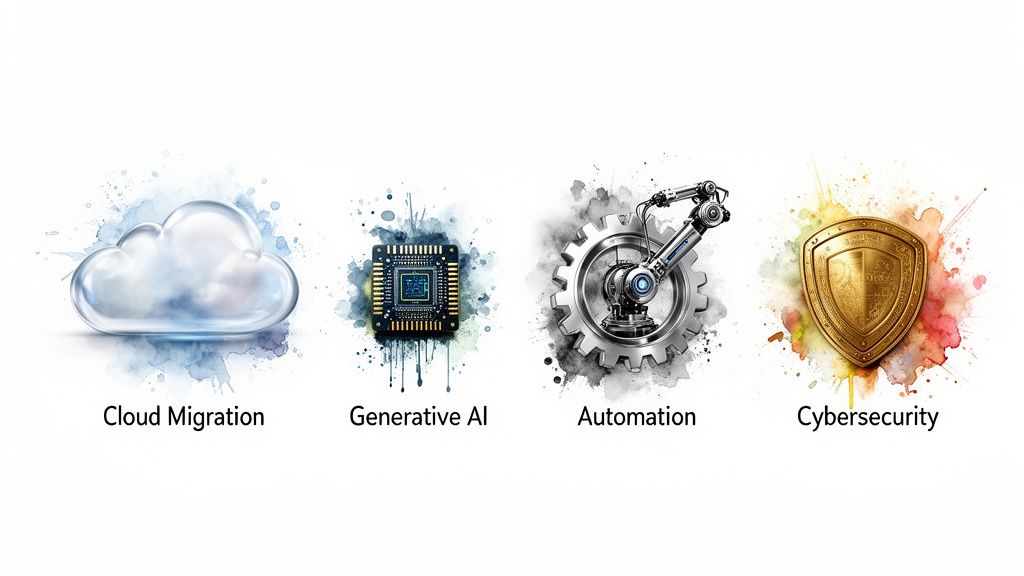
When you hire a digital transformation consultant, you’re not just paying for advice or a fancy slideshow. You’re investing in real, tangible solutions to stubborn business problems. These services bridge the gap between where your company is now and where it needs to be to grow and stay resilient.
Think of it like this: a consultant is part specialist doctor, part master architect. They diagnose the operational pain points holding you back, then draw up the blueprint and oversee the construction of a more modern, efficient business. Whether it’s a startup struggling to build a scalable app or an enterprise needing to lock down its cybersecurity, the solutions are always designed to solve a specific need.
Let’s break down the most common—and impactful—offerings.
Strategic Roadmap Development
Jumping into new technology without a plan is a recipe for disaster. The very first thing a consultant does is help you build a clear, actionable roadmap. This isn’t just another document to file away; it’s a strategic blueprint that aligns your business goals with the right tech investments.
It’s all about answering the tough questions upfront: Where are our biggest operational bottlenecks? Which technologies will give us the highest ROI? And how, exactly, will we measure success? This deep dive into your current workflows and market position ensures every dollar you spend is a purposeful step forward, preventing costly missteps down the road.
Cloud Migration and Modernization
Many businesses are still anchored by clunky, on-premise infrastructure that’s expensive to maintain and impossible to scale quickly. Cloud migration services tackle this problem head-on by moving your applications, data, and workloads to modern platforms like AWS, Azure, or Google Cloud.
The benefits are almost immediate.
- Scalability: You can instantly ramp resources up or down to meet demand, without buying a single new server.
- Cost Efficiency: You shift from a huge upfront capital expense to a predictable, pay-as-you-go operational cost.
- Enhanced Security: You get to tap into the world-class security infrastructure built by the biggest names in tech.
Of course, a smart cloud move requires a solid foundation. That’s why understanding current data architecture best practices for scalable systems is so critical—it ensures your new cloud environment is built for the future, not just for today.
A digital transformation consultant’s job is to map out the specific services that will drive the most value for your business. Here’s a look at the key areas they typically cover.
Table: Key Digital Transformation Consulting Service Areas
| Service Area | Description | Common Solutions | Primary Business Benefit |
|---|---|---|---|
| Strategy & Roadmap | Defining the ‘why’ and ‘how’ by aligning tech with core business goals. | Digital Maturity Assessment, Technology Roadmap, ROI Analysis | Clear direction and focused investment |
| Cloud Services | Moving infrastructure and applications from on-premise to cloud platforms. | AWS/Azure/GCP Migration, Cloud-Native App Development | Increased scalability and lower operational costs |
| Data & Analytics | Turning raw data into actionable insights for better decision-making. | Data Warehousing, Business Intelligence (BI) Dashboards, Predictive Analytics | Data-driven strategy and improved foresight |
| AI & Automation | Using AI and RPA to automate repetitive tasks and unlock new capabilities. | Robotic Process Automation (RPA), AI-Powered Chatbots, Generative AI Content Tools | Boosted productivity and enhanced customer experience |
| Cybersecurity | Protecting digital assets from threats and ensuring regulatory compliance. | Security Audits, Threat Detection & Response, Compliance Management | Reduced risk and stronger customer trust |
Each of these areas represents a powerful lever for change. The right combination, tailored to your specific needs, is what truly sparks a successful transformation.
Generative AI and Automation Implementation
Generative AI isn’t science fiction anymore; it’s a practical tool that can give you a serious business advantage. Consultants help businesses pinpoint the best use cases, from deploying intelligent chatbots that handle customer queries to using AI for creating marketing copy or analyzing complex market data.
Similarly, process automation goes after the repetitive, soul-crushing manual tasks that drain your team’s energy. By implementing technologies like Robotic Process Automation (RPA), you can free up your people to focus on strategic work that actually grows the business. A mid-sized company, for example, could automate its entire invoicing process, cutting down on errors and saving hundreds of hours a month.
The real magic of digital transformation consulting lies in its power to connect technology to real business numbers. It’s about using a cloud migration to slash operational costs by 30%, or implementing an AI tool to boost sales lead conversion by 15%.
The Advantage of a USA-Based Outsourcing Partner
Choosing a partner for these critical projects is a huge decision. Opting for a USA-based outsourcing provider gives you some distinct advantages that go far beyond just technical skills. You get a team that operates in your timezone, which means real-time collaboration and clear communication without frustrating delays.
This proximity also brings a shared understanding of the US business culture and regulatory landscape, making compliance and project management much smoother. Plus, working with a domestic partner offers stronger legal protections for your intellectual property and sensitive data. For a direct conversation with a US-based expert, call +1 (310)800-1398 to get your transformation started.
Your Phased Roadmap to a Successful Transformation
Embarking on a digital transformation isn’t a chaotic leap into the unknown; it’s a structured journey. Think of it less like a sprint and more like building a house. You don’t just start laying bricks randomly. You begin with an architect’s blueprint, lay a solid foundation, construct the frame, and only then do you install the internal systems and add the finishing touches.
An expert consultant acts as your master architect and project manager, guiding the process through a predictable, phased roadmap. This methodical approach turns ambitious goals into measurable results, ensuring your project stays on track, on budget, and aligned with your core business objectives from start to finish.
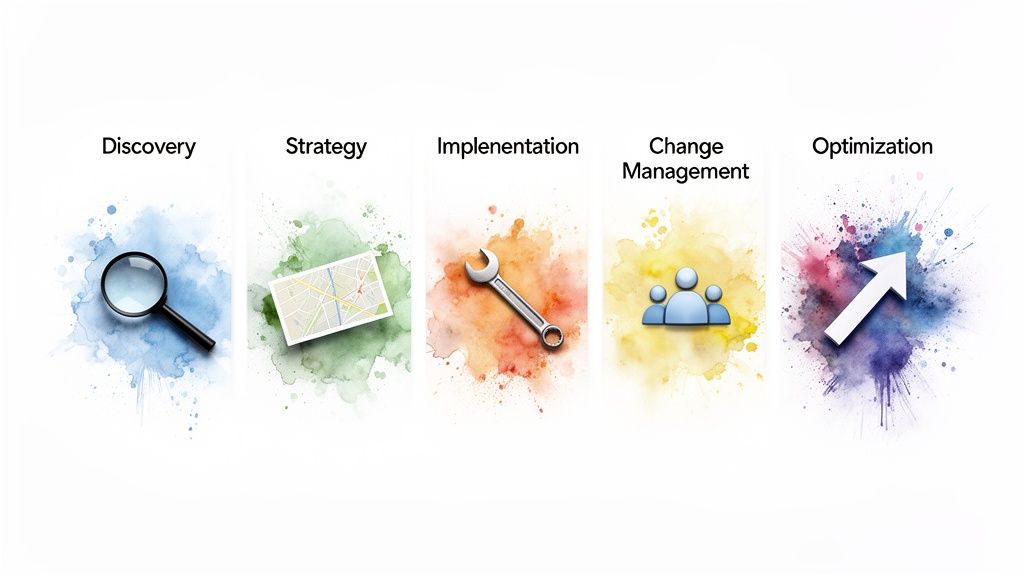
Phase 1: Discovery and Assessment
The journey always begins with a deep dive into your current state. In this initial phase, a consultant acts like a detective, meticulously auditing your existing processes, technology stacks, and team capabilities. The goal here is to get brutally honest about what’s working and what isn’t.
This isn’t just a surface-level review. It involves stakeholder interviews, workflow analysis, and a thorough technology audit to uncover specific pain points, operational bottlenecks, and hidden opportunities. By the end of this phase, you’ll have a crystal-clear picture of where you are now, which is the only place to start planning where you want to go.
Phase 2: Strategy and Planning
With a clear understanding of your current landscape, the next step is to build the strategic blueprint. This is where we translate broad business objectives—like “increase efficiency” or “improve customer experience”—into specific, quantifiable outcomes.
This phase is all about setting clear, achievable goals and defining the “how.” It typically involves:
- Defining Key Performance Indicators (KPIs): We establish the metrics that will define success, such as reducing operational costs by 20% or increasing customer retention by 15%.
- Technology Selection: We evaluate and choose the right software and platforms that align with your goals and budget.
- Creating a Detailed Project Plan: This outlines timelines, resource allocation, and key milestones for the entire project.
This strategic planning is what separates successful projects from failed ones. It’s why digital transformation consulting is set to become the powerhouse of the consulting industry, growing at a staggering 28.5% compound annual growth rate by 2025 within a market projected to hit $1.06 trillion. You can read the full analysis on consulting industry trends.
Phase 3: Implementation and Integration
Now, we get our hands dirty. This is the phase where the plan comes to life, and consultants manage the heavy lifting of technical execution. Whether it’s migrating your data to the cloud, deploying a new CRM system, or implementing automation tools, their role is to oversee the entire process.
They ensure new systems are integrated seamlessly with your existing infrastructure, minimizing friction and keeping the project moving forward. Using a USA-based outsourcing partner for this phase is a huge advantage, as it guarantees clear, real-time communication and project management, preventing costly delays or misunderstandings.
A consultant’s value shines brightest during implementation. They manage vendors, troubleshoot technical hurdles, and ensure the build-out adheres strictly to the strategic plan, acting as a single point of accountability for your project’s success.
Phase 4: Change Management and Training
Technology is only one part of the equation; people are the other, more important half. This critical phase focuses on ensuring your team is not just ready for the change but excited about it. A consultant develops a comprehensive change management strategy to get everyone on board.
This includes clear communication about the “why” behind the changes, hands-on training sessions to build confidence with new tools, and creating support systems to help employees adapt. After all, even the best technology will fail to deliver its promised value if no one wants to use it.
Phase 5: Optimization and Scaling
Your transformation journey doesn’t end at launch. The final phase is a continuous cycle of monitoring, learning, and improving. Consultants help you track the KPIs established back in the planning phase, gather user feedback, and analyze performance data.
This data-driven approach allows for ongoing adjustments to optimize the new systems and processes. As your business grows, your consultant will help you scale your digital capabilities to meet new challenges and seize future opportunities, ensuring your investment continues to deliver a powerful ROI for years to come.
For expert guidance through every phase, call us at +1 (310)800-1398.
How to Choose the Right Transformation Partner
Picking the right digital transformation partner is probably the single most important decision you’ll make. This isn’t just about ticking boxes on a technical checklist; it’s about finding a team that feels like a genuine extension of your own. The right partner gets your industry, fits with your company culture, and brings a flexible, consultative approach to the table, not a rigid, one-size-fits-all product.
Think of it like hiring a co-pilot for a long-haul flight. You need someone with proven expertise who can navigate turbulence, communicate clearly when the pressure is on, and is just as committed as you are to reaching the destination safely and on time. A bad match can lead to blown budgets, missed deadlines, and a final product that doesn’t actually solve the business problem it was supposed to.
Looking Beyond the Technical Checklist
While technical skill is non-negotiable, it’s just the starting point. The best digital transformation consulting services come from partners with deep, hands-on experience in your industry. They’ve seen what works—and more importantly, what doesn’t—in your specific market, saving you from expensive trial and error.
When you’re vetting potential firms, get specific with your questions to see how deep their knowledge really goes:
- Industry Experience: “Can you show us how you’ve solved problems just like ours for other companies in our field?”
- Cultural Alignment: “How do you typically work with a client’s internal team? Describe your communication and collaboration style.”
- Flexibility: “Tell me about a time when a project’s scope or priorities shifted. How did your engagement model adapt?”
A partner who gives you thoughtful, specific answers is showing a consultative mindset. That’s exactly what you need to navigate the twists and turns of a major business overhaul.
The Strategic Advantage of a USA-Based Partner
In a world that’s more connected than ever, choosing a USA-based outsourcing partner offers some very real, practical advantages. Working with a team in the same or similar time zones just makes life easier. It cuts out the friction and delays, making real-time collaboration the default, not the exception—which is critical for agile projects where quick decisions are everything.
Beyond that, a domestic partner already gets the nuances of the U.S. business culture and regulatory landscape. This shared understanding simplifies everything from contract talks to compliance, making the whole process smoother.
But maybe the biggest peace of mind comes from knowing your sensitive data and valuable intellectual property are protected under robust U.S. legal frameworks. This lets you move forward with confidence, knowing your most critical assets are secure.
The demand for these skills is exploding. The digital transformation consulting market, valued at around $268.46 billion in 2025, is expected to skyrocket to $548.29 billion by 2035. This growth isn’t just about new tech; it’s about the shift to AI-driven strategies. It also shines a light on a major talent shortage—a gap that expert distributed teams are built to fill. You can learn more about the digital transformation market’s future.
Key Questions to Guide Your Selection
To make sure you find a partner who will truly elevate your business, use this short checklist during your evaluations. You’re looking for a firm that offers tailored guidance, not just a generic product off the shelf.
- Do they ask sharp questions about your business goals? A great partner is more interested in your desired outcomes than the tech itself.
- Is their style collaborative or prescriptive? Look for someone who wants to work with you, integrating into your team to create shared ownership of the success.
- How do they measure success? They should be able to define clear Key Performance Indicators (KPIs) and give you transparent updates on progress.
- Can they back it up with credible client stories? Proven success is the best predictor of future performance.
Finding the right fit is about starting a long-term, strategic relationship. To discuss your specific needs with a trusted US-based expert, call us today at +1 (310)800-1398.
Seeing Transformation in Action with Real-World Examples

Strategies and roadmaps are great on paper, but the real test of digital transformation consulting services is what they deliver in the real world. At the end of the day, what does success actually look like? The answer isn’t found in buzzwords, but in tangible results that solve specific, nagging business problems.
These aren’t just stories about new tech; they’re stories about overcoming real obstacles and unlocking serious growth. Each one follows a clear arc: a company hits a wall, a consulting partner helps them break through it, and the business reaps the rewards. To see how this plays out in practice, you can explore illumichat’s real-world use cases for more examples.
Slashing Overhead for a Mid-Sized Business
The Problem: A growing logistics company was drowning in paperwork. Their small accounting team spent hundreds of hours every month wrestling with bookkeeping, invoicing, and payroll. The manual work was not just slow; it was leading to expensive errors and holding them back from focusing on what they did best.
The Solution: The company brought in a USA-based outsourcing firm to set up a Business Process Outsourcing (BPO) solution. The consultants didn’t just take over the work—they automated the entire bookkeeping workflow, from data entry all the way to financial reporting, and handled payroll management.
The Result: In just six months, the company cut its administrative overhead by a staggering 30%. The finance team was finally free to work on strategic financial planning, and with accuracy way up, cash flow improved and decisions got a whole lot faster.
Accelerating Market Entry for a Tech Startup
The Problem: A tech startup had a game-changing idea for a mobile app but no in-house developers to build it. They were in a race to market, and they knew that speed was everything.
The Solution: They partnered with a consulting firm that provided a dedicated team of outsourced full-stack developers. This USA-based team meshed perfectly with the startup’s founders, using an agile approach to build, test, and refine the app in quick, focused sprints.
By tapping into an external team, the startup got access to top-tier talent without the massive overhead and slow hiring process. This wasn’t just about saving money—it was a strategic move to prioritize speed and expertise.
The Result: The startup launched its app 50% faster than they ever thought possible, securing a vital first-mover advantage. That early lead helped them capture a huge user base and lock in a critical round of venture capital funding.
Boosting Security and Collaboration for an Enterprise
The Problem: An established manufacturing company was stuck with a messy, outdated IT setup. Employees were using a mix of ancient legacy systems and unapproved personal apps, creating huge security holes and making it nearly impossible for teams to work together effectively.
The Solution: A digital transformation consultant walked them through a complete migration to Microsoft 365. This was more than just a tech install; it included a full change management program with employee training to make sure everyone actually adopted tools like Teams, SharePoint, and OneDrive.
The Result: The move created a single, secure, and collaborative digital workplace. Employee productivity jumped by an estimated 20%, and the company shut down major security risks by getting all its data and communications onto one modern, protected platform.
These examples make one thing clear: the right consulting partner delivers outcomes, not just technology. For a consultation on your unique challenges, call us at +1 (310)800-1398.
So, where do you go from here?
If this guide has done its job, you’ve seen that modernizing your business isn’t some overwhelming, impossible leap. It’s a series of deliberate, strategic steps. The journey from tangled, outdated processes to a resilient, future-ready organization is absolutely achievable—especially when you have the right strategy and a committed partner in your corner.
Now, it’s time to turn that spark of inspiration into real action. We’ve put together a simple checklist to help you get started with clarity and purpose.
Your Initial Action Checklist
Before you even think about vendors or technology, you need to build a solid foundation. These first few steps ensure you walk into any conversation about digital transformation consulting services knowing exactly what you need.
- Run an Internal Readiness Check: Take an honest look under the hood. Assess your current technology, your day-to-day processes, and your team’s skills. What’s actually working well? And more importantly, where are the biggest friction points that are costing you time and money?
- Define Your Core Business Challenge: Forget about the tech for a minute and focus on the problem. Is it slow, manual invoicing that’s killing your cash flow? Clunky customer service that’s hurting your reputation? A gaping security vulnerability you know you need to patch? Naming the specific problem is the only way to find the right solution.
- Outline a Preliminary Budget: Get a realistic financial scope in mind. It doesn’t have to be perfect, but having a working number helps frame the entire conversation. It forces you to prioritize the initiatives that will deliver the biggest and fastest return on your investment.
- Schedule a No-Obligation Consultation: The final step is simple: talk to an expert. A quick consultation lets you lay out your challenges, explore what’s possible, and get a feel for what a partnership could actually look like, with no strings attached.
Choosing a USA-based outsourcing partner ensures clear, real-time communication and a deep understanding of your business landscape, accelerating your path to tangible results while protecting your intellectual property.
This structured approach turns a huge, intimidating idea into a manageable, actionable plan. You can start mapping out your own success story today.
To talk through your specific goals and challenges with a trusted US-based team, give us a call for a no-obligation consultation at +1 (310)800-1398. Let’s build your future, together.
Your Top Questions About Digital Transformation Answered
When leaders start exploring digital transformation consulting services, a few practical questions always come up. It’s only natural. You want to get a feel for the real-world nuts and bolts—timelines, costs, and whether this is even right for your business—before you dive in. Let’s tackle those head-on.
How Long Does a Typical Transformation Project Take?
There’s no single timeline, and any consultant who gives you one without knowing your business isn’t being straight with you. The honest answer is: it depends entirely on the scope.
Think of it like a home renovation. If you’re just looking to automate a single, clunky business process, that’s like painting a room. You could see results in just a few months. But if you’re talking about a full-scale enterprise modernization—overhauling everything from your systems to your culture—that’s a complete gut remodel of the whole house.
That kind of project is less of a one-and-done deal and more of an ongoing strategic partnership. The best approach is always phased, designed to deliver measurable wins at each stage. You shouldn’t have to wait for one “big reveal” at the end to see value.
What Are the Common Pricing Models for These Services?
Consultants usually offer a few different ways to structure their fees, which gives you the flexibility to find a model that aligns with your goals and budget. It’s all about finding a financial approach that makes sense for both of you.
Here are the most common models you’ll run into:
- Fixed-Price: This is perfect for projects where the scope and deliverables are crystal clear from the start. It gives you total cost predictability, which is great for budgeting.
- Time and Materials: If your project is more exploratory and you know the requirements will probably evolve, this model offers the most flexibility to adapt as you learn.
- Retainers: This is the way to go for ongoing strategic advice and support. It ensures you have an expert in your corner, ready to jump in whenever you need them.
The best partners don’t lock you into a rigid contract. They offer flexible engagement models that can scale up or down as your needs change, tying their success directly to yours.
Choosing a USA-based outsourcing partner offers significant advantages beyond pricing. You benefit from real-time communication without timezone barriers, a shared understanding of American business culture and regulations, and robust legal protection for your intellectual property.
Can Small Businesses Benefit from Transformation Consulting?
Absolutely. In fact, for small and mid-sized businesses (SMBs), this isn’t just a “nice-to-have”—it’s a game-changer. Digital transformation consulting completely levels the playing field, giving SMBs access to the kind of high-level talent and tools that used to be reserved for massive enterprises.
By outsourcing key functions like IT development, cybersecurity, or even business process outsourcing (BPO) to a skilled partner, you get enterprise-grade capabilities for a fraction of what it would cost to build them in-house. This frees up your team to focus on what they do best—running your core business—while you leverage expert support to improve your market position.
Ready to see how a strategy built for your business can drive real growth? The team at NineArchs LLC specializes in creating scalable IT and BPO solutions that deliver measurable results. Give us a call for a no-obligation consultation at +1 (310)800-1398 to start your modernization journey.