
So, how does cybersecurity actually work? It’s not about a single piece of software or one magical fix. True cybersecurity is a coordinated effort, weaving together people, processes, and technology to protect your digital world.
Think of it like securing a high-value building. You wouldn't rely on just one lock on the front door. You'd have security guards, access rules for different floors, and employees trained to spot anything unusual. It’s a complete system working in unison.
How Cybersecurity Works in Simple Terms
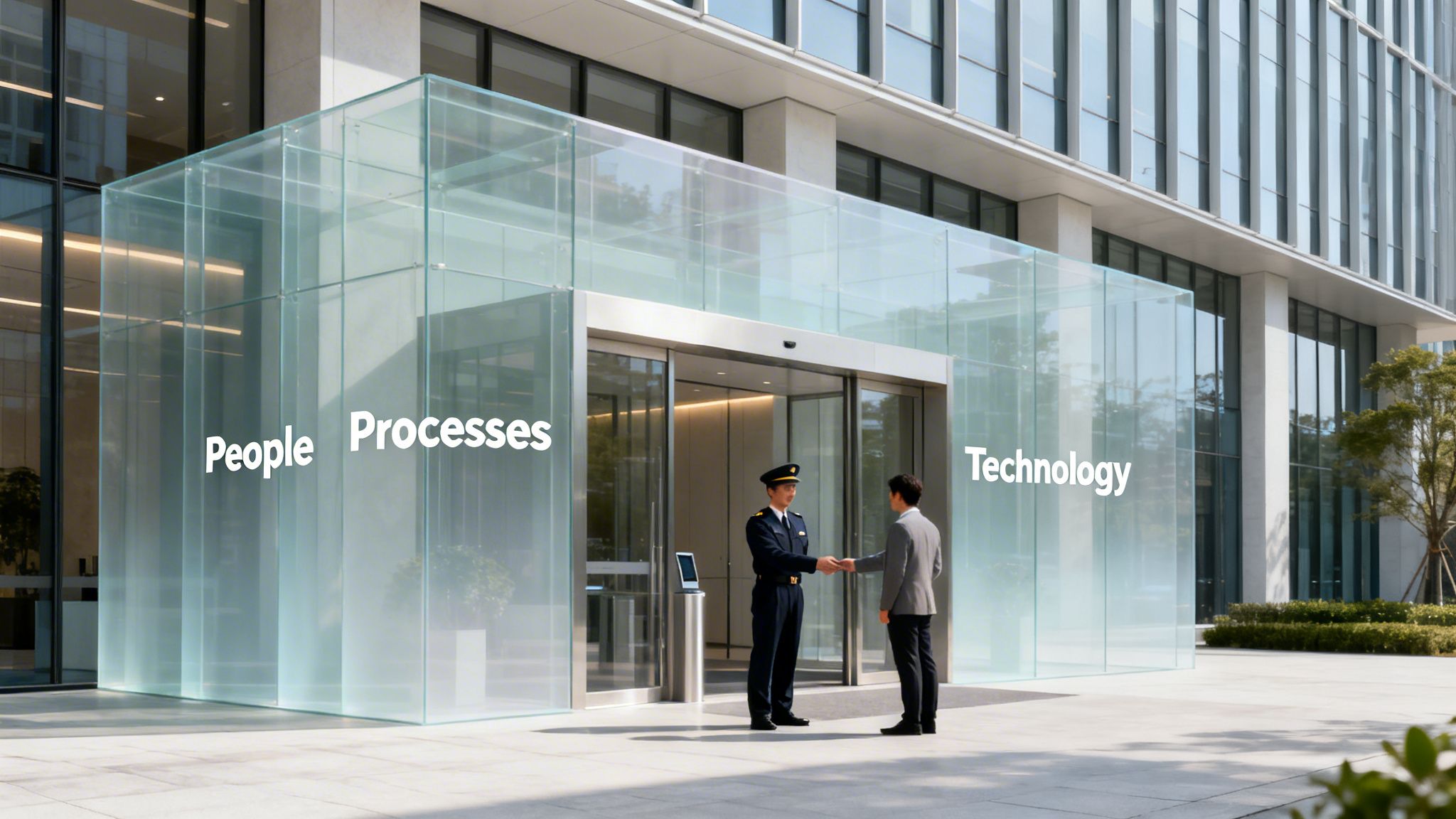
The guiding principle behind any solid security plan is a strategy called defense-in-depth. It’s all about creating multiple layers of protection.
Imagine your most critical business data is a treasure locked away in a vault. To get to it, an attacker wouldn't just have to pick a single lock. They'd need to get past a perimeter fence, evade security guards, bypass surveillance cameras, and only then attempt to crack the vault itself. Each barrier makes an attack harder and, just as importantly, increases the odds of getting caught.
This layered approach is absolutely essential today. Cyber threats have exploded in recent years, and the spending reflects that reality. Global cybersecurity investment is on track to blow past $520 billion a year by 2026. To put that in perspective, it was just $3.5 billion back in 2004. For small and medium-sized businesses, cloud-based tools are driving much of this growth. You can see more data on this sharp escalation in cybersecurity spending at EIN Presswire.
The Three Pillars of Cybersecurity
A solid cybersecurity strategy rests on three interconnected components. Each pillar supports the others, and neglecting one can undermine your entire defense.
| Pillar | What It Is | Examples in Practice |
|---|---|---|
| People | The "human firewall." This includes every person in your organization, from the C-suite to the front desk. | Security awareness training, recognizing phishing emails, practicing good password hygiene, reporting suspicious activity. |
| Processes | The formal rules, policies, and procedures that guide how your organization handles data and responds to threats. | An official incident response plan, strict password policies, protocols for data backup and recovery, vendor security reviews. |
| Technology | The hardware and software tools you use to enforce policies and block attacks. | Firewalls, antivirus software, multi-factor authentication (MFA), encryption tools, and endpoint detection and response (EDR). |
Ultimately, technology is only as good as the people and processes that manage it. True security is a team effort.
There’s a common and dangerous misconception that just buying the latest security software is enough. The truth is, even the most advanced tools can be bypassed if your employees aren't trained and your processes are weak.
Getting these pillars right requires deep expertise, which is a major hurdle for many businesses. This is where working with a dedicated partner in the USA can make a world of difference. A domestic team gives you access to seasoned security professionals who live and breathe local compliance standards and work in your time zone—ensuring clear communication and a fast response when you need it most.
For expert guidance on building a robust, three-pillar security strategy, contact NineArchs at (310) 800-1398 / (949) 861-1804 or email us at [email protected].
Understanding the Threats Cybersecurity Defends Against

To get a real handle on cybersecurity, you first need to know what you're up against. Security isn't built in a vacuum; every control, every policy, is a direct answer to the creative and often ruthless tactics used by attackers. They’re constantly looking for a way in.
Those pathways are what we call attack vectors. An attack vector can be as blunt as a suspicious email or as subtle as a compromised piece of software. Understanding these common threats is the first real step toward building a defense that actually works.
The Most Common Cyber Threats
This isn't some abstract technical problem. The financial sting is very real. The FBI reported that in 2023 alone, Americans lost over $12.5 billion to cybercrime. These aren't just one-off scams; they range from simple deceptions to sophisticated, long-term attacks designed to dismantle a business from the inside.
Here are the threats that modern cybersecurity is built to stop:
Phishing: This is pure social engineering. Attackers pose as a trusted name—your bank, a big brand, even your CEO—to trick you into giving up sensitive information. It’s the digital version of a con artist’s phone call, but instead of a fake prize, they’re after your passwords, credit card numbers, or login credentials. It remains the most reported cybercrime for a reason: it works.
Malware: Short for “malicious software,” this is the catch-all term for any code written to harm a system. It’s a broad family of digital weapons, from viruses that scramble your files to spyware that quietly sits in the background, logging every keystroke.
Ransomware and Denial of Service Attacks
Two types of attacks are particularly devastating for businesses, highlighting why a solid security posture is non-negotiable for staying in business.
Ransomware is an especially vicious form of malware that encrypts your files, locking you out of your own data. The attackers then demand a ransom, almost always in cryptocurrency, for the key to unlock it. The attack on Change Healthcare in February 2024 was a chilling example, compromising the personal and medical data of potentially one-third of all Americans.
A successful ransomware attack is a full-stop event for a business. Imagine every customer file, every financial record, every critical document suddenly gone, with no guarantee you'll ever get them back, even if you pay. That's the reality.
Another major threat is the Denial-of-Service (DoS) attack. Here, attackers bombard a server with so much junk traffic that it gets overwhelmed and shuts down, denying access to legitimate customers. It's the digital equivalent of a mob blocking the entrance to your store—no real customers can get in.
To get ahead of these threats, practices like professional vulnerability assessment and penetration testing are invaluable. They let you find and plug the holes before an attacker does.
Trying to manage this constant barrage of threats is a huge challenge, especially if you don’t have a dedicated security team on staff. By working with a US-based security provider, you get immediate access to professionals who live and breathe this stuff. They bring the vigilance and expertise needed to give your business enterprise-grade protection, without the massive overhead, and ensure seamless communication in your time zone.
For a consultation on how we can protect you from these threats, call NineArchs at (310) 800-1398 / (949) 861-1804 or email [email protected].
Building Your Defenses with a Layered Security Approach
If you’re looking for a single magic bullet to solve cybersecurity, you’re going to be disappointed. Effective security isn’t a product you buy; it’s a strategy you build, layer by layer. This is the core idea behind defense-in-depth: instead of relying on one strong lock on the front door, you build a fortress with a moat, high walls, vigilant guards, and a secure inner keep.
But how do you turn a fortress analogy into a real-world plan? For that, we can lean on the NIST Cybersecurity Framework. Developed by the U.S. National Institute of Standards and Technology, it’s less of a rigid rulebook and more of a common-sense roadmap. It gives everyone a shared language and organizes the massive job of security into five continuous functions.
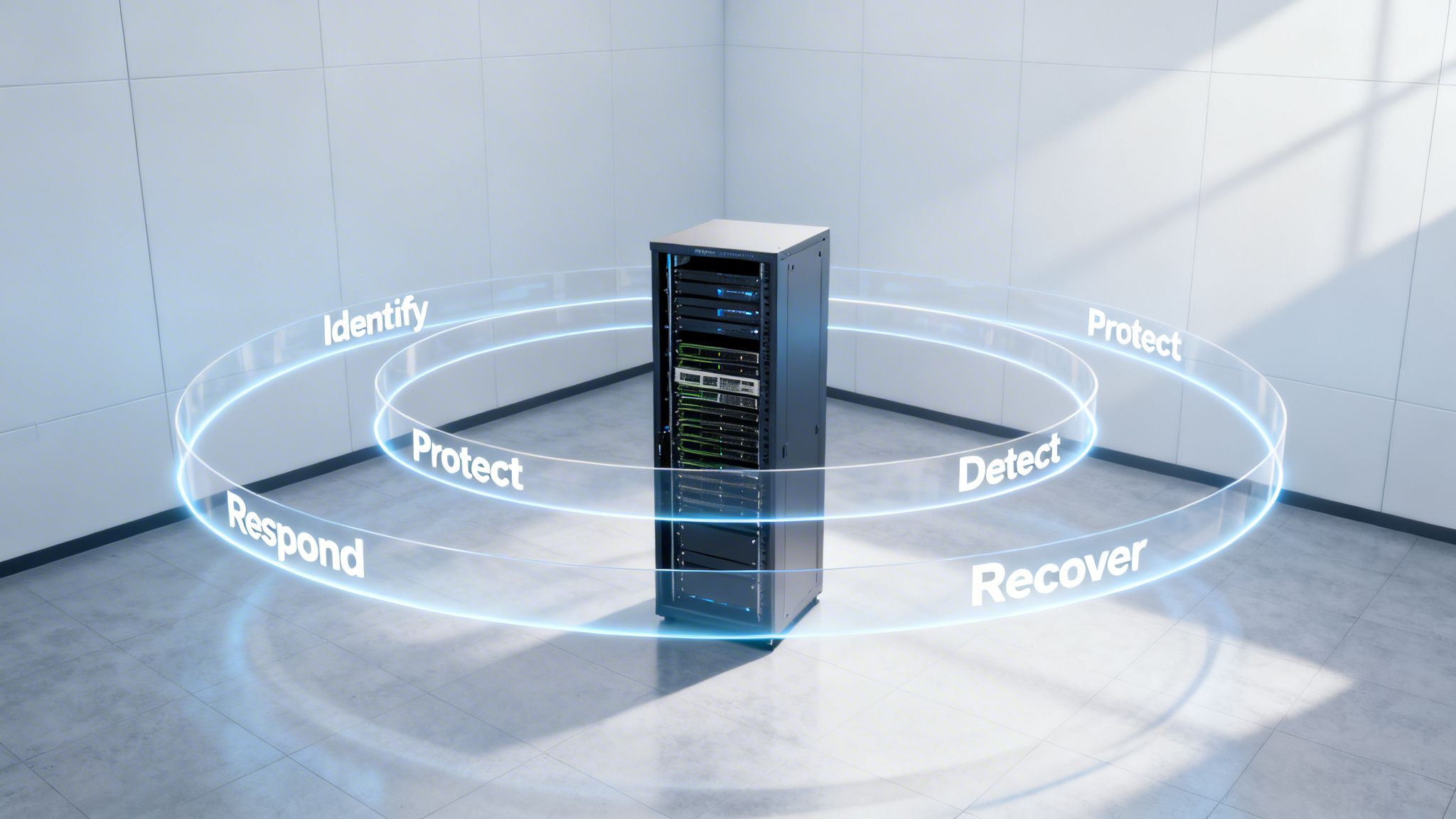
Think of these five stages not as a checklist you complete once, but as a living cycle. Your business is always evolving, and so are the threats. This framework ensures your security posture adapts right along with it. Let’s break down what each function looks like in practice.
Identify: Know What You’re Protecting
You can’t defend what you don’t know you have. That’s the entire point of the Identify function. It’s the foundational first step: taking a full inventory of everything that makes your business run.
- What it involves: This means mapping out all your hardware (servers, laptops, phones), software, critical data (customer lists, financial records, IP), and the key people and processes that depend on them.
- Why it’s crucial: A complete inventory isn’t just a list. It gives you context, helps you see what’s most valuable, and allows you to prioritize where you spend your time and money. Without it, you’re just guessing.
Protect: Lock the Doors and Windows
Once you know what’s important, the Protect function is all about putting the right safeguards in place. This is where you proactively lock the doors, bar the windows, and train your staff to be vigilant. The goal is to limit the damage before an attack can even gain a foothold.
This stage covers a wide range of controls, from strong passwords and access policies to employee security awareness training. For a more modern and rigorous approach, you might also consider a strategy like the one detailed in our guide on how to implement Zero Trust security.
Detect: Spot Trouble in Real Time
No defense is impenetrable. The Detect function operates on a simple, pragmatic assumption: eventually, an attacker might find a way through. The goal here is to spot that intrusion the moment it happens.
The average time to identify and contain a data breach is a staggering 277 days. Rapid detection is your single best tool for minimizing the fallout, making this function absolutely non-negotiable.
This is where continuous monitoring becomes your eyes and ears. Modern security relies on constantly watching for anomalies across your networks, endpoints, and cloud services—often with AI and machine learning sifting through the noise to find genuine threats. This monitoring-response cycle is a huge driver of the global cybersecurity market, projected to hit $816 billion by 2033.
Respond and Recover: The Plan for When Things Go Wrong
When the alarm sounds, you need a clear, well-rehearsed plan. The Respond function is all about the immediate actions you take to contain the threat, kick the attacker out, and figure out what happened. A good incident response plan prevents panic and turns chaos into a controlled process.
Right after, the Recover function kicks in. This is about getting back to business. It involves safely restoring any systems or data that were compromised and, just as importantly, learning from the incident to make your defenses even stronger next time.
Navigating this entire lifecycle takes expertise that most businesses don't have on staff. This is where partnering with a USA-based security provider comes in. An outsourcing partner brings the team and the tools to manage this framework for you, providing enterprise-grade resilience without the enterprise-grade headcount and ensuring seamless communication during your business hours.
Ready to build your fortress? Call us at (310) 800-1398 / (949) 861-1804 or email [email protected] to start the conversation.
Essential Cybersecurity Tools and Technologies in Action
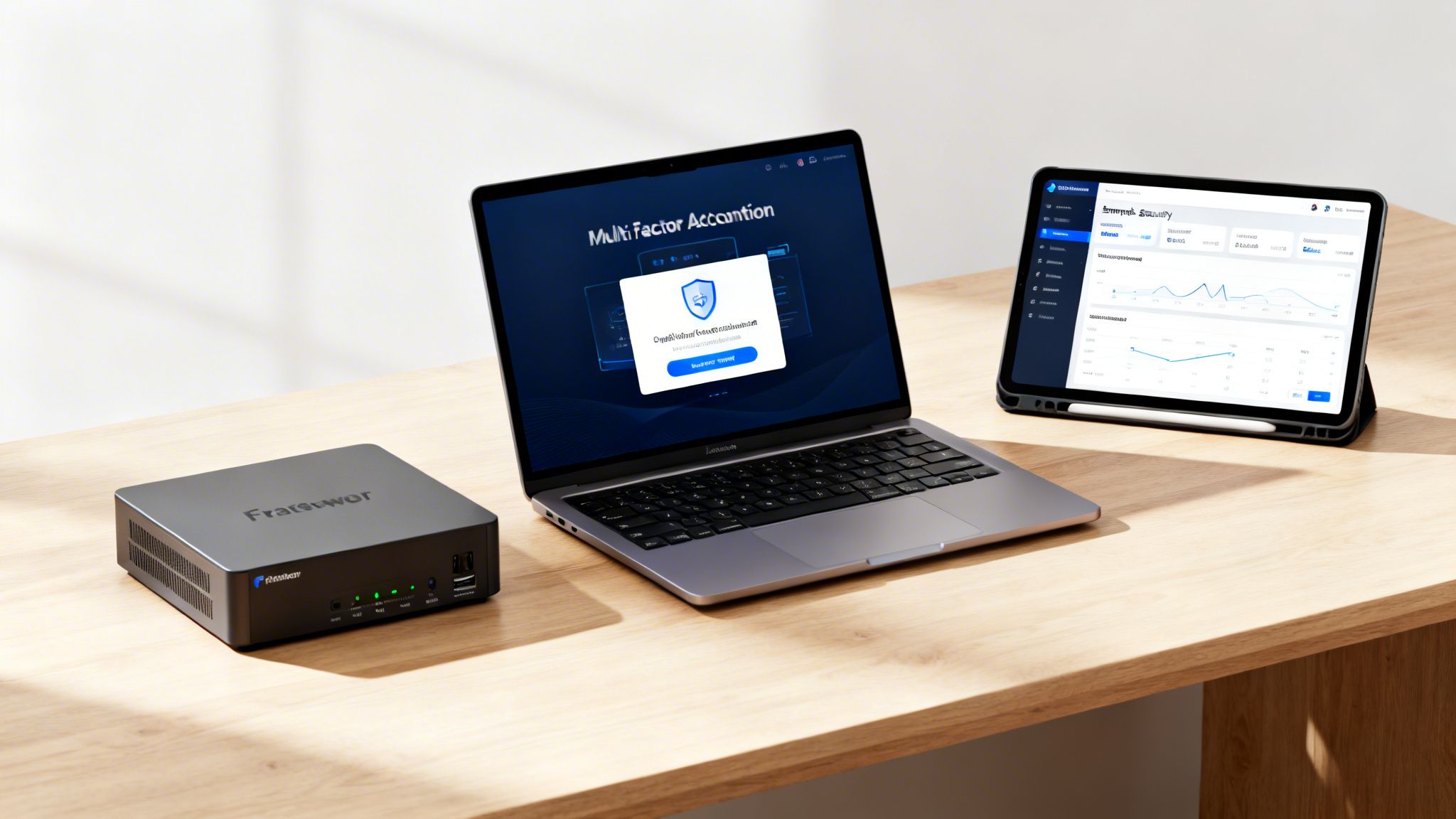
Knowing the theory behind a security framework is one thing, but the real work happens when you deploy the tools that bring it to life. This is where cybersecurity stops being a concept and becomes a set of digital guards, gates, and surveillance systems that form your layered defense.
Each piece of technology has a specific job, and they all work together to block threats at different points across your business. Let's get practical and look at the essential tools that keep businesses running securely every single day.
Network Security: Your Digital Perimeter
Your first line of defense is always going to be your network security. It’s all about controlling who and what gets into your digital workspace from the outside world. The undisputed cornerstone of this defense is the firewall.
Think of a firewall as a digital bouncer standing at the front door of your private network. It inspects every bit of data trying to get in or out, checking it against a strict set of security rules you've defined. If a packet of data looks sketchy or comes from a known bad neighborhood on the internet, the firewall blocks it on the spot. No questions asked.
This simple but incredibly powerful idea is the foundation of practical cybersecurity. It creates a secure perimeter that shields your internal systems from the chaos of the open internet.
Endpoint Security: Protecting Your Devices
While firewalls guard the network’s edge, endpoint security protects the individual devices connected to it—laptops, servers, and smartphones. In a world of remote work, every single one of those devices is a potential entry point for an attacker. With the average cost of a data breach now at a staggering $4.45 million, protecting them isn't optional.
Effective endpoint security relies on a couple of key technologies working in tandem:
- Antivirus (AV): This is the classic tool everyone knows. It scans files for the digital fingerprints (signatures) of known malware and quarantines anything malicious it finds.
- Endpoint Detection and Response (EDR): This is the modern, more intelligent evolution of antivirus. EDR doesn't just look for known threats; it constantly monitors device behavior for suspicious activity, allowing your security team to spot and shut down new or complex attacks that traditional AV would miss.
EDR acts like a security camera and an alarm system combined. It doesn't just catch known criminals; it flags anyone acting suspiciously, giving you a chance to intervene before they can do any real damage.
You can dive deeper into this topic with our guide on endpoint security best practices.
Identity and Access Management: Who Are You, Really?
Sometimes, the most effective security measure has nothing to do with malware and everything to do with identity. Identity and Access Management (IAM) is the practice of making sure only the right people can access specific data and systems. It’s about enforcing the principle of least privilege.
The most common IAM tool you’ve probably used is Multi-Factor Authentication (MFA). Instead of just relying on a password—which can be stolen, cracked, or guessed—MFA demands a second piece of proof to verify it’s really you. This is usually a one-time code sent to your phone or generated by an app. It's a simple step that makes stolen passwords almost worthless to an attacker.
We can pull all the data from these different tools into a central hub for a complete view of your security posture. To get that comprehensive threat detection, many organizations use advanced tools like Security Incident and Event Management (SIEM) systems to consolidate and analyze security alerts from every corner of the network.
Common Cybersecurity Tools and Their Functions
| Tool Category | Primary Function | Analogy |
|---|---|---|
| Firewall | Filters incoming and outgoing network traffic based on security rules. | A bouncer at the door of a private club. |
| Endpoint Protection (EDR/AV) | Scans devices for malware and monitors for suspicious behavior. | A security guard and camera system inside the building. |
| Identity & Access (IAM/MFA) | Verifies user identities and controls access to resources. | An ID card and key system for different rooms. |
| SIEM | Aggregates and analyzes log data from all tools for threat detection. | The central security control room watching all the monitors. |
Each of these technologies plays a critical role. Without one, you leave a significant gap in your defenses that attackers are more than happy to exploit.
Implementing and managing this entire tech stack can easily become a full-time job. Partnering with a US-based security provider gives you immediate access to professionals who can deploy, monitor, and maintain these tools for you. With a team in your time zone, you get rapid response and clear communication, ensuring your defenses are always up and running effectively.
To secure your business with the right technology stack, call NineArchs at (310) 800-1398 / (949) 861-1804 or email [email protected].
How to Get Enterprise-Grade Security on an SME Budget
For most small and mid-sized business owners, the answer to "how does cybersecurity work" often leads to a frustrating dead end. You see the threats and you understand the frameworks, but the idea of building an in-house security team feels completely out of reach. The costs are astronomical, and finding the right people in today's talent market is a battle in itself.
This is where a strategic partnership completely changes the game. Outsourcing your security to a dedicated IT partner gives you immediate access to the kind of tools and expertise that large enterprises rely on, but at a fraction of the cost and without the management headache.
Why a US-Based Partner Is a Strategic Advantage
Choosing the right partner is everything, and for businesses in the United States, working with a domestic provider offers benefits that go far beyond just technical skill. It’s about operational alignment and, most importantly, trust.
When your security partner operates in the same country, you eliminate the friction that causes chaos during a crisis. There are no late-night calls to accommodate clashing time zones, no language barriers to muddy the waters during an emergency, and no cultural misunderstandings to slow things down. When you’re under attack, clear, immediate communication is your most valuable asset.
A US-based team inherently gets the domestic compliance landscape. They are deeply familiar with regulations like HIPAA and CCPA, ensuring your security strategy isn’t just effective—it's fully compliant with the laws that govern your business.
Furthermore, a domestic partner works when you work. This simple alignment means faster response times for day-to-day issues and a team that’s ready to jump in during your core business hours, which is precisely when most incidents happen.
Your Path to Affordable, Expert Security
Partnering with an outsourced provider like NineArchs transforms security from a massive capital expense into a predictable, manageable operational cost. Instead of a huge upfront investment in software licenses and six-figure salaries, you get a comprehensive security program managed for you.
This allows you to secure your business from every angle, accessing a suite of managed services that work together.
As the screenshot shows, services like endpoint security and cloud management aren't standalone products; they come together to form a complete protective shield. This integrated approach ensures there are no gaps in your defense, covering everything from individual employee laptops to your entire cloud infrastructure.
This model lets you offload the complex, time-consuming work of modern cyber defense. A partner can immediately take over critical areas, including:
- Endpoint Security Management: Deploying and monitoring advanced EDR tools on all company devices to stop malware and ransomware before they can do any damage.
- Microsoft 365 Security: Properly configuring and hardening your M365 environment—a common target for attackers—to prevent account takeovers and data leaks.
- 24/7 Monitoring and Response: Providing round-the-clock vigilance over your network, detecting threats in real-time and acting immediately to contain them.
By outsourcing, you’re not just buying tools; you’re gaining a dedicated team of security professionals. For a deeper look at this model, you can learn more about Cybersecurity as a Service and see how it empowers small and mid-sized businesses.
This frees up your internal team to focus on what they do best—driving growth and innovation for your business. Let us handle the complexities of cybersecurity while you focus on your core mission.
To get enterprise-grade security tailored for your budget, contact NineArchs today. Call us at (310) 800-1398 / (949) 861-1804 or email [email protected] for a consultation.
Your Cybersecurity Questions, Answered
Even with a solid grasp of the frameworks and tools, turning theory into action is where the real work begins. It’s one thing to understand how cybersecurity works, but knowing where to start and how to apply that knowledge is what truly protects a business.
This is where the most common and practical questions come up. Let's tackle the concerns business leaders have when they're ready to move from planning to doing.
What Is the Very First Step I Should Take?
The most critical first step is to Identify what you need to protect. You simply can’t defend what you don’t know you have. This means taking a detailed inventory of your most important digital assets—your data, software, and physical hardware like servers and laptops.
Think of it as drawing a blueprint for your entire digital operation. Where does your most sensitive customer information live? Which software applications are non-negotiable for your team to function? What devices can access all of this? Once you have this map, you can start prioritizing. This simple act of cataloging brings immediate clarity and is the foundation for every security decision you'll make.
Is Cybersecurity Really Affordable for a Small Business?
Absolutely. The idea that robust security is only for massive corporations is a dangerous myth. You don’t need a six-figure budget to build a strong defensive posture. It's not an all-or-nothing expense.
You can start with foundational, high-impact measures that are surprisingly cost-effective. Some of the best first moves include:
- Enabling Multi-Factor Authentication (MFA): This is arguably the single most effective control you can implement. It’s often free and instantly neutralizes the threat of stolen passwords.
- Implementing Security Awareness Training: A well-trained employee is your best defense against phishing. Low-cost training programs can dramatically reduce your risk, especially when human error is a factor in over 74% of breaches.
- Using Reputable Endpoint Protection: Basic antivirus isn't enough anymore. A modern endpoint protection service gives you a powerful layer of defense for a reasonable monthly fee per device.
For more advanced capabilities, partnering with an outsourced IT provider is the most affordable route. It gives you access to enterprise-grade tools and expert management for a fraction of what it would cost to hire an in-house security team.
How Big of a Role Do My Employees Play?
Your employees play a massive, often decisive, role. They are your most important line of defense—your "human firewall." The vast majority of cyberattacks, especially sophisticated phishing and social engineering campaigns, are designed specifically to exploit human nature, not just technology.
An advanced firewall can block millions of automated threats, but it only takes one person clicking one malicious link to bypass it all. This is why security awareness training isn't a compliance checkbox; it's one of the highest-return investments you can make in your defense.
A team that is trained to be vigilant and feels empowered to report suspicious activity is invaluable. When you create a culture where security is a shared responsibility, your workforce transforms from a potential weakness into your most powerful defensive asset.
How Can an Outsourced Partner Help Me Get Started?
For any business without a dedicated security expert on staff, the whole process can feel completely overwhelming. An outsourced partner from the USA, like NineArchs, cuts through the complexity by acting as your dedicated security department. The immediate benefit is gaining deep expertise without the cost and headache of building an internal team from scratch.
A US-based partner brings seamless communication during your business hours—a crucial advantage when you need to make quick decisions. They have a native understanding of the domestic regulatory landscape and can guide you through compliance with standards relevant to your industry. They start by assessing your environment, identifying your critical assets and vulnerabilities, and then building a clear, prioritized roadmap. This turns a huge, complex problem into a series of manageable, actionable steps, ensuring you get the most protection for your investment.
At NineArchs, we specialize in making enterprise-grade security accessible and affordable for businesses of all sizes. Let our team of US-based experts manage your defenses so you can focus on growing your business.
Contact us today for a consultation at (310) 800-1398 / (949) 861-1804 or email us at [email protected].