
Think about the last time you stared at a tech problem you couldn’t solve, knowing your team was falling behind. It’s a frustratingly common hurdle for small businesses. Juggling daily operations is tough enough without adding network failures, software glitches, and cybersecurity threats to the mix.
This is where IT outsourcing becomes a game-changer.
Why Smart Small Businesses Outsource IT
Imagine gaining an entire tech department on demand. You get cybersecurity experts, cloud engineers, and support specialists ready to tackle any challenge—all without the staggering costs of salaries, benefits, and training that come with an in-house team.

Gaining A Strategic Advantage
Instead of a massive capital investment, you get immediate access to a deep well of specialized expertise for a predictable monthly fee. This move isn’t just about fixing what’s broken; it’s about proactively building a more secure, efficient, and scalable business from the ground up.
When you outsource strategically, you can finally focus on your core mission—serving customers and driving real growth—while your technology works seamlessly in the background. It transforms IT from a source of stress into your competitive edge.
By partnering with an external provider, small businesses can access enterprise-grade technology and security that would otherwise be out of reach, effectively leveling the playing field.
The Value Of A USA-Based Partner
Choosing the right partner is critical, and for many businesses, a USA-based firm offers clear advantages. Communication is seamless, with no language barriers or cultural misunderstandings to slow down projects or cause confusion during a crisis. Aligned time zones mean your support team is available when you are, ensuring critical issues get addressed immediately during your business hours. This proximity fosters a stronger, more collaborative relationship, turning your provider into a true extension of your team.
Ready to build a more resilient and competitive business? Call +1 (310)800-1398 to discuss how a tailored IT solution can fuel your growth.
The Real Financial Impact Of Outsourcing IT
For a small business, every dollar has a job to do. It’s tempting to look at hiring an in-house IT specialist as a simple investment, but the real cost goes far beyond what you see on a paycheck. Let’s get past the theory and look at the actual numbers to see why IT outsourcing for small business success is such a powerful financial move.

Let’s say you hire one mid-level IT support person. Right off the bat, you’re looking at an annual salary that can easily top $60,000. But that’s just the tip of the iceberg. That salary triggers a cascade of other expenses that many business owners forget to factor in.
These “hidden” costs don’t just add up; they multiply, turning a single hire into a major financial commitment that can drain resources better spent elsewhere.
The True Cost Of An In-House Employee
When you pull back the curtain, the full picture of an in-house hire becomes a lot clearer—and a lot more expensive. That base salary is just a fraction of what it really takes to support just one technical employee on your team.
Here’s a quick rundown of the extra costs that pile up:
- Benefits and Taxes: You’ve got to cover health insurance, retirement contributions, and payroll taxes, which typically tack on another 20-30% to their salary.
- Recruitment and Onboarding: Finding the right person is expensive and time-consuming. You have to account for job postings, interviews, background checks, and the productivity dip while they get up to speed.
- Training and Certifications: Technology never stands still. To keep their skills sharp, your IT pro will need ongoing training and certifications—all on your dime.
- Software and Hardware: They’ll need access to diagnostic tools, security software subscriptions, and maybe even specialized hardware, all of which come with their own recurring fees.
- Turnover Costs: What if they leave? You’re right back at square one, starting the expensive cycle of recruiting, hiring, and training all over again, causing disruption and more costs.
When you add it all up, that $60,000 salary can quickly balloon into a $90,000+ annual expense. That’s a huge chunk of capital that could be fueling your growth instead.
The core financial benefit of outsourcing is converting a large, unpredictable capital expense (hiring) into a predictable, manageable operational expense (a monthly subscription). This shift frees up cash flow for revenue-generating activities like marketing, sales, or product development.
The Advantage Of A USA-Based Partner
Beyond the hard numbers, where your outsourcing partner is located has a real financial impact. Choosing a USA-based provider smooths out common friction points that cost you time and money. With a domestic partner, you share the same business hours, which means help is there exactly when you need it, eliminating late-night calls or waiting for a response from a different time zone. You also get the benefit of cultural alignment and a native understanding of the US business environment, which makes communication clearer and problem-solving faster. This seamless collaboration is a key reason IT outsourcing for small business works so well with a stateside team.
The data confirms this strategic shift. Small businesses are increasingly turning to IT outsourcing to slash their operational costs. Surveys show that 46% of organizations save around 25% on IT expenses after partnering with a managed service provider (MSP), while another 13% see savings of 50% or more. You can learn more about these outsourcing savings and how they apply to businesses like yours.
This model transforms your IT from a volatile, expensive department into a stable, strategic asset. By offloading the financial weight and complexity of an in-house team, you can reinvest your resources directly into growing your business.
To see how this model could impact your bottom line, call +1 (310)800-1398 for a tailored financial analysis.
Choosing The Right IT Outsourcing Model
Picking the right approach to IT outsourcing for small business is like choosing the right tool for a job—you wouldn’t use a hammer to drive a screw. Not all outsourcing is the same. The model you choose will directly shape your costs, the level of control you keep, and the final results you get.
To build a partnership that genuinely helps your business, you first have to understand the different ways you can work with an outside team. Let’s break down the most common models so you can see which one fits your specific needs.
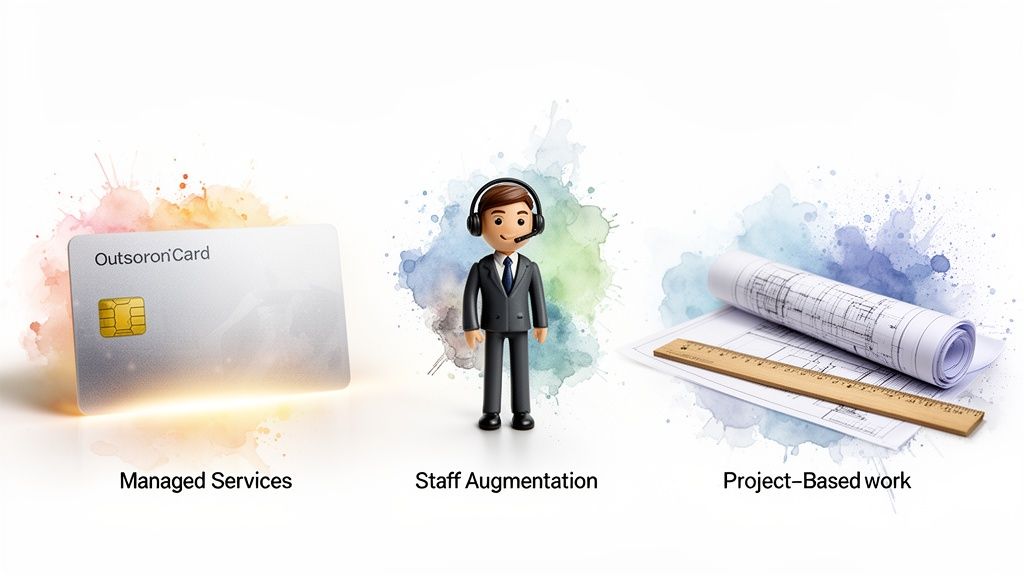
Managed Services Provider (MSP)
Think of a Managed Services Provider (MSP) as a subscription for your company’s total IT health. Instead of calling for help after something breaks, an MSP works in the background to stop problems from ever happening in the first place. For a predictable monthly fee, they take over the management, monitoring, and maintenance of your entire IT infrastructure.
This “all-you-can-eat” model is perfect for small businesses that need comprehensive, ongoing support but don’t have the budget or need for a full-time in-house IT department. An MSP handles everything from cybersecurity and data backups to network monitoring and day-to-day help desk support, making sure your systems are always secure and running smoothly.
The real power of the MSP model is that it’s proactive. It flips IT management from a reactive, break-fix cycle into a strategic, preventative one. The result? Less downtime, fewer headaches, and a more productive team.
Working with a USA-based MSP adds another layer of security and convenience. Since they operate in your time zone, you get support during your actual business hours, which gets rid of those frustrating delays. When an urgent issue pops up, you get immediate attention from a team that gets how American businesses operate.
Staff Augmentation
Staff augmentation is like hiring a specialist for a specific mission. Imagine your in-house team has a temporary skills gap or is just swamped with a big project—you can bring in an external expert to add some serious firepower. You aren’t handing over your entire IT department; you’re just adding a skilled professional to your existing roster for as long as you need them.
This model is a fantastic fit when you need specific expertise, like a cloud migration engineer or a cybersecurity analyst, but only for a limited time. You manage their day-to-day tasks, and they slot right into your team. It gives you the exact skills you need without the long-term cost and commitment of a full-time hire.
Project-Based Outsourcing
Project-based outsourcing is a lot like hiring a general contractor to build an extension on your house. You have a specific, well-defined goal in mind—like developing a new mobile app, redesigning your website, or setting up the network for a new office. You and the provider agree on a fixed scope, a clear timeline, and a set budget from the very beginning.
The biggest benefit here is clarity. Your outsourcing partner takes full responsibility for delivering the finished product, managing the entire project from kickoff to completion. This model is ideal for one-off initiatives with clear deliverables because it guarantees a specific result for a predetermined cost.
Comparing IT Outsourcing Models For Small Businesses
To make the choice a bit clearer, let’s put these models side-by-side. This table breaks down how each one serves different business needs, helping you find the perfect match for your company.
| Model | Best For | Pricing Structure | Key Benefit |
|---|---|---|---|
| Managed Services | Businesses needing complete, proactive IT management and ongoing support without an in-house team. | Fixed Monthly Fee | Predictable costs and preventative care for your entire IT environment. |
| Staff Augmentation | Companies with an existing IT team that need to fill a temporary skill gap for a specific role. | Hourly or Daily Rate | Flexible access to specialized talent without long-term hiring commitments. |
| Project-Based | Organizations that have a specific, one-time project with a clearly defined scope and deadline. | Fixed Price Per Project | A guaranteed outcome delivered on time and on budget with minimal oversight. |
Each of these structures offers a solid path for IT outsourcing for small business. The right one for you comes down to your current challenges and where you want to go. Whether you need a full-service partner, a temporary expert, or a team to bring a specific vision to life, there’s a model designed to help you get there.
Ready to find the right model for your business? Call +1 (310)800-1398 to discuss your needs with an expert.
Essential Services You Can Outsource Today
So you’ve decided to explore IT outsourcing. That’s a big step. But the next question is always, “Okay, but what can I actually hand off?”
The short answer? Pretty much any tech-related headache that pulls you away from running your actual business. By breaking down the possibilities, you can see where a partner could make an immediate, tangible difference.
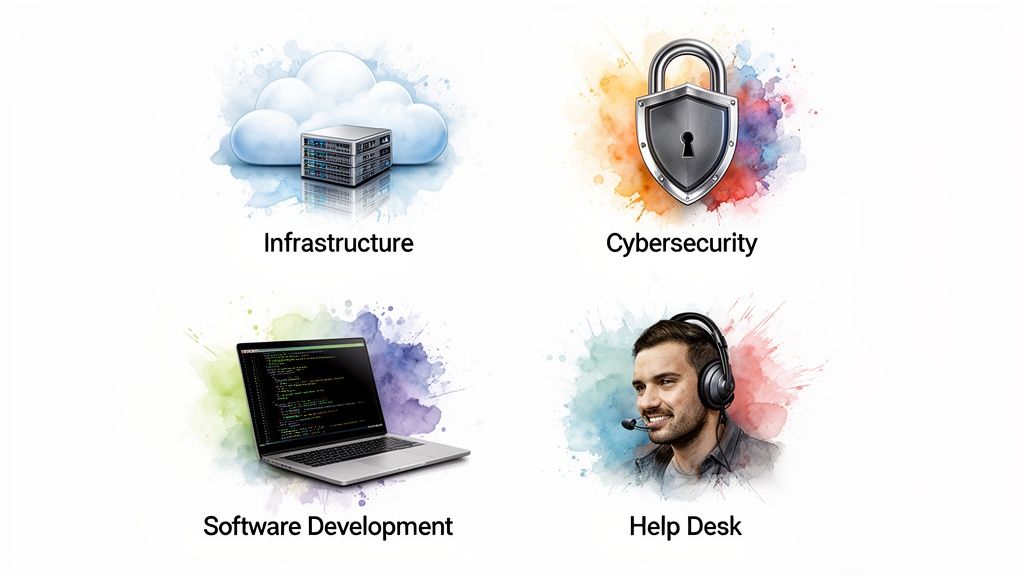
Let’s think about your IT needs in a few distinct buckets. The first and most obvious one is the daily grind—the engine room of your business technology. Keeping that running smoothly is a full-time job in itself, and it’s the perfect place to start.
Infrastructure And Operations Management
This is all about the day-to-day tech that keeps your team working. When a laptop won’t connect to the printer or a critical app crashes right before a deadline, business stops. Outsourcing this ensures you have a dedicated team on standby to fix things now, not later.
What does this typically cover?
- Help Desk Support: Think of this as your frontline defense against lost productivity. It’s instant, expert help for your team’s daily tech troubles, from password resets to software glitches.
- Network Management: This is the proactive work—monitoring and maintaining your servers, routers, and Wi-Fi to keep everything stable, secure, and fast.
- Cloud Services Management: If you’re using platforms like Microsoft 365 or Google Workspace, an outsourced partner can manage it all: setting up new users, configuring security, and handling data backups.
A quick tip: choosing a USA-based partner for these services is a game-changer. When your team needs help, they get it during their business hours from people who understand their context, which means faster fixes and a whole lot less frustration.
Advanced Cybersecurity Protection
For most small business owners, cybersecurity is a constant, nagging worry. The threats are complex, they’re always changing, and one bad breach can be devastating. Outsourcing your security gives you access to a level of protection that would be nearly impossible to build yourself.
An outsourced security team brings serious firepower:
- 24/7 Threat Monitoring: They watch your network around the clock, ready to spot and shut down threats before they cause any real damage.
- Endpoint Protection: This is advanced security software for every company device—laptops, desktops, and phones—to shield them from malware and ransomware.
- Compliance and Data Protection: They make sure your data handling meets industry rules. This includes strategic initiatives like implementing Privacy by Design for SMBs & Startups, which is vital for building trust and avoiding fines.
Strategic Software Development
Innovation drives growth, but hiring a full-time team of software developers is a huge financial commitment. This is where project-based outsourcing shines. You can build a custom app, automate a clunky internal process, or launch a new company website without taking on permanent staff. You get the exact skills you need, for exactly as long as you need them.
This approach is becoming more and more common. In fact, over 37% of small businesses now outsource both their accounting and IT services. It’s a strategic move to tap into high-level expertise without the overhead, and it’s why 52% of small firms plan to do more outsourcing soon.
By figuring out which services to hand off, you can start systematically removing tech roadblocks and build a stronger, more secure, and more efficient business.
Ready to offload your IT burdens? Call us at +1 (310)800-1398 to discuss which services are right for you.
How to Find an IT Partner You Can Actually Trust
Picking an IT outsourcing partner for your small business is one of the most critical decisions you’ll make. This isn’t just about finding someone to fix a glitchy laptop; it’s about handing over the keys to a core part of your operations. The right partner becomes a true asset that helps you grow. The wrong one? A source of endless frustration and risk.
Finding that perfect match starts long before you even look at a proposal. The very first step is to look inward. You need to get crystal clear on your own goals and what you need help with. Are you hunting for 24/7 security monitoring, day-to-day help desk support for your team, or a specialist to wrangle your cloud setup?
Once you have a sharp picture of what you need, you can start vetting potential partners with a solid framework, making sure you judge them on the things that actually matter.
Creating Your Evaluation Checklist
A methodical approach is your best defense against a slick sales pitch. Your evaluation needs to be built on real, tangible proof that a provider is both capable and reliable.
Here are the non-negotiable criteria to build your checklist around:
- Verified Technical Expertise: Don’t just take their word for it. Ask to see certifications (like those from Microsoft or CompTIA), case studies from businesses like yours, and references you can pick up the phone and call.
- Relevant Industry Experience: An IT partner who gets the unique headaches and compliance rules of your industry—whether it’s healthcare, finance, or retail—is worth their weight in gold. They’ll speak your language and see problems coming before you do.
- A Proven Ability to Scale: Your business is going to grow, and your IT partner has to be ready to grow right alongside you. Ask them about their process for bringing on new employees, adding new services, and handling a bigger workload.
This disciplined vetting process helps you cut through the marketing fluff and focus on what a provider can truly deliver for your business.
The Strategic Edge of a USA-Based Partner
For small businesses here in the States, choosing a domestic partner brings some serious strategic advantages that go way beyond simple logistics. It’s about building a seamless, collaborative relationship that feels like a natural part of your own team.
When you partner with a USA-based firm, you get rid of the friction from clashing time zones and cultural disconnects. If a critical system goes down at 2 PM your time, you get immediate help from a team that’s wide awake and ready to jump in—not one that’s just rolling out of bed.
This alignment leads to clearer communication and a much deeper understanding of how your business operates. Your partner just gets the nuances of the US market, the regulatory landscape, and what your customers expect, which means faster solutions and smarter strategic planning.
Understanding the Service Level Agreement
The Service Level Agreement (SLA) is the single most important document in your new partnership. It’s the contract that lays out all the expectations and holds your provider accountable. Don’t just skim it; take it apart and understand every line.
Look for specific, measurable promises on the metrics that hit your operations the hardest:
- Guaranteed Response Times: How quickly will they acknowledge a new support ticket?
- Resolution Times: What’s the absolute maximum time they have to fix different issues (e.g., a critical server down vs. a low-priority printer issue)?
- System Uptime: What percentage of uptime do they guarantee for your crucial systems (e.g., 99.9%)?
The global IT outsourcing market is absolutely exploding—it’s projected to hit USD 850.73 billion by 2030. A huge driver of that growth is small businesses looking for these kinds of reliable, scalable tech solutions without the massive upfront investment. Already, 24% of small businesses in the US outsource their IT needs, joining the 66% of companies that bring in external expertise to fill critical skill gaps. You can dive deeper into these software development outsourcing statistics to see just how big this trend has become.
By following this framework, you can move forward confidently and choose a reliable, long-term IT partner. Ready to find yours? Give us a call at +1 (310)800-1398 for a consultation.
Where Do We Go From Here?
You now have the roadmap. The journey into IT outsourcing for small business isn’t about replacing what you have, but amplifying its potential. Think of it as a strategic move that grants you access to top-tier expertise, frees up your team from fighting fires, and lets you get back to what you do best—growing your business. This isn’t just about cutting costs; it’s about turning technology into an engine for growth.
That entire process, however, starts with one simple action: taking an honest look at where your IT stands today and where you need it to be tomorrow.
Starting Your Assessment
Before you can find the right partner, you have to know what problems you’re actually trying to solve. This internal audit doesn’t need to be some complicated, month-long project.
Just start by asking a few fundamental questions:
- What are our biggest IT pain points? Is it the daily grind of slow computers and network glitches, or bigger worries like data security and compliance?
- Where are our skill gaps? Are we struggling with cloud management? Do we have anyone who truly understands modern cybersecurity threats?
- What business goals could technology help us achieve? Could we improve customer service, boost efficiency, or launch new products if our tech was actually on our side?
Answering these honestly paints a clear picture of your needs, and that picture is the foundation for any successful partnership.
Remember, the goal of IT outsourcing isn’t just to fix what’s broken. It’s to build a technology foundation that actively supports and accelerates your business. It’s about turning a reactive cost center into a proactive, strategic asset.
To make sure things go smoothly with your new IT partner, it’s incredibly helpful to document your IT processes quickly and efficiently. Having this documentation ready means your chosen provider can understand your workflows from day one, skipping weeks of painful discovery.
Working with a USA-based partner can simplify this journey immensely. When you have aligned business hours and a shared cultural understanding, communication just flows. Your goals are understood and executed correctly from the start, building the kind of collaborative spirit that’s essential for a lasting, effective relationship.
The path forward is clear. By assessing your needs and finding a trusted advisor, you can solve your current tech headaches and unlock powerful new opportunities.
We invite you to take that first step. Call us today at +1 (310)800-1398 for a no-obligation consultation to explore a solution that will help you achieve your goals.
Got Questions? We’ve Got Answers
Stepping into the world of IT outsourcing can feel like learning a new language. It’s natural to have questions, and getting clear, honest answers is the first step toward making a smart decision for your business. Let’s tackle some of the most common things business owners ask.
Is IT Outsourcing Just For Big Companies?
Not a chance. In fact, you could argue it’s even more valuable for small businesses. Most SMBs can’t afford to hire a full-time cybersecurity guru, a cloud specialist, and a network engineer. That’s a massive payroll hit.
Outsourcing gives you immediate access to that entire team of experts for a predictable monthly cost. It’s the ultimate way to level the playing field, letting you use the same caliber of technology as the big players without the enterprise-level budget.
Will I Lose Control of My Own IT?
This is probably the biggest myth out there. A good IT partnership doesn’t take control away—it actually gives you more strategic control. You’re the one setting the vision and the business goals; your partner is the one in the trenches, handling the day-to-day technical grind.
Think of it this way: you’re the captain of the ship, and they’re your expert crew. You decide the destination, and they make sure the engine is running perfectly. Through clear Service Level Agreements (SLAs), detailed reports, and a dedicated contact, you always know what’s happening. You’re simply freed from worrying about the technical nuts and bolts so you can focus on steering your business forward.
A great IT partner doesn’t take control. They provide the stability and data you need to exercise better control over your company’s future.
Choosing a USA-based partner strengthens this collaboration even more. When you’re in the same time zone and share the same business culture, communication just clicks. Your goals are understood and executed correctly, which only enhances your strategic oversight.
What’s This Going to Cost Me?
The cost of IT outsourcing for small business really depends on what you need—how many users you have, how complex your setup is, and which services you want. But here’s the key: it is almost always more cost-effective than building and managing an in-house team.
Typically, you’ll see a couple of models:
- Fixed monthly fees for all-in-one managed services. These can start as low as a few hundred dollars a month.
- Hourly rates if you just need help with a specific project or a one-off consultation.
Any provider worth their salt will take the time to understand your business and give you a clear, customized quote that fits your budget. You should know exactly what you’re paying for, making it easy to see the return on your investment.
Why Should I Choose a USA-Based Partner?
Working with a USA-based firm gives you real, practical advantages that directly affect how smoothly your business runs. This is about more than just convenience; it’s about effectiveness.
The biggest win is seamless communication. When you share a language and business culture, misunderstandings disappear. Plus, with no time zone headaches, you get help when you actually need it—during your business hours. A domestic partner also has an ingrained understanding of US regulations and compliance standards, which is huge for managing risk. All this leads to smoother projects, faster solutions, and a partnership that feels like a true extension of your own team.
Ready to get answers tailored specifically to your business? We are here to help. Give us a call at +1 (310)800-1398 for a no-pressure chat about how our IT services can solve your headaches and open up new doors for growth.