

You're in a weekly leadership meeting and the numbers won't settle. One client has delayed a renewal, a vendor has raised prices, and two teams are waiting for a decision on hiring. Each person in the room has a different theory about what happens next, and each theory points to a different action.
That's the normal condition for leading through uncertainty, not an exception you can wait out. The risk isn't only that you'll choose badly. It's that you'll argue about solutions before you've agreed on what you don't know, communicate confidence your staff don't feel, and load one more change onto teams that are already stretched.
I treat uncertainty as a portfolio problem. You have a limited stock of cash, attention, trust, and team capacity. Every decision draws on that stock. Good leadership development, grounded in human behavior and transformational thinking, means spending that stock deliberately, testing what you can reverse, and protecting the people who have to deliver. The routines below are built for that trade-off.
Diagnose Which Kind of Uncertainty You Face
The meeting stalls because the forecast slipped again. Sales says demand is softening, finance says payments are slowing, and operations says the team can't absorb another project. All three may be right, but they're describing different problems that need different first moves.
Most uncertainty falls into five groups: market demand, cash and funding, technology and vendors, people capacity, and regulatory or policy change. Each group sends a signal before the problem becomes obvious. Naming the group early is the practical work behind building organizational resilience at work, because resilience starts with seeing strain before it becomes failure.
| Uncertainty type | Early signal | First move | Decision window |
|---|---|---|---|
| Market demand | Orders or pipeline shift faster than forecasts | Model demand at 10, 20 and 30 percent declines and note which costs change | Within one week |
| Cash and funding | Runway shrinks or client payments slow | Rebuild the cash forecast and count runway in months under each decline | Within one week |
| Technology and vendors | Outage, price change or single-provider dependency | Map single points of failure and test one fallback | Within two weeks |
| People capacity | Attrition, overtime or missed deadlines | Count concurrent initiatives per team and pause the lowest value one | Within two weeks |
| Regulatory or policy | New rules with unclear effective dates | Assign an owner, track the source and set a review date | Monthly review |
Three Questions That Sort the Problem
Ask what is unknown, what it affects, and how fast it will arrive. A shrinking pipeline that affects next quarter's hiring is a demand question. The same pipeline paired with longer payment cycles and a short runway is a cash question, and cash usually wins the argument because it shortens every other deadline.
Look for combinations, because shocks rarely arrive one at a time. In June 2020, the World Bank press release on the COVID-19 recession projected global gross domestic product would contract by 5.2% that year, with advanced economies shrinking by 7%. Demand, supply, employment, and access to capital moved together, which is why a single departmental fix would have missed the point.
Name the type of uncertainty, give it an owner, and set a date. A vague worry has no deadline, so it consumes every meeting.
Your first move in each row should take days, not weeks. Counting concurrent initiatives takes an afternoon. Mapping which provider handles all deployments takes a whiteboard and the people who run releases. You're not solving the problem yet. You're converting a general sense of risk into a bounded question with an early signal you can watch and a window in which you'll decide.
How to Run a Scenario Planning Session in One Afternoon
Scenario planning isn't forecasting. You're not picking the future most likely to happen and betting the plan on it. You're exposing hidden assumptions while you still have time to change them, and you're shortening response time by agreeing on triggers before pressure arrives.
It helps to see the working format before you book the room.
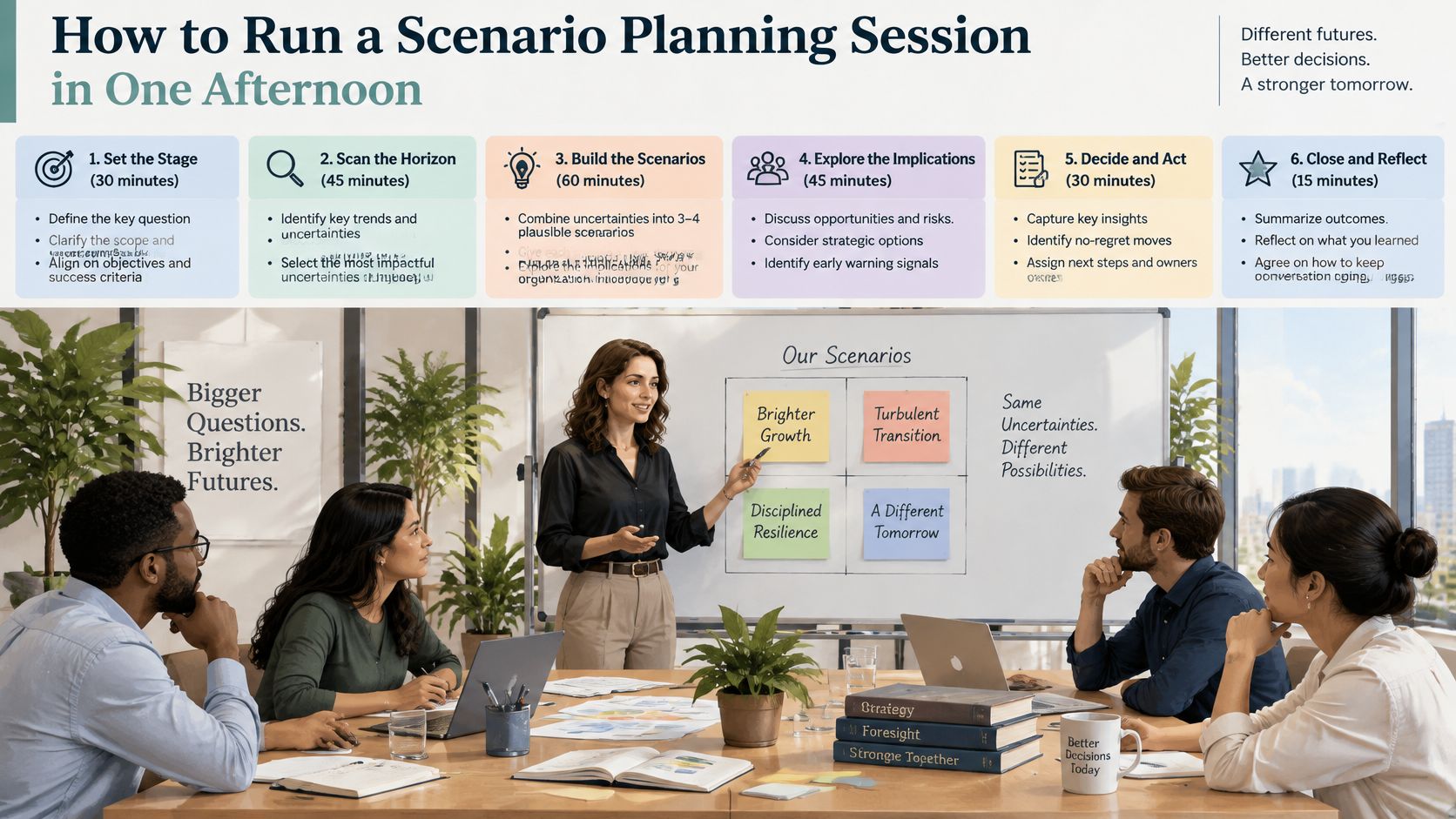
The Five Steps
- Define the strategic question in one sentence. Tie it to a real decision, such as whether to hire ahead of a contract renewal or commit to a larger office. The common mistake is choosing a topic instead of a decision. "The market next year" produces discussion. "Do we add three engineers before the renewal is signed" produces a choice.
- List external drivers and rank them by impact and uncertainty. Three to five drivers is usually enough, drawn from the groups you diagnosed earlier. The mistake here is listing everything that worries people. Keep only drivers that would change the decision if they moved.
- Build three to four plausible scenarios that differ in direction. Include steady growth, a sharp demand drop in your worked example, and an operational shock such as a supplier failure during a launch. If every scenario is a mild version of the same outcome, you've written a forecast with decoration.
- Stress-test the current plan against each scenario. Change several variables at once, because real shocks interact. Test budget, staffing, technology dependencies, and continuity plans together. The mistake is varying one input at a time and concluding you're safe when the combined effect is what breaks you.
- Assign triggers, owners, and one pre-approved response per scenario. Use measurable thresholds such as cash runway in months, service-level breaches, supplier failure, or cybersecurity severity. A narrative without a threshold gives nobody permission to act when conditions change.
This discipline is moving up the governance agenda. A 2025 Deloitte Global study of board members and C-suite executives found that 73% reported greater board involvement in strategy development and scenario planning, and 71% identified scenario planning as an area where board oversight can improve resilience. Boards aren't asking for better predictions. They're asking whether management knows what it will do when the prediction is wrong.
Making Expert Judgement Less Fragile
Inside the session, separate evidence gathering from consensus. Ask people to estimate ranges privately before discussion, then display the differences and investigate the assumptions behind them. The University of Sheffield description of the SHELF process follows that sequence, retaining disagreements rather than artificially eliminating them and incorporating quantitative uncertainty into decision models.
That order matters because seniority anchors rooms. If the most senior person states a number first, weaker signals disappear. Record a confidence range, the assumptions behind it, and what evidence would change the decision. False precision is worse than an honest range, because it hides the point where you'd need to pivot.
Output rule: Finish with one page per scenario showing the trigger, the owner, and the pre-approved response. If it doesn't fit on one page, nobody will find it during an incident.
Review trigger indicators quarterly, or whenever a material condition changes. A scenario exercise done once a year and filed away is a workshop, not an operating routine. The value comes from checking whether the signals you named are moving, and whether the owner still has authority to act.
Communicating When Leaders and Staff See Different Pictures
Executives may see a clear plan on a slide while staff contend with frozen roles, delayed tools, and clients asking harder questions. When those pictures conflict, more messages can deepen distrust. The gap is less about how much leaders send than whether employees can act on what they hear.
The Edelman Trust Barometer Trust at Work summary reports that 79% of executives say management always tells employees the truth, compared with 46% of entry-level employees and non-managers. It also reports that 78% of executives say management communicates regularly, versus 55% of associates.
Executives often judge communication by what was sent; frontline staff judge it by whether it helps them decide what to do. Another town hall cannot resolve a gap between the official message and the constraints people face in daily work.
Three Routines That Close the Gap
- Run anonymous pulse checks by role and geography. Ask what remains unclear and which decision is blocking work. Confidence ratings can show that morale is low, but open responses help identify the uncertainty behind it.
- Publish what is known and unknown, with dates. State what is settled, what remains open, when the next update will come, and when the decision may be revised. A stated review date gives staff a clear point to revisit the decision.
- Name an owner for each decision that may change. Give people a person to ask, not just a channel to post in. The owner should be able to explain the decision and say when an answer is still pending.
Delivery matters. Learning to speak with authority in leadership meetings helps leaders present an incomplete position clearly. State the knowns, unknowns, and next update date without overstating what the organization can promise.
Measure comprehension, perceived fairness, and ability to act, rather than message volume. After an update, ask a small sample of staff to explain what changed and what they will do differently this week. If they cannot, the communication has not reached the people doing the work.
The gap between an executive message and frontline experience can persist across roles and locations. Treat it as a recurring operating issue, and assess whether the organization's concurrent changes are adding to the load staff must absorb.
Test whether uncertainty decreased where the work happens. If only the leadership team feels clearer, you have aligned the wrong audience.
The Gallup analysis of leadership during the global financial crisis reports that 69% of employees who strongly agreed leadership made them feel enthusiastic about the future were engaged, compared with 1% of those who disagreed or strongly disagreed. Credible direction depends on whether staff can connect leadership's message to the conditions they face at work.
Acting Reversibly and Protecting Team Capacity
Under ambiguity, prefer moves you can undo. Reserve irreversible commitments for cases where the evidence is strong and the cost of waiting is higher than the cost of being wrong. Classify the decision before you debate the details, because the classification sets how much proof you need.
| Decision type | Reversible | Example | Rule before acting |
|---|---|---|---|
| Pilot or trial | Yes | Two-week pilot of a new support tool | Set the metric, review date and stop rule before starting |
| Process change for one team | Yes | Moving approvals to a shared queue | Run for one sprint and compare cycle time against the old process |
| Hiring on fixed-term contracts | Partly | Three contractors for a seasonal peak | Agree the end date and the trigger that would extend them |
| Multi-year vendor contract | No | Three-year cloud commitment | Require scenario stress tests and an exit clause before signing |
| Office or site closure | No | Closing a regional office | Require two scenarios where the closure is reversed and their costs |
Set Up Experiments Before They Start
Write down four items before any pilot begins: the hypothesis, the single metric that confirms or rejects it, the review date, and a stop, continue, or pivot rule. This is the practical core of adopting a lean startup mindset, applied to internal decisions rather than only to products.
Say you pilot a new support tool for two weeks, targeting 20 percent faster first-response times in that worked example. Review on day 14. If the metric hasn't moved, you stop or change one variable and restart the clock. Without that rule, pilots drift into permanent commitments that nobody chose.
Treat Concurrent Change as the Real Constraint
Ambiguity gets blamed for strain that's caused by overload. The Edelman 2026 Trust Barometer special report on work reports that three in four employees experienced at least one major workplace transformation during the previous year, while more than four in ten experienced three or more. Among employees who experienced a transformation negatively, only 49% trusted their CEO, compared with 82% among those reporting a positive experience.
Rank active initiatives by expected value, reversibility, and team load. Pause or cancel the lowest-ranked ones, and write down what the team is deliberately not doing so the pause holds when someone asks again next month. Slowing a selected initiative can increase long-term speed by preventing fatigue, resistance, and rework.
The confidence gap makes this urgent. According to PwC's Global Workforce Hopes and Fears Survey, in 2025 only 53% of workers said they felt strongly optimistic about the future of their roles, with optimism at 43% among non-managers and 72% among executives. The people closest to the work are the least confident, so their capacity needs explicit planning rather than encouragement.
Protect the People Making the Decisions
Give each team a visible learning budget of time for small experiments, so people shape outcomes instead of only absorbing them. Keep the active list to what can be delivered in a quarter. If a team can't name its top three commitments without checking a document, the portfolio is already too large.
Build short recovery routines into the calendar. A one-minute breathing pause before high-stakes meetings is a simple form of meditation that lowers the chance of a reactive first response. A weekly review of what went well keeps attention on evidence rather than only on threats.
Fatigued leaders pick the fastest option, not the reversible one. Steadiness is a visible behavior your team copies, so it's part of decision quality, not a personal extra.
Close the month with a dashboard of no more than five measures. Track learning as experiments closed with a recorded decision, cash as runway in months, delivery as cycle time, people as a pulse score on comprehension and fairness, and client impact as retention or churn. Five measures force trade-offs into the open, which is the point of transformational thinking in practice. Where specialist capacity is the constraint, Kushan Business Solutions LLC is one option organizations use to augment teams while keeping internal staff focused on priority work.
Choose One Uncertainty to Work on This Week
A leadership team is midweek with five open uncertainties on the table. Cash runway is shrinking. A policy discussion is loud but has no effective date. Three fixed-term contracts need a yes or no. Work the item with the highest cost of delay and the earliest visible signal. Cash outranks the louder policy conversation.
A Five Day Checklist
- Name the decision in one sentence. Write the actual choice, such as whether to extend three fixed-term contracts, and attach one owner to it.
- Write three scenarios with triggers. Each scenario gets one measurable trigger indicator and one pre-approved response, kept on a single page.
- Send one team update. State what is known, what is unknown, when the next update comes, and the date you may revise the decision. Spell out what staff will see this week, not only what the leadership meeting agreed.
- Start one reversible experiment. Record the hypothesis, metric, review date, and stop rule before work begins, not after early results arrive.
- Put the review date on the calendar now. Fix which dashboard measures you'll check on that date, so the review can't turn into a general discussion.
If the team is stretched, ask which item can be delegated, simplified, or postponed rather than dropped. A smaller pulse check still tells you what's unclear. A two-scenario exercise still beats none. Holding all five items at full size lets the hardest one disappear. Concurrent changes stack, so cutting scope on four of them keeps capacity for the one you chose.
The sequence turns one worry into a bounded question with an owner, a trigger, a reversible test, and a date. Treat that as an operating habit, repeated weekly rather than performed during a crisis.
Start with the smallest version that produces evidence. One named uncertainty, one owner, one review date on the calendar before you close this page. Each closed experiment gives the next decision a better starting point.