
Your team moved to the cloud for good reasons. You wanted speed, flexibility, and room to grow without buying more hardware every time demand changed. For a while, that promise probably felt real.
Then the monthly bill started climbing. A once-simple setup turned into a mix of workloads, storage choices, security settings, access rules, backups, and urgent questions no one fully owns. Performance feels uneven, finance wants answers, and leadership wants to know whether the cloud is helping growth or draining budget.
That’s where cloud infrastructure consulting becomes useful. Not as a narrow technical fix, but as a practical business discipline. It helps you decide what belongs in the cloud, how to design it, how to control cost, how to reduce risk, and how to keep the environment aligned with the business after launch.
Your Cloud Is an Asset Not a Liability
A common story goes like this. A growing company launches new apps quickly, adds remote teams, and shifts systems into the cloud because on-premise infrastructure feels too slow and rigid. At first, the move works. Teams deploy faster and stop waiting on physical servers.
A year later, the same company is asking harder questions. Why are cloud costs rising when headcount hasn’t grown at the same pace? Why do some systems still slow down during busy periods? Why does every security review uncover a new configuration issue or unclear ownership gap?

Cloud environments often become messy for understandable reasons. Different teams make sensible decisions in isolation. Engineering focuses on shipping. Operations focuses on uptime. Finance focuses on spend. Security focuses on access and compliance. Without one unifying strategy, the cloud starts acting less like a growth platform and more like a storage closet where everyone keeps adding things.
What leaders usually feel first
Most business leaders don’t begin with technical complaints. They notice business friction.
- Budget friction: Bills arrive, but the line items don’t clearly map to business value.
- Delivery friction: Releases slow down because infrastructure choices weren’t designed for scale.
- Risk friction: Teams worry about backups, access controls, resilience, and audit readiness.
- Staffing friction: Internal teams are capable, but they’re stretched thin and forced into reactive work.
Cloud problems rarely begin as cloud problems. They begin as business priorities moving faster than infrastructure decisions.
That’s why cloud infrastructure consulting matters. A good consultant doesn’t just “manage servers in the cloud.” They step in the way a skilled architect would step into an overgrown building project. They assess what exists, identify what’s wasteful or fragile, and redesign the environment so it supports growth instead of fighting it.
What changes with the right guidance
When the work is done well, the cloud becomes easier to understand and easier to govern. Costs become explainable. Security becomes structured. Capacity planning becomes proactive instead of reactive. Teams stop guessing.
That shift is where the value lies. The cloud stops being a liability you tolerate and starts becoming an asset you can use confidently.
What Is Cloud Infrastructure Consulting Really
The easiest way to understand cloud infrastructure consulting is to stop thinking of it as a collection of technical tasks. It’s closer to hiring an architect for your digital headquarters.
An architect doesn’t begin by asking where to pour concrete. They begin by asking how the building will be used, how many people need to work there, what safety rules apply, how future expansion should work, and what tradeoffs the budget allows. Cloud infrastructure consulting works the same way. It connects technology design to business intent.
Think like a digital architect
If your business were opening a new office, you wouldn’t want random rooms added by different contractors with no shared plan. You’d want a layout that supports how your teams work. In the cloud, those “rooms” are compute, storage, networking, identity, backup, monitoring, and security controls.
A consultant helps answer questions like these:
- What should move first: Not every workload belongs in the cloud at the same time.
- What should stay separate: Sensitive systems may need tighter controls than general business apps.
- How should it scale: Traffic can be predictable, seasonal, or highly volatile.
- Who should access what: Permissions should match job responsibilities, not convenience.
- How should costs be governed: Fast growth without spending guardrails becomes expensive quickly.
That’s why cloud infrastructure consulting is strategic. The technical design matters, but the “why” matters first.
Why this work has become so important
The market itself shows why businesses need clearer guidance. The global cloud infrastructure market reached $419 billion in 2025, a nearly ninefold increase since 2017. Spending also crossed $100 billion in a single quarter for the first time in Q3 2025, and 90 to 95 percent of organizations use some form of cloud computing according to Statista’s cloud infrastructure revenue analysis.
Those numbers matter because scale creates complexity. When nearly every organization uses cloud services, the challenge is no longer whether to adopt the cloud. The challenge is how to use it well.
For leaders who want a broader operational view, this explanation of what IT infrastructure management entails is useful because it shows how cloud decisions fit into the larger picture of systems, support, governance, and reliability.
A cloud consultant’s value isn’t that they know cloud terminology. It’s that they can translate business needs into an environment your team can actually run.
What consulting is not
Cloud infrastructure consulting isn’t only migration work. It’s not just “move the servers and we’re done.” A mature engagement often includes planning, architecture, governance, security design, operational standards, cost control, resilience planning, and support for future change.
It also isn’t the same as owning every task forever. In many organizations, the consultant builds the roadmap, designs the foundation, guides implementation, and helps the internal team operate with more confidence afterward.
That distinction matters. The goal isn’t dependence. The goal is a cloud environment that supports the business with fewer surprises.
Core Services and Key Deliverables
A useful cloud consulting engagement should leave your team with more than advice. It should leave you with working plans, clear decisions, and operating standards your staff can effectively use.
That matters because cloud work often looks invisible from the executive seat. Servers are no longer sitting in a room down the hall. Costs arrive as line items. Risks hide inside permissions, architecture choices, and undocumented dependencies. Good consulting makes those hidden parts visible and manageable.
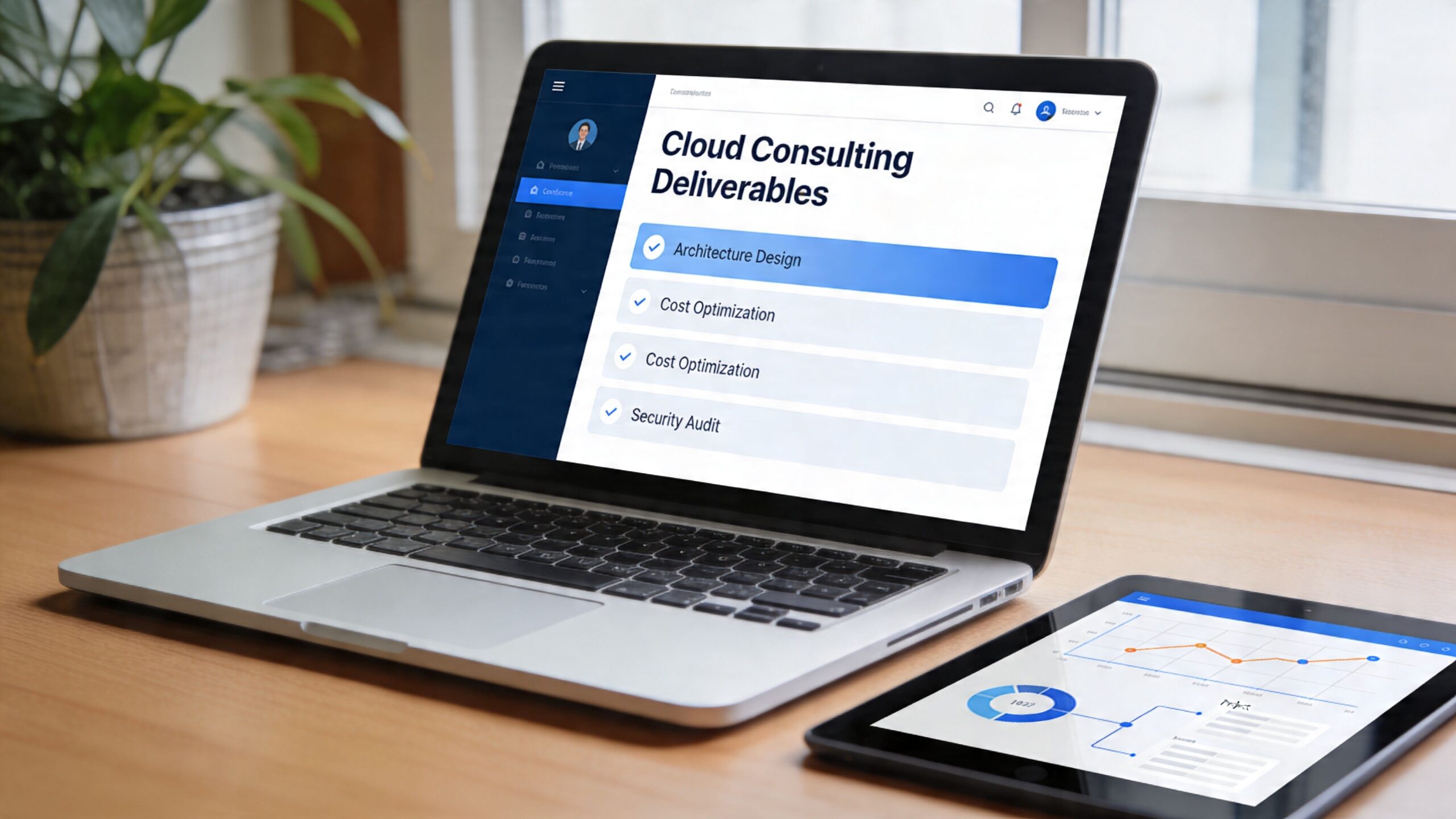
The service areas below are the ones that usually matter most to SMEs and larger enterprises. Together, they form a practical roadmap from uncertain cloud usage to a cloud environment that supports growth, controls risk, and produces measurable return.
Cloud migration planning
Migration planning answers four business questions. What should move, what should stay put for now, what must change before it moves, and how do you avoid disrupting the business during the transition?
This work resembles planning a factory relocation. You do not move every machine on the same day and hope production continues. You map dependencies, identify the equipment that keeps revenue flowing, schedule each move in phases, and prepare a fallback plan if something breaks.
A sound migration planning package often includes:
- Migration roadmap: A phased sequence showing which systems move first, which need redesign, and which should remain where they are for the time being
- Dependency map: A record of how applications, databases, integrations, and user groups connect
- Risk register: A list of likely failure points, business impact, and mitigation steps
- Business continuity plan: Recovery expectations, backup design, and service restoration priorities for critical systems
For business leaders, the value is straightforward. You get a migration path tied to business importance, not just technical convenience.
Infrastructure architecture design
Architecture design turns business goals into technical structure. If migration planning decides the route, architecture decides what the destination should look like.
A good design package explains more than where workloads live. It shows how environments are separated, how traffic moves, how access is approved, where backups reside, and how the company will detect issues before customers notice them.
Typical deliverables include:
- Network topology diagram: How production, testing, development, and internal services are segmented
- Identity and access model: Which roles can reach which systems, under what controls
- Storage strategy: Which data belongs in high-performance storage and which can shift to lower-cost archival tiers
- Scalability plan: How capacity expands during spikes without permanently paying for peak demand
Strategy takes tangible form. An architecture decision made early can lower future costs, reduce outage risk, and make acquisitions, new locations, or product launches easier to support.
Cost optimization and FinOps
Cloud cost work is often misunderstood. The goal is not just to shrink the bill. The goal is to match spending to business value.
A consultant usually starts by separating useful spend from waste. Some systems are expensive because they support revenue, analytics, or customer experience. Others are expensive because no one retired old resources, resized oversized workloads, or assigned clear ownership. Those are very different problems, and they need different responses.
A FinOps-focused engagement often produces:
| Deliverable | What it shows | Why it matters |
|---|---|---|
| Cost baseline report | Current usage patterns, spending by environment, and major cost drivers | Gives finance and IT a shared starting point |
| Rightsizing recommendations | Overprovisioned compute, idle instances, and unused services | Reduces waste without harming performance |
| Storage tiering plan | Which data needs fast access and which can move to archive storage | Cuts recurring storage expense |
| Budget governance model | Ownership rules, alerts, review cycles, and approval paths | Helps prevent cloud sprawl from returning |
For many organizations, the return on investment comes into clear view. Lower waste is part of the story. Better forecasting, clearer accountability, and fewer billing surprises matter just as much.
Cost control and risk control are often tied together. Weak governance tends to create both overspending and exposure. This overview of common cloud security and governance challenges is useful context if your team is dealing with both at once.
Security and compliance design
Security design in the cloud is really a decision about operating discipline. Tools matter, but clear rules matter more.
Many cloud incidents start with ordinary mistakes. Access rights grow over time. Logging is incomplete. Backup policies exist on paper but are not tested. A consultant helps reduce those gaps by building controls into the environment from the start, instead of treating security as a cleanup project later.
A security and compliance engagement often delivers:
- Access control matrix: Permission rules by role, team, and system
- Compliance checklist: Required controls based on your regulatory obligations and internal policies
- Backup and recovery design: Retention expectations, immutable backup options, and restoration procedures
- Posture review findings: Misconfigurations, policy drift, ungoverned assets, and priority remediation steps
The business benefit is resilience. Your team gets a clearer answer to a hard question: if something goes wrong, do we know what is exposed, what is recoverable, and who is accountable?
Cloud operations and ongoing governance
The cloud still needs day-to-day management after the architecture is built and the workloads are running. Without operating rules, even a well-designed environment can become expensive, confusing, and risky within a year.
This service area defines how the environment is maintained over time. It often includes monitoring dashboards, incident workflows, patching schedules, tagging standards, review cadences, escalation paths, and handoff documentation for internal teams.
NineArchs LLC provides cloud platform support as part of its broader IT services and outsourcing model. For companies that want a US-based consulting partner with access to global delivery talent, that model can provide strategic guidance and flexible execution without requiring the business to hire every specialty in-house.
The strongest deliverable in this phase is confidence. Your team should understand how the environment works, who owns what, how changes are approved, and how performance, security, and cost are reviewed over time.
Navigating the Consulting Engagement Lifecycle
Hiring a cloud consultant can feel abstract until you see how the work usually unfolds. In reality, a good engagement follows a steady rhythm. It starts with diagnosis, moves into design, then into implementation, and finally into long-term refinement.
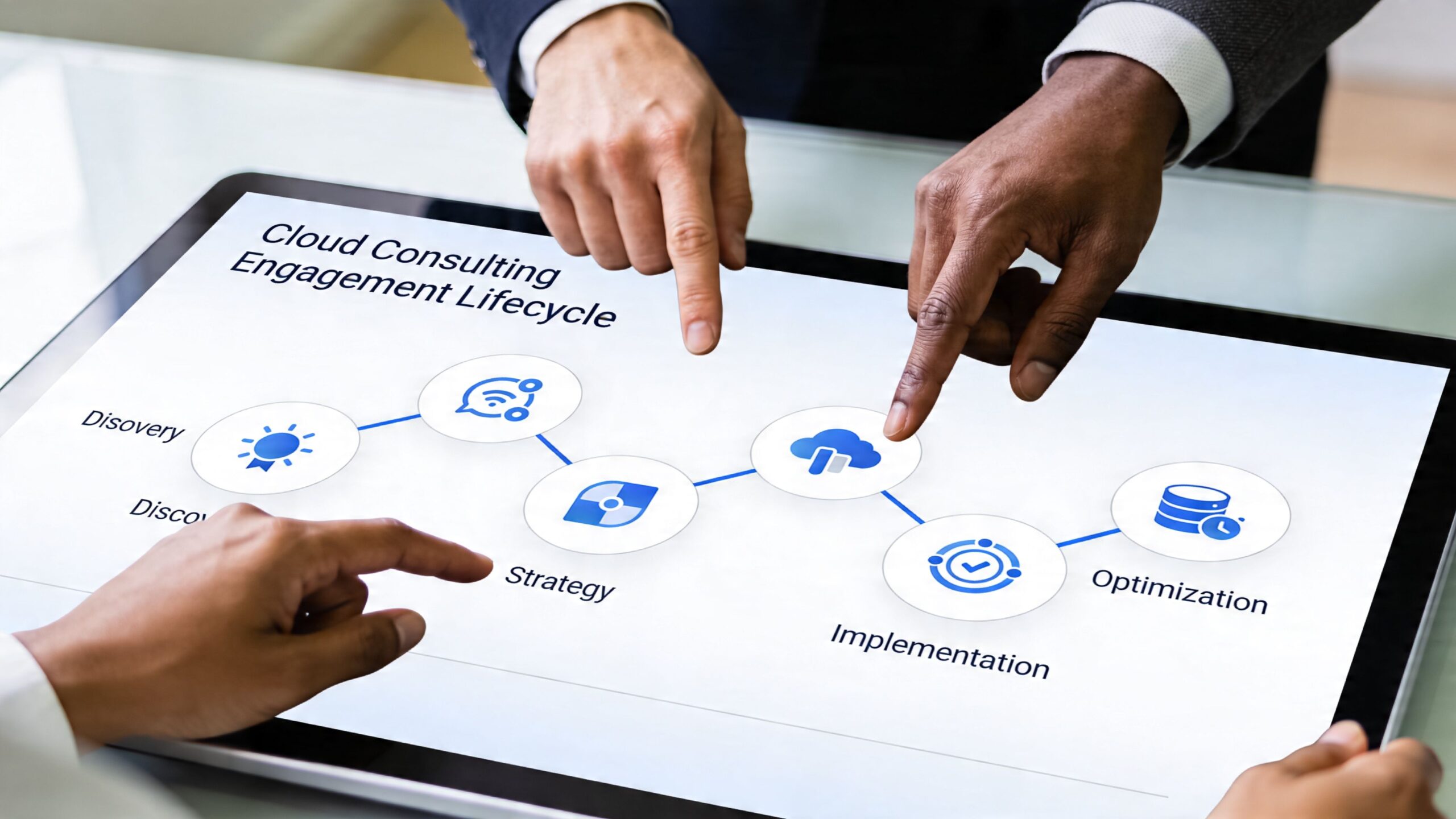
Discovery and assessment
This phase is part interview, part investigation. The consultant talks with leadership, operations, engineering, security, and finance because each group sees a different part of the problem.
One company might say its issue is “cloud cost,” but discovery reveals something deeper. Maybe environments were duplicated for speed and never cleaned up. Maybe a business-critical system was lifted into the cloud without redesign, so it runs expensively and performs inconsistently. Maybe access policies evolved informally and no longer match current staff roles.
The output here is clarity. Your team gets a picture of what exists, where risk sits, and where the biggest opportunities are.
Strategy and design
Once the environment is understood, the consultant develops a target-state plan. Decisions become explicit within this plan.
Some workloads may stay where they are for now. Others may be consolidated, reconfigured, or redesigned. Security controls get structured. Governance gets assigned. Cost ownership gets tied to teams or business units rather than sitting as one opaque bill.
A good strategy phase also forces prioritization. Not everything should be fixed at once.
- High-risk items first: Exposed configurations, weak recovery posture, or unclear access control
- High-cost items next: Overbuilt environments, avoidable storage choices, or unused resources
- High-value changes after that: Improvements that help delivery speed, developer productivity, or resilience
Good cloud strategy is sequencing. The order of decisions matters almost as much as the decisions themselves.
Implementation and migration
This is the most visible phase, but it shouldn’t be the first phase. By the time implementation starts, the team should already know what success looks like.
A disciplined consultant will typically run pilots, validate assumptions, test rollback scenarios, and move in stages. That lowers disruption and gives business stakeholders confidence that the migration isn’t an uncontrolled leap.
This phase also tends to reveal operational realities. Documentation gaps show up. Old integrations surface. A business process someone assumed was retired turns out to be essential. That’s normal. The value of a structured engagement is that these surprises can be managed instead of becoming crises.
Optimization and governance
The project isn’t finished just because workloads are live. Cloud environments change constantly. New hires need access. Old resources should be retired. Budgets shift. Product usage changes.
That’s why the final phase focuses on governance. Review cycles get established. Cost and usage reports get tied to owners. Security posture gets monitored. Backups and recovery processes get tested. Teams decide what the consultant continues to support and what internal staff will own.
In the healthiest engagements, the consultant eventually becomes less of a firefighter and more of an advisor. That’s a sign the cloud environment has matured.
Calculating ROI and Managing Cloud Risks
A cloud program often looks affordable at the start. Then the second bill arrives, a backup restore takes longer than expected, and no one can explain which team owns half the running resources. That is the point where cloud stops feeling like a technology upgrade and starts feeling like an unmanaged financial and operational exposure.
Cloud infrastructure consulting earns budget approval by changing that equation. The return is not limited to a lower monthly invoice. It also shows up in faster delivery, fewer avoidable incidents, clearer accountability, and better decisions about where to spend next. For SMEs, that discipline prevents cloud from becoming a collection of expensive guesses. For larger enterprises, it helps tie platform decisions to business outcomes that finance and operations leaders can track.
Where the ROI shows up
A useful way to measure cloud ROI is to treat it like a distribution network. The bill is only one cost line. Speed, waste, reliability, and control all affect the final result.
Some gains are direct and easy to see. Rightsizing compute, cleaning up unused storage, improving reservation strategy, and enforcing tagging can reduce recurring spend within one or two billing cycles. If your team needs a stronger handle on that side of the equation, this guide to cloud cost optimization strategies is a practical starting point.
Other gains show up in the operating model. Product teams wait less for environments. Finance gets cleaner chargeback or showback data. Operations teams spend less time on repetitive maintenance. Leadership gets a better answer to a basic question: what are we paying for, who owns it, and is it producing value?
That last point matters more than many buyers expect.
A consultant should help you measure return across three lenses:
- Financial return: Lower waste, better capacity planning, and fewer surprise charges
- Operational return: Faster provisioning, more consistent environments, and less manual rework
- Risk-adjusted return: Fewer outages, better recovery readiness, and lower exposure from weak controls
How to think about risk reduction
Risk in cloud is similar to carrying inventory without a stock count. The business may keep operating for a while, but hidden gaps build up underneath the surface.
A cloud environment can appear stable while still carrying expensive weaknesses. Access permissions expand over time. Backups exist, but no one has tested restoration under pressure. Teams deploy quickly, yet no process retires old resources or checks whether architecture choices are creating long-term lock-in. Consulting helps surface those hidden liabilities before they become business interruptions.
Here are the main risk areas to review in business terms:
| Risk area | What it looks like in practice | What consulting helps prevent |
|---|---|---|
| Security drift | Access grows informally and controls become inconsistent | Standardized governance and clearer ownership |
| Recovery weakness | Backups exist, but restoration is untested or too slow | Recovery planning tied to business criticality |
| Cost sprawl | Teams provision quickly with little cleanup or tagging discipline | Accountability, review cycles, and spending guardrails |
| Vendor lock-in | Design choices make future change costly or impractical | More flexible architecture and clearer exit options |
The value is not only technical protection. It is management clarity. Leaders can decide faster when they know which risks are acceptable, which ones need investment, and what the likely business impact is if nothing changes.
Why the delivery model affects ROI
The consulting model you choose changes both cost and execution quality. A US-based firm with access to global talent can offer an advantage that many SMEs and enterprises find practical. You get commercial alignment, communication that fits your business hours, and a partner structure that often works better with procurement, legal review, and data handling expectations. At the same time, global delivery capacity makes it easier to staff specialized work without hiring every skill in-house.
That combination improves ROI because it reduces coordination loss. Strategy, architecture, implementation support, and ongoing optimization do not need to be split across disconnected vendors or overloaded internal teams. The result is often better continuity, clearer accountability, and a more predictable path from assessment to measurable business value.
If your cloud strategy overlaps with platform engineering and release practices, it also helps to review how to evaluate a DevOps consulting company in the USA. The same buying discipline applies. You want a partner that can explain tradeoffs in business terms, not just list technical capabilities.
A Checklist for Choosing Your Consulting Partner
A shortlist can look impressive on paper and still produce a poor fit in practice. One firm may be excellent at migrations but weak at governance. Another may speak fluently about cloud platforms yet struggle to explain why an architectural choice helps finance, operations, or risk management. The ultimate test is simpler. Can the partner connect technical decisions to business outcomes you can defend in a leadership meeting?
That is why partner selection should feel less like buying labor and more like choosing an operating advisor. For SMEs, the wrong choice often creates rework and delays. For larger enterprises, it can create confusion across procurement, security, compliance, and delivery teams. A strong consulting partner helps all of those groups pull in the same direction.
Questions worth asking early
Start with business fit, then move into technical depth. A good consultant should be able to answer both without hiding behind jargon.
- How do you assess business priorities before recommending architecture? Look for a method that starts with revenue impact, service criticality, compliance needs, and growth plans.
- How do you handle cloud-agnostic strategy? Flexibility matters if you want room to negotiate, reduce lock-in, or support acquisitions and regional requirements later.
- How do you approach governance after implementation? A migration is only the handoff. The operating model determines whether costs, security, and performance stay under control six months later.
- How do you define ownership between your team and ours? Clear roles prevent delays, duplicated work, and the familiar problem where everyone assumes someone else is handling the risk.
These questions reveal how the firm thinks. A useful answer has structure, examples, and tradeoffs. A weak answer sounds polished but vague.
Check for operating maturity, not just technical fluency
Cloud consulting works like hiring an architect for a new facility. You are not only asking whether they can draw the blueprint. You are asking whether they understand permits, budgets, safety standards, sequencing, and how the building will function once people move in. Cloud projects work the same way.
A mature consulting partner explains decisions in plain language, documents assumptions, and shows how choices will affect cost, speed, resilience, and accountability. That matters even more if you want a US-based firm with access to global talent. In that model, communication discipline, documentation quality, and clear handoffs are what turn distributed expertise into a business advantage instead of a coordination problem.
This resource on how to evaluate a DevOps consulting company is useful because the same buying habits apply here. You are assessing process quality, communication, and how well the partner works with your internal team, not just technical credentials.
Ask for evidence, not only promises
Capability statements are easy to write. Sample deliverables are harder to fake.
Ask to review a few redacted artifacts from past work:
- An architecture sample: It should show decision logic, dependencies, and documentation quality.
- A governance model: Look for roles, review cycles, escalation paths, and reporting expectations.
- A migration plan: It should include sequencing, dependencies, testing steps, and rollback logic.
- A cost review artifact: This shows whether the firm can identify waste and prioritize action based on business value.
If you are building a broader shortlist, this guide to cloud migration service providers can help you compare partners at the operational level, especially around delivery breadth and execution model.
If a consulting partner cannot explain a design choice simply, they may also struggle to explain its business consequence.
The final test
Picture the first steering committee meeting after the engagement starts. Your operations lead asks about downtime risk. Finance asks why the projected spend changed. Security asks who owns a policy exception. A strong partner answers clearly, assigns ownership, and explains the tradeoffs without creating more confusion.
That is the standard to use.
Choose the firm you would trust to represent your cloud decisions in front of non-technical stakeholders, not just the one with the most polished slide deck.
Frequently Asked Questions About Cloud Consulting
Is cloud consulting only for large enterprises
No. Smaller companies often benefit just as much because they have less room for expensive mistakes. A startup or SME may not need a massive engagement, but it can still benefit from architecture guidance, migration planning, security design, or cost governance.
What’s the difference between a consultant and a managed service provider
A consultant typically helps you assess, design, plan, improve, and govern the environment. A managed service provider usually focuses more on ongoing operation and support. In practice, some firms do both, but the distinction is useful. One shapes the strategy. The other often handles recurring execution.
How is pricing usually structured
It depends on scope, urgency, and whether the work is advisory, project-based, or ongoing. Here’s a simple comparison.
| Model | Best For | Typical Structure |
|---|---|---|
| Project-based | Defined migrations, architecture redesigns, or assessments | Fixed scope with clear deliverables |
| Retainer | Ongoing advisory support and governance reviews | Monthly fee for recurring access and planning |
| Time and materials | Complex environments where scope may evolve | Billing based on actual effort used |
| Hybrid | Businesses that need a defined project plus follow-on support | Initial project fee plus ongoing service component |
How long does a cloud consulting engagement take
It varies widely. A focused assessment can move quickly. A migration or operating model redesign can take much longer. What matters most is not speed alone, but whether the engagement reduces confusion and leaves your team with a durable foundation.
Take the Next Step Toward a Smarter Cloud
Cloud infrastructure consulting matters because the cloud doesn’t stay simple on its own. As your business grows, small technical decisions turn into financial, operational, and security consequences. The right consulting partner helps you bring those choices back under control.
That means clearer architecture, better governance, more disciplined spending, and less risk hiding behind day-to-day activity. It also means your internal team can focus more on delivering value and less on cleaning up preventable infrastructure issues.
If you’re evaluating your next move, a US-based outsourcing partner can offer a practical balance of accountability, communication, and scalable delivery support. That model is often a strong fit for companies that need expert guidance without overloading internal teams or slowing down execution.
If you’d like to discuss your cloud strategy, migration planning, cost optimization, security posture, or ongoing support options, contact NineArchs at (310)800-1398 or (949) 861-1804, or email info@ninearchs.com.
If you're ready to turn your cloud environment into a more efficient, secure, and scalable business asset, NineArchs LLC can help you assess where things stand and identify the right next steps. Call (310)800-1398 or (949) 861-1804, or email info@ninearchs.com to start the conversation.