

The most useful way to understand iot in telecom industry is to stop thinking about connected gadgets and start thinking about operating models. This market is already large, and it's getting larger fast. Future Market Insights estimates the Telecom Internet of Things market at USD 82.4 billion in 2025 and projects it to reach USD 558.2 billion by 2035, with a 21.1% CAGR in its telecom IoT market outlook. That isn't a side business. It's a structural shift in how telecom creates value.
The change lies in where that value sits. Devices matter, networks matter, but the winning position usually sits in the layer that makes fleets manageable, secure, billable, and useful inside business operations. That's why the conversation has moved beyond SIM activation and basic connectivity. Operators need monetization models that survive margin pressure. Enterprises need deployments that work outside slide decks, inside warehouses, grids, vehicles, towers, and field operations.
Most articles split this into two disconnected topics. Strategy on one side. Architecture and security on the other. In practice, those decisions are tied together. If a carrier picks the wrong service model, the platform won't scale commercially. If an enterprise picks the wrong connectivity and integration design, the business case falls apart long before expansion.
The Multi-Billion Dollar Shift to IoT in Telecom
Cellular already holds the largest share of telecom IoT, as noted earlier. That matters because it confirms where operators still have a structural advantage. IoT in telecom is no longer a side offering built around SIM volume. It is becoming a service layer tied to enterprise operations, long contract cycles, and recurring platform revenue.
The change shows up in buying behavior. Enterprises are no longer asking only for coverage and data plans. They want device lifecycle control, usage visibility, policy enforcement, API access, and integration into field service, ERP, and maintenance systems. For operators, that shifts the job from selling connectivity to running an operational service that customers can depend on every day.
A connected sensor has little value on its own. The value appears when its data triggers an action. That could be a truck roll avoided, a maintenance ticket opened automatically, a billing event created, or a compliance exception flagged before it becomes a penalty. Observable operations create business value. Telecom sits in a strong position when it can connect that visibility to provisioning, service assurance, and enterprise workflows.
The operators making real progress usually already have related modernization programs underway. Teams investing in cloud-native cores, NFV and SDN, service orchestration, AIOps, and digital BSS are building capabilities that also support scalable IoT services. That connection is clear in practical telecommunications digital transformation initiatives, where network modernization and operating model redesign have to be planned together.
There is also a less visible requirement. Large IoT estates create addressing, routing, and device management complexity that older network assumptions do not handle well. For many deployments, understanding Internet Protocol Version 6 is part of the operating model, not just a network engineering topic, because device scale, segmentation, and long-term manageability all depend on it.
The commercial lesson operators often miss
Device count is a weak KPI if the service model is wrong. I have seen large endpoint volumes produce disappointing returns because activation was manual, troubleshooting crossed too many teams, and customer data stayed trapped inside the network operations stack.
Practical rule: In telecom IoT, scale improves economics only when onboarding is standardized, support can be delivered remotely, and the service connects directly to a workflow the customer relies on.
That is a fundamental shift. The strongest telecom IoT businesses are built on repeatable service design, not just broad coverage. Enterprises face the same reality. Getting devices online is the start of the work, not the finish.
Understanding Core Telecom IoT Technologies
The hard part of telecom IoT isn't choosing “the best” network. It's choosing the right one for the job. Every deployment sits somewhere on five competing constraints: latency, bandwidth, power, range, and mobility. Push one up and another usually gets worse.

Matching the network to the workload
One verified rule is especially important here. Cellular connectivity is highly suitable for mission-critical IoT because of extensive coverage and low latency, but it uses more power. LoRaWAN is optimized for low-power, long-range transmission of small payloads, which makes it a stronger fit for battery-constrained remote devices, as outlined in this IoT connectivity guide.
A simple way to explain the trade-off:
- NB-IoT as a whisper network: It's built for small, infrequent messages from devices that need to last a long time in the field.
- LTE-M as a working road: It supports mobile and mid-range IoT needs where movement and regular communication matter.
- 5G as a superhighway: It's the choice when responsiveness, density, and richer data streams matter more than battery conservation.
- LPWAN as a long rural route: It reaches far and sips power, but it isn't designed for heavy or fast traffic.
- Edge computing as a local foreman: It processes urgent data close to where it's generated so everything doesn't need to travel back to a central platform first.
What these technologies actually do in the field
A smart meter that reports periodic usage doesn't need the same treatment as a camera watching a remote substation. A fleet tracker has different needs again because mobility changes the network design. Consequently, many projects go wrong. Teams buy one connectivity model and try to force every use case into it.
Use this decision lens:
| Workload type | Usually fits best | Why |
|---|---|---|
| Periodic sensor readings | NB-IoT or LPWAN | Low payload, long battery life |
| Moving assets and vehicles | LTE-M or cellular | Mobility support and regular updates |
| Video or rich telemetry | 5G or broader cellular | More bandwidth and better responsiveness |
| Local fast response systems | Edge plus cellular | Faster decisions near the device |
Another practical factor is addressing and lifecycle management. Large device fleets need clean identity management, remote provisioning, and room to grow without awkward workarounds. That's one reason teams involved in large-scale deployments benefit from understanding Internet Protocol Version 6. Not because IPv6 is a buzzword, but because device scale exposes every shortcut in your addressing model.
If the device sends tiny packets twice a day, don't design it like a mobile broadband product. If the device controls a physical process, don't design it like a meter.
Where edge computing and eSIMs fit
Edge computing matters when waiting on a distant cloud adds operational risk. Think industrial alarms, site access control, or remote asset protection. The network still matters, but the first decision happens closer to the event.
eSIMs help in a different way. They simplify provisioning, operator changes, and fleet administration across regions. For telecom providers, that reduces friction. For enterprises, it lowers the cost of managing devices over time. In mature deployments, those operational details matter more than launch-day demos.
Unlocking New Revenue with IoT Monetization Models
The biggest strategic mistake in telecom IoT is assuming that device growth alone creates profit. It often doesn't. Connectivity is necessary, but it's frequently the lowest-value layer in the stack.

Why connectivity alone is a weak position
The clearest data point on this comes from recent industry coverage. Global cellular IoT connectivity revenue was only $11 billion in 2022, and the stronger growth narrative is shifting toward network APIs, orchestration, and end-to-end vertical solutions rather than plain connectivity, according to this analysis of telco IoT trends.
That should reframe how operators build offers. Selling access is easy to understand, but hard to defend. Customers compare it quickly. Margins stay under pressure. The service becomes sticky only when the operator also handles the difficult parts: device onboarding, policy control, diagnostics, alerts, lifecycle actions, data exposure, and business workflow integration.
Four monetization models that work better
Some models are more durable than others.
- Connectivity plus management: The operator charges for the connection and for controlling the fleet. This is often the first step beyond commodity pricing.
- Platform access: Enterprises pay for dashboards, APIs, device rules, and operational controls. This turns the offer into an ongoing service, not a one-time activation.
- Outcome-aligned vertical solutions: Instead of selling “IoT,” the provider sells remote monitoring, cold-chain visibility, utility telemetry, or equipment uptime support.
- Integration-led services: Revenue comes from connecting device data into ERP, field service, security, and reporting systems. Many enterprise projects either become valuable or stall at this point.
A useful way to think about it is this: connectivity gets the data moving, but platform and integration services determine whether the customer can use that data at scale.
Pricing has to reflect actual value
Per-device pricing is easy to sell but often too blunt. Per-usage pricing can work when traffic patterns are variable. Value-based models make more sense when the service ties directly to asset visibility, compliance, reduced field visits, or better operational response.
The pattern shows up even in niche connected-device categories. For example, the structure of Magic Eagle's trail camera plans illustrates a practical truth: customers don't just buy connectivity capacity. They buy a service model that matches how often devices communicate, how much data they send, and how predictable their operating cost will be.
Revenue insight: The highest-value IoT offer usually isn't “more connected devices.” It's “fewer manual processes around those devices.”
For enterprises buying from telecom providers, the question should be blunt. Are you buying data transport, or are you buying an operating capability? That distinction changes procurement, architecture, and expected ROI.
Designing Your IoT Architecture and OSS BSS Integration
An IoT service becomes real when device events can move from the field into business systems without human patchwork. That means architecture matters at every layer, from the sensor to billing.
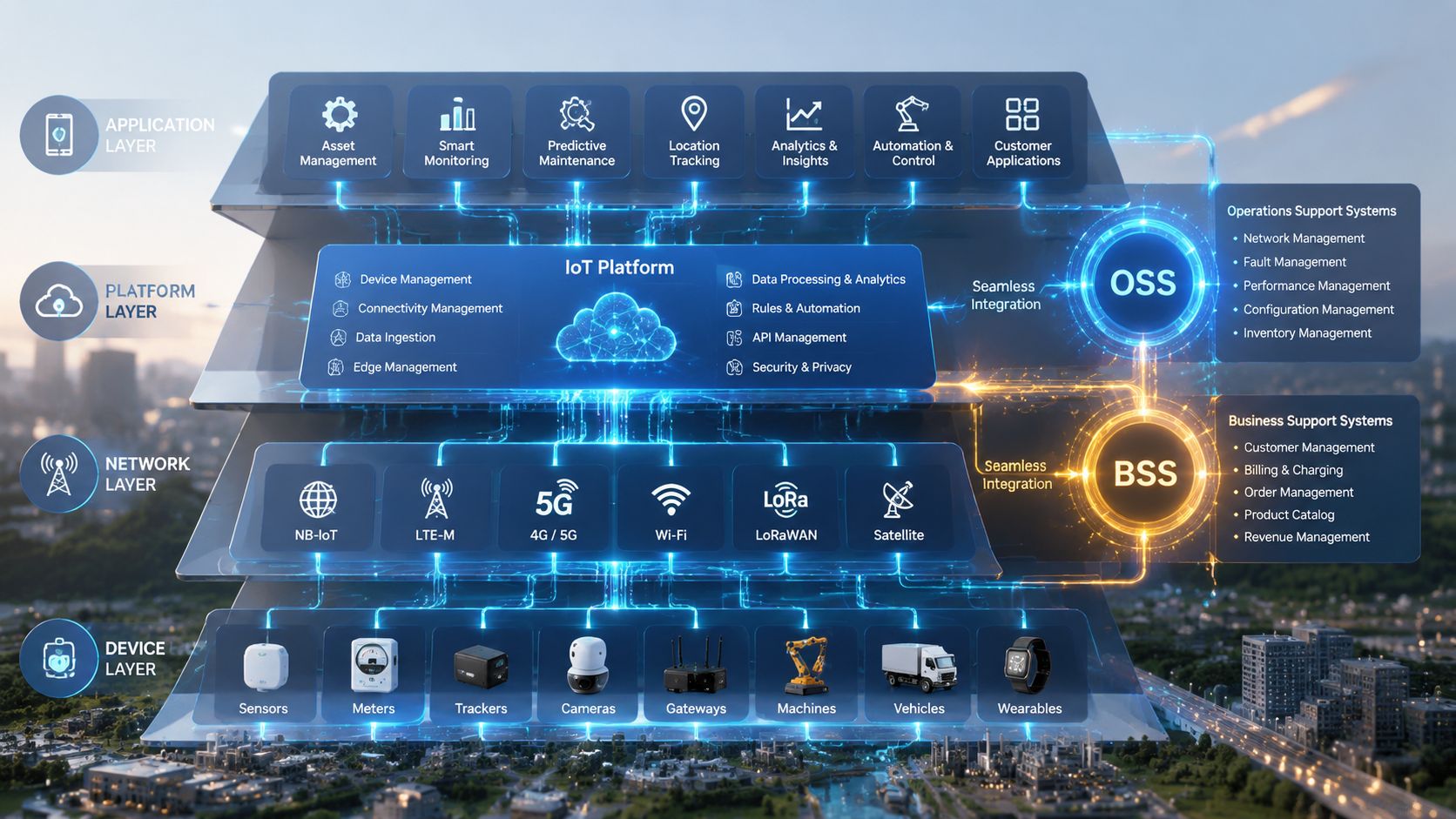
The blueprint from edge to application
A practical telecom IoT stack usually looks like this:
Device layer
Sensors, gateways, controllers, meters, trackers, or cameras generate events. This layer also handles local firmware, identity, and power constraints.Connectivity layer
Traffic moves over cellular, LPWAN, or hybrid links depending on the workload. Reliable session control matters more than headline speeds for most deployments.Control and management layer The layer encompasses onboarding, provisioning, policy, status monitoring, and connection management.
Platform and data layer
Events are normalized, stored, routed, and exposed to analytics or applications.Business system layer
OSS, BSS, ticketing, service assurance, billing, CRM, and enterprise workflows consume the outputs.
The reason telecom operators have an advantage here is structural. Operators can utilize their existing wide-area connectivity to offer managed platforms that bundle connectivity, device onboarding, and connection management, reducing friction for enterprises while also collecting operational telemetry to improve network planning and service quality, as described in this overview of IoT as a telecom growth path.
Where projects usually break
Most failures don't happen because the radio layer stops working. They happen because the service can't scale operationally. Devices get activated, but inventory records drift. Billing logic doesn't reflect real usage models. Faults show up in separate consoles. Support teams can't trace one customer issue across network, device, and application layers.
That's why OSS and BSS design can't be an afterthought.
- Provisioning must be automated: Manual onboarding may work for pilots. It fails fast in production fleets.
- Billing needs flexibility: IoT often involves pooled usage, low-volume devices, event-based charging, and service bundles.
- Service assurance must be device-aware: “Online” isn't enough. Teams need state, health, policy, and anomaly visibility.
- Inventory has to reflect reality: If SIM, device, customer, and service records don't stay aligned, support costs rise quickly.
Integration patterns matter more than many teams expect
In mature telecom environments, the key issue isn't whether systems are modern. It's whether they can exchange the right information at the right time without brittle custom logic. Event-driven integration, API orchestration, and decoupled workflows usually perform better than tightly bound point-to-point connections. Many of the practical choices mirror proven integration design pattern approaches that reduce rework as the service expands.
Build the architecture so a thousand more devices feel routine. If adding each new customer requires custom plumbing, the service isn't ready.
A good architecture doesn't just transport data. It makes device fleets governable, supportable, and billable.
Securing the Entire IoT Value Chain
Security in telecom IoT isn't a compliance box. It's part of service design. Every new endpoint expands the attack surface, and weak controls at one layer usually become someone else's incident at another layer.
Device security comes first
A device in the field is a physical object before it is a digital endpoint. It can be tampered with, cloned, reset, misplaced, or attached to the wrong environment. That means teams need secure boot, trusted identity, controlled firmware updates, and strict provisioning discipline from day one.
The common mistake is trusting the network to compensate for weak devices. It won't. If endpoint identity is loose, everything downstream becomes harder. Fraud detection gets noisier. Support teams waste time. Exposure spreads.
Network security has a different job
The network has to verify, encrypt, segment, and monitor. In telecom settings, that also includes protecting the service from abuse patterns that look like valid traffic until they accumulate at scale.
Three controls matter operationally:
- Authentication and policy enforcement: Every device should have a known identity and defined behavior boundaries.
- Segmentation: A sensor fleet should never have the same trust posture as enterprise user traffic.
- Anomaly detection: Teams need to catch unusual signaling, impossible usage patterns, and command behavior that doesn't match the device role.
In this context, a zero-trust model becomes practical rather than theoretical. Telecom and enterprise teams that need a useful primer on architecture-level controls can review how to implement zero trust security as a framework for device, identity, and access decisions.
Data security is where business risk shows up
Even when the device and network are locked down, weak data governance can still sink the program. Operational data often reveals location, maintenance behavior, staffing patterns, asset conditions, and customer operations. Access control can't be broad just because the platform is shared.
Use this three-layer checklist:
| Security layer | What to protect | What often goes wrong |
|---|---|---|
| Device | Identity, firmware, local interfaces | Weak provisioning, unmanaged updates |
| Network | Sessions, traffic, segmentation | Flat trust, poor monitoring |
| Data | Storage, access, privacy controls | Over-permissioned users, unclear ownership |
Security work in IoT should reduce operational ambiguity. If your team can't answer who owns the device identity, who approves firmware, and who can access telemetry, the design isn't finished.
The strongest deployments treat security as a lifecycle discipline, not a launch milestone.
IoT in Action Real World Telecom Case Studies
The most useful examples in iot in telecom industry aren't flashy demos. They're operating environments where the connectivity choice, the support model, and the business requirement fit together.

Smart city traffic and parking
A city authority wants better visibility into parking occupancy and traffic bottlenecks. The devices send small packets, often on predictable intervals, and many sit in locations where frequent battery maintenance is undesirable.
The right telecom IoT design here usually favors low-power connectivity and centralized fleet management. The commercial value comes from operational visibility, not from high data consumption. If the city also expects integration into traffic control dashboards or citizen services, the platform layer becomes more important than the radio layer.
What works:
- Low-power sensor design
- Centralized provisioning
- Alert logic tied to city operations
What doesn't:
- Treating the project like a mobile data plan rollout
- Ignoring battery replacement logistics
- Launching without integration into traffic workflows
Industrial maintenance on remote equipment
An industrial operator needs to monitor pumps, compressors, or site infrastructure spread across multiple regions. The telemetry volume may be modest, but some alerts are time-sensitive, and field teams need clear visibility when conditions drift.
Cellular connectivity often earns its keep. Coverage, reliability, and better support for responsive alerts matter more than squeezing every possible month of battery life. The business outcome isn't “connected equipment.” It's fewer blind spots in maintenance operations and faster intervention when conditions change.
A recurring pattern in successful deployments is narrow scope at the start. Teams usually begin with one asset class, one support workflow, and one maintenance KPI. They expand only after proving that alerts are trusted and acted on.
Agriculture and critical infrastructure in low-coverage regions
Remote monitoring gets harder when terrestrial coverage is weak. That's where the network story changes. Satellite and LPWA networks are essential for remote and underserved deployments, and satellite is the only platform capable of ubiquitous coverage, according to this market sizing and requirements report on IoT and M2M connectivity.
Utilities, agriculture, and critical infrastructure run into this constantly. A farm sensor, pipeline monitor, or remote field asset may sit well outside normal urban assumptions. In those cases, hybrid architecture is often the practical answer. Use terrestrial connectivity where it's strong. Shift to LPWA or satellite where geography wins.
The best remote IoT design accepts that no single network covers every operating condition well.
That's the difference between a pilot built for a conference slide and a deployment built for field reality.
Building Your IoT Deployment Roadmap with a Partner
IoT programs usually stall for a simple reason. The commercial plan and the delivery plan get built on separate tracks. One team defines the revenue case. Another team handles devices, connectivity, integration, and security. The roadmap has to join those pieces early or the pilot stays stuck as an isolated technical win.
A workable roadmap starts with one operating problem and one economic target. For a telecom operator, that might mean reducing truck rolls for field service or launching a managed monitoring offer for enterprise customers. For an enterprise, it might mean cutting equipment downtime or getting cleaner usage data into service and billing processes. The point is to tie architecture decisions to a business outcome from day one.
A deployment sequence that usually works
Use a staged path instead of a broad rollout.
Narrow the use case
Choose a problem with a budget owner, a support team, and a clear operating environment. If nobody owns the workflow after the alert fires, the deployment will struggle in production.Match the connectivity to the workload
Start with device behavior, message frequency, power limits, and coverage conditions. Then choose the network model that fits. Teams that begin with an existing network footprint often end up redesigning later.Design integration early
IoT data has limited value if it sits in a dashboard no one uses. Map how events will flow into OSS/BSS, ticketing, maintenance, reporting, and customer-facing processes before devices go live.Treat security as part of delivery
Set policies for device identity, provisioning, access control, software updates, incident response, and data ownership before scale creates operational debt.Pilot for operational truth
A strong pilot tests failed messages, battery issues, support escalation, installer mistakes, and billing exceptions. Real deployments break at process handoffs more often than at the radio layer.
The trade-off is speed versus rework. A fast pilot can prove demand, but if it skips integration and support design, the production rollout becomes slower and more expensive. I have seen teams save a few weeks early, then lose months fixing ownership gaps between network operations, IT, security, and customer support.
Why an experienced implementation partner helps
The implementation gap is usually not about one missing skill. It is about coordination. Many organizations can source devices and connectivity, but fewer can align cloud integration, OSS/BSS workflows, security controls, reporting, and support operations into one delivery plan.
An experienced implementation partner helps by sequencing that work. For telecom operators, this can shorten platform rollout and reduce friction between product, network, IT, and billing teams. For enterprises, it can turn a disconnected pilot into a managed deployment with defined ownership, service levels, and measurable outcomes.
The strongest IoT programs do not try to solve everything in one release. They sequence complexity so each phase proves technical fit and business value. Finding a partner who understands that sequencing is often what separates a repeatable deployment from an expensive pilot.
If you need help designing, integrating, or scaling an IoT initiative, NineArchs LLC can support implementation with software development, cloud integration, security, and outsourced delivery capacity. For a consultation, call (310)800-1398 / (949) 861-1804 or email info@ninearchs.com.