
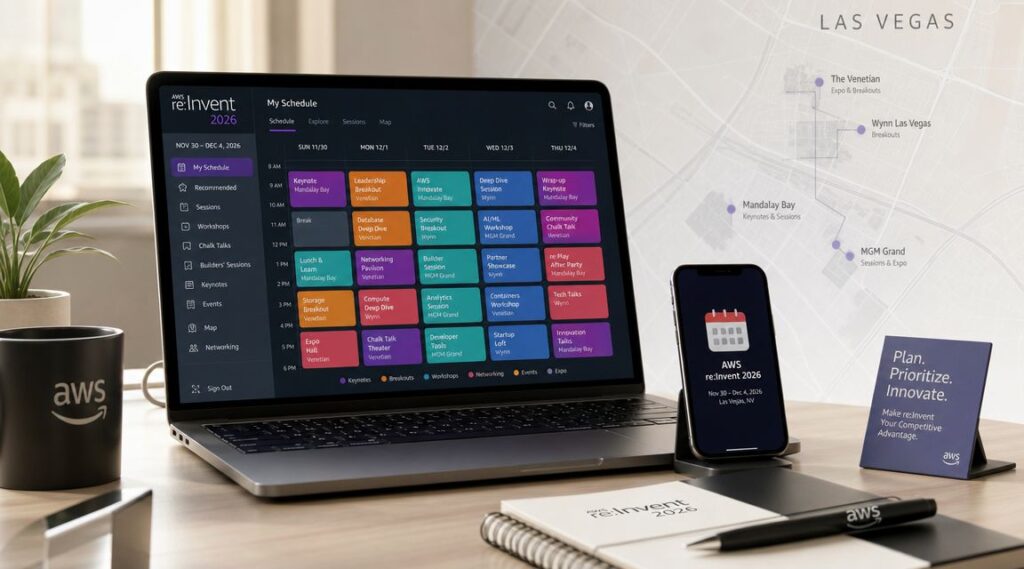
You've probably got the same tab open that everyone opens once the event planning starts: the AWS catalog, a half-built calendar, a hotel shortlist, and a growing sense that you can't possibly fit the right sessions into one week.
That's the core challenge with the AWS re:Invent schedule. It isn't just a list of talks. It's a resource allocation problem. Time, travel, attention, team coverage, and post-event execution all compete for the same limited budget. If you treat the week like a buffet, you'll leave with a pile of notes and very little momentum. If you treat it like an operating plan, you can turn the event into decisions, experiments, and roadmap movement.
Navigating the Immense World of re:Invent 2026
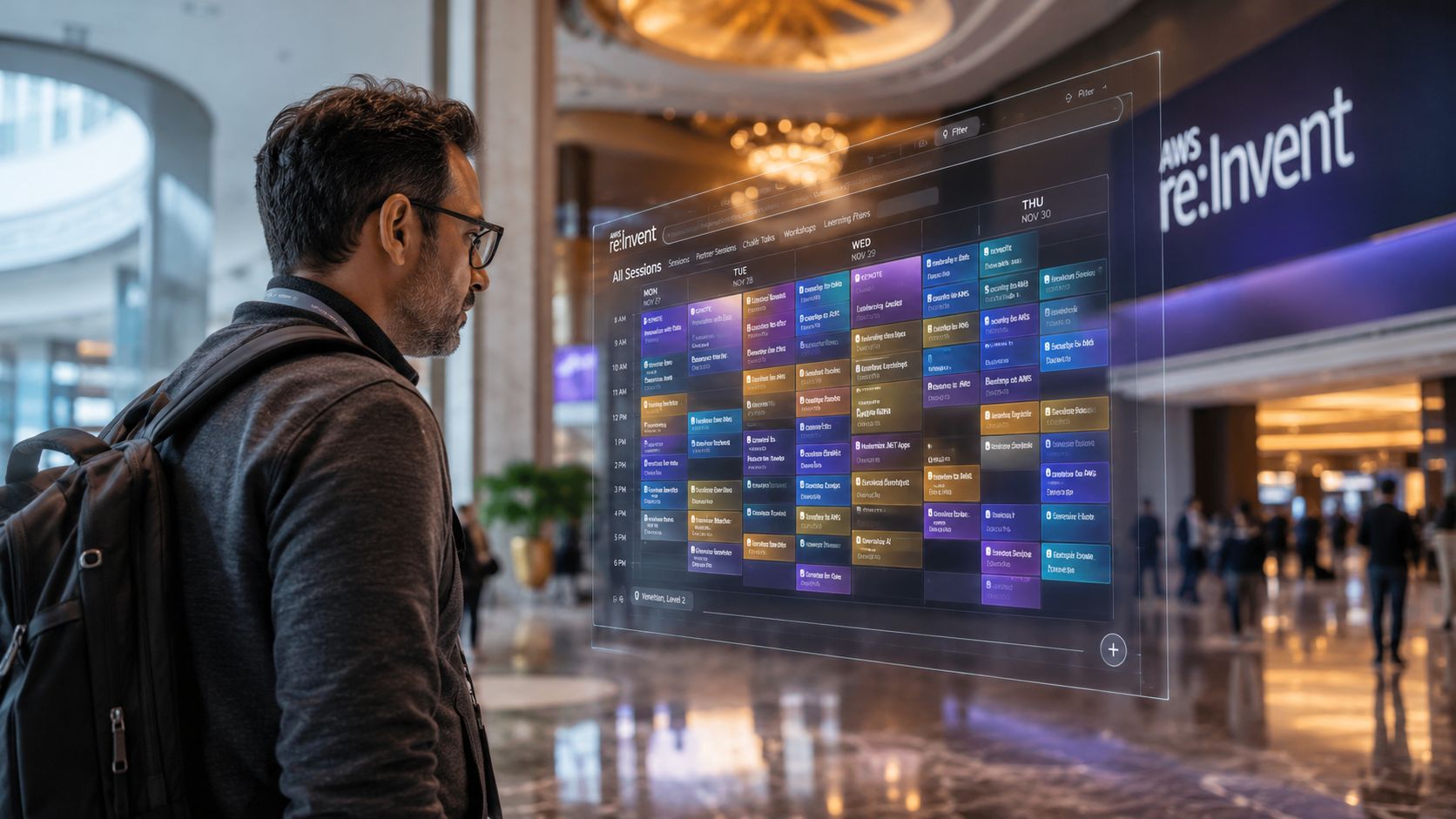
It is Monday morning in Las Vegas. Your lead architect is across the Strip for a roadmap session, your engineering manager is stuck in transit between venues, and the one workshop tied to a migration decision your offshore delivery team needs next quarter is already full. That kind of failure usually starts weeks earlier, when teams treat re:Invent as a calendar exercise instead of a business planning exercise.
As of this writing, AWS indicates on the official AWS re:Invent event page that re:Invent 2026 is expected to take place from November 30 to December 4, 2026, in Las Vegas, across Caesars Forum, Caesars Palace, Encore, MGM Grand, The Venetian, and Wynn, with registration expected to open on June 16, 2026. Those dates shape travel, budget approvals, team coverage, and meeting plans long before the full catalog becomes useful.
A common mistake is waiting for every session to appear before making decisions. By then, the practical constraints are already set. Hotel location drives commute time. Commute time limits how aggressively you can schedule. That schedule then determines whether your team gets usable knowledge back or just scattered notes.
Multi-venue events reward operators, not just enthusiastic attendees. Darkaa's event logistics insights are useful here because they frame logistics as part of event ROI, not as an admin task delegated to the side.
Treat the schedule like a portfolio
A strong re:Invent plan spreads effort across three kinds of value:
- Strategic value for roadmap decisions, platform direction, and leadership alignment
- Technical value for implementation patterns, architecture reviews, and skill transfer back to the team
- Network value for partner conversations, peer validation, and the informal context that never makes it into slide decks
The right mix depends on who needs the outcome. A staff engineer attending alone should not build the same week as a platform lead traveling with a broader transformation mandate. The same goes for distributed organizations. If part of delivery sits with a remote team or an external partner, session choices should map to work they can pick up after the conference, not just topics that sound timely in the room.
That is why I push teams to define post-event decisions before they finalize attendance. If a session cannot support a current initiative, close a known skill gap, or inform a near-term architecture choice, it belongs in the overflow list, not the core plan.
Teams that need help turning conference input into execution often tie their event plan to broader cloud consulting services so the follow-through is clear once everyone is back. The point is not to cover the most ground. The point is to return with decisions, owners, and work that ships.
Decoding the re:Invent Session Catalog
The schedule only becomes useful when you understand what each session format is designed to deliver. AWS re:Invent has evolved into a week-long conference with thousands of sessions, workshops, hands-on labs, and keynote presentations, and a 2025 guide notes that activities run Monday through Friday, begin on Sunday evening, and major keynotes start from Tuesday onward, as described in this re:Invent guide.
That scale creates a filtering problem. Many attendees choose based on topic alone. The stronger method is to choose by format plus topic. A session about security architecture means one thing as a keynote and something very different as a workshop.
What each format is really for
Keynotes are for direction. They help you understand what AWS is emphasizing, where service investments are heading, and which themes are likely to influence customer conversations for the next year. They're useful for leaders, architects, and anyone responsible for platform bets.
Leadership sessions work best when you need business context. These typically connect technology choices to operating models, governance, cost, modernization, or organizational change. They aren't where you go for implementation detail. They are where you go to sharpen decision criteria.
Breakout sessions are the default building block for most attendees. They usually offer a focused topic, a structured narrative, and practical architecture or product guidance. If you need a broad but meaningful understanding of a domain, this is often the right choice.
Which formats build skill, not just awareness
Workshops and builders' sessions are where execution capability grows. If your team plans to prototype a new architecture pattern soon after the event, these formats tend to produce more immediate value than passive listening.
Chalk talks are ideal when your team already knows the basics and needs nuance. The discussion format often exposes design trade-offs, limitations, and implementation realities that slide-driven sessions can hide.
Bootcamps suit people who want immersive topic concentration. They require more stamina and more schedule discipline, but they can reset someone's practical understanding of a domain in a single day.
Go to keynotes for context, chalk talks for judgment, and hands-on formats for capability.
AWS re:Invent Session Type Comparison
| Session Type | Format | Typical Length | Best For |
|---|---|---|---|
| Keynotes | Large audience presentation | Longer-form agenda block | Big announcements, strategic direction |
| Leadership Sessions | Executive or strategic presentation | Standard session block | Business alignment, platform planning |
| Breakout Sessions | Topic-focused presentation | Standard session block | Learning a domain quickly |
| Workshops | Guided hands-on learning | Extended session block | Building practical skills |
| Chalk Talks | Interactive discussion | Standard session block | Deep questions and trade-offs |
| Builders' Sessions | Small-group hands-on work | Structured practical block | Applied implementation experience |
| Bootcamps | Intensive deep dive | Extended agenda block | Focused immersion in one area |
A practical selection lens
Use a simple rule set when you build your schedule:
- Choose keynotes when you need to reset your view of the market or platform direction.
- Choose breakouts when you're evaluating options and need a solid working model.
- Choose chalk talks when a mature team needs detail that changes design decisions.
- Choose workshops or builders' sessions when someone on your team must return ready to test or build.
- Choose bootcamps only if you're willing to protect the time they require.
The best schedule rarely consists of a single session type. Strong weeks mix context, judgment, and hands-on learning.
Mastering the Official Schedule Builder and App
The official scheduler isn't just a convenience tool. It's your control plane for the week. Use it like one.
The hidden constraint that catches people off guard is capacity. According to Jimmy DQV's re:Invent session planning guidance, reserved seating is typically only about 75% of seats, and moving between venues can take roughly 30 minutes to more than an hour. That's why the smartest schedules are built around one primary session per day with backup options.
Build from anchors, not from wish lists
Start with your essential items. Those are usually keynote blocks, one or two critical technical sessions, and any team meetings you've committed to. Put those on the calendar first.
Then add supporting sessions by venue cluster. Don't build a perfect-looking sequence on paper if it requires crossing the city between every block. The schedule builder may allow it. Your legs and the shuttle flow may not.
Use the app like an operator
A few habits make a big difference:
- Save backups early: Popular technical sessions can hit capacity fast. If a topic is important, pick an alternate that still supports the same outcome.
- Filter by intent, not curiosity: Use topic, level, and format filters to find sessions that fit your role and maturity.
- Protect transition time: If two strong sessions are far apart, choose the one that supports your main goal and stop trying to squeeze both in.
- Check updates often: Room changes, seat status, and timing shifts can change your day.
The calendar should reduce risk, not create it.
What works and what doesn't
What works is a schedule with slack. You want room for hallway conversations, late arrivals, and the occasional spontaneous detour that ends up being more useful than the session you skipped.
What doesn't work is overbooking every hour and assuming the event will behave like a compact single-building conference. Re:Invent rewards focus. It punishes ambition without routing discipline.
Sample Itineraries for Key Technical Roles
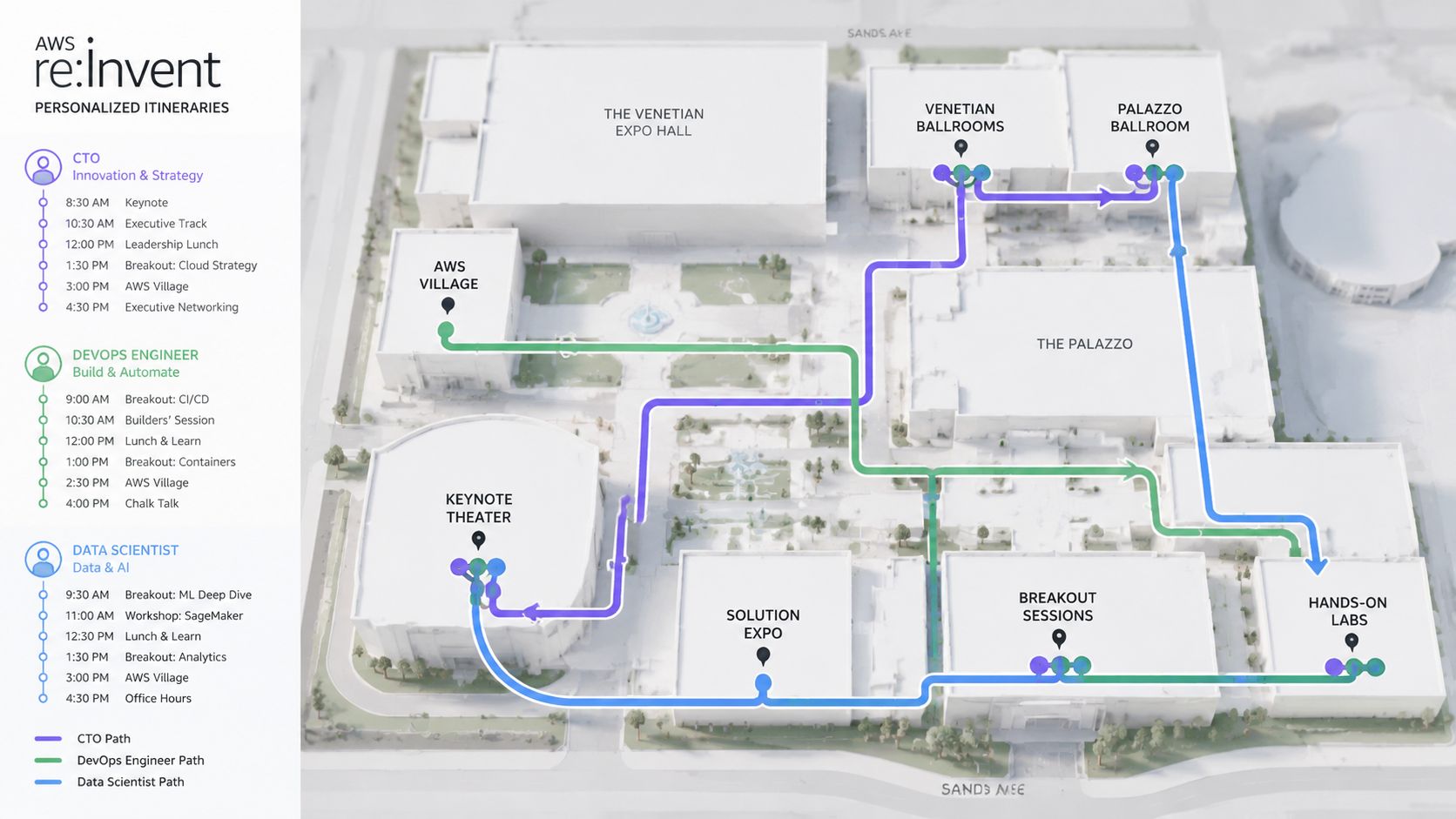
Different roles should use the AWS re:Invent schedule differently. A CTO trying to validate platform direction shouldn't attend like a developer who needs implementation depth. A security lead shouldn't spend the week chasing broad cloud content when governance and risk decisions are sitting in the queue back home.
The CTO schedule
A CTO's strongest day usually starts with a keynote or leadership-oriented session. The objective isn't feature collection. It's to understand what should influence the next planning cycle.
By late morning, the CTO should move into selected breakouts on modernization, platform governance, or architecture operating models. The afternoon is better used for focused conversations with team leads, partners, or peers about what should move from “interesting” to “funded.”
A useful CTO day often looks like this:
- Morning: Keynote or strategic leadership session
- Midday: Breakout tied to cost, architecture, AI adoption, or operating model
- Afternoon: One discussion-heavy session plus stakeholder follow-up
- Evening: Short debrief with the internal team
For leaders thinking about the financial side of platform choices, this is also the right lens to connect event learning with broader cloud cost optimization strategies.
The developer schedule
A hands-on developer should bias toward practical formats. Sitting through too many high-level talks creates the illusion of progress without creating much execution value.
The strongest developer day usually includes one deep technical session and one interactive build-oriented slot. Between them, the developer should leave time to review notes, capture implementation ideas, and compare what was shown against the team's current patterns.
That day might look like this:
- Early block: Technical breakout on a service or architecture pattern
- Core block: Workshop, builders' session, or lab
- Later block: Chalk talk to pressure-test edge cases and trade-offs
A developer who returns with one validated pattern is more valuable than a developer who attended six abstract sessions.
The security lead schedule
Security leads should avoid the trap of treating the week as generic cloud education. Their best sessions are tightly scoped: identity, data protection, governance, compliance design, incident response, and control automation.
A strong security itinerary often mixes one broad session that clarifies strategic direction with one narrower session that addresses implementation detail. The rest of the day should support internal translation. What changes in policy, architecture standards, or review workflows because of what was learned?
A good security-focused day includes:
- A high-level session to understand direction and governance implications
- A technical breakout on controls or security architecture
- An interactive discussion where detailed questions can be surfaced
- A short end-of-day synthesis that maps learning to policy or backlog updates
These aren't templates to copy exactly. They're role-based patterns. The right AWS re:Invent schedule aligns each day to the job the attendee needs to do after the conference ends.
A Guide for Remote Attendees and On-Demand Value
Not every team needs to be in Las Vegas to get value from re:Invent. In many organizations, the better decision is to send a small in-person delegation and treat the rest of the schedule as a structured content discovery process.
AWS provides an on-demand re:Invent library that includes keynotes, Innovation Talks, and breakout sessions from re:Invent 2025. That matters because the conference schedule is no longer just a live-attendance agenda. It's increasingly a map for later learning and team-wide enablement.
When live attendance matters
Live attendance is strongest when the value depends on interaction. That includes chalk-talk-style discussion, relationship building, side conversations, and the practical context you get from being immersed in the event.
If your goal is to absorb announcements, understand broad product direction, or review breakout content with your team later, on-demand is often enough. The schedule then becomes a curation layer. Your job is to identify what matters and ignore the noise.
A smart model for remote teams
Remote teams get more from re:Invent when they organize around themes instead of trying to replicate the event hour by hour.
Use a lightweight internal model:
- Assign coverage areas: One person tracks security, another data, another platform, another AI-related announcements.
- Create a watch list: Identify sessions worth reviewing after the event, grouped by immediate priority and later relevance.
- Run short team reviews: Discuss what changes current priorities, what confirms existing direction, and what can wait.
- Turn content into decisions: End each review with a concrete owner and next action.
The schedule doesn't stop being useful when the event ends. That's when many teams finally start using it well.
Live versus later
The simplest test is this: if you need dialogue, go live. If you need durable content, plan for on-demand. Most organizations need both, but not for every person.
That distinction helps with budget discipline, but it also improves focus. A smaller in-person team can hunt for insight and context. The broader team can consume the recorded material in a calmer, more deliberate way that supports actual implementation.
Turn re:Invent Learnings into Business Outcomes
The conference isn't the payoff. Implementation is.
A week at re:Invent can generate new architecture ideas, modernization options, and sharper views on security, data, and platform operations. None of that matters if your notes stay trapped in slide photos and vague team recaps. The value appears when someone turns learning into backlog items, proofs of concept, migration plans, policy updates, and funding requests.
Turn notes into decisions
The most useful post-event review is short and ruthless. Group what you learned into three buckets:
- Act now: Items that support a current initiative and have a clear owner
- Evaluate next: Ideas that need a small proof of concept or architecture review
- Watch: Announcements worth monitoring but not yet ready for adoption
That structure keeps the team from treating every conference insight as urgent. It also makes it easier to brief leadership, because the conversation shifts from “what I saw” to “what we should do.”
If the event surfaced priorities around protection, governance, or policy design, teams often need to connect those insights to concrete practices such as data loss prevention in AWS.
Where execution usually stalls
The bottleneck usually isn't strategy. It's capacity.
Internal teams come back from the event energized, then re-enter full sprint loads, support obligations, and delivery commitments. The result is familiar. The good ideas don't fail because they were wrong. They fade because no one had time to operationalize them.
That's where practical implementation planning matters. If migration or modernization is on your list, guidance like these cost-effective AWS migration strategies can help teams shape a more disciplined next step.
A strong re:Invent week should end with fewer opinions and more owned actions.
Why a USA-based outsourcing partner helps
For many companies, the best way to preserve momentum is to use an outsourcing partner from the USA. That model gives you a team that can work in close alignment with your business hours, communicate clearly with internal stakeholders, and support accountability in a way that feels operationally close to your core team.
It also reduces the pressure to hire full-time specialists for every post-conference initiative. If re:Invent surfaces a need for a pilot, a migration workstream, a security remediation effort, or a new cloud operations pattern, an external partner can absorb execution without derailing the roadmap your internal team already owns.
The main advantage isn't just extra hands. It's faster conversion from conference learning into shipped work.
Your Final Pre-Flight Checklist
A good AWS re:Invent schedule doesn't look packed. It looks intentional. Before the trip, make one final pass and remove anything that doesn't support a real outcome.
Final checks before you leave
- Confirm your anchors: Make sure your highest-value sessions, meetings, and keynotes are locked first.
- Review venue flow: Check whether your day is physically realistic. If it isn't, simplify it.
- Keep backups ready: Have alternates for the sessions you care most about.
- Align by role: Each attendee should know why they're attending each session and what they're expected to bring back.
- Prepare for remote follow-through: Build a post-event watch list for the sessions your wider team should review later.
- Set post-event owners: Every likely takeaway should have a person who can evaluate or execute it after the conference.
What to remember during the week
Don't chase volume. Chase impact.
Take fewer notes and write better next steps. Leave room for conversation. Protect your energy. If a session doesn't support a roadmap decision, a technical experiment, or a team capability gap, skip it.
That's how the AWS re:Invent schedule becomes more than a calendar. It becomes a way to direct attention toward work that moves the business.
If you want help turning cloud ideas into delivered outcomes after re:Invent, NineArchs LLC can support your team with scalable IT, cloud, development, and outsourcing capacity. A USA-based outsourcing partner can help you move faster on proofs of concept, cloud modernization, security initiatives, and operational follow-through without overloading your internal team. Call (310)800-1398 or (949) 861-1804, or email info@ninearchs.com.