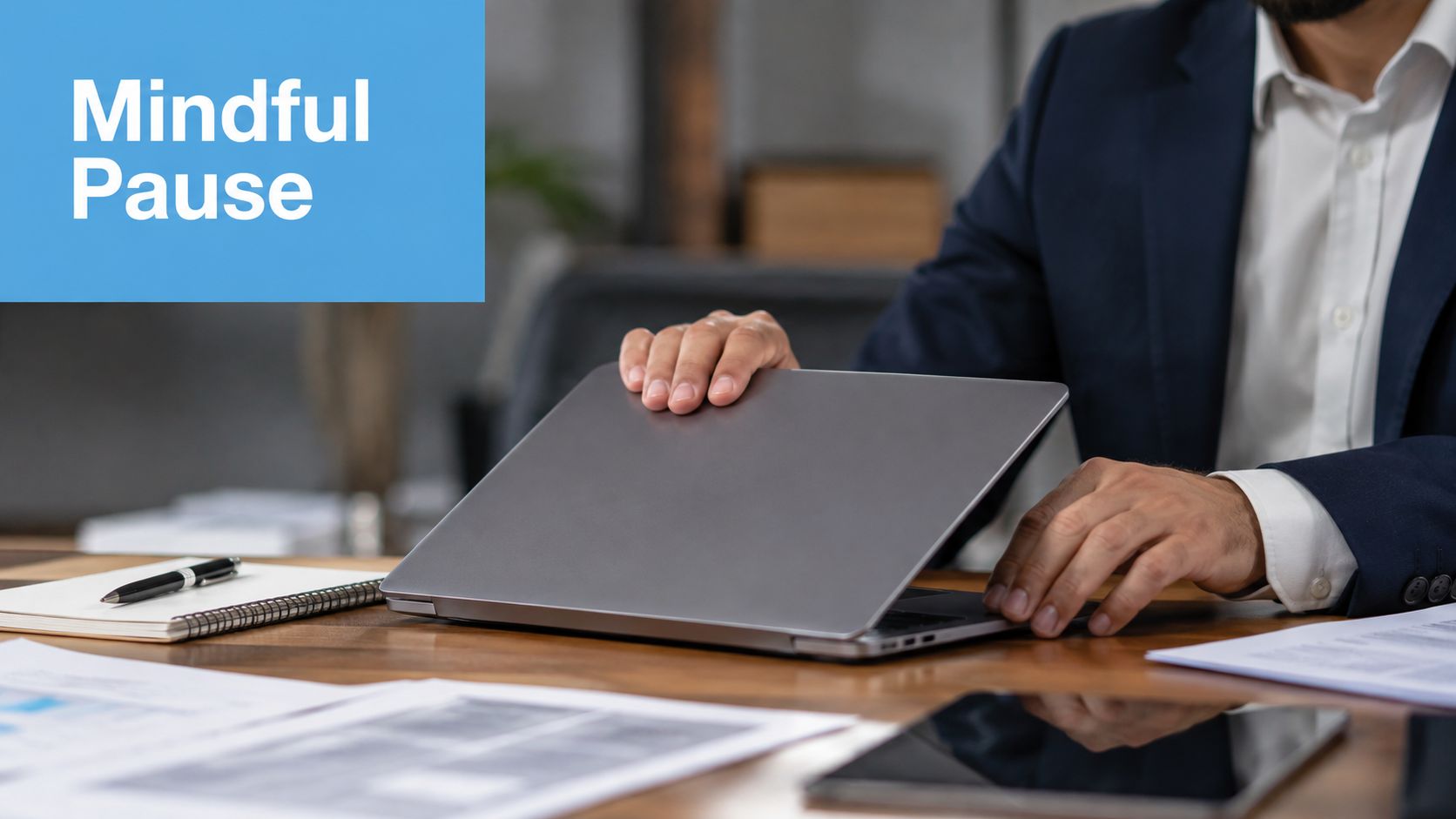
You close the laptop, but your mind keeps working. It reopens the pitch deck you need to finish, jumps to a family update you haven't answered yet, then lands on the show you half-watched while pretending to relax. By the time your head hits the pillow, your body is tired, but your attention is still on call.
That's why the technique of meditation matters. It isn't a personality transplant or a mystical performance, it's a structured drill for attention, the same way targeted reps train strength in the gym. The point is not to erase thought, it's to teach your mind what to do when it wanders, reacts, or won't settle.
If you've ever assumed your racing mind means you're bad at meditation, the opposite is usually true. A busy mind is the default mammalian setting, and willpower alone rarely overrides it for long. What changes things is having a method, a clear anchor, and a repeatable way to return.
Why Your Mind Will Not Slow Down
The professional at the center of the office is finally done for the night. The screen goes dark, the chair rolls back, and yet the brain stays bright. It starts tab-switching between tomorrow's meeting, a parent's health update, a message left on read, and whether sleep will come in time.
That's the problem meditation addresses. You're not trying to stop the mind from thinking, you're training it to stop dragging you around. The technique of meditation gives that training a shape, so the practice becomes repeatable instead of vague.
Attention needs a drill, not a pep talk
Trying to relax by telling oneself to calm down works for a few seconds, then the mind resumes its usual habit of planning, replaying, and anticipating. Meditation is more like practicing free throws than waiting for confidence to appear.
Practical rule: if your mind is loud, don't argue with it. Give it one clear job.
That job might be the breath, a phrase, a body sensation, or a guided voice. The specific object matters less than the act of returning to it again and again. In that sense, meditation is less about getting it right and more about noticing when you've drifted.
A useful way to think about it is this, racing thoughts are not a moral flaw. They're a sign that your attention has never had enough structured practice. Once you see that, meditation stops looking like an exam and starts looking like skill-building.
What you gain from a method
A method gives the evening a boundary. Instead of carrying every thought into bed, you choose one focus, practice with it for a short stretch, and let the nervous system learn a different rhythm. Over time, that repetition becomes a cue for steadier thinking.
The payoff here isn't abstract. You get a map of techniques, a decision rule for choosing one, and a simple 14-day starter plan that doesn't ask for perfection. It asks for enough consistency to make tonight different from last night.
The Ancient Roots of a Modern Practice
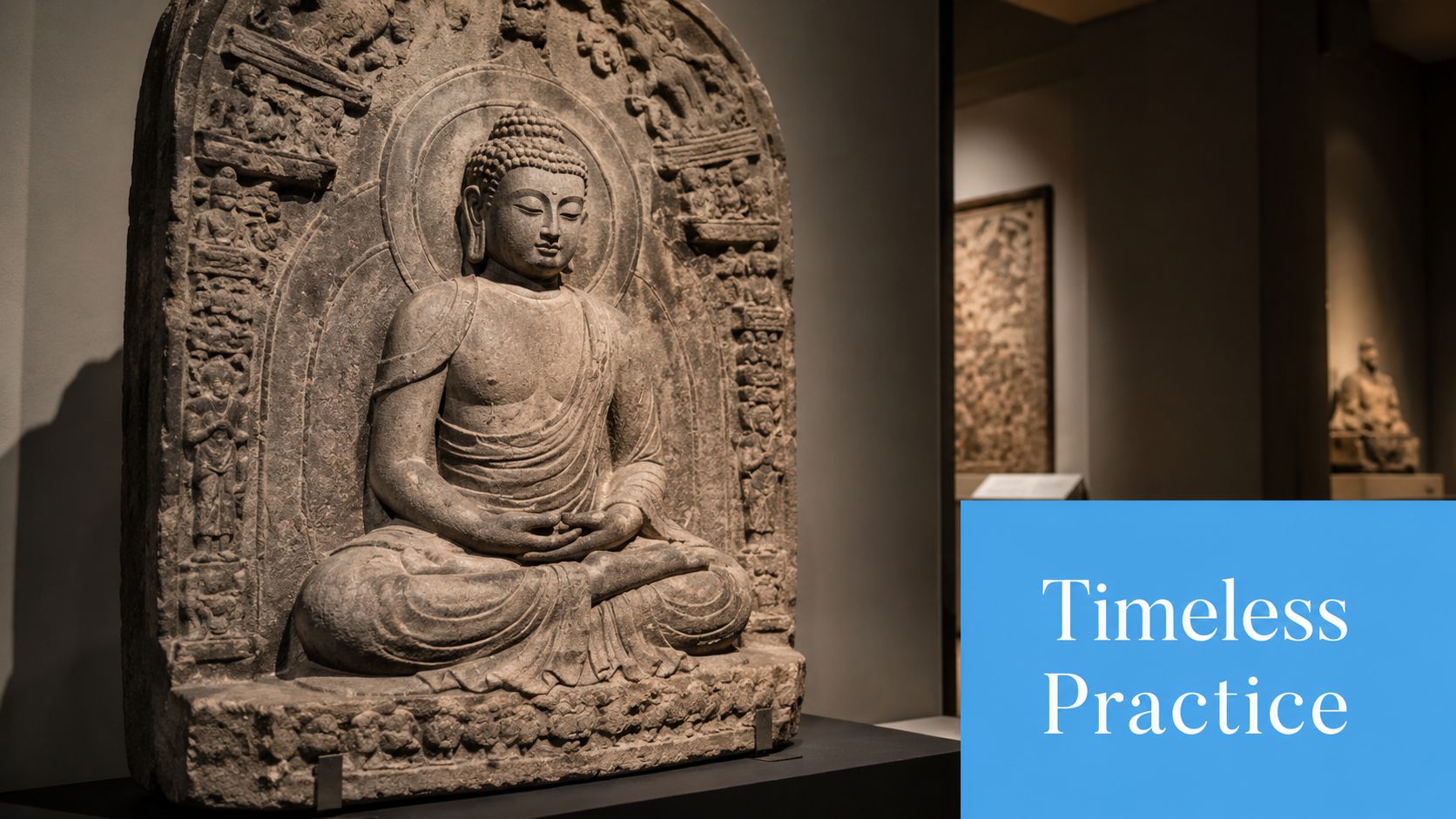
The technique of meditation is older than most modern systems of medicine, leadership, or psychology. Historians trace meditation-like practices in ancient Indian traditions as far back as 5,000 BCE, and the earliest written references appear in the Vedas, which places meditation among the world's oldest structured mental disciplines. That long history matters because it shows this practice didn't begin as a wellness trend.
Across centuries, meditation moved through religious and philosophical systems and kept changing form. It appears in the broader arc of South Asian tradition, then later takes on new expressions in other contemplative paths. What survives through all of that change is the same human problem, how to train attention when the mind is restless.
From niche practice to mainstream habit
The modern picture is much broader than the old stereotype of a monk on a mountain. In a 2024 study in Nature Scientific Reports, meditation was the most prevalent mind-body practice among U.S. adults in 2022, with a population prevalence of 18.3%, about 60.53 million people (Nature Scientific Reports study). The same study reported that meditation, yoga, and guided imagery generally increased between 2002 and 2022, aside from a dip in 2012.
Global survey data point in the same direction. The WIN World Survey reported that in 2024, at least 51% of respondents in the Philippines, 54% in the United States, 55% in Mexico and Malaysia, 56% in Pakistan, 57% in Morocco, and 79% in India said they meditate “at least sometimes” (WIN World Survey trend report). That spread tells you something important, meditation is no longer confined to one culture or one spiritual identity.
Why that history changes how you approach practice
If a practice has lasted for millennia, it's probably solving a durable human problem. That doesn't make every method equally useful for every person, but it does make the practice worth taking seriously. Meditation has moved from monastery to mainstream because ordinary people keep finding it useful for ordinary minds.
The other shift is scale. In the United States, meditation is now common enough to show up in public health data rather than only in spiritual circles. That makes it easier to treat the technique of meditation as a trainable behavior, not an exotic trait.
The Two Families Every Technique Belongs To
Most meditation methods look different on the surface, but they usually belong to one of two families. The first is focused attention, often linked with samatha, which means you keep returning to one object, like the breath, a mantra, or a candle flame. The second is open monitoring, often linked with vipassana, which means you notice whatever arises without clinging to it or pushing it away.
This split helps explain why meditation can feel so different from one session to the next. Concentration practices stabilize attention, while observation practices widen awareness. One builds a steadier beam, the other builds a wider field.
Where the common techniques sit
Here's a simple way to place the major forms.
| Two Families of Meditation Techniques | Core Mechanism | Best For | Representative Techniques |
|---|---|---|---|
| Focused attention | Hold one object and return when the mind wanders | Racing thoughts, scattered attention, mental fatigue | Breath counting, mantra, candle focus |
| Open monitoring | Notice sensations, thoughts, and emotions without reacting | Emotional reactivity, self-awareness, automatic habits | Noting, choiceless awareness, insight practice |
| Blended approaches | Use attention plus emotion or movement to support stability | Beginners, stress relief, embodied regulation | Loving-kindness, body scan, yoga, guided imagery |
Mantra practice sits firmly in focused attention because repetition gives the mind a rail to run on. Breath counting does the same thing. Mindfulness of breath and body scan sit closer to the middle, because they ask for both anchoring and observation.
Loving-kindness, yoga, and guided imagery are blends. They don't only stabilize attention, they also shift mood, body state, or emotional tone. That's why they can feel gentler for beginners who don't yet trust silence.
A practical rule for choosing between the families
If your main problem is racing thoughts, start with focused attention. If your main problem is emotional reactivity, start with open monitoring. That's the cleanest first decision you can make.
Quick test: if you want calm, anchor the mind. If you want clarity, watch the mind.
The important thing is not to treat the categories as rigid boxes. They're more like a map that helps you stop guessing.
Six Techniques You Can Try Tonight
If you want something usable tonight, keep the method simple. Each of these practices can be done in a chair, on a cushion, or on the floor. The four things to notice are posture, anchor, focal instruction, and duration cap.
Mindfulness of the breath
Sit upright with your hands resting naturally. Put attention at the nostrils or belly and follow the breath without trying to change it. When you notice that you've drifted, return to the next inhale. Start with 5 to 10 minutes. For a plain-language overview of several forms, the HD Asian Art meditation guide gives a helpful beginner-friendly overview.
Single-point concentration
Sit still and choose one object, a candle flame, a sound, or the feeling of air at the nose. Keep attention on that one target and return every time it slips away. Don't chase special experiences, just keep coming back. Cap it at 5 to 8 minutes if you're new.
Loving-kindness
Sit comfortably and soften the jaw. Repeat simple phrases such as “may I be safe” or “may I be steady,” then extend them to another person. The anchor is the phrase itself, and the work is to mean it gently, not force emotion. Try 5 to 10 minutes.
Mantra repetition
Sit with a straight but relaxed spine. Repeat a neutral word or phrase at a steady pace. Let the rhythm carry the mind when it starts to wander. Use 8 minutes or less at first, especially if silence feels hard.
Slow movement or yoga
Stand or sit with enough space to move slowly. Link the breath to simple motion, a stretch on the inhale, a release on the exhale, a walk with each step noticed clearly. This is a good fit when stillness makes your body fidgety. Begin with 5 to 10 minutes.
Guided imagery with body scan
Lie down or sit back in a supported chair. Move attention through the body from head to toe, noticing sensation without fixing it. If you want a script, keep it simple, scan the forehead, jaw, chest, belly, hips, legs, and feet, pausing briefly at each area. Limit it to 10 minutes.
The best match depends on the problem in front of you. For racing thoughts, breath or mantra usually works best. For emotional reactivity, loving-kindness and guided imagery are often steadier. For low motivation, mantra can be easier to begin. For physical restlessness, movement practice usually lands better than stillness.
What the Research Shows
The research does not promise magic, and that honesty helps. Consistent meditation can improve sustained attention, lower perceived stress, support sleep, and reduce how quickly people react to difficult thoughts and feelings. Those gains usually come after regular practice, not after one calm session.
A useful starting point is this overview of meditation and mental clarity, which frames the practice as training rather than escape: the power of meditation. That framing matters because the evidence tends to fit a skill-building model.
One clear signal comes from EEG work. Across neurophysiology studies, meditation most often increases alpha and theta brain-wave power compared with resting eyes-closed baselines, a pattern usually read as relaxed-alert rather than simple drowsiness (EEG review). Calm, in other words, does not have to mean sleepy.
Breath attention and the alerting system
A second finding comes from a study on respiration and attention. Breathing in was linked with a slight increase in locus coeruleus activity, and breathing out with a decrease. Stronger breath-attention synchrony also tracked with better focus during demanding tasks (respiration and attention study summary).
That makes breath practice especially useful when attention keeps jumping. A narrow breath anchor gives the mind one steady rhythm to return to, which is why it shows up so often in leadership settings and before hard conversations or focused work.
The pattern readers usually want
| Evidence-Backed Benefits of Meditation | What the Research Found | Typical Timeframe |
|---|---|---|
| Sustained attention | EEG studies show more alpha and theta activity, a pattern tied to relaxed alertness | With regular practice over time |
| Perceived stress | Breath-focused attention can quiet the alerting signal and support steadier focus | Early effects can show up quickly, stronger effects build with consistency |
| Sleep quality | A calmer attention pattern often supports the shift out of mental overdrive | Usually improves as practice becomes routine |
| Emotional reactivity | Open awareness and loving-kindness can create more space between trigger and response | Benefits tend to grow with regular practice |
For people trying to connect the practice to concentration, not just relaxation, the meditation for deep work article gives a useful angle.
The honest takeaway is simple. Meditation works best as a repeated skill, not a one-off rescue.
How to Choose the Right Technique for You
The biggest mistake is looking for the “best” meditation in general. The better question is, which technique solves the problem you have right now, in a format you'll repeat. The 2025 novice-meditator research summarized in the earlier section points toward a practical truth: fit matters a lot for early adherence.
Match the method to the problem
If your mind is loud and fragmented, start with mindfulness of breath or mantra. If you're snapping at people or carrying a lot of self-criticism, use loving-kindness. If you feel flat, unmotivated, or foggy, mantra can create just enough structure to begin. If your body won't sit still, choose movement-based practice instead of forcing stillness.
Match the setting to your temperament
There's also a guided versus silent choice. If you're a true beginner, guided practice usually lowers friction because it tells you what to do next. If you're already comfortable with attention practice, silence can help you notice subtler patterns. The same logic applies to static versus kinetic practice, restless bodies usually do better with movement before they do well with seated stillness.
Decision rule: match the problem, then match the setting, then commit for two weeks before you judge the result.
A helpful external check is to think about your own behavior patterns, not your ideals. A person who overthinks might need structure more than inspiration. A person who shuts down under pressure might need warmth before analysis.
A simple chooser
- Racing thoughts: choose breath mindfulness.
- Emotional reactivity: choose loving-kindness.
- Low motivation: choose mantra.
- Physical restlessness: choose walking or slow movement.
For readers dealing with anxiety that feels bigger than a home practice can hold, Kelowna anxiety counselling is one example of how structured support can complement meditation rather than compete with it. The most sustainable approach is usually the one that fits both your nervous system and your schedule.
Common Mistakes and the More Is Better Myth
Beginners usually don't fail because they're incapable. They fail because they set up impossible conditions, then mistake friction for failure. The most common trap is trying to silence the mind, which turns a training exercise into a battle you can't win.
Another mistake is grading every sit as good or bad. That habit creates pressure, and pressure makes people quit. A session where you noticed distraction ten times is still a session where you trained return.
What to fix immediately
- Stop trying to stop thinking. Swap “I need this to go quiet” for “I noticed thinking, and I'm coming back.”
- Don't sit like a statue. If your back hurts, adjust the posture before discomfort turns into resentment.
- Avoid technique hopping. Jumping between many methods in a week usually creates confusion, not progress.
- Don't practice next to a screen. The point is to reduce stimulation, not rehearse more of it.
The more-is-better myth deserves special attention. The dose-response question in the current literature is still open, and a 2025 research protocol explicitly frames the field as unresolved on the “right amount” of practice. That's useful because it prevents overconfidence. More time isn't automatically more benefit, especially for beginners who need consistency first.
The saner standard
A short daily sit usually beats heroic bursts followed by exhaustion. If you try to outwork your attention system, it often pushes back with boredom, agitation, or dropout. A modest practice you can repeat will usually serve you better than a dramatic one you can't sustain.
The goal isn't to become excellent at meditation in a weekend. The goal is to build a reliable return path for your attention.
Your 14-Day Starter Practice Plan
Keep the first two weeks simple enough that you can't argue with them. Practice at the same rough time each day if you can, morning or evening both work, and use a stable seat with your feet grounded or your body supported. The only progress rule that matters is whether you returned to the anchor more times than yesterday.
Days 1 to 3
Use a 5-minute guided body scan. Sit after waking or before bed, with your spine supported if needed. Start at the forehead and move slowly through the body, pausing briefly at the jaw, chest, belly, hips, legs, and feet. Your win is not calm, it's showing up and following the instructions.
Days 4 to 7
Switch to 8 minutes of breath counting. Sit upright, count one on the exhale, then two, up to ten, then begin again. If you lose count, return to one without making it a problem. This phase builds concentration without requiring much theory.
Days 8 to 10
Try 10 minutes of loving-kindness. Sit at a comfortable angle and begin with yourself, using phrases like “may I be steady” or “may I be at ease.” If self-criticism gets loud, that's not failure, that's the practice. Keep the tone soft and repeat the phrase without forcing emotion.
Days 11 to 13
Use 12 minutes of open-monitoring mindfulness. Sit, notice whatever appears, sound, sensation, thought, mood, then label it lightly and let it pass. You're not chasing emptiness, you're practicing non-reactivity. If that feels too slippery, return to the breath for a few breaths and then resume observing.
Day 14
Choose the practice that felt most usable and sit for 15 minutes. End with one line in a notebook, “What helped me return today?” That line turns the practice into something you can learn from, not just endure.
The point of the plan is not to prove anything. It's to give your mind repeated contact with steadiness, so the technique of meditation starts feeling practical instead of theoretical.
NineArchs LLC helps organizations that need steady, scalable support, from technology services to outsourced operations, and that same focus on reliable structure is what makes meditation work in real life. If your team is looking for a partner that values disciplined execution and thoughtful systems, visit NineArchs LLC and see how its services can support the work that matters most.