
The most popular advice about transformational thinking is also the least useful: think bigger. A grand vision can impress a room, but it won't change how people make decisions on an ordinary Tuesday. Transformation begins earlier, in the leader's ability to notice assumptions, regulate reactions, ask better questions, and help others see possibilities they couldn't yet articulate.
That distinction matters because transformational thinking isn't a personality label reserved for charismatic executives. It's a trainable inner practice that becomes visible through repeated leadership behaviors. Research on transformational leadership grew from James MacGregor Burns's 1978 leadership theory and Bernard M. Bass's later development of the concept in the 1980s. By 2020, a Scopus-based review had identified 2,136 documents, 64,460 citations, and sustained research activity across more than three decades, with business, management, and accounting representing 1,213 publications, or 33.41% of the total (review of transformational leadership research).
The practical question isn't whether you can deliver an inspiring speech. It's whether your presence helps people think more clearly, challenge weak assumptions, recover from pressure, and take ownership of meaningful change.
Why Transformational Thinking Is More Than Big Visions
A leader can speak passionately about the future and still leave the team trapped in old habits. Visionary language doesn't automatically create courage, curiosity, or better judgment. If every decision still flows upward, dissent still feels dangerous, and development conversations focus only on completed tasks, the organization isn't transforming. It's listening to a polished presentation.
Transformational leadership research offers a more demanding picture. The tradition associated with Bass identifies four observable behaviors: idealized influence, inspirational motivation, intellectual stimulation, and individualized consideration. These behaviors describe how a leader earns trust, gives work meaning, challenges established thinking, and develops people as individuals. They're less theatrical than charisma, but far more useful for diagnosing what happens inside a team.
A 2004 meta-analysis synthesized 626 correlations from 87 sources and found an overall validity of 0.44 for transformational leadership, with the relationship generalizing across longitudinal and multisource designs (2004 meta-analysis of transformational and transactional leadership). Earlier meta-analytic work also found positive correlations between leader effectiveness and all components of transformational leadership. The evidence doesn't suggest that a magnetic personality is the mechanism. It points toward a pattern of behaviors that people experience over time.
The speech versus the weekly conversation
Consider two executives facing a stalled product launch. The first calls an all-hands meeting, describes an exciting market opportunity, and asks everyone to bring their best energy. The second does something less dramatic. She asks the product team which assumption failed, invites contrary evidence from operations, gives a customer-facing employee space to describe what users are experiencing, and helps the group choose a small experiment.
Both leaders may have a vision. Only one is changing how the organization learns.
The inner capacity comes first. A leader who can't observe defensiveness will confuse disagreement with disloyalty. A leader who can't regulate urgency will spread panic while asking for creativity. A leader who hasn't examined personal assumptions will turn “innovation” into permission for ideas that already match their preferences.
Practical rule: If transformational thinking can't be seen in a one-to-one, a project review, or a tense decision, it isn't yet a leadership practice.
The encouraging conclusion is that transformational thinking is trainable, repeatable, and visible in small moments. You don't need a stage, a bold launch, or a heroic identity. You need enough awareness to choose a different response, then enough consistency for the team to notice.
The Four Building Blocks of Transformational Thinking
Think of transformational thinking as physical training. You don't build strength by admiring a fitness plan. You train specific muscles, repeat the movement, and pay attention to form. The four building blocks below work in the same way. Each one supports the others, and neglecting one creates instability that your team will eventually feel.
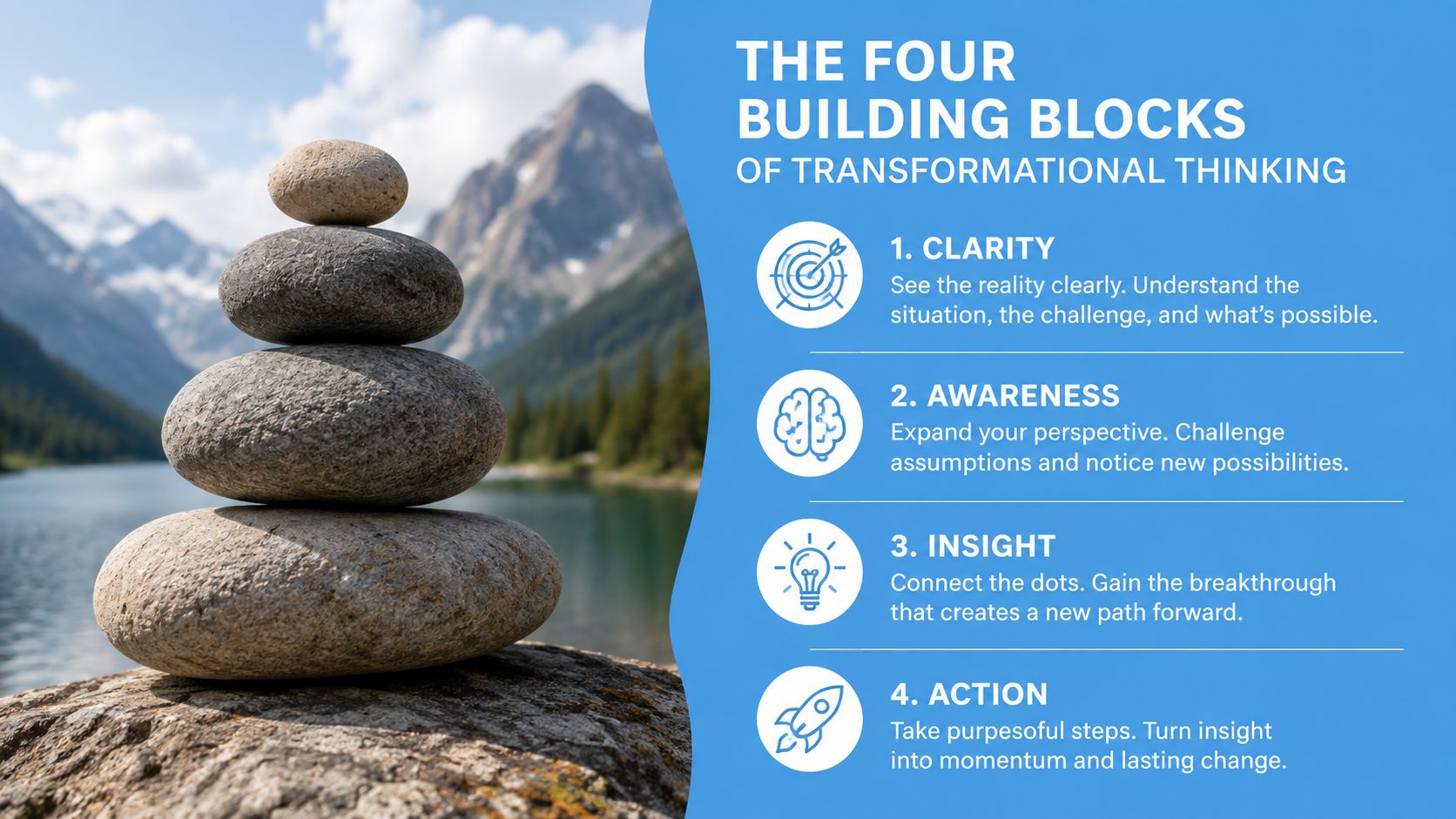
Clarity of purpose
Purpose is the pillar that keeps activity from becoming motion without direction. Before choosing tactics, define the north-star question your team is trying to answer. A useful weekly habit is to write a one-sentence team mission, such as, “How can we make the customer's next decision easier?” Then test the week's priorities against it.
Diagnostic: Can every person explain why this work matters without repeating a slogan?
Muscle trained: Strategic attention.
Critical questioning
Transformational thinkers don't treat the first explanation as the final explanation. In meetings, ask, “What assumption are we relying on?” and “What evidence would change our mind?” Rewarding dissent matters as much as requesting it. Otherwise, employees learn to offer safe agreement while privately seeing risks the leader never hears.
Diagnostic: Who can challenge the plan without losing status?
Muscle trained: Cognitive flexibility.
This is the mental equivalent of progressive overload. You gradually increase the difficulty of the questions, not the volume of the meeting.
Emotional regulation
Your team reads your nervous system before it processes your words. Emotional regulation doesn't mean suppressing frustration or pretending difficult news is easy. It means noticing activation early enough to choose a response that serves the work.
Diagnostic: Do people become more thoughtful or more hurried when you enter a tense conversation?
Muscle trained: Recovery under pressure.
Leaders working in demanding technology and outsourcing environments may find it useful to explore practical resources on prevent burnout with embodied leadership, especially when pressure is showing up physically before it becomes obvious in behavior.
Future projection
Future projection is more than optimism. It's the habit of running mental simulations before committing to a roadmap. Ask what happens next, who absorbs the cost, which capability becomes a bottleneck, and what second-order effect might appear after the initial success.
Diagnostic: Have we considered how this decision changes the system beyond the immediate deliverable?
Muscle trained: Systems imagination.
These four pillars build the bridge from current thinking to transformational thinking. Purpose gives direction, questioning tests the route, regulation keeps the group steady, and projection helps the team see beyond the first milestone.
How Transformational Thinking Shows Up in Real Leadership Moments
The Director of Operations opens a weekly status meeting. A transactional approach accepts the first update, records the delay, and moves to the next speaker. A transformational approach pauses and asks, “What assumption slipped through here?” Then the director asks who has contrary data, not to embarrass the project owner, but to make hidden information usable.
The meeting still concerns deadlines and dependencies. The difference is that one leader collects reports while the other improves the team's thinking.
The escalation that becomes a redesign
A customer escalation reaches the Head of Product. One manager forwards the complaint upward with a note about the team responsible. The Head of Product looks for the system behind the failure. Was the handoff unclear? Did the process make the correct action difficult? Did the customer have a way to identify the problem earlier?
She brings the people closest to the work into the review and, where appropriate, loops the customer into the fix. The goal isn't to remove accountability. It's to place accountability at the level where the process can improve.
The one-to-one that develops judgment
In a one-to-one, a task-focused manager reviews deliverables, asks about completion, and assigns the next item. A transformational manager spends part of the conversation asking the employee to name their own blockers. “Where are you making a decision you don't yet trust?” and “What capability would make this work easier next time?” turn a task review into a development conversation.
The manager still discusses performance. The employee also learns to interpret challenges as material for growth rather than evidence of inadequacy.
Leaders who want to understand how their natural habits affect these moments can discover your leadership style and use that reflection as a starting point, not a fixed identity.
Each scene looks ordinary. None requires a dramatic announcement. Yet every moment is a small referendum on the kind of leader the team will choose to follow tomorrow. People follow leaders who help them make sense of uncertainty, speak openly about risk, and become more capable through the work itself.
The Inner Foundation Where Meditation and Mindfulness Come In
The trait-based misconception says transformational leaders are naturally calm, empathic, and visionary. That view creates a quiet problem. If leadership depends on an inborn temperament, a busy professional has little practical influence. Mindfulness offers a different interpretation: attention, emotional awareness, and perspective-taking can be practiced.
A 2018 paper connected mindfulness with transformational leadership through autonomy, competence, and relatedness need satisfaction. In other words, mindfulness was associated with transformational leadership partly through the way it supported core psychological needs (mindfulness and transformational leadership). A 2021 systematic review and meta-analysis covered 25 intervention studies, 182 effect sizes, and 1,254 participants, finding corroborating evidence for improvements in autonomy-supportive leadership processes and leader-effectiveness outcomes (mindfulness among leaders).
What the practice trains
Breath awareness trains attentional control. You notice that the mind has moved to a worry, a reply, or a future conversation, then return to the chosen object. That return is the repetition. In a leadership setting, it can create a small gap between receiving bad news and sending a reactive email.
Body scans build emotional granularity. Instead of saying, “I'm stressed,” you may notice a tight jaw, shallow breathing, heat in the chest, or an urge to interrupt. More precise awareness gives you more choices.
Open-monitoring practice widens perspective-taking. You observe thoughts, feelings, and sensations without immediately treating them as instructions. That makes it easier to hear a difficult employee concern without turning it into a judgment about the employee.
A 2016 experience-sampling study found that daily behaviors reflecting transformational leadership improved actors' daily affect more than several other leadership behaviors, with the effect partly explained by fulfillment of daily needs (daily transformational leadership behaviors). The result translates into ordinary work: calmer incident bridges, fewer impulsive replies, and more considered vendor negotiations. It doesn't mean meditation eliminates pressure. It can help you meet pressure with less automaticity.
A delivery manager notices rising frustration during a 9 a.m. standup. Rather than asking who caused the delay, she feels her feet on the floor and takes three deliberate breath cycles. She then reframes the update: “What is blocking flow, and what decision would help us remove it?” The facts haven't changed, but the conversation has.
For readers exploring meditation as a broader route to attention and mental clarity, this journey to mindfulness and mental clarity offers a complementary starting point. If recurring anxiety or difficult inner patterns complicate practice, reflective work such as healing anxiety through shadow work may also deserve careful, appropriately supported consideration.
A Progressive Practice Path From Five Minutes to Real Depth
Don't begin by promising yourself a complete personal transformation. Begin with a practice small enough to survive a difficult workday. Meditation develops through returning, not through producing a blank mind.

Start with a meeting threshold
For the first stage, take two minutes before each important meeting. Feel the breath, relax the shoulders, and choose one sentence of intention, such as, “I will ask before I advise.” You need only a timer, and the likely failure mode is mind wandering. That isn't a mistake. Noticing the wandering is the practice.
Your progression marker is simple: you remember to pause before meetings often enough that the pause becomes familiar.
The second stage is a five-minute focused-attention sit. Use a timer and place attention on the sensation of breathing at the nostrils. When thoughts pull you away, label the event gently and return. Drowsiness is common, especially after a demanding morning. Sit upright, keep the practice brief, and don't interpret sleepiness as a verdict on your ability.
Widen awareness gradually
The third stage introduces ten-minute open awareness. Notice thoughts, emotions, and body sensations without grasping or pushing them away. Restlessness may arise because the mind has lost its usual stream of stimulation. Let the restlessness become an object of observation.
In the fourth stage, add weekly reflection with a notebook. Use three prompts:
- Trigger: What triggered me?
- Observation: What did I notice internally?
- Experiment: What will I try next?
The progression marker is not longer sessions. It's better recovery after activation.
Create deeper space
The fifth stage is a monthly half-day retreat-style block. It might include silent sitting, walking, journaling, and a review of recurring leadership patterns. You don't need ideal conditions. A protected block between calls can still create depth if you stop treating every empty space as available work time.
Meditation isn't a performance review. A restless session can still teach you how restlessness behaves.
Turning Inner Practice Into Outer Team Outcomes
Inner calm matters only when people can experience its consequences. A regulated leader sets a cleaner direction because urgency no longer hijacks the purpose conversation. Emotional granularity supports development discussions that name effort and behavior rather than assigning personality judgments. Perspective-taking creates a stronger innovation climate because employees have more confidence that weak assumptions can be surfaced without humiliation.
The useful bridge is the Inner to Outer Loop:
- Notice the internal reaction and the external facts.
- Name the feeling, assumption, or pattern without confusing it with truth.
- Choose the response that serves the team's purpose.
- Communicate the response as a clear question, decision, or invitation.
A service desk example
A service desk manager sees repeated SLA misses. Her first interpretation is that the team isn't disciplined enough. During a short pause, she separates observation from story: tickets are aging, handoffs are unclear, and she feels anger rising.
She names the pattern privately, then chooses curiosity over accusation. At the team meeting, she asks, “Where does work wait, and what information is missing at that point?” The team identifies two process fixes and owns their implementation. The manager hasn't lowered the standard. She has changed the route to accountability.
| Inner Capacity | Outer Leadership Behaviour | Team Outcome Signal |
|---|---|---|
| Regulated attention | Sets priorities without transmitting panic | Meetings become clearer and less hurried |
| Emotional granularity | Names behavior and effort precisely in development conversations | Feedback feels actionable rather than personal |
| Perspective-taking | Invites contrary evidence and lived experience | Employees surface more weak assumptions |
| Reflective judgment | Separates observation from interpretation before deciding | Post-incident reviews examine systems, not scapegoats |
Measure the loop through signals rather than self-image. Notice meeting energy, voluntary idea submission, retention signals among high performers, and the quality of post-incident reviews. These aren't proof of causation by themselves, but they help you see whether inner practice is becoming an outer team pattern.
Common Pitfalls That Stall the Transformational Journey
Most leadership derailments are predictable stages, not proof that you're incapable of change. The useful response is to identify the pattern early and install a practical correction.

Seven patterns to recognize
- Grand vision too early: You announce a future-state before examining your own reactions and assumptions. Start with one recurring leadership moment and observe it for a week.
- Borrowed charisma: You copy another executive's language or performance style. Replace imitation with authentic presence, including a sentence that admits what you don't yet know.
- Meditation as performance: You judge the session by how calm you feel. Judge it by whether you noticed distraction and returned without self-criticism.
- Difficult feedback avoided: You call yourself compassionate while leaving harmful behavior unnamed. Use specific observations, explain the impact, and ask what support or accountability is needed.
- Operational detail dismissed: You label process discipline as small thinking. Transformational leaders understand that vision requires handoffs, ownership, data, and review rhythms.
- Busyness confused with progress: You fill the calendar with transformation workshops while repeating the same decisions. Protect a short reflection period before adding another initiative.
- Practice abandoned at a plateau: Early novelty fades, so you assume the method stopped working. Change the context, shorten the session, or ask a trusted colleague to help you examine what has become automatic.
Technology and outsourcing leaders face an extra temptation: treating a failed change initiative as a communication problem alone. Sometimes the team resisted because the workflow was unrealistic, the capability wasn't available, or leaders changed priorities without acknowledging the cost.
If you miss a weekly reflection, don't create a recovery project. Write the three prompts the next morning and record one honest answer for each. If the team resists new behaviors, ask what the change threatens, then adjust the environment instead of demanding enthusiasm. After a failed initiative, hold a review that distinguishes flawed assumptions, weak execution, and external constraints.
A stalled practice is information. Use it to redesign the practice, not to construct a story about personal failure.
Your First Thirty Days of Transformational Thinking
A thirty-day plan works best when it creates habit stacking, not an overloaded development program. This sequence suits leaders in IT, BPO, and outsourcing environments because each action can fit around live delivery work.
Four weekly arcs
During the first week, practice a five-minute daily mindfulness anchor and complete a baseline assessment. Record how you respond to interruption, disagreement, ambiguity, and pressure. Don't try to improve everything at once. You're establishing a reference point.
In the second week, add weekly reflection journaling using the three prompts from the practice path. Connect each response to the four building blocks: purpose, questioning, regulation, or future projection. Look for one repeated trigger rather than a complete personality diagnosis.
The third week introduces structured development conversations with two direct reports. Ask, “What work is stretching you?” “Which decision do you want to own more fully?” and “What do you need from me that you aren't receiving?” Listen for capability gaps and environmental barriers.
In the fourth week, combine the practices into a feedback loop. Ask two peers and one team member what behavior they've noticed, what has become more useful, and where you still create friction. Receive the feedback without explaining it away.
| Week | Daily Practice | Weekly Anchor | Measurement Focus |
|---|---|---|---|
| Week one | Five-minute mindfulness anchor | Baseline leadership self-assessment | Reflection consistency and emotional reactivity |
| Week two | Brief pause before one consequential decision | Journal using the three prompts | Awareness of assumptions and clarity of purpose |
| Week three | One intentional listening moment each day | Development conversations with two direct reports | Psychological safety signals and initiative-taking |
| Week four | Notice, name, choose, communicate | Feedback from two peers and one team member | Decision quality, retention signals, and post-incident learning |
Keep the daily action singular. One pause, one question, one reflection, or one conversation is enough. The objective is to make transformational thinking part of the operating rhythm, where leadership development meets actual work.
The broader evidence base supports treating this as a durable field rather than a motivational trend. A 2025 meta-analysis in public administration reviewed 70 primary studies, 151 independent effect sizes, and 718,601 participants, reinforcing that transformational leadership remains an evidence-based domain (recent meta-analysis of transformational leadership). At the same time, mindfulness research calls for humility. A 2018 review identified 19 studies, found encouraging signs for leader well-being, resilience, and capability, but noted varied study quality and no evidence of benefits for participants' direct reports (mindfulness interventions for managers and leaders). Practice should therefore be evaluated through observed behavior, not assumed outcomes.
NineArchs LLC helps organizations turn leadership intent into operational capability through knowledge outsourcing, IT services, skills-based staffing, software development, cloud and security support, generative AI solutions, and BPO services. Visit NineArchs LLC to discuss flexible support that gives your leaders more room to build thoughtful, resilient teams.