
Figuring out the cost of custom software can feel like trying to hit a moving target. You might hear a number like $25,000 for a simple Minimum Viable Product (MVP), or you might see a quote that soars past $1,000,000 for a massive, enterprise-grade system. The truth is, both are possible. This huge range exists because building software isn’t a one-size-fits-all purchase; it’s a strategic investment shaped entirely by your business goals.
Decoding the True Investment in Custom Software

It’s easy to fall into the trap of viewing software development as just another line-item expense. But that’s a mistake. Think of it instead as building a critical business asset—something designed from the ground up to boost your efficiency, open up new revenue streams, or deliver an experience your customers will love.
Off-the-shelf software makes you bend your processes to its will. A custom solution, on the other hand, is built to amplify what makes your business unique. This guide will give you a clear roadmap for understanding the real factors that drive your final investment, moving beyond vague price tags to get to the heart of what shapes your budget.
Core Pillars of Software Cost
Before you can build a realistic budget, you need to understand what actually goes into the price tag. The total investment isn’t arbitrary; it’s a direct reflection of the project’s scope and complexity, which boils down to a few key factors.
These are the foundational elements that will have the biggest impact:
- Feature Complexity: How many features do you need, and how intricate are they? A simple login screen is one thing; a multi-layered analytics dashboard is another entirely.
- Team Composition: Who is on the job? The size and expertise of your development team—including developers, project managers, and QA testers—play a huge role.
- Technology Stack: What are we building it with? The choice of programming languages, frameworks, and databases all factor into the cost and timeline.
- Third-Party Integrations: Does your new software need to talk to other tools? Connecting with platforms like your CRM, payment gateways, or marketing automation software adds another layer of work.
By focusing on the value you’re creating, not just the price you’re paying, you set yourself up for a serious return. It’s not uncommon to see businesses report profit increases between 25% and 95% after launching tailored software that fits their operations like a glove.
The Strategic Advantage of a US-Based Partner
As you’re thinking about cost, don’t forget to consider who you’re working with. Partnering with a US-based outsourcing firm gives you a powerful mix of benefits. You get access to a global talent pool, which can seriously optimize your budget, but without giving up the quality, seamless communication, and legal security that comes from working with a domestic company.
This approach strikes the perfect balance. Your project is managed effectively in your own time zone, while you get to tap into cost-effective resources from around the world. It turns what could be a headache—managing a remote team—into a major strategic advantage.
Ready to find a partner that delivers both value and peace of mind? Give our experts a call at +1 (310)800-1398 to talk about how we can build your solution efficiently.
Choosing the Right Pricing Model for Your Project
Picking the right pricing model is one of the most important calls you’ll make when figuring out your custom software development cost. Think of it like building a house: you can buy a pre-designed model with a fixed price tag, hire a contractor and pay for their time and the materials they use, or bring an entire construction crew in-house to work exclusively on your vision. Each path makes sense depending on how clear your blueprint is, how much flexibility you need, and what your long-term goals are.

Getting to know these models—Fixed Price, Time & Material, and Dedicated Team—is the key to building a partnership that lines up with your budget and your business. Let’s break down how each one works so you can decide which is the right fit for your software build.
The Fixed Price Model: Predictability and Structure
The Fixed Price model is exactly what it sounds like: a single, locked-in price for the entire project. This approach is a perfect fit when you have a crystal-clear vision, iron-clad requirements, and a detailed scope that isn’t going to change. It’s the turnkey home contract of the software world.
You hand over the complete blueprint, and your development partner agrees to build it for that one set cost. For companies with strict financial oversight, this model is a huge win because it offers maximum budget predictability. No surprises.
But that rigidity can also be its biggest weakness. If you suddenly need to add a feature or pivot your strategy mid-stream, it usually means kicking off a formal—and often slow—change request process that adds time and money. It’s ideal for smaller projects or MVPs where the path forward is already mapped out in detail.
The greatest benefit of a Fixed Price model is financial certainty. Knowing the total custom software development cost upfront allows for precise budget allocation and eliminates the risk of unexpected expenses, provided the initial scope is flawlessly defined.
The Time and Material Model: Flexibility and Agility
On the flip side, the Time & Material (T&M) model is more like a custom home renovation. You pay for the actual hours your development team works and cover the cost of any necessary tools or third-party resources. This approach gives you incredible flexibility, making it perfect for complex, long-term projects where the requirements are likely to evolve.
If your project involves R&D or you plan to adapt based on early user feedback, T&M is almost always the better choice. You aren’t locked into the initial scope and can easily shuffle priorities, add features, or change direction as you go. That kind of agility is the cornerstone of modern software development.
The potential catch? Budget variability. Since the final price tag isn’t set in stone, this model demands a high level of trust and transparent communication with your development partner to keep things on track. Regular check-ins and clear progress reports are absolutely essential for making it work.
The Dedicated Team Model: A True Extension of Your Company
The Dedicated Team model is the most integrated of the three. With this approach, you’re hiring a full team—developers, designers, project managers—who work exclusively on your projects. They become a remote extension of your in-house crew, getting to know your business goals, your culture, and your long-term vision inside and out.
This is the go-to model for large-scale, ongoing development or for businesses that have a constant need for software expertise but can’t hire a full-time internal team. It delivers stability, deep product knowledge, and a group of professionals who are 100% focused on your success.
Partnering with a US-based outsourcing firm gives you a huge advantage with any of these models. A domestic partner guarantees clear communication, cultural alignment, and strong project oversight, which helps manage risk while giving you access to world-class talent. It’s a hybrid approach that delivers both cost-efficiency and the quality that comes from working with a local team.
To figure out which model best fits your project, give our experts a call at +1 (310)800-1398 for a consultation.
So, What Really Drives Your Software Costs?
What’s the difference between a $50,000 project and a $500,000 one? It’s not just about the hours logged. It comes down to the depth and complexity of what you’re trying to build. Getting a handle on these key cost drivers is the first, most crucial step to setting a realistic budget and keeping your project’s scope from running wild.
Think of it like commissioning a custom car. A basic work truck gets the job done and is relatively straightforward to build. A high-performance sports car with a bespoke engine, custom electronics, and a handcrafted interior? That’s an entirely different beast. Both are vehicles, but the engineering, materials, and specialized skills required are worlds apart. Software works exactly the same way.
The Gravity of Feature Complexity
The single biggest factor pushing your software cost up or down is the complexity of its features. It’s a classic case of “not all features are created equal,” and the difference in development effort can be absolutely massive. A simple page that just displays information is one thing; an interactive, AI-powered analytics engine is another thing entirely.
Let’s take something as common as user login:
- The Simple Route: A standard email and password system. This is a well-trodden path for developers, who can lean on existing libraries to get it done quickly.
- The Advanced Route: Now, let’s add social sign-on (with Google or Facebook), two-factor authentication (2FA), and maybe even biometric login like a fingerprint or face scan. Each of these additions piles on layers of complexity, requiring significant time for development, integration, and testing.
This logic holds true for every single piece of your application. An AI recommendation engine, real-time data processing, or an intricate administrative dashboard will add far more to your final bill than simple forms or informational pages.
The secret to smart budgeting is learning to separate the “must-have” core functions from the “nice-to-have” enhancements. Most successful businesses find that launching with a lean set of high-impact features is the most cost-effective way to get to market and start generating feedback.
The Web of Integrations and Platforms
Modern software rarely lives on an island. To be truly useful, it has to talk to other systems, and every one of these connection points—these third-party integrations—adds to the timeline and, consequently, the cost. They are vital for a smooth user experience, but they demand careful planning.
Here are a few common integrations that can inflate a budget:
- Payment Gateways: Hooking into services like Stripe, PayPal, or Braintree means handling sensitive financial data. That requires bulletproof security and exhaustive testing.
- CRMs and ERPs: Syncing your software with platforms like Salesforce or SAP is key to unifying business operations, but it often means wrestling with complex, sometimes poorly documented, APIs.
- Mapping and Geolocation: Integrating with Google Maps or other location services can add powerful features, but it also brings in new subscription fees and development work.
On top of that, you have to decide where your software will live. Building a web application is one project. But if you also need native apps for both iOS and Android, you’re not just adding a little more work—you’re essentially tripling the effort. Each platform comes with its own codebase, unique design guidelines, and separate testing requirements.
The Price of Great Design and Bulletproof Compliance
Your user experience (UX) and user interface (UI) are, quite literally, the face of your application. It’s what your customers see, touch, and interact with. While it’s always tempting to cut corners here to save money, a clunky or confusing design can kill an otherwise brilliant app.
A cheap, template-based design gets you out the door fast, but it leaves zero room for brand identity or a unique, intuitive workflow. On the other hand, a fully custom, user-centric design involves deep research, wireframing, prototyping, and user testing. It’s more expensive upfront, but this investment pays for itself many times over in user adoption and satisfaction. In fact, studies have shown a well-designed interface can boost conversion rates by over 200%.
Finally, for many industries, security and compliance aren’t just features—they’re non-negotiable table stakes. If you’re building software that needs to be HIPAA compliant for healthcare or adhere to GDPR for data privacy, you’re adding necessary layers of complexity. These regulations demand specific security protocols, data encryption standards, and audit trails. All of this has to be meticulously built, tested, and documented. This isn’t just extra work; it’s specialized work that is absolutely essential for avoiding massive fines and protecting your users.
A skilled US-based partner can help you navigate these complexities, ensuring your project meets all technical and regulatory standards. For a detailed discussion of your project’s specific cost drivers, call our experts at +1 (310)800-1398.
How Outsourcing Can Reshape Your Development Budget

Here’s a truth that surprises many founders: the single biggest factor driving your custom software development cost isn’t the tech stack or a complex feature. It’s geography. Where your developers are physically located can either inflate your budget to impossible heights or shrink it into a smart, manageable investment.
This is where strategic outsourcing becomes your most powerful tool. By looking beyond your local talent pool, you tap into a global network of skilled engineers whose rates are shaped by their local economies. That gap creates a massive opportunity to build world-class software without the eye-watering price tag of a domestic team.
The USA-Based Outsourcing Advantage
Let’s be honest: trying to directly manage a team on the other side of the world can be a recipe for disaster. You’re juggling communication gaps, cultural misunderstandings, and chaotic time zone differences. It’s exhausting.
This is why working with a US-based outsourcing partner is a much smarter, hybrid approach. It gives you the best of both worlds.
You get a single, accountable point of contact in your own time zone, working under the legal and commercial protections of a US contract. All the while, you’re reaping the huge cost savings of a global team without any of the classic frustrations. Your US partner handles all the heavy lifting—recruitment, vetting, project management, and quality control—ensuring your project stays perfectly aligned from start to finish. You can find more insights on cost variations in this detailed guide from spdload.com.
This strategic partnership delivers:
- Cost Efficiency: You get access to global talent at a fraction of domestic rates.
- Seamless Communication: A US-based project manager bridges any language or cultural gaps, so nothing gets lost in translation.
- Legal Security: Your contract is governed by US law, giving you accountability and peace of mind.
- Quality Assurance: You benefit from rigorous management processes that guarantee high standards.
Outsourcing isn’t about a race to the bottom to find the cheapest possible option. It’s about unlocking the absolute best value—getting top-tier engineering talent at a price that makes your project viable and maximizes your return.
This model flips outsourcing from a potential risk into a powerful strategic advantage, making it possible to build incredible software on a budget that actually makes sense. To see how a US-based partner can optimize your development spend, call our experts at +1 (310)800-1398 today.
How to Create a Software Development Budget You Can Actually Trust
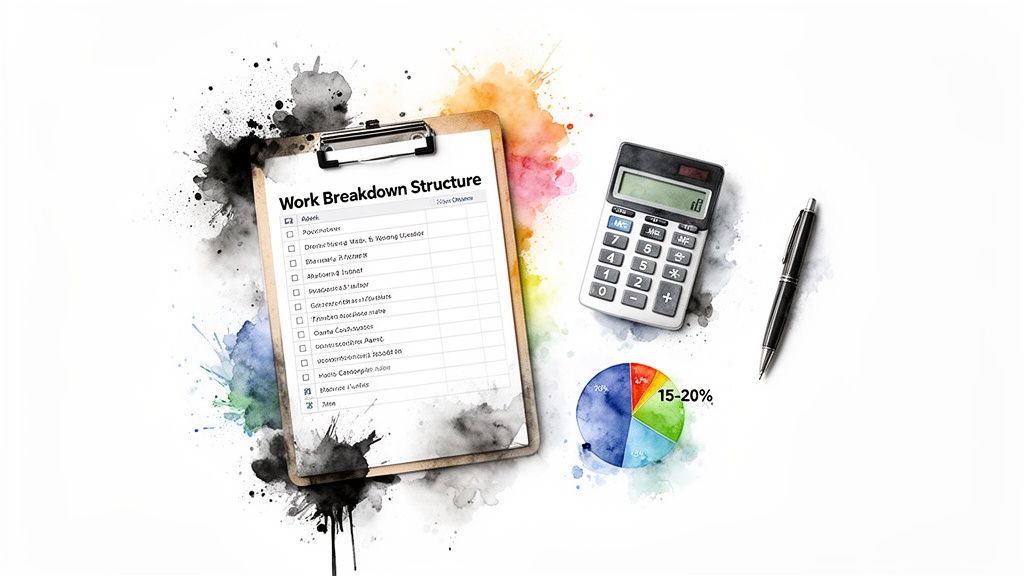
**. Don’t let the name intimidate you. Think of it as a detailed recipe for your software. Instead of one giant, overwhelming goal like “build an e-commerce app,” you break it down into smaller, bite-sized tasks.
Deconstructing Your Project with a WBS
Creating a WBS is about mapping out every single feature, function, and screen your software will have. This detailed inventory is the single best way to get your arms around the full scope of the project. By listing everything from “user registration” to “payment processing,” you turn a fuzzy concept into a concrete action plan.
For a deeper dive, it’s worth understanding the nuances of mastering software development cost estimation. The process generally follows these steps:
- List the Big Chunks: Start with the high-level features. For an e-commerce app, this might be things like a Product Catalog, User Accounts, and a Shopping Cart.
- Break It Down Again: Under each of those big features, list out all the smaller tasks involved. “User Accounts,” for instance, breaks down into “Registration,” “Login/Logout,” and “Password Reset.”
- Estimate the Hours: This is where the magic happens. Assign an estimated number of hours to complete each of those small tasks. An experienced development partner is your best friend here—their real-world expertise will make these time estimates far more accurate.
From Hours to Dollars: An Estimation Example
Once you have a list of tasks and the hours they’ll likely take, calculating your core development cost is simple math. Let’s walk through a stripped-down WBS for a basic e-commerce app.
| Feature Area | Sub-Task | Estimated Hours |
|---|---|---|
| User Accounts | User Registration | 20 hours |
| User Login/Logout | 15 hours | |
| Product Display | Product Listing Page | 30 hours |
| Individual Product Page | 25 hours | |
| Shopping Cart | Add/Remove Items | 35 hours |
| Checkout Process | 50 hours | |
| Total Estimated Hours | 175 hours |
Let’s say you’re working with a US-based partner with a blended hourly rate of $150/hour. The initial math is straightforward: 175 hours x $150/hour = $26,250.
No software project goes exactly as planned. Unforeseen technical hurdles, minor scope adjustments, or integration complexities are normal. A contingency buffer is not for adding new features; it’s a safety net for the unexpected.
Don’t Forget the Contingency Buffer
A budget without a buffer is a budget waiting to fail. It’s absolutely critical to add a 15-20% contingency on top of your calculated cost. This is your safety net for all the little things that inevitably pop up during development.
Using our example: $26,250 x 20% = $5,250.
This brings your realistic, trustworthy budget total to $31,500. This proactive step saves you from stressful budget renegotiations and project delays down the road. When you consider that enterprise-level projects regularly top $1 million—with team salaries and infrastructure eating up 60-70% of that—you can see why meticulous planning is vital at every scale.
For a detailed estimate on your specific project, call our experts at +1 (310)800-1398.
Smart Ways to Control Your Development Spend
Getting a budget approved for your custom software is a huge win. But keeping the final custom software development cost in check? That takes a hands-on, strategic mindset. Smart financial management isn’t about cutting corners and hoping for the best; it’s about making deliberate choices that squeeze every drop of value from your investment and cut out wasteful spending.
With the right game plan, you can build something truly exceptional without watching your budget spiral out of control. These aren’t just theories—they are battle-tested methods that successful companies use to build better products for less. By focusing relentlessly on core value and efficiency, you can slash expenses and get to market faster.
Start Lean with a Minimum Viable Product
Without a doubt, the most powerful way to control costs is to launch with a Minimum Viable Product (MVP). Instead of trying to build every feature you’ve ever dreamed of, an MVP laser-focuses on the absolute essential functionality needed to solve one core problem for your very first users.
Think of it like building a car. You build the engine, wheels, and steering first—the parts that make it go. The leather seats and premium sound system can wait.
An MVP lets you:
- Validate Your Big Idea: You get to test your core business assumption with real people before committing to a massive, expensive build-out.
- Slash Your Initial Investment: By concentrating on a smaller, tighter feature set, you dramatically lower the upfront development cost and financial risk.
- Gather Real-World Feedback: There’s no substitute for user data. An MVP allows you to collect feedback that steers all future development, making sure you only build features customers actually want.
Prioritize Features with Precision
Once your MVP is out in the wild, the temptation to add just one more thing can quickly blow up your budget. To stop this “scope creep” in its tracks, you need a disciplined way to prioritize what comes next. The MoSCoW method is a brilliantly simple framework for this.
It forces you to categorize every potential feature into one of four buckets:
- M – Must-have: These are the non-negotiables. Without them, the product simply doesn’t work.
- S – Should-have: Important features that add serious value but aren’t absolutely critical for this version.
- C – Could-have: Desirable, “nice-to-have” features that can be added down the line if the budget and schedule allow.
- W – Won’t-have (this time): Features you all agree are out of scope for the current release.
This framework sparks tough but necessary conversations about what truly matters. It ensures your development team is always pouring their energy into features that deliver the biggest impact.
Embrace Open-Source and Agile Methods
You don’t always have to build every single component from scratch. Leaning on open-source technologies—like code libraries, frameworks, and databases—can shave off huge amounts of development time and eliminate licensing fees. An experienced partner can point you to reliable open-source tools that are a perfect fit for your project, saving you thousands.
At the same time, adopting an agile development process is your best defense against costly rework. By building in short, iterative cycles (often called “sprints”), your team can adapt to new information quickly and catch issues before they snowball into major headaches. The clear, constant communication baked into an agile framework keeps everyone on the same page, minimizing the kind of misunderstandings that lead to wasted time and money.
If you’re looking for more actionable advice, there are some excellent strategies to reduce software development costs that don’t force you to sacrifice quality.
Working with a US-based partner provides the direct oversight needed to put these strategies into practice, making sure your project stays on track and on budget. To see how we can help you get the most out of your development spend, give our experts a call at +1 (310)800-1398.
Got Questions About Software Development Costs? We’ve Got Answers.
Even with a detailed plan in hand, it’s completely normal to have lingering questions about the final price tag for custom software. To clear things up, we’ve put together the questions we hear most often from our clients, with direct answers to help you budget confidently and understand exactly where your investment is going.
What Are the “Hidden Costs” I Should Know About?
The initial build is just the beginning of the story. Smart budgeting means looking beyond launch day to understand the total cost of ownership over the software’s entire life.
Here are the big ones to plan for:
- Ongoing Maintenance: This is almost always the largest post-launch expense, typically running 15-20% of the initial development budget each year. Think of it like maintaining a car—it covers bug fixes, security updates, and small tweaks to keep everything running smoothly.
- Third-Party Subscriptions: Your software won’t live on an island. It will likely rely on other services for things like cloud hosting (AWS or Azure), databases, and API connections. These recurring fees are part of the operational cost.
- Scope Creep: While not exactly “hidden,” new feature ideas that pop up mid-project can definitely inflate your budget if they aren’t managed well. This is precisely why a crystal-clear scope and a contingency fund are your best friends.
A good development partner won’t shy away from these topics. They’ll help you map out these future costs from day one, so there are no surprises waiting for you down the road.
Is It Always Better to Go with the Cheapest Outsourcing Option?
Absolutely not. It’s a tempting shortcut, but chasing the lowest hourly rate often backfires, leading to much higher costs in the long run. An unusually low price can be a major red flag for shoddy code, frustrating communication barriers, or a team that might disappear when things get tough—all of which lead to expensive, time-consuming rework.
The goal isn’t to find the lowest price; it’s to find the best value. True value is a mix of top-notch technical skill, clear communication, and dependable project management that delivers a great product on time and on budget.
This is where a US-based partner managing a global team really shines. You get the significant cost benefits of a global talent pool, but with the high-quality standards, legal protections, and seamless communication you’d expect from a domestic company. It’s a model built to give you a far better return on your investment.
How Can I Get a Truly Accurate Quote for My Project?
The accuracy of the quote you receive is a direct reflection of the detail you provide. To give you a reliable estimate, a development team needs to get inside your head and see the vision as clearly as you do.
A powerful project brief should always include:
- Your Business Goals: What problem is this software solving? What does success look like for you?
- Your Target Audience: Who are the real people who will be using this? Understanding their needs is everything.
- A Prioritized Feature List: Don’t just list features—rank them. A simple “Must-have, Should-have, Could-have” framework works wonders.
- Technical Specifics: Do you have any required technologies, integrations with other systems, or compliance standards like HIPAA to meet?
- Design Mockups: If you have wireframes or design files, share them. A picture is worth a thousand lines of code and eliminates a huge amount of guesswork.
The more you can share upfront, the sharper the estimate will be. This simple step is the best way to prevent unexpected costs and ensure everyone is aligned from the start.
Ready to turn your vision into reality with a team you can trust? The experts at NineArchs LLC are here to help you navigate every step of the process. For a comprehensive, no-obligation quote tailored to your project, call us today at +1 (310)800-1398.