
Think of your business as a top-tier restaurant. Your secret sauce? Creating unforgettable culinary experiences. But running a restaurant also means dealing with payroll, taking reservations, and scrubbing the kitchen floors. These tasks are critical, but they aren’t what make your food incredible.
Now, what if you could hand off your payroll to a professional accounting firm and let a dedicated service handle every single reservation call? That’s business process outsourcing (BPO) in a nutshell. You’re entrusting specific, vital functions to an outside expert so your team—your chefs, in this analogy—can stay laser-focused on what they do best.
What Is Business Process Outsourcing Anyway

This isn’t just about cutting costs; it’s a powerful strategy for driving growth and achieving operational excellence. Companies of all shapes and sizes, from scrappy startups to global giants, use BPO to tap into specialized skills and technology without the headache and expense of building those departments from the ground up.
Business Process Outsourcing At a Glance
To make it even clearer, let’s break down the core idea of BPO into a simple table. This gives you a quick snapshot of what it is, what it aims to do, and where you’ve likely already seen it in action.
| Concept | Primary Goal | Common Examples |
|---|---|---|
| Delegation of Tasks | Offload non-core but essential business functions to a third-party expert. | Customer support call centers, payroll processing, IT helpdesks. |
| Specialization | Allow internal teams to focus on core competencies that drive revenue and innovation. | A software company outsourcing its accounting to focus on product development. |
| Strategic Partnership | Gain access to specialized skills, technology, and operational efficiency. | A retail brand partnering with a logistics firm to handle all warehousing and shipping. |
As you can see, BPO is all about strategic delegation. It’s a partnership model that frees up your most valuable resource—your team’s time and attention—to concentrate on pushing the business forward.
The Driving Force Behind BPO
The BPO market isn’t just growing; it’s exploding. Valued at roughly $347.95 billion in 2025, it’s on track to hit a staggering $840.60 billion by 2034, with a compound annual growth rate of 10.30%. This surge is all about companies getting smarter about efficiency, especially as new technologies make it easier than ever to collaborate with external teams. You can learn more about the key factors driving BPO market growth and how businesses are adapting.
At its core, BPO is about specialization. It allows a business to concentrate on what it does best by offloading other essential functions to a partner who specializes in them.
This model is built on a simple premise: a BPO provider’s entire business is designed to perform a specific function—like data entry or IT support—at scale. They’ve already perfected the processes, invested in the best technology, and hired trained experts. For you, this translates into some serious advantages:
- Access to Expertise: You get a team of skilled professionals on day one, without the lengthy and expensive process of recruiting and training.
- Increased Efficiency: BPO partners live and breathe their specialty. They use optimized workflows and modern tools to get things done faster and more accurately.
- Scalability on Demand: Need to ramp up for a busy season or scale back during a slow one? You can adjust your service levels easily, without the pain of hiring or layoffs.
- Focus on Core Activities: Your team is finally free to pour its energy into what truly matters—innovation, strategy, and other high-value work that grows your business.
Opting for a USA-based partner brings its own set of perks, like shared time zones for real-time collaboration, a natural cultural fit for smoother communication, and compliance with tough US data security laws. It’s like adding an extension to your team that’s secure, seamless, and perfectly in sync. To see how a domestic partner can work for you, give us a call at +1 (310)800-1398.
Understanding The Different Flavors of BPO
Business process outsourcing isn’t some monolithic, one-size-fits-all service. It’s more like a restaurant menu, with different options designed for specific business appetites. Figuring out which “flavor” of BPO is right for you is the first step toward finding a partner who can deliver real, measurable value.
The world of BPO is generally split into three main categories. The easiest way to think about them is based on where the work happens—either behind the scenes, keeping the business running, or right out front, interacting with your customers.
Back-Office Outsourcing: The Engine Room
Think of back-office outsourcing as the engine room of your company. These are all the crucial functions that keep your business humming along smoothly, but they happen completely out of your customers’ sight. They are absolutely essential, but they don’t involve picking up the phone to talk to a client.
When you hand over these processes, you’re essentially giving the keys to a specialized crew that lives and breathes operational excellence. This frees up your in-house team to stop wrestling with administrative headaches and start focusing on the big-picture ideas that actually grow the business.
Common back-office services include:
- Bookkeeping and Payroll: Keeping the books clean and making sure everyone gets paid on time.
- Data Entry and Management: Handling huge volumes of information quickly and accurately.
- IT Support: Managing your entire tech stack, from helpdesk tickets to network security.
- Human Resources: Taking care of recruiting, onboarding, and benefits administration.
And this isn’t just about simple admin work anymore. Recent data shows that companies are outsourcing incredibly sophisticated functions, including legal services (64%), tax services (61%), and human resources (57%). You can discover more insights about BPO adoption trends to see just how strategically businesses are delegating entire operational arms.
Front-Office Outsourcing: The Face of Your Company
If the back office is the engine, then the front office is the face and voice of your company. Front-office outsourcing is all about delegating the activities where you directly engage with your customers. These partners become a true extension of your brand, managing the interactions that shape how people feel about you.
A growing ecommerce brand, for instance, might outsource its customer service to handle inquiries, returns, and support tickets 24/7. This ensures their customers get fast, professional help anytime, which builds loyalty and protects the brand’s hard-earned reputation.
By partnering with a front-office BPO specialist, you gain a dedicated team trained in customer engagement, equipped with the tools and temperament to handle any situation with professionalism.
Services in this category are all about communication:
- Customer Support Call Centers: Answering phone calls, live chats, and emails to solve customer problems.
- Technical Support: Providing specialized help for software, hardware, or other complex products.
- Sales and Lead Generation: Reaching out to potential customers to fill your sales pipeline.
Knowledge Process Outsourcing: The Brains of the Operation
Finally, there’s Knowledge Process Outsourcing (KPO). This is the most advanced and specialized form of BPO, going far beyond just handling tasks. KPO is about outsourcing high-level work that requires deep subject matter expertise, sharp analytical skills, and sound judgment.
This is where you delegate the “thinking” work. A tech startup, for example, might use a KPO provider for financial modeling and market research to guide its funding strategy. They get access to top-tier analysts without the astronomical cost of hiring them full-time.
KPO services are all about leveraging specialized intellect:
- Financial Analysis and Research: Performing complex market analysis, investment research, and financial planning.
- Data Analytics and Insights: Diving into large datasets to uncover trends and guide business decisions.
- Legal and Medical Services: Handling specialized research, documentation, and compliance tasks.
Choosing a USA-based outsourcing partner for any of these services offers distinct advantages, including seamless communication in shared time zones, strong cultural alignment, and adherence to rigorous US data security standards. Ready to explore which flavor of BPO fits your needs? Call +1 (310) 800-1398 to start the conversation.
The Real Benefits Of Strategic Outsourcing

When people talk about business process outsourcing, the conversation almost always starts with cost savings. But the truth is, focusing only on the bottom line is like buying a smartphone just to use it as a calculator—you’re ignoring its most powerful features.
The real magic happens when you see BPO not as a cost-cutting tactic, but as a strategic tool for building a more focused, efficient, and resilient organization. Partnering with a BPO provider isn’t about offloading tasks; it’s about importing expertise. You gain instant access to specialized talent and top-tier technology without the massive upfront investment in hiring, training, and infrastructure.
This single move can sharpen your competitive edge overnight.
Drive Operational Efficiency And Sharpen Core Focus
Every business has a mission—that unique value it delivers to customers. But the day-to-day reality is often a whirlwind of essential but non-core functions that drain time, energy, and your best people’s attention. Think about it: payroll, routine customer service, data entry. These tasks have to get done, but they can easily distract your team from the work that actually drives growth and innovation.
Strategic outsourcing acts as a filter. It lets you delegate these repetitive, high-volume processes to a team that lives and breathes them. This frees up your internal staff to concentrate on what they do best: developing new products, refining your market strategy, and building meaningful customer relationships.
By delegating routine functions, you’re not just clearing your team’s to-do list; you’re sharpening their focus on the core activities that define your company’s success and secure its future.
This shift naturally leads to greater operational efficiency. BPO partners are specialists. Their entire business model is built around performing specific functions with maximum speed and accuracy. They’ve already optimized the workflows, invested in the best tools, and trained their people to excel, delivering a level of performance that’s tough for a non-specialized, in-house team to match.
Achieve Unmatched Scalability And Flexibility
Market demand is never a straight line. It ebbs and flows with seasonal trends, economic shifts, and sudden industry changes. For an in-house team, this volatility is a nightmare. You’re either overstaffed during slow periods or completely overwhelmed during unexpected peaks.
BPO offers an elegant solution: built-in scalability. It gives your business the agility to ramp operations up or down almost instantly, perfectly matching your current needs.
- Seasonal Peaks: A retail company can easily double its customer support agents during the holidays without hiring a single temporary employee.
- Rapid Growth: A tech startup experiencing viral growth can scale its back-office support on demand, ensuring a seamless user experience.
- Market Contractions: When things slow down, a business can scale back its outsourced services, avoiding the painful and costly process of layoffs.
This operational agility turns a fixed overhead cost into a flexible operational expense. You only pay for the resources you need, exactly when you need them. When you’re weighing the strategic upsides against the potential downsides, a detailed look at the pros and cons of offshore outsourcing can provide a really balanced perspective.
The Advantage Of A USA-Based Outsourcing Partner
Choosing a domestic BPO partner brings a unique set of benefits that directly impact collaboration, quality, and security. A US-based provider operates in the same time zones, which gets rid of frustrating communication delays and allows for real-time problem-solving—it’s like they’re in the next office over.
Cultural alignment is another huge plus. With a shared understanding of business etiquette, communication nuances, and market dynamics, your brand’s voice and values are represented accurately in every single interaction.
Most importantly, US-based partners are bound by robust data security and privacy regulations. This gives you peace of mind that your sensitive company and customer information is protected by stringent domestic laws.
Ready to explore these strategic benefits for your business? Contact us at +1 (310) 800-1398 to discuss how a tailored BPO solution can drive your success.
How to Choose the Right BPO Partner
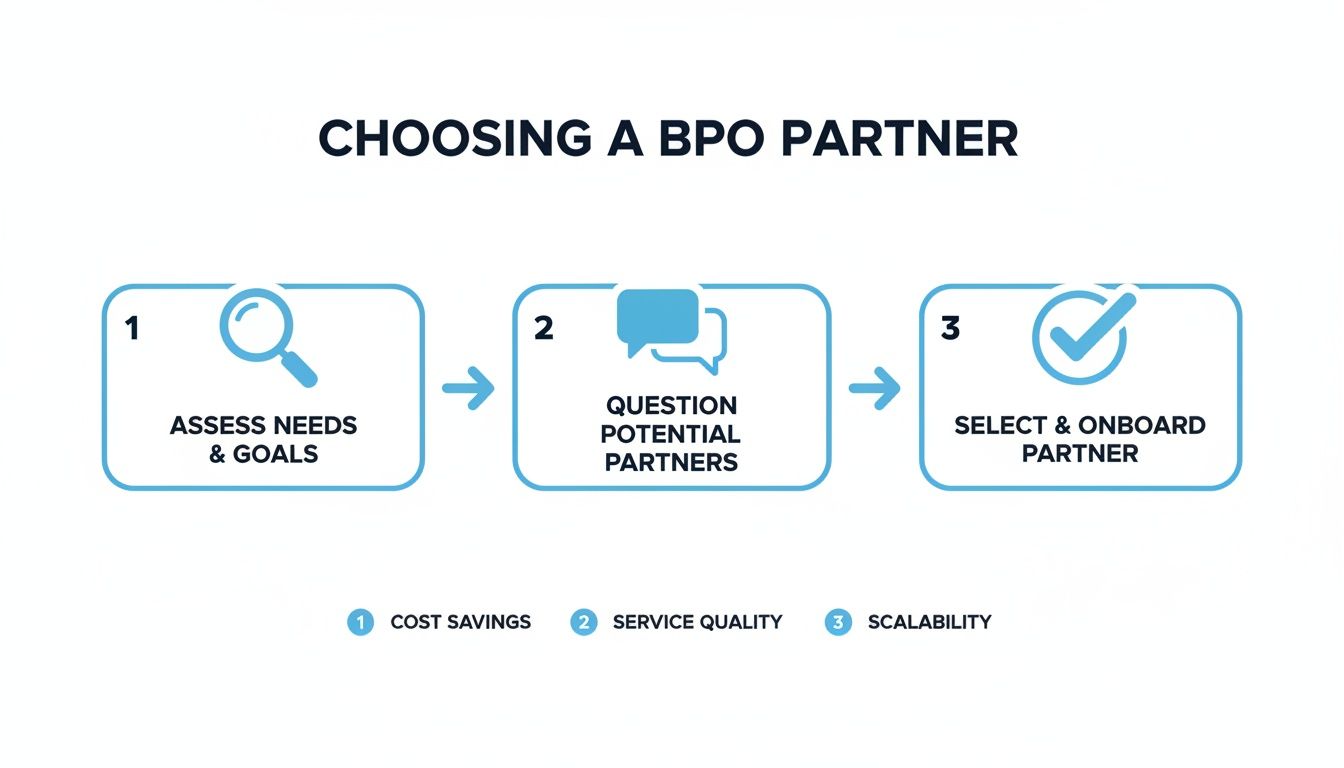
Picking the right BPO partner is one of the most important decisions you’ll make. This isn’t just about hiring a vendor to tick off a few tasks; it’s about inviting a team into your inner circle, making them an extension of your own company. Get it right, and you’ll sharpen your operations and accelerate growth. Get it wrong, and you’re in for a world of miscommunication, blown deadlines, and wasted money.
Finding that perfect fit requires a thoughtful, structured approach. You have to look beyond the slick sales presentations and really dig into how they operate, from their industry savvy to their security protocols. This isn’t just about meeting your needs today—it’s about finding a partner who can grow with you.
Look for Deep Industry Knowledge and Modern Tech
Not all BPO providers are built the same. A partner who already has deep roots in your industry—whether it’s healthcare, finance, or e-commerce—is worth their weight in gold. They’ll get the nuances, understand the regulations, and know what your customers expect. They speak your language from day one, which slashes the learning curve and cuts down on costly mistakes.
Beyond their experience, take a hard look at their technology. A modern BPO partner should be running on up-to-date software, using smart automation, and operating on secure cloud platforms. This is what allows them to work efficiently, deliver accurate data, and—most importantly—keep your sensitive information locked down.
When you’re vetting potential partners, don’t be shy. Ask the tough questions:
- Industry Chops: “Can you show me some case studies or connect me with a reference from a company like ours?”
- Tech Stack: “What specific tools do you use for [bookkeeping, customer support, etc.]?”
- Security: “What certifications do you have? How do you guarantee data privacy and stay compliant?”
Prioritize Communication and Cultural Harmony
A great outsourcing relationship lives and dies by communication. Even the most technically skilled provider will fail if your teams can’t collaborate smoothly. Look for a partner who is transparent and has clear, established channels for regular updates, feedback, and tackling problems as they arise.
Choosing a BPO partner is like hiring a key employee. Skills and price matter, but if the communication style and work ethic don’t align with your company’s culture, the relationship is unlikely to succeed.
Cultural alignment is just as crucial. A provider who shares your values and work ethic will feel like part of your in-house team almost immediately. This is one of the biggest advantages of choosing a USA-based outsourcing partner. You’re not just avoiding communication lags from mismatched time zones; you’re gaining a team that inherently understands the business etiquette and market dynamics your brand operates in. If you want that kind of seamless collaboration, give us a call at +1 (310) 800-1398 to see how a domestic partner can make all the difference.
BPO Vendor Selection Checklist
Here’s a practical checklist to guide you through evaluating potential BPO providers, ensuring you cover all the essential bases.
| Evaluation Criteria | Key Questions to Ask | Why It Matters |
|---|---|---|
| Industry & Domain Expertise | Do they have proven experience in our sector? Can they share relevant case studies or client references? | A partner who knows your industry speaks your language, understands your challenges, and requires less hand-holding. |
| Technical Capabilities | What technology and software platforms do they use? How do they leverage automation and AI? | Modern tools ensure efficiency, accuracy, and scalability. Outdated tech can create bottlenecks and security risks. |
| Security & Compliance | What are their data security protocols? Do they hold certifications like ISO 27001 or SOC 2? | Protecting your company and customer data is non-negotiable. Strong security is a must-have, not a nice-to-have. |
| Communication & Culture | What are their communication channels and frequency? Does their work ethic align with our company culture? | A cultural mismatch leads to friction and misunderstandings. Clear, proactive communication is the foundation of a successful partnership. |
| Scalability & Flexibility | Can they scale their services up or down as our business needs change? How do they handle shifts in scope? | Your business will evolve. You need a partner who can grow with you, not hold you back. |
| Pricing & Contract Terms | Is the pricing model transparent and aligned with our budget? Are the contract terms, SLAs, and exit clauses clear? | Hidden fees and rigid contracts can turn a good deal sour. You need clarity and fairness from the start. |
| Reputation & Reviews | What is their reputation in the market? What do current and former clients say about them on review sites? | A provider’s track record is a strong indicator of their reliability and service quality. |
By methodically working through these criteria, you move beyond the sales pitch and gain a true understanding of whether a provider is the right long-term strategic ally for your business.
Putting Your BPO Strategy Into Action
Deciding to outsource is one thing; making it work is another beast entirely. Signing a contract is just the starting line. The real challenge is weaving your new BPO partner into the operational fabric of your company without tearing a seam.
A successful partnership lives and dies by its implementation plan. It’s the roadmap that turns a smart decision on paper into a smooth reality. Without one, even the most promising BPO relationship can get messy, fast.
The journey starts by defining what a “win” actually looks like for you. You need to establish crystal-clear objectives and Key Performance Indicators (KPIs) that leave zero room for interpretation. Maybe you want to slash customer service response times by 30%. Or perhaps the goal is to get billing accuracy up to 99.5%. Whatever they are, these numbers become the common language you and your provider share.
Getting this right from day one ensures everyone is pulling in the same direction. It cuts down on miscommunication and lays the foundation for a transparent, results-focused partnership. From there, you can dig into the nuts and bolts of the transition.
Charting The Course For A Smooth Transition
Once your goals are set, it’s time for meticulous planning. Think of this stage as creating the ultimate instruction manual for your BPO partner. Every single workflow, tool, and oddball exception needs to be documented so the outsourced team can replicate your processes perfectly.
This phase usually breaks down into a few key actions:
- Detailed Process Documentation: Don’t just write it down; bring it to life. Create comprehensive guides for every task you’re handing over. Use flowcharts, step-by-step instructions, and even screen recordings to capture the little details that matter.
- Building a Transition Team: You need internal champions. Designate a few key people to be the direct points of contact for the BPO provider. This team acts as a bridge, answering questions, giving feedback, and making sure nothing gets lost in translation.
- Establishing Communication Channels: Set up dedicated tools right away, like a shared Slack channel or a project management board. Schedule regular check-ins—maybe daily at first, then weekly—to keep everyone aligned and squash problems before they grow.
Mitigating Risks And Formalizing The Partnership
As you start integrating your new partner, you have to tackle potential problems head-on. Data security is non-negotiable. Make sure your provider has ironclad security protocols, complies with all the relevant regulations (like GDPR or HIPAA), and signs a comprehensive non-disclosure agreement (NDA) to protect your company’s sensitive information.
Workflow disruption is another big worry. To keep things from grinding to a halt, don’t try to switch everything over at once. Consider a phased rollout. Start by transitioning one or two lower-risk processes first. This gives both teams a chance to iron out the kinks in a controlled way before you move on to the more critical stuff.
The Service Level Agreement (SLA) is the blueprint for your BPO relationship. It’s a non-negotiable document that codifies expectations, defines responsibilities, and provides a clear framework for measuring success.
Your SLA should spell everything out, from the scope of services and performance metrics to response times and how issues get resolved. It becomes the ultimate source of truth, holding both you and your partner accountable and ensuring the relationship stays productive for the long haul.
For businesses that need real-time collaboration and airtight data governance, partnering with a provider in the USA offers a huge advantage. Shared time zones kill communication lag, and you get the peace of mind that comes with adherence to US privacy laws. To learn how a domestic partner can simplify your implementation, call +1 (310) 800-1398 today.
BPO, IT, and The Future of Your Business

We’ve covered a lot of ground in this guide, moving past the old dictionary definition of business process outsourcing. The days of seeing BPO as just a line item to cut costs are long gone. Today, it’s a strategic investment in specialized talent, smarter operations, and focused growth.
When you delegate functions like bookkeeping, customer support, or data entry, you’re doing more than just offloading work. You’re buying back your team’s most precious resource: time. That freedom is what allows your people to get back to the core mission—developing your products, innovating, and building real relationships with your customers.
The Real Advantage: Blending BPO and IT
This is where things get interesting. The true competitive edge doesn’t come from BPO alone; it emerges when you pair it with sophisticated IT and AI.
Imagine your outsourced accounting team using AI-powered tools to spot financial trends before they become problems. Or picture your customer service agents, backed by smart systems that feed them instant answers, solving issues on the first call, every time.
This isn’t just about efficiency. It’s about creating a unified, intelligent engine for your business. It connects the dots between your back-office functions and the technology that drives them, ensuring your decisions are powered by data, not guesswork. To see this in action, check out our guide on outsourced IT services for small business—it shows how this synergy creates real-world results.
Strategic outsourcing isn’t just about who does the work anymore. It’s about building a smarter, more resilient operation that combines human expertise with intelligent technology to get things done better.
This modern partnership model is the foundation for sustainable growth. It lets you scale up or down, adapt to market shifts, and tap into specialized skills without the crushing weight of in-house overhead.
Why a USA-Based Partner Just Makes Sense
Choosing a partner here in the USA pulls this whole strategy together, delivering benefits you can’t get anywhere else.
Working in the same time zones means no more waiting overnight for an answer. Collaboration happens in real-time, just like your partner is in the office next door. Plus, the cultural alignment is seamless—they get your brand’s voice, your values, and your customers’ expectations without a translation guide.
Most importantly, a US-based provider operates under strict domestic data security and privacy laws. This gives you peace of mind, knowing your sensitive information is protected by some of the world’s tightest regulations. This blend of smooth communication, cultural fit, and rock-solid security makes a domestic partner a genuine strategic asset.
Ready to turn your operations from a cost center into a growth engine? The right BPO strategy, tailored to your unique goals, can make it happen.
Let’s talk about what that looks like for you. Call us today at +1 (310) 800-1398 to start the conversation.
Still Have Questions About BPO? Let’s Clear Them Up.
As you get more familiar with business process outsourcing, a few common questions are bound to pop up. Let’s tackle them head-on to clear up any lingering confusion and address some of the biggest concerns business owners have.
BPO vs. KPO: What’s The Real Difference?
This one comes up all the time. The simplest way to think about it is “process vs. knowledge.”
BPO (Business Process Outsourcing) is all about handing off transactional, rule-based tasks. Think of things like customer service calls or entering data from invoices. It’s a defined process that needs to be executed reliably, over and over again.
KPO (Knowledge Process Outsourcing), on the other hand, is for tasks that require deep expertise and analytical thinking. This is where you delegate work like market research, legal analysis, or complex financial modeling. With KPO, you’re not just outsourcing a task; you’re outsourcing specialized brainpower.
Is BPO Only For The Big Guys?
Not a chance. While it’s true that giant corporations use BPO to run their global empires, it’s an absolute game-changer for small and medium-sized businesses (SMEs). In many ways, it gives smaller companies their biggest competitive edge.
BPO is the great equalizer. It gives startups and growing businesses access to the same high-level skills and technology as their enterprise competitors, but without the crippling overhead. This is how you scale smart and punch way above your weight.
For a business on the rise, offloading functions like IT support or payroll frees up your best people—and your own limited time—to focus on what really matters: innovating your product and winning over customers.
How Can I Be Sure My Company’s Data Is Safe?
Data security isn’t just a feature; it’s the foundation of a trustworthy BPO partnership. Any provider worth their salt will have a multi-layered security strategy designed to protect your sensitive information like it’s their own.
When you’re vetting a potential partner, don’t be shy about digging into their security posture. You need to verify their credentials and protocols. Here’s what to look for:
- Industry Certifications: Do they hold certifications like ISO 27001 or SOC 2? These aren’t just fancy acronyms; they’re proof of a serious commitment to information security management.
- Airtight Security Protocols: This covers everything from end-to-end data encryption and secure networks to strict, role-based access controls for every single employee.
- Crystal-Clear Policies: Your Service Level Agreement (SLA) should spell everything out in black and white—data privacy rules, security measures, and a clear plan for what happens in the event of a breach.
Opting for a USA-based outsourcing partner adds a powerful, built-in layer of security. Domestic providers operate under stringent U.S. data privacy laws, giving you the peace of mind that your company and customer data are protected by some of the toughest standards in the world.
Ready to see how a secure, professional BPO partnership can help your business thrive? The team at NineArchs LLC is here to answer any other questions you may have. Give us a call at +1 (310) 800-1398 to talk about your specific needs.