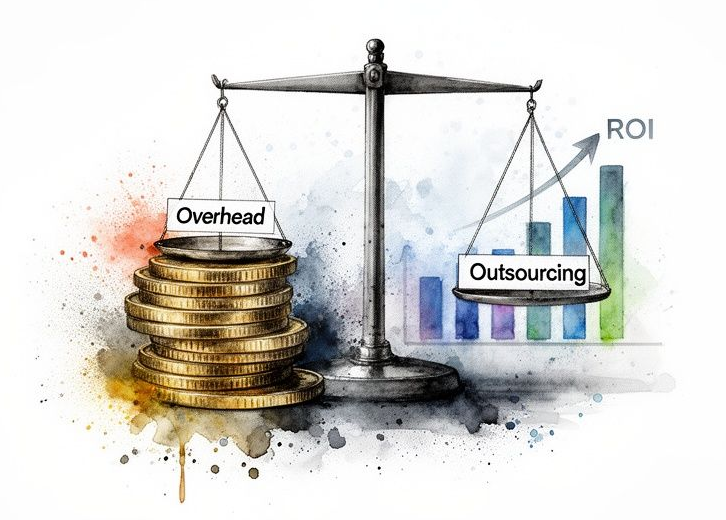
Outsourcing for a small or medium-sized business (SMB) is the practice of bringing in an outside company to run specific parts of your operation. This isn’t just about handing off tasks you don’t want to do. It’s a strategic move to tap into specialized talent and high-end technology without the crushing overhead of hiring a full-time in-house team. Done right, it makes your business leaner, smarter, and far more competitive.
What SMB Outsourcing Is and Why It Matters Now
Think of your favorite local restaurant. The chef and their team are obsessed with creating incredible food—that’s their core mission. They aren’t in the back office trying to manage a fleet of delivery drivers. Instead, they partner with a professional service that handles deliveries expertly.
That’s exactly how modern SMB outsourcing works. It lets you pour all your energy into what you do best, while a team of specialists manages other critical functions of your business.
This kind of strategic partnership used to be a luxury reserved for massive corporations, but that’s no longer the case. To really get it, it helps to first understand the basics of what is business process outsourcing and its guiding principles. For small and medium-sized businesses, it’s a game-changer, giving you access to elite skills in complex areas like IT, finance, and customer support without the heavy financial lift of recruiting, training, and retaining full-time staff.
The Modern Competitive Edge
Today’s business environment is unforgiving, and outsourcing gives you a vital edge. It’s no surprise that a growing number of businesses are catching on.
Recent trends show that more than one in three small businesses (37%, to be exact) already outsource at least one business process. Even more telling, 52% plan to do more of it in the near future. The most common hand-offs? Accounting and IT services, both leading the pack at 37%, followed closely by digital marketing (34%) and customer support (24%). The motivation is simple: nearly a quarter of these businesses (24%) say their main reason for outsourcing is to become more efficient.
By delegating essential but non-core functions, you convert fixed overhead costs into a flexible, powerful asset. This agility allows you to scale operations up or down based on demand, making your business more resilient and responsive.
The Advantage of a US-Based Partner
While the global talent pool is vast, there’s a strong case for partnering with a US-based firm. The benefits hit close to home, directly impacting your operations and giving you peace of mind.
A domestic partner means you’re working in the same time zones, which fosters real-time communication and much faster problem-solving. No more waiting overnight for an email response. More importantly, there’s a shared understanding of American business culture and regulatory standards—an invaluable asset for sensitive functions like finance and IT. This alignment simplifies compliance, reduces the risk of costly miscommunications, and builds a far more reliable partnership.
Ready to explore how a US-based team can help your business grow? Call us at +1 (310)800-1398 for a consultation.
Figuring Out What Your Business Should Outsource
Knowing what to hand off is probably the single most important decision you’ll make in your outsourcing journey. The secret is learning to separate the work that is your business from the work that just keeps your business running. Get this right, and you can focus your team’s precious energy where it creates the most value.
Think of it like this: your business has core competencies. These are the special things you do that give you a real advantage—your groundbreaking product design, your hyper-specialized consulting, your magnetic brand story. These are the crown jewels you should guard and grow internally.
Everything else is an operational necessity. These are the non-negotiable, must-do tasks like keeping your IT systems from crashing, processing payroll, or answering customer questions. They’re absolutely vital, but they don’t define what makes you unique. These tasks are prime candidates for outsourcing.
This decision tree gives you a great visual for thinking through the process, guiding you from a growth challenge all the way to a strategic choice.
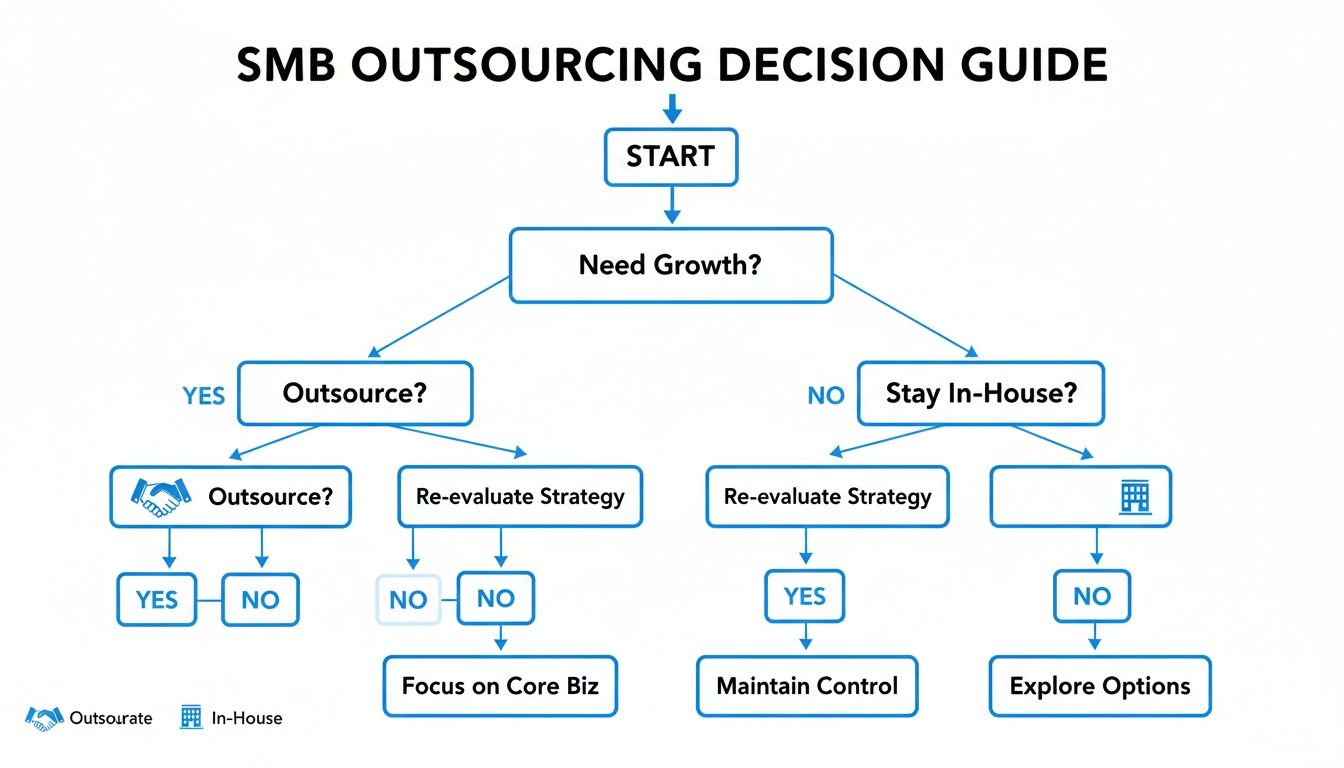
As the flowchart makes clear, when growth is the goal, outsourcing isn’t just a cost-cutting move; it’s a powerful strategic lever to pull.
Pinpointing Your Best Outsourcing Opportunities
Before you can decide what to delegate, you need a crystal-clear map of how your business actually runs. Drawing on strategies from ‘The E-Myth Revisited’, the goal is to systematize your operations so you can see which processes are pulling you away from your core mission. Once you have that clarity, the right choices become obvious.
The numbers don’t lie. A staggering 83% of small and medium businesses are already using outsourcing to their advantage, outpacing even their larger counterparts. When it comes to IT and accounting—the two most commonly outsourced functions—37% of small businesses hand both off to experts. Why? Because it gives them access to top-tier talent without the crushing overhead of full-time salaries.
Let’s dig into the areas where most SMBs see the biggest and fastest returns.
Common Functions to Outsource
Here are five areas where bringing in a specialist partner can be a game-changer.
1. IT Management and Cloud Administration
- The Pain Point: Trying to keep up with cybersecurity threats, endless software updates, and complex cloud infrastructure is a full-time nightmare. For an SMB, a single data breach or system meltdown can be a company-ending event.
- The Solution: An outsourced IT partner gives you 24/7 monitoring, expert security, and proactive maintenance, often for less than the salary of a single in-house tech person. They make sure your systems are secure, compliant, and running at peak performance so you can sleep at night.
2. Bookkeeping and Financial Services
- The Pain Point: Financial mistakes, missed tax deadlines, and compliance headaches don’t just drain your bank account; they create massive legal risks and suck up your time.
- The Solution: Handing this off to a professional service ensures everything is accurate, on time, and by the book. It frees your team from soul-crushing admin work and gives you clean financial reports to make smarter decisions. Want to go deeper? Check out our complete guide to outsourcing your bookkeeping.
3. Virtual Assistance
- The Pain Point: As a leader, you get dragged into a thousand tiny tasks—scheduling meetings, drowning in emails, organizing files. This administrative quicksand is the biggest killer of strategic thinking.
- The Solution: A virtual assistant (VA) takes on all those time-consuming jobs, acting as a force multiplier for your leadership. They handle the daily grind so you can finally focus on the big picture.
4. Customer Support
- The Pain Point: Great customer support is non-negotiable, but building and training a reliable team is a huge resource drain. One bad experience can tarnish your brand forever.
- The Solution: Outsourcing your support gives you a professionally trained team that can offer coverage across different time zones. Your customers get fast, expert help, which builds the kind of loyalty that grows a business.
By methodically evaluating each part of your business against your core mission, you can build a clear roadmap for what to keep in-house and where a strategic partner can pour fuel on your growth.
Choosing a US-based partner adds another layer of security and seamless collaboration. With shared time zones and a deep understanding of the American business landscape, they operate as a natural extension of your own team.
Ready to find out where outsourcing can make the biggest difference for you? Contact our US-based specialists today for a personalized assessment at +1 (310)800-1398.
The Financial Case for Outsourcing
For most small and medium-sized businesses, any talk about outsourcing kicks off with a single phrase: “cost savings.” And while that’s a huge piece of the puzzle, focusing only on a lower hourly rate is like admiring the tip of an iceberg. The real financial muscle is hidden just beneath the surface, where you strategically convert bulky, fixed overhead into a flexible asset that actually fuels your growth.
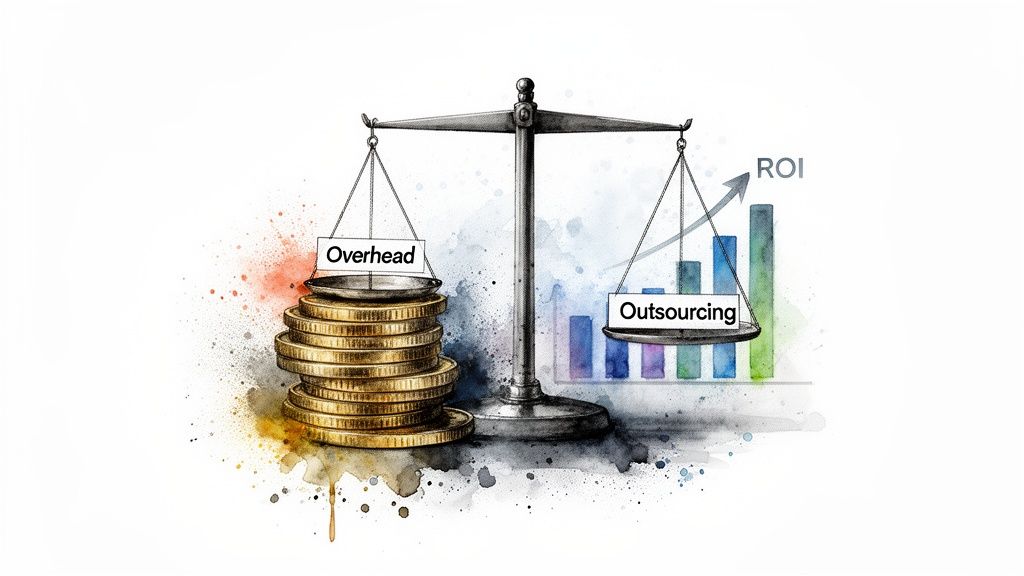
True ROI isn’t just about what you spend; it’s about what you gain. Outsourcing shifts your financial structure from rigid to agile. Suddenly, you can scale resources up or down precisely when you need them, without the heavy, long-term commitment of a new hire.
Demystifying Outsourcing Pricing Models
To really grasp the financial upside, you first have to understand how outsourcing partnerships are actually priced. There’s no one-size-fits-all approach. Instead, you get to choose a model that lines up perfectly with your project needs and your budget.
Here’s a look at the three most common pricing models you’ll run into:
- Fixed-Price: Perfect for projects with a crystal-clear scope and predictable deliverables, like building a specific software feature or getting through tax season. You agree on one price upfront, which gives you total budget certainty and keeps financial risk on a tight leash.
- Time & Materials: When a project’s scope is more fluid or you know it’s going to evolve, this model gives you the most room to breathe. You pay an agreed-upon hourly or daily rate for the work performed, giving you the freedom to pivot and adjust priorities as you learn more.
- Dedicated Team: Got a long-term, ongoing need like IT support or customer service? This model gives you a team of specialists who work exclusively for your business. It’s the best of both worlds: the focus of an in-house team with the cost-efficiency of outsourcing.
Choosing the right model is a strategic decision. The goal is to match the financial arrangement to the nature of the work, ensuring you only pay for what you truly need, when you need it.
When you’re weighing your options, the right pricing model can make or break the financial success of your outsourcing relationship. It’s all about aligning the cost structure with the nature of the work you need done.
Choosing the Right Outsourcing Pricing Model
| Pricing Model | Best For | Key Advantage |
|---|---|---|
| Fixed-Price | Projects with a clear, unchanging scope and defined deliverables (e.g., a website build, an accounting audit). | Budget Certainty. You know the total cost upfront, eliminating the risk of unexpected expenses. |
| Time & Materials | Evolving or long-term projects where requirements may change (e.g., ongoing software development, marketing campaigns). | Flexibility. You have the freedom to adjust priorities and project scope without renegotiating a contract. |
| Dedicated Team | Continuous, long-term operational needs requiring specialized skills (e.g., full-time customer support, IT helpdesk). | Integration & Focus. You get a team that functions like an extension of your own, deeply embedded in your business. |
Ultimately, the best model ensures your financial commitment is directly tied to the value you receive, preventing overspending while maximizing your return.
Uncovering the Hidden Savings
Let’s be honest—the most satisfying financial wins from outsourcing often come from the bills you no longer have to pay. An in-house employee’s salary is just the opening act. When you outsource, you wipe out an entire category of indirect and “hidden” expenses that quietly bleed your budget dry.
Just think about the real cost of a full-time hire versus an outsourced partner. The difference is staggering.
- Recruitment & Hiring: Gone. All those agency fees, job board costs, and countless hours spent interviewing are handled by your partner.
- Salary & Benefits: That complex web of base pay, health insurance, retirement plans, and payroll taxes? It gets replaced by a single, predictable fee.
- Training & Development: You get an expert from day one, which means you can stop investing in pricey courses, certifications, and conferences.
- Infrastructure & Tools: The costs for office space, new computers, software licenses, and dedicated IT support are also eliminated. Your partner brings their own resources to the table.
Every single one of these eliminated costs represents money and time you can pour directly back into what makes you money—developing your product, closing sales, and marketing your brand. By partnering with a US-based firm, you also sidestep costly miscommunications that can pop up due to major time zone and cultural gaps.
Calculating Your Potential Return on Investment
Figuring out your potential ROI starts with a simple side-by-side comparison. First, add up all the annual costs tied to an in-house role—salary, benefits, training, software, and even a slice of your office overhead.
Next, stack that number up against the projected annual cost of an outsourced partner. The difference is your immediate, direct savings. But the full picture of your ROI also has to include the value of reallocated time, a lighter management load, and the growth you can finally unlock by letting your core team focus on what they do best.
Outsourcing isn’t an expense; it’s a strategic investment in efficiency and scalability. When you are ready to explore the powerful financial case for your business, our US-based team is here to help you model the potential ROI. Call us today at +1 (310)800-1398 to start the conversation.
How to Select the Right Outsourcing Partner
Picking the right company for your SMB outsourcing is single-handedly the most important decision you’ll make in this entire process. I can’t stress this enough. This isn’t just about finding a vendor to do a job; you’re choosing a strategic partner who will become woven into the fabric of your daily operations.
The right partner feels like a natural extension of your team. The wrong one? They can create more fires than they put out.
The global IT outsourcing market—a huge space for small businesses—was valued at a staggering $471.1 billion in 2023 and is projected to hit $1,094.9 billion by 2033. But there’s a catch hiding in those numbers. A painful 40% of companies get hit with higher-than-expected costs from hidden fees, and 51% end up unhappy with the work they receive. These figures from recent IT outsourcing statistics aren’t just data points; they’re a warning. A careful, structured vetting process isn’t just a good idea—it’s essential.

Core Pillars of a Great Partnership
When you’re sizing up potential partners, everything boils down to three non-negotiables: technical chops, real-world industry experience, and a genuine cultural fit. A provider might have world-class skills, but if they don’t get your industry’s nuances or if their communication style clashes with your team’s, you’re heading for a relationship full of friction.
Think of it like hiring a key employee. You wouldn’t just glance at their resume and call it a day. You’d dig into their personality, their work ethic, and how they’d mesh with your company’s mission. Apply that same level of rigor here.
Key Questions to Ask Potential Partners
To slice through the slick sales pitches and get to what really matters, you have to ask the right questions. Bring this checklist with you to your initial calls to evaluate each candidate systematically.
- Technical and Industry Experience: “Can you show me case studies or give me references from clients in my industry? What specific problems did you solve for them?”
- Team and Communication: “Who’s my dedicated point of contact going to be? What’s your rhythm for meetings and updates to keep me in the loop?”
- Security and Compliance: “Walk me through your data security protocols. How do you handle compliance with regulations like GDPR or HIPAA?”
- Problem Resolution: “Describe your process for when things go wrong—like a project delay or an unexpected glitch. How do you ensure accountability?”
These questions force them to move beyond vague promises and show you concrete proof of their reliability and value.
A great outsourcing partner doesn’t just follow a to-do list—they challenge your assumptions, bring proactive ideas to the table, and genuinely invest in your success. Their goal should be to become an indispensable advisor, not just another line item on your P&L.
The Distinct Advantage of a US-Based Partner
While the global talent pool offers a world of options, sticking with a US-based firm brings some clear advantages that directly boost efficiency and lower your risk. This becomes especially critical when you’re outsourcing work that involves sensitive data or requires tight collaboration.
The benefits are immediate and practical:
- Seamless Collaboration: Working in the same or similar time zones means no more late-night calls or waiting 24 hours for an email response. Real-time problem-solving becomes the standard.
- Shared Business Culture: There’s a mutual understanding of American business etiquette, market dynamics, and communication styles that prevents costly misunderstandings.
- Robust Legal and Regulatory Alignment: A US partner operates under the same legal framework you do. This simplifies contracts and ensures everyone is on the same page with domestic data privacy laws.
This shared ground creates a foundation of trust that makes the partnership feel less like a transaction and more like a true extension of your own team.
Red Flags to Watch For
Just as important as knowing what to look for is knowing what to run from. Keep your eyes peeled for these warning signs during your search, as they often signal trouble ahead.
- Vague or Evasive Answers: If a provider gets cagey when you ask about their processes, security, or pricing, that’s a huge red flag. Transparency isn’t optional.
- One-Size-Fits-All Solutions: Your business is unique. Any partner pushing a cookie-cutter package without first digging deep into your specific needs is not invested in your outcome.
- High-Pressure Sales Tactics: A confident, capable partner knows their value. They won’t need to rush you into signing a contract; they’ll focus on earning your trust.
Finding the right outsourcing partner is a deliberate hunt for alignment. When you find a team that pairs technical skill with a genuine commitment to your goals, you’re not just hiring a service—you’re unlocking a powerful engine for growth.
To connect with a trusted US-based team and find your strategic advisor, call us at +1 (310)800-1398.
Ensuring a Successful Long-Term Partnership
Signing on the dotted line isn’t the finish line—it’s the starting block. A truly great outsourcing relationship is built on everything that comes after the contract. It’s a deliberate process of turning a service provider into a genuine partner, where the value you were promised is the value you actually get.
Those first few steps are everything. They set the tone for the entire partnership. A smooth transition isn’t just about handing over logins; it’s a secure and thorough transfer of knowledge. Your new partner needs to understand not just what to do, but why it matters to your business.
From there, it’s all about creating durable lines of communication. Simple things, like a dedicated Slack room for quick questions or non-negotiable weekly check-in calls, can stop small misunderstandings from turning into big problems.
Setting Clear Expectations with SLAs and KPIs
For any partnership to last, both sides need to agree on what “success” actually looks like. This is where Service Level Agreements (SLAs) and Key Performance Indicators (KPIs) become your best friends. They take the relationship out of the realm of feelings and into the world of objective, measurable results.
Think of an SLA as your rulebook. It’s the formal document that lays out the standards of service you expect—things like system uptime, response times for support tickets, and project deadlines. It’s the foundational promise your partner makes to your business.
KPIs, on the other hand, are your scorecards. They’re the specific metrics you track to see how they’re performing against your goals.
- For IT Support: A classic KPI is ‘Average Ticket Resolution Time,’ making sure your team isn’t left waiting when something breaks.
- For Bookkeeping: You might track ‘Financial Reporting Accuracy,’ with the goal of a zero-error rate each month.
- For Customer Service: A crucial one is often the ‘Customer Satisfaction Score (CSAT),’ which directly measures the quality of every interaction.
This isn’t about micromanagement. It’s about alignment. These numbers ensure everyone is pulling in the same direction, focused on the outcomes that actually move your business forward.
Governance Practices for a Healthy Partnership
Strong governance is the framework that keeps your outsourcing relationship on track. It’s what prevents common headaches like miscommunication or scope creep. It’s all about creating a predictable rhythm for communication and clear lines of accountability that build trust and encourage proactive problem-solving.
A well-governed partnership operates on a simple principle: no surprises. Regular, structured reviews and clearly defined points of contact ensure that everyone is aligned on priorities, progress, and potential roadblocks long before they become critical issues.
A few key practices make all the difference:
- Define Points of Contact: Assign a single, dedicated contact on both your side and theirs. This streamlines every conversation and makes decisions happen faster.
- Schedule Regular Reviews: Put monthly or quarterly business reviews on the calendar. Use this time to go over performance against KPIs, tackle challenges, and plan for what’s next.
- Manage Scope Creep: Nothing kills a budget faster than scope creep. Implement a formal change request process so any new tasks are properly evaluated, approved, and budgeted for, keeping everyone focused on the original goals.
When you partner with a US-based firm, this governance just works better. Shared business hours and cultural alignment mean these essential check-ins and strategic talks happen seamlessly, without the friction of navigating huge time-zone gaps. It leads to a more fluid, collaborative, and ultimately more successful partnership.
Ready to build a partnership that delivers lasting value? Call our US-based team at +1 (310) 800-1398 to discuss how we create successful, long-term engagements.
Your Next Steps to Strategic Growth
We’ve covered a lot of ground, and the big takeaway is this: SMB outsourcing isn’t just a line item for cutting costs. It’s a strategic lever you pull to build a smarter, tougher, more competitive business.
When you hand off key functions, you’re not just getting tasks off your plate. You’re bringing in specialized talent, sharpening your team’s focus, and making your entire company more agile.
The journey starts with an honest look in the mirror. Use the ideas we’ve talked about to audit what you’re currently doing. Your goal is to separate the mission-critical work—the stuff only you can do—from the necessary but distracting functions that an expert partner could handle far more efficiently. This first step is everything; it’s where you pinpoint the exact areas that will give you the biggest bang for your buck.
From Audit to Action
Think of this audit as a strategic choice to double down on what you do best, not as an admission of weakness. Every single hour your team gets back from chasing invoices or troubleshooting IT is another hour they can pour into innovation, building customer relationships, and actually growing the business. That shift is what turns a small company into a scalable one.
The right partner doesn’t just take over tasks; they amplify what your team is capable of, letting you punch above your weight without the crippling overhead of hiring everyone in-house.
And when that partner is US-based, you get an extra layer of confidence. There’s no wrestling with crazy time zones or cultural disconnects. The communication just flows, making the partnership feel like a genuine extension of your own team, not some faceless vendor halfway across the world. That alignment is what helps you hit your goals, faster.
Outsourcing is a deliberate choice to invest in expertise, efficiency, and focus. It’s the tool that lets you turn operational headaches into strategic advantages, freeing your business to finally reach its true potential.
When you’re ready to see how a dedicated partnership can unlock that next stage of growth, we’re here to map it out with you.
Give our US-based specialists a call for a consultation at +1 (310) 800-1398.
Got Questions About Outsourcing? We’ve Got Answers.
Even after seeing the benefits, jumping into outsourcing for the first time can feel like stepping into the unknown. It’s natural to have questions. Here are some straightforward answers to the most common ones we hear from business owners.
Is Outsourcing Just for Big Corporations?
Not at all. In fact, you could argue that small and medium-sized businesses stand to gain the most. Outsourcing gives you instant access to enterprise-level talent in critical areas like cybersecurity, IT, or finance without the six-figure price tag of a full-time hire.
It helps you build a more flexible, efficient, and scalable operation that can stand strong in a competitive marketplace.
How Do I Keep Control Over the Work I Outsource?
This is a big one, and it comes down to clear agreements and great communication. A good partner doesn’t just take tasks off your plate; they work with you to define what success looks like. This is done through detailed Service Level Agreements (SLAs) that set expectations and Key Performance Indicators (KPIs) that measure results.
Regular check-ins, transparent reports, and shared project tools keep you in the driver’s seat. You get to stay in full control of the outcomes without getting tangled up in the day-to-day grind of managing the tasks themselves.
The biggest myth about outsourcing is that it means giving up control. The reality? A great partnership actually enhances your control by giving you clear, data-driven insights into performance. You start managing by results, not by tasks.
What’s the Advantage of a US-Based Partner?
Choosing a partner in the US brings some practical, real-world advantages that make a huge difference in efficiency and risk.
- Real-Time Collaboration: When you’re on the same (or similar) time zone, you solve problems as they happen. No more waiting 12 hours for an email response on an urgent issue.
- Shared Business Culture: A domestic partner just gets the nuances of the American market and professional etiquette. This avoids the kind of misunderstandings that can cost you time and money.
- Simpler Compliance: Working with a provider who operates under the same legal and regulatory frameworks as you is a massive relief, especially when you’re dealing with sensitive financial or customer data.
This kind of alignment makes the relationship feel less like a transaction and more like a genuine extension of your team.
How Soon Can I Expect to See a Return on Investment?
While every situation is a bit different, many businesses see an immediate ROI. The most obvious wins come from slashing the costs tied to salary, benefits, office space, and the whole recruitment headache.
But the savings don’t stop there. Within the first few months, you’ll notice huge gains in efficiency. When your core team is freed up to focus on what they do best—driving sales, talking to customers, and developing products—the true value of outsourcing really starts to shine. Any partner worth their salt will help you map out this potential ROI before you even sign a contract.
Ready to unlock strategic growth and operational efficiency? The team at NineArchs LLC specializes in providing scalable IT and BPO support tailored for SMBs. We connect you with exceptional global talent to strengthen your business from the inside out. Explore our services and start building a more resilient company today at https://www.ninearchs.com or call us at +1 (310)800-1398.