
A business strategy is the master blueprint that charts the course for your company. It’s the high-level game plan that answers the big questions: how you’ll win in the market, build a loyal customer base, and create something that lasts. More than just a document, it’s the thinking that ensures every decision, big or small, pulls in the same direction toward your ultimate vision.
Defining Your Architectural Vision

Think of your business strategy as the architectural plans for a skyscraper. You wouldn’t just start digging a foundation and throwing up beams hoping for the best. That would lead to chaos, wasted resources, and a structure that’s bound to crumble. A well-defined strategy gives your organization that same foundational integrity.
This blueprint isn’t just about goals; it’s a living guide that forces you to answer the tough questions about your company’s purpose and direction. It clarifies where you are going and, more critically, how you actually plan to win in your specific corner of the market.
The Foundational Elements of Strategy
A truly effective business strategy is built from a few interlocking parts, each with a distinct job. When they work together, they transform abstract ambitions into a concrete roadmap that aligns your entire team.
Let’s break down these essential building blocks. Each piece provides clarity and focus, turning fuzzy goals into something everyone can understand and act on.
| The Core Components of Business Strategy | ||
|---|---|---|
| Component | Description | Primary Purpose |
| Mission Statement | A clear and concise declaration of your company’s core purpose—what you do, who you serve, and what makes you unique. | To provide a “North Star” that grounds daily operations and decision-making in a shared identity. |
| Vision Statement | An aspirational picture of the desired future state. It paints a vivid image of what success looks like down the road. | To inspire and motivate the entire organization by giving everyone a compelling future to work toward. |
| Core Values | The non-negotiable guiding principles that shape your company culture and inform every decision, from hiring to customer service. | To establish the behavioral and ethical guardrails that define “how we do things around here.” |
| Market Analysis | A thorough look at your industry, customers, and market positioning to find opportunities for differentiation. | To identify your unique competitive advantage and carve out a defensible position in the marketplace. |
These elements are the bedrock of any solid plan. To get a better handle on how to define them, it’s worth digging into the strategic planning process. It provides a structured way to think through each component so nothing important gets missed.
Why a Documented Strategy Matters
Getting your strategy down on paper transforms ambiguity into action. It’s simple: organizations that clearly define and communicate their strategy are far more likely to hit their targets. When every person on the team understands the big picture, they can make smart, independent decisions that still support the company’s main objectives.
This alignment is an incredible force multiplier. It stops departments from working in silos and makes sure that your most valuable resources—time, money, and talent—are all pointed at the initiatives that will make the biggest impact. For many growing companies, this clarity is the difference between spinning your wheels and achieving scalable success.
A great strategy is a story well told, with a clear beginning (where we are now), a compelling middle (how we will get there), and an inspiring end (where we want to be). It turns complexity into a clear path forward for everyone.
Partnering with a US-based outsourcing provider can be a key part of executing that story. You get seamless communication, cultural alignment, and a shared understanding of how business gets done, making them a true extension of your team. For a consultation on aligning your strategy with powerful IT and operational support, give us a call at +1 (310)800-1398 today.
Choosing the Right Strategic Framework
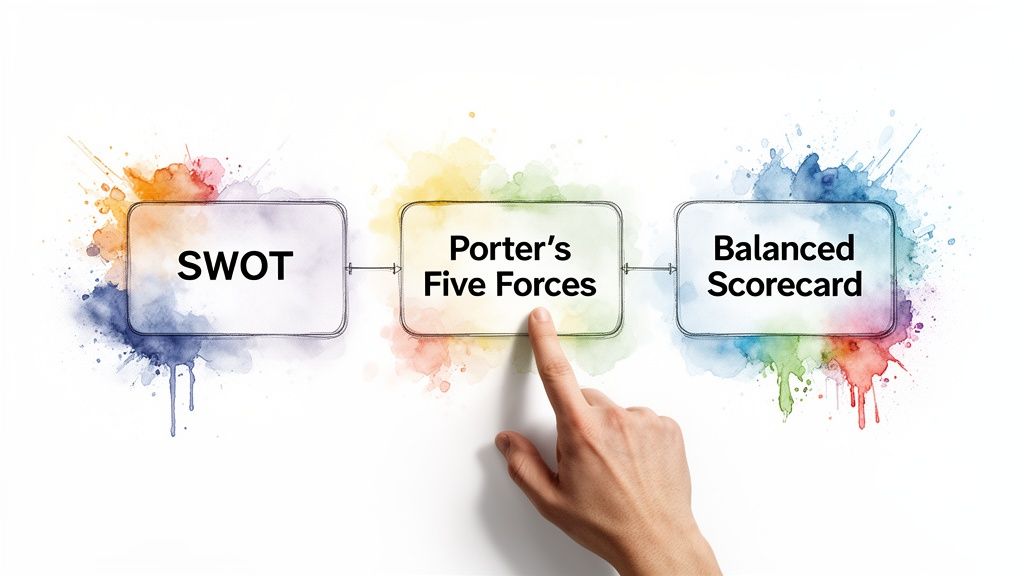
Once you’ve got a handle on what goes into a business strategy, the next question is how to actually build one. This is where strategic frameworks come in. Think of them not as rigid rules, but as proven models for thinking—structured ways to analyze your business, get a clear-eyed view of your market, and ultimately make smarter decisions.
Each framework is like a different lens in a camera kit. One might give you a wide-angle view of your entire landscape, while another zooms in on the market forces right in front of you. The key is picking the right lens for the job. You don’t need to use every tool in the box, but selecting the right one can turn abstract ideas into a real competitive edge.
The goal here is clarity. What do you need to understand right now? Your internal capabilities? The power dynamics in your industry? Or how to measure what truly matters for long-term success? Let’s break down three of the most essential frameworks.
Auditing from the Inside Out with SWOT Analysis
The SWOT analysis is almost always the best place to start. It’s a beautifully simple but incredibly powerful framework for taking stock of your business, both internally and externally. It forces an honest look at four critical areas.
- Strengths: What are your unique advantages? This could be anything from a patented technology or a rock-solid brand reputation to a highly skilled, motivated team. These are the assets you need to double down on.
- Weaknesses: Where are you falling short? Maybe it’s a clunky supply chain, a gap in your team’s expertise, or limited access to capital. Acknowledging your vulnerabilities is the first step toward fixing them.
- Opportunities: What external trends can you jump on? This could be a new market opening up, a shift in consumer behavior, or a new technology you can adopt before anyone else.
- Threats: What’s on the horizon that could hurt you? Think of shifting government regulations, economic downturns, or supply chain disruptions. Identifying threats early gives you time to build a defense.
By mapping out these four quadrants, you get a complete snapshot of where you stand today. That clarity is the foundation for every strategic decision that follows—helping you play to your strengths while protecting yourself from what could go wrong.
Understanding the Rules of the Game with Porter’s Five Forces
While SWOT gives you the big picture, Michael Porter’s Five Forces model drills down into the nitty-gritty of your industry’s landscape. It’s designed to help you understand where the power really lies in your market, so you can position your business to win. You can’t build a solid strategy without knowing exactly what you’re up against.
This framework examines five specific pressures that shape how profitable an industry can be:
- Industry Rivalry: How intense is the fight for customers among existing players? A crowded market full of similar offerings usually means price wars and squeezed profits for everyone.
- Threat of New Entrants: How easy is it for a new company to hang a shingle and join the market? High barriers to entry—like massive startup costs or fierce brand loyalty—act as a protective moat for existing businesses.
- Threat of Substitute Products or Services: Can customers solve their problem in a totally different way? The more viable substitutes there are, the less pricing power you have.
- Bargaining Power of Buyers: How much leverage do your customers have to demand lower prices? Their power is high when they buy in huge volumes or have many other options to choose from.
- Bargaining Power of Suppliers: How much control do your suppliers have over your costs? If you depend on just one or two key suppliers, they can dictate terms and eat into your margins.
By analyzing these forces, you uncover the unwritten rules of your industry. This allows you to position your company where the market pressures are weakest and build a defensible strategy that can withstand the inevitable storms.
Measuring What Matters with the Balanced Scorecard
A great strategy isn’t just about hitting a quarterly revenue target. The Balanced Scorecard (BSC) is a framework that pushes you beyond financials to measure the overall health and long-term potential of your organization. It forces you to look at the leading indicators of success, not just the lagging ones.
The BSC organizes your metrics across four distinct perspectives:
- The Financial Perspective: How do we look to our shareholders? This is where you track classic metrics like revenue growth, profitability, and return on investment.
- The Customer Perspective: How do our customers see us? Here, you’ll measure things like customer satisfaction, retention rates, and market share.
- The Internal Process Perspective: What must we be the best at? This focuses on operational excellence, quality control, and the efficiency of your core processes.
- The Learning & Growth Perspective: How can we keep improving? This covers employee skills, technology infrastructure, and your company’s ability to innovate.
By setting goals and KPIs in each area, you get a complete, balanced view of your company’s performance. This ensures your business strategy doesn’t just chase short-term financial wins at the expense of long-term value. An experienced outsourcing partner in the USA can be a game-changer here, bringing in expertise to optimize key internal processes or manage technology upgrades, which frees up your team to focus on customers and growth.
To learn how we can help, call us at +1 (310) 800-1398.
How to Build Your Business Strategy Step by Step

Crafting a killer business strategy isn’t some mystical art form reserved for corporate giants. It’s a structured process, and any determined leader can get it right. Think of it like assembling a high-performance engine piece by piece—each component must be carefully chosen and perfectly fitted to make the whole machine run with power and precision.
This step-by-step approach breaks down that complex assembly into manageable stages. We’ll start with inspiration and end with execution, turning broad ambitions into a concrete plan that guides decisions and drives real, measurable success.
Step 1: Solidify Your Core Identity
Before you can figure out where you’re going, you have to know who you are. The very first step is locking down your core identity: your mission, vision, and values. These aren’t just fluffy phrases for your “About Us” page; they are the anchors for your entire plan.
- Mission Statement: This is your purpose. What do you do? Who do you serve? What makes you different? Nail your “why” in a single, powerful sentence.
- Vision Statement: This paints a picture of the future you’re building. Where do you see the company in five or ten years? A strong vision inspires everyone to aim higher.
- Core Values: These are your non-negotiables, the principles that guide every action. They define your culture and set the standard for how your team operates, from customer calls to internal meetings.
Step 2: Analyze Your Position
With your identity defined, it’s time for a reality check. You need a clear-eyed view of your current position, which means an honest look at both your internal capabilities and the external market. The goal is to understand exactly where you stand today so you can chart the smartest path forward.
A SWOT analysis is the perfect tool here. It gives you a structured way to assess your Strengths, Weaknesses, Opportunities, and Threats, creating a complete snapshot of your strategic landscape. This objective look helps you identify which advantages to lean into and which vulnerabilities to protect.
An effective business strategy is built on a foundation of reality, not optimism. A candid analysis of your market position is the single most important input for making smart, defensible strategic choices that lead to long-term success.
Step 3: Set Clear and Actionable Goals
Now that you know where you are and where you want to go, you need to set goals that bridge that gap. Vague ambitions like “increase sales” just won’t cut it. Your goals need to be sharp, specific, and designed to drive action.
This is where the SMART goal framework becomes your best friend. Every objective you set should be:
- Specific: Clearly defined, with no room for confusion.
- Measurable: Quantifiable with clear metrics (KPIs).
- Achievable: Realistic and attainable with the resources you have.
- Relevant: Aligned with your overall mission and vision.
- Time-bound: Tied to a specific deadline to create urgency.
For example, instead of “improve customer satisfaction,” a SMART goal would be: “Increase our Net Promoter Score (NPS) from 45 to 55 within the next 12 months.” That kind of clarity makes progress easy to track and holds everyone accountable.
Step 4: Formulate Your Strategic Initiatives
With clear goals in place, the final step is to decide how you’re going to achieve them. This means formulating your core strategic initiatives—the major projects, programs, and big moves that will bring your business strategy to life. These are the actions that will set you apart in the market and create a lasting advantage.
Think of these initiatives as the main pillars holding up your strategy. They could be anything from entering a new market or launching a flagship product to overhauling your customer service model. Each initiative should directly support one or more of your SMART goals. For a deeper look at developing your own roadmap, check out these strategic planning process steps for a comprehensive overview.
This is also where an outsourcing partner can become a true strategic asset. Working with a US-based firm can fast-track your initiatives by giving you access to specialized skills in software development or back-office operations, all without the overhead of hiring in-house. It allows your team to focus on what they do best, while a partner handles critical support functions with seamless communication. To see how we can support your strategic initiatives, give us a call at +1 (310) 800-1398.
Integrating Your Strategy with Outsourcing and Technology

A business strategy crafted in a boardroom is just an idea. It only comes to life when you connect it to the tools and partners that make execution possible. In today’s world, the success of your plan is directly tied to how well you weave technology and smart sourcing into its very fabric.
These elements aren’t just operational details anymore; they’re the engines of innovation, efficiency, and real competitive advantage. Connecting your high-level goals to your IT infrastructure, cloud services, and AI is no longer optional. These technologies are the foundation for scalable growth, letting you automate tasks, gather smarter data, and serve customers in ways you couldn’t before.
Equally important is the role of strategic outsourcing. It’s moved far beyond a simple cost-cutting trick. Now, it’s a powerful lever for executing your core business strategy with greater speed and precision than you could alone.
Leveraging Technology as a Strategic Enabler
Technology shouldn’t be an afterthought bolted onto your strategy. It has to be woven into its core from day one. The right tech stack acts as a force multiplier, giving you the tools to execute your plans with an efficiency that was once unimaginable.
Think about how specific technologies directly support your strategic goals:
- Cloud Computing: This is the backbone of modern agility. It gives you the scalability and flexibility to grow or pivot without locking up huge amounts of capital in hardware.
- Data Analytics: Raw information is just noise. Analytics turns it into actionable insights, helping you decode customer behavior, spot market trends, and make decisions based on evidence, not just gut feelings.
- Artificial Intelligence (AI): AI is here to automate the repetitive work that bogs your team down. It can personalize customer experiences and uncover hidden opportunities, freeing up your people for high-value, creative work.
When your technology is perfectly in sync with your strategic goals, it becomes a powerful competitive weapon. This alignment is a critical piece of the puzzle in using digital transformation to elevate the customer experience.
Outsourcing as a Strategic Growth Lever
Just as technology enhances your capabilities, strategic outsourcing expands your capacity. By partnering with a specialized provider for knowledge work, IT, or business processes, you can sharpen your focus on what truly sets your business apart—your core competencies.
This isn’t about offloading random tasks to the lowest bidder. It’s a calculated decision to access elite talent and build operational resilience without the overhead of scaling an in-house team. The global outsourcing services market is projected to hit USD 1.09 trillion by 2025, a figure that shows a fundamental shift in business thinking. Companies now see outsourcing as a core enabler of strategy, not just a line item on the expense sheet.
A great business strategy identifies not only what your company should do but also what it should not do. Strategic outsourcing empowers you to delegate critical functions to experts, allowing your team to pour all its energy into winning where it matters most.
The Advantage of a US-Based Outsourcing Partner
Choosing the right partner is everything. For many businesses, a US-based outsourcing firm offers distinct strategic benefits that go far beyond just getting the work done. The goal is to create a seamless extension of your own team.
Partnering with a provider in the USA ensures:
- Cultural Alignment: A shared understanding of business etiquette, market dynamics, and customer expectations makes collaboration incredibly smooth and effective.
- Clear Communication: With no time zone headaches or language gaps, communication is instant and clear. This prevents the small misunderstandings that can derail projects.
- Reliable Integration: A domestic partner can integrate more deeply into your existing workflows and systems, acting as a true strategic ally rather than just a vendor.
This deep alignment makes the partnership more than a transaction; it becomes a key part of your strategic execution. When you need to scale operations, access specialized IT skills, or streamline back-office functions, a trusted US-based partner is invaluable.
For a consultation on aligning your business strategy with powerful IT and outsourcing solutions, call us today at +1 (310) 800-1398.
Bringing Your Strategy to Life: From Paper to Pavement
A brilliant business strategy collecting dust on a server is worse than useless—it’s a wasted opportunity. We’ve all seen it happen. The offsite meetings, the expensive consultants, the beautiful slide decks… all leading to a plan that never quite leaves the boardroom. An idea without execution is just a dream, and if there’s one place where most strategies fall apart, it’s in the messy, real-world work of making it happen.
This is where we shift gears from planning to doing. It’s about translating those big, ambitious goals into the everyday tasks your teams tackle. It’s about creating a culture where everyone, from the front lines to the C-suite, understands their part in the larger story. Success here means your strategy stops being a document and starts being a living, breathing guide that shapes decisions at every level.
Get Everyone on the Same Page
The first step? Talk about it. Constantly. You can’t expect your team to execute a plan they don’t understand, believe in, or feel connected to. This isn’t about sending a single memo. It’s about a sustained campaign to embed the vision into the company’s DNA.
- Tell a Compelling Story: People rally around stories, not spreadsheets. Frame your strategy as a narrative. Where have we been? Where are we going? And what will it feel like when we get there? Give them something to root for.
- Make It Personal: Every single person needs to see themselves in the plan. Show your software developers how their code directly impacts customer retention. Connect the dots for your sales team between their targets and the company’s market expansion goals.
- Repeat, Repeat, Repeat: The message needs to be everywhere. Talk about it in team huddles, reinforce it in one-on-ones, feature it in internal newsletters. The strategy should become so familiar that it’s part of your company’s shared language.
Build a Culture That Owns the Outcome
With the vision clear, it’s time to build a framework for accountability. This is what ensures goals aren’t just aspirational posters on a wall but are actively chased down and achieved. A culture of accountability is one where ownership is crystal clear, progress is transparent, and people feel empowered to deliver.
Accountability is the glue that binds commitment to results. It’s about fostering an environment where people willingly take responsibility for outcomes, not just for checking off a list of tasks. Without it, even the most inspiring strategy will eventually lose steam.
This isn’t about pointing fingers; it’s about creating clarity. Every major initiative needs a designated owner. Every goal needs a handful of Key Performance Indicators (KPIs) to measure what success actually looks like. When you remove ambiguity, you focus everyone’s energy on the metrics that truly move the needle.
Find Your Rhythm
Strategy execution isn’t a project with a start and end date; it’s a continuous cycle of acting, reviewing, and adjusting. You need a consistent rhythm to maintain momentum and stay agile enough to pivot when things change—and they always do.
A quarterly business review (QBR) is an incredibly powerful tool for this. It creates a structured, recurring forum for leadership and key teams to come together and ask the tough questions.
- Review Performance: How are we tracking against our KPIs? Where are we winning, and where are we falling short?
- Identify Roadblocks: What’s getting in the way? Let’s be honest about the challenges and obstacles holding us back.
- Adjust Tactics: Based on the data, what do we need to change for the next 90 days?
- Realign Resources: Are our people, time, and budget still pointed at the most important things?
This regular cadence keeps the strategy front and center. It builds the organizational muscle needed to respond to market shifts without getting knocked off course. It’s this kind of operational discipline that separates the companies that succeed from those with well-intentioned but ultimately unfulfilled plans.
When execution gets complex, partnering with a US-based outsourcing provider can streamline operations, freeing your team to focus on these core strategic goals. For a consultation on how to operationalize your business strategy, give us a call at +1 (310) 800-1398.
Common Strategic Planning Mistakes to Avoid
Even the sharpest business strategy can run aground if it hits one of the common, totally avoidable sandbars. Frankly, learning from the missteps of others is one of the smartest ways to keep your own plan from sinking. These mistakes usually aren’t about a lack of vision; they’re about failures in process and communication that turn a powerful roadmap into a document that just gathers dust.
One of the most frequent errors is creating a strategy in a vacuum. When leaders cook up a plan behind closed doors and then unveil it as a finished product, they almost guarantee a lack of buy-in from the very people they need to execute it. In fact, one study found that a staggering 86% of workplace failures boil down to bad communication or a simple lack of collaboration.
A business strategy is a team sport. If the players don’t understand the game plan or feel like they had a voice in creating it, you can’t expect them to execute it with passion and commitment on the field.
Setting Unclear or Unrealistic Goals
Another classic failure point is setting goals that are just plain mushy. An objective like “increase market share” sounds good, but it gives your team nothing to aim for. How much? By when? Without specific, measurable, and time-bound targets, people are left guessing what success looks like, and momentum dies on the vine. A good strategy replaces that ambiguity with crystal clarity.
Just as damaging is being too rigid. The market doesn’t care about your five-year plan; it’s going to shift, and a strategy that can’t adapt is doomed. Think of your plan as a living guide, not as commandments carved in stone. Regular reviews and the courage to pivot based on new data are non-negotiable for survival, let alone success.
Preventing Common Strategy Pitfalls
Sidestepping these mistakes demands a proactive and inclusive approach right from the jump.
- Foster Inclusive Planning: Pull key people from different departments into the planning process. Their diverse perspectives will not only make the plan stronger but also build a powerful sense of shared ownership. Everyone fights for a plan they helped build.
- Communicate Relentlessly: Once the strategy is set, talk about it. Then talk about it again. Make sure every single employee understands the main goals and, more importantly, sees exactly how their daily work helps achieve them.
- Delegate Execution Wisely: Let’s be honest—sometimes your internal team just doesn’t have the bandwidth or specific skills to nail every initiative. Partnering with a US-based outsourcing firm can bring in the expertise you need without the overhead of hiring. It also ensures seamless communication and cultural alignment, making them feel like a true extension of your team.
For a consultation on how an outsourcing partner can help you avoid execution pitfalls, call us at +1 (310) 800-1398.
Answering Your Lingering Questions About Business Strategy
Even with a solid plan, a few questions always pop up. It’s natural. Let’s tackle some of the most common ones that leaders ask when they’re in the thick of strategy development. Getting these cleared up will give you the confidence to move forward.
How Often Should We Revisit Our Strategy?
Think of your business strategy as a living guide, not some dusty document you file away. The best practice is to give it a full, deep-dive review once a year. This is your chance to step back and honestly assess if your mission, vision, and big-picture goals still make sense in the current market.
But that’s the annual check-up. The real work happens much more frequently. You should be tracking your progress against your Key Performance Indicators (KPIs) in quarterly business reviews, at a minimum. These regular check-ins are where you make agile, tactical adjustments to stay on course without having to rip up the whole map. And of course, if a major industry disruption hits, you need to be ready to adapt on the spot.
Your strategy is like a ship’s heading, not a train on a fixed track. You have to constantly adjust for winds and currents to reach your destination. The annual review sets the destination, while your quarterly check-ins are the small, crucial adjustments to the rudder.
What’s the Real Difference Between a Strategy and a Business Plan?
This is a critical distinction, and one that trips up a lot of people.
Your business strategy is your destination and the route you’ve chosen to get there. It answers the huge, foundational questions: ‘Where are we going to play?’ and ‘How are we going to win?’ It’s your high-level vision for carving out a real competitive advantage.
A business plan, on the other hand, is the detailed itinerary for that journey. It lays out all the specifics—the ‘how,’ the ‘who,’ and the ‘when.’ This is where you’ll find your financial projections, marketing tactics, operational timelines, and exactly how resources will be allocated.
Simply put: your strategy guides the plan, and the plan executes the strategy.
Is a Formal Strategy Really Necessary for a Small Business?
Absolutely. In fact, for a small business with tight resources, a formal strategy is even more critical. It acts as a powerful filter, making sure every dollar you spend, every hour you work, and every decision you make is laser-focused on what actually moves the needle for growth.
Without a clear strategy, it’s far too easy for the team to get pulled in a dozen different directions, chasing shiny objects that lead nowhere. A solid strategic framework forces you to make tough choices and keeps everyone aligned. For a small team, that kind of shared focus is a massive advantage that directly boosts efficiency and your odds of success.
For smaller teams, partnering with an outsourcing provider from the USA can be a game-changer. It gives you access to specialized IT and operational talent without the heavy overhead of full-time hires, ensuring your lean team can still execute like a much larger organization. This kind of partnership offers seamless communication and cultural alignment, making them feel like a true extension of your own crew.
At NineArchs LLC, we don’t just offer services; we align our technology and outsourcing solutions with your core business strategy, helping you execute with the precision and efficiency your vision deserves. To see how we can help you achieve your strategic goals, give us a call at +1 (310) 800-1398 or explore our services at https://www.ninearchs.com.