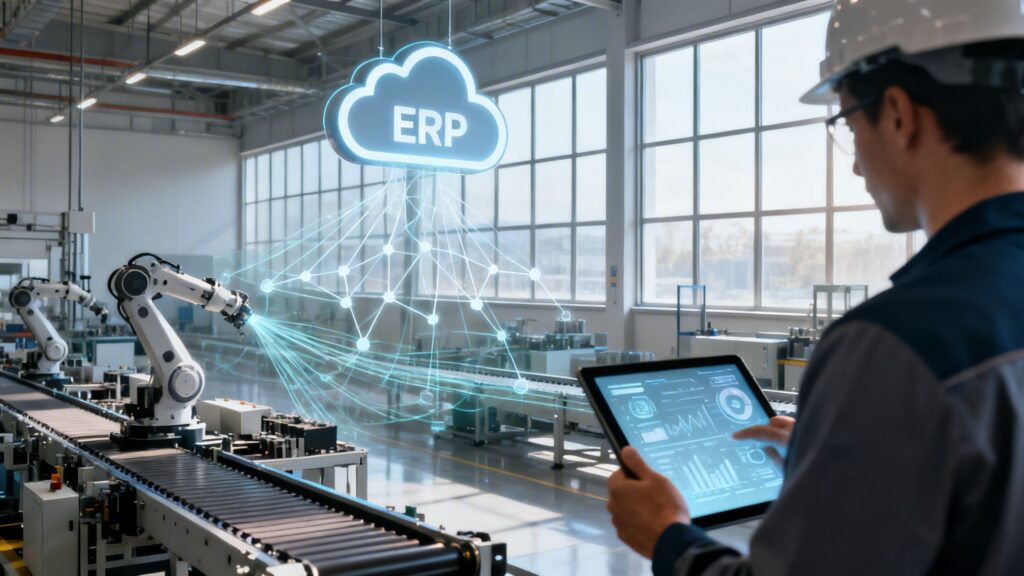
Imagine your manufacturing facility operating with a single, intelligent 'brain' connecting every department in real-time. That’s the power of a cloud based erp for manufacturing. It acts as the digital nervous system for your entire operation—a unified, accessible platform that is no longer a luxury but a foundational tool for modern competition.
Your Factory's New Digital Nervous System
A cloud based erp for manufacturing represents a strategic shift away from clunky, disconnected on-premise systems. Think of it less as a piece of software and more as a central command center. It links the shop floor with finance, inventory with sales, and your supply chain with quality control, all through a secure, accessible cloud platform.

This move empowers manufacturers of all sizes, from agile SMEs to large enterprises, to respond instantly to market changes, supply chain disruptions, and evolving customer demands. Instead of data being locked away in separate department spreadsheets, it flows freely, providing a single source of truth for decision-making.
The Shift From On-Premise To Cloud
For decades, traditional ERP systems were housed on physical servers within a company's walls. This model demanded massive upfront investments in hardware, a dedicated IT staff for endless maintenance, and complex, disruptive upgrades. The process was expensive, rigid, and painfully slow to adapt.
A cloud-based ERP completely upends this model. By hosting the system on remote servers managed by a provider, you eliminate the need for on-site hardware and the associated maintenance headaches.
This transition to the cloud is about more than just technology; it's about building operational resilience. It enables your business to be more agile, secure, and ready to scale without being held back by outdated infrastructure.
A clear understanding of the benefits of a cloud approach versus a traditional on-premise one is crucial. The cloud model isn't just a different delivery method—it fundamentally changes the cost structure, agility, and security posture of a manufacturing operation by shifting the burden of managing complex IT infrastructure to the experts. This allows you to focus on what you do best: making things.
Why This Matters For Modern Manufacturing
The competitive environment for manufacturers demands speed and precision. A cloud-based system provides the real-time data visibility needed to optimize every corner of your operation.
- Real-Time Decision-Making: Access live production data, inventory levels, and financial reports from anywhere, at any time.
- Enhanced Collaboration: Connect teams across different departments and even different locations, ensuring everyone is working with the same up-to-date information.
- Cost-Effective Scalability: Easily add new users, production lines, or facilities as your business grows without incurring massive capital expenditures.
The market has overwhelmingly recognized these advantages. As of today, cloud-based ERP software has captured a staggering 83.07% of the total market share in the manufacturing sector. This shift allows manufacturers to reduce costs by up to 23% through better visibility into production planning and operational excellence. This transition isn't just about software; it's about gaining a strategic asset. To truly understand how a cloud ERP becomes your factory's new digital nervous system, consider this Cloud ERP for Manufacturers A Practical Guide.
Ready to explore how a cloud based erp for manufacturing can fit your unique operational needs? Contact our specialists today at (310)800-1398 / (949) 861-1804 or email us at info@ninearchs.com.
Why Smart Manufacturers Are Migrating to the Cloud
The shift to a cloud based erp for manufacturing is far more than a trend; it's a strategic survival move. Manufacturers are cutting through the buzzwords and looking for real results, finally abandoning the clunky, on-premise systems that kill agility and drain budgets. The reasons behind this migration are compelling, ranging from dramatic financial relief to a new level of operational strength.
This move is fundamentally rewiring how factories operate. It's about building a business that can pivot on a dime—whether reacting to a supply chain nightmare or a sudden surge in customer orders. Sticking with siloed, on-premise servers is becoming an unacceptable risk in a market that punishes the slow.
The Overwhelming Financial Case
One of the most powerful arguments for moving to the cloud is the financial one. It's just that simple. Traditional ERPs demand a massive upfront investment in hardware and licenses, followed by a never-ending stream of cash for maintenance and dedicated IT staff. A cloud-based model completely flips that script, replacing unpredictable capital expenditures (CapEx) with a steady, predictable operating expense (OpEx) through a subscription fee.
This switch almost always results in a significantly lower Total Cost of Ownership (TCO). Instead of pouring money into servers that are outdated the moment you buy them, that capital can be put back into the business—funding innovation, developing new products, or hiring top talent. This financial freedom is a game-changer for manufacturers of every size.
The numbers from real-world factories tell a clear story. The manufacturing sector isn't just a player in cloud adoption; it's leading the charge.
A recent study shows that manufacturing now holds a staggering 53.71% share of the global cloud ERP market. Companies that make the switch are reporting a 66% improvement in operational efficiency, 78% gains in productivity, and a massive 91% optimization in inventory management. The average ROI clocks in at 52%, with payback periods often as short as 2.5 years.
These aren't just abstract statistics; they are proof of what's possible.
Tangible Improvements on the Factory Floor
Beyond the balance sheet, a cloud based erp for manufacturing delivers concrete, day-to-day improvements. The real-time, unified data it provides allows for smarter, faster decisions from the top floor to the shop floor.
Think about these real-world scenarios:
- Drastic Inventory Reduction: A mid-sized automotive parts supplier uses real-time data to sync its inventory perfectly with production schedules and supplier lead times. This newfound visibility lets them slash inventory carrying costs by 38% within the first year, freeing up both cash and warehouse space.
- Improved On-Time Deliveries: A custom furniture maker integrates sales orders directly into the shop floor schedule in real time. This eliminates manual data entry, cuts down production lag, and boosts on-time delivery rates, leading to happier, more loyal customers.
- Boosted Production Efficiency: With live data streaming from machines and production lines, managers can spot bottlenecks the moment they happen. This has helped manufacturers increase their overall production efficiency by an average of 18%, getting more out of the equipment they already own.
These examples show how a cloud ERP becomes a catalyst for operational excellence, not just another piece of software.
Building Resilience and Ensuring Continuity
In an age of constant disruption—from supply chain shocks to local emergencies—business continuity isn't a luxury; it's essential. On-premise servers represent a single, glaring point of failure. A fire, a flood, or a cyberattack can bring your entire operation to a halt for days or even weeks. It's a vulnerability that modern manufacturers simply can't afford.
A cloud-based system offers far superior data security and operational continuity. Reputable cloud providers invest in security measures—like 24/7 monitoring, geo-redundant backups, and disaster recovery protocols—that are well beyond the reach of most individual companies. This ensures your critical operational data is safe and accessible, even if your physical facility is down. You can discover more about the specific advantages in our guide on the benefits of cloud migration.
Ultimately, migrating to a cloud based erp for manufacturing is a proactive step toward building a more resilient, efficient, and profitable business. To get these benefits without the common implementation headaches, partnering with a US-based outsourcing expert is a smart move. An experienced partner brings the specialized knowledge needed for a smooth transition and makes sure your system is configured for maximum ROI right from the start.
To discuss how a cloud ERP and a skilled outsourcing partner can strengthen your operations, call (310)800-1398 / (949) 861-1804 or email us at info@ninearchs.com.
Unlocking Your Smart Factory Potential
A cloud based erp for manufacturing acts as the central hub of your operation, but its real magic is unlocked through connection. Think of your ERP as the brain. On its own, it’s brilliant, but to build a truly “smart factory,” you need to connect it to the nervous system—all the other critical software and hardware running on your plant floor. This is how you transform isolated data points into a cohesive, intelligent network that drives real efficiency and foresight.

First, let’s get a handle on the core modules inside the ERP. These are the foundational pillars that manage every phase of production. While vendors might use different names, these components form the backbone of any serious manufacturing process.
The Core Modules of Your Manufacturing ERP
A modern cloud ERP for manufacturing comes equipped with specialized modules designed to tackle the complexities of production. These pieces work together, giving you a complete, top-down view of your entire operation, from raw materials all the way to finished goods.
Key modules you'll always find include:
- Production Planning and Scheduling: This is where you answer the big questions: what to make, how much, and when. It’s a master-level puzzle solver, helping you balance your capacity, materials, and labor to hit demand right on time.
- Inventory Management: This module is your eye in the sky for raw materials, work-in-progress (WIP), and finished goods. It gives you real-time tracking to prevent stockouts, slash excess inventory, and cut down on those painful carrying costs.
- Quality Control: Here, you define what "good" looks like. It lets you set quality standards, track inspections, and manage any non-conformance issues, ensuring your products meet both customer expectations and regulatory rules.
These modules are the essentials, but the real power surge happens when you start connecting them to other systems on the factory floor and across your supply chain.
Integrating with MES for Real-Time Shop Floor Control
Connecting your cloud ERP to a Manufacturing Execution System (MES) is like giving your operational brain eyes and ears right on the shop floor. While the ERP handles the "why" and "what" of production (planning and resources), the MES is all about the "how," managing everything in real time.
An MES tracks and documents the entire production process from start to finish. When integrated, data flows instantly between the two. For example, as soon as a work order is marked complete in the MES on the factory floor, the inventory levels and financial records in the ERP are updated automatically. This kills manual data entry, eliminates errors, and gives managers a perfectly accurate, up-to-the-minute view of what’s happening.
Creating End-to-End Visibility with SCM Integration
Your factory doesn’t operate in a bubble. By integrating your cloud based erp for manufacturing with a Supply Chain Management (SCM) system, you extend your visibility far beyond your own four walls. This connection creates a seamless flow of data from your suppliers all the way to your end customers.
By linking your ERP and SCM, you gain end-to-end visibility. You can track incoming raw materials from a supplier's warehouse all the way to the final delivery of your product to a customer, creating a resilient and transparent supply chain.
This integration makes for much better demand forecasting, optimized logistics, and proactive supplier management. When a delay pops up with an incoming shipment, the SCM system alerts the ERP, which can then automatically adjust production schedules to minimize disruption. Governing this interconnected web of data is critical; you can learn more about managing these complexities by exploring effective strategies for governance in the cloud.
Enabling Predictive Maintenance with IoT Integration
Perhaps the most forward-thinking integration is with the Internet of Things (IoT). This is where you start predicting the future. By placing sensors on your critical machinery, you can stream real-time performance data—like temperature, vibration, and output—directly into your ERP.
Let me paint a picture for you: a CNC machine on a busy production line has an IoT sensor monitoring its motor's vibration. The data feeds into the ERP, where an analytics module spots a subtle anomaly—a pattern that predicts a bearing failure is likely within the next 72 hours. Instead of a surprise breakdown that could halt production for a day and cost you thousands, the ERP automatically:
- Creates a high-priority maintenance work order.
- Checks the maintenance team’s schedule and assigns a technician.
- Verifies that a replacement bearing is in stock through the inventory module.
- Slightly tweaks the production schedule to build in time for the planned downtime.
This is the essence of a smart factory. It’s about using integrated data to move from reactive firefighting to proactive, predictive management. Pulling off this level of integration is complex, which is why partnering with a US-based outsourcing partner can be so valuable. They bring the technical chops and deep manufacturing knowledge needed to connect these different systems, ensuring they work together flawlessly to unlock your factory's true potential.
Start building your smart factory today. Contact us at (310)800-1398 / (949) 861-1804 or email info@ninearchs.com for a consultation.
Your Roadmap for a Successful ERP Migration
Moving to a new ERP system is a massive undertaking. There's no sugarcoating it. But it doesn't have to be a painful one. With careful planning, what seems like a monumental task becomes a predictable project with clear milestones and measurable wins. A successful ERP migration always starts with a well-defined and effective project roadmap. Let’s walk through the critical phases of a smooth transition, breaking this complex challenge down into a manageable process.
The real work starts long before anyone installs a single piece of software. It begins by tying the project to your core business goals and making sure everyone—from the C-suite to the shop floor—gets the "why" behind the change. This first step lays the foundation for everything else.

Phase 1: Define and Prepare
First things first: get crystal clear on your strategic goals. What, exactly, are you trying to fix or improve? Are you drowning in inventory costs? Struggling with on-time delivery rates? Flying blind without real-time production data? These goals become your north star, guiding every decision you make from here on out.
Once you know your destination, you can start looking for the right vehicle. The vendor selection process kicks off, where you'll look for a provider whose cloud based erp for manufacturing truly fits your industry and how you operate. At the same time, you need to start preparing your team for what’s coming and—critically—begin the often-painful process of data cleansing. Bad data is a notorious project killer; migrating clean, accurate information is non-negotiable.
Phase 2: Implement and Test
This is where the plan gets technical. Your new system is configured to mirror your unique manufacturing processes, and the data migration begins. It’s crucial to see this not as a one-and-done event but as a cycle of building, testing, and refining.
Your team’s involvement here is everything. The people who will live in this system day in and day out are your best bet for finding gaps or friction points before they become major problems. A pilot program with a small, dedicated group of users can offer priceless feedback before you flip the switch for the entire company.
An ERP migration is as much about people as it is about technology. More than 60% of ERP implementations fail to meet their objectives due to poor change management. Securing buy-in and providing comprehensive training are the most critical investments you can make.
Don't ever underestimate the human element. Change management isn't an afterthought; it needs to be woven into every stage with transparent communication, hands-on training, and visible support from leadership.
Phase 3: Go Live and Optimize
The "go-live" date is a huge milestone, but it's the starting line, not the finish line. This is the moment your new cloud based erp for manufacturing becomes the official system of record. Be prepared for an adjustment period. It’s normal for your team to need some time to adapt to new workflows.
Once things stabilize, your focus shifts to continuous optimization. Start using the system's analytics to track the KPIs you defined back in Phase 1. Are you seeing that inventory reduction you hoped for? Has production efficiency ticked up? This data is your guide for refining processes and squeezing even more value out of your investment. For more on handling this shift, check out our resources on finding qualified cloud migration service providers.
Pulling off a complex migration like this often calls for specialized expertise. Partnering with a US-based outsourcing firm can give you access to seasoned ERP consultants and project managers who have been down this road many times. They bring industry best practices to the table, help you sidestep common pitfalls, and ultimately accelerate your time-to-value.
If you’re ready to build your roadmap for a successful ERP migration, our team is here to help. Contact us at (310)800-1398 / (949) 861-1804 or email info@ninearchs.com to start the conversation.
Gaining an Edge with a US-Based Outsourcing Partner
Successfully rolling out a cloud-based ERP for manufacturing takes a level of specialized expertise that most in-house IT teams simply don’t have on hand. This is where partnering with a US-based outsourcing firm isn't just helpful—it's a strategic move that de-risks your entire project and gives you an immediate competitive advantage.

Think of it like hiring a general contractor to build a new, custom factory. You wouldn't expect your current facilities manager to suddenly become an expert architect and structural engineer overnight. In the same way, an outsourcing partner gives you instant access to a vetted team of ERP consultants, developers, and project managers who have built these systems time and time again.
Accelerate Deployment and Ensure Best Practices
One of the biggest wins of working with an experienced partner is speed. They aren’t learning on your dime; they bring proven methodologies and battle-tested templates that can dramatically shorten your deployment timeline.
Instead of navigating the project through trial and error, you’re guided by a team that knows exactly where the common landmines are buried and how to sidestep them. This expertise also means that industry best practices are baked into your system from day one, helping you optimize processes you didn’t even realize were holding you back and preventing costly rework down the line.
The Value of a US-Based Partnership
Choosing a partner based in the USA offers distinct advantages that go far beyond pure technical skill. During a complex ERP project, clear and real-time communication is everything. Working with a domestic team eliminates the time-zone headaches and cultural misunderstandings that can so easily derail progress.
A US-based partner has a deep, intrinsic understanding of the domestic manufacturing landscape. They are fluent in the local regulatory and compliance standards that your business must adhere to, ensuring your ERP is configured correctly for everything from tax reporting to safety compliance.
This shared operational context is invaluable. The global cloud ERP market is exploding, projected to grow from $50.3 billion in 2024 to $128.3 billion by 2033. For manufacturers, this shift is already delivering incredible results, including 62% cost reductions in purchasing and 66% boosts in operational efficiency, with payback in as little as 2.5 years. To capture those gains, you need a partner who gets your specific market. Find out more about how digital transformation is accelerating the cloud ERP market.
A Cost-Effective Model for Top-Tier Talent
Partnering with an outsourcing firm like NineArchs provides a smart, cost-effective way to access elite talent without the long-term overhead of full-time hires. You get the flexibility to scale your expert team up or down based on your project's needs, from the initial heavy lifting of implementation to ongoing support and optimization.
This model allows you to tap into a level of expertise that might otherwise be completely out of reach.
Ready to gain a competitive edge with a trusted US-based partner? Contact NineArchs today. Call (310)800-1398 / (949) 861-1804 or email info@ninearchs.com to discuss how we can accelerate your ERP success.
Time to Take the First Step
This guide has walked you through the real-world power of a cloud-based ERP for manufacturing. You've seen how it delivers real-time visibility, slashes costs, and builds in security and scalability. But insight without action is just an idea. Now it's time to act.
The most important step in any major business improvement is always the first one. Whether you’re a growing SME finally ready for a real system, or a large enterprise planning a strategic overhaul, the path forward starts with a clear, honest look at your current operations.
You have to know where the pain is before you can fix it. Understanding your specific bottlenecks and long-term goals is the bedrock of a successful move to the cloud.
Your Readiness Checklist
Before you start dialing vendors, take a moment to see where your company stands. This quick checklist will help you gauge if you're ready for an ERP upgrade and pinpoint where a new system could make the biggest difference.
- Data Visibility: Are your teams still fighting with disconnected spreadsheets and reports that are outdated the second they’re printed?
- Inventory Control: Do you struggle with high carrying costs, frustrating stockouts, or warehouses full of obsolete inventory?
- Production Efficiency: Are you constantly putting out fires on the shop floor and reacting to bottlenecks instead of preventing them?
- Operational Agility: Can your current setup actually adapt when the market shifts or a supplier suddenly goes dark?
- Growth Potential: Is your technology holding you back from launching new products or breaking into new markets?
If you answered "yes" to any of these, it’s a clear sign. Your operations are ready for what a modern cloud ERP can do.
You Don't Have to Go It Alone
Trying to navigate this journey by yourself can be overwhelming. Partnering with a US-based expert like NineArchs LLC gives you the specialized knowledge and hands-on support to make your implementation a success. We're here to help you steer through the complexities, sidestep the common pitfalls, and build a system that delivers real results from day one.
The most critical step is the one you take now. Start your journey toward a smarter, more resilient factory by getting a clear picture of what you truly need.
Begin your transformation today. Contact NineArchs for a personalized assessment of your manufacturing operations and see how a cloud-based ERP for manufacturing can launch your business into its next chapter.
Call (310)800-1398 / (949) 861-1804 or email info@ninearchs.com to schedule your consultation.
Frequently Asked Questions
When you're thinking about moving your manufacturing operations to a cloud ERP, a lot of questions come up. It's a big step, and you need clear, direct answers to feel confident moving forward. Let’s tackle some of the most common concerns head-on.
How Secure Is My Manufacturing Data in a Cloud ERP?
This is often the first and most pressing question. The reality is, your data is frequently safer in a professionally managed cloud environment than on your own servers. Reputable cloud ERP providers invest in multi-layered security measures that are simply out of reach for most individual companies.
Think of it like this: they have physical security at data centers, end-to-end data encryption, and teams dedicated to continuous threat monitoring. They also have to maintain strict compliance with standards like SOC 2 and ISO 27001. When you weigh that against the risks of on-site hardware failure or a ransomware attack, the cloud often comes out far ahead. The key is partnering with an expert, like a US-based outsourcing firm, who can ensure your system is configured correctly for your specific security needs from day one.
Can a Cloud ERP Handle Our Unique Manufacturing Processes?
Absolutely. This isn't your grandfather's rigid, one-size-fits-all ERP. Modern cloud ERPs are built for flexibility. Whether you're in discrete, process, or mixed-mode manufacturing, these systems use a modular architecture and powerful configuration tools that adapt to your specific workflows.
The success of an implementation hinges on aligning the software with your business, not the other way around. The key is working with an implementation partner who deeply understands manufacturing and can map your unique processes to the ERP's capabilities.
This ensures the software supports how you actually work, rather than forcing your operations into a pre-defined box.
What Is the Typical Cost for a Small or Medium-Sized Manufacturer?
One of the biggest game-changers with a cloud based erp for manufacturing is how it has opened up this technology for SMEs. Instead of a massive upfront capital investment, you move to a predictable subscription model (SaaS), typically billed per user, per month. This shifts the expense from a major capital outlay to a manageable operational cost.
While you'll have a one-time cost for implementation and migrating your data, the total cost of ownership is almost always significantly lower. You get to eliminate ongoing expenses for server hardware, dedicated IT maintenance staff, and forced system upgrades. With studies showing payback periods averaging just 2.5 years—thanks to huge efficiency gains and reduced inventory—the return on investment is both fast and substantial.
How Long Does an ERP Implementation Take?
The timeline really depends on your company's size, the complexity of your operations, and how much data needs to be moved over. For a small to mid-sized manufacturer, a well-managed implementation can take anywhere from 3 to 9 months.
A large enterprise with multiple sites and more complex integrations might be looking at a 12 to 18-month project. You can dramatically shorten this timeline by bringing in a skilled outsourcing partner from the USA. An experienced firm brings proven methodologies to the table, helping you sidestep common pitfalls and ensuring your transition is as fast, smooth, and predictable as possible.
To get clear answers tailored to your specific manufacturing needs, contact NineArchs LLC for a personalized consultation.
Call us at (310)800-1398 / (949) 861-1804 or email us at info@ninearchs.com.