
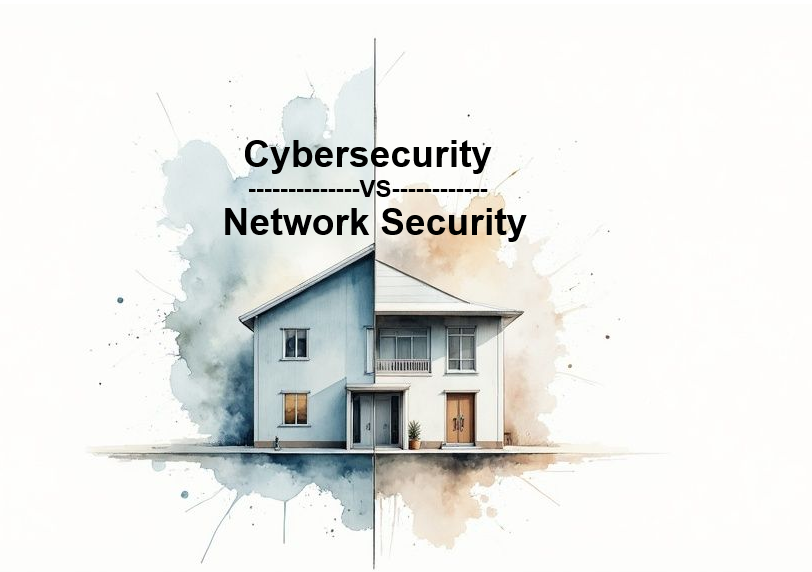
The difference really boils down to this: Cybersecurity is the art of protecting all your digital stuff from being stolen or messed with. Network security, on the other hand, is a specialized slice of that pie, zeroed in on protecting the integrity of your company’s computer networks.
Think of it like securing your entire property versus just locking the doors and windows. Both are critical, but one is a much bigger picture.
Understanding The Core Differences
People throw around “cybersecurity” and “network security” like they’re the same thing, but they’re two distinct disciplines with very different game plans. Getting this distinction right is the first step toward building a defense that actually works. One protects your entire digital world; the other defends the roads and bridges that connect it.

A Matter of Scope
Cybersecurity is the parent discipline, the big umbrella that covers everything involved in protecting systems, networks, and software from digital attacks. Its domain is huge, stretching from application security and data protection to employee awareness training and incident response. It’s the holistic strategy for managing digital risk across the entire organization.
Network security has a much tighter focus. Its mission is to stop unauthorized people from getting into or messing with your network infrastructure. This means securing the hardware and software—the routers, switches, firewalls—that form the communication backbone of your organization.
The market size really tells the story here. In 2023, the global cybersecurity market was valued at around USD 181 billion, while the network security market sat at about USD 24.55 billion. That gap makes it clear: network security is a vital piece, but it’s just one piece of a much larger security puzzle. You can dig into more market findings about network security trends to see where things are headed.
A strong network security posture is a non-negotiable component of any successful cybersecurity program. However, relying on it alone leaves critical assets like endpoints, cloud applications, and sensitive data exposed.
To make this crystal clear, here’s a quick table breaking down the fundamental differences.
Cybersecurity vs Network Security At A Glance
This table sums up the core distinctions at a high level.
| Aspect | Cybersecurity | Network Security |
|---|---|---|
| Primary Focus | Protecting all digital assets, including data, systems, and people | Protecting the usability and integrity of the network and its data |
| Scope | Broad and all-encompassing | Focused on network infrastructure and traffic |
| Key Objectives | Upholding confidentiality, integrity, and availability of information | Preventing unauthorized network access and malicious activity |
For any business trying to build a security strategy that holds water, these nuances are everything. Partnering with a US-based outsourcing partner provides the benefit of streamlined communication and deep expertise in domestic compliance standards, ensuring your security architecture is both robust and aligned with local regulations. Give us a call at +1 (310) 800-1398 for a consultation.
Comparing Scope And Strategic Objectives
To really get the difference in the cybersecurity vs network security debate, you have to look past the textbook definitions and dig into their strategic goals. While they both exist to protect a company, they operate on different battlefields and defend against different threats. Their scope and endgames show why one is a piece of the other, not a replacement for it.

Cybersecurity’s scope is massive. It covers every single digital asset your organization owns, manages, or even just interacts with. Its main objective is to protect the Confidentiality, Integrity, and Availability (CIA) of information, no matter where that data lives or how someone tries to access it. This is a huge undertaking that touches every corner of the business.
Cybersecurity: A Holistic Defense
Cybersecurity pros are concerned with a lot more than just technical controls. They’re responsible for protecting the entire digital ecosystem, which includes:
- Data Protection: Guarding sensitive information from snoops, whether it’s sitting on a server, in a cloud app, or on an employee’s laptop.
- Application Security: Making sure the software you build or buy is free from holes that attackers could exploit.
- Endpoint Security: Protecting individual devices like laptops, servers, and smartphones from malware and other direct attacks.
- The Human Factor: Training employees to spot phishing scams and follow security rules, because over 90% of successful data breaches start with a person making a mistake.
- Regulatory Compliance: Ensuring the organization follows industry and government rules like HIPAA, GDPR, or CCPA.
Cybersecurity is a strategic function focused on managing digital risk across the entire organization. It assumes threats can come from anywhere—inside or out—and aims to build resilience at every level, from the data center to the individual employee.
Network Security: A Focused Perimeter
Network security, on the other hand, has a much more defined and tactical mission. Its scope is locked onto the infrastructure that connects your digital assets—the routers, switches, firewalls, and the data packets zipping between them. The primary goal here is to stop unauthorized access to the network and block threats right at the digital border.
Think of a network security specialist as the guard at the gate. Their job is to inspect everyone and everything trying to get in or out. Their responsibilities are critical but very specific.
Key Objectives of Network Security
- Access Control: Setting up the rules that dictate who can get on the network and what they’re allowed to touch once they’re inside.
- Threat Prevention: Using tools like firewalls and Intrusion Prevention Systems (IPS) to block malicious traffic, like data from known bad IP addresses or attempts to exploit network weaknesses.
- Traffic Monitoring: Watching network traffic patterns to spot weird behavior that could signal an attack, like a Distributed Denial of Service (DDoS) attempt.
- Securing Connections: Making sure data sent across the network, especially over public Wi-Fi or the internet, is encrypted and safe using tech like Virtual Private Networks (VPNs).
This focused approach is absolutely essential for creating a strong first line of defense. But its limits become obvious when threats come from inside the walls or find a way to sneak past the network defenses entirely.
A Real-World Scenario: Phishing Bypasses The Perimeter
Imagine your organization has top-of-the-line network security. You’ve got a next-gen firewall, an advanced intrusion detection system, and a secure VPN for remote staff. Your network perimeter is a fortress.
One morning, an employee gets a slick phishing email that looks like it’s from a trusted vendor. The email has a link to a malicious website. Because the email itself doesn’t contain a virus, it sails right past your network security filters. The employee, thinking it’s legitimate, clicks the link and types their login credentials into a fake portal.
In this all-too-common scenario, your robust network security was completely bypassed. The failure wasn’t in the network’s defenses but in a different domain—the human element, which falls squarely under the broad umbrella of cybersecurity. A solid cybersecurity program would have included employee awareness training to spot phishing attempts and endpoint protection on the employee’s computer that might have blocked the malicious site. This example perfectly illustrates the cybersecurity vs network security dynamic: you need both the strong gates (network security) and the informed citizens within (cybersecurity) to be truly secure.
Managing these intertwined yet distinct security layers can be complex. For organizations looking for a unified strategy, partnering with a US-based outsourcing partner ensures clear communication and expert management of both disciplines. A domestic team understands the specific threats and compliance needs of American businesses, providing a significant advantage. For a professional assessment of your security posture, call our team today at +1 (310) 800-1398.
Exploring Essential Tools And Technologies
The easiest way to grasp the difference between cybersecurity and network security is to look at the tools each discipline uses. Think of network security as your frontline defense—a set of specialized tools built to control traffic and block external threats right at the perimeter. Cybersecurity, on the other hand, deploys a much broader arsenal to get visibility and control over the entire digital environment, protecting things network tools can’t even see.

It’s a critical distinction. Network security tools are the gatekeepers. Cybersecurity tools are the comprehensive surveillance and response system for the whole property. You can’t have one without the other, or you’ll leave massive gaps in your defenses.
The Network Security Toolkit
Network security pros focus on tech that inspects, filters, and secures data in transit. Their main job is to build a strong, defensible perimeter around the company’s network infrastructure.
Here’s what’s in their toolkit:
- Next-Generation Firewalls (NGFWs): These aren’t your basic firewalls. NGFWs inspect data packets on a much deeper level, actually understanding the applications creating the traffic. This lets them block malicious activity from specific apps, even when it’s trying to hide as legitimate traffic.
- Intrusion Detection and Prevention Systems (IDS/IPS): An IDS is like a burglar alarm; it detects suspicious activity and alerts your team. An IPS takes it a step further by actively blocking the threat it identifies, neutralizing it before it can do any damage.
- Virtual Private Networks (VPNs): VPNs create a secure, encrypted tunnel for data traveling over public networks like the internet. This is essential for protecting remote employees and securely connecting multiple office locations without exposing sensitive information.
These tools are all about controlling access and flow, making sure only authorized users and safe data can get through the network.
The Broader Cybersecurity Arsenal
While network tools guard the perimeter, cybersecurity technologies provide the deep visibility and response capabilities needed to handle threats that inevitably get through—or that start from within. This is a much wider field of play, covering devices, identities, and the data itself.
Cybersecurity tools are designed with the assumption that a breach is not a matter of if, but when. Their purpose is to detect, investigate, and neutralize threats quickly, no matter where they appear in the digital ecosystem.
The toolkit for a cybersecurity professional is far more extensive, because its scope is so much bigger.
- Endpoint Detection and Response (EDR): EDR solutions are installed on individual devices like laptops and servers. They constantly monitor for signs of compromise—like unusual processes or file changes—and give security teams the tools to isolate infected devices and investigate the attack.
- Security Information and Event Management (SIEM): A SIEM system is the central nervous system of a security operations center. It pulls in log data from everywhere—firewalls, servers, applications—and uses analytics to connect the dots, identifying potential security incidents that would otherwise go completely unnoticed.
- Identity and Access Management (IAM): IAM solutions are all about making sure only the right people have access to the right resources. These systems manage user identities and enforce access policies, often using multi-factor authentication (MFA) to shut down unauthorized logins. For stronger authentication, many are exploring modern biometric-first approaches to tighten their security posture.
Managing all these complex tools requires serious expertise, which is a real challenge for most organizations. A US-based managed security partner brings the specialized knowledge needed to deploy, configure, and monitor these advanced technologies effectively. They provide the 24/7 oversight necessary to respond to threats in real time, without the massive overhead of building an in-house security operations center. This allows you to get enterprise-grade security tools and expertise while your team focuses on its core business.
For expert guidance on implementing a unified security toolkit, call +1 (310) 800-1398 to speak with our US-based team.
The People Behind the Clicks: Roles and Responsibilities
One of the best ways to get a real feel for the difference between cybersecurity and network security is to look at the people who do the work. The job titles, the day-to-day grind, and the skills they need—it all paints a clear picture of what separates securing the network perimeter from protecting an entire organization’s digital life. For any business leader, knowing these roles is the first step toward building a security team that actually works.
At its core, a network security professional is an infrastructure specialist, deeply hands-on with the hardware and software that keeps data moving. A cybersecurity pro, on the other hand, often works at a higher, more strategic level, managing risk across everything digital, not just the network itself.
The Network Security Professional Role
Think of a Network Security Engineer as the architect and gatekeeper of your digital borders. These are highly technical experts focused on the tactical side of things—implementing and maintaining the defenses that guard your network. Their main job is to keep the network up, running smoothly, and locked down tight against anyone who shouldn’t be there.
Their world revolves around tasks like:
- Configuring and Managing Firewalls: This is their bread and butter. They’re constantly setting up and tweaking firewall rules to control every bit of traffic flowing in and out.
- Monitoring Network Traffic: They use specialized tools to watch data packets, hunting for strange patterns or anomalies that could signal a DDoS attack or an intruder trying to find a way in.
- Managing Access Control: They’re the ones who implement and enforce the policies deciding who gets to access what on the network.
- Maintaining VPNs: They ensure that when your team works remotely, their connection to company resources is both secure and reliable.
These pros live and breathe network protocols, routing, and switching. You measure their success by network uptime and how many perimeter breaches they stop before they start.
The Cybersecurity Professional Role
Cybersecurity professionals, like a Security Analyst or a Chief Information Security Officer (CISO), have a much wider lens. They absolutely understand network principles, but their focus extends far beyond that to include data, applications, employee laptops, and even human behavior. They are the strategic thinkers tasked with building a tough, resilient security posture for the whole organization.
A network security expert makes sure the gates are locked. A cybersecurity strategist makes sure the entire kingdom is resilient against every threat imaginable, from a disgruntled employee to a sophisticated phishing campaign.
A cybersecurity pro’s to-do list is more varied and often driven by policy and risk:
- Developing Security Policies: They write the rulebook that governs how the entire organization protects its information.
- Conducting Risk Assessments: They proactively hunt for weaknesses across every department and system, not just the network infrastructure.
- Orchestrating Incident Response: When a breach happens, they’re in the command center, coordinating the effort to contain the threat and get things back to normal.
- Performing Penetration Testing: They essentially try to hack the company—legally, of course—to find vulnerabilities before the real bad guys do.
To see how these roles stack up in terms of skills and responsibilities, let’s break it down side-by-side.
Comparing Professional Roles And Skills
The table below offers a comparative look at the common job roles, primary responsibilities, and essential skills required in the fields of cybersecurity and network security.
| Attribute | Cybersecurity Professional | Network Security Professional |
|---|---|---|
| Common Job Titles | Security Analyst, CISO, Security Architect, Penetration Tester | Network Security Engineer, Firewall Administrator, Network Administrator |
| Primary Goal | Protect all digital assets (data, apps, people) and manage organizational risk. | Ensure network availability, performance, and perimeter security. |
| Daily Focus | Policy development, risk assessment, incident response, threat intelligence. | Firewall configuration, VPN management, traffic monitoring, access control. |
| Key Skills | Risk management, security frameworks (NIST, ISO 27001), threat modeling, compliance. | TCP/IP, routing & switching, firewall management, intrusion detection systems. |
| Scope of Work | Enterprise-wide, covering endpoints, cloud, applications, and human factors. | Focused on network infrastructure: routers, switches, firewalls, and servers. |
As you can see, while their goals overlap, the day-to-day work and the required expertise are worlds apart. One builds the fortress walls, while the other defends the entire city within them.
Bridging the Talent Gap with a US Partner
Here’s the hard truth: finding, hiring, and keeping experts in either of these fields is incredibly difficult. The cybersecurity talent market is very competitive, and a specialized role like network security engineering demands a very specific, and rare, skillset. This skills gap puts a ton of pressure on organizations, especially small and medium-sized businesses.
This is exactly where partnering with a dedicated security provider makes a difference. Working with a US-based team gives you instant access to vetted professionals who cover both network and cybersecurity disciplines. An American partner means no time zone headaches during a crisis and a team that’s already fluent in US regulatory mazes like HIPAA and CCPA.
Instead of trying to build an expensive internal team from the ground up, you can have a full-fledged security operation ready to go almost overnight. To talk directly with our US-based experts about how we can fill your security talent gaps, give us a call today at +1 (310) 800-1398.
Building Your Unified Defense Strategy
The conversation around cybersecurity vs. network security should never be about picking one over the other. The real goal is to build a unified, layered defense where both disciplines work together, protecting your organization from every possible angle. This strategy, known in the industry as defense-in-depth, is built on the simple truth that no single security control is foolproof.
Instead of one high wall, you build a series of concentric defenses. Solid network security creates an essential foundation, acting as your first line of defense against threats trying to get in from the outside. But in an era of cloud services and remote work, the traditional network perimeter isn’t the clear boundary it once was.

This is precisely where a broad cybersecurity framework becomes so critical. It extends protection to assets that live far beyond your physical network—think cloud-based apps, employee laptops at home, and the sensitive data stored on them.
Weaving Network and Cybersecurity Together
Creating this integrated defense means ensuring your network security tools and broader cybersecurity strategies are actively communicating and reinforcing one another. It’s a dynamic process, combining perimeter controls with deep internal visibility and response capabilities.
A practical approach to achieving this synergy involves a few key steps:
- Establish a Strong Foundation: Start by hardening your network perimeter. This means implementing next-generation firewalls, properly configuring access control lists, and locking down all Wi-Fi access points. This first step dramatically minimizes the “attack surface” available to external threats.
- Extend Protection to Endpoints: Next, deploy Endpoint Detection and Response (EDR) solutions on all devices, whether they’re in the office or on a coffee shop’s Wi-Fi. This ensures that even if a threat somehow bypasses your network defenses, you can still detect and contain it right at the device level.
- Monitor Holistically: Use a Security Information and Event Management (SIEM) system to pull in and analyze logs from both your network hardware (firewalls, routers) and your cybersecurity tools (EDR, identity management). This creates a single pane of glass, allowing you to spot complex attacks that cut across multiple layers of your defense.
A unified strategy treats network security as the gatekeeper and cybersecurity as the comprehensive surveillance and response system. The gatekeeper stops obvious threats, while the surveillance system catches anything that slips past or originates from within.
The Outsourcing Advantage with a US-Based Partner
For many businesses, designing and managing such a complex, multi-layered defense is a huge challenge. It demands specialized expertise that is incredibly difficult and expensive to hire and retain. This is where partnering with a managed security service provider becomes a powerful strategic move. Outsourcing this function gives you immediate access to a team of seasoned experts who can build and operate your entire security program from day one.
Choosing a US-based outsourcing partner offers several distinct benefits that directly impact your security posture and compliance. An American partner operates in your time zone, which guarantees seamless communication and rapid response during a critical security incident—you won’t be waiting for an overseas team to wake up.
More importantly, a domestic provider has deep, firsthand expertise in US-specific regulatory standards like HIPAA, CCPA, and the various NIST frameworks. This alignment isn’t just a convenience; it’s essential for ensuring your security strategy is both technically sound and legally compliant. For businesses looking to streamline their defense, exploring a practical guide to managed network security solutions can offer significant advantages.
By integrating robust network defenses with a comprehensive cybersecurity framework, you create a resilient posture capable of withstanding modern threats. Partnering with a US-based expert ensures this strategy is implemented flawlessly, aligning top-tier security with your critical business and regulatory requirements. To discuss building your unified defense with our American team of experts, call us today at +1 (310) 800-1398.
Frequently Asked Questions
When you’re trying to build a solid defense for your business, the lines between cybersecurity and network security can get blurry. Let’s clear up some of the most common questions that come up in strategic planning. Getting these distinctions right is the first step toward building a defense that actually works.
Can I Have Strong Cybersecurity Without Good Network Security?
In a word, no. It’s practically impossible. Think of network security as one of the most critical, foundational layers of your entire cybersecurity strategy. It’s the gatekeeper, protecting the pathways where most of your business data travels and where many attacks start.
Without solid network security, your organization is a sitting duck for common threats that should have been stopped at the perimeter. A strong cybersecurity posture is built in layers, just like a medieval castle’s defenses. If you neglect your network security, it’s like locking all the interior doors but leaving the main castle gate wide open for invaders to just walk right through.
Which Is More Important For a Small Business To Focus On First?
For a small business juggling a tight budget, network security is the most practical and high-impact place to start. Your first priority should be creating a secure perimeter to fend off the most common external attacks. This gives you the biggest bang for your buck right out of the gate.
This foundational stage usually involves:
- Implementing a Firewall: This is your primary gatekeeper, controlling all traffic coming in and out of your network.
- Securing Wi-Fi Networks: You have to lock this down to prevent unauthorized users from getting a foothold inside your network.
- Establishing Access Controls: This ensures only the right people can get to your sensitive network resources.
Once that solid foundation is in place, you can start building out your broader cybersecurity program. The next phase will tackle things like endpoint protection for employee devices, regular security training for your team, and creating reliable data backup and recovery plans. It’s a phased approach, and it starts with locking down the network first.
How Do Cloud and Remote Work Change This Discussion?
The explosion of cloud services and remote work has completely shattered the traditional idea of a network perimeter. That shift makes a broader cybersecurity approach more critical than ever. The old model of a secure office network just doesn’t cut it when your data and your people are scattered everywhere.
Network security is still vital for protecting whatever on-premise infrastructure you have left, but its scope is limited now. It can’t protect what it can’t see.
A modern cybersecurity strategy must be built for a borderless world. This means bringing in tools like cloud security posture management (CSPM), endpoint protection for remote devices, and strong identity management to protect assets no matter where they are.
This evolution in how we work really drives home the core idea in the cybersecurity vs network security debate: network security is one crucial piece, but it’s part of a much larger, more complex puzzle that now extends far beyond the office walls.
Why Choose a US-Based Partner For Security Management?
When the stakes are high, you need clarity and alignment. Working with a US-based security provider gives you real advantages in communication, compliance, and accountability that are tough to get with offshore teams. A domestic partner operates in your time zone, which means during a critical security incident, you get immediate access to experts without any delays.
More importantly, a US-based team gets the nuances of the American business landscape and has deep expertise in US-specific regulations like HIPAA, CCPA, and the patchwork of state-level data privacy laws. This ensures your security strategies are not only effective but also fully compliant. That local expertise cuts through the ambiguity and gives you peace of mind.
At NineArchs LLC, our US-based leadership works with global talent to provide robust security solutions tailored to your business needs. We bridge the gap between complex security demands and practical implementation, offering everything from endpoint security to comprehensive IT support.
To fortify your defenses with an expert American partner, call us for a consultation at +1 (310) 800-1398 or learn more about our IT and skills outsourcing services.
Facebook
Twitter
LinkedIn
WhatsApp
Telegram
Email