

On the surface, data entry sounds simple enough: taking information from one place and putting it somewhere else. But in reality, modern data entry operations are the unsung heroes of the business world—the critical, systematic engine that turns a chaotic flood of raw information into a structured, high-value asset.
It’s the foundational work that transforms messy invoices, handwritten forms, customer surveys, and digital documents into the clean, organized data that your entire business runs on.
What Are Modern Data Entry Operations?

Think of your data entry operation as a digital refinery. Raw information, much like crude oil, is often messy, scattered, and nearly useless in its original state. These operations are the process of refining that raw data into the high-grade fuel that powers everything from analytics and AI to customer service and compliance.
When this process works well, the entire organization feels it. Decisions are sharper, reports are more accurate, and customers are served better. When it fails, the consequences ripple outward, leading to costly mistakes and missed opportunities.
What was once seen as a simple back-office task has become a strategic necessity. This shift isn’t just about keeping records; it's about recognizing that bad data leads to bad decisions, and in today's market, you can't afford either.
The quality of your data entry directly impacts your bottom line. Every billing error, flawed sales forecast, or bungled customer record can be traced back to a breakdown in this process. Getting it right isn't just about efficiency—it's a non-negotiable part of running a healthy business.
To understand how this works, it helps to break down the core stages. A typical data entry workflow isn't just about typing; it's a multi-step process designed to ensure data is captured, cleaned, and made ready for use.
Core Components of Data Entry Operations
| Stage | Description | Key Objective |
|---|---|---|
| 1. Data Collection | Gathering raw information from various sources like paper forms, digital files (PDFs, images), and online submissions. | To centralize all incoming data, regardless of its original format. |
| 2. Data Capture & Entry | Extracting the relevant information and inputting it into a target system, such as a CRM, ERP, or database. | To accurately transfer data from its source into a structured digital environment. |
| 3. Data Cleansing & Verification | Reviewing the entered data to identify and correct errors, duplicates, and inconsistencies. This often involves both automated rules and manual checks. | To ensure the data is accurate, complete, and reliable before it's used. |
| 4. Data Formatting & Structuring | Organizing the data into a consistent, standardized format that aligns with the requirements of the destination system. | To make the data uniformly usable for analysis, reporting, and other business applications. |
| 5. Data Storage & Management | Securely storing the processed data in a well-organized database or system for easy retrieval and ongoing management. | To create a secure, accessible, and well-maintained single source of truth. |
Each stage is a critical link in the chain. A weakness in any one of these areas can compromise the integrity of the entire dataset, which is why a systematic, professional approach is so vital.
The Growing Importance of Data Management
The demand for expert data management is surging. The global data entry service market was valued at approximately $11 billion in 2025, and it's projected to climb to $20 billion by 2033. That’s a steady compound annual growth rate of 7%, a clear signal that organizations everywhere are realizing they need professional help to manage their information flows. You can explore a full analysis of these data entry outsourcing trends.
This growth highlights a simple truth: you can't build a modern, data-driven strategy on a foundation of messy, unreliable information. A well-oiled data operation is the bedrock of it all.
For many businesses, trying to build this capability in-house is a major distraction. It pulls resources away from your core mission. That’s why many are turning to specialized partners. A US-based outsourcing provider offers a smart blend of cost-efficiency and high-quality service, with the added benefits of shared time zones, a familiar legal framework for data security, and seamless cultural alignment. It’s a way to tap into expert teams and advanced technology without the massive overhead.
Ready to stop wrestling with your data and start putting it to work? A strategic partner can help you build the reliable data foundation you need for growth.
Contact us to learn more at (310) 800-1398 / (949) 861-1804 or email info@ninearchs.com.
The Technology Driving Efficient Data Operations
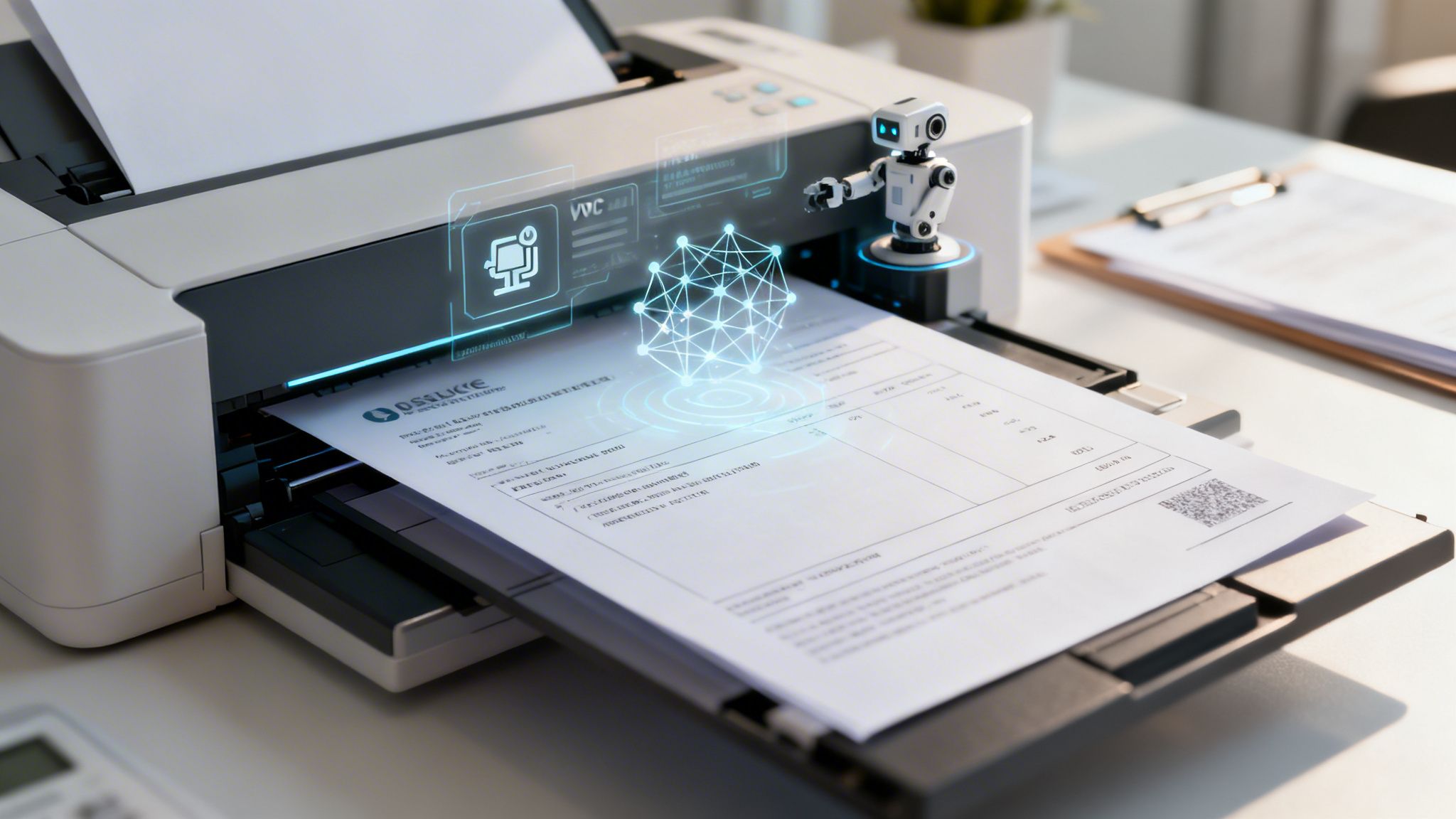
Let's be honest. The old way of doing data entry—rows of people manually typing information from paper into a computer—is broken. It’s slow, expensive, and a breeding ground for errors that can cost you dearly. The engine room of a modern business doesn't run on tedious labor anymore; it’s powered by smart, interconnected technologies that get the job done faster and more accurately than ever before.
Think of it not as a single tool, but as a specialized digital team. Each piece of technology has a specific job, and they all work together to take raw information from a document and turn it into clean, usable data in your systems. Understanding how this team works is the key to unlocking real efficiency.
The Eyes and Hands of Automation
The first step in any data entry workflow is getting information off the page. This is where two foundational technologies come into play: Optical Character Recognition (OCR) and Robotic Process Automation (RPA).
Optical Character Recognition (OCR) acts as the eyes of your operation. It's the technology that scans a document—an invoice, a new client form, a purchase order—and "reads" it. Instead of a person having to decipher handwriting or type out printed text from a PDF, OCR software converts it all into digital, machine-readable text in seconds.
Once the data is read, Robotic Process Automation (RPA) serves as the hands. These are software “bots” programmed to handle repetitive, rules-based tasks. An RPA bot can take the data extracted by OCR and do exactly what a human would: open your accounting software, navigate to the right screen, and plug the data into the correct fields. It's a digital clerk that never gets tired or makes a typo.
Working together, OCR and RPA form the backbone of modern data capture. But on their own, they're just following simple instructions. The real magic happens when you give them a brain.
The Brains of the Operation
This is where Artificial Intelligence (AI) and Machine Learning (ML) come in. They provide the cognitive horsepower that turns simple automation into an intelligent, self-improving process. AI and ML don’t just move data; they understand it.
Technologies like AI Document Processing are completely changing the game. An AI model can look at the data an OCR tool extracts and ask, "Does this make sense?" It can check an invoice total against the original purchase order, verify vendor details against your master file, and flag anything that looks suspicious for a human to review.
Imagine an invoice coming in. OCR reads it instantly. An AI model then confirms the vendor is legitimate, checks if the PO number matches an open order, and validates that the final amount is correct. If everything checks out, an RPA bot posts the payment to your ERP. The only time a human gets involved is when the AI finds a problem. That’s the power of this integrated system.
An Integrated Technology Ecosystem
This combination of tools creates a powerful cycle that gets smarter over time. In fact, by 2026, analysts predict that AI-driven routing will be standard practice, automatically sending documents to the right department without anyone having to touch them.
By bringing these tools together, you're not just getting work done faster. You're unlocking major strategic advantages. Freeing your team from the mind-numbing work of manual entry allows them to focus on what humans do best: analyzing information, solving complex problems, and finding new opportunities for growth. You can explore more of the core business process automation benefits to see the full picture.
Of course, building and managing this kind of technology stack isn’t for everyone. It’s a huge undertaking that requires specialized expertise. This is where a top-tier outsourcing partner in the USA can be a game-changer. You get immediate access to a proven, mature tech stack and a skilled team that operates in your time zone, all without the massive upfront investment and steep learning curve. The benefit of a USA-based partner is seamless communication and alignment on data security protocols, making them a true extension of your team. It’s the fastest way to reap the rewards of automation.
Ready to see how this technology can transform your operations? Contact our team at (310) 800-1398 / (949) 861-1804 or email info@ninearchs.com.
Measuring Success with KPIs and Best Practices
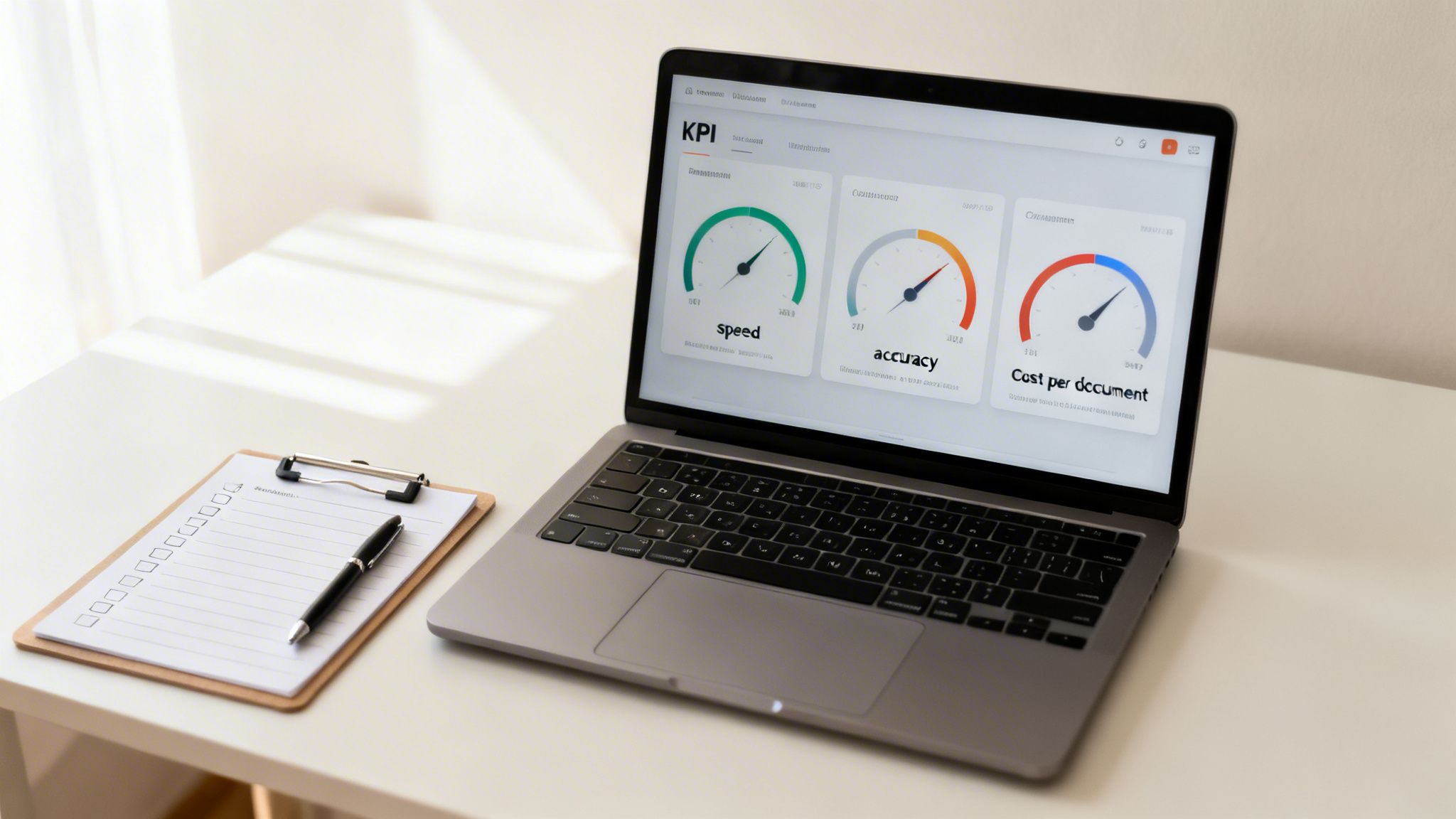
There’s an old saying in business: if you can’t measure it, you can’t improve it. This is especially true for data entry operations. A well-run process isn't just about speed; it's a careful balancing act between accuracy, efficiency, and security. To transform data entry from a reactive cost center into a strategic asset, you have to track the right metrics.
Think of these metrics as the dashboard on your car. They give you a clear, real-time view of your operational health, telling you what’s working, where the bottlenecks are, and how your team is performing. Without them, you’re flying blind—unable to make smart decisions or justify investments in better tools or processes.
Key Performance Indicators for Data Entry
To get a true picture of performance, you need a blend of metrics that cover speed, quality, and cost. Each Key Performance Indicator (KPI) tells a part of the story; together, they show you everything.
Keystrokes per Hour (KPH): This is the classic metric for raw speed—how many keys an operator can press in an hour. While it's a good baseline for productivity, it’s meaningless without its counterpart: accuracy.
Accuracy Rate: This is arguably the most critical KPI of all. It’s the percentage of data entered correctly. A seemingly high 99% accuracy rate still means one mistake for every 100 entries, which can be disastrous for sensitive financial or customer records. Top-tier operations don't settle for anything less than 99.95% accuracy.
Error Rate: The flip side of the accuracy coin, this is often tracked as the number of errors per thousand entries. The real gold here is in tracking not just the rate, but the type of error (e.g., typos, wrong numbers, incorrect formatting). This helps pinpoint the root cause, whether it's a training gap or a system flaw.
Turnaround Time: This measures the full cycle time from the moment a document arrives to the moment its data is successfully entered. It’s a powerful indicator of your overall process efficiency and instantly flags any logjams in the workflow.
Cost per Document/Record: This is the bottom-line metric. It calculates your total operational cost—labor, software, and overhead—divided by the number of documents you process. It’s the ultimate measure of financial efficiency and is essential for budgeting and proving ROI.
When you track these metrics together, you can start making smart optimizations. For instance, if accuracy dips every time speed picks up, it might signal a need for better data validation tools or a less frantic work environment.
Best Practices for Quality and Security
Great numbers are the result of great habits. Establishing clear best practices isn't optional; it's the only way to build a reliable and secure data operation. These rules and procedures are the guardrails that prevent chaos and ensure every entry is consistent and correct.
Manual data entry introduces error rates of 1–5%, even in well-run operations. These mistakes create downstream problems that ripple through every business process, from payroll to customer relationship management. Implementing verification and standardization is the only way to mitigate this risk.
Establishing Data Standardization Rules
Standardization ensures all your data is entered in a consistent format. It’s absolutely vital for creating clean, usable databases and running analytics. Without it, you just have a pile of unusable information.
- Define Formats: Create a clear, documented style guide for things like dates (MM/DD/YYYY vs. DD/MM/YYYY), addresses, names, and phone numbers.
- Use Drop-Down Menus: Whenever you can, use predefined lists or drop-down menus in your software. This severely limits the opportunity for free-text errors.
- Create a Data Dictionary: Maintain a central document that defines every data field, its required format, and what it’s used for. This becomes your team’s single source of truth.
Implementing Verification Techniques
No process is perfect, which is why a verification step is non-negotiable, especially for mission-critical data like invoices or medical records.
- Double-Entry Verification: This is the gold standard for accuracy. The method is simple: two operators enter the same data independently. The system then compares both versions and flags any differences for a third person to review. It's a highly effective way to get near-perfect accuracy.
- Automated Validation Rules: You can also build rules directly into your systems to automatically flag entries that don't make sense, like a zip code with too many digits or an invoice total that doesn't add up correctly.
Adhering to Data Privacy and Security
In an age of strict data privacy laws like GDPR and CCPA, security isn't just a best practice—it's the law. A data breach can lead to crippling fines and shatter your company's reputation overnight. The benefit of working with a USA-based outsourcing partner is that they operate under the same robust legal framework as your business, simplifying compliance and providing invaluable peace of mind that your data is handled with the utmost care.
Ready to establish a high-performing, secure data operation? Contact us to see how we can help. Call (310) 800-1398 / (949) 861-1804 or email info@ninearchs.com.
Choosing Between In-House vs. Outsourced Data Entry
Sooner or later, every growing business hits a crossroads. It’s the point where the once-manageable trickle of invoices, customer forms, and reports becomes a relentless flood. This is where a critical decision has to be made: do you build an internal team to handle it all, or do you find a partner who specializes in this work?
This isn't just about hiring someone to type. It's a fundamental "build versus buy" choice that will shape your budget, your team's focus, and how quickly you can scale. To get it right, you need to look beyond the obvious price tag and ask what it really costs to run a top-notch data entry operation yourself, compared to the focused, predictable model of outsourcing.
The Hidden Costs of an In-House Team
On the surface, hiring your own data entry clerks feels like the most direct solution. You get total control, a team that’s part of your company culture, and their undivided attention. But the true cost of that team goes far beyond their paychecks.
Before you start writing job descriptions, you need to tally up all the associated expenses. The reality is often surprising:
- Hiring and Training: This isn't free. You'll spend time and money on job postings, interviews, and getting new hires up to speed on your systems.
- The Full Payroll Picture: Don't forget about health insurance, retirement plans, and payroll taxes. These can easily add 20-30% or more to a base salary.
- Tech and Tools: Your team needs the right gear. This means licensing fees for software, capable computers, and a secure network to keep your data safe.
- Management Overhead: Someone has to lead the team, manage their performance, and guarantee quality. That manager's salary is part of the total cost.
- A Place to Sit: Desks, chairs, and the office space they occupy all come with a price tag for rent and utilities.
Add it all up, and the cost of an in-house team is often far higher than business owners expect. This model can also be surprisingly rigid. What happens when you have a seasonal rush or a big one-off project? Scaling your team up—and then back down—is a slow, expensive headache.
Outsourcing: The Strategic Alternative
Outsourcing presents a completely different way of thinking. Instead of building this entire function from the ground up, you partner with a firm that has already put in the work. They’ve already invested in the skilled people, the advanced technology, and the battle-tested processes. For you, this means turning a large, fixed operational headache into a predictable, manageable expense.
This isn't just a small business tactic, either. The enterprise world's embrace of data entry outsourcing shows a major shift in how companies approach efficiency. Big corporations, in particular, depend on these partners to manage incredibly complex financial data across different systems, regions, and regulatory environments. You can see the full scope of this trend in research on the global data entry service market.
Partnering with an expert turns data entry from a resource-draining necessity into a streamlined, managed service. You gain access to a dedicated team and advanced technology without the burden of owning and maintaining it all yourself, allowing you to focus on your core business.
Why a USA-Based Outsourcing Partner Makes Sense
For many American businesses, a US-based outsourcing partner offers the ideal balance of cost-effectiveness, quality, and collaboration. It delivers strategic advantages that are difficult to replicate with other models.
Here’s why it works so well:
- Seamless Communication: With a domestic partner, you eliminate time zone headaches and cultural misalignments. Your partner works when you work, making collaboration feel natural and immediate.
- Shared Business Culture: A US-based team inherently understands the expectations for quality, deadlines, and professional communication common in the American business landscape.
- Ironclad Data Security: Working with a provider in the United States means they operate under the same strict data privacy and security laws you do. This simplifies compliance and gives you peace of mind that your sensitive information is protected by a familiar legal framework.
- Access to Top-Tier Talent and Tech: You instantly gain the benefit of a highly skilled, domestic talent pool and a mature technology stack without having to spend a single dollar on building it yourself.
By choosing a domestic partner, you get the cost savings and scalability of outsourcing while maintaining the seamless collaboration and security you'd expect from an in-house team. We have more insights on this approach in our other articles on outsourced data entry services. It’s a powerful model that helps you streamline workflows, reduce overhead, and unlock your next stage of growth.
Ready to see how a US-based partner can transform your data operations? Let's talk. Call us at (310) 800-1398 / (949) 861-1804 or email us at info@ninearchs.com.
Your Roadmap to a Successful Data Entry Strategy
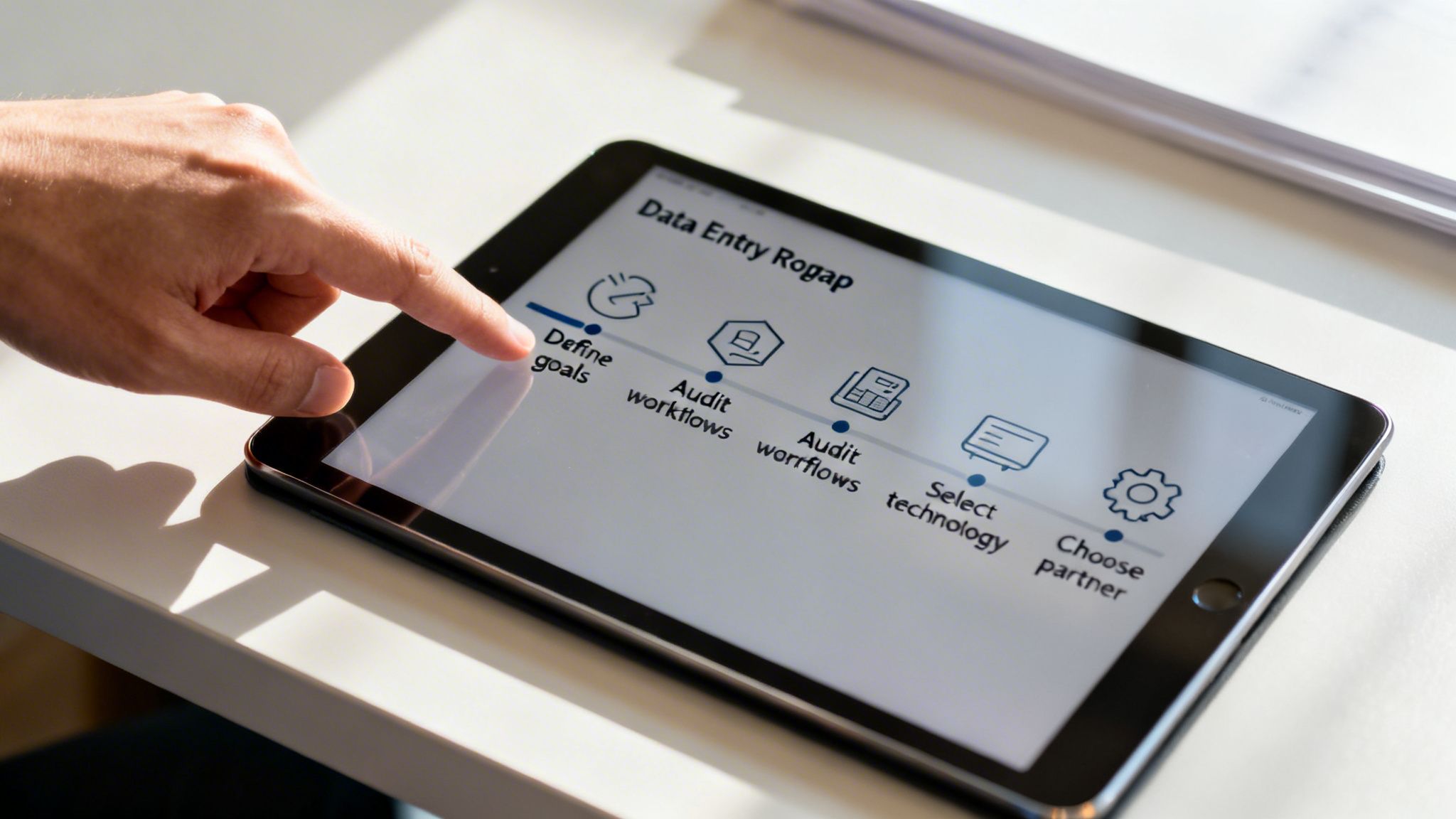
Turning your data entry operations from a necessary chore into a real business asset requires more than good intentions. It demands a deliberate plan. Without a roadmap, well-meaning efforts to improve things often fizzle out, money gets wasted, and you end up right back where you started—drowning in errors and delays.
Think of it like building a house. You wouldn’t start with the roof. You need a solid foundation built on clear goals, an honest look at where you are today, and the right choices in tools and partners. Following a methodical process ensures every decision you make actually supports your long-term vision.
Phase 1: Define What Winning Looks Like
First things first, you have to define what "success" actually means for your business. Fuzzy goals like “improving data entry” are useless. Your targets need to be specific, measurable, and tied directly to the health of your company. This clarity will be the compass for every decision that follows.
Start by asking what pain you’re trying to solve. Are late invoice payments choking your cash flow? Is bad customer data derailing your marketing campaigns? Are your best people wasting their days on manual processing? A 2025 study found employees spend over nine hours a week on manual data tasks alone, highlighting a significant drain on productivity.
With those pain points in mind, set concrete, quantitative goals. For example:
- Cut down invoice processing time by 40% within six months.
- Hit a 99.9% data accuracy rate for all new customer files.
- Lower the cost of processing each document by 25% by the end of the year.
These kinds of precise targets give you a benchmark to measure against. They also transform a vague idea into a tangible project with a clear ROI, making it much easier to justify any investment.
Phase 2: Audit Your Current Reality
Once your goals are set, it's time for an honest audit of your existing processes. You can't fix what you don't truly understand. This phase is all about mapping every single step of your current workflow, from the moment a document enters your world to its final resting place in your systems.
Your job here is to find the friction. Where does work pile up? Which steps demand the most hands-on effort? A detailed analysis often shows that over 70% of business data needs some manual touch, creating bottlenecks all over the place.
An audit isn't just about finding what's broken; it's about spotting opportunity. By pinpointing exactly where manual effort is highest and errors are most common, you can see where a bit of automation or expert help will have the biggest impact.
This audit should be detailed. Document the types of files you handle (invoices, POs, contracts), where the data comes from, what software you’re using, and who is involved. This map becomes your guide for designing a better future.
Phase 3: Evaluate Your Path Forward
With a clear picture of your goals and your current state, you’re ready to look at your options. The choice usually boils down to investing in new technology, like an AI-powered document platform, or bringing in an outsourcing partner. For many businesses, the answer is a smart combination of both.
As you weigh your choices, here’s what to look for:
- Scalability: Can this solution handle your volume today and grow with you? A retail brand, for example, needs a partner that can handle the holiday rush without breaking a sweat or letting quality slide.
- Security and Compliance: Does the technology or provider meet critical standards like SOC 2 or ISO 27001? When you’re handling sensitive data, this is non-negotiable for staying compliant with regulations like GDPR.
- Disaster Recovery: What happens if there’s an outage? A solid disaster recovery plan isn't a nice-to-have; it's essential for keeping your operations running no matter what.
- Integration: How well does the solution play with your existing systems, like your ERP or CRM? You want seamless integration, not another data silo to worry about.
This is where engaging a USA-based outsourcing partner offers a distinct benefit. You gain access to a highly skilled team and top-tier technology while enjoying the advantages of shared time zones, a common business culture, and a familiar legal framework. It simplifies communication and compliance, making the partnership feel like a secure and natural extension of your own team.
A well-planned strategy elevates data entry from a reactive cost center to a proactive, strategic asset. By following this roadmap, you can build a system that delivers accurate, timely, and secure data—the fuel for smarter decisions and real, sustainable growth.
For a tailored assessment of your data entry operations and to build your own success roadmap, contact NineArchs. Call us today at (310) 800-1398 / (949) 861-1804 or email info@ninearchs.com.
The Real Value of Spotless Data
If you've followed along, you've seen that modern data entry operations are so much more than a back-office chore. They’re the very heartbeat of your business intelligence, customer happiness, and financial stability. Technology and smart outsourcing have brought elite-level data accuracy and speed within reach for everyone.
The final thought to leave you with is this: seeing your data processes as just another line item on a budget is a huge missed opportunity. It’s not a cost. It’s an investment in the single most valuable asset you own—your information.
By making spotless data a priority, you’re not just cleaning up spreadsheets. You’re building a stronger, smarter, and more agile organization that’s ready for anything. It’s the bedrock of reliable analytics and confident, decisive action.
For your data entry work to produce real insights and strategic wins, you need a plan. A practical guide to improving data quality is a great place to start. High-quality data stops expensive mistakes before they happen and, just as importantly, builds trust in your own systems.
From Cost Center to Strategic Asset
When your data is accurate, on time, and secure, it becomes fuel for growth. It’s how marketing campaigns hit the right people, financial forecasts become something you can actually count on, and your service teams have the correct information when a customer calls.
This kind of operational excellence doesn’t happen by accident. It’s the direct result of a thoughtfully managed data strategy. You can learn more about what it takes to build a solid data quality framework to get these efforts off the ground.
Partnering with a USA-based outsourcing team is a powerful shortcut to getting this right. You tap into expert teams and proven tech while gaining the advantages of shared time zones, cultural alignment, and a secure legal framework. It’s a straight line to turning your data operations into a genuine competitive edge.
Ready to unlock what your business data is truly capable of? Contact the experts at NineArchs today.
Call us at (310) 800-1398 / (949) 861-1804 or email info@ninearchs.com to get started.
Your Data Entry Questions, Answered
When you're running a business, "data entry" can feel like a necessary evil—a mountain of paperwork and digital files that never seems to shrink. It’s natural to have questions about how to manage it all.
Let's cut through the noise and tackle some of the most common questions we hear from leaders trying to get a handle on their operations.
Data Entry vs. Data Processing: What's the Real Difference?
People often use these terms as if they mean the same thing, but they're two very different steps in a much larger process. Think of it like making a meal.
Data entry is gathering your raw ingredients. It’s the simple, focused act of getting information from point A to point B—from a scanned invoice, a customer form, or a survey—and putting it into a system. The entire goal is transcription, pure and simple.
Data processing, on the other hand, is the actual cooking. It’s what happens after the data is entered. This is where you organize, sort, analyze, and calculate that raw information to turn it into something useful, like a sales report, a financial forecast, or a customer insights dashboard. Entry is about input; processing is about output.
How Do I Actually Measure Data Entry Accuracy?
You can't improve what you don't measure, and this is especially true for data entry. The standard metric is the data accuracy rate—the percentage of fields entered correctly versus the total number of fields.
A 99% accuracy rate sounds great on paper, but it still allows for 1 error in every 100 entries. If you process thousands of records a day, that adds up to a lot of costly mistakes. The best operations shoot for 99.95% accuracy or higher.
So, how do you get that number? The gold standard is double-entry verification. Two operators enter the same data, and a system automatically flags any differences for a third person to review. Regular audits—pulling a random sample and comparing it to the original source documents—are also vital for spotting recurring error patterns and keeping quality high.
Is It Safe to Outsource My Data Entry?
Handing over company information, especially if it's sensitive, is a major concern. The short answer is yes, outsourcing can be incredibly secure—if you choose the right partner.
Reputable providers don't just treat security as a checkbox; it’s the foundation of their business. A top-tier, USA-based partner like NineArchs operates under strict domestic data privacy laws and often holds certifications like SOC 2. This isn't just a piece of paper; it’s proof that they have rigorous, audited controls for protecting client data. The benefit of this domestic partnership is the assurance that your data is handled under a familiar and robust legal framework, minimizing compliance risks.
They use tools like end-to-end encryption, secure networks, and strict access controls to ensure your information is shielded at every step. In many cases, their security infrastructure is far more robust than what a small or medium-sized business could build and maintain on its own.
Ready to build a flawless data entry strategy? NineArchs provides expert teams and advanced technology to transform your operations. Contact us for a consultation.
(310) 800-1398 / (949) 861-1804 Email: info@ninearchs.com