

Monday's revenue report says one thing. Tuesday's finance dashboard says another. Sales insists the customer count is right. Operations says half the records are duplicates. Meanwhile, your team is exporting spreadsheets, reconciling fields by hand, and delaying decisions because nobody fully trusts the numbers.
That situation is more common than most leaders admit.
A founder feels it when growth outpaces process. A CFO feels it during close and audit prep. A CTO feels it when every new system adds another layer of integration work. The problem isn't just “too much data.” It's that the business lacks a reliable way to collect it, organize it, protect it, and turn it into usable decisions.
That's where Data management services come in. Done well, they take scattered records, inconsistent definitions, and fragile reporting workflows and turn them into a stable operating system for the business. The goal isn't technical neatness for its own sake. The goal is better forecasting, faster reporting, cleaner customer records, fewer compliance headaches, and more confidence in every decision that depends on data.
Introduction From Data Chaos to Business Clarity
A regional services company started with a simple setup. Sales tracked leads in one system. Finance managed invoices in another. Customer support kept notes in shared folders and spreadsheets. For a while, that worked.
Then growth made the cracks obvious.
The leadership team began seeing conflicting answers to basic questions. Which customers were active? Which contracts were current? Which product line was most profitable? A board meeting required three teams to prepare three versions of the same report, then spend hours debating whose numbers were “closest.”
That's usually the moment leaders realize data problems aren't IT problems alone. They're business problems.
When records are inconsistent, decisions slow down. When access rules are unclear, risk rises. When systems don't connect, staff members build workarounds that create even more inconsistency. Over time, the business starts running on guesswork, manual fixes, and institutional memory.
Data chaos rarely looks dramatic at first. It looks like one extra spreadsheet, one manual export, one “temporary” workaround that never goes away.
Data management services solve that by putting structure around how information moves through the company. Instead of treating data as something that accumulates in different departments, a managed approach treats it as a business asset that needs design, rules, ownership, and upkeep.
For leaders, that shift changes the conversation. You stop asking, “Why are our reports always off?” and start asking better questions. Which data matters most? Who owns it? What controls keep it accurate? How quickly can teams use it to make decisions?
That's business clarity. Not because the data became magical, but because someone finally built a system that makes it dependable.
Decoding Data Management and Its Core Components

The term "data management" often brings to mind databases, backups, or storage. That's only part of the picture. A comprehensive service combines collection, processing, secure access, and continuous governance, along with operational work such as designing enterprise database strategies, reviewing data for accuracy, managing and updating stored data, and making sure data is ready for audits, as outlined in IBM's overview of data management.
A useful way to think about it is a city.
A city doesn't function because it owns roads. It functions because roads, water, electricity, zoning, safety rules, and maintenance all work together. Data management services do the same for your digital operations. They create the infrastructure that lets reporting, finance, operations, customer service, and analytics run without constant friction.
Governance sets the rules
Data governance is the rulebook. It defines who can access what, which fields are required, how records should be named, and who approves changes.
Without governance, every department creates its own version of reality. One team says “customer” means a billed account. Another says it means a signed contract. A third says it means anyone in the CRM. Good governance resolves that confusion before it spreads into reporting and compliance work.
Leaders in regulated and data-intensive sectors often benefit from broader strategic planning frameworks, such as this guide to data strategy for bank leaders, because it shows how governance decisions connect directly to executive priorities.
Quality keeps the data usable
Data quality is about accuracy, completeness, consistency, and timeliness. If pricing fields are outdated, units are entered inconsistently, or duplicate customer records keep appearing, downstream teams inherit those mistakes.
That's why quality controls belong early in the process, not after reports break.
- Validation at entry: Check required fields, formats, units, and business rules before bad records spread.
- Ongoing monitoring: Review duplicates, stale records, and exceptions as part of operations, not as a one-time cleanup.
- Shared standards: Use a documented framework so teams know what “good data” means. A practical reference is this data quality framework.
Security, integration, and master data make it work at scale
Data security protects the business. It covers access controls, permissions, secure handling, and the procedures that reduce unnecessary exposure.
Data integration connects systems that otherwise operate in silos. It allows finance, sales, operations, and service teams to work from connected records rather than isolated exports.
Master data management creates a trusted core set of records for critical business entities such as customers and products. HEC Paris cites McKinsey's finding that 83% of organizations consider client and product data among the most important data domains to manage, and the same HEC Paris summary notes that 89% of respondents totally agree that effective data management will play an increasingly vital role in the long-term survival of companies in its discussion of effective data management and business success.
Practical rule: If two executives can ask the same question and get two different answers from two trusted systems, you don't have a reporting problem. You have a data management problem.
The Strategic Business Benefits of Mastering Your Data
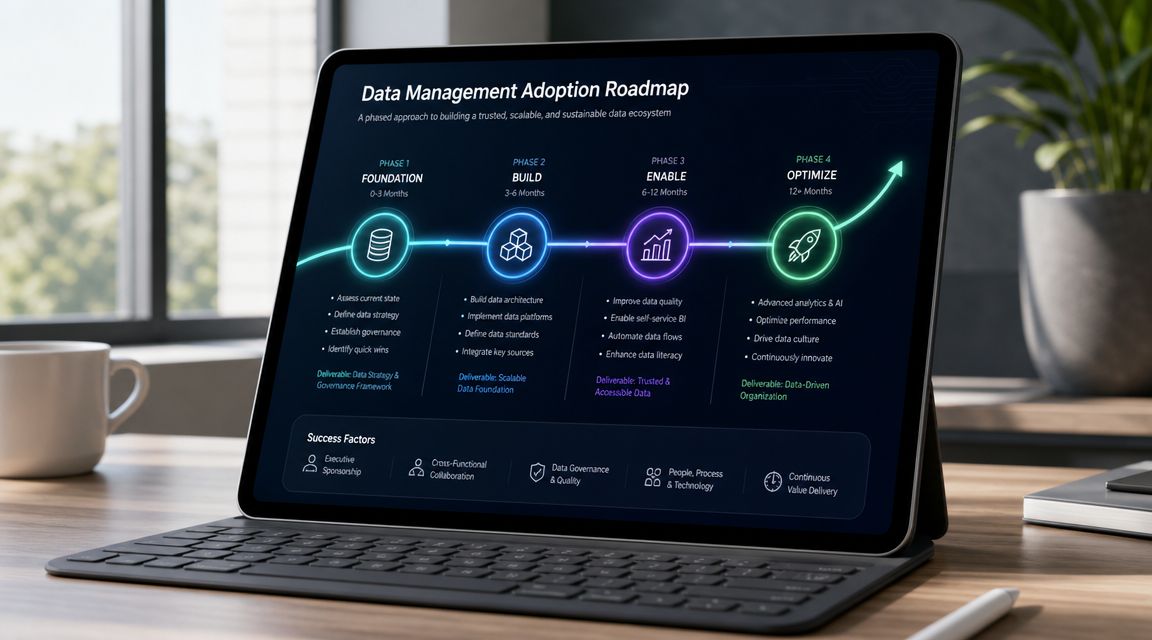
The business case for data management services becomes obvious when you look at what bad data costs in practice. Teams wait for reconciliations. Leaders second-guess dashboards. Audits take longer than they should. Revenue opportunities sit inside disconnected systems because nobody can see the full picture.
Good data management doesn't just tidy your systems. It improves how the business operates.
Better decisions with fewer caveats
When leadership teams trust the underlying records, meetings change. People spend less time debating inputs and more time discussing action.
A CFO can review margin trends without asking finance to manually rebuild source files. A sales leader can evaluate pipeline quality without wondering whether inactive accounts are inflating totals. A founder can look at one dashboard and feel confident it reflects the actual business.
That trust matters because decisions get delayed when every answer comes with an asterisk.
Faster operations and cleaner execution
Manual data work hides inside ordinary business routines. Teams rekey invoice details, merge spreadsheets, correct duplicate contacts, and email version after version of “final” reports.
Those tasks don't always look expensive on paper, but they slow the company down. Clean, connected data reduces the need for handoffs and rework. It lets staff focus on exceptions and judgment instead of repetitive cleanup.
| Business area | What improves when data is managed well |
|---|---|
| Finance | Month-end reporting is easier to compile and explain |
| Operations | Teams spend less time reconciling records across systems |
| Customer service | Staff can see a more complete account history |
| Leadership | Strategy discussions start from shared facts |
Stronger compliance and audit readiness
Compliance gets harder when records are incomplete, inconsistent, or hard to trace. Even simple questions become painful. Who changed this field? Which version is current? Why does this report differ from the one submitted earlier?
A disciplined data management approach creates clearer ownership, stronger controls, and better audit trails. That doesn't eliminate compliance work, but it makes it more predictable.
Reliable data shortens the distance between “prove it” and “here's the record.”
More value from customer and product data
The most strategic payoff often comes from visibility. When customer and product information is consistent across the business, leaders can spot patterns they'd otherwise miss.
That might mean identifying customers with declining activity, seeing which offerings create repeat business, or understanding where service issues cluster. None of that requires flashy analytics first. It requires dependable foundations.
For business leaders, that's the key shift. Data management services aren't a support function in the background. They're part of how the company protects margin, serves customers, and makes decisions with confidence.
Choosing Your Data Management Partner
Outsourcing data management doesn't mean handing over a technical chore. It means selecting a partner that will influence reporting quality, operational discipline, security posture, and leadership confidence. That choice deserves more scrutiny than a simple price comparison.
The first filter is technical relevance. The market is moving hard toward cloud delivery. The global cloud-based data management services market was estimated at USD 43.83 billion in 2024 and is projected to reach USD 173.63 billion by 2030, representing a 26.8% CAGR from 2025 to 2030, according to Grand View Research's cloud-based data management services market report. If a partner can't operate comfortably in modern cloud environments, that gap will show up later in performance, scalability, and governance.
What to evaluate beyond price
A strong partner should be able to explain how it handles the basics and the hard parts.
- Architecture capability: Can the team design schemas, data flows, and access structures that fit your business model?
- Governance discipline: Do they have a practical approach to policies, data definitions, and change management? This overview of a data governance consultant is a useful reference for what mature governance support should look like.
- Security thinking: How do they limit access, manage permissions, and support auditability?
- Integration experience: Can they connect systems without creating more fragile workarounds?
- Operational maturity: Will they maintain quality controls after go-live, or just complete a one-time setup?
A weak partner talks mostly about tools. A strong one talks about workflows, ownership, exceptions, and business outcomes.
Why a USA-based outsourcing partner matters
For critical data functions, a USA-based outsourcing partner offers practical advantages that business leaders feel quickly.
Communication tends to be easier. Legal expectations are clearer. Meetings happen in working hours that support real-time decisions instead of overnight lag. Cultural alignment also helps when teams need to agree on definitions, escalation paths, and documentation standards.
That doesn't replace technical skill. It strengthens delivery.
When finance, operations, and IT need to resolve an issue quickly, timezone overlap and business context matter. A partner in the USA can often make workshops, approvals, and issue resolution more direct, especially when data touches customer records, financial reporting, or sensitive operations.
One example of the kind of provider businesses often look for is NineArchs LLC, which offers IT services, cloud support, BPO, data entry, and finance operations support. That combination can matter when a company needs both technical data infrastructure and disciplined back-office execution from the same operating model.
Choose the partner you'd trust in a reporting dispute, a security review, and an audit meeting. If they can't handle all three conversations, keep looking.
A Practical Roadmap for Data Management Adoption
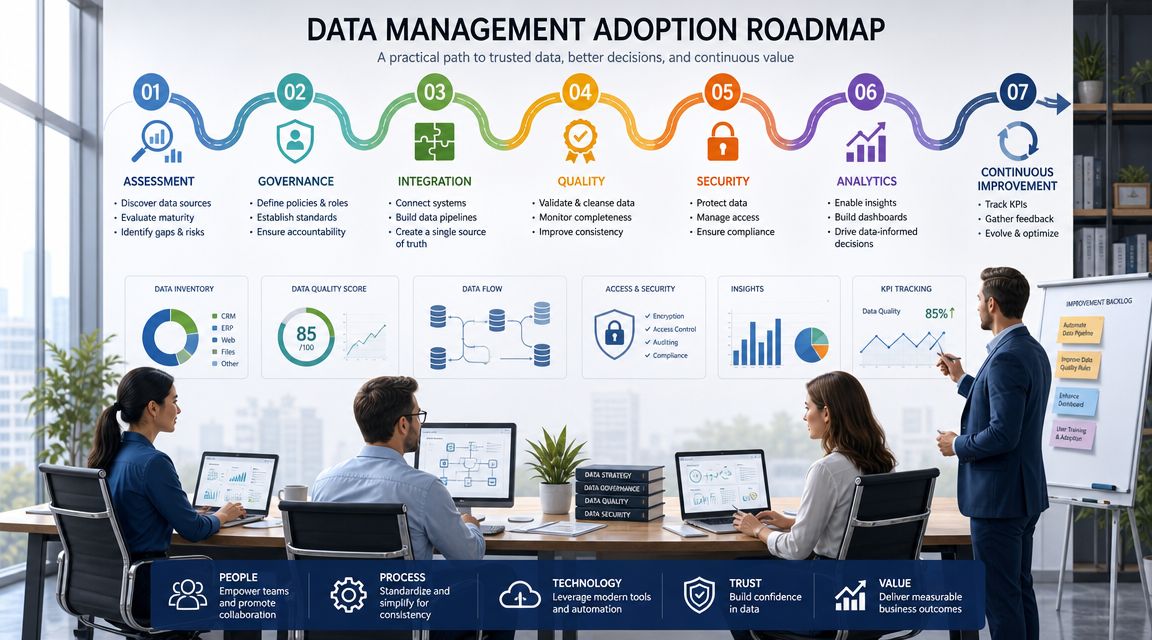
Most companies delay data management because the work feels too broad. There are too many systems, too many stakeholders, and too many old habits to untangle. The fix is to stop treating it like one giant transformation and start treating it like a sequence of business decisions.
For many organizations, the goal isn't just collecting more data. It's building data-to-decision workflows that turn fragmented operational information into better service delivery, a point illustrated in Government Technology Insider's discussion of data management in public sector decision-making.
Start with business pain, not technology
Begin by identifying where poor data hurts the business most.
Is finance spending too long reconciling reports? Is customer support missing account history? Is leadership losing confidence in dashboards? Those pain points tell you where to start.
A useful way to frame the work is through a staged maturity lens. This data maturity model can help leaders assess whether they're still operating in reactive cleanup mode or moving toward controlled, repeatable processes.
A four-phase adoption path
Assessment and discovery
Inventory the systems, key data sources, and recurring breakdowns. Look for duplicate records, inconsistent definitions, access gaps, and manual workarounds.Strategy and design
Define which business entities matter most first. Many companies start with customer, product, vendor, or financial data because those domains affect multiple teams at once.Implementation and migration
Build the workflows, validation rules, integrations, and access controls. Migrate carefully. Preserve business continuity. Don't move everything at once if a phased cutover lowers risk.Governance and optimization
Assign ownership, review quality regularly, and treat exceptions as operating signals. Through these practices, data management integrates into the business rhythm rather than remaining a one-time project.
Keep the first win small and visible
Leaders often assume the first phase has to be enterprise-wide. It doesn't.
A smaller, targeted initiative usually works better. Unify customer records for support and billing. Clean product data before a pricing review. Standardize finance inputs before audit season. Early wins build trust because people can see the operational difference.
- Pick one painful domain: Choose the area where confusion is frequent and business impact is clear.
- Name an owner: Someone must be accountable for decisions on definitions, exceptions, and changes.
- Set review routines: Quality slips when teams assume cleanup will happen “later.”
That progression matters. Businesses don't become data-driven because they buy new infrastructure. They become data-driven because they create repeatable habits for keeping important information accurate, accessible, and usable.
Data Management in Action Use Cases for Every Leader

The value of data management services looks different depending on where you sit in the organization. The underlying discipline is the same, but the business impact changes by role.
For the CTO
A CTO often inherits a patchwork of systems that were added at different stages of growth. One application stores customer records. Another handles billing. A third captures support activity. A fourth contains documents and attachments that nobody has classified properly.
That setup becomes a larger problem when the business wants to use AI. A key challenge today is making unstructured enterprise content AI-ready, which requires work beyond storage, including discovery, tagging, classification, and sensitive-data detection, as discussed in Komprise's article on unstructured data services and AI readiness.
For the CTO, data management services help by creating order across structured and unstructured information. They improve access control, reduce duplication, and make it easier to support analytics and AI initiatives without exposing the business to unnecessary risk.
For the CFO
A CFO usually feels the problem through reporting friction.
The close takes longer because data arrives from multiple teams in different formats. Adjustments keep appearing late because source records don't match. Audit requests trigger a scramble for documentation because nobody can easily trace where a number came from.
A managed data approach gives finance something it prizes: Consistency. One version of customer, product, invoice, and transaction data reduces reconciliation work and makes reports easier to defend. The payoff isn't abstract. It shows up in smoother closes, cleaner support for audits, and fewer arguments about whose spreadsheet is correct.
Finance doesn't need more data. It needs fewer contradictions.
For the founder
A founder usually sees data problems as drag.
The team is small. Everyone is wearing multiple hats. Operations run on hustle, shared folders, and quick fixes. That's normal early on, but it gets expensive as the business scales. The same founder who once knew every customer personally now needs a reliable system to see churn risks, cash timing, support load, and delivery trends.
Outsourced data management helps founders add discipline without building a large internal data team too early. They can get cleaner workflows, stronger controls, and better reporting while keeping internal focus on product, growth, and customers.
A startup doesn't need enterprise bureaucracy. It does need enough structure that growth doesn't turn information into noise.
Partner with NineArchs to Transform Your Data Strategy
Data management stops being a technical topic the moment it affects revenue reporting, audit readiness, customer visibility, service delivery, or AI plans. At that point, it becomes an executive issue.
The practical answer for many organizations isn't to build every capability internally. It's to work with a partner that can support the full operating model. That may include cloud infrastructure, database and governance support, data entry discipline, bookkeeping inputs, payroll-related workflows, and finance operations that depend on accurate records from the start.
A partner helps you move faster because the work gets organized. Priorities become clearer. Ownership gets defined. Quality controls show up earlier in the process, where they prevent downstream rework instead of cleaning up after it.
For businesses that want the advantages of a USA-based outsourcing relationship, NineArchs can support both technical and operational needs under one model. That's useful when your challenge spans more than one department and the primary issue is coordination, not just tooling.
| Method | Details |
|---|---|
| Phone | (310)800-1398 / (949) 861-1804 |
| info@ninearchs.com |
If your team is spending too much time fixing reports, reconciling records, or managing disconnected workflows, it may be time to bring structure to the problem. Contact NineArchs LLC at (310)800-1398 / (949) 861-1804 or Email: info@ninearchs.com to discuss a practical data management approach that fits your business.