

It's 8:40 on a Tuesday, and the founder has already made four decisions. One was about money, one about a hire, one about a client message that arrived at 11pm, and one about whether to cancel a meeting she suspects is theater. None of them went into writing. By Friday she will remember two, and she will judge both by how they turned out.
That morning is the subject. How leaders think isn't a personality trait or a talent for charisma. It's a set of repeatable habits: how a decision gets framed, who gets invited to disagree, which biases get checked before commitment, and whether the person deciding can hold still long enough to notice what's in front of them.
The habits can be trained, and the training is unglamorous. It looks like a written success test, a named owner, a premortem nobody enjoys, and ten quiet minutes before the loudest message of the day gets answered. What follows is that practice, and the places where it stops working.
Why Leadership Thinking Uses So Much of the Day
Say a founder takes three calls before nine. The first is a customer escalation she can fix with one sentence. The second is a supplier who wants a bigger order commitment than feels safe. The third is an investor who mentions growth twice and headcount once. Each call feels urgent. None is written down, and by the afternoon the supplier question has been decided by mood rather than by arithmetic.

The desk looks calm after those calls. The thinking doesn't. The 2018 McKinsey Global Survey on decision-making asked 1,259 respondents across regions, industries, company sizes, and functions about how decisions get made, and the time arithmetic is blunt. More than half said they spent over 30% of their working time making decisions, and more than one-quarter spent a majority of their time on that activity. Seniority makes it worse: 14% of C-suite respondents reported spending more than 70% of their time deciding.
Heavy involvement doesn't buy quality. In the same survey, 61% said at least half of their decision-making time was ineffective, only 48% said their organizations made decisions quickly, and just 37% said decisions were both high-quality and timely. Badly structured decisions cost the day twice: once in the meeting and again in the rework.
The working principle: effective leaders think less about proving they are the smartest person in the room and more about who owns the decision, how fast information reaches them, and whether anyone checks that execution followed.
That's not a capacity problem, it's a design problem. It's also why 26% of CEOs named greater agility and faster decision-making as the most important leadership capability in the current environment, according to KPMG's 2025 Global CEO Outlook. The rest of this piece works through six habits, the biases that bend them, where an inspiring style stops traveling, three short decision stories, an attention practice, and a week you can run.
Six Thinking Habits Effective Leaders Repeat
A pilot runs the same instrument scan in the same order on every takeoff. Not because the instruments change, but because a fixed sequence means surprise never becomes panic. How leaders think works the same way. The scan is the skill. Personality is the paint.
Six habits make up that scan, and each one counters a specific human reflex rather than a knowledge gap.
| Habit | The question it forces | Behavior it counters | Ten-minute practice |
|---|---|---|---|
| Strategic framing | What decision is this, and what would make it good? | Jumping to a favorite option | Write the decision and three success tests before listing any options |
| Systems thinking | What conditions produced this information? | Blaming one person for a system result | Map who sees the problem, who filters it, and who owns the next step |
| Risk calibration | Is this reversible, and what range is honest? | Treating every choice as all or nothing | Label the choice reversible or not, then write a low, middle, and high outcome |
| Stakeholder empathy | Who pays if I am wrong? | Deciding only from the people in the room | Name three affected people and one cost each would feel |
| Learning orientation | What did I expect, and what would change my mind? | Defending the original story after the result | Record the forecast, the owner, and the evidence that would reverse it |
| Attentional stillness | What am I not noticing because it is loud? | Reacting to the latest message as if it were the priority | Sit for ten quiet minutes, then reread the decision with one sentence changed |
The order matters. Framing before options keeps a leader from defending the first idea that felt good. Risk calibration before commitment keeps a reversible experiment from being argued with the gravity of an irreversible one. Stakeholder empathy before the announcement keeps the cost visible while there's still room to change the plan.
Most leaders run four of these well and skip two. The two they skip are almost never random. They're the ones that feel like friction on a tired afternoon: the premortem when everyone wants to go home, the dissenting question when the room has already agreed.
Look at your last hard week and mark the row you dropped first. That row is your training plan, not the row you already enjoy.
Biases That Quietly Bend Leadership Judgment
No leader can hold every fact in a room, so the brain substitutes shortcuts. That's useful at speed and costly at scale. A few pieces of evidence arrive, the pattern fills in, and the conclusion feels like observation when it's really a prediction.
The most expensive of those shortcuts is confirmation bias, which overweights evidence supporting a belief already held and discounts the rest. A founder who suspects the new sales lead is weak will notice every missed update and miss the two accounts that closed.
These shortcuts are not rare exceptions. Deloitte's overview of how people make decisions identifies more than 200 cognitive biases that can affect business judgment, including confirmation, outcome, and hindsight bias. McKinsey's work on decision quality names confirmation bias and overconfidence bias as major causes of poor corporate decisions, and its early research suggested cognitive and behavioral biases contributed to roughly 75% of bad decisions.
| Bias | How judgment bends | Counter before commitment |
|---|---|---|
| Confirmation | Favoring evidence that supports the existing belief | Require a written statement of disconfirming evidence |
| Overconfidence | Overestimating personal judgment or organizational capability | Separate the probability estimate from the preferred outcome |
| Outcome | Judging the choice mainly by how it turned out | Score the process against what was knowable at the time |
| Hindsight | Treating the past as more predictable after the result | Document the reasoning and the range before the outcome is known |
Six moves that hold a decision
- Set the criteria first. Define what a good decision would look like before anyone states a preference.
- Ask for the disconfirming note. Require a written line of evidence that argues against the leading option.
- Split estimate from hope. Write the probability separately from the outcome you want.
- Run a premortem. Ask the room to explain why the chosen path failed, in past tense, and write down the answers.
- Record the forecast and the owner. Assumptions, a range, and one named person go in the log before execution.
- Compare later. Put the result beside the original forecast so a weak process isn't confused with bad luck.
Strong leaders don't claim to be unbiased. They test the claim, in writing, while changing their mind is still cheap.
Apply those six moves to one live decision this week. Not every meeting. One decision, one page.
Where Transformational Thinking Stops Being Universal
Transformational thinking raises a shared purpose, invites people to lead parts of the change themselves, and treats a shift as a human process rather than a slogan. It works. It just doesn't travel unchanged.
The operating path is more mechanical than the inspirational language suggests. A multilevel field study of 5,884 employees and 92 leaders in 92 German small and medium-sized companies found that shared leadership mediated the relationship between employees' perceptions of transformational leadership and their adoption of IT innovations, and that management innovation at the organizational level strengthened that relationship, according to the published study record. Inspiring people isn't sufficient by itself. The influence moves through employees who own portions of the change and through how the organization manages the work.
What the evidence keeps and what it limits
The case for the style is strong but bounded. A global meta-analysis of transformational leadership in the Journal of Applied Psychology synthesized 625 samples collected across four decades, 937 leadership-outcome correlations, and 200,732 participants. Transformational leadership positively predicted employee commitment, trust, task performance, and creativity. Its effectiveness varied significantly by occupation, culture, and time period, and cultural and occupational differences had stronger moderating effects on attitudinal outcomes than on performance outcomes.
Three local adjustments
In a culture where direct challenge reads as disrespect, ask for dissent in writing before the public meeting. You still get the information, and nobody has to perform disagreement in front of the group.
In a technical occupation that trusts evidence over vision language, pair the purpose with the criteria and the forecast range. Say what would have to be true for the plan to work, then let the engineers argue with the numbers.
In a small firm under cash pressure, inspiration without decision rights feels like another speech. Name the owner, name the constraint, name the date the money runs out. Purpose lands harder when it sits next to a real limit.
A compass is still useful. It just needs a local map, and someone has to read the terrain. Pair the purpose with one shared-leadership assignment and one concrete management change, such as a named owner for the new workflow, then pick whichever adjustment fits the room.
Transformational thinking is a direction, not a script. Copied unchanged into the wrong culture or occupation, it can lower trust even when the intent is generous.
How These Habits Show Up in Real Decisions
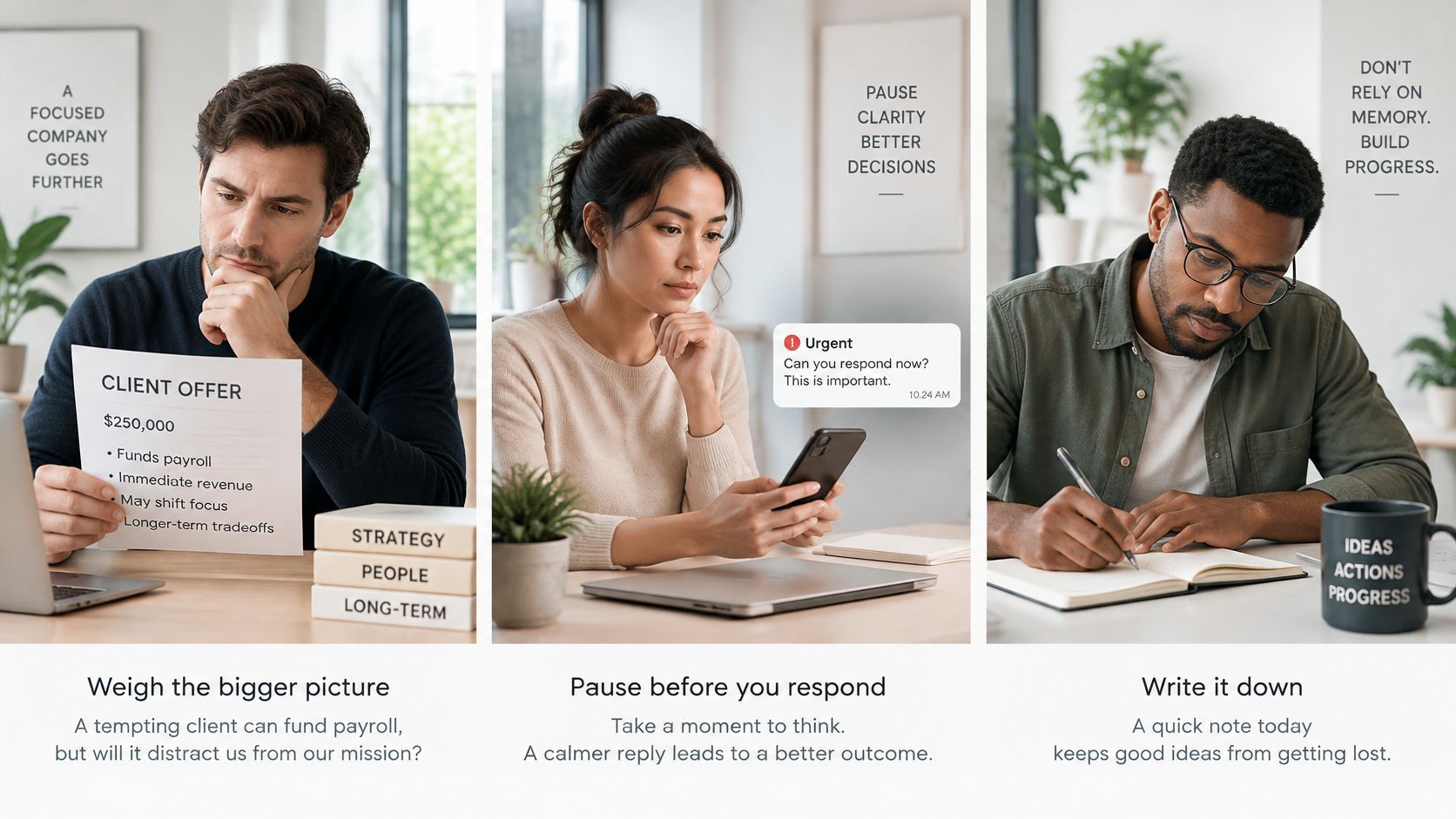
The habits only matter on the days when the answer isn't obvious. Three scenes show how they change an outcome.
Scene one. The client who funds payroll. A founder has a seven-figure contract on the table from a client whose work would pull the whole team off the product that defines the firm. The cash would cover two quarters. Strategic framing forces the question into the open: this isn't a revenue decision, it's a decision about what the company becomes. Stakeholder empathy names who pays, which is the three engineers whose roadmap disappears and the customers who were promised the next release. Three success tests, written in advance, usually show the deal failing two of them.
Communication is where these decisions break. Only 47% of employees in a 2026 study believed senior leaders told the full story about major decisions, according to reporting on the study from Business Insider. The fix isn't more polish. It's separating facts, assumptions, constraints, values, and unknowns, then saying which alternative was rejected and why.
Scene two. The calm status update. A program manager reports green while the people doing the work already know a dependency slipped. Systems thinking treats that silence as information about conditions, not as a character flaw in one person. When reporting bad news is costly, bad news arrives late.
Google's study of 180 teams found that psychological safety, the shared belief that people can take interpersonal risks without embarrassment or punishment, was associated with stronger effectiveness outcomes, as summarized in Google's guide to understanding team effectiveness. Teams with stronger cultures were more likely to use diverse ideas, less likely to see members leave, generated more revenue, and were rated effective twice as often by executives.
The sequence that changes the information flow is simple enough to run on a Thursday:
- Ask before you answer. Request dissent before stating a preferred view, so the room isn't reacting to the leader's face.
- Start at the edge. Invite the most junior relevant participant to speak first.
- Close in writing. End with unresolved risks and a named owner for each.
Google's reported intervention of opening meetings with a recently taken risk improved psychological-safety ratings by 6% and structure-and-clarity ratings by 10%. Small, repeated leader behaviors moved how the team thought, not just how it felt.
Scene three. The hire that didn't work. A leader wants to call a failed hire proof that her instinct is broken. Learning orientation sends her back to the original forecast instead. What was knowable at the time? Which test did the interview skip? Was the miss a weak process or a person who interviewed well and started badly? One answer improves the next hire. The other just costs confidence.
Which scene matches a decision already sitting on your desk?
Meditation That Sharpens Attention Without Magic Claims
Meditation earns its place here as attention training, not as a route to charisma or better margins. The interesting question is narrow: can a leader improve the specific cognitive capacities that decision-making depends on?
The evidence is narrower than the marketing and more useful than the skepticism. A blinded experiment comparing mindfulness-based stress reduction with an active control randomly assigned 48 healthy meditation novices to mindfulness-based stress reduction, a nonmindfulness stress-reduction program, or an inactive control. Mindfulness-based stress reduction produced significantly greater improvement in selective attention than the comparison conditions, and it was the only intervention that improved the threshold for conscious perception and visual working-memory capacity. Those participants also reported lower perceived stress, showed lower physiological stress, and increased their mindfulness levels.

Keep the caution attached. The researchers noted that some reaction-time improvements may be confounded by test effort, which is a good reason not to tell your board that sitting calmly makes every call wiser. What the evidence supports is selective attention, visual working memory, and stress. What it doesn't support is a universal lift in leadership performance.
Four steps for a decision day
- Sit for ten minutes with the breath. Put attention on the sensation of breathing. When the mind leaves, note where it went, then return without grading yourself.
- Write the one decision that matters. After the sit, put the day's most consequential decision into a single sentence, including who owns it.
- Label the loudest urge. Notice the pull to answer that message or defend that plan, and name it as an urge rather than a fact.
- Train the row you skip. Take the habit you drop when tired and spend ten minutes on it only, using the practice from the six-habit scan.
Run that five days a week for four weeks. A single session won't move a habit, and the point of the repetition is the same as in any strength work: the structure does more than the intensity. If you want the physiology of repetition and how the brain responds to structured practice over time, this guide to brain rewiring support for aging minds lays out the sequencing clearly.
If you finish the four weeks and notice only that you interrupt people less often, that's a result. Judge the practice by what it changed, not by how calm the photo looks.
Build a Weekly Practice for Clearer Judgment
One week is enough to test whether any of this changes a real decision, provided the week is small enough to survive a crowded calendar. Each day takes under half an hour, and each day trains one habit already described.
| Day | Practice | Habit | Time |
|---|---|---|---|
| Monday | Write one decision, its owner, and three success tests | Strategic framing | Under 30 minutes |
| Tuesday | Collect one piece of disconfirming evidence and name one stakeholder who bears the cost | Invited dissent and stakeholder empathy | Under 30 minutes |
| Wednesday | Mark the choice reversible or irreversible and write a low, middle, and high outcome | Risk calibration | Under 30 minutes |
| Thursday | Ask for a risk before stating a preference, then record unresolved risks and owners | Systems thinking | Under 30 minutes |
| Friday | Ten minutes of breath attention, then compare the forecast with what happened | Attentional stillness and learning orientation | Under 30 minutes |
Set the expectation clearly. A meta-analysis of self-leadership interventions identified 11 qualifying studies involving 571 participants in leadership positions, and leadership training produced positive effects that were generally small to medium in size on the primary outcomes, according to the published meta-analysis record. Structured development can improve how leaders think and act. It is not automatic, and it isn't transformational for everyone who shows up.
Three conditions decide whether the week produces anything. The practice gets repeated rather than admired. The goal is behavioral and attached to a live decision, not a general intention to be more strategic. And there is a look-back after four weeks, because a routine nobody reviews becomes a ritual. If the weekday structure feels thin after the first pass, this guide to how to build habits that stick covers the cue and reward mechanics that keep a routine alive past week two.
Start Monday with the decision you've been carrying since last week. Write it in one sentence, name its owner, and set three success tests before you look at a single option. Then run the five days, once, and keep only the day that changed what you did. That's the difference between deciding by mood and deciding on purpose, and it's the whole of how leaders think when the week is crowded.