
This isn’t just another software development outsourcing guide. It’s a roadmap for tech leaders who see outsourcing for what it truly is: a powerful strategic tool for growth, not just a line item to cut costs. The goal here isn’t to complete a transaction; it’s to build a resilient, scalable tech team by forging a genuine partnership.
Why Smart Businesses Outsource Software Development
The conversation around outsourcing has completely changed. It’s no longer the last-ditch effort for a project on a shoestring budget. Today, it’s a primary strategy for getting—and staying—ahead of the competition. Modern founders and CTOs know that the key to smashing local hiring barriers and fast-tracking their product roadmap is tapping into the global talent pool.
This shift isn’t happening by accident. It’s driven by a raw need for speed, specialized skills, and an operational nimbleness that traditional hiring simply can’t match. Outsourcing lets you bring in experts for a specific technology on-demand, get your product built faster, and pivot on a dime without the dead weight of permanent overhead.
The Strategic Edge of Outsourcing
The global IT outsourcing market is absolutely booming, projected to hit a staggering $731.2 billion by 2025. What’s fueling this explosive growth? A perfect storm of rapid digitization and a persistent, frustrating shortage of in-house tech talent.
Companies that get outsourcing right are seeing incredible results: 40-60% cost savings compared to building an internal team, a reduction in time-to-market by up to 45%, and a serious return on investment. With over 64% of companies globally now outsourcing at least one software function, it’s clear the model works. You can dive deeper into these trends and the future of IT models with this comprehensive guide on Arnia.com.
But this is about more than just saving a few bucks. The real advantages are far more strategic:
- Accelerated Innovation: Get access to specialized developers who can help you experiment with new technologies and build features your in-house team simply doesn’t have the bandwidth for.
- Enhanced Focus: When you hand off development tasks, your core team is freed up to concentrate on what they do best—business strategy, marketing, and talking to customers.
- Improved Scalability: You can spin your development team up or down based on project needs. You only pay for the resources you’re actually using, right when you need them.
By framing outsourcing as a long-term partnership rather than a one-off transaction, businesses can build a resilient and adaptable technology function that drives sustainable growth and keeps them ahead of the competition.
The Advantage of a US-Based Partner
While pulling from a global talent pool offers immense value, the management layer is what makes or breaks the entire engagement. This is where partnering with a US-based outsourcing company gives you a unique and powerful edge.
This hybrid model truly offers the best of both worlds. You get the cost-effective talent from global markets, but with the accountability, seamless communication, and ironclad legal protections of a domestic firm.
A US partner becomes your local point of contact, ensuring crystal-clear project oversight and heading off the risks that come with cultural gaps or massive time-zone differences. It’s about peace of mind—knowing your contracts are enforceable and your intellectual property is safe under a legal framework you know and trust.
Ready to explore this hybrid advantage? Call our experts at +1 (310)800-1398 to talk about a solution that fits your goals.
Choosing Your Ideal Outsourcing Model
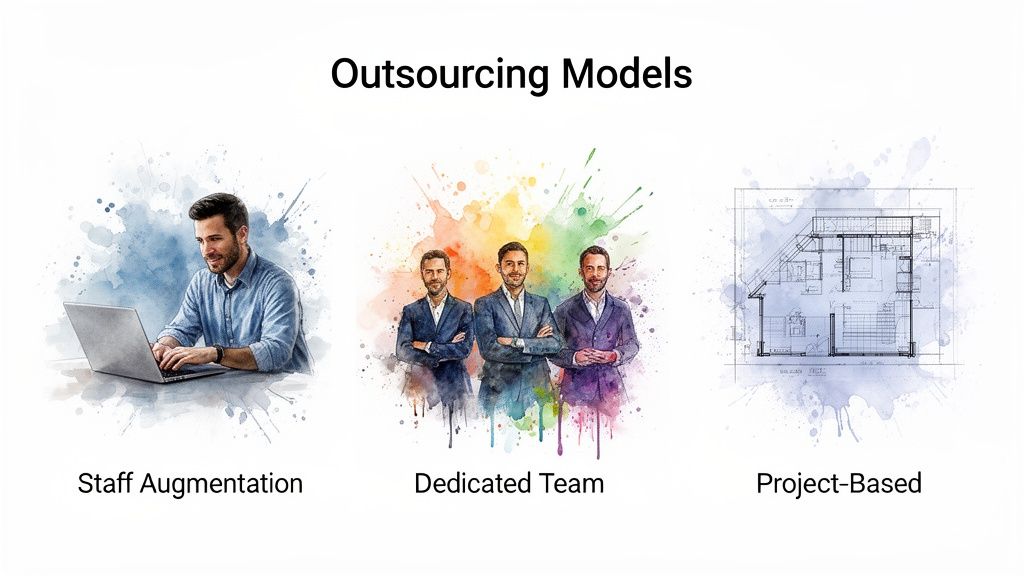
Once you’ve decided to outsource, your next move is crucial: picking the right engagement structure. This isn’t just about choosing a service; it’s about defining the entire relationship with your development partner. The model you select will shape your level of control, how you manage costs, and your ability to adapt down the road.
Think of it like building a house. Do you just need a skilled plumber for a specific leaky pipe? Or do you need a full construction crew on retainer, ready for any project you dream up? Maybe you just want an architect to design and deliver a finished blueprint for a fixed price.
Each approach works, but the best one depends entirely on your project, your timeline, and your long-term goals. Getting this choice right from the start prevents mismatched expectations and sets you up for a win. Let’s break down the three main models so you can find the perfect fit.
Staff Augmentation The Flexible Talent Infusion
Staff augmentation is the most direct way to plug a skills gap. It’s like hiring a highly specialized contractor to join your existing team for a specific mission. You bring one or more developers directly into your current workflow, where they report to your project manager and work side-by-side with your in-house staff.
This model is perfect when your process is solid, but you’re missing a key player—like a senior iOS developer or a cloud security expert. You keep full control over the project and the team, simply adding the horsepower you need to cross the finish line.
This model is best for:
- Filling specific skill gaps without the long-term overhead of a full-time hire.
- Temporarily scaling your team to hit a tight deadline or manage a sudden surge in work.
- Projects where you want to keep complete managerial control and oversight.
Staff augmentation gives you surgical precision. It lets you add the exact talent you need, right when you need it, blending external expertise seamlessly into your team’s culture and processes.
Dedicated Team The Long-Term Strategic Partnership
A dedicated team is a more integrated, long-term solution. In this model, an outsourcing partner assembles a complete, self-managed team of developers, QA engineers, and project managers who work exclusively on your projects. This team essentially becomes a remote extension of your company, diving deep to understand your business goals and product vision.
This approach is ideal for complex, long-haul projects or for companies looking to build a product from the ground up without the headache of in-house recruiting. While you set the high-level strategy, the dedicated team handles the day-to-day project management, freeing you up to focus on your core business. You can explore more on this in our detailed comparison of staff augmentation vs outsourcing.
Some companies take this a step further by establishing an Offshore Development Center (ODC), which functions as a fully operational, branded office in another country. For an in-depth look, check out this comprehensive guide to Offshore Development Centers.
Project-Based Model The Fixed-Scope Solution
The project-based, or fixed-price, model is the most hands-off of the three. You define the project scope, requirements, and deliverables upfront, and your partner agrees to deliver the final product for a set price on a set timeline. It’s like commissioning a finished piece of art.
This model shines for smaller, well-defined projects where requirements aren’t likely to change. Its biggest advantage is cost predictability—you know exactly what you’re paying from day one. The trade-off, however, is a lack of flexibility. Any changes to the original scope will almost always require contract renegotiations and additional costs.
Comparison of Software Outsourcing Models
To make the decision clearer, here’s a side-by-side comparison. This table breaks down the key features of each model to help you quickly identify which one aligns best with your project’s needs, budget, and desired level of control.
| Feature | Staff Augmentation | Dedicated Team | Project-Based (Fixed Price) |
|---|---|---|---|
| Control Level | High. You manage the augmented staff directly as part of your in-house team. | Medium. You set the overall strategy, but the team manages its own daily tasks. | Low. You define the outcome; the vendor manages the entire process. |
| Flexibility | High. Easy to scale the team up or down as your needs change. | Medium. Adaptable to evolving project goals, but changes require coordination. | Low. Scope is fixed. Changes often lead to renegotiation and added costs. |
| Cost Structure | Time & Materials. You pay a monthly rate per developer. | Monthly Retainer. A fixed monthly cost for the entire team. | Fixed Price. One predetermined cost for the entire project. |
| Best For | Short-term projects, filling skill gaps, or when you need to quickly add capacity. | Long-term, complex projects with evolving requirements or building a product. | Small, well-defined projects with clear, stable requirements and a fixed budget. |
| Management | Managed entirely by you. The developers integrate into your existing project management. | Self-managed by the vendor’s project manager, who reports to you. | Fully managed by the vendor. Minimal involvement needed from you after the kickoff. |
Each model offers distinct advantages. The key is to match the model’s strengths to your business reality. Staff augmentation offers control, a dedicated team provides a strategic partnership, and a project-based approach delivers predictability.
The USA Partner Advantage in Every Model
No matter which model you choose, working with a US-based partner provides a critical layer of security and operational smoothness. A domestic partner means communication is clear, expectations are aligned, and contracts are governed by a familiar and robust legal framework. This setup gives you peace of mind, knowing your IP is protected and you have a local point of accountability.
For a personalized consultation on which model—backed by our US-based management—is right for you, call us at +1 (310)800-1398.
A Practical Checklist for Selecting Your Partner
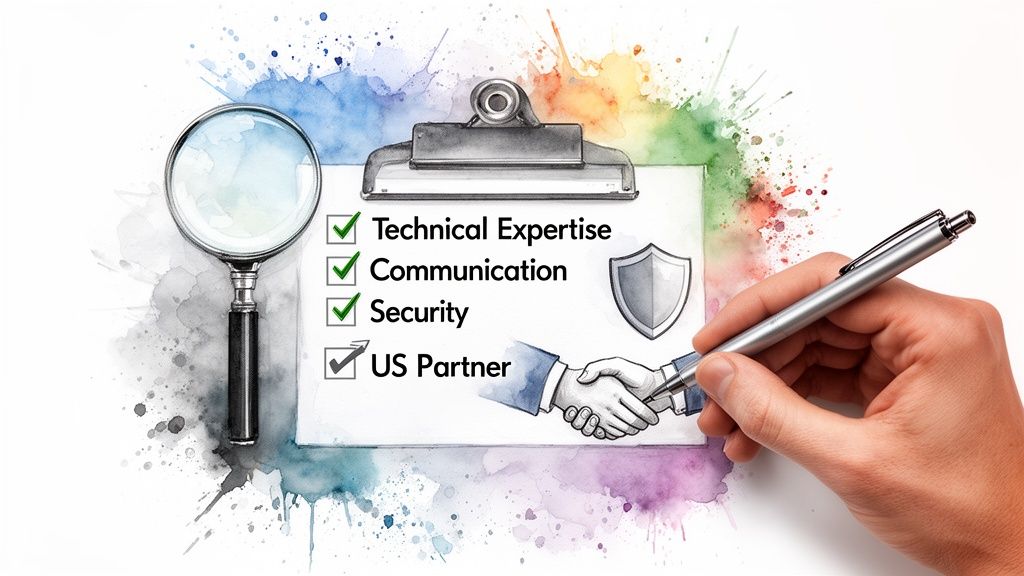
Choosing a software development partner is one of the most consequential decisions you’ll make. This isn’t just about hiring a team that can write code; it’s about entrusting a piece of your business’s future to an external group.
Get it right, and your partner becomes a seamless extension of your company. Get it wrong, and you’re looking at costly delays, endless frustration, and a product that misses the mark. To make this decision with confidence, you need a way to cut through the sales pitches and evaluate what truly matters.
Assessing Technical Prowess and Experience
First things first: can they actually do the work? Verifying a vendor’s technical chops is the absolute baseline. You need to know they have the right skills for today’s project and the depth to handle whatever comes next. Don’t just take their word for it—dig in.
Start by tearing apart their portfolio and case studies. Look for projects that mirror yours in scope, industry, and complexity. This is where you find hard evidence, not just promises.
Next, get specific about your tech stack. If your entire world is built on Python and AWS, a partner who only sings the praises of .NET and Azure might not be the right fit, no matter how great their reputation is.
Key Technical Questions to Ask:
- Can you walk me through a detailed case study from our industry?
- How do you make sure your developers are staying ahead of the curve, not just current?
- What does your process for code reviews, testing, and quality assurance actually look like day-to-day?
A partner’s technical expertise is their ticket to the game. But their proven track record of using that expertise to solve real-world business problems is what truly earns them a seat at the table.
Evaluating Communication and Cultural Fit
Even the most brilliant developers are useless to you if you can’t communicate effectively. Misunderstandings, delays, and misaligned expectations almost always trace back to poor communication and a lack of cultural sync. A great partnership feels like a collaboration, not a transaction.
Pay close attention to how they communicate during those first few calls. Are they proactive and transparent? Do they ask smart, insightful questions that show they’re genuinely trying to understand your business goals, or are they just waiting for their turn to talk?
Find out what project management tools (like Jira or Asana) and methodologies (like Agile or Scrum) they live by. If their workflow clashes with yours, you’re signing up for unnecessary friction from day one.
Verifying Security and Compliance Standards
In an age where data breaches are a daily headline, you can’t afford to be casual about security. Your outsourcing partner will have the keys to the kingdom—sensitive data, customer information, and valuable intellectual property. Their security has to be ironclad.
Ask them to get specific about their security policies. This covers everything from data encryption and access controls to secure coding practices. See if they hold any industry-recognized certifications, like ISO 27001, or if they’re compliant with regulations critical to your industry, such as GDPR or HIPAA.
These aren’t just fancy badges; they’re proof of a systematic commitment to protecting your assets. Understanding the cost of custom software development means recognizing that these non-negotiable security investments are part of the price.
The Strategic Benefit of a USA Partner
While skills and security are universal, a partner’s location is a strategic choice that can dramatically shape your experience. This is a critical component of any software development outsourcing guide. Choosing a partner headquartered in the USA adds a layer of assurance and operational smoothness that offshore-only vendors often struggle to match.
With a US-based partner, you get:
- Seamless Communication: Working in similar time zones and sharing a common business language erases the friction that plagues so many offshore projects. Collaboration is just easier and more responsive.
- Straightforward Legal Recourse: Your contracts fall under a familiar and robust US legal system. This makes agreements easier to enforce and gives you a clear, predictable path if disputes ever arise.
- Superior IP Protection: US intellectual property laws are some of the strongest in the world. Partnering with a domestic firm provides the highest level of confidence that your code, trade secrets, and proprietary data are locked down.
This model provides an invaluable sense of security and peace of mind. To explore how a US-based partnership can de-risk your outsourcing initiative, call our specialists at +1 (310)800-1398 for a consultation.
How to Navigate Contracts and Secure Your IP
Jumping into a software development project without a solid legal framework is like building a house with no blueprint. All the early excitement can quickly sour into expensive misunderstandings, scope creep, and the ultimate nightmare: a fight over who actually owns the finished product. A well-written contract is the single most important tool you have to keep everyone on the same page and protect your business.
This part of the process can feel like you need a law degree, but it really boils down to a few key documents that work together. Once you understand what each one does, you can confidently set the terms of your partnership and lock down your digital assets from day one.
The Core Legal Documents You Need
Think of your legal agreements as a layered defense system. You have the Master Service Agreement (MSA) setting the big-picture rules, the Statement of Work (SOW) detailing a specific project, and the Non-Disclosure Agreement (NDA) keeping your secrets safe.
These aren’t just formalities to be signed and filed away. They are the operating manual for your entire partnership.
- Master Service Agreement (MSA): This is your foundational contract, the one that governs the long-term relationship. It covers the big stuff like confidentiality, intellectual property rights, liability, and how to handle disputes. This way, you don’t have to renegotiate the fundamentals every single time you start a new project.
- Statement of Work (SOW): This document is where you get into the nitty-gritty of a single project. A good SOW spells out the scope, deliverables, timelines, milestones, payment schedule, and exactly how you’ll define “done.” It’s your best defense against the dreaded scope creep.
- Non-Disclosure Agreement (NDA): Usually the first thing you sign, an NDA is a legally binding promise to protect your trade secrets and any other proprietary information you share. It makes sure that what you discuss in confidence stays in confidence.
A well-structured contract suite does more than just cover you legally. It forces both sides to think through every detail of the project, creating a shared understanding that is the true foundation of a successful outsourcing partnership.
Protecting Your Intellectual Property
One of the biggest anxieties for anyone outsourcing is the security of their intellectual property (IP). Who owns the code? What happens to that proprietary algorithm you build together? Your MSA needs to tackle this head-on with a crystal-clear IP ownership clause.
The industry standard is simple and non-negotiable: the code and all related IP developed for you, and paid for by you, belongs 100% to you. The contract must state this explicitly, ensuring a complete transfer of ownership as soon as the work is paid for. There is absolutely no room for ambiguity here.
Implementing Non-Negotiable Security Practices
Beyond the legal paperwork, your partner has to show a real, practical commitment to cybersecurity. You’re trusting them with your proprietary code and potentially sensitive data, so their security posture is really an extension of your own. Your contract should require them to follow specific security best practices.
Essential security measures to enforce include:
- Secure Coding Standards: Your partner must follow established guidelines (like the OWASP Top 10) to prevent common security holes from being built right into your application.
- Strict Access Controls: This is all about the principle of least privilege. Developers should only have access to the systems and data they absolutely need to do their jobs, and nothing more.
- Endpoint Protection: Every single device the outsourced team uses to access your systems—laptops, desktops, you name it—must be locked down with up-to-date antivirus, firewalls, and encryption.
The USA Partner Advantage in Contracts and Security
Let’s be honest: navigating complex contracts and enforcing security rules gets a lot simpler when your partner is based in the US. This isn’t just about convenience; it adds a powerful layer of legal and operational safety.
A US-based firm operates under the same legal system you do. That means your contracts are drafted and enforced under familiar US law, giving you clear and predictable options if a dispute ever pops up. On top of that, US companies have a built-in understanding of domestic data privacy and security standards, making sure your project is compliant from the get-go. This legal alignment provides a level of protection and peace of mind that’s tough to replicate with offshore-only vendors.
Ready to build a partnership on a secure and legally sound foundation? Call our experts at +1 (310)800-1398 to discuss how we protect your interests.
Managing Your Remote Team for Peak Performance

So you’ve signed the contract. A lot of people think that’s the finish line, but in reality, it’s just the start. The real value in any outsourcing relationship isn’t found in the paperwork—it’s forged in the day-to-day partnership that follows.
True success depends on how well you manage, integrate, and transform a group of talented developers into a seamless extension of your own team. This isn’t about just handing off tasks. It’s about building a system of transparency, communication, and shared goals. Get it right, and your outsourced talent stops feeling “remote” and becomes an indispensable part of your workforce.
Establishing Clear Communication Channels
Communication is the absolute lifeblood of any successful outsourced project. Without it, even the most brilliant developers can drift off course, leading to misaligned expectations and expensive rework. The goal is to create a predictable, consistent rhythm of interaction that keeps everyone on the same page.
Think of it like a ship’s crew navigating a long voyage. The captain doesn’t just point in a direction and hope for the best. They rely on constant communication—status reports, course corrections, and team huddles—to ensure everyone is working in unison. In our world, daily stand-up meetings are the non-negotiable equivalent, whether they’re quick video calls or updates in a dedicated Slack channel.
These brief, daily check-ins are where progress is shared, roadblocks are identified, and priorities are adjusted in real-time. It’s a simple ritual that prevents small hiccups from becoming major disasters and builds a powerful sense of daily accountability.
Maintaining Visibility with Project Management Tools
You can’t manage what you can’t see. To keep a firm grip on your project, you need robust project management tools. Platforms like Jira, Asana, or Trello act as a centralized “single source of truth,” making tasks, timelines, and progress visible to absolutely everyone involved.
This transparency is what turns a black box of development work into a crystal-clear workflow. It lets you track a task from start to finish, see where every piece of the project stands, and make sure the team is always focused on what matters most. It replaces guesswork with data-driven oversight.
Fostering a unified ‘one team’ culture is the ultimate goal. It’s achieved by breaking down the ‘us vs. them’ mentality and integrating your remote developers so deeply that they operate as a genuine extension of your in-house workforce.
Measuring Progress with the Right KPIs
To truly understand how things are going, you need to look beyond just whether deadlines are being met. Key Performance Indicators (KPIs) give you objective metrics to measure the health and efficiency of your development engine. If you’re looking for a practical guide on how to measure developer productivity, it’s an invaluable resource for getting this right.
Essential KPIs to Track:
- Velocity: An Agile metric that measures how much work the team knocks out in a single sprint. It’s your crystal ball for forecasting future timelines.
- Cycle Time: This tracks how long it takes a task to go from “in progress” to “done.” It’s brilliant for spotting bottlenecks in your workflow.
- Code Quality: Use metrics like bug density or code churn to make sure that speed isn’t coming at the cost of a stable, reliable product.
- Deployment Frequency: How often are you shipping code to production? This KPI reflects your team’s agility and efficiency.
These numbers give you concrete data, turning subjective feelings about progress into objective conversations that drive real improvement.
The Advantage of a USA-Based Partner
Let’s be honest: managing a remote team, especially one across multiple time zones, comes with its own set of headaches. This is precisely where partnering with a US-based firm gives you a powerful edge. They act as a management and communication bridge, aligning global talent with your business hours and cultural norms.
This structure smooths out the friction points, ensuring communication flows effortlessly and your project is managed within a familiar framework. It’s a strategic move that helps explain why the U.S. is projected to dominate outsourcing spending at $213.60 billion in 2025.
For a fully managed solution that turns talent into peak performance, call our experts at +1 (310)800-1398. By focusing on people and processes, you can unlock incredible value. Learn more about retaining talent with these essential strategies.
Common Questions About Software Outsourcing
Even with a solid strategy in hand, stepping into the world of software outsourcing can bring up a lot of “what if” questions. That’s completely normal. Feeling confident about the journey means getting straight answers to the things business leaders worry about most.
Let’s tackle some of the most common questions we hear, so you can move forward with clarity.
How Can I Ensure Quality Control with a Remote Team?
This is usually the number one concern, and for good reason. The secret to quality isn’t about having everyone in the same room; it’s about having a rock-solid process and the right people running it. A partner worth their salt doesn’t leave quality to chance.
Here’s what that looks like in practice:
- Rigorous Vetting: Top-tier partners don’t just test for coding skills. They have a multi-stage vetting process that digs into problem-solving, communication, and big-picture thinking.
- Structured Code Reviews: Quality is built in, not bolted on. Systematic peer code reviews and oversight from senior architects catch potential issues before they ever become real problems.
- Automated Testing: A strong suite of automated tests for unit, integration, and end-to-end functionality acts as a safety net, ensuring new features don’t break what already works.
When you focus on these process-driven guardrails instead of physical location, you can easily match—and often even surpass—the quality standards of an in-house team.
Will Time Zone Differences Negatively Impact My Project?
Time zone differences can be a roadblock, but they can also be a hidden advantage if you know how to work with them. While a 12-hour difference can create painful communication delays, a smaller gap can actually boost productivity. Many companies find that a 2-4 hour overlap each day is the sweet spot for real-time collaboration.
The goal isn’t to erase time differences but to build a workflow that thrives on them. This usually involves structured handoffs, smart asynchronous communication on tools like Slack, and scheduling important sync-ups during that overlap window to keep everyone aligned.
This is a huge benefit of working with a US-based partner. They serve as a management layer that bridges any time zone gaps, making sure your project is actively managed during your business hours while still giving you access to global talent. You get seamless communication without giving up the cost benefits.
How Much Can I Realistically Expect to Save?
Cost savings are definitely a major reason to outsource, but the numbers can vary. While you might see headlines promising savings up to 60%, a more realistic expectation for a high-quality engagement is in the 30-50% range. That’s compared to the fully-loaded cost of an equivalent in-house hire in a major US tech hub.
“Fully-loaded cost” is the key phrase here. It’s not just salary. It’s everything else that comes with an employee:
- Recruitment fees
- Benefits and payroll taxes
- Office space and equipment
- Training and onboarding costs
When you add up all those associated expenses, the financial case for outsourcing becomes incredibly compelling.
Is Outsourcing a Permanent Shift Away from In-House Teams?
Not at all. Thinking about outsourcing as an all-or-nothing decision is an outdated approach. Today, it’s a flexible, strategic tool you can pull out of the toolbox whenever you need it. The industry has moved away from one-off, transactional projects and is now focused on building integrated, long-term partnerships. The data backs this up.
Over 64% of global companies now outsource at least one software function, with development itself making up 64% of all outsourced services. What’s really telling is that 87% of companies integrate these professionals just like internal team members, and a massive 83% commit to these partnerships for the long haul. This shows a clear trend toward building flexible, scalable teams for everything from AI initiatives to enterprise cloud migrations. You can explore more of these software outsourcing statistics on onetechnologyservices.com.
Many businesses use outsourcing to augment their current teams, fill a temporary skill gap, or fast-track a product launch, all while their core team stays focused on the long-term vision. It’s about adding firepower and expertise exactly where and when you need it most.
How Do I Start a Conversation About Outsourcing?
The best first step is simply to talk to an expert—someone who can listen to your specific situation and walk you through the options. A quick consultation can help you define your project scope, figure out the right engagement model, and get a clear picture of potential costs and timelines. There’s no faster way to cut through the noise than by talking to someone who solves these kinds of challenges every day.
Ready to build a resilient, scalable tech team with a trusted partner? The experts at NineArchs LLC can provide a clear, no-obligation consultation to map out a strategy that fits your business goals. Call us today at +1 (310)800-1398 or visit us online to get started.