

Technology strategy consulting is all about making sure your company’s technology isn’t just a cost center, but a genuine driver of your business goals. It’s not about picking the latest software off the shelf; it’s about drawing a strategic blueprint that uses technology to fuel growth, create efficiencies, and give you an edge in the market.
What Is Technology Strategy Consulting
Think of a technology strategy consultant as a business architect. But instead of designing a physical building, they design a master plan for your company’s digital foundation. This plan ensures every tech decision you make—from moving to the cloud to automating a painful internal process—is deliberate and pushes your long-term vision forward.

This approach is the opposite of reactive problem-solving. It’s about building a robust framework that connects your people, processes, and technology into a single, cohesive system. The goal is a solid foundation for sustainable growth, not just applying another temporary fix to a recurring problem.
The Architect Versus The Handyman
Your IT support team is like a great handyman—they are absolutely essential for fixing leaks, replacing faulty wiring, and keeping the lights on day-to-day. A technology strategy consultant, on the other hand, is the architect who designed the building in the first place.
They made sure the plumbing, electrical systems, and structural supports were all designed from the ground up to meet the owner’s future needs. This distinction is critical. One manages the present; the other builds for the future. A smart strategy ensures you aren’t constantly calling the handyman for problems that a better initial plan could have prevented entirely.
Core Objectives of a Technology Strategy
A technology strategist is laser-focused on hitting specific business outcomes. While every company is different, the primary objectives almost always circle back to these three areas:
- Improving Operational Efficiency: This means hunting down and eliminating bottlenecks. It could involve automating manual tasks that drain your team’s time, integrating systems that don’t talk to each other, or redesigning entire workflows from scratch.
- Gaining a Competitive Edge: Here, technology becomes a weapon. It can be used to create new products, break into new markets, or deliver a superior customer experience that your competitors simply can’t match.
- Future-Proofing the Business: The goal is to build a flexible and scalable tech infrastructure that can adapt to whatever comes next—market shifts, new regulations, or unexpected opportunities. You’re building for change, not just for today.
The demand for this kind of expertise is exploding. The global technology consulting market is on track to blow past $400 billion in 2026, largely because businesses feel an urgent need to upgrade and bring in specialized skills they don’t have in-house. With 84% of businesses planning operational upgrades in the next year alone, many are looking to consultants to help them get it right.
To help clarify what this looks like in practice, here are some of the key domains a technology strategy engagement typically covers.
Key Focus Areas in Technology Strategy Consulting
This table breaks down the core pillars of technology strategy, showing how each area connects directly to real business results.
| Focus Area | Description | Business Impact |
|---|---|---|
| IT Infrastructure & Cloud | Assessing and optimizing servers, networks, and cloud services for scalability, security, and cost-effectiveness. | Reduces operational costs, enhances security, and improves system reliability and performance. |
| Data & Analytics | Developing strategies to collect, manage, and analyze data to drive informed decision-making and uncover insights. | Enables data-driven decisions, improves customer understanding, and identifies new revenue opportunities. |
| Cybersecurity & Risk | Creating a comprehensive security posture to protect digital assets, ensure compliance, and mitigate cyber threats. | Protects brand reputation, prevents costly data breaches, and ensures regulatory compliance. |
| Digital Transformation | Reimagining business models, processes, and customer experiences using modern digital technologies. | Enhances customer engagement, improves operational agility, and creates a sustainable competitive advantage. |
| Software & Application | Rationalizing the application portfolio and planning for the development or adoption of new software solutions. | Eliminates redundant software costs, improves user productivity, and aligns tools with business needs. |
| IT Governance & Operating Model | Designing the organizational structure, roles, and processes to manage technology effectively and align with business goals. | Ensures IT investments deliver value, improves project success rates, and fosters clear accountability. |
These focus areas aren’t just technical jargon; they are the building blocks of a business that’s ready for the future.
A technology strategy isn’t about the tech you have; it’s about what you do with the tech you have. The right plan turns technology from a cost center into a powerful engine for growth and innovation.
For businesses here in the USA, working with a domestic outsourcing firm offers a massive advantage. A US-based partner means clear communication, cultural alignment, and a shared understanding of your market. That proximity is vital for a process that demands deep collaboration. To see how top leaders connect the dots, check out this guide on Strategy & Technology: A Guide for Executive Leadership.
Ready to architect your business’s future? Call us at +1 (310)800-1398 to start the conversation.
When Does Your Business Need a Technology Strategy Consultant?
Knowing the right moment to call in an expert isn’t just a smart move—it’s a powerful competitive advantage. Too many businesses treat technology like a series of fires to put out, only dialing for help when something is already smoking.
But the smartest companies engage technology strategy consultants proactively. They spot key moments where a bit of outside guidance can prevent small headaches from morphing into expensive, growth-stifling migraines.

These moments aren’t always big, dramatic crises. More often, they’re the subtle but persistent pains that signal a deep misalignment between your current tech and your future ambitions.
Key Triggers for Engaging a Consultant
Certain scenarios are dead giveaways that it’s time to bring in some outside perspective. If you see your company in any of these situations, a consultant can deliver the clarity and direction you need to break through.
- When Growth Outpaces Your Systems: Your startup is taking off, but the patchwork of software and manual processes that worked for a team of ten is now creating chaos for fifty. A consultant helps design a scalable architecture and software stack that grows with you, not against you.
- When Outdated Processes Become Bottlenecks: Manual data entry, disconnected apps, and repetitive tasks are grinding your teams to a halt and causing costly mistakes. An expert can pinpoint automation opportunities and integrate your systems, creating workflows that actually flow.
- When You’re Staring Down a Major Transformation: You’re planning a huge shift, like migrating your entire infrastructure to the cloud, rolling out a new ERP system, or navigating a merger. These are complex, high-stakes projects that demand a strategic roadmap to manage risk and get everyone pulling in the same direction.
- When Legacy Systems Turn into Liabilities: Your core software is old, unsupported, and a nightmare to maintain. A consultant can assess the real risks, evaluate modern alternatives, and build a phased modernization plan that won’t disrupt your entire operation.
These triggers are universal, hitting everything from agile startups to established enterprises. The common thread is always a growing gap between where the business is today and where it needs to be tomorrow.
A technology consultant is most valuable when you’re asking, “What’s next?” not just, “What’s broken?” They provide the foresight to build a bridge to your future, instead of just patching the road you’re already on.
The Value of a Domestic Outsourcing Partner
For businesses in the USA, choosing a domestic outsourcing partner for technology strategy offers huge benefits that go far beyond just technical skill. Working with a US-based firm means seamless collaboration. You get professionals who operate in your time zone and have a deep, intuitive grasp of the local market and regulatory landscape.
This alignment eliminates the communication friction that can derail complex strategic talks. When you’re making critical decisions about your company’s future, having a partner who speaks your language—both literally and culturally—is non-negotiable.
If you’re facing any of these strategic challenges, don’t wait for the pain points to become full-blown emergencies. A proactive approach saves time, money, and a whole lot of frustration. Call +1 (310)800-1398 to discuss how a clear technology strategy can help you navigate your next stage of growth.
The Core Framework of a Winning Technology Strategy
A winning technology strategy doesn’t just materialize out of thin air. It’s born from a disciplined, methodical process that turns ambitious goals into a plan you can actually execute. Think of it like building a bridge: first, you survey the land where you are, then you design the structure needed to reach the other side, create a step-by-step construction plan, and finally, establish rules to make sure the bridge is used safely and maintained for the long haul.
Top technology strategy consulting firms lean on a proven four-phase framework that gets this done. It’s designed to move a business from its current challenges to its desired future without the guesswork.
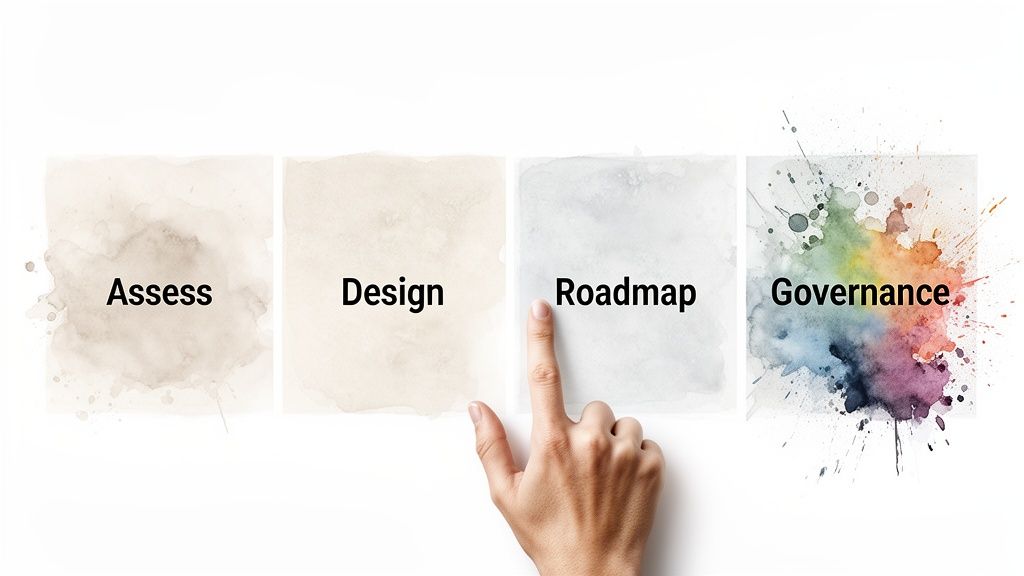
This structured approach grounds the entire project in data and business reality. Let’s walk through each phase to see how it all comes together.
Phase 1: Current-State Assessment
The journey always starts with an honest, unflinching look at where your business stands right now. This is far more than a quick inventory of servers and software licenses; it’s a deep diagnostic. Consultants will sit down with your stakeholders, analyze day-to-day workflows, and audit your entire technology stack.
The whole point is to find real answers to critical questions:
- What are the biggest tech-related headaches for our employees and customers?
- Where are the hidden slowdowns and process bottlenecks?
- Which systems are outdated, insecure, or actively holding us back from growing?
This phase is all about uncovering the “why” behind the problems. It’s like a doctor running diagnostic tests before writing a prescription—you need an accurate diagnosis to make sure the cure actually works.
Phase 2: Target-State Architecture
Once you have a crystal-clear picture of the present, you can start designing the future. The Target-State Architecture is the blueprint for what your technology environment will look like once the strategy is in place. Crucially, this design isn’t created in a vacuum; it’s tied directly to your biggest business goals.
For example, if your five-year plan is to expand into Europe, the target-state architecture will prioritize a scalable, cloud-based infrastructure and e-commerce platforms ready for multiple currencies and languages. If the goal is to become the industry leader in customer service, the design will center on CRM integration and AI-powered support tools.
This phase is what connects your business vision to tangible technology solutions, ensuring every dollar spent serves a strategic purpose. It’s this kind of critical planning that is fueling the explosive growth of the software consulting industry. The market, estimated at $380.26 billion in 2026, is projected to nearly double to $801.43 billion by 2031. This surge comes from companies racing to implement advanced data, AI, and ML services to get a real competitive edge, with North America standing out as the premier hub for these strategic partnerships.
Phase 3: Strategic Roadmap
A beautiful blueprint is useless without a construction plan. That’s exactly what the Strategic Roadmap is. It breaks down the massive journey from your current state to the target state into a series of clear, actionable, and sequenced projects.
This isn’t some vague wish list. A proper roadmap includes:
- Prioritized Projects: Initiatives are ranked based on business impact, urgency, and resource needs. Quick wins that build momentum are identified alongside long-term foundational projects.
- Timelines and Milestones: Every project gets a defined timeline with key milestones, making progress measurable and transparent for everyone.
- Resource Allocation: The roadmap clearly outlines the budget, people, and tools needed for each phase of the rollout.
- Dependency Mapping: It shows how different projects are interconnected, ensuring foundational work gets done before later initiatives can begin.
This phase transforms a grand vision into a manageable, step-by-step guide your teams can actually follow. It’s a game-changer for getting everyone, from the C-suite to the IT department, on the same page. You can explore our guide on digital transformation consulting services to see how these roadmaps power major business changes.
The purpose of a roadmap is not just to show what needs to be done, but to build organizational alignment on how and when it will get done. It turns a strategic document into a living execution plan.
Phase 4: Governance Model
Finally, to make sure the strategy succeeds for years to come, you need a Governance Model. This is the set of rules, roles, and processes that will guide technology decisions and execution from this point forward. It ensures the plan stays on track and can adapt to new challenges and opportunities without losing its way.
A strong governance model clearly defines:
- Who makes the final call on key technology decisions?
- How are new projects proposed and approved?
- How will the budget be managed and tracked?
- How will we measure performance and report on it?
This structure is what prevents the organization from slipping back into old habits of making reactive, siloed tech decisions. It instills the discipline needed to keep your technology and business strategy permanently aligned.
Throughout this intensive four-phase process, partnering with a US-based outsourcing team is a distinct advantage. Seamless communication, aligned time zones, and a shared business culture are essential for the deep collaboration required to build a winning strategy. When the stakes are this high, you need a partner who is right there with you. To discuss how this framework can be applied to your business, call us at +1 (310)800-1398.
Measuring the ROI of Your Technology Strategy
A great strategy delivers real results, not just impressive reports. To truly prove the value of your technology investments, you have to move beyond abstract goals and get down to the tangible outcomes and Key Performance Indicators (KPIs) that signal real business impact. This is how you connect every dollar spent on technology directly to bottom-line improvements.

This process isn’t about chasing vanity metrics; it’s about identifying the concrete numbers that actually matter to your organization. The right technology strategy consulting partner helps you define these metrics from day one, building accountability and a clear definition of success right into the plan.
From Business Goals to Tangible KPIs
The key is to translate high-level business objectives into specific, quantifiable KPIs. This ensures every technology initiative is directly tied to a desired business outcome, making it easy to justify investments with hard data.
For example, think about these common goals:
- Reduced Operational Costs: Are you implementing a new automation platform? The real KPI isn’t the platform’s features, but the reduction in manual processing hours or the decrease in operational expenditures quarter-over-quarter.
- Increased Team Productivity: If you’re upgrading collaboration tools, success is measured by a reduction in project completion times or an increase in tasks completed per employee.
- Higher Customer Satisfaction: For an improved e-commerce infrastructure, track metrics like Net Promoter Score (NPS), customer retention rates, or a decrease in support ticket volume.
- Faster Time-to-Market: When refining your development pipeline, the goal is to see a tangible reduction in the product development lifecycle from concept to launch.
This level of detailed tracking is what separates a successful strategy from a failed one. It empowers you to hold your consulting partner accountable and demonstrate clear value to stakeholders.
The real measure of a technology strategy is not in the sophistication of the tools it recommends, but in the simplicity and power of the business results it delivers. ROI is proven with numbers, not just narratives.
To make this even clearer, here’s a table showing how business goals translate directly into technology initiatives and measurable KPIs.
Sample KPIs for Technology Strategy Engagements
| Business Goal | Technology Initiative | Primary KPI |
|---|---|---|
| Reduce Operational Costs | Implement Robotic Process Automation (RPA) | -25% in manual data entry hours |
| Improve Customer Retention | Launch a new CRM and customer support platform | +15% in customer retention rate within 12 months |
| Increase Sales Velocity | Upgrade e-commerce checkout and payment gateway | -20% in shopping cart abandonment rate |
| Enhance Team Collaboration | Migrate to a cloud-based project management tool | -30% in average project completion time |
| Accelerate Product Innovation | Adopt a CI/CD pipeline and DevOps practices | 50% faster deployment frequency |
As you can see, every initiative is designed to move a specific needle. This is the kind of accountability that turns a technology strategy from an expense into a powerful growth engine.
The Growing Demand for Measurable Outcomes
This intense focus on ROI is driving significant growth in the consulting market. The IT consulting services sector is projected to hit a market value of $117.1 billion by the end of 2025, with forecasts showing it rocketing to $278.779 billion by 2033. North America is leading the charge, with the US market accounting for nearly 80% of the region’s share. This underscores its role as the primary hub for high-value engagements centered on delivering measurable returns. You can dive deeper into these trends by exploring the full market report on IT consulting services.
Partnering for Success with a US-Based Firm
Choosing an outsourcing partner from the USA for your technology strategy consulting engagement provides a distinct advantage in hitting these measurable goals. A US-based team operates in your time zone, which means real-time collaboration and swift problem-solving. This proximity fosters the kind of clear, direct communication essential for defining, tracking, and reporting on complex KPIs.
Ultimately, a domestic partner shares a deep understanding of the US business environment, making it far easier to align technology initiatives with your specific market pressures and opportunities. They’re simply better positioned to help you translate strategic plans into the hard data that proves your success. You can learn more about how to put these changes into action by reading our article on the benefits of business process automation.
Ready to build a strategy that delivers a clear, measurable return on investment? Call us at +1 (310) 800-1398 to start a conversation focused on your business outcomes.
How To Choose The Right Technology Strategy Partner
Picking a technology strategy partner is one of those make-or-break decisions. Get it right, and you’re on a path to real growth with a serious competitive edge. Get it wrong, and you’re looking at wasted money, stalled projects, and a whole lot of frustration.
This isn’t just about hiring a vendor. It’s about finding a partner who becomes an extension of your team, someone who aligns not just with your tech stack but with your culture and long-term vision. The selection process needs to be deliberate and thorough.
First, Figure Out What You Actually Need
Before you even think about looking at consulting firms, you need to look inward. The first step is to get your own house in order by creating a clear and concise Request for Proposal (RFP). Think of this document as your compass. It outlines what you’re trying to achieve, the specific headaches you’re dealing with, and the scope of work you have in mind.
A solid RFP should clearly lay out:
- Your main business goals for the project.
- A quick summary of your current tech setup and known pain points.
- The specific skills you’re looking for (e.g., cloud migration, cybersecurity, AI integration).
- Your expected timelines and budget realities.
Getting this down on paper forces you to build consensus internally. It also gives potential partners a real foundation to build a thoughtful proposal on. Without it, you’re just window shopping without a list.
Key Things to Look For On Your Shortlist
Once the proposals start rolling in, your job is to look way beyond the price tag. A truly great technology strategy consulting firm brings a mix of hard technical skills and soft people skills to the table. You need to size them up across a few critical areas.
Look for a partner who shows:
- Deep Industry Experience: Do they get your world? A firm with a track record in your sector will already understand the unique challenges and regulatory quirks you face, saving everyone a ton of time.
- Proven Technical Chops: Their team should have real, demonstrable skills in the technologies that matter for your future—whether that’s cloud architecture, data analytics, AI, or cybersecurity. Don’t be shy about asking for certifications and project examples.
- A Clear, Proven Methodology: How do they actually do the work? They should be able to walk you through their process for assessment, design, and implementation. You want to see a clear, logical framework, not just vague promises.
Look For Proof, Not Promises
Talk is cheap. The best way to know what a firm can do is to see what they’ve already done. When you’re picking a partner, digging into their past performance is non-negotiable, which you can often do by reviewing their past projects.
Ask for detailed case studies relevant to your company’s size and challenges. When you read them, don’t just look at the shiny outcome. Pay attention to how they handled unexpected roadblocks and collaborated with the client’s team. Even better, ask for client references—and actually call them.
A partner’s value isn’t just in the strategy they deliver, but in how they deliver it. The best firms are master communicators and collaborators who empower your team, not just hand over a report.
During the interview process, ask tough questions. Give them a hypothetical challenge specific to your business and see how they tackle it. Their answers will tell you volumes about their strategic thinking and whether they’ll be a good cultural fit.
The Clear Advantage of a US-Based Partner
For businesses in the United States, there are some very practical, down-to-earth benefits to choosing a domestic partner for your technology strategy. Working with an outsourcing partner from the USA offers an operational and cultural sync that you just don’t get with offshore alternatives.
The key advantages are pretty straightforward:
- Timezone Alignment: Real-time collaboration is a must for complex strategic work. A US-based partner is working when you are, which kills communication lag and makes working together frictionless.
- Superior Communication: With no language barriers or major cultural gaps, conversations are just clearer and more direct. This prevents the kind of small misunderstandings that can derail big projects.
- Robust IP Protection: Working with a US company gives you the peace of mind that comes with strong intellectual property laws and data security regulations. Your sensitive business information stays protected.
When you need a partner who can slot right into your team, understand your market, and be there when you need them, a domestic firm is simply the better choice. If you’re a US-based business looking for a partner that gets your culture and works your hours, give us a call at +1 (310)800-1398 for a consultation. You can also explore our guide if you need a specialized cloud strategy consultant to help map out your digital infrastructure.
Right, you’ve absorbed the frameworks and seen the models. You have the blueprint for a solid technology plan. But let’s be honest—a strategy is just a document until you make it move. It’s time to bring this thing to life.
And remember, a real technology strategy isn’t a project you finish and file away. It’s a discipline, something you weave into the very fabric of your business to drive real, sustained growth.
The best place to start is often the simplest, yet most critical: an honest look in the mirror. Conduct an internal audit. Get real about your current tech headaches, talk to the people on the front lines, and nail down your most urgent business goals. This initial clarity is what gives you the confidence to take that first meaningful step forward.
Your Immediate Next Steps
To get from planning to doing, forget the giant, intimidating project plan for a moment. Focus on these three initial actions instead:
- Chase a Quick Win: Find one or two immediate pain points that technology can fix with minimal fuss. Automating a single, frustrating manual process can build incredible momentum and get everyone excited about what’s next.
- Form a Core Team: You can’t do this alone. Pull together a small, cross-functional crew to champion the strategy. Make sure you have people from IT, operations, and leadership in the room from day one to keep everyone aligned.
- Define Your Top 3 Goals: What are the three most important things technology must achieve for the business in the next 12 months? Be brutally specific. Write them down. These are your north stars for every initial project.
This approach stops “analysis paralysis” dead in its tracks and starts delivering value right away.
A technology roadmap is a living document, not a static map. The goal isn’t to predict the future perfectly. It’s to build an agile foundation that lets your business adapt and thrive, no matter what comes next.
When you’re ready to build and execute a roadmap designed for the long haul, bringing in an expert can be a game-changer. An experienced technology strategy consulting firm helps you navigate the messy parts of implementation, from picking the right vendors to managing the human side of change within your organization.
And when that execution phase is mission-critical, engaging a trusted outsourcing partner from the USA ensures you get seamless communication and cultural alignment. A domestic partner is in your time zone, gets your market, and provides the kind of hands-on collaboration needed to turn your strategic vision into a working reality.
Ready to build a technology roadmap that actually drives growth? Contact us today for a strategic consultation at +1 (310)800-1398.
Still Have Questions About Tech Consulting?
It’s completely normal. Even after you see the potential, there are always practical questions that come up before you bring a partner on board. Let’s tackle some of the most common ones we hear from business leaders. Getting these answers sorted out is often the final step before you can move forward with confidence.
Think of this as the nuts-and-bolts conversation about cost, time, and what separates true strategy from everyday IT help.
What Does a Typical Engagement Cost?
This is the big one, and the honest answer is: it depends. The cost of a technology strategy engagement isn’t a one-size-fits-all number. It’s shaped by the scope of what you need, the size of your company, and just how tangled the challenges are.
An engagement might range from a few thousand dollars for a sharp, focused assessment to a six-figure investment for a complete overhaul of an enterprise-level strategy. The key is that a good firm won’t just throw a number at you. They’ll provide clear, value-based pricing that ties every dollar directly to the business outcomes you’re trying to achieve.
How Long Does It Take to Develop a Technology Roadmap?
The timeline for building a roadmap is all about the depth of the discovery process and the scale of your business. A quick, slapped-together plan is a recipe for disaster. You need something that’s both ambitious and grounded in reality.
- For Small to Mid-Sized Businesses: We can often develop a comprehensive, actionable roadmap in 4 to 8 weeks.
- For Large Enterprises: If you’re dealing with complex legacy systems or juggling multiple business units, it’s more realistic to expect a 3 to 6-month process. This ensures we get deep into the details and get everyone on the same page.
Remember, the goal isn’t just speed; it’s precision. A well-crafted roadmap saves an incredible amount of time and money later on by preventing those costly detours and course corrections.
What’s the Difference Between IT Support and Technology Strategy?
This is a critical distinction, and mixing them up can lead to a lot of frustration. They’re both essential, but they play completely different roles.
Think of IT support as the firefighters. They are fundamentally reactive. Their job is to put out immediate fires, fix what’s broken, and keep the day-to-day operations running smoothly. From troubleshooting software glitches to managing the network, they keep the lights on.
Technology strategy consulting, on the other hand, is proactive. A strategist is the architect drawing the blueprint for your future. They aren’t just focused on making sure your tech works today; they’re designing a long-term plan to ensure your technology is actively driving your business goals and creating a real competitive advantage.
Choosing an outsourcing partner from the USA for strategic work offers a distinct advantage here. Having a domestic team means you get real-time collaboration and a deep, intuitive understanding of the US market—both are vital for building a winning, proactive technology plan.
Ready to get clear, actionable answers for your specific business challenges? Contact us to discuss your technology goals.
Start the conversation today by calling us at +1 (310)800-1398.