

A lot of business leaders arrive at the same point. Customer emails are piling up, phone queues are becoming unpredictable, sales follow-up is inconsistent, and internal teams are spending too much time on conversations that require patience, process discipline, and strong systems.
That is where the voice process in BPO becomes relevant.
For some companies, it is the front door to customer support. For others, it is a revenue engine for lead generation, renewals, collections, or appointment setting. In both cases, the voice channel still matters because some problems are too emotional, too urgent, or too nuanced to solve through chat alone.
The challenge is that many leaders hear the phrase “voice process” and picture an old-fashioned call center. Modern voice operations are much more than that. They combine trained people, clear workflows, quality controls, CRM visibility, routing logic, and increasingly, AI tools that help agents work faster without removing the human element customers still expect.
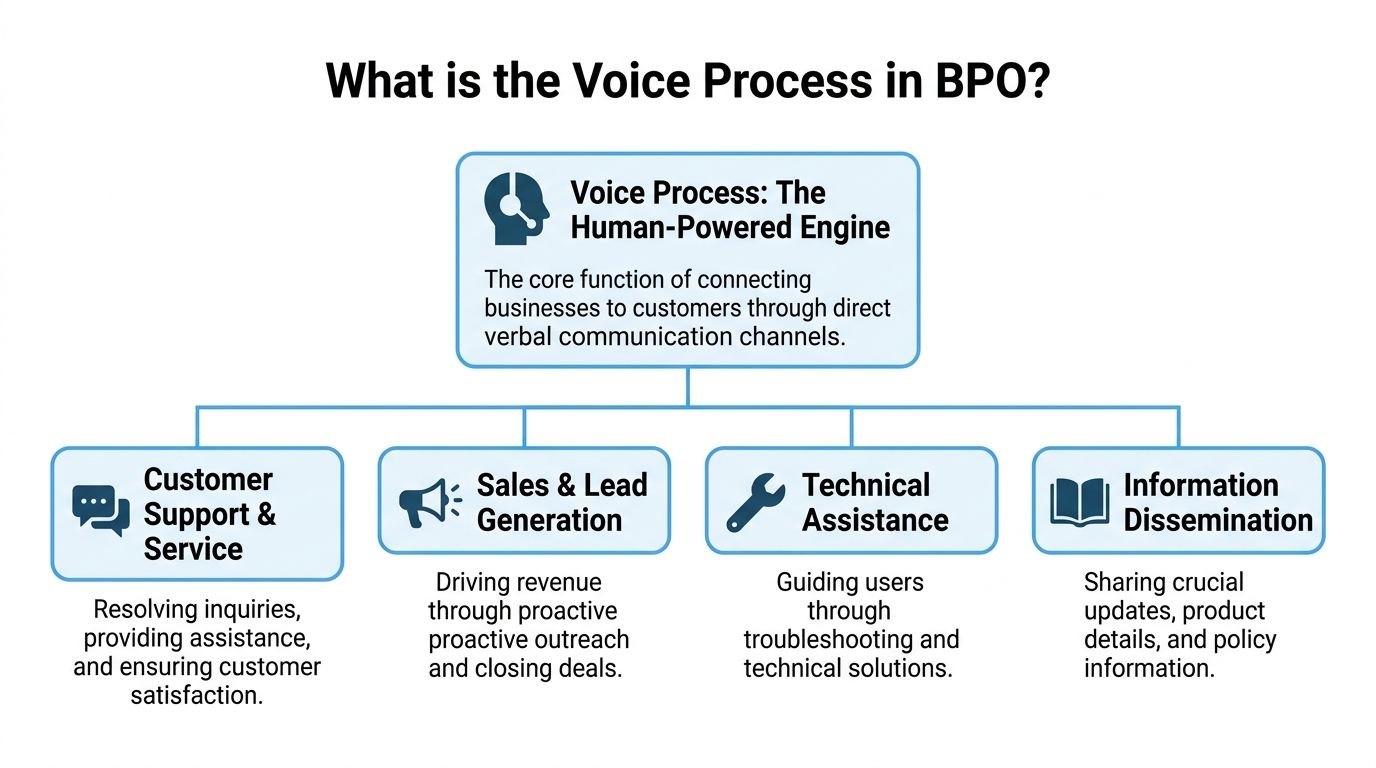
What Is the Voice Process in BPO
Think of a voice operation as an air traffic control system for customer conversations. Calls come in or go out. Someone has to guide each interaction to the right destination, keep communication clear, and make sure nothing important gets lost in transit.
In simple terms, voice process in BPO means handling business communication through live phone interactions. That can include customer support, technical help, sales calls, appointment reminders, account updates, and issue resolution. The work is performed by a specialized outsourcing team rather than entirely by your in-house staff.
Why voice still matters
Digital channels are useful for speed and convenience. But voice remains important when customers need reassurance, explanation, or a decision in real time.
A billing dispute is a good example. A customer may ignore a templated email, but a trained agent can listen, clarify the issue, confirm the account details, and resolve the concern in one call. That direct exchange builds trust in a way text-based channels often cannot.
Voice is also still a major business segment. The voice process within customer experience outsourcing held the largest revenue share in 2024, and the overall customer experience BPO sector was estimated at USD 102.03 billion in 2024, with a projection of USD 296.29 billion by 2033 according to Unity Connect’s overview of BPO performance metrics.
Voice process versus non-voice work
The easiest way to separate the two is this:
- Voice process: Real-time spoken interactions over the phone
- Non-voice process: Email, chat, ticket handling, back-office processing, and other text-based tasks
That distinction sounds simple, but it matters strategically.
Voice work handles moments where tone, empathy, and immediate clarification are valuable. Non-voice channels are better for routine updates, documented exchanges, and high-volume transactional work. Most growing businesses need both. The question is not which one is better. The question is which customer situations require a live human conversation.
Key takeaway: Voice is not just a support channel. It is the part of the customer experience where your brand sounds human.
What businesses usually outsource
Common voice functions include:
- Customer service: Order questions, billing help, account updates
- Technical support: Troubleshooting and guided problem-solving
- Sales outreach: Lead qualification, follow-ups, renewals
- Notifications and reminders: Appointment confirmations, service updates
When leaders understand voice process this way, it stops sounding like a generic outsourcing term and starts looking like what it is. A structured system for handling the conversations that most affect customer trust, revenue, and retention.
Understanding Inbound and Outbound Workflows
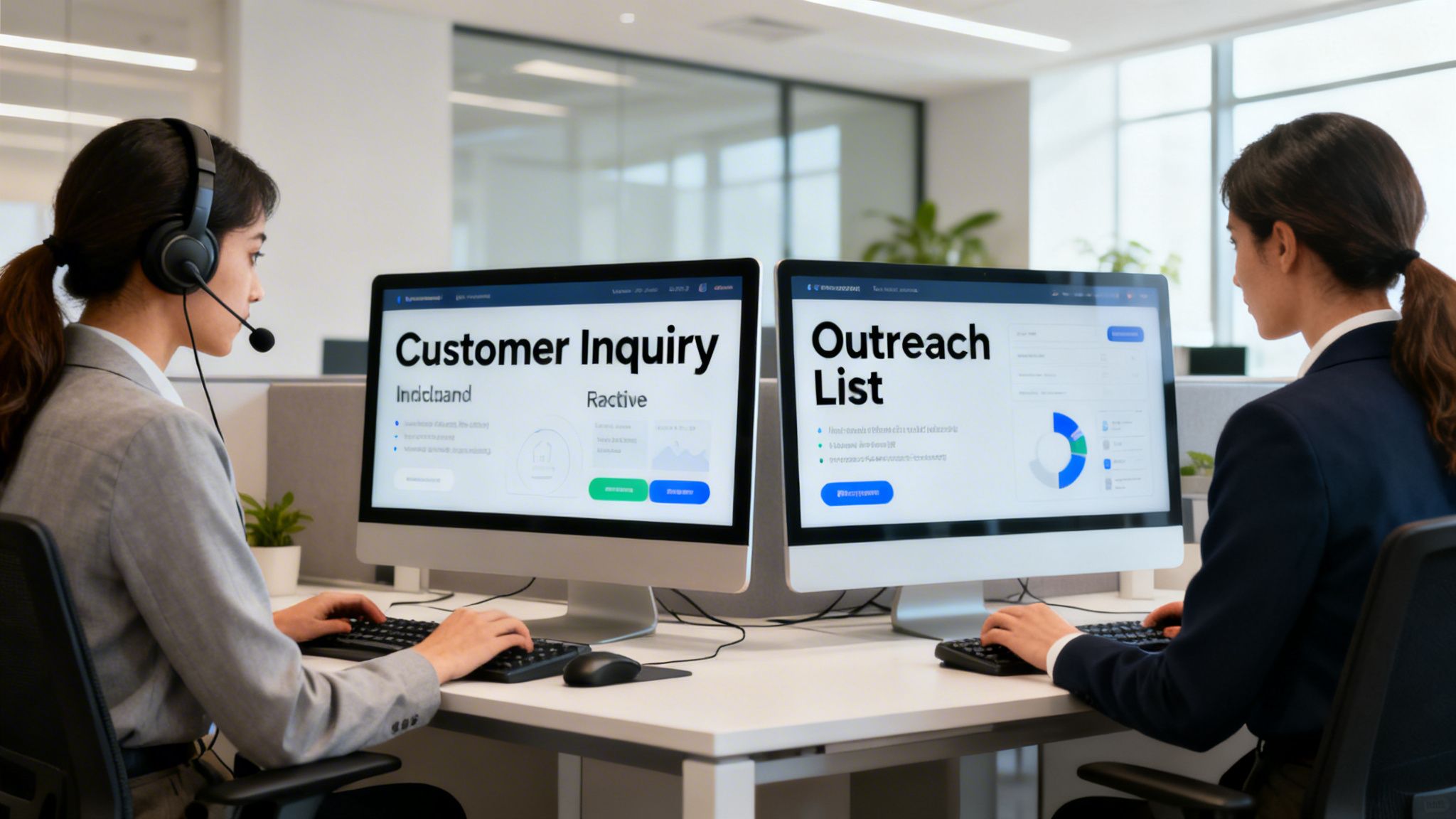
The clearest way to understand voice operations is to split them into inbound and outbound work. One reacts to customer demand. The other creates momentum.
Inbound work
Inbound calls happen when the customer contacts you first.
This is the classic support model. A customer calls to check an order, dispute a charge, reset a password, ask about coverage, or get help with a product issue. The business is responding to an existing need.
Inbound teams usually succeed when they do three things well:
- Answer quickly: Long waits create frustration before the conversation even begins.
- Understand context fast: Agents need account history, recent actions, and notes in front of them.
- Resolve without transfer loops: Customers dislike repeating their problem to multiple people.
A good inbound operation feels calm and organized. The customer should feel that the business knows who they are, understands why they called, and has a path to resolution.
Outbound work
Outbound calls happen when your team initiates the contact.
These calls may support sales, renewals, collections, surveys, appointment setting, win-back campaigns, or lead qualification. The business is not waiting for a need to arrive. It is proactively reaching out.
Outbound work requires a different rhythm. Agents need stronger opening statements, clearer objection handling, and better list management. A support-style agent may be excellent on inbound calls but struggle in outbound if they are not trained to guide the conversation confidently.
A simple comparison
| Workflow | Who starts the call | Typical goal | Common example |
|---|---|---|---|
| Inbound | Customer | Solve a problem or answer a question | “Where is my order?” |
| Outbound | Business | Drive action or gather information | “Are you available for a product demo?” |
How leaders choose the right model
Many businesses do not need to choose one or the other. They need the right mix.
A software company may need inbound technical support and outbound renewal calls. A healthcare practice may need inbound scheduling plus outbound reminders. A B2B services firm may rely heavily on outbound prospecting while keeping a smaller inbound help desk.
The confusion usually comes from treating “voice process” as one single department. In reality, inbound and outbound workflows behave like two different engines. They use the same channel, but they run on different goals, scripts, staffing models, and management rules.
Practical test: If the conversation starts with a customer need, it is inbound. If it starts with a business objective, it is outbound.
Where businesses make mistakes
Three errors show up often:
Using the same agents for everything
Support and outreach require different strengths.Applying the same script logic
Inbound scripts should reduce friction. Outbound scripts should create engagement.Measuring both workflows the same way
A support queue and a sales campaign should not be judged by identical standards.
When leaders separate these workflows early, staffing decisions become clearer and performance management becomes more realistic.
Key Roles and Essential Skills for Success
A voice process succeeds or fails through people. Technology helps, but customers remember the agent who answered, the supervisor who solved the escalation, and the team that sounded prepared.

A strong team usually includes four core roles.
The front-line agent
This is the voice your customer hears first.
A capable agent does more than read a script. They listen for what the customer means, not just what they say. They ask clarifying questions, explain next steps clearly, and keep the call moving without sounding rushed.
In practice, the best agents combine several skills at once:
- Active listening
- Empathy
- Product and policy knowledge
- Clean system navigation
- Composure under pressure
The team lead
The team lead is the floor coach.
When queues spike, policies change, or an angry caller needs escalation, the team lead keeps the operation stable. Good leads do not just monitor dashboards. They coach behavior in the moment. They hear where agents are getting stuck and turn that into usable feedback.
A strong lead often sounds less like a manager and more like a sports coach. Short corrections. Fast support. Clear standards.
The quality analyst
Quality analysts protect consistency.
They review calls, score performance, identify recurring mistakes, and flag coaching needs. If the operation is the stage performance, the QA team studies the recordings like game film. They look for gaps in compliance, weak explanations, poor listening, and missed opportunities to resolve the issue fully.
Without QA, many voice operations become inconsistent. Some agents sound polished. Others improvise too much. The customer experience starts to vary by shift, not by brand standard.
The operations manager
The operations manager connects staffing, scheduling, targets, quality, and client expectations.
This role matters because voice work is not just about individual calls. It is also about queue design, training plans, reporting, escalation paths, and workforce planning. The operations manager sees the whole machine.
Skills that matter more than leaders expect
Technical knowledge is important, but several soft skills carry outsized weight in voice environments.
- Clarity of speech: Customers should not have to work hard to understand the agent.
- Accent neutralization where needed: The goal is not to erase identity. It is to reduce misunderstanding.
- Cultural affinity: Agents should understand how customers speak, complain, ask questions, and interpret tone.
- Decision discipline: Agents need to know when to solve, when to escalate, and when to stop talking and listen.
Tip: The strongest voice teams hire for communication habits and coach for product knowledge. It is much easier to teach a system than to teach calm judgment under pressure.
A business leader evaluating a voice partner should pay close attention to these human roles. Headcount alone does not tell you much. A key question is whether the team has the structure and coaching discipline to produce consistent conversations at scale.
The Technology Powering Modern Voice Processes
If people are the front of the operation, technology is the control room behind it. A modern voice process in bpo depends on systems that route calls, surface context, automate simple tasks, and help agents make better decisions faster.

IVR as the digital receptionist
Interactive Voice Response, or IVR, is the system that greets callers and guides them through options.
You already know the experience. “Press 1 for billing. Press 2 for technical support.”
A useful IVR reduces confusion and sends customers toward the right queue quickly. A bad IVR traps people in menus and creates frustration before an agent even joins the call. Leaders often underestimate how much first impressions are shaped by this one layer.
ACD as the intelligent switchboard
An Automatic Call Distributor, or ACD, decides which available agent should receive which call.
That may sound basic, but it is a major performance lever. According to Expertia’s discussion of voice process operations, ACDs route calls algorithmically and can reduce wait times by 30 to 50 percent. The same source notes that CRM integration can provide 360° customer views, raise First Call Resolution from 65% to over 82%, and reduce average handle time by 20%.
That matters because call routing is not just a traffic issue. It is a match-quality issue. If a billing dispute lands with a technical specialist, the customer waits longer, the agent transfers the call, and the experience feels disorganized.
CRM as the customer’s living diary
A CRM like Salesforce or Dynamics 365 gives agents context.
Instead of asking the customer to repeat every detail, the agent can see past orders, prior tickets, recent complaints, open issues, and account notes. That turns the conversation from “Tell me everything again” into “I see the issue. Let’s fix it.”
This is one reason modern support teams are investing in more connected environments. A broader look at connected customer service systems shows why fragmented tools create avoidable friction for both agents and customers.
AI chatbots and speech tools
AI is not replacing the voice process. It is reshaping what humans handle.
Chatbots can absorb routine questions before they become calls. Speech analytics can review recorded conversations for patterns in sentiment, compliance, or recurring pain points. Some systems generate summaries after the call so agents spend less time writing notes and more time handling the next interaction.
Call recording as game film
Recorded calls give operations leaders a way to improve performance based on evidence, not guesswork.
They help answer practical questions:
- Are agents asking the right verification questions?
- Are transfers happening for the right reasons?
- Are customers repeatedly calling about the same product issue?
- Is the script helping or slowing people down?
A modern voice operation should feel less like a room full of phones and more like a coordinated service platform. The technology stack is what makes that possible.
Measuring Performance with Core KPIs and Quality Assurance
A voice operation can feel busy and still perform poorly. That is why serious leaders track a small set of metrics that show whether calls are being answered efficiently, handled well, and resolved in a way customers value.
The KPIs that matter most
The best-known benchmark is service level. In voice operations, the industry standard aims to answer 80% of calls within 20 seconds, according to Telvista’s overview of voice-process KPIs. This is often called the 80/20 standard.
That metric matters because long waits create abandonment and frustration before the conversation even begins.
First Call Resolution, or FCR, measures whether the issue was solved on the first interaction. The same Telvista source notes that top-performing centers target over 90% FCR. High FCR usually means fewer repeat contacts, lower operational waste, and stronger customer confidence.
Customer Satisfaction, or CSAT, measures how customers rate the interaction afterward. Telvista notes that 85% to 90% CSAT is a benchmark for excellence, and that a single-point drop can increase churn by 5%.
A quick reference table
| KPI (Key Performance Indicator) | What It Measures | Industry Benchmark |
|---|---|---|
| Service Level | How quickly calls are answered | 80% of calls within 20 seconds |
| First Call Resolution | How often issues are solved on first contact | Over 90% for top-performing centers |
| Customer Satisfaction | How customers rate the interaction | 85% to 90% for excellent performance |
Why AHT and QA matter too
Average Handle Time, or AHT, tells you how long the full interaction takes, including talk time, hold time, and after-call work. It is useful, but easy to misuse.
AHT should never become a “get customers off the phone” metric. If agents rush calls to protect handle time, FCR and CSAT usually suffer. Good operations balance efficiency with resolution quality.
That is where Quality Assurance comes in.
Quality teams review recordings, score calls, flag compliance gaps, and identify patterns that dashboards alone cannot show. For leaders exploring tools such as real-time agent assistance, the value is straightforward. Agents can receive support during live conversations, not just after a supervisor reviews the call later.
Practical rule: If a KPI tells you what happened, QA helps explain why it happened.
What business leaders should ask for
A reporting pack should not just contain numbers. It should show operational meaning.
Look for:
- Trend views: Not just one week of data
- Call quality samples: True interactions, not summary claims
- Root-cause tagging: Why customers are contacting you
- Coaching actions: What changed after a problem was identified
Compliance belongs in this same discipline. In healthcare, finance, and payment-related environments, call handling standards are not optional. Monitoring, scoring, and script governance help protect the customer, the brand, and the contract.
When KPI reporting is mature, you stop managing a phone queue and start managing a customer experience system.
Best Practices for Outsourcing Your Voice Process
Outsourcing works best when leaders treat it as an operating model, not just a staffing shortcut. The most successful partnerships start with clear business goals, clean escalation paths, and shared definitions of quality.
Start with the outcome, not the headcount
Some companies approach outsourcing with a simple request. “We need ten agents.”
That is rarely the right starting point. A better question is, “What problem do we need this team to solve?” Faster response times, better lead follow-up, stronger retention, improved after-hours coverage, or more consistent quality all require different setups.
A useful first pass looks like this:
- Define the call types: Support, sales, scheduling, technical help, collections
- Set the success standard: What a good call sounds like and achieves
- Clarify escalation rules: What the partner can solve and what must come back in-house
Choose a US-based partner for more than convenience
A US-based outsourcing partner offers practical advantages that go beyond labor cost.
Cultural alignment tends to be stronger. Collaboration during business hours is easier. Security expectations are usually easier to align with domestic stakeholders. For many companies, especially those serving US customers, that reduces friction in training, QA, reporting, and issue escalation.
This is one reason many decision-makers revisit the broader logic of business process outsourcing models before selecting a partner. The right fit is not only about coverage. It is about operational trust.
Protect the Voice of the Customer
One of the least discussed outsourcing risks is VOC misalignment. If a partner is rewarded mainly for volume or ticket closure, they may not surface the deeper reasons customers keep calling.
According to CMSWire’s analysis of why Voice of the Customer can break down at the BPO level, BPOs may inadvertently produce reporting that obscures root causes in order to maintain call volumes. The same source notes that companies investing in transparent onboarding and education can cut support calls and can potentially boost loyalty by 30% when contracts align with true VOC capture.
Key question to ask a partner: How will you show us not just what customers asked for, but what keeps causing the same calls?
Build the relationship like an operating partnership
Good outsourcing relationships have a few visible habits:
- Weekly operational reviews
- Shared access to call examples
- Joint calibration on quality scoring
- Clear feedback loops into product, billing, or service teams
When those habits exist, outsourcing becomes a strategic extension of the business rather than a remote queue with its own agenda.
How NineArchs Can Elevate and Scale Your Operations
A modern voice operation needs more than agents on phones. It needs workflow design, CRM visibility, reporting discipline, quality controls, and the right balance between automation and human judgment.
That is the environment where a partner like NineArchs can add value.
NineArchs combines BPO capability with broader IT and operations support. That matters because voice processes do not live in isolation. They connect to Microsoft 365 environments, customer records, endpoint security requirements, cloud systems, and increasingly, AI-enabled workflows.
Why the hybrid model matters
Voice work is changing. According to SuperStaff’s discussion of voice and non-voice role shifts, overall call volume is declining as omnichannel support expands, but call complexity is rising. The same source notes that BPOs integrating voice AI can see up to 40% faster handling times and 30% satisfaction gains, while businesses can reduce costs by up to 40% when they blend AI orchestration with human oversight.
That is a significant opportunity for businesses in 2026. Not replacing people. Redesigning which interactions belong with AI, which belong with trained agents, and how the handoff works between the two.
What that looks like in practice
A strong partner can help you build a model where:
- AI handles routine intake: Common questions, basic triage, and repetitive tasks
- Agents handle nuance: Escalations, emotionally charged issues, and complex decisions
- Systems stay connected: CRM notes, call history, routing logic, and reporting are aligned
- Leadership gets useful insight: Not just activity counts, but process and customer intelligence
For startups, that can mean flexible coverage without building an internal support department too early.
For mid-sized companies, it can mean scaling customer service or outbound outreach without losing operational control.
For larger enterprises, it can mean modernizing legacy voice environments while improving coordination across IT, security, and service operations.
Why the US-based element matters
For companies serving American customers, working with a US-based partner can improve communication cadence, policy alignment, and stakeholder confidence. It also helps when leadership wants a partner that understands local expectations around tone, responsiveness, data handling, and escalation discipline.
That becomes especially important when the goal is not just answering calls, but protecting the brand and capturing the authentic Voice of the Customer.
If you want a practical plan for building or improving your voice process in bpo, connect with NineArchs LLC. Their team can help you design a voice operation that blends trained talent, modern systems, AI-enabled workflows, and the advantages of a US-based outsourcing partner. Call (310)800-1398 or (949) 861-1804. Email info@ninearchs.com.