

For decades, we’ve hired people based on a piece of paper. We look at a resume, see a degree from a good university or a prestigious job title, and assume that person is qualified. It’s like picking a race car driver by looking at their driver's license instead of watching them on the track.
Skills-based hiring flips that entire model on its head. It asks a much smarter question: What can this person actually do?
Beyond the Resume: What Is Skills-Based Hiring, Really?
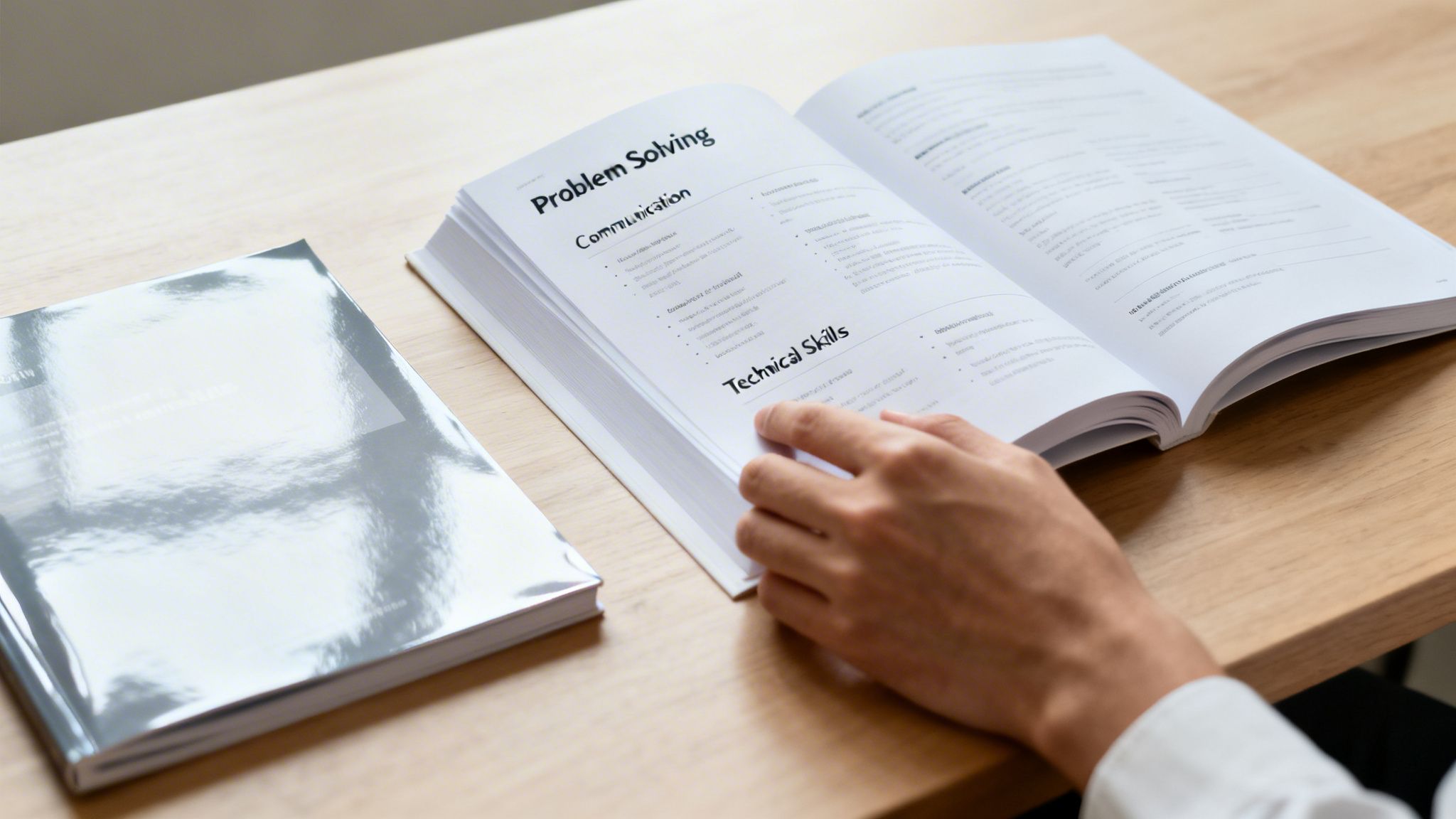
Think of a resume as the cover of a book. It gives you the title, the author's name, maybe a fancy blurb. But it tells you nothing about the story inside. Skills-based hiring is about opening the book and reading the chapters. It prioritizes what a candidate can demonstrably do—their actual abilities—over proxies like degrees, job history, or years on the job.
This approach looks for proof of specific skills needed for success. We’re talking about hard skills like coding in Python or running a financial analysis, but also the equally critical soft skills like clear communication, creative problem-solving, and adaptability.
It’s about hiring for capability, not credentials.
To understand the difference, let’s compare the two philosophies side-by-side.
Traditional Hiring vs. Skills-Based Hiring at a Glance
The table below breaks down the fundamental differences between clinging to old-school credentialism and embracing a modern, skills-first mindset.
| Aspect | Traditional Hiring | Skills-Based Hiring |
|---|---|---|
| Core Focus | Past experience, degrees, and job titles. | Demonstrable abilities and potential. |
| Evaluation Criteria | Resume keywords, university prestige, years in a similar role. | Skills assessments, work samples, and competency-based interviews. |
| Talent Pool | Narrowed to those with a specific pedigree. | Broadened to include talent from non-traditional backgrounds. |
| Key Question | "Where have you worked and where did you study?" | "What can you do and how can you prove it?" |
| Primary Outcome | Hires who look good on paper. | Hires who can perform the job well from day one. |
As you can see, the shift is from judging the past to evaluating the present and future potential of a candidate.
From Credentials to Competencies
This isn't just a new trend; it's a necessary response to a world where skills matter more than ever. The old way of hiring, using degrees and past titles as a filter, automatically screens out incredible talent. It misses the self-taught coder, the project manager who learned through an apprenticeship, or the marketing genius who honed their craft through online courses and freelance gigs.
By removing these artificial barriers, a skills-first approach creates a fairer and far more effective process. Companies that make the switch find they can:
- Access a much wider talent pool: You suddenly open the door to a diverse range of people who were previously invisible to your applicant tracking system.
- Make better hires: Focusing on what truly drives performance leads to a stronger job-fit, which naturally boosts retention.
- Build a more resilient workforce: You identify people with transferable, adaptable skills who can evolve as your business needs change.
The momentum is undeniable. Recent industry data from 2026 shows that 81% of employers are now using skills-based practices in their hiring. The trend is especially powerful for early-career roles, with nearly 70% of employers adopting this approach to find new talent.
Creating a Process That's Structured and Fair
Making this transition means moving beyond "gut feelings" and resume-scanning. To do it right, you need a structured foundation. A great starting point is learning what a competency framework is and how it helps you define the exact skills required for success in any given role.
This framework ensures every evaluation is consistent, objective, and tied directly to what your business needs to achieve. It’s an essential tool, especially when tapping into new talent pools like the Gen Z workforce. You can learn more about the unique dynamics of the Gen Z workforce in our detailed article.
Building out this system can feel like a heavy lift, which is why many companies partner with an expert. A US-based partner like NineArchs brings the strategic insight and infrastructure needed to design and run a skills-based hiring process, ensuring you get cultural alignment and access to pre-vetted global talent.
Ready to find people based on what they can do, not just what their resume says? Give us a call at (310)800-1398 / (949) 861-1804 or email info@ninearchs.com.
The Business Case for a Skills First Mindset
Switching to a skills-first mindset isn’t just another HR trend. It’s a fundamental business strategy that delivers a real competitive edge. While traditional hiring gets stuck on credentials and pedigree, a skills-based approach is all about performance and potential—two things that directly impact your bottom line. It’s about building a team that’s not just qualified on paper, but ready for the challenges of today and tomorrow.

The most immediate payoff is a massive improvement in hiring accuracy. Think about it: when you evaluate candidates on what they can actually do through structured assessments, you get a clear preview of their on-the-job performance. This evidence-based approach drastically cuts the risk of a bad hire, ensuring new team members can hit the ground running.
Ultimately, people who are a great fit for their job stick around. When employees land in roles that perfectly match their skills, they’re more engaged, more productive, and far more satisfied. This naturally reduces expensive turnover and helps you build a stable, committed workforce for the long haul.
Broaden Your Talent Pool and Boost Diversity
One of the most powerful results of skills-based hiring is its ability to unlock a vast, overlooked talent pool. Traditional hiring, with its rigid degree and experience requirements, automatically screens out huge segments of the workforce. For example, in the U.S., only about 36% of the workforce holds a four-year college degree.
By removing these arbitrary barriers, you open your doors to a more diverse group of candidates who gained their skills through non-traditional paths. We’re talking about people from apprenticeships, online certification programs, military service, or years of hands-on experience.
A skills-first mindset naturally cultivates a more inclusive workplace. It levels the playing field, making sure every candidate is judged on their capability, not their background. This focus on objective skills helps neutralize the unconscious bias that creeps into hiring, leading to a team with a richer mix of perspectives and problem-solving styles.
A more diverse talent pipeline isn't just a social good; it's a business imperative. Organizations with diverse teams consistently demonstrate higher levels of creativity, better problem-solving abilities, and greater resilience in the face of market changes.
Build an Agile and Future-Ready Workforce
In an economy where job roles are constantly being redefined, hiring for a fixed set of past experiences is a losing game. A skills-based approach, however, allows you to hire for adaptability. You can spot candidates with core, transferable skills—like critical thinking, communication, and a knack for learning—who can evolve right alongside your company.
This strategic focus on skills gives you several key advantages:
- Increased Agility: Teams built on a foundation of diverse skill sets can pivot far more effectively when new business demands or market disruptions hit.
- Improved Internal Mobility: When you have a clear map of your employees' skills, you can easily spot internal candidates for new roles. This promotes from within and fosters a culture of continuous growth.
- Long-Term Resilience: Hiring for potential instead of just past performance ensures your organization is ready for whatever comes next, with the talent needed to innovate and thrive.
Putting a full-scale skills-based hiring model into practice takes expertise and resources. Partnering with a US-based outsourcing firm like NineArchs gives you immediate access to proven assessment frameworks and a pre-vetted global talent pool. This lets you fast-track your transition, ensuring seamless communication and cultural fit while you build a team that’s ready for the future.
To discover how our skills-based staffing can strengthen your business, contact us today. Call (310)800-1398 / (949) 861-1804 or email info@ninearchs.com.
How to Implement a Skills Based Hiring Framework
Switching from a traditional, resume-first model to a skills-based hiring framework isn’t an overnight flip of a switch. It’s a deliberate process that requires you to rethink the very foundation of how you find, vet, and welcome talent into your organization.
The goal is to build a system that prioritizes what a person can actually do, not just where they’ve been. It’s about creating a more precise, equitable, and effective hiring machine.

This journey starts with a fundamental shift in perspective: defining roles based on what someone needs to accomplish, not the credentials they’ve collected. It’s a practical roadmap that any organization, big or small, can follow to start building a more capable and future-ready team.
Step 1: Redefine Roles and Rewrite Job Descriptions
This first step is the most critical: you have to deconstruct your job roles. Forget starting with a list of required degrees or a specific number of years of experience. Instead, begin by identifying the core competencies truly essential for someone to succeed in the role.
Think of it as creating a blueprint for the ideal performer, not just a carbon copy of the last person who held the job.
To get there, dig deep and ask the right questions:
- What specific tasks will this person perform daily, weekly, and monthly?
- Which technical skills (like Python, Salesforce, or GAAP) are completely non-negotiable?
- What soft skills (like client communication, problem-solving, or collaboration) are the secret sauce for high performance in this position?
Once you have this skills blueprint, you can rewrite your job descriptions to reflect this new reality. The goal is to attract candidates who see their own abilities mirrored in your ad, not just those who are checking off boxes on a list.
Job Description Rewrite Template
| Traditional Focus | Skills-Based Focus | Example (for a Project Manager) |
|---|---|---|
| Requirements | Core Competencies | "Proven ability to manage project budgets and timelines." |
| "Bachelor's Degree in Business" | Technical Skills | "Proficiency in Asana, Jira, or similar project management software." |
| "5+ years of experience" | Performance Outcomes | "Experience successfully delivering at least 3 mid-to-large scale projects." |
| "PMP certification preferred" | Soft Skills | "Excellent stakeholder communication and negotiation skills." |
This simple change in language signals a massive shift in your hiring philosophy. It invites a wider, more diverse, and more genuinely qualified group of candidates to apply.
Step 2: Design and Implement Objective Skills Assessments
With a crystal-clear definition of the skills you need, the next step is to figure out how to measure them accurately. This is where skills assessments come in. These aren’t abstract personality quizzes; they are practical, hands-on evaluations designed to see a candidate’s abilities in action.
The key is to use a mix of assessment methods tailored to the specific role. There is no one-size-fits-all solution here.
A well-designed skills assessment provides objective, empirical evidence of a candidate’s ability to perform the job. It moves the conversation from "Tell me about a time when…" to "Show me how you would…"
Different roles demand different kinds of proof. Here are a few common methods and when to use them:
- Work Sample Tests: These are perfect for creative or technical roles. Ask a graphic designer to create a sample social media post, a writer to draft a short blog intro, or a data analyst to interpret a small dataset. It’s a direct preview of their work quality.
- Technical Challenges: For software developers, engineers, or IT specialists, a coding challenge or a system configuration task is essential. These tests evaluate their real-world proficiency with specific languages, frameworks, and tools.
- Situational Judgment Tests (SJTs): These are brilliant for evaluating soft skills and decision-making. Present candidates with a realistic workplace scenario—like a difficult client or a project roadblock—and ask how they would respond. This reveals their problem-solving and interpersonal instincts.
- Structured, Competency-Based Interviews: It's time to move away from unstructured chats. Every question should be tied to a specific competency you identified in Step 1. Instead of asking "What are your weaknesses?" try "Describe a complex project you managed where you faced challenges. How did you adapt your plan?"
Step 3: Leverage an Expert Outsourcing Partner
Let’s be honest: implementing a skills-based hiring framework requires significant upfront work, from building competency maps to designing valid assessments. For many organizations—especially small to medium-sized businesses—this can feel like a heavy lift.
This is where a strategic partnership with a US-based outsourcing firm like NineArchs becomes a powerful accelerator. An experienced partner brings the infrastructure, expertise, and proven methodologies to help you transition seamlessly.
You gain immediate access to pre-built assessment frameworks and a global talent pool that has already been vetted for key skills. This allows you to bypass the steep learning curve and start hiring for ability right away.
Working with a USA-based partner ensures clear communication, cultural alignment, and a deep understanding of your business standards. This combination of global talent and local oversight allows you to implement a robust, skills-based hiring process faster and more effectively than going it alone.
Ready to start building your skills-based hiring framework with expert guidance? Contact NineArchs today at (310)800-1398 / (949) 861-1804 or email us at info@ninearchs.com.
Using Technology and AI for Smarter Skill Assessments
Manually assessing skills through work samples and structured interviews is a huge step forward, but let’s be honest—it’s tough to scale. When you’re sifting through hundreds of applicants, it can feel impossible. This is where modern technology, especially artificial intelligence (AI), becomes a game-changer. These tools don't just speed things up; they make skills-based hiring more precise, objective, and fair for everyone involved.

Think of technology as a powerful lens that brings a candidate’s true abilities into sharp focus. Instead of relying on intuition or subjective feedback, you get hard data on their proficiency. This empowers your hiring managers to make confident decisions based on evidence, not just a gut feeling after a 30-minute chat.
By thoughtfully integrating these tools, you can automate parts of the assessment process, gather richer insights, and give every single applicant a more engaging and equitable experience.
Automating Technical Skill Verification
For technical roles in IT, software development, or finance, verifying hard skills is non-negotiable. AI-powered platforms have made this process incredibly accurate and consistent, moving far beyond simply scanning resumes for keywords. These tools create a standardized environment to test what people can actually do.
Here are a few common technologies in action:
- Automated Coding Platforms: For developers, platforms like HackerRank or Codility are invaluable. They give candidates real coding challenges, and the system automatically runs their code to check for correctness, efficiency, and quality. The result is an objective score, free from human bias.
- Technical Simulations: For roles like system administrators or cybersecurity analysts, simulations can create a virtual environment where candidates have to diagnose a network issue or respond to a mock security threat. This directly measures their practical, on-the-job problem-solving skills under pressure.
- Data Analysis Challenges: When hiring for financial or data analyst roles, you can give candidates a dataset and ask them to build a model or generate insights. Their work is then evaluated on the accuracy of their analysis and the clarity of their conclusions.
These tools don't just tell you if a candidate claims they know Python; they show you how well they can use it to solve a problem. This shift toward verifiable skills is a cornerstone of modern talent acquisition and one of the many ways artificial intelligence is transforming business operations.
Assessing Soft Skills with Interactive Simulations
One of the biggest hurdles in skills-based hiring has always been objectively measuring soft skills—communication, collaboration, leadership, and critical thinking. These are often the abilities that make or break long-term success in a role. Thankfully, new technologies are finally rising to meet this challenge.
AI-driven simulations can present candidates with realistic workplace scenarios, like handling a difficult client or navigating a team conflict. The platform analyzes their responses, choices, and even their communication style to build a data-backed profile of their soft skills.
This provides a level of insight that’s nearly impossible to get in a traditional interview. It’s like getting a preview of how a candidate will actually behave on the job, not just how well they can answer a hypothetical question.
Choosing and Integrating the Right Tech Stack
Bringing these technologies on board doesn't have to mean a complete, painful overhaul of your entire recruitment workflow. The key is to choose the right tools and integrate them smoothly. A poorly chosen tool can create a clunky, frustrating experience for both your recruiters and your candidates.
When building your tech stack, focus on platforms that:
- Integrate seamlessly with your existing Applicant Tracking System (ATS).
- Offer a positive and intuitive candidate experience.
- Provide clear, actionable data and reporting for your hiring managers.
However, building and managing this kind of tech stack is complex and time-consuming. This is where an outsourcing partner from the USA can provide a significant advantage. A firm like NineArchs brings not only a deep understanding of the global talent market but also access to a pre-vetted, proven technology infrastructure for skills assessment. This allows you to deploy a world-class, data-driven hiring process quickly and cost-effectively, without the burden of building it all from scratch.
To learn how we can help you implement a smarter skills assessment process, call us at (310)800-1398 / (949) 861-1804 or email info@ninearchs.com.
Accelerate Your Transition with a US-Based Outsourcing Partner
Making the switch to skills-based hiring is a powerful move, but let’s be honest—it’s a huge operational undertaking. It’s not just about tweaking a few job posts. You’re redesigning roles from the ground up, building entirely new ways to assess talent, and learning to find candidates in places you’ve never looked before. For most companies, the internal lift can feel daunting.
This is where a strategic partnership with a US-based outsourcing firm can be a game-changer. Instead of spending months—or even years—building a skills-based hiring engine from scratch, you can plug directly into a proven system. You get to skip the painful learning curve and start bringing in top-tier, verified talent right away.
Think of an expert partner as a force multiplier. They bring the frameworks, tools, and talent access you need to make the transition smooth, fast, and incredibly effective.
The Advantage of a Seamless US-Based Partnership
Choosing a partner located in the USA, like NineArchs, gives you clear advantages that are critical for getting this right. It’s about more than just a shared map; it’s about genuine alignment. You’re collaborating with a team that operates on your clock, instinctively understands your business culture, and holds themselves to the same high bar for communication and professionalism.
This shared context gets rid of all the friction that can come from working with teams halfway across the world. No more late-night calls, cultural guesswork, or lost-in-translation moments. You get a seamless extension of your own organization, which is essential when you're tackling something as strategic as talent.
A US-based partner provides a single point of accountability, ensuring that global talent acquisition is managed with local oversight, clear communication, and a deep understanding of American business expectations.
When you partner with a US-based firm, you truly get the best of both worlds: access to a pre-vetted, global talent pool combined with the reliability and cultural fluency of a local team. This model is especially powerful for sourcing specialized roles in IT, software development, BPO, and finance. You can dive deeper into this approach by reading our guide on how SMB outsourcing can drive growth.
Bypass the Learning Curve with Proven Frameworks
Implementing what is skills based hiring successfully goes far beyond rewriting a few job descriptions. It demands a sophisticated, data-backed approach to identifying and verifying what people can actually do. A specialized outsourcing partner brings a ready-made toolkit of proven methods and technologies straight to your doorstep.
This lets your organization immediately:
- Access validated assessment libraries: Instantly use technical challenges, work sample tests, and situational judgment tests that have been built and proven for specific roles.
- Utilize pre-vetted talent pools: Tap into a global network of professionals whose skills have already been verified, dramatically cutting down your time-to-hire.
- Implement data-driven processes: Make objective hiring decisions based on hard performance data, not just keywords on a resume.
The table below breaks down the core advantages of bringing in a specialized partner to handle the heavy lifting.
Benefits of Partnering with a US-Based Outsourcing Firm
| Benefit | Description | Impact on Your Business |
|---|---|---|
| Instant Expertise | Gain immediate access to recruiters and HR specialists already trained in skills-based methodologies. | Avoid the time and cost of training your internal team on complex new hiring practices. |
| Cultural & Time Zone Alignment | Work with a US-based team that shares your business hours and cultural norms for seamless collaboration. | Eliminate communication delays and misunderstandings, ensuring projects stay on track. |
| Global Talent Access | Tap into a pre-vetted global talent network to find top candidates for hard-to-fill roles. | Dramatically expand your talent pool beyond local markets, increasing hiring quality. |
| Reduced Overhead | Outsource the resource-intensive tasks of sourcing, screening, and assessing candidates. | Allow your core team to focus on strategic initiatives while reducing recruitment costs. |
By working with an expert like NineArchs, you aren’t just outsourcing a task; you’re adopting a fully functional, high-performance talent engine. We manage the complexities of skills-based staffing so you can focus on what matters most: integrating exceptional new people into your team.
Start building your future-ready workforce today. To discuss how we can accelerate your transition to skills-based hiring, call (310) 800-1398 / (949) 861-1804 or email info@ninearchs.com.
Common Questions About Skills-Based Hiring
Moving to a skills-based hiring model sounds great in theory, but it’s a huge change. It means rethinking how we’ve hired people for generations, and it’s completely natural for leaders to have some tough questions.
When you’re challenging decades of habits built around degrees and resumes, you need to know how it actually works in the real world. Let's tackle the most common concerns we hear from organizations on the fence about leaving credential-based hiring behind.
How Does This Approach Work for Non-Technical or Creative Roles?
This is always one of a leader’s first—and most important—questions. It’s easy to picture a coding challenge for a developer, but what about a salesperson or a graphic designer? How do you test for skills that feel less tangible?
The principle is exactly the same: identify what a person needs to do to succeed, then find a way to see them do it.
For these roles, you simply shift from technical tests to other kinds of practical, hands-on assessments.
- Creative Roles (e.g., Graphic Designer, Content Writer): Forget hypotheticals. Ask for a small work sample. Have a designer mock up a social media graphic for a specific campaign, or ask a writer to draft a short blog intro. This gives you a direct preview of their style and quality—no guessing required.
- Sales Roles: Use a role-playing exercise. Give the candidate a real-world client profile and ask them to run a mock discovery call. You’ll learn more about their communication style and rapport-building skills in ten minutes than from an hour of interview questions.
- Marketing Roles: Give them a mini case study. Present a business goal (like "increase leads by 15%") and a small budget, then ask for a high-level campaign outline. This instantly reveals their strategic thinking and channel knowledge.
The goal is always to move the conversation from "Tell me about a time when…" to "Show me how you would…"
Will Removing Degree Requirements Compromise Candidate Quality?
This is probably the single biggest fear leaders have, but it’s based on a myth we’ve been told for a very long time: that a college degree equals competence. In reality, a degree is just a proxy for skill, not proof of it. Relying on it actually shrinks your talent pool dramatically.
In the U.S. alone, only 36% of the workforce holds a four-year college degree. By requiring one for roles where it isn't truly necessary, you automatically disqualify nearly two-thirds of potential candidates—many of whom have the exact skills you’re desperate to find.
Skills-based hiring doesn't lower the bar; it changes the bar. Instead of accepting a credential as a stand-in for ability, you're demanding real, demonstrated competence. A candidate who aces a practical work-sample test has given you concrete evidence they can do the job. That data is a far more reliable predictor of success than a diploma they earned years ago.
Can We Implement This Gradually Without a Complete HR Overhaul?
Absolutely. In fact, we recommend it. A "big bang" approach is rarely the right move. The smartest way to start is with a pilot program.
Pick one or two roles—or even a single department—to test the new process. Choose positions where the necessary skills are clear and measurable. This gives you a safe, manageable space to experiment, learn, and fine-tune your approach before scaling it.
Here’s a simple path for getting started:
- Select a Pilot Role: Choose a high-volume role (like customer service) or one that’s business-critical.
- Redefine the Job: Work with the hiring manager to rewrite the job description, focusing entirely on the core skills needed. Remove the degree requirement.
- Introduce One Assessment: Add a single, relevant skills test (like a work sample or a situational judgment test) into your current process.
- Measure and Compare: Track the performance of new hires from the pilot program against those hired the old-fashioned way.
This iterative approach lets the results speak for themselves, building internal buy-in with hard data before you commit to a company-wide change.
How Are Soft Skills Evaluated in This Model?
This is another critical piece of the puzzle. How do you objectively measure "soft" skills like communication, collaboration, or problem-solving?
The key is to use behavioral and situational questions within a structured interview. Instead of asking vague questions like, "Are you a good problem-solver?" you create scenarios that require the candidate to prove it.
Here are a few examples of structured, competency-focused questions:
- For Communication: "Describe a time you had to explain a complex technical issue to a client who had no technical background. How did you approach it?"
- For Problem-Solving: "Walk me through a project where your initial plan went completely off the rails. What were the first three steps you took to get it back on track?"
- For Leadership: "Tell me about a time you had to lead a team that was feeling burnt out and unmotivated. What specific actions did you take to re-engage them?"
By asking every candidate the same set of questions, you get a clear, apples-to-apples comparison. It transforms the evaluation of soft skills from a gut feeling into a reliable, data-driven assessment.
Shifting to skills-based hiring is a strategic decision, but the payoff in talent quality, diversity, and retention is undeniable. A US-based outsourcing partner can provide the expertise and infrastructure to accelerate this transition.
NineArchs offers proven skills assessment frameworks and access to a pre-vetted global talent pool, ensuring you can build a future-ready team with confidence and speed.
Ready to start hiring for what truly matters? Contact us today. Call (310)800-1398 / (949) 861-1804 or email info@ninearchs.com.