
A lot of people arrive at accounts payable from one of two places. They’re either trying to get their first steady finance job, or they’re running a business and realizing invoices, approvals, and vendor payments have started slipping through the cracks. Both situations feel stressful for the same reason. Money is moving, and nobody wants mistakes.
That’s why accounts payable entry level work matters more than people think. It isn’t just “entering bills.” It’s the function that helps a business pay the right vendor, for the right amount, at the right time, with the right backup. When that process works, operations stay calm. When it breaks, vendors chase payments, managers lose visibility, and the finance team wastes hours fixing avoidable errors.
For job seekers, this role is one of the most practical ways into finance. For employers, it’s one of the clearest operational bottlenecks to solve fast, either with an employee or with outside support. The role sits close to the core flow of business, so it teaches discipline, systems thinking, and financial judgment early.
Your Starting Point in the World of Finance
A small business owner often notices the AP problem before they know what to call it. Invoices sit in email. Someone approves one by text, another by memory, and a third not at all. A vendor follows up. Then another. By the end of the week, nobody’s sure what’s due, what’s disputed, or what’s already paid.
That same mess creates opportunity for someone looking for a first finance role. A strong entry-level AP hire brings order to that process. They create naming rules, verify invoices, route approvals properly, and make sure the books reflect what the business owes.

This is one reason the field remains accessible. In the United States, over 959,516 accounts payable clerks are currently employed, and 25% have less than 1 year of experience, which shows how often businesses need new people in the function. Education is flexible too. 46% hold a bachelor’s degree, 29% an associate degree, and 13% a high school diploma, with comparable salaries across those education levels according to accounts payable clerk demographics data.
Why this role is such a practical entry point
If you’re new to finance, AP teaches habits that transfer everywhere else:
- Process discipline: You learn to follow rules instead of guessing.
- Document control: You get comfortable with backup, approvals, and audit trails.
- Basic accounting logic: You start seeing how expenses, liabilities, and cash connect.
- Business communication: You deal with vendors, internal approvers, and month-end pressure.
Practical rule: If you can learn to handle outgoing payments carefully, you build the kind of trust that opens doors in accounting.
People exploring how to start an accounting career often look for a path that doesn’t require years of prior experience. AP is one of the roles that gives that path structure. It’s repetitive in a good way. The repetition helps you build accuracy, speed, and judgment.
What an Entry Level AP Specialist Actually Does
An entry-level AP specialist is a financial gatekeeper. Their job is to make sure money doesn’t leave the company carelessly. That means checking whether a bill is valid, entering it correctly, and moving it through the process so the company can pay on time without paying twice.
At the start, the work can look administrative. It isn’t. Every invoice tells a story about a purchase, a department, a vendor relationship, and a future cash outflow. Your task is to make sure that story is accurate before the payment happens.

The daily work in plain terms
Most entry-level AP work falls into a few core activities:
Review incoming invoices
Check the vendor name, invoice number, dates, amount, and supporting documentation. A missing purchase order or a mismatch in quantity is a reason to stop and verify, not to push the invoice through.Enter data into the accounting system
This includes coding the expense, assigning the right vendor record, and recording the liability properly. The quality of this step affects reporting, cash planning, and vendor history.Route invoices for approval
AP doesn’t usually decide whether a department should have bought something. AP confirms the invoice belongs in the process, then sends it to the right approver.Prepare payments
Once approved, invoices move toward scheduled payment. That may mean batching payments, checking due dates, and confirming the final amount.Handle follow-up
Vendors ask where payment stands. Internal teams ask whether something has been posted. Entry-level AP staff often become the first line of response.
Why accuracy matters so much
Small mistakes in AP don’t stay small. A typo in an amount can distort an expense account. A duplicate invoice can become a duplicate payment. Wrong coding can make month-end cleanup harder than it needs to be.
According to Franklin University’s overview of what accounts payable specialists do, data entry errors can cause financial leakage of 0.5% to 2% annually. The same source notes that AP specialists work from double-entry bookkeeping principles, debit expenses and credit accounts payable, and often aim for over 99% accuracy, with 10-key speeds exceeding 8,000 keystrokes per hour as a common benchmark.
Good AP work is quiet. Nobody notices it when it’s done well, but everyone feels it when it’s done badly.
What new hires usually learn first
A manager rarely expects a new AP clerk to know every exception on day one. What matters early is whether you can:
- Follow a checklist consistently
- Pause when something looks off
- Keep clean records
- Ask useful questions instead of guessing
- Protect the company from preventable payment errors
That’s the essential job. Not speed alone. Controlled, reliable speed.
Mastering the Tools and Workflows of Accounts Payable
A new AP professional becomes useful faster when they understand the workflow, not just the screen in front of them. If you only know where to click, you’ll freeze the first time an invoice doesn’t match. If you understand the process, you’ll know what went wrong and who needs to fix it.
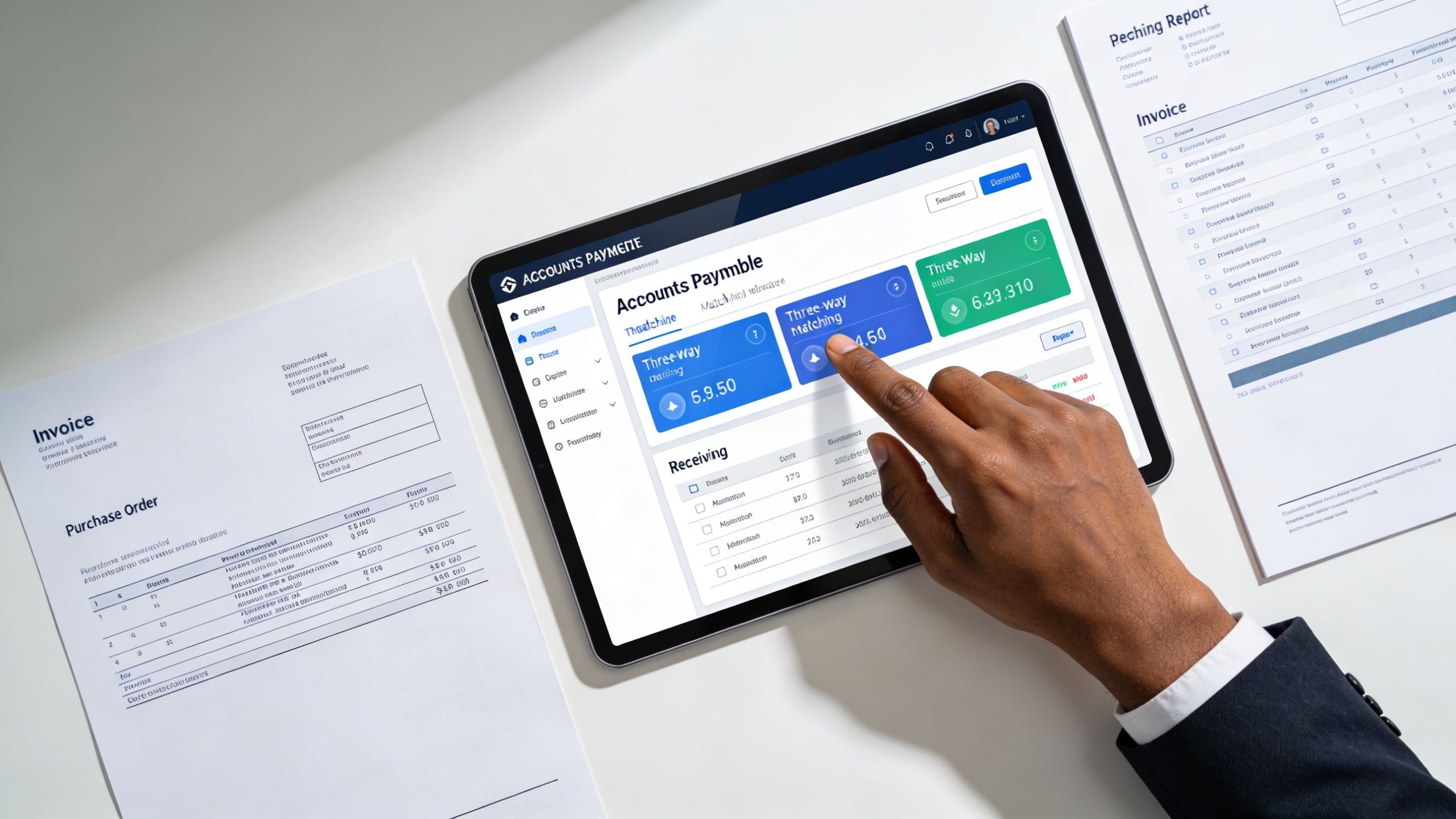
The three-way match in real life
Think of three-way matching like checking three pieces of evidence before releasing cash:
| Document | What it answers | Why it matters |
|---|---|---|
| Purchase order | Did we authorize this purchase? | Prevents paying for something nobody approved |
| Invoice | What is the vendor asking us to pay? | Sets the billing details and due date |
| Receipt or receiving proof | Did we actually receive the goods or service? | Confirms the business got what it’s paying for |
If those three records agree, the invoice can usually move forward. If they don’t, AP should stop the process and resolve the difference.
That detective mindset matters. Good AP staff don’t force bad paperwork through the system just to clear a queue.
The tools that matter most
Most entry-level AP teams rely on some combination of spreadsheets and accounting systems. Spreadsheets are useful for cleanup, reconciliations, exception tracking, and simple validations. Accounting or ERP systems hold the official records, approvals, and payment status.
The systems vary by company, but the skills are consistent:
- Spreadsheet confidence: Sorting, filtering, lookups, and basic validation checks
- ERP or accounting system discipline: Accurate entry, document attachment, and status tracking
- Inbox and file hygiene: Naming, saving, and retrieving support quickly
- Workflow awareness: Knowing when to post, when to escalate, and when to hold
According to this review of must-have skills for accounts payable specialists, proficiency in accounting software such as SAP, Oracle, or QuickBooks can improve invoice processing efficiency by 20% to 30% and reduce error rates by up to 40% compared with manual methods. The same source states that automation in QuickBooks can reduce invoice approval cycle times from 5 to 7 days down to 1 to 2 days.
Workflow advice: Learn the logic behind the screen. Software changes. Process discipline stays valuable.
For readers who want a clearer picture of the broader payables and receivables relationship, this guide on understanding UK accounts receivable gives useful context on how both sides of working capital fit together. If you're also exploring flexible work models, this overview of remote accounts payable roles is a practical next read.
A standard invoice journey
A well-run AP workflow usually looks like this:
- Invoice arrives by email, portal, or scan.
- Basic check happens for vendor, date, amount, and duplicates.
- Coding and entry happen in the accounting system.
- Matching happens against supporting documents.
- Approval routing begins to the right manager or department.
- Payment is scheduled based on terms and internal controls.
- Payment is recorded and archived with support attached.
What doesn’t work is informal processing. If invoices live in individual inboxes, approvals happen verbally, and documentation is incomplete, the AP team spends more time chasing answers than doing finance.
Essential Skills and Qualifications for Your First AP Job
Hiring managers usually separate AP candidates into two groups fast. The first group looks organized, trainable, and careful. The second group looks like they’ll create cleanup work for everyone else. Technical knowledge matters, but your work habits matter just as much.
The technical skills that move you to the top
You don’t need to be a senior accountant to start. You do need a working command of the basics.
- Spreadsheet fluency: You should be comfortable organizing data, checking totals, filtering records, and spotting mismatches.
- Basic accounting understanding: Know what an expense is, what a liability is, and why AP entries affect both.
- Data entry reliability: Fast is good. Accurate is better.
- Document review: Read invoices carefully. Many applicants skim and miss obvious issues.
- System comfort: If you can learn one accounting platform well, you can usually learn another.
The soft skills managers actually notice
AP sits in the middle of finance, operations, and vendor communication. That means the best entry-level hires are not just “good with numbers.”
- Attention to detail: You catch missing information before it becomes a payment problem.
- Organization: You keep queues, folders, and follow-ups under control.
- Professional communication: You can ask a vendor for a corrected invoice without creating friction.
- Judgment: You know when to resolve something yourself and when to escalate it.
- Consistency: Finance teams trust people who work carefully every day, not just when someone is watching.
A lot of employers now think in terms of demonstrated ability, not just credentials. This is why skills-based hiring matters in AP. If you can show that you understand process, controls, and system discipline, you often become a stronger candidate than someone with a broader background but weaker practical habits.
What education helps, and what isn’t mandatory
A degree can help. It isn’t always the deciding factor. In many AP teams, managers care more about whether you can handle invoices, approvals, coding, and follow-up without constant correction.
A strong entry-level AP candidate looks dependable before they look impressive.
If you’re building your profile, focus on proof of competence. Clean spreadsheets, accurate sample work, bookkeeping coursework, and process-minded resume bullets all matter.
How to Land Your First Accounts Payable Entry Level Job
The hardest part of breaking into AP isn’t usually the work itself. It’s getting past job descriptions that call something “entry level” while still asking for prior experience. That frustrates a lot of good candidates.
The good news is that hiring managers often use those requirements as a preference, not an absolute rule. If your resume shows accuracy, trustworthiness, and process discipline, you can still compete.
The experience paradox, and how to beat it
According to this AP job market summary, over 70% of “entry-level” AP postings still ask for 1 to 3 years of experience or specific skills like three-way matching. The same source notes that true no-experience roles average $18 to $25 per hour, and that certifications can boost promotion rates by up to 40%.
That tells you two things. First, employers want less hand-holding. Second, you need to signal readiness clearly.
Resume bullets that work better
If you don’t have AP job history yet, rewrite your past work in finance language where it’s honest to do so.
Try bullets like these:
- Tracked records accurately for recurring transactions and maintained organized documentation for review.
- Handled cash, receipts, or payment reconciliation with a strong focus on error prevention.
- Managed administrative workflows involving approvals, data entry, and deadline tracking.
- Supported budget or expense monitoring for a student organization, office team, or small operation.
- Resolved customer or vendor questions by reviewing records and communicating next steps clearly.
Those bullets work because they show transferability. A manager hiring for accounts payable entry level wants evidence that you can handle repetition, follow process, and stay careful under volume.
Interview answers that show maturity
A few interview questions come up repeatedly. Strong answers are usually simple.
How do you handle repetitive work?
Say that repetition helps you build consistency, and that you use checklists so quality doesn’t slip.
What would you do if an invoice didn’t match the support?
Say you would hold the invoice, review the documents, and ask for clarification before posting or paying it.
How do you prioritize when multiple invoices are due?
Say you review due dates, approval status, and any exceptions first, then work from urgency and completeness, not guesswork.
Hiring managers trust candidates who sound careful. They don’t trust candidates who sound fast but loose.
A practical plan for the next few weeks
If you’re serious about getting hired, focus on a short list:
- Learn invoice flow and matching concepts
- Practice spreadsheet cleanup and validation
- Build one clean, AP-focused resume
- Prepare short, direct interview stories
- Apply consistently to real entry-level roles
- Add a course or certification if your profile looks thin
For candidates applying at scale, tools that help organize applications can save time. If you want to automate your job search with AI, use that support to stay consistent, but keep your resume grounded in real skills and honest examples. In AP, inflated claims are easy for employers to spot.
Your AP Career Path From Entry Level to Finance Leader
A good AP career rarely stays at invoice entry forever. The role teaches operational finance from the ground up, and that foundation travels well.
A typical path starts with an AP clerk or junior specialist role. At that stage, the focus is transaction accuracy, approvals, vendor follow-up, and clean records. After that, many people move into a specialist position where they handle exceptions, reconciliations, month-end support, and more complex vendor issues.
How the role expands over time
As your judgment improves, your work usually shifts in this direction:
- AP Clerk or Junior AP: Transaction entry, verification, document handling
- AP Specialist: Discrepancy resolution, coding accuracy, process ownership
- AP Supervisor or Manager: Team oversight, controls, approvals, workload management
- Controller-track responsibilities: Policy, close support, cash planning, audit readiness
The key change isn’t just seniority. It’s perspective. Early on, you process invoices. Later, you improve the process itself.
Why AP creates strong finance managers
People who start in AP often become reliable finance leaders because they understand where errors begin. They’ve seen what weak approvals do. They know what poor recordkeeping costs. They understand that cash control is operational, not theoretical.
That makes AP a strong launchpad for broader accounting, operations finance, and controllership paths. If you learn the discipline well at entry level, you’re building more than a first job. You’re building finance judgment.
A Smart Alternative Outsourcing AP for Business Growth
Business owners don’t always need to solve AP by hiring in-house first. Sometimes the better move is to treat AP as a function to stabilize quickly, then decide later whether it belongs fully inside the company.
That matters most when invoices are piling up, leadership is approving payments informally, and the current team doesn’t have enough capacity for controlled follow-up. In those cases, outsourcing can bring structure faster than a rushed hire.

When outsourcing makes more sense than adding headcount
An outsourced AP setup is often a better fit when:
- Volume changes often: You need flexibility more than fixed payroll.
- Leadership wants tighter process control: Standardized intake, routing, and follow-up matter.
- Internal staff are overloaded: AP work is getting done late or inconsistently.
- You need support without building a full department: Especially common in small and midsize businesses.
A USA-based outsourcing partner adds an important layer here. You get clearer communication, easier accountability, and better time-zone alignment for approvals and issue resolution, while still gaining access to a broader talent pool behind the scenes.
There’s also a genuine market gap. According to this review of entry-level AP job demand and remote opportunity gaps, there’s little guidance around global remote AP roles despite BPO demand for AP outsourcing surging 15% year over year. That gap is exactly why managed support models have become more attractive for companies that want dependable finance operations without building everything internally from scratch.
What good outsourced AP support should improve
You should expect better control over:
| Area | What improvement looks like |
|---|---|
| Invoice intake | Fewer lost invoices and clearer submission rules |
| Approval flow | Less chasing and more visibility |
| Vendor communication | Faster responses and cleaner status updates |
| Documentation | Stronger audit trails and easier retrieval |
| Scalability | Support that can expand when workload rises |
If you’re evaluating that route, this page on outsourced finance and accounting services is a useful overview of the model.
Your Accounts Payable Questions Answered
Will automation eliminate entry-level AP jobs
No. It changes the work, but it doesn’t remove the need for judgment. Systems can route invoices, flag duplicates, and speed up approvals. People still need to review exceptions, confirm support, communicate with vendors, and keep records clean.
The strongest entry-level candidates lean into that shift. They learn process, systems, and exception handling instead of treating AP like pure typing work.
Do you need an accounting degree to get started
Not always. Many employers care more about practical ability than academic pedigree. If you can show spreadsheet confidence, process discipline, invoice handling knowledge, and professional communication, you can be a viable candidate.
A degree may help. It’s not the only path.
What’s the biggest challenge in the first three months
Most new AP hires struggle with judgment, not mechanics. Entering an invoice is teachable. Knowing when to stop the process, ask questions, or escalate takes practice.
The best way to improve is simple. Don’t guess when documents conflict. Don’t rush to clear your queue at the expense of accuracy. Learn the approval structure, understand the company’s coding logic, and build a habit of checking the details that others skip.
Should a business hire internally or outsource AP
It depends on urgency, volume, and management capacity. If you want direct internal development and have time to train, hiring can work well. If your AP process is already messy and leadership needs reliability quickly, outsourcing is often the smarter first move.
A USA-based outsourcing partner is especially useful when you want consistent communication and accountability without taking on the full burden of recruiting, training, and managing AP operations alone.
If your business needs dependable accounts payable support, NineArchs LLC can help you streamline invoice processing, bookkeeping, data entry, and finance operations with the advantage of a USA-based outsourcing partner. For a consultation, call (310)800-1398 or (949) 861-1804, or email info@ninearchs.com.