
If you're hiring for software development or remote IT support right now, you already know the pattern. Open roles stay open. Strong candidates disappear fast. Internal teams burn time screening resumes that look qualified on paper but don't map cleanly to your stack, your ticketing workflows, or your support standards.
That's why more companies are looking at IT apprenticeship programs as an operating model, not just a training idea. Its value isn't abstract. You build talent around the work you need done, then turn that learning path into a repeatable pipeline. For companies that don't want to create that machinery inside HR, a US-based outsourcing partner can take on much of the design, coordination, and day-to-day administration while keeping delivery aligned with domestic business expectations.
The Modern Tech Talent Pipeline Problem
A lot of tech hiring breaks down in the same three places. The role is defined too broadly, the market is too competitive, and the onboarding plan is too thin. Companies end up paying for experience they can't fully validate, then asking new hires to learn internal systems after they start.
That approach is especially weak for junior software development roles and remote support positions. In both cases, success depends less on a generic credential and more on whether the person can learn your codebase, your documentation habits, your escalation logic, your security expectations, and your communication style.

Why apprenticeship belongs in a tech hiring strategy
Registered apprenticeship is already a scaled workforce model in the United States. In FY 2021, the U.S. Department of Labor reported nearly 27,000 active registered apprenticeship programs and over 241,000 new apprentices entering the system, according to the U.S. Department of Labor apprenticeship statistics for FY 2021.
That matters because it changes the conversation. Apprenticeship isn't a niche experiment for a narrow set of trades. It's a structured way to build capability through supervised work, formal instruction, and measured progression.
What employers usually get wrong
Many employers still treat apprenticeships as an HR side project. That's the wrong frame. In technology, this is a delivery model.
A well-designed program does three things at once:
- Builds role-ready talent: Apprentices learn inside live production environments, support queues, and engineering workflows.
- Reduces hiring volatility: You stop depending entirely on external recruiting cycles for every junior opening.
- Improves role fit: Training aligns to your tools, your client expectations, and your internal operating rhythm.
Practical rule: If a role can be broken into teachable tasks, supervised milestones, and measurable output, it can usually support an apprenticeship pathway.
This is also where outsourcing becomes useful. If your company wants the benefits of apprenticeship but doesn't want to build an internal program office, a partner can handle recruiting coordination, curriculum support, manager enablement, and reporting. That approach is especially useful for firms focused on reducing employment risk through talent acquisition, where the goal is to lower bad hires and create more predictable workforce planning.
Why a US-based outsourcing partner helps
For software and remote support work, location still shapes execution. A US-based outsourcing partner helps keep communication, service expectations, documentation standards, and client-facing accountability aligned with how US companies operate. That doesn't eliminate global delivery options. It gives you a domestic layer of coordination and oversight that de-risks implementation.
When apprenticeship is managed well, it stops being a feel-good initiative and starts functioning as a practical talent system.
Understanding IT Apprenticeship Programs
An IT apprenticeship program is a work-based learning model where a company hires someone into a defined role and trains them through structured production work, related instruction, and ongoing mentorship. The apprentice isn't shadowing indefinitely. They're learning while contributing.
According to Apprenticeship.gov technology apprenticeship data, more than 58,000 registered apprentices were served across technology, cybersecurity, and AI-related occupations in 2025. That scale confirms that technology apprenticeships are already operating in real labor markets, not sitting in pilot mode.

What makes an apprenticeship different
Internships, bootcamps, and apprenticeships often get bundled together. They shouldn't be.
An internship is usually temporary and exploratory. A bootcamp is usually training-first. An apprenticeship is job-first.
The difference shows up in daily operations:
- The apprentice has a role: They're tied to actual business output.
- Learning follows the job: Instruction supports the work, instead of existing separately from it.
- Progress is staged: The apprentice earns more responsibility as competence grows.
If your company has moved toward skills-based hiring, apprenticeships fit naturally. They let you evaluate people by learning agility, work quality, communication, and consistency instead of over-weighting degree filters.
The three working parts
Most effective IT apprenticeship programs rely on three connected elements.
On-the-job training
This is the center of the model. In software development, that might mean starting with bug fixes, test support, documentation updates, or low-risk feature tickets before moving into larger implementation work. In remote IT support, it often starts with account setup, password resets, device triage, FAQ-driven ticket handling, and escalation hygiene.
The work has to be real. If apprentices spend too much time in artificial exercises, they don't develop production judgment.
Related technical instruction
Apprentices need formal learning alongside work. That instruction should reinforce what they're encountering on the job. For a development apprentice, that may include version control discipline, API concepts, testing practices, and secure coding habits. For a support apprentice, it may cover endpoint basics, identity management, documentation standards, and customer communication.
Many employers overcomplicate things. The instruction doesn't need to look like a university course. It needs to support task readiness.
Mentorship
Without mentorship, apprenticeship becomes cheap labor with extra paperwork. A strong mentor shortens confusion loops, reviews work product, explains trade-offs, and helps the apprentice understand why one decision is preferred over another.
A mentor doesn't need to solve every problem. They need to keep the apprentice from getting stuck in the same problem repeatedly.
What this looks like in practice
A software apprentice might spend the first phase learning repository structure, coding standards, backlog grooming habits, and how pull requests are reviewed. A remote support apprentice might begin with internal knowledge base use, service etiquette, security checks, and how to document ticket resolution clearly enough for the next technician.
Those examples matter because they show what apprenticeship is really for. It builds people around delivery environments, not generic classroom outcomes.
Benefits of Apprenticeships for Outsourced Teams
Outsourced teams succeed when work is documented well, managers know what quality looks like, and the talent model is repeatable. Apprenticeships support all three. They create a training lane for roles that don't require full mastery on day one but do require consistency, judgment, and steady skill growth.
The bigger opportunity in tech is still underused. Between 2010 and 2020, the number of new youth apprentices ages 16 to 24 grew by 113%, yet only 1.17% were in STEM occupations, according to Jobs for the Future research on youth apprenticeship trends. For employers in software development and remote support, that points to an obvious opening. Tech roles remain far less saturated by apprenticeship pathways than they could be.
What businesses gain
The first business benefit is control over ramp-up. Instead of hiring a junior employee and hoping they adapt, you define what they learn, when they learn it, and how their work gets reviewed.
A second benefit is role alignment. Apprentices can be trained on the exact conditions that matter in outsourced delivery:
- Client communication discipline: How updates are written, when issues are escalated, and what “resolved” entails.
- Documentation habits: Ticket notes, handoff quality, code comments, and internal runbooks.
- Service consistency: Repeatable behavior across shifts, accounts, and support scenarios.
- Delivery standards: Acceptance criteria, QA expectations, and production safeguards.
For outsourced software teams, that produces developers who understand your workflow instead of just your language stack. For remote support, it creates technicians who don't just close tickets but close them correctly.
Why outsourced teams benefit more than most
An apprenticeship model often works better in outsourced settings because these teams already operate with process discipline. They use documented workflows, service queues, review loops, and defined handoffs. That structure gives apprentices a cleaner learning environment.
A US-based outsourcing partner adds another layer of stability. US account management and program oversight help keep communication clear with stakeholders, especially when apprentices support domestic users, internal employees, or regulated workflows. It also helps when managers need a partner who can translate operational needs into role design without adding HR drag.
The best outsourced apprenticeship programs don't hide learners from client work forever. They stage exposure carefully, then expand responsibility when quality becomes predictable.
What apprentices gain
The apprentice side matters too. This model creates a direct path into software and IT work through paid, supervised learning tied to a real job. That's more practical than asking candidates to complete disconnected training and hope someone hires them later.
For many candidates, the appeal is simple:
- They earn while learning
- They see how work is done
- They build experience employers can verify
- They move toward a real role, not an abstract credential
That mutual benefit is why apprenticeship can outperform ad hoc junior hiring. The business gets a structured pipeline. The apprentice gets a clearer route into the field.
Choosing Your Apprenticeship Model
A company decides to start an apprenticeship program for junior developers or remote support staff. Within a few weeks, the same problem shows up. Engineering managers want better entry-level talent, but they do not want to build training plans, review frameworks, and progress tracking on top of delivery work. That tension usually determines the model.
There are two workable options. Build the program in-house, or use a partner-managed model that handles much of the setup and day-to-day coordination. The right choice depends on how much operating burden your team can absorb without slowing delivery.
The in-house route
An internal model gives you maximum control over how the program runs. Your team sets role scope, learning milestones, coaching standards, documentation rules, and hiring criteria. That can work well if you already have strong people operations, training ownership, and managers who know how to coach juniors without losing pace on production work.
The cost is not just budget. It is management attention.
Internal teams usually need to handle several workstreams at the same time:
- Program design: Define which roles can be taught in stages and which roles need experienced hires.
- Candidate sourcing: Build a funnel that looks beyond degree-based screening and traditional junior recruiting.
- Manager readiness: Prepare supervisors to coach, assess, and document performance consistently.
- Instruction planning: Organize job-related learning that supports what apprentices are doing on live work.
- Administration: Track reviews, progression, documentation, and any compliance requirements.
That workload is manageable for some companies. It is a poor fit for teams already under pressure to ship software, maintain service levels, and fill open seats.
The partner-managed route
A partner-managed model keeps ownership of outcomes with the company, while shifting much of the operating work to a delivery partner. That distinction matters. The business still defines what good looks like. The partner turns those expectations into a program that can run.
For companies already weighing staff augmentation vs outsourcing models, apprenticeship usually fits closer to managed delivery than simple headcount expansion. The goal is to create a repeatable pipeline for future developers and support technicians, not just add junior labor.
This model tends to work well in outsourced environments because the operating structure already exists. Partners can set up onboarding sequences, mentor cadences, review checkpoints, documentation routines, and reporting without asking your HR or engineering leaders to invent the system from scratch.
NineArchs LLC is one example of the kind of outsourcing partner that can support this approach. In practice, that means helping companies build junior pathways for software development and remote IT support, while reducing the internal overhead that often stalls apprenticeship programs before the first cohort starts.
Apprenticeship model comparison
| Factor | In-House DIY Model | Partner-Managed Outsourced Model |
|---|---|---|
| Program setup | Internal teams create the framework, documents, and workflows | Partner helps build the framework around business needs |
| Launch speed | Often slower because design and approvals happen internally | Usually faster because the partner already has operating methods and templates |
| Internal resource demand | High. Managers, HR, and operations carry more of the load | Lower. Internal teams focus on outcomes, quality, and oversight |
| Curriculum support | Company builds or coordinates learning components itself | Partner helps organize instruction tied to the actual role |
| Mentor structure | Must be created and maintained internally | Partner can run a defined coaching and review cadence |
| Scalability | Harder if the model depends on a few internal champions | Easier if the partner standardizes intake, training, and progression |
| Administrative burden | Company owns tracking, coordination, and documentation | Partner handles much of the administration |
| Best fit | Firms with mature training infrastructure and manager capacity | Firms that want a scalable talent pipeline without building a program office |
The trade-off
The trade-off is control versus operating burden.
Some companies should build internally. If you already have training ownership, strong frontline managers, and time to refine the model, a DIY approach can produce a program that closely matches your culture and delivery standards.
Many companies do not have that margin. In those cases, a partner-managed approach reduces startup friction, lowers coordination work, and gets apprentices into a structured environment faster. For software development and remote support teams, that can be the difference between talking about a pipeline and building one.
Playbook Part 1 Designing Your Program with a Partner
A strong apprenticeship program starts with role design, not recruiting. If the role is vague, the training will be vague. If the work is structured, the program can scale.
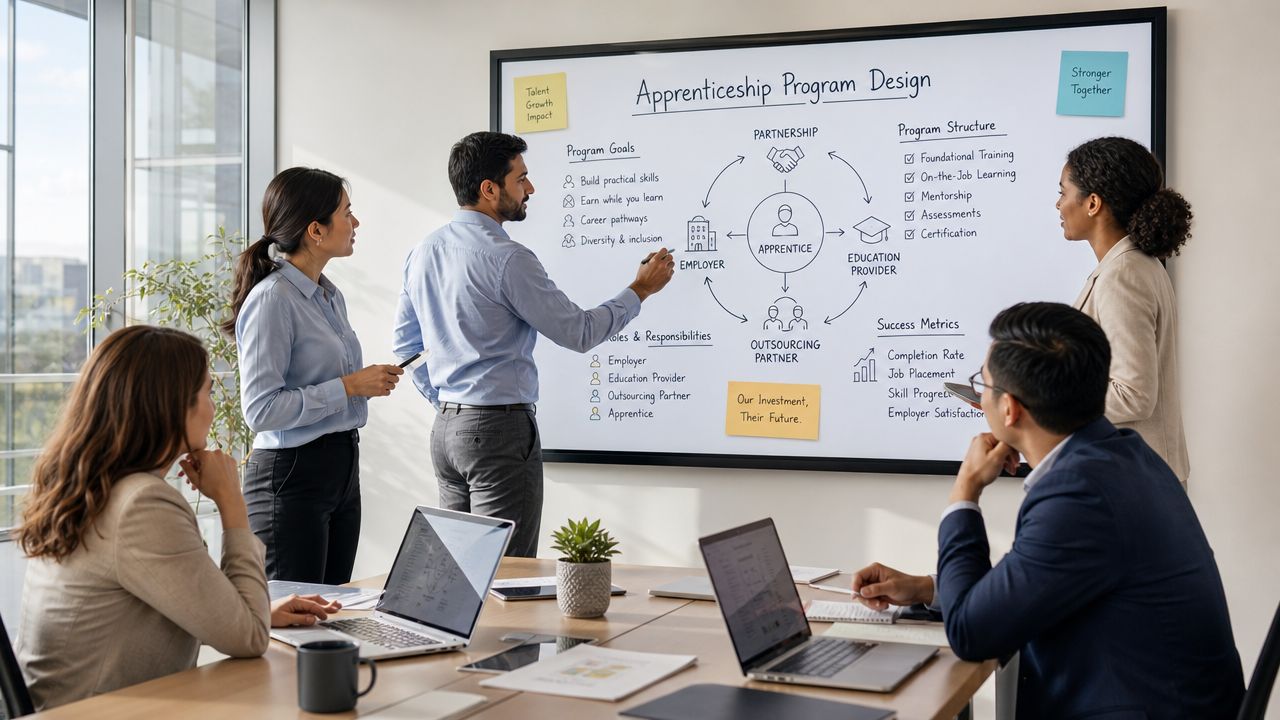
A typical registered apprenticeship is one year or 2,000 hours and combines on-the-job training with instruction, according to BMCC apprenticeship program guidance. That structure is useful because it forces companies to think in stages. You don't need a fully productive junior employee on day one. You need a pathway from supervised basics to dependable output.
Start with the right roles
Not every IT role belongs in an apprenticeship. The best candidates share three traits. The work is repeatable, the skills can be sequenced, and quality can be reviewed.
For outsourced delivery, the strongest starting points are usually:
- Junior software development roles: Front-end support, QA-adjacent coding tasks, bug fixing, documentation support, testing assistance, and controlled feature work.
- Remote IT support roles: Help desk intake, user account support, endpoint setup, ticket triage, knowledge base usage, and standard issue resolution.
- Hybrid support roles: Application support, implementation assistance, and internal tooling support.
Roles that demand independent architecture decisions or high-stakes production authority too early usually aren't the best first apprenticeship targets.
Build the work map before the curriculum
Most companies do this backward. They start by asking what to teach. The better question is what the apprentice must be able to do at each stage.
A partner should help map the job into progressive capability bands such as:
- Observe and learn: Understand workflows, systems, and terminology.
- Perform basic tasks with oversight: Complete low-risk work using checklists and templates.
- Handle routine work independently: Deliver predictable output within defined guardrails.
- Take on more complex assignments: Solve standard problems with less supervision.
That work map becomes the spine of the program. It also gives managers a cleaner basis for feedback.
Design instruction around actual delivery
Related instruction should support the work, not compete with it. If your apprentices are in software development, teach repository discipline, issue tracking, testing logic, documentation, and review etiquette in sync with live assignments. If they're in remote support, train them on ticket quality, customer communication, access control basics, troubleshooting flow, and escalation standards.
A good partner also helps connect program design to broader workforce planning. If your organization is already working with a talent management consultant, apprenticeship design should feed directly into succession planning and junior-to-midlevel role development.
Field note: Apprentices don't need a giant curriculum library. They need the next right lesson at the moment the work demands it.
Source for potential, not polish
Traditional hiring filters often eliminate strong apprenticeship candidates before the first interview. That's a mistake.
For these programs, screening should focus more on:
- Learning agility: Can the person absorb feedback and apply it quickly?
- Communication habits: Can they explain what they tried, what failed, and what they need?
- Work discipline: Do they follow process, document clearly, and show consistency?
- Problem approach: Can they break down an issue instead of freezing at ambiguity?
A partner can help redesign the funnel around practical assessments, structured interviews, and readiness signals that matter for software and support work. That widens access without lowering standards.
Define manager obligations early
The manager side needs equal attention. Apprenticeship programs fail when managers think they're getting fully formed junior hires with extra administration attached. They're not. They're getting developing talent that needs planned supervision.
Set expectations up front:
- Review cadence must be scheduled
- Feedback must be specific
- Escalation paths must be documented
- Task difficulty must increase intentionally
If that foundation is solid, the rest of the program becomes much easier to run.
Playbook Part 2 Running and Scaling Your Program
Once a program launches, most of the core work shifts from design to discipline, determining whether many IT apprenticeship programs become a repeatable talent engine or fade into a one-off experiment.

Research highlighted by the Urban Institute on what works in tech apprenticeship stresses that success depends on more than enrollment. Retention and completion matter, and wraparound support such as mentorship and financial support can heavily influence whether apprentices finish and convert into long-term employees.
Treat mentorship as an operating function
Mentorship can't be informal if you want consistent outcomes. In software teams, mentors should review code, explain trade-offs, model documentation standards, and help apprentices understand production risk. In remote support, mentors should review ticket notes, troubleshoot communication issues, and reinforce escalation judgment.
A useful structure is to separate mentor responsibilities into three lanes:
- Technical guidance: How the work gets done correctly
- Workflow guidance: How the work moves through systems and teams
- Professional guidance: How to communicate, ask for help, and recover from mistakes
That separation matters because one person may not be ideal for all three.
Strong programs don't assume talented engineers or technicians automatically know how to mentor. They give mentors a clear role, a review cadence, and a shared standard for what “good progress” looks like.
Remove friction before it becomes dropout risk
Apprentices often struggle for reasons that don't show up in a skills assessment. Schedule instability, unclear expectations, weak onboarding, lack of support, and poor communication can all derail a cohort. If the program serves early-career or underrepresented talent, those issues can be even more damaging.
A partner-managed approach helps because someone is actively watching for friction points instead of waiting for a resignation. That includes checking attendance patterns, manager responsiveness, task load, confidence issues, and whether the apprentice is getting enough structure to succeed.
Practical support can include:
- Clear weekly goals
- Regular one-on-one check-ins
- Fast intervention when mentors disengage
- Extra coaching after quality slips
- Documentation that answers common questions before confusion spreads
Keep compliance and administration out of the critical path
Many companies hesitate because they assume apprenticeship means endless paperwork. Some programs do require formal structure and oversight. But the bigger operational risk usually isn't compliance itself. It's letting administration distract the technical team.
A partner can coordinate the moving parts so engineering leads and support supervisors stay focused on output. That may include documentation collection, milestone tracking, review schedules, training coordination, and communication with stakeholders. Whether a company chooses a registered framework or a more informal internal pathway, someone still needs to keep the system organized.
Measure outcomes that actually matter
If you only measure how many apprentices started, you'll miss whether the program is working. Better metrics are operational.
Track what matters to delivery:
| Operational area | Useful question |
|---|---|
| Ramp quality | Are apprentices completing routine work with less correction over time? |
| Manager load | Is supervision becoming lighter as skills improve? |
| Work accuracy | Are tickets, code submissions, and documentation meeting baseline standards? |
| Retention | Are apprentices staying engaged through the learning curve? |
| Conversion | Are completers moving into stable delivery roles? |
Pilot programs usually prove their value when a first cohort reaches steady output in clearly bounded work. You can then expand into additional support queues, development functions, or client accounts.
Scale by standardizing, not improvising
Scaling doesn't mean hiring more apprentices at once. It means making the program easier to repeat without depending on heroics from one manager or one mentor.
That requires a standard operating layer:
- documented role maps
- repeatable onboarding
- mentor playbooks
- review templates
- progression checkpoints
- escalation procedures
When those elements exist, apprenticeship becomes part of workforce planning. It stops being a special initiative and starts functioning like a durable talent channel.
Start Your IT Apprenticeship Program Today
For software development and remote IT support, the hiring market doesn't reward companies that wait for perfect candidates to appear. It rewards companies that build dependable ways to create talent around the work they need done.
That's why IT apprenticeship programs make sense. They give employers a structured path to develop junior developers, support technicians, and hybrid operations talent inside real delivery environments. They also create a better alternative to the usual cycle of over-screening, slow hiring, rushed onboarding, and uneven retention.
The model works especially well when you remove unnecessary internal friction. A US-based outsourcing partner can help companies launch faster, reduce administrative burden, support mentors, and keep the program tied to operational needs instead of turning it into a standalone HR exercise. For firms that want to expand software capacity or stabilize remote support pipelines, that kind of support can make the difference between a pilot that stalls and a program that lasts.

A good first step is simple. Pick one role family. Define the lowest-risk work an apprentice can own. Assign who will mentor, who will review, and what successful progression looks like. Then build the program around delivery reality, not theory.
If your team wants a practical path to build an apprenticeship model for outsourced software development or remote IT support, this is the right time to put the structure in place.
If you're exploring a partner-led approach, NineArchs LLC can help you design and operationalize apprenticeship-ready delivery pathways for software development and remote IT support while reducing internal overhead. To start the conversation, call (310)800-1398 / (949) 861-1804 or email info@ninearchs.com.