Think about this for a second: what if you could have a world-class, 24/7 security team watching over your business, but without the eye-watering price tag and headache of building it from scratch? That’s the simple idea behind Cybersecurity as a Service (CaaS). It’s a completely different way to handle digital protection, flipping security from a massive upfront investment into a predictable monthly cost.
What Is Cybersecurity as a Service?
At its core, CaaS is a strategic partnership. Instead of buying expensive hardware, licensing a dozen different software tools, and fighting to hire hard-to-find security talent, you subscribe to a service. An external provider plugs their entire security stack—and their expert team—directly into your business.
It’s a lot like Netflix for your digital safety. You don’t need to build a movie studio, hire directors, or manage production schedules. You just pay a flat fee and get instant access to a massive library of content. CaaS operates on the same principle, giving you enterprise-grade protection without the crippling upfront cost.
This model is the modern answer to two huge problems: an increasingly dangerous digital world and a global shortage of security experts. To really get it, it helps to understand what managed cybersecurity services are all about—outsourcing your digital defense to specialists who provide around-the-clock protection.
Shifting From Capital to Operational Costs
One of the biggest wins with CaaS is how it changes your budget. Building your own in-house Security Operations Center (SOC) is a massive capital expenditure (CapEx). You’re on the hook for:
- Expensive Hardware: Firewalls, servers, and all the other blinking boxes.
- Software Licensing: Hefty fees for threat intelligence feeds, endpoint protection, and SIEM tools.
- Talent Acquisition: The high salaries and recruitment costs for security analysts, engineers, and threat hunters are staggering.
CaaS completely transforms these huge, unpredictable costs into a manageable, predictable operational expense (OpEx). Suddenly, top-tier security isn’t just for Fortune 500 companies; it’s accessible to everyone from scrappy startups to established enterprises.
By adopting Cybersecurity as a Service, businesses can immediately upgrade their security posture, gaining access to advanced technologies and skilled professionals that would otherwise be out of reach.
The Advantage of a USA-Based Partner
Choosing the right outsourcing partner is crucial, and a USA-based firm brings significant advantages. A team located in the USA ensures there are no late-night calls across time zones or cultural misunderstandings that could delay a critical response when every second counts. More importantly, a domestic partner has a deep, practical understanding of US compliance regulations. This alignment with data privacy laws and industry standards not only simplifies your compliance journey but also provides genuine peace of mind.
To explore how a USA-based partner can fortify your defenses, call us at +1 (310)800-1398 for a consultation. You can also learn more by reading our guide on the differences between cybersecurity vs network security.
The Core Components of a CaaS Solution
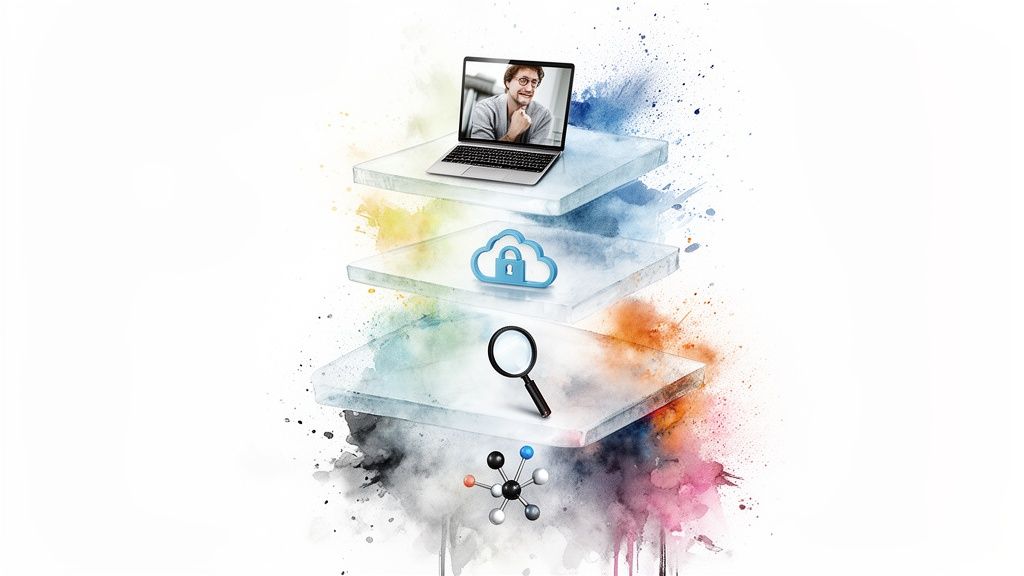
Think of a Cybersecurity-as-a-Service solution less like a single product and more like a multi-layered fortress built to defend your digital turf. Each layer is a distinct service, but they all work together to create one formidable, unified defense. These aren’t just alarms that go off; they’re an active, intelligent system run by real experts.
This integrated approach is catching on for a reason. The global CaaS market is expected to rocket from USD 17.60 billion in 2024 to a staggering USD 83.96 billion by 2034. This explosion is fueled by two colliding realities: cyber threats are getting nastier, and the talent shortage for security pros is getting worse, forcing businesses to find smarter ways to stay safe.
When you peel back the layers, you find the essential services that give a CaaS offering its muscle. These aren’t siloed tools that don’t talk to each other. They’re interconnected functions that share intel and context, protecting your organization from every possible angle.
Managed Detection and Response (MDR)
Imagine having a team of elite threat hunters actively prowling your network for intruders, 24/7. That’s the heart of Managed Detection and Response (MDR). It’s a world away from traditional antivirus software, which usually only reacts after the damage has already started.
MDR services combine advanced tech with human expertise to proactively sniff out and neutralize threats before they can do real harm. This team becomes your always-on surveillance crew, investigating anything that looks fishy and responding to incidents with the speed and precision needed to slash the time an attacker can lurk in your systems.
Security Information and Event Management (SIEM)
If MDR is your boots-on-the-ground threat hunting team, then Security Information and Event Management (SIEM) is the central command center where all the intel flows. A SIEM platform pulls in log data from every nook and cranny of your IT environment—servers, firewalls, apps, you name it.
It then pieces all this information together, looking for patterns and strange behaviors that could signal a breach. Without a SIEM, security alerts are just noise. With it, they become actionable intelligence that steers your entire defense strategy.
A well-run SIEM, as part of a CaaS solution, turns a flood of raw data into a clear, real-time picture of your security posture. This clarity leads to faster detection and smarter decisions when a crisis hits.
Vulnerability Management and Endpoint Security
A fortress is only as strong as its weakest wall. Vulnerability Management is the constant, proactive process of finding, assessing, and patching those weak spots in your systems before attackers can exploit them. This covers everything from outdated software to a misconfigured cloud server.
Working hand-in-glove with this is Endpoint Security, which is all about locking down the devices your team uses every day—laptops, desktops, and phones. Since these devices are the most common entry points for attackers, leaving them unprotected is simply not an option. For a deeper dive, check out our guide on essential endpoint security best practices.
Identity and Access Management (IAM)
Finally, there’s the digital gatekeeper: Identity and Access Management (IAM). This component is all about controlling who gets access to what within your organization. It’s what ensures that only authorized users can touch your sensitive data and systems.
By enforcing strong authentication and the principle of least privilege—giving people access only to what they absolutely need to do their jobs—IAM dramatically cuts down the risk from both external attacks and insider threats. Together, these core components form a robust, modern defense, all managed by your CaaS partner.
Why CaaS Is a Game-Changer for Your Business
Thinking about Cybersecurity as a Service (CaaS) as just another IT upgrade misses the point. It’s a fundamental shift in how you manage, fund, and scale security—transforming it from a reactive cost center into a proactive strategic asset. For both growing businesses and established enterprises, the advantages are powerful and immediate.
For Small and Medium-sized Enterprises (SMEs), CaaS is the great equalizer. It offers access to elite security talent and sophisticated tools that would otherwise be completely out of reach financially. Suddenly, that lone IT generalist trying to fend off organized cybercriminals is backed by an entire Security Operations Center (SOC), all for a predictable monthly fee.
This model flips the script on security spending. The need for massive upfront investments in hardware, software licenses, and recruitment simply vanishes, replaced by a straightforward, scalable subscription.
Leveling the Playing Field for SMEs
Let’s be honest: for a small business, the idea of hiring a single, experienced cybersecurity analyst—let alone a full team—is often a non-starter. CaaS is the cost-effective alternative, giving you immediate access to a deep bench of specialists who handle everything from 24/7 monitoring to incident response.
This frees up your team to focus on what they do best: growing the business, not fighting a constant digital battle they aren’t equipped to win.
The market data tells the same story. While large enterprises still make up the bulk of the CaaS market, SMEs are catching on fast, adopting these services at a blistering 13.98% CAGR. This isn’t just a trend; it’s a response to a harsh reality. With regulations increasingly scrutinizing supply chains and 95% of breaches tracing back to human error, having outsourced expertise is becoming a matter of survival. You can get a closer look at these market dynamics in this in-depth industry report.
Augmenting and Scaling Enterprise Security
For large enterprises, the challenge looks different, but it’s just as urgent. Many already have internal security teams, but those teams are often buried in alerts, stretched thin, and struggling to keep up with an ever-expanding attack surface. A cybersecurity as a service partner doesn’t come in to replace them; it comes in to supercharge them.
A CaaS provider can take over the relentless, around-the-clock monitoring and initial threat triage. This frees up your in-house experts to focus on higher-value work like threat intelligence, security architecture, and strategic planning. This co-managed model builds a more efficient, resilient, and scalable security operation.
The real power of CaaS for an enterprise is its ability to deliver immediate scale and specialized expertise on demand. When a new threat emerges or the company expands into a new market, your security capabilities can grow instantly without a months-long hiring and procurement cycle.
The table below breaks down how these benefits play out differently for SMEs versus large enterprises, highlighting the unique value CaaS brings to each.
CaaS Benefits For SMEs vs Enterprises
| Benefit | Impact on SMEs | Impact on Enterprises |
|---|---|---|
| Cost Efficiency | Transforms a large capital expenditure (CapEx) into a predictable operational expense (OpEx). Avoids the high cost of in-house hiring and infrastructure. | Optimizes existing security budgets. Reduces the cost of 24/7 monitoring and frees up high-salaried internal experts for strategic tasks. |
| Access to Expertise | Provides immediate access to a full team of security specialists (SOC analysts, threat hunters, engineers) that would be impossible to hire directly. | Fills niche skill gaps (e.g., cloud security, threat intelligence) without lengthy recruitment. Augments the existing team with specialized, on-demand talent. |
| Scalability | Security can scale seamlessly as the business grows, without needing to rip and replace technologies or go on a hiring spree. | Allows security operations to scale rapidly to support new business units, M&A activity, or geographic expansion without internal headcount delays. |
| Advanced Technology | Gains access to enterprise-grade tools like SIEM, EDR, and threat intelligence platforms that are typically unaffordable for smaller companies. | Leverages the provider’s best-in-class tech stack, reducing the burden of tool management, maintenance, and licensing on the internal team. |
| Focus on Core Business | Frees up leadership and IT staff to concentrate on revenue-generating activities instead of being bogged down by complex security management. | Allows the in-house security team to shift from reactive alert-chasing to proactive strategic initiatives like policy development and risk management. |
Ultimately, whether you’re a 50-person company or a 5,000-person corporation, CaaS delivers the right resources at the right time, allowing you to build a more robust and agile security posture.
The Critical Advantage of a US-Based Partner
Choosing an outsourcing partner is a big decision, and where they’re located matters. Partnering with a USA-based provider offers clear, practical benefits that directly impact your effectiveness and peace of mind.
- Seamless Communication: When a security incident is unfolding, you can’t afford delays or misunderstandings. Working with a team in your time zone means clear, real-time communication is a given, not a headache.
- Regulatory Alignment: A US-based partner lives and breathes domestic business regulations. They have an intrinsic understanding of everything from data privacy laws like CCPA to industry-specific compliance standards, which simplifies audits and reduces risk.
- Access to Top-Tier Talent: The United States is home to some of the world’s best cybersecurity talent. By partnering with a domestic firm, you tap into this elite pool of experts without the hurdles of international recruitment.
This blend of accessibility, expertise, and regulatory fluency makes a USA-based partner a smarter choice for protecting your business. To discuss how our US-based team can strengthen your security posture, give us a call at +1 (310) 800-1398 today.
How to Choose the Right CaaS Partner

Picking a Cybersecurity-as-a-Service (CaaS) provider is one of the most critical relationships your business will ever form. This isn’t just about selecting a vendor; it’s about entrusting a partner with your most sensitive digital assets. Get it right, and they become a seamless extension of your team. Get it wrong, and you invite risk, friction, and headaches.
The market for CaaS is exploding for a reason. Projections show it rocketing from USD 29.48 billion in 2025 to a staggering USD 50.99 billion by 2030. This isn’t just hype—it’s a direct response to the messiness of modern IT, where most businesses are running hybrid or multi-cloud environments ripe for misconfigurations. For a deeper dive into these numbers, the full research on CaaS growth paints a clear picture.
This growth means you have more options than ever, but it also means a generic checklist won’t cut it. To find a true security partner, you need to dig deeper into their tech, their processes, and—most importantly—their people.
Scrutinize the Technology Stack and Threat Intelligence
A provider is only as good as their tools. Don’t settle for a list of acronyms. You need to ask pointed questions.
What specific Security Information and Event Management (SIEM) and Endpoint Detection and Response (EDR) platforms do they use? But the real question is why they chose them. A top-tier partner can explain exactly how their particular tools integrate to give them better visibility and slash response times. It’s the difference between a box-ticker and a security strategist.
Just as crucial is the quality of their threat intelligence. A provider analyzing bad data is worse than useless. Ask where they source their intel. Is it just the free, publicly available feeds that everyone else has? Or do they invest in premium, industry-specific intelligence services? The best partners blend multiple sources to build a rich, accurate picture of the threats that actually matter to your business.
Verify Certifications and Real-World Experience
Certifications are your baseline for quality and professional maturity. At a minimum, look for key attestations that prove a provider’s commitment to doing things the right way.
-
SOC 2 (Service Organization Control 2): This audit is a deep dive into a provider’s controls around security, availability, and confidentiality. A SOC 2 Type II report is the gold standard, as it verifies those controls were effective over an extended period.
-
ISO 27001: This international standard proves the provider has a formal, systematic approach to managing sensitive information. It’s a sign that security isn’t an afterthought; it’s baked into their DNA.
But paperwork is only part of the story. The real differentiator is the hands-on, in-the-trenches experience of their security team. Ask about the background of their analysts. Have they managed real security crises in your industry before? A team of seasoned incident responders is infinitely more valuable than a room full of analysts who’ve only ever seen threats in a simulator.
A provider’s true value is revealed not on a quiet Tuesday, but in the critical moments of a security crisis. Their ability to manage an incident with calm, precision, and clear communication is the ultimate test of their expertise.
Demand Clarity on SLAs and Incident Response
A Service Level Agreement (SLA) isn’t just another document; it’s a promise. Vague SLAs are a massive red flag. Your agreement needs to have specific, measurable guarantees for the metrics that count.
- Time to Detect (TTD): How quickly will they spot a potential threat?
- Time to Respond (TTR): Once detected, how fast will they start taking action?
Beyond the numbers, you need to understand their incident response process inside and out. What are the escalation protocols? Who is your direct point of contact during a crisis? How often will they update you? A partner who can walk you through a clear, well-rehearsed plan is one you can trust when the pressure is on. This level of preparation is the hallmark of a mature cybersecurity as a service provider.
The Advantage of a USA-Based Partner
Finally, don’t overlook the significant benefits of working with a provider based in the USA. A domestic partner means no communication barriers and no time-zone delays—which is absolutely critical when every second counts during an incident.
They also have an inherent understanding of US business regulations and compliance standards, which simplifies your risk management from day one. This alignment ensures a smoother, more effective, and culturally attuned partnership.
Choosing the right CaaS partner is about finding a team that blends technical skill with business sense and cultural alignment. For a consultation on how a USA-based partner can meet your needs, call us at +1 (310)800-1398.
Putting CaaS to Work in Your Business

Signing on the dotted line for a cybersecurity as a service provider is the first step. The real work—and the real value—begins when their team starts weaving their technology and expertise into your daily operations. This isn’t about a disruptive, rip-and-replace overhaul. Think of it as a structured, collaborative process designed to bolt on serious defenses with as little friction as possible.
It all starts with a discovery phase. This is way more than just a questionnaire; it’s a deep-dive mapping of your entire IT world. The provider’s team works right alongside yours to get a handle on your network architecture, figure out what your most critical assets are, and start flagging potential weak spots. This initial groundwork ensures the security solution is fitted to your specific reality, not just some generic, off-the-shelf fix.
That collaborative spirit is everything. Your provider shouldn’t feel like a vendor; they should feel like an extension of your own team, bringing specialized skills to the table that you don’t have in-house.
Forging a True Partnership
Once everyone’s on the same page, the focus shifts to getting the security tools in place and locking down the rules of engagement. This is where the partnership really comes to life. Your CaaS provider will start deploying agents on endpoints, hooking their SIEM into your log sources, and fine-tuning the detection rules.
But this isn’t a “black box” operation. Transparency is key. Your internal team isn’t kept in the dark; they’re right there in the mix, learning how the new tools work and seeing how they plug into the bigger security picture. This approach ensures a much smoother and more effective operation down the line.
Ultimately, this integration is less about tech and more about getting people and processes to work in sync. Nailing these connections early on is vital for building long-term operational resilience.
The goal of CaaS integration is not to replace your IT team but to empower them. By handling the 24/7 burden of threat monitoring and initial response, a CaaS partner frees up your internal experts to focus on strategic business initiatives.
Defining Who Does What, and When
With the technical pieces in place, it’s time to build the human framework. This means creating a rock-solid communication plan that spells out exactly how your team and the provider’s security analysts will interact every day. This usually covers:
- A Regular Reporting Rhythm: Setting up a schedule for reports on your security posture, any threats that were caught, and what the analysts recommend you do next.
- Dedicated Lines of Communication: Establishing secure channels for real-time chats, whether that’s a dedicated portal, a shared Slack channel, or something similar.
- Crystal-Clear Escalation Paths: Defining precisely who gets called—and how—when a critical incident kicks off. This ensures a swift, coordinated response without any confusion.
These protocols eliminate the guesswork and delays when a threat hits. Everyone knows their role, what to expect, and how to communicate effectively under pressure. You can get a better sense of today’s threats by exploring the latest cloud security challenges.
The Advantage of a USA-Based Partner
Let’s be honest: integration gets a whole lot simpler when you choose a USA-based outsourcing partner. Working with a team in the same country just smooths out so many logistical and communication bumps. You can forget about those late-night calls across impossible time zones. Having a shared cultural and business context makes communication clearer and more direct—something that’s absolutely essential during a security incident.
A domestic partner also comes with an innate understanding of U.S. regulatory standards, which dramatically simplifies compliance and risk management. This alignment ensures the entire process, from creating policies to reporting on an incident, is perfectly in step with local requirements.
Ready to see how our USA-based team can seamlessly integrate with your operations? Call us at +1 (310) 800-1398 to start the conversation.
Ready to Build a More Secure Future?
We’ve covered a lot of ground on what Cybersecurity as a Service is and isn’t. At its core, CaaS is much more than a defensive tool—it’s a strategic move that builds resilience, protects your reputation, and clears the runway for long-term growth. It’s about gaining access to elite security minds, stabilizing your costs, and frankly, getting some genuine peace of mind in a pretty chaotic digital world.
The time to act is now.
Waiting for a breach to justify a security investment is like waiting for a house fire to buy insurance. The steps you take today are what will safeguard your assets and keep your customers’ trust intact tomorrow. A solid security posture isn’t a luxury anymore; it’s a fundamental part of doing business.
Your Path Forward
The first step is always the clearest: you have to know where you stand. Before you can strengthen your defenses, you need an honest look at your weaknesses. It’s about a clear-eyed assessment of your real-world risks and mapping out a practical plan to fix them.
A huge piece of this puzzle is making sure your data is protected from creation to deletion. That includes securely sanitizing data from retired IT assets, following authoritative frameworks like the NIST SP 800-88 guidelines. A good CaaS partner doesn’t just block attacks; they help you implement these kinds of robust, end-to-end practices as part of a complete strategy.
Cybersecurity as a Service flips the script, turning your security from a source of anxiety into a competitive advantage. It frees you up to focus on innovation and growth while experts handle the complexities of digital defense.
Partner with a Leader in Cybersecurity
As a premier USA-based outsourcing partner, we connect you with the top-tier security talent you need to protect what you’ve built. Why does “USA-based” matter so much? It means seamless communication, total alignment with domestic business regulations, and access to leading security pros without fighting time zones or cultural gaps. That local expertise gives you a massive advantage in building a security program that’s both effective and responsive.
Take the definitive step to fortify your organization against modern threats.
Give us a call today at +1 (310) 800-1398 for a no-nonsense consultation. Let’s figure out how a CaaS solution can secure your company’s future.
Your Top CaaS Questions, Answered
As you start thinking about Cybersecurity-as-a-Service, a few key questions always come up. Here are some straight answers to help you figure out if this model makes sense for your business.
Is CaaS Just a Big Company Thing?
Not at all. While enterprises certainly use CaaS, it’s arguably even more of a game-changer for Small and Medium-sized Enterprises (SMEs). Why? Because it gives them a fighting chance.
For most SMEs, building an in-house security team with enterprise-grade tools and 24/7 monitoring is financially out of reach. CaaS flips the script. The subscription model gives smaller businesses access to the same level of firepower as the big players for a predictable monthly cost, leveling the playing field against modern cyber threats.
How Does CaaS Work With Our Current IT Team?
Think of a CaaS provider as a specialized extension of your existing team, not a replacement. They’re the specialists who handle the heavy lifting of security—the constant threat monitoring, the deep-dive investigations, and the immediate response when an alarm bell rings.
This frees up your internal IT staff to focus on what they do best: driving strategic projects that move the business forward. Instead of being buried under a mountain of security alerts, they can work on innovation. It’s a partnership built on clear roles and open communication, designed to make the whole operation run smoother.
One of the smartest moves you can make is choosing a USA-based partner. When a security incident hits, every second counts. You don’t want to be fighting timezone delays; you need seamless, real-time communication to resolve the issue fast.
What Does the Pricing Usually Look Like?
CaaS ditches the traditional, massive upfront capital expense (CapEx) for a much more manageable operational expense (OpEx). It’s a subscription model, plain and simple.
The cost is typically based on a few key factors:
- The number of users and endpoints (laptops, servers, etc.) you need to protect.
- The number of servers under watch.
- The specific services you choose for your package.
This structure makes budgeting for top-tier security predictable and straightforward. You avoid the seven-figure shock of building your own Security Operations Center and get a clear, monthly number you can plan around.
Ready to see how our solutions can fit your organization? Give us a call at +1 (310) 800-1398 for a no-nonsense consultation.