
If you’ve ever been on a team building something complex, you know the feeling. Everyone works on their own piece, heads down, making progress. But when it’s time to put it all together, nothing fits. It’s a chaotic, stressful scramble to fix conflicts and get everything working.
In software development, we call this "integration hell," and it’s exactly what Continuous Integration (CI) was designed to prevent.
What Is Continuous Integration?
Think of it like building a huge, intricate Lego model. The old way was for each person to build their section in a separate room and then try to connect them all at the end. It was a mess. Pieces wouldn’t align, connectors were in the wrong place, and the final assembly was a nightmare.
CI flips that script completely. Instead of one massive, painful integration event, developers merge their small additions to the main model multiple times a day. Each time a new piece is added, an automated system instantly checks if it fits perfectly with the entire structure.
This isn't a chaotic free-for-all; it's a highly organized and automated process.

A Modern Engine for Quality
At its core, Continuous Integration is a development practice where every time a developer merges code into a central repository, an automated build and test sequence kicks off. This creates a rapid feedback loop, flagging issues in minutes instead of weeks. It’s a foundational pillar of modern software delivery for a reason.
Consider the scale of modern software. Automotive giants like Volvo Cars, for example, manage over 35,000 builds daily using CI. It’s the only way to handle the immense complexity of the software running inside their vehicles.
This approach brings a few powerful advantages to the table:
- Find Bugs Faster: Catching errors early makes them dramatically simpler and cheaper to fix.
- Boost Developer Productivity: Automation takes over the repetitive, soul-crushing tasks, freeing up your team to focus on what they do best: building great features.
- Improve Code Quality: Constant integration and testing lead to a much more stable and dependable product over time.
Continuous Integration is a vital practice within the larger DevOps philosophy. To see how CI fits into the big picture, it’s worth understanding what is DevOps automation and how it accelerates software delivery.
To help clarify these ideas, let's break down the core principles that make CI work.
Core Principles of Continuous Integration at a Glance
The following table summarizes the key concepts that define the practice.
| Principle | Description |
|---|---|
| Single Source Repository | All team members commit to a single, shared codebase to ensure everyone is working from the same version. |
| Automate the Build | The process of compiling code, linking libraries, and creating a runnable application is fully automated. |
| Make the Build Self-Testing | Every build automatically triggers a suite of tests to verify its correctness and prevent regressions. |
| Commit Frequently | Developers integrate their work into the main branch in small, frequent batches—often multiple times a day. |
| Fast Feedback Loop | The time from code commit to test results should be minutes, allowing developers to fix issues immediately. |
These principles work together to create a seamless, reliable, and predictable development process.
The whole idea behind CI is to make integration a non-event. By doing it constantly, you shrink the risks and turn a stressful, unpredictable process into a quiet, routine part of the day.
For any business serious about speeding up its development cycle, a solid CI process is no longer a "nice-to-have." But getting it right requires specialized expertise. Partnering with a US-based outsourcing partner can provide the skills needed to build and manage an effective CI system, letting your team enjoy the benefits without the steep learning curve.
For expert guidance, contact us today. (310)800-1398 / (949) 861-1804 Email: [email protected]
How a CI Pipeline Works Step by Step
If Continuous Integration is the philosophy of quality, then the CI pipeline is where the rubber meets the road. Think of it as an automated assembly line for your code. It takes a developer’s raw contribution and guides it through a series of checkpoints, transforming it from a local change into a verified, stable part of the main project.
Let’s trace the journey of a single piece of code as it travels down this digital conveyor belt.

The Commit and Trigger
The whole process kicks off the moment a developer finishes a small piece of work—maybe a bug fix or a tiny new feature. They "commit" this change to a shared code repository, which acts as the central source of truth for the entire project.
This is where a solid foundation becomes non-negotiable. You can’t have CI without disciplined version control. If your team isn't already proficient, it’s essential to learn how to use Git for version control to keep your codebase organized and track every change.
That commit is the trigger. A dedicated CI server—like Jenkins, or a cloud-based service like GitHub Actions—is constantly watching the repository. The moment it detects that new commit, it springs into action, pulling the latest code and starting the pipeline.
The Build and Test Stages
With the code in hand, the CI server begins its automated workflow. This is where the magic happens, typically moving through a few key stages in sequence.
- Build Stage: First, the server tries to compile the source code into a runnable application. If the code can't even be compiled because of a syntax error or a missing file, the pipeline fails immediately. This is your first and fastest line of defense against broken code.
- Unit Test Stage: After a successful build, the pipeline unleashes a battery of unit tests. These are hyper-focused, lightning-fast tests that check individual functions or components in isolation to make sure they do exactly what they're supposed to.
- Integration Test Stage: Once the individual pieces pass muster, it’s time to see how they play together. The pipeline runs integration tests, which verify that different parts of the application can communicate and work together correctly. This is where you catch the subtle bugs that only pop up when separate modules interact.
The real power of these automated stages is the incredibly tight feedback loop. Instead of a developer finding out they broke something weeks later, they get a notification within minutes of their commit. They can fix it on the spot while the code is still fresh in their mind.
Reporting and Feedback
The journey’s final step is the report card. The CI server notifies the team of the outcome. A "green" build means every checkpoint passed, and the change is certified as safe and ready to be merged. A "red" build means something failed along the way.
This immediate feedback is the heart and soul of continuous integration. The automated system acts as a tireless gatekeeper, ensuring the main codebase stays clean and stable, and that bugs are squashed almost as soon as they're written.
For teams ready to implement this kind of process, partnering with a US-based outsourcing partner can provide the specialized skills needed to design and manage a robust CI pipeline, helping you get results faster without the overhead of building an in-house team. For a consultation, contact us. (310)800-1398 / (949) 861-1804 Email: [email protected]
To see how CI fits into a larger development framework, check out our guide on Spec-Driven Development for more insights.
The Strategic Business Value of Adopting CI
It’s easy to get lost in the technical weeds of continuous integration—the automated builds, the endless test scripts, the pipeline configurations. But make no mistake, CI isn't just an engineering practice. It's a business strategy that pays real, measurable dividends, strengthening your bottom line and sharpening your edge in a crowded market.

The most immediate impact is on your speed. By automating the grunt work of integration and testing, CI makes your software releases smaller, faster, and far more predictable. This isn't about just one or two big launches a year; it’s about creating a rhythm of continuous delivery that lets you respond to market shifts, push out new features, and deliver value to customers on your schedule, not your old process's.
This kind of agility is driving massive market growth. The industry for Continuous Integration tools is expected to jump from $2.58 billion in 2026 to an incredible $12.66 billion by 2034. Why? Because it works. A full 49% of companies report a faster time-to-market after adopting CI and related practices. You can dig into the market trends driving CI adoption yourself to see the momentum.
Slashing Costs and Boosting Innovation
Beyond pure speed, CI brings powerful financial benefits by completely changing how your team finds and fixes bugs. Catching an error minutes after a developer writes it is exponentially cheaper than finding it weeks later in a manual QA cycle—or worse, after a customer complains.
This early detection creates a positive ripple effect across the business:
- Reduced Development Costs: Your developers stop wasting time on frustrating bug hunts and rework. Instead, they can focus their energy on building the new, revenue-generating features your customers actually want.
- Increased Team Productivity: Automation strips away the tedious, soul-crushing tasks of manual integration. This not only boosts morale but frees up your best talent to focus on innovation and problem-solving.
- Improved Customer Satisfaction: When you consistently ship a more stable, higher-quality product, you get fewer support tickets, better reviews, and customers who stick around.
Continuous Integration transforms quality control from a costly bottleneck at the end of a cycle into an efficient, automated part of everyday development. This shift frees up resources that can be reinvested directly into growing your business.
Gaining a Competitive Advantage with an Expert Partner
In a cutthroat market, the ability to release better software faster than your rivals is the ultimate advantage. Continuous Integration is the engine that drives this capability. But building and maintaining an effective CI system requires a specialized skillset that many in-house teams simply don't have.
This is where a USA-based outsourcing partner can provide immense strategic value. By collaborating with experts, you can implement a world-class CI pipeline tuned to your specific business goals—without the high costs and long learning curve of hiring and training a dedicated internal team. A partner helps you get a much higher ROI on your development investment, accelerating your path to becoming a more agile and competitive organization. If your company also relies on older systems, you can explore our guide on how to modernize legacy applications and integrate them with these modern practices.
To unlock the full business value of CI, contact us for a consultation. (310)800-1398 / (949) 861-1804 Email: [email protected]
Essential CI Metrics and Best Practices
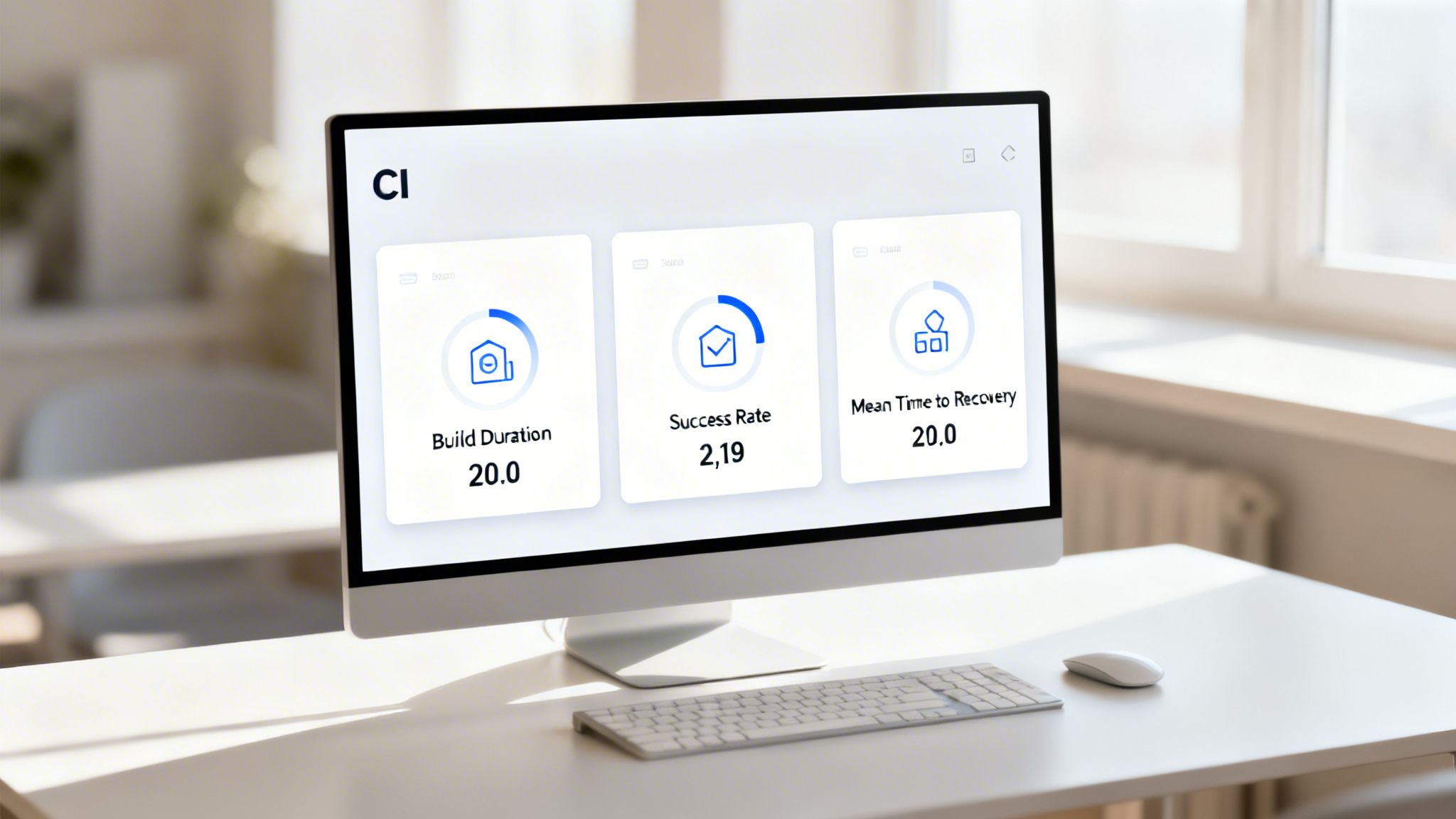
For CI to deliver on its promise, you have to know what to watch. Without the right data, you’re flying blind, unable to tell if your pipeline is a finely-tuned engine or an old clunker burning through time and money.
Key metrics are the health check for your pipeline. They reveal its speed, stability, and ultimate impact on your team’s momentum. These numbers tell a story about your workflow, and watching them is the first step toward building a truly high-performing development culture.
Key Metrics to Monitor
Just three core metrics can give you a crystal-clear picture of your CI system’s health. By tracking these, you can spot bottlenecks before they become roadblocks and celebrate the small wins that lead to big improvements.
Build Duration: This is the stopwatch for your pipeline—how long does it take to run from a developer’s commit to a final result? A consistently slow build is a productivity killer, so keeping this number as low as possible is non-negotiable.
Build Success Rate: Out of all your builds, what percentage passes without a single error? A low success rate is a red flag. It often points to flaky tests or a habit of pushing broken code, signaling that problems are slipping into the main branch far too often.
Mean Time to Recovery (MTTR): When a build inevitably breaks, how long does it take the team to fix it and get back to a “green” build? A low MTTR is the hallmark of a responsive team that can diagnose and resolve issues without derailing everyone’s day.
These numbers are your diagnostic tools. But they only lead to real improvement when you pair them with disciplined habits.
Fundamental Best Practices for CI
Adopting a few core rules is what turns CI from a tool into a transformative practice. These best practices ensure your pipeline stays fast, reliable, and valuable to everyone on the team.
The goal of CI is to make integration a non-event. These best practices are all designed to shrink the size and risk of each change, turning a once-feared process into a simple, everyday routine.
Here are the rules that successful teams live by:
Commit Small, Frequent Changes: Instead of huge, complex commits, developers should push small, self-contained changes to the repository multiple times a day. This makes bugs infinitely easier to find and fixes far simpler to implement.
Keep the Build Fast: Your pipeline is a feedback mechanism. If it takes an hour to run, developers lose focus and context while they wait. Aim for a build time under 10 minutes to maintain a tight, effective feedback loop.
Maintain a Single Source Repository: All code, for every part of the project, should live in one central place. This "single source of truth" cuts out confusion and guarantees that everyone is building from the exact same foundation.
Make Pipeline Status Visible: Everyone on the team needs to see the status of builds in real time. Whether it's on a shared monitor in the office or through instant chat notifications, high visibility ensures that when a build breaks, it becomes everyone's immediate priority to fix it.
Implementing these practices requires expertise. A USA-based outsourcing partner can provide the skilled guidance needed to set up these metrics and instill these best practices, ensuring you get the maximum value from your CI investment. To get expert help, contact us. (310)800-1398 / (949) 861-1804 Email: [email protected]
Choosing Your CI Strategy: Cloud Tools and Expert Partners
Getting a Continuous Integration strategy off the ground has never been easier. Not long ago, setting up CI meant buying, configuring, and maintaining a room full of expensive servers—a huge barrier that kept most smaller businesses from even trying. Today, that old model is quickly becoming a relic.
The game has completely changed with the rise of modern, cloud-based CI solutions. They get rid of the need for massive upfront hardware costs and the constant headache of server maintenance. Instead, you get access to incredibly powerful, scalable infrastructure for a predictable subscription fee.
The Power of Cloud-Based CI
Cloud tools have leveled the playing field, giving businesses of any size the same world-class CI capabilities that were once reserved for giants. This isn't just a small trend; it's a fundamental shift in how modern software gets built. The data is clear: cloud-based solutions are now the standard, with 62% of enterprises having already adopted cloud integration frameworks.
This shift is especially powerful for small and mid-sized businesses, where 48% now work with managed service providers to run their cloud environments. It gives them the muscle to compete without the burden of owning and managing a data center. You can explore more on how cloud adoption is reshaping development practices in recent market analysis.
The core benefits of moving your CI to the cloud are hard to ignore:
- Unmatched Scalability: Cloud platforms automatically scale resources up or down based on what you need. Whether you're running a few builds a day or thousands, you only pay for the computing power you actually use.
- Lower Maintenance Overhead: Your team is finally free from managing hardware, patching operating systems, and updating server software. This lets your developers get back to what they do best: writing code and creating features.
- Predictable Costs: Instead of a huge capital expense that drains your budget, you move to a flexible operational cost. This makes budgeting far more straightforward and accessible, especially for growing companies.
These advantages are why cloud CI isn't just an option anymore—it's become the default choice for anyone serious about modern development.
The Smartest Approach: An Expert Outsourcing Partner
While cloud tools make CI more accessible, just signing up for a service doesn’t guarantee you’ll get it right. Designing, building, and managing an effective CI pipeline requires deep DevOps expertise—a skillset that is notoriously expensive and difficult to hire for. This is where a strategic partnership becomes your greatest asset.
Collaborating with a specialized outsourcing partner is the smartest way to leverage cloud CI tools. You get the benefit of expert knowledge and proven experience without the risk and cost of building a dedicated in-house team from scratch.
A USA-based outsourcing partner brings the specialized knowledge needed to build a CI pipeline that is perfectly wired into your business goals. This approach dramatically accelerates your time-to-value, helping you see results much faster than you ever could alone. For more insights on this model, read our comprehensive software development outsourcing guide.
By entrusting your CI implementation to experts, you make sure it’s done right the first time. You get to skip the common mistakes and maximize the return on your investment from day one.
Ready to build a world-class CI pipeline tailored to your business? Contact us for expert guidance. (310)800-1398 / (949) 861-1804 Email: [email protected]
Getting Started with Continuous Integration Today
Thinking about continuous integration can feel overwhelming. Many leaders picture a massive, company-wide overhaul that drains resources and disrupts everything. But that’s not how successful CI adoption works.
The best way to begin is to forget the grand vision for a moment. Successful CI starts small, proves its value on a single project, and grows from there. The goal isn't to change everything overnight; it's to get a quick, tangible win that builds momentum.
Start by picking one project—ideally one with a team that’s motivated to try something new. Then, define what success looks like in the simplest terms. Maybe it's just automating the build process and a small handful of unit tests. That’s it. That’s your first win.
Your First Steps Will Look Different
How you start depends on your company’s DNA. A startup’s first pipeline will naturally look different from an enterprise's, but the core principle is the same: find the path of least resistance to the biggest immediate impact.
- For Startups: Speed and simplicity are your currency. Your goal is to stand up a single, straightforward pipeline for your most active project. Prove that an automated build and test cycle catches bugs earlier and helps you ship faster.
- For Enterprises: You’re likely juggling legacy systems, multiple teams, and tangled dependencies. Don’t try to boil the ocean. Instead, find one high-impact team or project where a CI pilot can clearly demonstrate better stability and efficiency. A victory here becomes the case study you need for wider adoption.
No matter your size, the mantra is the same: start small, show results, and build on your successes. This approach sidesteps the risk of a big-bang failure and lets your team build confidence one step at a time.
Choosing the Right Tools for the Job
The market for CI tools is crowded, but don't get lost in comparing endless feature lists. That’s a trap. The real question is about your team’s workflow and your company’s infrastructure.
The best tool is the one that fits how your team already works, not one that forces everyone to change their habits.
Think about the fundamental trade-offs first:
- Self-Hosted vs. Cloud-Based: Do you have the in-house expertise and desire to manage your own servers? Or would a cloud service free up your team to focus on what they do best—writing code?
- Integrated Platforms vs. Specialized Tools: Would an all-in-one platform that handles your code, pipelines, and deployments simplify your world? Or does your team need the best-in-class tool for each specific stage of the process?
Answering these questions first will narrow the field dramatically and guide you to a solution that solves problems instead of creating new ones.
You Don’t Have to Start Alone
Here’s the honest truth: while the concepts of CI are straightforward, the implementation is full of technical tripwires and common pitfalls. This is where most do-it-yourself initiatives get stuck. Getting it right requires specialized knowledge.
This is exactly why partnering with an expert is your most valuable asset.
Working with a USA-based outsourcing partner gives you direct access to the deep expertise needed to design and build a CI system that actually serves your business goals. A partnership helps you skip the painful trial-and-error phase and start seeing measurable value from day one. You get world-class skills without the time and expense of building that team from scratch.
To start your CI journey with confidence and ensure a successful implementation, contact the experts.
(310)800-1398 / (949) 861-1804 Email: [email protected]