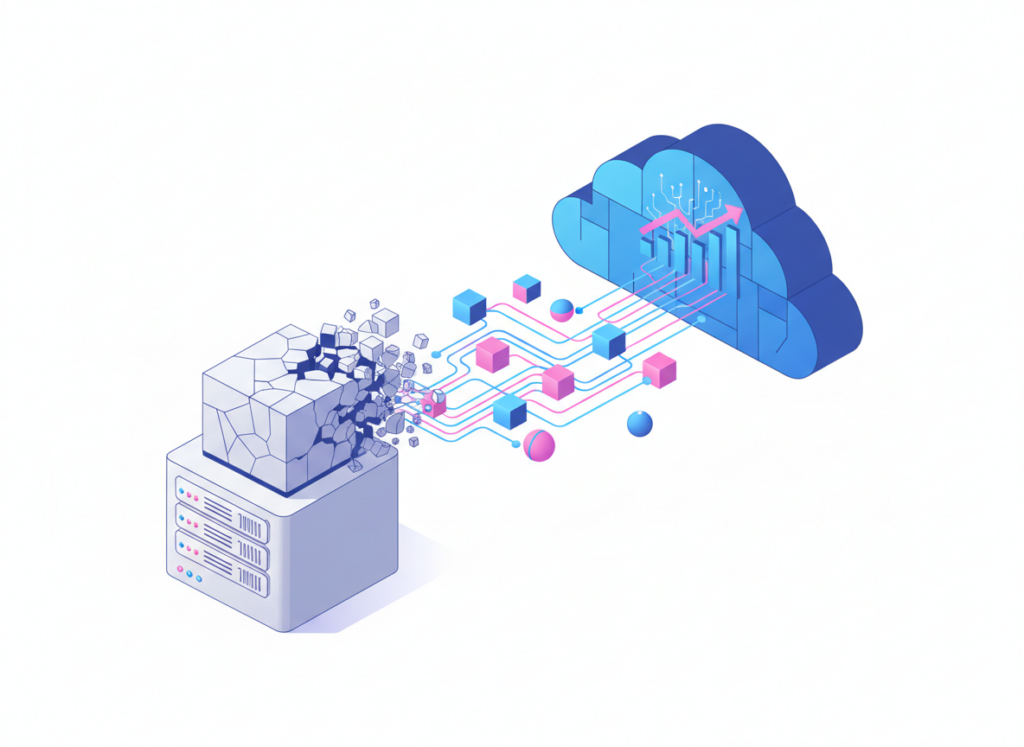
Knowing how to modernize legacy applications isn’t just about code—it starts with a solid business case. The real journey involves a hard look at your current system’s limitations, picking the right modernization strategy for your goals (like rehosting or refactoring), and getting the right team to make it happen.
Success hinges on treating modernization as a strategic business initiative that drives growth and cuts risk.
Why Modernization Is a Business Imperative
Staring down a legacy system often feels like a purely technical problem. In reality, it’s a massive business bottleneck. I define a legacy application not by its age, but by its impact—its inability to deliver the speed, security, and scale your business needs to stay competitive. To get started, it’s crucial to understand the fundamentals of Modernizing Legacy Systems and why it’s such a critical move for any company looking to grow.
These outdated systems are innovation killers. They quietly consume resources that should be fueling new features, better customer experiences, and market expansion. The pain points are real, and they touch every single part of the organization.
The Hidden Costs of Inaction
Many leaders seriously underestimate the true cost of just keeping things as they are. Legacy systems aren’t just old; they’re expensive, clunky, and dangerously insecure. The financial drain is far more than just server maintenance—it creates a domino effect of operational headaches.
Here’s what you’re really up against:
- Soaring Maintenance Costs: A shocking amount of IT budgets, sometimes over 70%, is spent just keeping the lights on for these old systems. That leaves almost nothing for new, valuable projects.
- Critical Security Gaps: Older platforms often can’t support modern security protocols. This makes them a prime target for cyberattacks, which can lead to disastrous data breaches and destroy your reputation.
- Shrinking Talent Pool: Try finding developers who are experts in COBOL or ancient versions of Java. It’s getting harder and more expensive every year, creating a massive dependency risk.
The real danger of a legacy system isn’t just its technical debt; it’s the opportunity cost. Every dollar spent maintaining an obsolete application is a dollar not invested in innovation, customer experience, or market expansion.
Breaking Free with a Strategic Partner
Navigating the minefield of modernization requires a special kind of expertise that most in-house teams just don’t have. For most businesses, partnering with a team of experts is the fastest and most efficient way forward.
A specialized USA-based outsourcing partner can be the perfect solution. You get immediate access to a deep pool of talent skilled in modern cloud architectures, seamless migration, and secure development practices. This approach guarantees clear communication and strategic oversight, which are absolutely essential for keeping a complex project on track and aligned with your business goals from day one. Instead of getting bogged down by talent gaps and technical roadblocks, you can focus on your core business while your partner handles the heavy lifting.
Ready to turn your legacy system from a liability into an asset?
Contact us to discuss your modernization roadmap.
(310) 800-1398 / (949) 861-1804
Email: info@ninearchs.com
Picking Your Modernization Play: A Guide to the 6 R’s
Okay, so you know why you need to modernize. The real question is how. This isn’t a one-size-fits-all deal. The right move for your business depends entirely on your goals, your budget, how fast you need to move, and how much risk you’re willing to stomach.
To make sense of it all, we use a framework known as the “6 R’s of Modernization.” Think of it less like a technical manual and more like a playbook. Each “R” is a different strategy, ranging from quick, low-effort wins to deep, game-changing transformations.
Are you just trying to slash server costs ASAP? Or are you aiming for a total architectural overhaul that will set you up for the next decade? Let’s walk through each play with some real-world examples.
Rehost: The “Lift-and-Shift”
Rehosting is the quickest way to get your application into the cloud. It’s exactly what it sounds like: you lift your application from its on-premise server and shift it over to a cloud provider like AWS, Azure, or Google Cloud. You barely touch the code.
Imagine a startup burning cash on maintaining its own physical servers. Their immediate goal isn’t to reinvent the app; it’s to stop the financial bleeding and improve reliability now. Rehosting is their perfect first move. They can migrate in a few weeks, immediately ditch the hardware expenses, and gain the uptime and scalability of a major cloud platform. It doesn’t fix the core application, but it buys them precious time and frees up capital for what comes next.
Key takeaway: Rehosting is a tactical first step, not the final destination. It solves immediate infrastructure headaches and cuts operational costs fast, clearing the way for bigger modernization efforts later on.
Replatform: The “Lift-and-Tinker”
Replatforming takes the lift-and-shift approach one step further. You move the app to the cloud, but you also make a few small, strategic tweaks to take advantage of cloud-native services. This could mean swapping out your self-managed database for a managed one or containerizing part of the application.
Think of an e-commerce site whose on-premise database gets crushed by traffic every holiday season. A full rearchitecture is too slow and expensive for their current needs. By replatforming, they can move their app to the cloud and migrate their database to a managed service like Amazon RDS. That one change can solve their scaling problem and slash database admin time, all without a massive rewrite.
Refactor and Rearchitect: The Long-Term Transformation
This is where the real magic happens. Refactoring and rearchitecting are about making significant changes to your application’s code and structure to unlock future growth and agility.
- Refactoring is about cleaning up and improving your existing code without changing what it does on the outside. It’s like renovating the plumbing and electrical inside a house while keeping the facade the same. The house works better, but it looks the same to visitors.
- Rearchitecting is a much bigger lift. You’re fundamentally changing the application’s structure, often by breaking a massive monolithic system into smaller, independent microservices. This is a major project aimed at achieving ultimate flexibility and scalability.
A classic candidate for rearchitecting is an established company with a monolithic CRM that’s become a bottleneck. It’s core to their business, but every tiny update takes months to deploy. By breaking it into microservices—one for customer data, another for order processing—they can update and deploy each piece independently. Suddenly, their development cycle shrinks from months to days, and the whole system becomes far more resilient.
Rebuild and Replace: The Clean Slate
Sometimes, an application is just too old, too broken, or too far from what the business needs to be worth saving. In these cases, you’re better off starting fresh.
- Rebuild: You write the application from the ground up. You keep the original scope and vision but use modern tools, languages, and architectures.
- Replace: You just get rid of the old application and switch to an off-the-shelf Software-as-a-Service (SaaS) solution that does the job.
Let’s say a company is limping along with a custom accounting system built 20 years ago. The original developers are long gone, the code is a mystery, and it can’t connect to any modern financial tools. Trying to patch it up is a fool’s errand. The smart move is to either rebuild it with a modern stack or, more likely, replace it with a proven solution like QuickBooks or NetSuite. They get instant access to new features, better security, and ongoing support.
Comparing the 6 R’s of Application Modernization
Choosing the right strategy can feel overwhelming. This table breaks down each “R” to help you quickly compare them based on what matters most: cost, effort, risk, and the kind of benefits you can expect.
| Strategy | Description | Ideal Use Case | Relative Cost & Effort | Key Benefit |
|---|---|---|---|---|
| Rehost | Move the application to the cloud with no code changes. (Lift-and-Shift) | Need to exit a data center quickly or reduce infrastructure costs immediately. | Low | Speed to market and immediate cost savings. |
| Replatform | Move to the cloud with minor optimizations to leverage cloud services. (Lift-and-Tinker) | Want to gain cloud benefits (e.g., managed databases, auto-scaling) without a full rewrite. | Low to Medium | Improved performance and reduced operational overhead. |
| Refactor | Restructure and optimize existing code without changing its external behavior. | The core architecture is sound, but the codebase is messy, inefficient, or hard to maintain. | Medium | Improved code quality, maintainability, and performance. |
| Rearchitect | Fundamentally alter the application’s architecture (e.g., monolith to microservices). | The existing architecture is limiting scalability, agility, and innovation. | High | Maximum agility, scalability, and long-term resilience. |
| Rebuild | Rewrite the application from scratch with modern technology, keeping the original scope. | The application is critical but too outdated to be salvaged; no suitable SaaS alternative exists. | Very High | A completely modern application tailored to your exact needs. |
| Replace | Decommission the old application and switch to a third-party SaaS solution. | The application provides a common business function that a commercial product can handle better. | Varies | Fast access to modern features, reduced maintenance burden. |
Ultimately, this table is a guide. The best path for you might even involve a mix of these strategies—rehosting some applications while rebuilding others. The key is to align your technical decisions with your business objectives.
Don’t Go It Alone: Navigating Your Decision with an Expert
Picking a path from the 6 R’s is a huge strategic decision. It demands a deep technical dive into your current app, a crystal-clear understanding of your business goals, and a realistic look at the costs and risks. This is where having an experienced partner is a game-changer.
A US-based outsourcing partner can bring an outside perspective, performing a comprehensive assessment to connect the dots between your legacy system and your business vision. We help you weigh the pros and cons of each “R,” identifying the path that delivers the best ROI for your company. With clear communication and a shared time zone, we ensure the project stays aligned and turns a daunting challenge into a calculated business win.
Ready to figure out the best modernization path for your application? Let’s build your roadmap together.
Call us at (310) 800-1398 / (949) 861-1804 or email us at info@ninearchs.com.
Navigating the Technical Trinity: Cloud, Security, and Data
When you get down to the brass tacks of modernizing a legacy application, it all boils down to three technical pillars: your cloud strategy, your security posture, and your data migration plan. Let me be blunt: getting these right isn’t just a technical box-ticking exercise. It’s the difference between a project that delivers real business value and one that becomes a costly, painful failure. These three are so deeply interconnected you can’t treat them as separate workstreams.
The move to cloud-native isn’t some fleeting trend; it’s the new standard for how business gets done. Just look at the numbers—a recent analysis shows a staggering 95% of new digital workloads are now built this way. Why? Because companies using modern methods are seeing up to 50% faster application development and 40% drops in infrastructure costs, all thanks to things like containers and microservices. And it’s not all public cloud, either. Hybrid cloud is set to eat up nearly 49.63% of cloud spending by 2025, especially for regulated industries that need to balance compliance with scalability. You can dig into the specifics in this in-depth analysis of application modernization trends.
Choosing the Right Cloud Environment
“Moving to the cloud” is not a strategy. It’s a starting point. The real work is in picking the environment that actually fits your application’s needs, balancing security, compliance, performance, and, of course, cost.
Here are your main plays:
- Public Cloud: This is your AWS, Azure, or Google Cloud. It’s built for massive scalability with a pay-as-you-go model that’s perfect for apps with unpredictable traffic or those that need to innovate quickly.
- Private Cloud: Think of this as your own dedicated cloud, either on-premise or hosted by a third party. It offers maximum control and security, which is often non-negotiable for government agencies or companies handling hyper-sensitive data.
- Hybrid Cloud: This approach is a mix of both, letting you run workloads where they make the most sense. For instance, you could keep a legacy database full of sensitive customer info tucked away in a private cloud, while your flashy new customer-facing web app runs on the public cloud to handle traffic spikes. It’s the best of both worlds.
For many businesses I’ve worked with, especially in finance or healthcare, the hybrid model is the sweet spot. It lets them hit strict regulatory targets without giving up the agility and cost benefits of the public cloud. For more targeted advice, check out our guide on cloud migration strategies for small businesses.
Embedding Security from Day One
In any modernization project, security cannot be something you bolt on at the end. The old way of thinking—where developers build something and then toss it over the wall to the security team—is dangerously slow and creates massive risks.
The only way to do it right is with DevSecOps. This means weaving security directly into every single phase of the development lifecycle. Security becomes everyone’s job, from the architect drawing the first diagram to the SRE keeping the lights on.
Security isn’t a feature; it’s a foundational component of the entire modernization process. By embedding security checks and automated testing into your CI/CD pipeline, you catch vulnerabilities early, reduce remediation costs, and build a more resilient application from the ground up.
Putting DevSecOps into practice means:
- Automated Security Scanning: Using tools that automatically scan code for vulnerabilities every single time a change is committed.
- Threat Modeling: Thinking like an attacker during the design phase to identify potential security holes before a line of code is even written.
- Immutable Infrastructure: Treating servers and other components as disposable. Instead of patching them, you just replace them with new, secure versions.
Mastering Data Migration
Data is the lifeblood of your application. That means migrating it is often the single most challenging—and riskiest—part of any modernization effort. A botched data migration can lead to data loss, corruption, and extended downtime that completely undermines the project. This has to be a meticulously planned and executed operation.
As you navigate the cloud and security puzzle, knowing how to properly migrate your database to the cloud is a make-or-break skill for building a scalable foundation.
The key activities here involve:
- Data Cleansing and Validation: Before you even think about moving a byte, you have to ensure the source data is accurate, consistent, and clean. This is the grunt work of finding and fixing duplicate records, bad entries, and outdated info.
- Data Mapping: This is a crucial step where you create a detailed blueprint of how data fields in the old system will match up with fields in the new one. Any mismatch here will cause data integrity headaches down the road.
- Choosing the Right Tools: There’s a whole ecosystem of tools out there, from simple scripts to powerful ETL (Extract, Transform, Load) platforms. The right tool depends entirely on the volume and complexity of your data.
Navigating these complexities often requires bringing in specialized expertise. A USA-based outsourcing partner can provide the strategic guidance and hands-on skill to manage cloud configurations, implement rock-solid security protocols, and execute a flawless data migration. With clear communication and aligned time zones, they ensure these critical pillars are built correctly from the start.
Ready to secure your modernization project’s foundation? Contact us at (310) 800-1398 / (949) 861-1804 or email info@ninearchs.com.
Assembling Your Modernization Crew and Fine-Tuning Your Engine
A brilliant modernization strategy is only as good as the people and processes bringing it to life. I’ve seen the most elegant technical roadmaps fall apart because the right team structure or a modern development workflow wasn’t in place. Getting a legacy application modernization right hinges on two things: assembling specialized talent and adopting practices that speed up delivery without sacrificing quality.
Think of this phase as building your engine for change. It starts with a critical decision: should you upskill your current team, hire new experts, or bring in an external partner to augment your capabilities? Each path comes with its own trade-offs around speed, cost, and immediate expertise.
Assembling Your Modernization A-Team
Let’s be blunt: the skills needed to modernize a monolithic application are worlds away from those required to just maintain it. You need people who live and breathe cloud architecture, microservices, containerization, and automated testing. These are skill sets that probably aren’t sitting on your current bench.
This forces a crucial choice:
- Upskilling In-House Talent: This is a great long-term play. Investing in your existing team builds deep institutional knowledge and is a fantastic morale booster. The downside? The learning curve can be steep, potentially dragging out your project timeline in a major way.
- Hiring New Experts: Bringing in specialists gives you an instant injection of expertise. However, finding and hiring these folks is a slow and expensive ordeal, especially in today’s competitive tech market.
- Augmenting with an External Partner: This hybrid approach often hits the sweet spot. You get immediate access to specialized skills without the long-term overhead and commitment of new full-time hires.
For many organizations, the smartest move is to partner with a specialized firm. The results speak for themselves. Companies that nail their modernization efforts often see a 25-35% reduction in infrastructure costs and accelerate their release cycles by an incredible 40-60%. Working with experts just gets you to those numbers faster.
The Advantage of a US-Based Outsourcing Partner
Choosing an outsourcing partner isn’t just about finding technical talent; it’s about finding the right talent that slots seamlessly into your existing team. This is where a US-based partner offers a distinct advantage.
You get the best of both worlds: access to a global talent pool, ensuring you have top-tier experts in modern technologies, but with project management, communication, and strategic oversight handled right here at home. This model sidesteps the classic frustrations of mismatched time zones, cultural disconnects, and communication gaps that can completely derail a complex project. What you get is a fluid, collaborative environment where everyone is pulling in the same direction. For a deeper dive into this, you might find our guide on technology strategy consulting useful.
A successful partnership isn’t just about augmenting staff; it’s about gaining a strategic ally. A US-based partner provides the perfect blend of world-class technical skill and the clear, consistent communication necessary to navigate the complexities of a modernization project.
Implementing Modern Development Processes
Getting the right team in place is only half the battle. You also need to arm them with modern processes designed to slash manual effort while cranking up speed and quality. This is where Continuous Integration/Continuous Deployment (CI/CD) and automated testing become absolutely non-negotiable.
CI/CD is essentially an automated pipeline that moves new code from a developer’s machine into production quickly, safely, and reliably.
- Continuous Integration (CI): Developers merge their code changes into a central repository multiple times a day. Each merge automatically triggers a build and a battery of tests, catching integration bugs early before they snowball into massive headaches.
- Continuous Deployment (CD): Once the code aces all the automated tests, it’s automatically pushed live to production. This practice shrinks release cycles from months down to days, or even hours.
Automated testing is the critical safety net that makes CI/CD possible. By building a comprehensive suite of tests that automatically check the application’s functionality, performance, and security, you can deploy changes with real confidence. This frees up your team from soul-crushing manual testing and lets them focus on what they do best: building new features that add real value to the business.
Put together, these processes create a powerful, self-reinforcing feedback loop. They dramatically reduce the risk of human error, elevate the quality of your application, and give your business the agility it needs to outmaneuver the competition.
Ready to build the expert team and efficient processes your project needs?
Contact us to discuss how our US-based team can help you succeed.
Call us at (310) 800-1398 / (949) 861-1804 or email info@ninearchs.com
Gauging the Payoff and Dodging Project Potholes
So, how do you convince the powers that be that a massive, complex legacy modernization project is actually worth the time and money? This is almost always the biggest roadblock. To get that crucial buy-in, you need more than just a good idea; you need a rock-solid business case built on a clear return on investment (ROI) and a smart plan for navigating the inevitable risks.
The trick is to shift the entire conversation away from pure cost and toward tangible business value. You have to show not just what the project will cost, but what the company stands to gain—from sharper operational efficiency to a real competitive edge.
Calculating the True ROI of Modernization
To build a compelling case, you need to pit the Total Cost of Ownership (TCO) of your clunky old system against the very real benefits of a modern one. And let’s be honest, the TCO of your legacy app is more than just server costs; it’s a financial black hole of hidden expenses that quietly drain your budget.
When you’re adding up the legacy TCO, make sure you’re brutally honest about these costs:
- Direct Maintenance Costs: This is the obvious stuff—hardware upkeep, ancient software licenses, and the premium salaries you pay specialized developers who are the only ones left who know how to wrangle that old code.
- Indirect Operational Costs: Think about the countless hours your team wastes on manual workarounds. Factor in the cost of every outage and the resources sucked up by painfully slow processes. It all adds up.
- Opportunity Costs: This is the killer, and it’s the one most people miss. This is the revenue you didn’t earn because you couldn’t launch that new feature fast enough, enter a new market, or react to what your customers were demanding.
Once you have a clear, unvarnished picture of what the old system is really costing you, you can contrast it with the gains from modernization. These aren’t just pie-in-the-sky promises; they are measurable outcomes that hit the bottom line.
Key Performance Indicators to Track Success
To prove you’re delivering value, you need to track the right things. Vague promises of “making things better” won’t get you funded. You need to focus on specific Key Performance Indicators (KPIs) that draw a straight line from a technical upgrade to a business win.
Here are the essential KPIs you should be monitoring:
- Developer Productivity: Look at metrics like deployment frequency and lead time for changes. A modern system should drastically shrink the time it takes to get an idea into production.
- Application Uptime and Performance: Track system availability and response times. Modern, cloud-native apps are simply more resilient and faster, which leads to a much better experience for your users.
- Time-to-Market: How fast can you roll out new products? Modernization should compress this cycle, giving you a huge advantage over others still stuck in the slow lane.
- Security Incident Reduction: Monitor the number and severity of security vulnerabilities. A modern, secure-by-design architecture will slash your risk profile and the insane costs that come with a data breach.
- User Engagement and Satisfaction: Keep an eye on user adoption rates, session duration, and customer satisfaction scores. A faster, more intuitive application means happier, more loyal customers.
A successful modernization project isn’t just about flipping a switch on a new application. It’s about hitting specific, measurable business goals. By defining your KPIs upfront, you create a clear benchmark for success and can prove the project’s value every step of the way.
Mitigating Common Modernization Risks
Even the most carefully planned projects can go sideways. Being proactive about identifying and planning for risks is what separates a successful project from a cautionary tale. The first step to avoiding these pitfalls is knowing what they are. You can get a deeper look by exploring our guide on risk analysis for businesses.
Here are some of the most common risks I’ve seen and how to get out in front of them:
| Risk | Mitigation Strategy |
|---|---|
| Scope Creep | Lock down a clear, documented project scope with defined milestones and a formal change control process. Any new feature request has to be justified with its own business impact and ROI before it even gets considered. |
| Budget Overruns | Develop a detailed budget that includes a contingency fund—15-20% is a good rule of thumb. Use a phased approach to modernization; this lets you control costs and deliver some early wins to keep stakeholders happy. |
| Talent Gaps | Do a skills assessment early. Be realistic about what your team can and can’t do. Bring in external experts to fill critical gaps in areas like cloud architecture, DevSecOps, or data migration. Don’t let pride sink the project. |
| Business Disruption | Use a parallel run strategy. Keep the old and new systems running at the same time for a period. This gives you a safety net for thorough testing and allows for a smooth, gradual cutover that won’t disrupt daily operations. |
The Value of a US-Based Outsourcing Partner
Let’s be real: navigating these financial models and risk strategies requires a level of experience most in-house teams just don’t have. This is where a strategic partner can be a game-changer. A US-based outsourcing partner brings not only the technical chops to execute the project but also the strategic foresight to build that bulletproof business case.
With clear communication and shared cultural context, we help you define the right KPIs, calculate a realistic ROI, and map out a comprehensive risk management plan. This partnership gives you the confidence to move forward with a clear vision, backed by solid data and a proven strategy for success.
Ready to build a business case for modernization that can’t be ignored?
Contact our experts at (310) 800-1398 / (949) 861-1804 or email us at info@ninearchs.com.
Looking to modernize your applications? You shouldn’t have to go it alone.
Taking on a legacy modernization project is a massive commitment. It’s not just about swapping out old code for new; it’s a strategic business decision that needs to deliver a real, measurable return on investment. The right partner does more than just write code—they bring the strategic roadmap to get you there.
Choosing that partner is arguably one of the most critical steps in the whole process.
Working with a US-based partner like NineArchs hits the sweet spot. You get world-class talent that operates on your clock, understands your market, and can work hand-in-glove with your own people. It just smooths out the entire process and helps you sidestep common outsourcing pitfalls like time zone delays and communication gaps.
The real value of a great partner isn’t just their technical skill. It’s their ability to see the business goal behind the code and turn a complex technical challenge into a clear business win. They’re the ones who transform a legacy system from a liability into a genuine competitive advantage.
Ready to figure out what that roadmap looks like for you? Let’s talk.
Connect with our modernization experts today to get the conversation started.
Call us at (310) 800-1398 or (949) 861-1804, or shoot an email to info@ninearchs.com.
Answering Your Questions About Legacy Modernization
When you’re staring down a legacy modernization project, it’s natural for questions to bubble up. Leaders—both on the business and tech sides—want to know what they’re getting into, how to justify the spend, and how to keep the lights on while the work gets done. Let’s tackle some of the most common questions we hear from the field.
Where On Earth Do I Even Start?
The only right answer is with a thorough assessment. Don’t even think about touching a line of code until you’ve done a deep dive into the application you have today. That means analyzing its architecture, untangling the business logic, mapping out dependencies, and understanding its data structures. This isn’t just a technical exercise; it’s a strategic one.
This initial discovery phase is where you’ll pinpoint the biggest operational headaches and uncover the most promising opportunities. The findings from this audit will point you directly to the right modernization strategy—whether it’s a simple Rehost, a more involved Rearchitect, or a full-on Replace. It ensures your plan aligns with your real-world budget and business goals from day one.
How Do I Convince Stakeholders This Is Worth the Cost?
You need to build a rock-solid business case that’s rooted in ROI, not just the upfront price tag. Start by calculating the Total Cost of Ownership (TCO) of your current legacy system. And be ruthless about it—include all the hidden costs people often forget, like the insane number of hours your team spends on maintenance, the revenue you lose every time the system goes down, and the steep price of patching security vulnerabilities.
Once you have that number, contrast it with the projected benefits of modernizing. Frame the gains in the language your stakeholders care about:
- Slash infrastructure spending by moving to the cloud.
- Boost developer productivity, which means shipping new features faster.
- Strengthen your security posture and avoid a data breach that could cost millions.
The most convincing case for modernization isn’t just about fixing old, creaky technology. It’s about showing how this investment directly fuels growth, cuts operational risk, and builds a more agile, competitive company for the future.
Does “Modernization” Just Mean a Complete Rewrite?
Absolutely not. That’s a common misconception. A complete rewrite, what we call a Rebuild or Replace strategy, is just one tool in the toolbox—and it’s usually the most expensive and disruptive one. Many of the most successful modernization projects start with much less intensive approaches.
For instance, a Rehost (or “lift-and-shift”) gets your application into a cloud environment with minimal code changes, giving you an almost immediate win on infrastructure costs. On the other hand, Refactoring involves cleaning up the internal structure of your existing code without changing what it does on the outside. This makes the system far more efficient and easier for your team to maintain. The right path is always the one that fits your specific goals and resources.
How Do We Pull This Off Without Disrupting the Business?
You mitigate risk by avoiding a “big bang” cutover at all costs. Instead, you adopt a phased, iterative approach. Think of it as modernizing your application one piece at a time, in smaller, more manageable modules or services. This strategy lets you run the new and old systems in parallel for a while.
Running in parallel is your safety net. It gives you the breathing room for rigorous testing and ensures a smooth, controlled transition for your users. It also creates opportunities for early wins, which are fantastic for building momentum and keeping stakeholders confident. This is where working with an experienced partner really pays off; they can help architect a detailed migration plan that anticipates roadblocks and puts business continuity above everything else.
Navigating these questions is what we do. A US-based outsourcing partner provides the strategic guidance and deep technical expertise to build a clear, actionable roadmap for your modernization project with confidence.
Ready to get started? Contact our experts today.
(310) 800-1398 / (949) 861-1804
Email: info@ninearchs.com