
You’re probably in the worst part of the hiring cycle right now. The roadmap is committed, product wants dates, sales already promised a feature, and your team still doesn’t have the full-stack developer who’s supposed to connect the frontend, backend, and deployment flow.
That’s when founders make bad hires. They rush the job description, screen for buzzwords, skip real technical validation, and convince themselves they can “coach up” a weak generalist later. Later never comes. You just lose time.
A disciplined approach to how to hire full stack developer talent matters more now because demand is fierce. In 2025, full-stack developers ranked as the most demanded IT role worldwide, outpacing AI specialists and front-end only postings, according to Statista’s recruiter survey. If you’re hiring casually, you’re competing seriously against companies that are not.
Starting Your Hiring Journey
A common founder mistake is treating this hire like a generic software role.
You don’t need “a developer.” You need someone who can take ownership across the application, move without constant handoffs, and make practical tradeoffs when the product is still changing weekly. That’s a very specific profile.
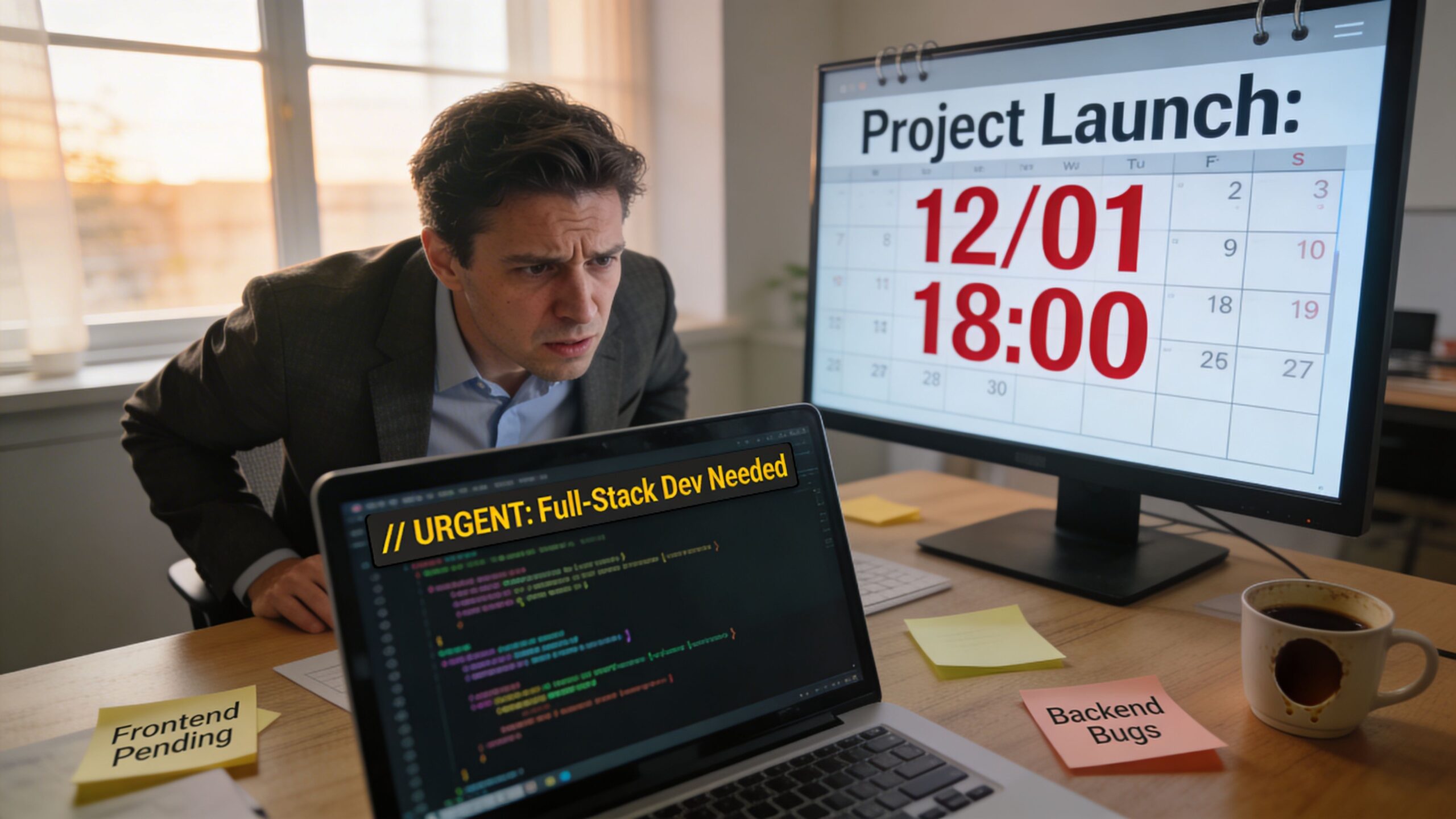
When a deadline is close, teams usually default to one of three bad moves:
- Posting too broad a role and attracting people who know a little of everything and own nothing.
- Over-indexing on speed and hiring the first decent freelancer who replies.
- Interviewing without a scorecard so every stakeholder judges candidates by gut feel.
None of that works consistently.
The better move is to decide what problem this person must solve in the next six to twelve months. Is it shipping an MVP in React and Node.js? Stabilizing a Django app that keeps breaking under load? Rebuilding internal tooling on a cloud stack your current team barely understands? Start there.
If you want a broad market view before writing your role, Underdog’s guide on how to hire a full stack developer is useful because it frames the hire around actual product needs rather than a laundry list of frameworks.
Hire for ownership first, stack second. A smart engineer can learn an adjacent tool. A low-ownership engineer will drain your team in any stack.
The companies that hire well don’t improvise. They define the role tightly, choose the right hiring model, screen for depth and judgment, and make onboarding part of the hiring plan instead of an afterthought.
Defining the Full Stack Role and Tech Stack
A founder says, “We need a full-stack developer,” and three people hear three different jobs. Product wants features shipped fast. Ops wants fewer incidents. Design wants cleaner frontend execution. That confusion is how you hire the wrong person at the wrong price.

Define the role before you source a single candidate. If you skip that step, your applicant pool gets noisy, your interviews drift, and your cost of ownership rises fast because you spend senior team time correcting a bad match.
Start with the product surface area
Write the role around the systems this person will own in the first 90 days.
Be specific:
- Frontend: React, Vue, Angular, Next.js, mobile web, design system work
- Backend: Node.js, Django, Laravel, Go, API design, background jobs
- Data layer: PostgreSQL, MySQL, MongoDB, Redis, schema design, query performance
- Infrastructure: AWS, GCP, Docker, CI/CD, observability, deployment ownership
- Integrations: Auth, payments, third-party APIs, analytics, admin tooling
That list does more than improve the job description. It sets your real screening baseline and helps you estimate management load later. A developer who can ship React and Node features but cannot handle cloud deployments is a different hire from someone who can own the full delivery path. Those differences affect salary, ramp time, and who else you need on the team.
Separate required skills from optional ones
Startup job specs get bloated because everyone adds a preference.
Cut that out. If the product is built on React, Node.js, PostgreSQL, and AWS, make those the required stack. If TypeScript or Terraform would help but can be learned on the job, label them as preferred. If a tool will not show up in the first two quarters, remove it.
Use a simple filter:
| Category | What belongs here |
|---|---|
| Required | Tools and responsibilities the hire must handle immediately |
| Preferred | Adjacent experience that shortens ramp time |
| Exclude | Trendy tools with no clear use in your roadmap |
This discipline matters financially. Every inflated requirement narrows the pool, lengthens the search, and pushes compensation up without improving outcomes.
Define the outcome, not just the stack
A stack list is not a role.
Spell out what the business needs this person to accomplish. A strong brief answers four questions clearly:
What are they shipping first?
Customer-facing product, internal operations tool, partner dashboard, API platform, or technical debt cleanup.How much ownership do they carry?
Feature execution under a lead, or architecture and delivery ownership with minimal oversight.What constraints shape the work?
Release speed, security standards, uptime expectations, performance issues, or cloud cost control.How will you measure success?
Feature throughput, defect rate, incident reduction, migration progress, or cycle time from spec to production.
Map the role into your broader software development team structure. If nobody can explain where frontend, backend, QA, DevOps, and product responsibilities begin and end, you are not hiring a full-stack developer. You are hiring someone to absorb organizational confusion.
Define the level of complexity up front
Do not hide scale, mess, or ambiguity.
Say whether the new hire is walking into a stable codebase, a half-built MVP, or a system held together by urgent fixes and contractor patches. Say whether they need to support heavy API traffic, build around brittle integrations, or improve a backend that slows down under real usage. Candidates with genuine production depth want this context. Weak candidates avoid it or fake confidence.
This is also where total cost of ownership starts to show up. A cheaper hire who needs constant architecture support, vague tickets, and close code review is rarely cheaper in practice. An experienced full-stack developer with the right production background costs more upfront and often saves money by reducing rework, handoff friction, and founder intervention.
Set collaboration rules before interviews start
Full-stack developers fail as often on working style as on code quality.
If the team is remote, define how work moves. State your expectations for async updates, pull request turnaround, written RFCs, sprint planning, incident response, and overlap hours. Then assess candidates against those habits, not just their stack.
Use cultural fit as an operating metric, not a vibe check. Score for clarity in written communication, response reliability, ownership across functions, and comfort with ambiguity. For remote full-stack talent, those traits directly affect delivery speed and management overhead. They also change the true cost of the hire, which matters when you later compare in-house, freelance, and outsourced options.
One rule is simple. If two interviewers describe the role differently, the role is still not ready to hire against.
Comparing Hiring Models and Sourcing Options
You have three realistic paths. In-house, freelance, and outsourcing or staff augmentation.
Many teams choose emotionally. That’s expensive. Choose based on speed, control, management load, and total cost of ownership.
Why most comparisons are incomplete
Most hiring content gives surface-level advice and avoids the financial reality.
That gap matters. Existing guides omit total cost of ownership: they don’t compare hourly rates, onboarding expenses, or management overhead across hiring models, which is a key problem for CTOs and finance leaders, as noted by Zenesys.
If you only compare salary or hourly rate, you’ll make the wrong decision.
In-house hiring
An in-house full-stack developer makes sense when the role is core to your product and you’re building a long-term engineering culture.
The upside is commitment, continuity, and deeper context. Over time, that matters.
The downside is friction. You own sourcing, interviews, compensation, onboarding, tooling, management, benefits, and retention risk. If the candidate is wrong, you absorb all of it.
Best fit for:
- Foundational product roles
- Long-horizon roadmap ownership
- Teams with strong internal engineering leadership
Watch-outs:
- Hiring moves slowly
- Local market constraints are real
- A weak onboarding process turns a good hire into a mediocre one
Freelancers
Freelancers are useful when you need a contained outcome. A feature, migration, bug backlog cleanup, prototype, or temporary capacity spike.
The problem is predictability. Some are excellent. Some disappear. Some can code but can’t collaborate. Some are productive only when requirements are frozen, which is not how startups operate.
Freelancers also tend to optimize for task completion, not product stewardship. That isn’t a moral failing. It’s the model.
Best fit for:
- Short projects
- Well-scoped work
- Temporary specialist support
Watch-outs:
- Uneven accountability
- More screening burden on your team
- Knowledge leaves when the contract ends
Outsourcing and staff augmentation
This is the practical middle ground for many startups and SMEs.
A good outsourcing or staff augmentation partner gives you access to vetted developers without forcing you through the full overhead of direct hiring. You still direct the work, but you don’t carry the entire recruitment and operational burden yourself.
The difference between the two matters:
| Model | What it means | When it works |
|---|---|---|
| Staff augmentation | External developer joins your workflows and reports into your team | You already have engineering leadership |
| Outsourcing | Partner owns delivery of defined work or a broader development function | You need execution support plus process |
If you’re weighing those options, this overview of staff augmentation vs outsourcing is a practical framework for deciding which model fits your current stage.
My recommendation for founders
If you have a strong internal tech lead and a clear roadmap, staff augmentation is often the cleanest route.
If your product process is still messy, direct freelance hiring usually creates more chaos. You’ll spend your time managing instead of shipping.
A USA-based outsourcing partner gives you one major advantage that founders underestimate. You get commercial accountability and client-facing reliability that aligns better with US expectations around communication, contracts, responsiveness, and escalation. That matters when priorities shift fast, stakeholders need answers, and you can’t afford timezone friction plus delivery ambiguity.
A cheap developer who needs constant supervision costs more than an expensive one who ships cleanly.
How to choose fast
Use this decision lens:
- Choose in-house if the person will become central to product architecture and you can support a proper hiring process.
- Choose freelance if the work is narrow, urgent, and easy to verify.
- Choose a USA-based outsourcing partner if you need speed, vetted talent, flexible scaling, and less operational drag.
That last option is especially strong when you need to move now without lowering the bar.
Establishing Screening Criteria and Interview Frameworks
A founder hires fast because the roadmap is slipping. Three weeks later, that developer still has not shipped a usable feature, your senior engineer is losing hours to hand-holding, and now you are paying twice. Salary or contract cost on one side. Management drag, rework, and delay on the other.
That is what bad screening costs.
Use a hiring process that tests delivery, communication, and ownership before you commit. As noted earlier, a structured 7-step approach works better than ad hoc freelance sourcing because it forces clear requirements, consistent evaluation, practical assessment, portfolio review, trial work, and tighter hiring decisions.
Build the scorecard before you meet anyone
Every interviewer should score the same areas, with the same standards, against the same evidence.
Use five buckets:
| Category | What to check |
|---|---|
| Frontend execution | React, Angular, or Vue fluency, state management, UI composition, performance judgment |
| Backend execution | API design, auth, data modeling, debugging, security basics |
| Data judgment | Schema design, query quality, SQL versus NoSQL tradeoffs |
| Delivery discipline | Testing, documentation, pull request quality, deployment familiarity |
| Remote operating fit | Written communication, ownership, responsiveness, feedback handling, time zone reliability |
This is the right place to use skills-based hiring for technical roles. Degrees and brand-name employers are weak proxies. Shipped work and decision quality are what matter.
Add a simple weighting system. For example, if this person will own customer-facing features in a distributed team, remote operating fit should carry real weight, not sit at the bottom as a vague culture check.
Screen resumes for proof, not polish
Resume review should take minutes, not half an hour.
Look for stack relevance, evidence of ownership, and shipped products with clear impact. A strong full-stack candidate can explain what they built, what they broke, and what they improved after release.
Watch for obvious warning signs:
- Tool sprawl without depth
- Buzzword-heavy summaries with no outcomes
- Team participation framed as ownership
- No portfolio, GitHub, or code samples when the role is hands-on
- No examples of working across product, design, and engineering
If you are comparing candidates across geographies or hiring models, estimate total cost, not just hourly rate. A cheaper candidate who needs more oversight is more expensive in practice. Even a basic salary calculator helps founders sanity-check level, location, and budget assumptions before they waste time interviewing the wrong tier of talent.
Run short technical screens tied to your actual work
Whiteboard theater is a poor filter.
A better interview loop checks whether the person can reason across the stack, make tradeoffs, and communicate clearly under normal working conditions. Keep it short and realistic:
Architecture discussion
Ask how they would design a small app with auth, dashboard views, background jobs, and an API layer.Practical coding task
Give a contained task such as building an endpoint, fixing a broken frontend flow, or adding validation and tests.Code walkthrough
Ask why they made certain choices, what they would change next, and where the hidden risks are.
The explanation matters as much as the code. Strong developers explain tradeoffs cleanly. Weak ones hide behind jargon or jump straight to tools.
Use behavioral questions to measure operating risk
Technical ability gets someone through the first month. Operating habits decide whether they last.
Ask questions that surface how they work when things are unclear, urgent, or messy:
- Tell me about a time frontend and backend work drifted apart. How did you fix it?
- Describe a production issue you owned end to end.
- What do you do when product requirements are incomplete?
- How do you document decisions for remote teammates?
- Tell me about a disagreement with a designer or product manager. What happened next?
Listen for specifics. Good answers include constraints, tradeoffs, and accountability. Weak answers sound abstract or shift blame.
Validate portfolio claims like an operator
Portfolio review is not about visuals. It is about ownership.
Ask what they personally built, what was difficult, what failed after launch, how they tested changes, and how they handled deployment. If they cannot talk through the messy parts, they probably did not own much.
For remote full-stack hires, score cultural fit with observable behaviors instead of gut feel. Use a simple rubric:
- Clarity: Do they write and speak in a way your team can act on?
- Reliability: Do they show up prepared and follow through quickly?
- Autonomy: Can they make progress without constant prompting?
- Adaptability: Can they handle changing priorities without drama?
- Collaboration: Do they make life easier for product, design, and engineering?
That gives you something you can compare across in-house, freelance, and outsourced candidates. It also ties directly to total cost of ownership. Poor cultural fit in a remote setup creates delay, rework, missed handoffs, and management overhead. Those costs are real, even if they never show up on the invoice.
Use a paid trial for finalists
For high-stakes roles, run a paid trial with a defined outcome and a short deadline.
Ask the finalist to fix a realistic bug, ship a small feature, improve an endpoint, or clean up a rough UI flow. You will learn more from that exercise than from another interview round. You will also see how they clarify assumptions, document choices, and communicate blockers.
That is how you avoid expensive hiring mistakes.
Structuring Compensation Contracts and Cost Comparisons
A founder offers $120K, gets a fast yes, and assumes the hiring problem is solved. Three months later, they have recruiter fees, slower delivery, senior team interruptions, a half-finished onboarding plan, and a developer who writes decent code but creates friction across time zones. That is the actual bill.
Compensation is not a salary line. It is total cost of ownership.
Know the salary market before you negotiate
Start with market reality, then build the full budget around it.
2025 salary trends show US full-stack developer pay ranging from $80K to $150K annually, with mid-level roles at $110K to $135K and senior roles up to $200K+, according to Bristow Holland. If your offer misses the market for the level of ownership you expect, strong candidates will leave the process.
If you need a rough planning baseline, a salary calculator helps you sanity-check geography, seniority, and role scope before you send an offer.
Then add the costs founders routinely ignore: payroll taxes, benefits, equipment, recruiter fees, interview time, onboarding drag, management attention, and replacement cost if the hire fails.
Choose the contract model that fits the work
Contract structure should match delivery risk.
Full-time employment
Use full-time hires for core product ownership, long-term roadmap work, and systems that need continuity. You pay more upfront, but you get tighter context, better accountability, and stronger retention of product knowledge.
Time and materials
Use time and materials when priorities change often and scope is still fluid. This model works for startup environments where product direction shifts sprint to sprint and you need flexibility more than a fixed number.
Fixed-price project work
Use fixed-price only when scope is stable, technical assumptions are known, and acceptance criteria are written clearly. If you force a fixed-price contract onto an unclear backlog, the vendor protects margin by narrowing interpretation, slowing change requests, or cutting quality.
Retainer model
Use a retainer for ongoing support, maintenance, or a steady stream of small to mid-sized tasks. It gives you predictable access to capacity without committing to a full internal hire too early.
The wrong contract model turns normal product work into avoidable conflict.
Compare price against true operating cost
Founders should compare hiring models on control, continuity, and management overhead, not hourly rate alone.
| Model | Direct Cost | Hidden Operating Cost | Cultural Fit Risk in Remote Work | Best Use Case |
|---|---|---|---|---|
| In-house full-time hire | Higher fixed annual spend | Recruiting time, benefits, equipment, onboarding, replacement cost | Lower if you hire well and integrate them fully | Core product ownership |
| Freelancer | Lower short-term commitment | Vetting burden, availability gaps, weak documentation, handoff risk | High if communication is inconsistent or priorities shift fast | Short, well-defined projects |
| Outsourcing or staff augmentation | Variable by partner and contract | Vendor onboarding, process alignment, internal review overhead | Medium. Depends on communication habits, overlap, and accountability | Fast scaling or capability gaps |
That fourth column matters more than founders expect.
A remote full-stack developer who scores poorly on clarity, reliability, autonomy, adaptability, or collaboration costs more even if their rate looks attractive. The invoice stays low. Management load rises. Product decisions stall. Rework grows. Deadlines slip because nobody fully owns the handoff points.
That is why cultural fit should be treated as a cost variable, not a soft judgment. For remote teams, poor fit creates measurable drag across engineering, product, and design.
Pay for outcomes, not optimism
A cheap freelancer can become expensive fast. A high-salary employee can still be a bargain if they ship reliably, reduce coordination overhead, and improve team velocity.
The same logic applies to outsourcing. A strong partner often costs more than the lowest bid and less than a failed internal search plus six months of delay. For many startups and SMEs, a USA-based outsourcing partner is the safer commercial choice because contracts are clearer, communication standards are easier to enforce, and escalation paths are more practical when delivery slips.
Cost control comes from matching the model to the work, then pricing in execution risk.
Protect yourself in the contract
Every agreement should define these points before work starts:
- Code and IP ownership
- Confidentiality requirements
- Availability and time-zone overlap
- Acceptance criteria for deliverables
- Payment terms tied to scope or capacity
- Termination rights and notice periods
- Documentation requirements
- Security, access, and credential handling
Weak contracts create expensive ambiguity. Clear contracts protect speed, code ownership, and working relationships.
Designing Onboarding Roadmap and Retention Best Practices
A great hire can still fail if onboarding is loose.
Founders often sabotage themselves when onboarding is loose. They spend weeks searching, finally land someone strong, then drop them into a half-documented codebase, scattered Slack threads, missing credentials, and a product backlog that reads like archaeology.

Most hiring guides ignore cultural fit frameworks. They lack tools to assess remote collaboration, time-zone communication, and integration metrics, which are critical for long-term retention in globally distributed teams, as noted by Gigson. That gap shows up during onboarding more than anywhere else.
Week one should be about orientation, not heroics
Your new developer does not need a giant feature on day one.
They need context, access, and a clean map of how your team works.
Start with these basics:
- Access setup including repo permissions, cloud access, CI/CD visibility, project management tools, staging environments, and documentation
- Codebase tour covering architecture, service boundaries, deployment flow, local setup, testing approach, and known pain points
- Business context so they understand users, product priorities, constraints, and what the team is trying to fix or build right now
- People map clarifying who owns product, design, QA, infrastructure, and approvals
If any of that is missing, your onboarding isn’t ready.
Use a 30 60 90 day operating plan
You don’t need a bureaucratic onboarding packet. You need milestones.
First 30 days
The developer should be able to set up the environment, understand the main application flows, ship small changes, and ask informed questions.
Good signs:
- Their pull requests improve quickly
- They reference architecture docs instead of asking the same setup questions repeatedly
- They flag unclear areas without drama
By 60 days
They should own a meaningful feature or system improvement with moderate independence.
That means they can coordinate with product, understand the stack, and handle basic tradeoffs without being hand-held through every decision.
By 90 days
They should feel like part of the team, not a guest in the repo.
At this point, a strong hire starts identifying issues proactively, improving code quality, suggesting better workflows, and contributing beyond assigned tickets.
If a developer still looks lost after several weeks, that’s usually an onboarding failure first and a talent problem second.
Build cultural fit into onboarding, not just interviews
Remote fit isn’t a soft concept. It’s observable.
Track practical signals:
| Area | What strong integration looks like |
|---|---|
| Communication | Clear updates, concise questions, documented decisions |
| Time-zone collaboration | Predictable overlap habits, timely handoffs, no avoidable blockers |
| Team engagement | Participates in reviews, asks for context, contributes to problem solving |
| Ownership | Raises risks early, follows through, closes loops |
| Adaptability | Handles shifting requirements without freezing or resisting every change |
These are your real cultural fit metrics. Not personality matching.
Give them a first task that touches the whole stack
The first assignment should be small but real.
Examples:
- Fix an API issue and update the related frontend error handling
- Add a simple admin workflow from UI to backend to database
- Improve authentication flow and write basic tests around it
That kind of task teaches your codebase better than ten meetings.
It also exposes whether the new hire can move across layers cleanly or whether they’re stronger on one side than the other. Both outcomes are useful. You just need to know early.
Retention comes from clarity, not perks
Strong engineers stay where the operating environment is sane.
That means:
- Clear ownership
- Real feedback
- Stable priorities
- Reasonable process
- Respect for engineering judgment
If your team changes direction every few days and never closes decisions, no retention strategy will save you.
Run lightweight but consistent check-ins
Use structured check-ins with the manager or tech lead.
A simple format works:
- What’s clear
- What’s blocked
- What feels messy
- What needs better documentation
- Where they think they can contribute more
That creates early warning signals without turning onboarding into bureaucracy.
Watch for red flags early
A few signs deserve quick intervention:
- Missed updates in a remote environment
- Repeated confusion about the same systems
- Pull requests with no context
- Low participation in review or planning discussions
- Defensiveness when receiving feedback
- A tendency to wait instead of unblocking themselves
None of those should linger.
Address them directly. Ask for examples. Clarify expectations. Document the next step. Fast feedback protects both sides.
Don’t leave remote integration to chance
If your team is distributed, create explicit working agreements.
Set norms for:
- Daily or weekly updates
- Review turnaround expectations
- Core overlap hours
- Escalation channels
- Documentation standards
- Decision logging
Remote teams fail when everybody assumes “common sense” means the same thing.
Mentorship matters even for senior hires
Senior full-stack developers don’t need hand-holding, but they do need context and political clarity.
Pair them with a technical counterpart who can answer architecture questions, explain historical decisions, and help them understand where the codebase reflects tradeoffs versus neglect. That shortens integration time and reduces frustration on both sides.
Final Thoughts on Hiring Success
Hiring a full-stack developer well isn’t about writing a clever job post or running a harder coding test.
It’s about discipline. Define the role precisely. Choose the right hiring model. Screen for actual capability, not resume theater. Use contracts that match the work. Then onboard with enough structure that a strong hire can become productive without fighting your internal mess.
If you’re serious about how to hire full stack developer talent, stop optimizing for the cheapest visible option. Optimize for execution, communication, and fit with your operating model.
For many startups and SMEs, a USA-based outsourcing partner is the most practical path because it combines access to vetted talent with stronger commercial accountability, easier communication, and less internal hiring drag. That doesn’t remove your responsibility to manage well. It does reduce the odds of wasting months on a bad process.
The best hires don’t just write code. They increase your team’s ability to ship.
If you need a reliable outsourcing partner with USA-based client support to help you hire full-stack developers, scale delivery, and reduce hiring friction, talk to NineArchs LLC. Call (310)800-1398 / (949) 861-1804 or email info@ninearchs.com.