

For many business leaders, IT only becomes visible when something fails. A server crashes, Microsoft 365 slows down, a phishing email slips through, or a remote employee can't access a critical system. The result is always the same. People stop working, managers start escalating, and technology turns from a business enabler into a business interruption.
That break-fix model is expensive in ways that don't always show up neatly on a budget line. Emergency vendor calls, inconsistent support quality, delayed projects, internal finger-pointing, and lost momentum all add up. Beyond these issues, reactive IT keeps leadership focused on recovery instead of planning. The business spends time asking what broke, not what should happen next.
Managed IT services change that equation. Instead of paying for chaos after the fact, companies shift toward proactive monitoring, maintenance, security, backup, cloud management, and predictable monthly support. That model grew for a reason. Businesses moved away from break-fix support because proactive managed services reduce downtime, improve reliability, and make IT spending easier to plan, while the broader market continues to expand toward a projected USD 511 billion by 2029 according to research cited by Netrix Global.
For leaders weighing their options, the core question isn't whether IT matters. It's whether IT will stay a recurring disruption or become an operational advantage. If you're also reviewing infrastructure decisions, this complete guide to managed hosting is a useful companion read.
1. Cost Reduction and Predictable IT Budgeting
The first practical benefit is financial clarity. Managed services shift IT from irregular emergency spending to a recurring operating expense model. That matters most when leadership is trying to plan hiring, cash flow, and technology investments at the same time.
One industry estimate places the managed services market at $278.9 billion in 2022, with projected growth at an 8.1% CAGR from 2023 to 2028, signaling that subscription-based IT support has become a mature buying model rather than a niche workaround, as noted by Market.us managed services statistics. In real terms, that gives businesses a cleaner way to budget for monitoring, backup, cloud support, and user management without large upfront capital commitments.

Where the savings actually show up
The biggest mistake I see is treating managed IT as a line-item replacement for one technician. That undersells the model. The better comparison is total cost of ownership across tools, licenses, backup, endpoint security, vendor management, after-hours support, and downtime exposure.
NineArchs often fits best when a business wants to consolidate cloud management, Microsoft 365 licensing, endpoint security, and support into one operating framework instead of juggling multiple vendors. That can simplify approvals, reduce billing confusion, and help finance teams tie IT spend to business functions more directly.
- Run a TCO review: Compare internal labor, overtime, contractor spend, tools, renewals, and outage-related disruption before you compare monthly fees. This article on reducing operational costs is a useful lens for that exercise.
- Ask for billing transparency: Separate labor, licensing, and infrastructure so finance can see what's fixed and what's usage-based.
- Reinvest intentionally: The best-managed service relationships don't just cut noise. They free budget for modernization, automation, or product work.
Practical rule: If your IT budget changes dramatically every time something breaks, you don't have a support model. You have a recurring financial surprise.
A U.S.-based outsourcing partner can also help on the budget side when your leadership team needs overlapping business hours, faster approvals, and easier coordination with domestic compliance, legal, and finance stakeholders.
2. 24/7 Monitoring, Proactive Maintenance, and Incident Prevention
A server alert at 2:13 a.m. rarely stays an IT issue for long. By the time staff log in, it can turn into missed orders, idle payroll hours, customer complaints, and a leadership team asking why no one saw it coming.
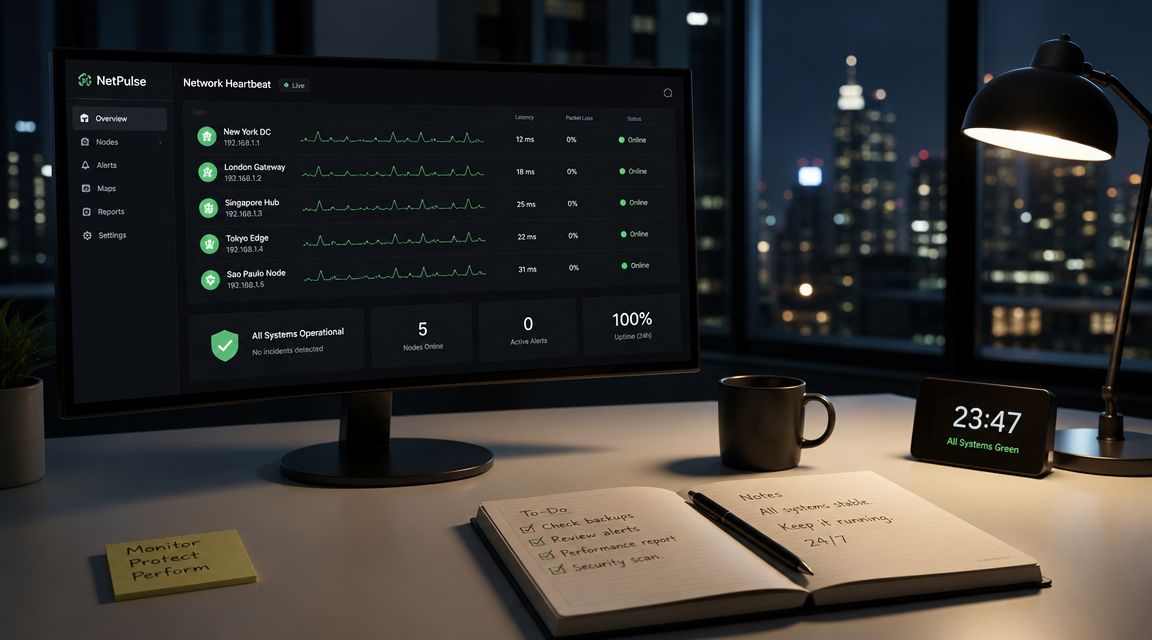
That is the business case for managed monitoring. The goal is not merely to watch systems around the clock. It is to detect abnormal behavior early, contain it quickly, and reduce the number of incidents that reach employees or customers. IBM's overview of IT infrastructure monitoring explains the core idea well: continuous monitoring gives teams visibility into performance, availability, and emerging faults before they become larger service problems.
What good monitoring looks like
Good monitoring is an operating discipline, not a dashboard. It covers patch deployment, endpoint telemetry, backup verification, access anomalies, service health checks, and a defined escalation process with named owners.
The KPI that matters is not the number of alerts generated. It is how many incidents are prevented, how quickly issues are detected, and how much business disruption is avoided. In practice, leaders should ask for evidence around mean time to detect, mean time to resolve, recurring incident volume, patch compliance, backup success rates, and after-hours response coverage.
There is a trade-off here. More visibility creates more alerts, and more alerts can create noise if triage is weak. A provider that floods a client with notifications without context adds work instead of reducing risk. A better model is filtered alerting tied to action: what happened, what was done, what business impact remains, and whether management needs to approve the next step.
For smaller firms, this is often the point where outsourced support becomes practical rather than optional. A business that depends on cloud apps, remote devices, and shared file access usually does not need a full internal operations center. It needs outsourced IT services for small business that can monitor, maintain, and respond without waiting for employees to report the damage.
NineArchs is relevant when that monitoring needs to connect to more than infrastructure alone. A distributed company running Microsoft 365, remote endpoints, cloud storage, and back-office workflows can use NineArchs for endpoint oversight, user access support, routine maintenance, and related BPO support. That integration matters. If an account issue affects both system access and an operational process such as payroll or customer support, one partner can coordinate the technical fix and the business workaround faster.
A good provider does not stop at reporting an alert. They explain the cause, the action taken, the remaining exposure, and the decision the business still needs to make.
Proactive support does not mean zero incidents. It means fewer preventable failures, faster containment, and less operational confusion when a problem does occur. That is the actual return. Lower downtime, fewer surprise escalations, and a support model that protects business continuity instead of reacting after the loss is already visible.
3. Access to Specialized Technical Expertise Without Long-Term Hiring Commitments
Most companies don't need a full-time expert in every technical domain. They need the right expertise at the right moment. That could mean cloud architecture during a migration, endpoint hardening during a security upgrade, or a development team during a product launch.
This is one of the most practical managed IT services benefits because the labor market doesn't make specialized hiring easy. Managed services are often used as a staffing workaround in response to skills shortages, but the better use is strategic access to capability without carrying permanent headcount for every niche skill, as discussed by Synoptek's perspective on why businesses need managed services.
When external expertise works best
It works well when the business need is specific, time-sensitive, or hard to hire for locally. Startups often need full-stack development support before they can justify a full internal engineering bench. Mid-sized companies may need cloud or security expertise for a transition period, not forever.
NineArchs is relevant here because its service mix isn't limited to infrastructure. A company can use one partner for full-stack development, Microsoft 365 support, cloud computing, endpoint security, and even BPO functions such as payroll or bookkeeping when operations are stretched. That's especially useful for leadership teams that don't want five separate providers managing adjacent workflows.
- Define the handoff: External experts should document environments, decisions, and configurations.
- Use specialists for strategic benefit: Reserve them for migrations, redesigns, security improvements, and bottleneck areas.
- Protect internal knowledge: Pair provider staff with internal owners. This guide to outsourced IT services for small business is useful if you're evaluating where to draw that line.
The downside is dependency. If the provider becomes the only place where operational knowledge lives, your flexibility drops. Good managed service governance always includes documentation and transition planning.
4. Enterprise-Grade Security and Compliance Without High Capital Investment
A company usually feels the security gap at an uncomfortable moment. A client security questionnaire lands in the sales pipeline. A regulator asks for evidence. An employee clicks the wrong link. Leadership then has to answer a hard question fast. Can the business prove its controls work without building an expensive internal security function from scratch?
That is one of the strongest business cases for managed IT services. The benefit is not only better protection. It is the ability to put defined controls, response processes, and compliance support in place with operating expense instead of major upfront capital investment. For many small and mid-sized firms, that changes security from a delayed project into an active business capability.
Managed support in this area often includes endpoint protection, identity and access management, email security, backup oversight, vulnerability remediation, incident response coordination, and audit preparation support. Bundling those functions matters because gaps between tools cause real risk. A company can buy separate products for each control area and still fail an audit or mishandle an incident if no one owns policy enforcement, evidence collection, and response timing.

Security as a business lever, not just an IT line item
Leaders should evaluate this benefit with business metrics, not only technical ones. Useful KPIs include patch compliance rates, multi-factor authentication coverage, phishing incident frequency, backup recovery success, time to isolate compromised devices, and audit readiness by control family. Those measures tie security spending to outcomes the board, finance team, and customers actually care about.
NineArchs is relevant here because security and operations often intersect in the same daily workflow. Endpoint security, Microsoft 365 administration, cloud support, and business process support can sit under one operating model instead of being split across disconnected vendors. That can reduce handoff failures, shorten response time, and make compliance evidence easier to collect when regulated teams need documented controls across both IT and back-office processes.
There is a trade-off. Outsourcing security operations can improve coverage and consistency, but it does not remove management responsibility. Leadership still needs clear escalation paths, approved access policies, incident communication rules, and internal ownership of risk decisions. The provider can run controls. The business still owns the consequences.
A practical evaluation should cover four points:
- Response accountability: Confirm who triages alerts, who can isolate devices, and how executives are notified during an active incident.
- Compliance fit: Map controls to your actual obligations, whether they come from customer contracts, insurance requirements, or regulated data handling.
- Evidence discipline: Ask how logs, policy records, backup tests, and access reviews are documented for audits and renewals.
- User risk reduction: Pair technical controls with training and policy reinforcement. A broader overview of cybersecurity as a service for growing businesses can help frame that decision.
A U.S.-based outsourcing partner can also help when legal expectations, audit communication, and response coordination depend on domestic availability and familiarity with local compliance practices. In practice, that often matters as much as the toolset itself.
5. Scalability and Flexibility to Match Business Growth
Growth creates technical friction before it creates technical elegance. More users, more endpoints, more licenses, more vendors, more permissions, more support tickets. If the support model doesn't scale with the business, growth starts to feel messy.
Managed services give companies a way to expand capacity without rebuilding the operating model each time headcount changes. That's one reason the market keeps expanding. Businesses use managed services not only as a help desk substitute but increasingly as a capacity-extension model for functions such as cybersecurity and cloud operations, as noted earlier from the Market.us market estimate.
What scaling looks like in practice
A startup at 15 employees can often survive on informal systems. At 75 employees, that breaks. New hires need accounts, devices need policies, security settings need consistency, and leaders need confidence that expansion won't create hidden risk.
NineArchs can support that growth path through cloud services, Microsoft 365 licensing, endpoint management, and staff augmentation that expands or contracts with demand. That's especially helpful for companies adding a second office, onboarding remote teams, or building a new internal function without enough technical management depth.
Growth doesn't break IT because the business got bigger. It breaks IT because the original processes never scaled past the founding stage.
The caution here is overprovisioning. Some companies buy a broad managed package too early and end up paying for complexity they don't yet need. A good provider should right-size the service, not oversell the stack.
6. Business Process Optimization and Operational Efficiency
A common breaking point shows up after growth. Revenue is up, but invoicing still waits on manual approvals, customer requests bounce between inboxes, and payroll exceptions pull managers into work that should be routine. At that stage, the IT issue is no longer just support coverage. It is process design.
Managed IT creates more value when it improves how work flows across departments, not just how systems are maintained. This gain stems from fewer handoffs, clearer ownership, better data quality, and faster cycle times. Those are operating metrics, not just technical ones.
That is why this benefit sits closer to business process design than traditional help desk work.
NineArchs matters here because it combines IT services with BPO and virtual assistant support. A company can improve the systems behind bookkeeping, invoicing, payroll, customer service, data entry, and finance operations while also assigning execution capacity to the workflows themselves. That integrated model changes the ROI conversation. Instead of measuring success only through ticket closure or uptime, leaders can track invoice turnaround, first-response time, backlog volume, exception rates, and labor hours removed from repetitive tasks.
For example, if a finance team still rekeys data between systems, the cost is not only time. It shows up in delayed billing, preventable errors, and slower cash collection. If customer service teams work from disconnected tools, response quality slips and supervisors spend more time correcting work. Process optimization fixes those operational leaks at the source.
A practical rollout usually follows three steps:
- Map the current workflow: Identify where approvals stall, where data is entered twice, and where exceptions pile up.
- Set business KPIs before outsourcing: Track turnaround time, accuracy, backlog, rework, and output per full-time employee equivalent.
- Start with one process: Stabilize a single workflow first, then expand once reporting, ownership, and quality controls are in place.
There is a trade-off. Outsourcing execution without internal process ownership usually creates a cleaner version of the same inefficiency. The client still needs a decision-maker who defines success, reviews output, and resolves policy questions. In my experience, companies get the best results when they treat managed services and BPO as an operating model change, not a staffing shortcut.
For teams exploring automation as part of that operating model, this piece on implementing AI for local businesses is a useful reference. It helps frame where automation fits, and where human oversight still matters.
7. Faster Time-to-Market Through Accelerated Development and Deployment
When companies talk about speed, they usually focus on developers. In practice, release speed depends just as much on infrastructure readiness, support coordination, access control, testing discipline, and deployment process.
A managed partner can remove a lot of that drag. If cloud environments, development support, user provisioning, and operational maintenance sit under one coordinated delivery model, product teams spend less time waiting for handoffs and more time shipping.
Where speed actually comes from
A common example is the early-stage SaaS company that needs to launch an MVP while still formalizing engineering leadership. Another is an established business modernizing an old internal tool that no longer fits current workflows. In both cases, delays usually come from missing capability around environment setup, release operations, and cross-functional coordination.
NineArchs supports this kind of work through full-stack development, cloud computing, and generative AI solutions, which can help teams move from concept to implementation without building every layer internally first. For businesses exploring automation and product acceleration, this piece on implementing AI for local businesses adds a useful perspective.
The limit to this benefit is governance. Speed improves when decision rights are clear. If internal stakeholders can't approve priorities, sign off on requirements, or review deliverables on time, no provider can manufacture momentum on their behalf.
8. Improved Business Continuity and Disaster Recovery
Most companies don't think seriously about recovery until a failure forces the conversation. By then, the quality of backup, restore procedures, and incident coordination determines whether the outage becomes an inconvenience or a business event.
Managed services are useful here because continuity planning becomes operational instead of aspirational. Backups get monitored, restore procedures get documented, and someone outside the business is accountable for the recovery process alongside internal leadership.
Continuity is a business issue, not just an IT issue
A good continuity setup prioritizes systems by business function. Payroll access, customer communication, financial records, operational platforms, and executive reporting don't all have the same urgency. The recovery plan should reflect that reality.
NineArchs can support continuity through cloud services, endpoint management, and coordinated operational support that helps businesses maintain access to key systems during disruption. This is especially valuable for distributed teams and companies that can't afford prolonged service interruptions.
If backup testing isn't happening, you don't really know whether you have recoverability. You only know you have stored data.
The trade-off is that disaster recovery planning requires client participation. Leadership has to define which systems matter first, who makes recovery decisions, and how employees and customers get updated during an incident.
9. Enhanced Focus on Core Business Strategy and Innovation
This is the benefit executives care about most, even if they rarely phrase it this way. Managed services remove operational drag from leadership attention.
When IT support, user administration, security monitoring, routine maintenance, and back-office workflows consume too much management time, strategy suffers. Founders stop building. Operations leaders stop optimizing. Finance leaders spend more time fixing process gaps than planning.
What leaders get back
The biggest gain is cognitive bandwidth. A leadership team that isn't constantly dealing with IT noise can spend more energy on pricing, hiring, market expansion, customer retention, product direction, and process redesign.
NineArchs is useful in this context because the service model spans both technical operations and business support functions. A startup founder can lean on one partner for development support and virtual assistant capacity. A finance leader can outsource bookkeeping, invoicing, payroll, and data handling while keeping internal attention on decision-making and growth planning.
- Use quarterly reviews well: Don't turn them into ticket recaps. Use them to align IT and operations with business priorities.
- Keep one internal owner: Outsourcing doesn't remove accountability. It changes where the work gets done.
- Push the provider up the value chain: Ask for recommendations, not just execution.
This is also where a U.S.-based outsourcing partner can be particularly helpful. Shared business hours, easier executive communication, and smoother collaboration with domestic teams make it easier to turn outsourced support into a strategic operating rhythm.
10. Reduced Risk Through Vendor Expertise, Compliance, and Knowledge Continuity
A controller resigns on Friday. By Monday, no one knows which scripts run payroll exports, who approves access changes, or where the latest recovery notes live. That is the kind of operational risk managed services can reduce. The benefit is not limited to security controls. It also comes from documented processes, repeatable support workflows, and shared ownership of institutional knowledge.
For leadership teams, this is a governance issue as much as a technical one. Risk rises when one employee, contractor, or department holds undocumented knowledge about vendor accounts, integrations, patching routines, compliance tasks, or exception handling. Managed IT services help reduce that exposure when the provider is required to document the environment, maintain clear escalation paths, and keep operating procedures current.
NineArchs adds value here because the scope can extend beyond infrastructure support. If the same partner supports IT operations, development workflows, and selected back-office processes, fewer handoffs get lost between teams. That matters in audits, staff transitions, and periods of fast growth. It also creates a more realistic continuity model. The business is not relying on one systems administrator or one operations manager to remember how everything works.
Leaders should evaluate a key trade-off. A provider can lower day-to-day execution risk, but weak oversight can replace key-person risk with vendor dependence. The answer is not to keep everything internal. The answer is to set terms that preserve control, portability, and visibility.
For companies operating across borders, compliance risk can also sit outside the server room. Data handling rules, access restrictions, and local internet controls affect how systems are configured and how support teams work. This reference on understanding China's internet laws is a useful reminder that vendor expertise should include operating context, not just technical administration.
A practical way to measure this benefit is to track audit readiness, onboarding speed for replacement staff, incident handoff quality, and the percentage of critical systems covered by current documentation. Those KPIs show whether the provider is reducing business risk or only absorbing tickets.
- Require documentation ownership: Runbooks, admin account inventories, asset maps, and escalation paths should be maintained on a defined schedule and accessible to your internal team.
- Review exit terms before signing: Contracts should state how credentials, configs, logs, SOPs, and knowledge transfer will be handled if the relationship ends.
- Keep decision rights in-house: The provider can execute change management, monitoring, and support. Your leadership team should still approve policy, risk tolerance, and priority trade-offs.
- Test continuity, not just promise it: Ask for tabletop exercises, backup access validation, and cross-training records to confirm that knowledge is transferable.
Managed IT Services: 10-Benefit Comparison
| Service | Implementation complexity | Resource requirements | Expected outcomes | Ideal use cases | Key advantages |
|---|---|---|---|---|---|
| Cost Reduction and Predictable IT Budgeting | Low–Medium, subscription transition and TCO analysis | Low capital; predictable monthly fees; vendor SLAs | 20–30% IT spend reduction; predictable budgeting | SMEs, startups, budget-conscious organizations | Predictable Opex; scalable pricing; reduced hiring/training overhead |
| 24/7 Monitoring, Proactive Maintenance, and Incident Prevention | Medium, tool setup and integrations | Continuous monitoring tools, access permissions, vendor support | Prevents ~80–90% issues; significantly reduced downtime | Mission-critical operations, high-availability services | Proactive detection, automated patching, rapid response |
| Access to Specialized Technical Expertise Without Long-Term Hiring Commitments | Low–Medium, onboarding external teams | Flexible staffing, certified specialists, remote collaboration tools | Faster project delivery; access to niche skills on demand | Projects needing specialized skills; startups lacking local talent | On-demand expertise, lower hiring cost, rapid scaling of skills |
| Enterprise-Grade Security and Compliance Without High Capital Investment | Medium–High, assessments, remediation, policy alignment | Security stack, audits, compliance tooling, ongoing monitoring | Improved compliance (HIPAA/SOC2/PCI/GDPR); reduced breach risk | Regulated industries, sensitive-data organizations | Multi-layered security, compliance support, incident response |
| Scalability and Flexibility to Match Business Growth | Low–Medium, planning and contract flexibility | Cloud resources, variable licensing, elastic staffing | Elastic capacity; faster expansion; pay-for-use efficiency | Rapid-growth startups, seasonal workloads, market expansion | On-demand provisioning, cost efficiency, geographic support |
| Business Process Optimization and Operational Efficiency | Medium–High, process mapping and automation | BPO staff, RPA/tools, documentation and KPI tracking | 30–40% back-office efficiency gains; fewer manual errors | Finance ops, customer service, repetitive admin tasks | Standardization, cost savings, 24/7 operational coverage |
| Faster Time-to-Market Through Accelerated Development and Deployment | Medium, CI/CD, infra-as-code, alignment on requirements | Full-stack teams, CI/CD tooling, cloud infrastructure | 30–50% shorter development cycles; faster releases | SaaS, MVPs, product-driven startups | Pre-built infra, automated deployments, rapid iteration |
| Improved Business Continuity and Disaster Recovery | Medium–High, DR design, testing, redundancy | Backup/replication, standby sites, failover automation, testing | RTO/RPO reduced to minutes; minimized outage impact | Finance, healthcare, critical services | Automated failover, tested recovery plans, data protection |
| Enhanced Focus on Core Business Strategy and Innovation | Low–Medium, governance and vendor management | Strategic advisory, outsourced operations, reporting cadence | 60–70% fewer IT distractions; more time for strategy | Executive teams, scaling organizations, innovation-led firms | Frees leadership time, enables innovation, vendor insights |
| Reduced Risk Through Vendor Expertise, Compliance, and Knowledge Continuity | Medium, vendor assessment and governance setup | Compliance frameworks, risk assessments, documentation | Lower compliance and operational risk; reduced key-person risk | Regulated industries, orgs with skill gaps | Knowledge continuity, best practices, documented controls |
From Overhead to Advantage: Activating Your IT Strategy
The most important shift in managed services isn't technical. It's managerial. You stop treating IT as a series of isolated fixes and start managing it like an operating capability tied to cost control, security, continuity, speed, and growth.
That's why the best managed IT services benefits show up across the business, not just inside the IT function. Finance gets cleaner budgeting. Operations gets more reliable systems. Leadership gets fewer interruptions. Security improves because someone is monitoring, patching, and responding with discipline. Product and growth teams move faster when infrastructure and support stop becoming blockers.
There are real trade-offs, and serious buyers should face them directly. A managed provider can create dependency if they hold all the knowledge. A poorly structured agreement can produce vague accountability. An overscoped contract can add cost before the business is ready. That's why governance matters as much as technical capability. Clear SLAs, documentation standards, escalation paths, business reviews, and exit terms make the difference between useful outsourcing and avoidable friction.
The other practical question is who you want to work with. For many organizations, using a U.S.-based outsourcing partner makes collaboration easier because leadership, finance, legal, and operations teams can work in familiar time zones and business rhythms. That doesn't eliminate every challenge, but it often improves responsiveness, communication clarity, and execution consistency.
NineArchs LLC is one relevant option if you're looking for a partner that combines managed IT, software development, cloud support, Microsoft 365, endpoint security, and BPO services under one operating model. That combination can be useful when your business doesn't want separate vendors for infrastructure, staffing support, and back-office execution.
If you're evaluating providers, keep the standard simple. Choose a partner that helps your business spend less time recovering from IT issues and more time using technology deliberately. This is the transition from overhead to advantage.
Ready to turn technology into a more stable, scalable part of your business? Contact NineArchs to discuss your goals at (310)800-1398 / (949) 861-1804 or email info@ninearchs.com.
If you're looking for a practical outsourcing partner that can support IT operations, software development, cloud services, Microsoft 365, endpoint security, and business process outsourcing, NineArchs LLC is worth a conversation. Reach the team at (310)800-1398 / (949) 861-1804 or email info@ninearchs.com.