It's Monday morning. You've already handled three escalations, moved between back-to-back meetings, and opened a Slack thread that's becoming more personal by the minute. Your team is waiting for direction, two decisions are under-specified, and your attention is fragmented before the day has properly started.
Meditation earns its place. Not as retreat content, a luxury, or another wellness benefit people ignore, but as a practical leadership discipline. A leader who can notice pressure before acting has more room to listen, decide, and respond deliberately. The practice is simple. Making it part of working life requires better design.
Why Meditation Belongs in a Leader's Working Week
A leader's attention is usually the first capacity to deteriorate under sustained load. You may still be answering messages and making decisions, but your listening narrows, your patience shortens, and every interruption feels like a challenge to your authority. Meditation trains the exact moment where that deterioration begins: the moment you notice that attention has wandered or emotion has taken control, then choose where to place your attention again.
That choice matters in ordinary management situations. Five quiet minutes before a difficult one-to-one can help you hear what the employee is saying instead of preparing your rebuttal. A brief pause before replying to a heated message can separate urgency from importance. A reset before choosing between two poor options can reveal which risk you're avoiding and which one you're willing to manage.
Practical rule: Use meditation before the work that demands judgment, not only after the work has exhausted you.
The case for treating meditation as a working-week practice is also supported by adoption. Meditation use among U.S. adults rose from 7.5% in 2002 to 17.3% in 2022, according to the National Center for Complementary and Integrative Health's meditation use trend analysis. A separate 2024 study estimated that 18.3% of U.S. adults, or about 60.53 million people, practiced meditation in 2022, making it a mainstream mind-body practice rather than a niche activity.
The leadership application is straightforward. Meditation gives you a repeatable way to interrupt automatic behavior. It won't remove conflict, uncertainty, or workload. It can improve the quality of the person who enters the conflict, makes the decision, or leads the meeting.
That's why I recommend treating it like hygiene. Attach it to existing transitions, keep the first routine small, and judge it by behavior rather than by whether every session feels peaceful. The useful question isn't, “Did I have a calm meditation?” It's, “Did I create a little more choice before I acted?”
What Meditation Actually Is and What It Is Not
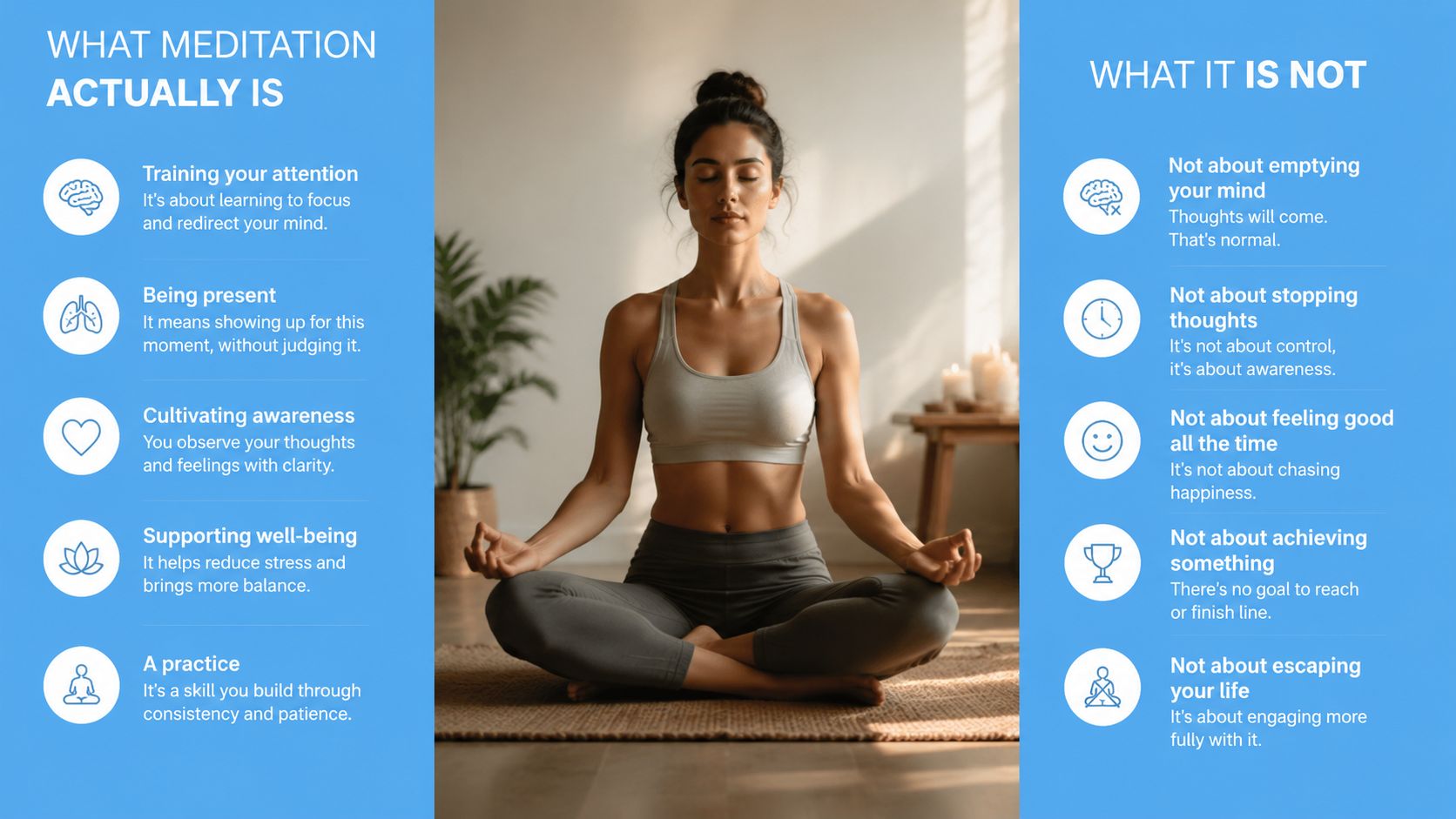
Meditation trains attention through repetition. You choose an anchor, such as the breath, a sound, a physical sensation, or a phrase. The mind wanders, you notice, and you return. That return is the practice. It builds the ability to recognize distraction and choose where attention goes next.
A busy leader's thoughts will keep appearing. That does not indicate failure. Planning, judging, remembering, and worrying are part of the training environment. The work is to notice those movements without automatically following them. This skill creates a pause between an impulse and the words or action that follows.
Meditation may bring relaxation, but relaxation is not the entire purpose. It is not a belief system, and it does not require a particular personality. It will not make a decisive leader passive or replace accountability with pleasant feelings. It gives you a clearer view of impulses before they shape a message, meeting, or decision.
Learn the four main practice families
Focused attention keeps attention on one anchor, often the breath, a mantra, or a repeated sound. Use it when your mind is scattered and you need steadiness before demanding work.
Open monitoring notices thoughts, sensations, and emotions as they arise. Labelling an experience “planning,” “anger,” or “hearing” helps you observe it without turning observation into reaction.
Body-based practice uses physical sensation as the entry point. A body scan or somatic exercise helps desk-bound professionals detect tension before it becomes irritability, rushed communication, or fatigue.
Contemplative and compassion practices use phrases, gratitude, kindness, or concern for others to shape attention and relational intent. They suit leaders caught in criticism, defensiveness, or interpersonal distance.
The vocabulary matters. Ask what someone is training when they say they are meditating. These techniques fit broadly into one of the four families. Once you can name the method, choose it for a specific job instead of collecting random sessions and hoping one changes your leadership.
The Evidence Leaders Should Care About
A leader enters a difficult meeting already carrying a full inbox, a tight deadline, and rising irritation. The useful question is whether meditation changes what happens next: stress physiology, attention, self-regulation, and behavior under pressure.
A 2016 meta-analysis of 45 randomized controlled trials found that meditation reduced several physiological stress markers. All practice subtypes lowered systolic blood pressure. Focused-attention practices also reduced cortisol, while open-monitoring practices reduced heart rate. Pooled analyses reported reductions in cortisol, C-reactive protein, blood pressure, heart rate, triglycerides, and tumor necrosis factor-alpha in the randomized-trial meta-analysis indexed by PubMed. For leaders, the practical point is clear: different practices may affect different parts of the stress response. Choose a method for the pressure you need to handle, rather than treating meditation as one interchangeable activity.
Brain research supports that distinction. A quantitative neuroimaging meta-analysis covered 78 functional MRI and PET studies, including 257 peak foci from 31 experiments and 527 participants, and found different activation and deactivation patterns across meditation styles. Across practices, activity appeared in regions associated with interoception, self-regulation, attention, and memory, including the insula, supplementary motor area, and hippocampus, according to the neuroimaging meta-analysis published through PubMed. In management terms, meditation can train awareness of bodily stress, attention control, and reflective choice. The findings do not establish that every leader will have the same experience.
Workplace research gives leaders more direct signals. An eight-week Mindful Leader programme involving 57 senior leaders improved mindfulness, resilience, and self-perceived leadership competencies, including collaboration and agility in complex situations, as described in the Journal of Management Development study. A separate study of 20 manager-leaders examined how regular mindfulness meditation, practiced at least three days per week, was perceived to affect leader development in the manager-leader mindfulness study. Treat these results as useful evidence, not a guarantee of better performance. Much of the workplace research depends on self-perception.
Workplace-relevant meditation evidence at a glance
| Evidence area | Key finding | Leader or team outcome | Strength of evidence |
|---|---|---|---|
| Physiological stress | Multiple stress markers declined across pooled randomized trials | More room to pause before reacting under load | Stronger for physiological outcomes than for specific workplace behavior |
| Brain function | Different styles produced distinguishable activation patterns in attention and self-regulation regions | Better reason to match practice to the skill being trained | Quantitative, but not a direct measure of leadership performance |
| Senior leadership | An eight-week programme improved reported mindfulness, resilience, collaboration, and agility | More deliberate communication and adaptation | Workplace-relevant, though non-randomized and partly self-reported |
| Leadership skills | Secularized Vipassana practice improved self-perceived leadership skills in a randomized study of senior managers | Potential gains in vision, moral intelligence, and motivation | Promising, with a specific population and intervention |
| Team-facing leadership | Workplace training improved self-leadership, relating to others, and adapting to change | Better transitions between tasks and relationships | Small organizational sample, so apply cautiously |
Leaders can also review these nervous system regulation techniques to support practice beyond seated meditation. Use the evidence with discipline. Meditation has credible support, but results vary with the person, method, amount of practice, context, and starting condition. Do not present it as a guaranteed solution for burnout or as a replacement for manageable workloads, adequate staffing, clinical care, or sound management. Its value at work comes from consistent practice linked to specific leadership demands.
Main Techniques and How to Choose One
The right meditation technique depends on the work in front of you. A method that settles you before a difficult conversation may be a poor fit when you are exhausted, restless, or emotionally activated. Leaders should choose for the state they need to handle, then test whether the practice improves their next decision or interaction.
Match the method to the moment
| Technique | Time Needed | Difficulty | Best Workplace Fit | Watch Out For |
|---|---|---|---|---|
| Focused attention | A brief sit can be useful | Beginner-friendly, but repetitive | Before a presentation, negotiation, or high-stakes decision | Treating wandering attention as failure |
| Open monitoring | Short or moderate sessions | Requires patience and observation | After conflict, during a transition, or when thoughts feel tangled | Turning analysis into more mental rumination |
| Body scan or body-based practice | A short scan can fit between demands | Accessible, especially for tense professionals | After long screen time or before a one-to-one | Becoming preoccupied with discomfort |
| Loving-kindness and compassion | A brief phrase-based practice | Emotionally challenging for some people | When criticism, resentment, or defensiveness is dominating | Forcing warmth when the emotion isn't available |
| Walking or movement meditation | Fits into a walk or corridor transition | Low barrier for people who dislike sitting | Between meetings, during a commute, or on restless days | Moving quickly while calling it mindful |
With five minutes before a tough conversation, use focused attention. Feel the breath, count a few cycles if helpful, and return whenever your mind races ahead to the argument. The aim is steadier attention, not a perfectly quiet mind.
Restless body? Walk. Sensory grounding can also work when sitting increases agitation. After a tense meeting, use open monitoring. Label the strongest thoughts, emotions, and physical sensations without trying to solve them immediately. That pause gives you a better chance of separating facts from your first reaction.
A mantra provides a clear anchor when breath awareness feels too narrow. Loving-kindness may suit a manager who remains outwardly composed but is growing contemptuous of the team. Body-based practice often fits better than forced stillness when tension is already high. Choose the method that supports the behavior your role requires next.
Leaders who want a structured bridge between reflection and language can use the United We Transform affirmation exercise. Pair intentional statements with meditation as an exercise in attention and self-talk. Do not use affirmations to deny difficult facts, excuse poor performance, or suppress legitimate concerns.
Keep the method that helps you work with the next real situation. Drop any practice that becomes another obligation without improving how you listen, decide, or respond. Consistency matters more than loyalty to a particular style.
Who Should Be Cautious and Why
Corporate meditation guides often skip the uncomfortable part. Meditation can be helpful, but it isn't uniformly safe for every person or every state of mind.
Recent research identifies adverse effects including anxiety, depression, traumatic re-experiencing, cognitive anomalies, and functional impairment. A pooled estimate placed adverse-event prevalence at 8.3% overall and 33.2% in observational studies, while a 2025 review reported that 25% to 87% of users may experience some adverse effect and 3% to 37% may experience functional impairment, as summarized in the adverse-effects review indexed by PubMed. Those ranges vary because studies define and measure adverse effects differently. They still make one point clear: “just sit with it” is not responsible universal guidance.
People with active psychosis, untreated PTSD, severe anxiety, recent trauma, or a history of dissociation should consult a qualified clinician before beginning an unsupervised practice. People taking psychiatric medication should also ask their clinician whether a particular practice is appropriate, especially if meditation changes sleep, activation, mood, or perception.
Screen before offering a team practice
Ask five simple questions privately:
- Does sitting still tend to intensify panic, traumatic memories, or dissociation?
- Are you currently receiving care for a mental-health concern that meditation might affect?
- Has a clinician advised you to avoid practices that increase internal focus?
- Do you have a way to stop, ground yourself, and seek support if distress appears?
- Would you prefer eyes-open, guided, movement-based, or sensory practice?
Red flags include unusual activation, intrusive memories, derealization, panic, severe sleep disruption, or distress that continues after practice. Modify first with shorter sessions, eyes open, external sensory anchors, movement, or guided instruction. Stop and refer to qualified clinical support when symptoms repeatedly worsen.
Caution isn't fear. It's competence.
Three Routines for Busy Professionals
The best routine is the one that survives a difficult week. Start with a cue already in your calendar, not an idealized promise about waking earlier or finding a perfect room.
The five-minute executive reset
Use this before a difficult meeting, sensitive one-to-one, or decision that could trigger defensiveness.
- Minute one: Sit or stand with your eyes open. Feel your feet, seat, or hands and let the exhale lengthen naturally without forcing it.
- Minutes two and three: Use focused attention on the breath. Each time planning or rehearsing appears, label it briefly and return.
- Minute four: Open monitoring. Notice the strongest thought, emotion, or body sensation without turning it into a conclusion.
- Minute five: Choose a closure cue. Name the behavior you want to bring into the meeting, such as listening fully, asking one more question, or stating the trade-off plainly.
If you've only got two minutes, keep the breath settle and closure cue. Don't skip the routine because you can't complete the ideal version.
The fifteen-minute daily anchor
Place this after a reliable transition, such as arriving at work, finishing lunch, or closing the first major block of meetings. Begin with breath settling, continue with focused attention, spend a short period noticing thoughts and sensations openly, then close by identifying the next priority.
This routine builds continuity across the day. It's especially useful for middle managers who move between individual contributors, senior stakeholders, and operational details. If travel or a crunch period disrupts it, preserve the cue and complete the shortest workable version rather than waiting for the schedule to become generous.
The thirty-minute deeper practice
Use this when you want more substantial reflection, ideally at a consistent time outside the most chaotic part of the day. Combine body awareness, focused attention, open monitoring, and a brief compassion practice. End by writing one sentence about how you want to lead the next day.
Expect the first stage to feel like familiarizing yourself with the process, not becoming transformed. Longer-term traction depends on repetition, fit, and whether the practice improves behavior. The minimum effective approach during travel is a brief reset attached to a meeting or transition.
Founders often need the five-minute reset because their calendars change constantly. Middle managers usually benefit from the fifteen-minute anchor. Individual contributors can start with either the five-minute reset or a movement-based version when their work makes seated practice impractical.
Bringing Meditation Into Your Team and Culture
Don't tell employees to “meditate more.” That turns a useful practice into an individual responsibility for adapting to organizational strain.
Attach meditation to work that already exists. A team can take a short pause before a recurring meeting, begin a one-to-one with a centering exercise, or use a brief decompression practice after a high-stakes session. Keep participation opt-in, keep the purpose explicit, and let the leader participate without tracking attendance or asking people to explain their personal practice.
Offer equivalent choices. One person may prefer guided breath awareness, another sensory grounding, another silent observation, and another sitting without guidance. No one should have to disclose trauma, diagnoses, or emotional experiences to take part or decline.
Build the ritual into real transitions
Use meditation to mark the movement between conversations, priorities, and decisions. That makes it operational rather than decorative.
A lightweight pilot can begin with one recurring meeting and gather private feedback about meeting quality, perceived stress, and recovery between demands. Retire any ritual people dislike. A shared practice works when it creates space for better work, not when it becomes compulsory, performative, or another measure of compliance.
Leaders should also make the surrounding workload credible. If the team has impossible deadlines, unclear ownership, or constant after-hours demands, a breathing pause won't solve the underlying problem. Meditation can help people meet work with more awareness, but leaders still need to fix avoidable sources of strain.
Include the practice in onboarding and leadership development only when it serves a clear transition or capability. The same principle applies to distributed operations. If you're reviewing support for remote administrative work, the guide to hiring a virtual assistant can help you think about how delegation creates protected space for focused leadership work. The practice becomes more sustainable when the calendar reflects the priorities leaders claim to value.
Troubleshooting and Your 30-Day Adoption Plan
Adoption fails for predictable reasons. The routine is too ambitious, the cue is vague, or people feel pressured to perform calmness for an audience.
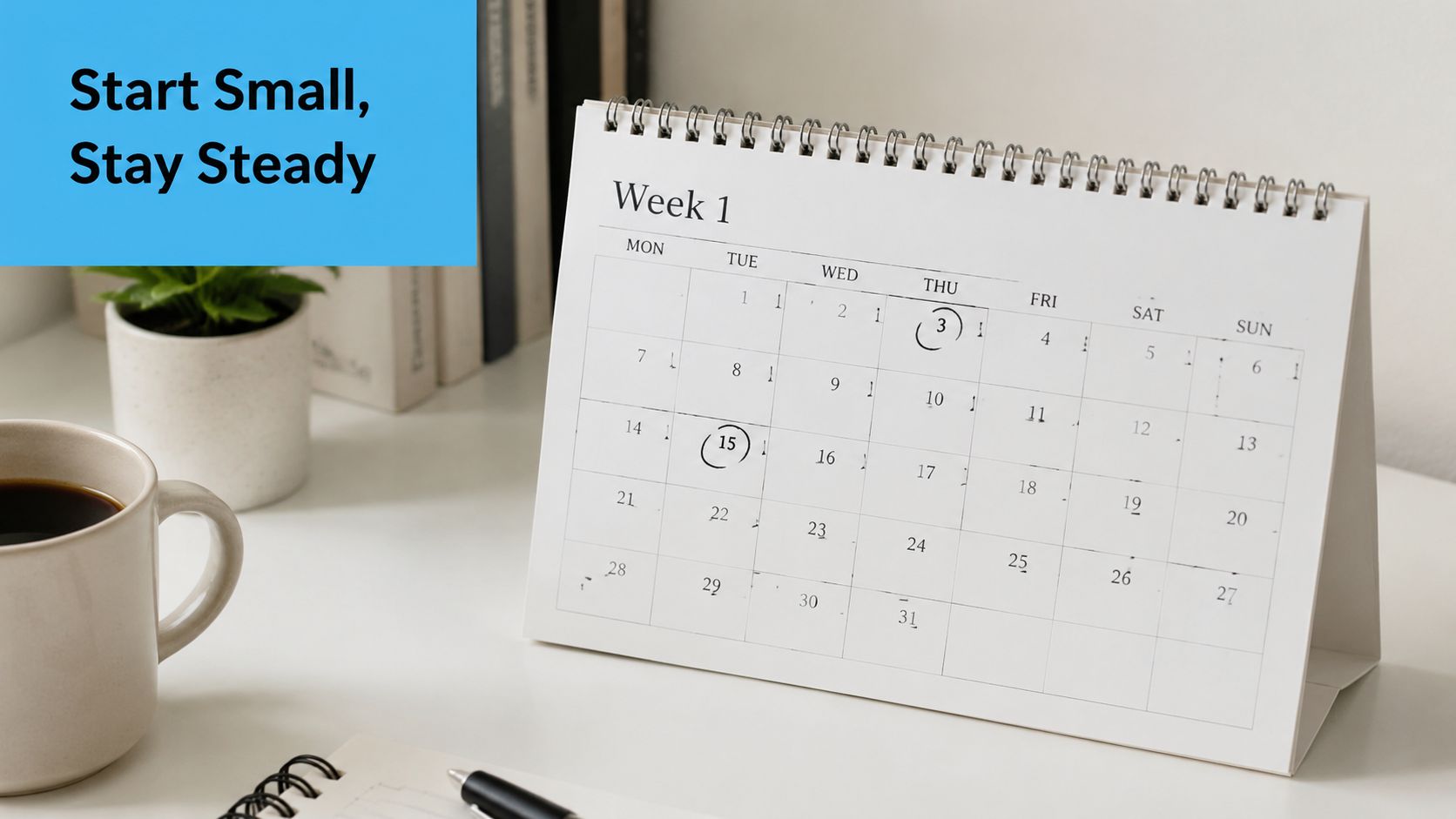
Use one behavior per week
- Days 1 to 7: Try two-minute sessions at the same cue twice daily. Use breath awareness or sensory grounding.
- Days 8 to 14: Extend one session to five minutes. Note stress, focus, and energy without turning the notes into a performance score.
- Days 15 to 21: Add one team ritual, such as a brief pause before a recurring meeting. Gather private feedback.
- Days 22 to 30: Remove anything that doesn't help. Choose a sustainable schedule for the following month.
Fix the problem in front of you
- Racing mind: Label the thought, then return to the breath.
- Restlessness: Switch to walking or sensory grounding.
- Worsening sleep: Shorten evening sessions or move them earlier.
- Physical discomfort: Adjust posture, change position, or practice with eyes open.
- Missed session: Resume at the next scheduled cue. Don't compensate with an oversized session.
- Emotional flooding: Open your eyes, orient to the room, and stop if activation continues.
- Intrusive memories: Don't force exposure through meditation. Seek qualified support.
- Derealization or panic: End the practice and use external grounding. Get clinical guidance if it repeats.
Screen for unusual activation, intrusive memories, derealization, panic, and sustained distress before expanding the routine. If practice repeatedly worsens symptoms, stop and seek qualified clinical support. Leaders must never frame continuing as evidence of commitment.
Research on meditation still has major unanswered questions about who benefits, under what dose, and with which format. A 2025 review identified the lack of a unified theoretical framework, significant individual differences, and a need for precision approaches that clarify who benefits, who may be harmed, and which adaptations improve access, as reported in the precision meditation review indexed by PubMed. That uncertainty should make your rollout more thoughtful, not less practical.
Success isn't an unbroken streak. It's a repeatable routine that improves attention, supports better leadership behavior, and doesn't harm the people expected to use it.
NineArchs LLC helps growing organizations create the operational space for better leadership through scalable IT services, knowledge outsourcing, BPO, and virtual assistant support. Visit NineArchs LLC to explore flexible staffing and technology solutions that let your team protect focus for the decisions that matter.