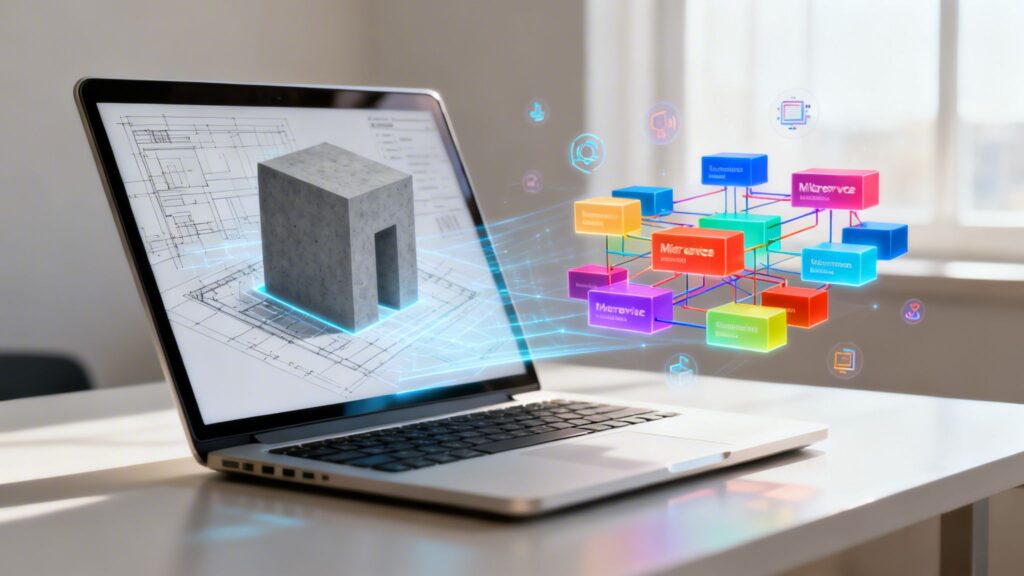
Application modernization is a term that gets thrown around a lot, but what does it actually mean? At its core, it’s the strategic process of updating your older, legacy software so it aligns with what your business needs today. It's about making your software faster, more secure, and far more adaptable to change.
Defining Application Modernization Without The Jargon

Think of your company's long-standing software as a classic house. It has a strong foundation and has served you well for years, but the plumbing is slow, the wiring is outdated, and the layout just doesn't fit your lifestyle anymore. You wouldn't demolish the whole house; you’d renovate it.
That renovation? That's application modernization. You keep the core business logic—the "good bones" of your software—while overhauling the underlying technology. This transforms it from a rigid, aging system into a flexible, high-performing asset that can actually support your future growth, not hold it back.
More Than Just a Tech Upgrade
This process is a whole lot more than a simple software update or a "lift and shift" to a new server. It's a fundamental re-evaluation of how your applications support your business. To get a real sense of it, practical examples help. For instance, A SharePoint migration is the process of moving an organization's content, data, and applications from a legacy platform—such as an on-premise SharePoint—to a modernized environment like Microsoft 365. That single move touches on data, user functionality, and the core infrastructure—all key parts of modernization.
When done right, a modernization initiative delivers some serious business advantages:
- Reduced Operational Costs: Let's be honest, old systems are expensive to maintain. Modernized applications run on more efficient cloud infrastructure, which directly lowers your long-term expenses.
- Enhanced Security: Legacy software is often riddled with known vulnerabilities. Modernization lets you build current security protocols in from the ground up, protecting your most sensitive data.
- Increased Agility: Modern applications can be updated quickly. This means your business can respond faster to market shifts and customer demands instead of waiting months for a simple change.
Application modernization is not just a technical chore to be checked off a list. It is a strategic business decision that directly impacts your ability to compete, innovate, and grow.
Partnering for a Clear Path Forward
The road to modernization can feel complex, with a dizzying number of choices about strategy and technology. This is where an experienced partner provides immense value.
Engaging a US-based outsourcing partner ensures clear communication, a shared business context, and seamless collaboration without time zone barriers. An expert team can assess your current applications, create a clear roadmap, and execute the heavy lifting, allowing your internal teams to stay focused on what they do best: running the business.
For a no-obligation consultation on how to begin your modernization journey, contact us today at (310)800-1398 / (949) 861-1804 or email us at info@ninearchs.com.
The Hidden Costs Of Not Modernizing Your Applications

Clinging to old software can feel like the safe, predictable choice. The reality is, doing nothing carries a steep and often hidden price tag. Your legacy systems are quietly draining resources, blocking new ideas, and creating risks that only get worse over time.
This slow, silent erosion of your business’s capabilities is what we call technical debt. It’s one of the biggest—and most misunderstood—costs of kicking the modernization can down the road.
Think of it like interest on a loan. The longer you put off paying down the principal (in this case, updating your code), the more "interest" you rack up. This interest comes in the form of emergency patches, clunky workarounds, and maintenance costs that just keep climbing. Every dollar you spend propping up an old system is a dollar you can’t invest in growth.
Learning how to manage technical debt effectively is the first step to understanding just how much you’re losing by standing still. Without a clear strategy, this debt can quickly spiral out of control, putting your entire operation at risk.
The Real-World Impact Of Technical Debt
Technical debt isn’t just some abstract concept for developers; it creates tangible, negative effects across the entire business. You see its impact on your bottom line and your ability to compete.
Ever seen a sales team wrestling with a clunky, old CRM? They’re battling slow performance and constant crashes just to find basic customer data. That frustration isn't just an annoyance—it leads to lost productivity and, ultimately, lost deals because they can't jump on leads fast enough.
Or consider an ancient Enterprise Resource Planning (ERP) system. It might keep your financials in order, but it can’t connect to any modern analytics tools. You're left making decisions based on gut feelings while your competitors are moving with data-driven precision.
The cost of inaction far exceeds the investment in modernization. While updating systems requires a budget, failing to do so creates a continuous financial drain that cripples agility and exposes your business to unacceptable risks.
Spiraling Costs and Security Nightmares
The financial bleeding from legacy systems goes way beyond missed opportunities. The direct costs of just keeping outdated software running can become astronomical.
- Skyrocketing Maintenance: As applications age, finding developers who know the obsolete programming languages becomes harder and a lot more expensive. You end up paying a premium for specialists to work on creaky old code.
- Security Vulnerabilities: Old software is a giant, blinking target for cyberattacks. Unsupported systems no longer get security patches, leaving massive holes for attackers to waltz right through. This can lead to devastating data breaches and destroy your reputation.
- Compliance Failures: Regulations around data privacy are constantly evolving. Legacy systems often can't be updated to meet new compliance standards, exposing your business to heavy fines and legal headaches.
The market's reaction to these problems is loud and clear. The global push for application modernization is exploding, projected to surge from USD 27.46 billion in 2026 to an incredible USD 67.91 billion by 2031. That’s a compound annual growth rate of 19.86%.
This isn't just a trend; it’s a massive shift away from inefficient, risky systems. Organizations that wait are already paying the price, with 56% reporting that technical debt is eating their budgets and blocking them from adopting newer, essential technologies.
Breaking The Cycle With A Strategic Partner
The weight of technical debt and rising costs can feel overwhelming, but these problems are solvable. Partnering with a US-based outsourcing expert gives you a clear path forward. An external team brings the specialized skills needed to tackle complex modernization projects without you having to hire a whole new internal team. This approach lets your core team stay focused on winning in the market while the modernization work gets done efficiently in the background. A skilled partner can help you slash infrastructure costs, tighten up security, and build the agile, modern systems you need to compete and win.
To learn how an expert partner can help you escape the cycle of technical debt and unlock new value, contact us at (310)800-1398 / (949) 861-1804 or send an email to info@ninearchs.com.
Choosing Your Modernization Strategy

Alright, so you’re convinced that sticking with your legacy systems is a dead end. The next big question is, what’s the right way forward? Application modernization isn't a one-size-fits-all deal. It's a spectrum of choices, each with its own price tag, timeline, and impact on your business.
To make sense of it all, the industry has rallied around a framework known as the "7 Rs." Think of it as a menu of options, ranging from a quick touch-up to a complete teardown and rebuild. Getting to know these strategies is the key to making a smart decision that fits your goals, budget, and how much risk you're willing to take on.
Understanding The 7 Rs of Modernization
Instead of a dry, academic list, let's look at these strategies through a more familiar lens: renovating a house. Each "R" represents a different level of work, from simply keeping a room as-is to tearing the whole structure down to the studs and starting over.
Retain: Sometimes, the smartest move is no move at all. If an application is still doing its job, isn't causing problems for other systems, and delivers real value, just leave it alone. In our house analogy, this is deciding the sturdy, reliable garden shed doesn't need a renovation right now.
Retire: This one is straightforward: you decommission an application for good. If a system is redundant, nobody's using it anymore, or its functions have been swallowed up by a newer tool, retiring it is the cleanest path. It’s like demolishing an old, unsafe garage to make room for something better.
Rehost (Lift and Shift): This is the most basic migration strategy. You’re essentially picking up your application from your on-premise servers and dropping it into a cloud environment with almost no code changes. Think of it as moving your furniture to a new apartment in a better building. Everything works the same, but now you have better security and the ability to scale up easily.
Replatform (Lift and Reshape): A small step up from rehosting, this involves making a few targeted optimizations to take better advantage of the cloud. This is like moving into that new apartment but also buying a new, more efficient air conditioner and upgrading your internet. The core of your home is the same, but you’ve made some meaningful improvements.
Refactor: Here’s where the real work begins. You’re making significant changes to the application's underlying code to improve its structure and performance, all without changing what it does for the user. This is a major interior renovation—you're not changing the function of the house, but you are rewiring the electrical, upgrading the plumbing, and making it far more efficient to live in.
Rearchitect: This strategy involves fundamentally changing the application's architecture to unlock new capabilities. Often, this means breaking a single, monolithic application into smaller, independent microservices. This is like gutting the house and completely changing the floor plan, moving from one giant room to a series of specialized, interconnected spaces that work better together.
Rebuild/Replace: These are the most intensive options on the menu. Rebuilding means creating the application from scratch with modern tech. Replacing means ditching it entirely for a third-party SaaS product. This is the equivalent of tearing down the old house and building a brand-new one in its place. For a closer look, check out our guide on how to modernize legacy applications.
Choosing the right modernization strategy is a balancing act. It requires a clear-eyed assessment of an application's business value versus its technical condition to ensure the investment matches the expected return.
Application Modernization Strategies Compared
Each of these paths comes with its own unique set of trade-offs. A simple rehost is fast and low-risk, but it won't unlock the full power of the cloud. A full rebuild offers the greatest long-term value but requires the biggest investment of time and money. The table below breaks it down to help you weigh your options.
| Strategy | Description | Effort & Cost | Risk Level | Primary Benefit |
|---|---|---|---|---|
| Rehost | Move application to the cloud with minimal changes. | Low | Low | Quick cost savings and scalability. |
| Replatform | Move to the cloud with minor code optimization. | Low-Medium | Low | Improved performance with modest effort. |
| Refactor | Restructure existing code for better performance. | Medium | Medium | Reduced technical debt, improved agility. |
| Rearchitect | Fundamentally change the application's structure. | High | High | Maximum flexibility and future-proofing. |
| Rebuild | Rewrite the application from the ground up. | Very High | High | Complete control and modern capabilities. |
| Replace | Substitute with a third-party SaaS solution. | Varies | Medium | Fast time-to-market with standard features. |
Deciding which "R" is right for which application—and in what order—is where a clear strategy becomes absolutely critical. Your choice depends entirely on what you're trying to achieve, from quick wins to a total business transformation.
The Value Of A US-Based Outsourcing Partner
Navigating this decision-making process is complex, and the stakes are high. This is precisely where bringing in an experienced US-based partner makes a difference. A skilled partner doesn't just execute; they help you analyze your application portfolio, map out the best strategy for each piece of software, and build a pragmatic roadmap that makes sense for your business. With a US-based team, you get seamless communication and a shared business context, which is vital for making sure technical decisions align perfectly with your strategic goals. Let us help you find the right path.
Contact us for an expert consultation at (310) 800-1398 / (949) 861-1804 or info@ninearchs.com.
Building Your Modernization Roadmap
Once you’ve settled on a high-level strategy, the real work begins. Successful application modernization isn’t about a single, massive project that everyone dreads. It’s about creating a repeatable, factory-like process that turns a daunting mountain of work into a series of manageable, well-planned steps.
Thinking of modernization as a continuous “factory model” is the key to managing scope, reducing risk, and showing value fast. This approach breaks the journey down into four distinct, repeatable phases. Each step is deliberate and builds on the last, creating momentum and predictability.
Phase 1: Assess and Analyze
Before you can modernize anything, you have to know what you’re working with. This first phase is all about creating a detailed inventory of your application landscape. Think of it like an architect surveying an old building before a renovation; you need to map out the load-bearing walls and critical wiring before you start knocking things down.
This assessment goes way beyond just making a list of applications. It’s a deep dive into several key areas:
- Dependency Mapping: What other applications, databases, or services does each system depend on? Automated tools are a lifesaver here. They can uncover hidden connections that even the most experienced team members might have forgotten about.
- Business Value Evaluation: How critical is this app to the business? A high-traffic, customer-facing portal has a vastly different value than an internal tool used by a small team once a month.
- Technical Health Check: How much technical debt are you carrying? You need to analyze the code quality, architecture, and security posture to get a realistic idea of the effort involved in any modernization effort.
This thorough analysis gives you the hard data you need to make smart, fact-based decisions in the next phase. Without this foundational understanding, you’re just guessing.
Phase 2: Prioritize and Plan
With a clear picture of your application portfolio, you can shift from analysis to action. This phase is all about strategic decision-making—choosing where to focus your resources for the biggest and fastest impact. Not all applications are created equal, and trying to modernize everything at once is a classic recipe for disaster.
Your main goal here is to select a pilot application. This first project is crucial. It serves as your proof-of-concept, helping you fine-tune your process, test your assumptions, and build momentum across the organization. A good pilot candidate is typically an application that is visible enough to matter but not so critical that a setback would disrupt the entire business.
Once you've picked your pilot, it's time to build a compelling business case around it. This document should clearly tie your modernization plan back to the goals you defined during your assessment.
A strong business case connects technical actions to business outcomes. It needs to answer the real-world questions your stakeholders will ask: "How will this reduce our costs?" "How will it improve the customer experience?" and "What is the expected ROI?"
This plan becomes your guiding light, aligning everyone and setting clear expectations for success. These same principles of careful planning are just as critical for other major IT projects, something we cover in our guide on cloud migration for small business.
Phase 3: Execute and Migrate
This is where the rubber meets the road. During the execution phase, you put your chosen modernization strategy—whether it’s Rehosting, Refactoring, or Rearchitecting—into action. The key here is to take an iterative approach. Avoid a "big bang" cutover at all costs. For example, using a pattern like the “Strangler Fig” lets you gradually chip away at the old application, replacing pieces of it with new services while running both systems in parallel.
This phased execution gives you several huge advantages:
- Risk Mitigation: You can test new components in a live environment without having to take the entire system down.
- Continuous Feedback: Your team learns and adapts as they go, applying lessons from one small migration to the next.
- Early Value Delivery: The business starts seeing benefits and improvements long before the entire project is finished.
During this phase, rock-solid project management and crystal-clear communication are what keep everything on track and stakeholders in the loop.
Phase 4: Optimize and Operate
Modernization doesn’t just stop the moment a new application goes live. This final phase is about making sure the modernized system actually delivers on its promises and integrating it into your modern operational workflows. This means setting up robust monitoring to keep a close eye on performance, security, and costs.
More importantly, this is where you integrate the application into a DevOps or CI/CD (Continuous Integration/Continuous Deployment) pipeline. This is what truly unlocks business agility, allowing your teams to release updates and new features quickly and reliably—which was probably one of the main reasons you started this journey in the first place.
The Advantage of an Expert US-Based Partner
Navigating this four-phase roadmap demands specialized skills, deep experience, and dedicated focus that many internal teams just don't have the bandwidth for. A US-based outsourcing partner provides the expert resources needed to execute this factory model efficiently and effectively. With seamless communication and a deep understanding of the business landscape, a partner can manage the technical complexities from start to finish, freeing up your team to focus on their core strategic priorities.
Ready to build your roadmap? Contact us for a strategic consultation at (310) 800-1398 / (949) 861-1804 or email us at info@ninearchs.com.
How AI And Automation Are Changing The Game

The old way of modernizing applications was a long, painful slog. It meant months, sometimes years, of painstaking manual analysis, mapping, and planning. It was a high-effort, high-risk process that made even the most critical projects feel impossibly slow.
Today, that’s changing. Artificial Intelligence and automation aren't some far-off concepts; they are here now, fundamentally reshaping how we approach these projects. AI-assisted workflows are turning what used to be multi-year migrations into focused, quarterly wins, de-risking the entire process and unlocking ROI faster than ever before.
Automating The Heaviest Lifting
Let's be honest—the hardest part of any modernization project is just figuring out what you’re dealing with. This is where AI-powered tools deliver immediate, massive value. They take on the most tedious and error-prone tasks that used to eat up your team's time.
Instead of your best engineers spending weeks digging through millions of lines of archaic code, AI tools can scan entire codebases in hours. They automatically map complex dependencies, untangle convoluted business logic, and generate clear blueprints of the application's architecture. This removes a ton of guesswork and human error right from the start.
Think of it this way: AI acts as a force multiplier for your team. It frees your most skilled people from low-value detective work so they can focus on what really matters—making smart architectural decisions and building new features.
This shift allows you to create a "factory model" for modernization, treating it like a predictable assembly line instead of a one-off, artisanal project. This isn't just about speed. The impact is huge. A staggering 91% of tech companies globally prioritize generative AI for this kind of work.
By using AI to scan codebases and generate refactoring blueprints, companies can potentially save $19.1M in infrastructure costs over three years. They can also avoid downtime that costs an eye-watering $100K per hour.
Better Quality, Stronger Systems
Beyond the initial discovery phase, AI and automation are vital for ensuring the quality and stability of the modernized application. Manual testing has always been a bottleneck, but AI-powered tools are breaking it wide open.
- Automated Test Generation: AI can analyze new code and automatically create comprehensive test cases. This means better coverage and catching bugs that human testers might otherwise miss.
- Intelligent Monitoring: Once deployed, AI-powered monitoring systems can proactively spot performance anomalies and potential issues before they ever impact your users. The result is a far more resilient final product.
Integrating these automated systems is no longer a "nice to have"—it’s a core part of what defines a successful modernization effort. To see how this fits into the bigger picture, check out our guide on business process automation benefits.
The Advantage Of A US-Based Partner
Harnessing AI for application modernization isn’t something you just flip a switch on; it requires specialized expertise that many companies don't have in-house. This is where a strategic partner becomes invaluable. A US-based partner brings a team of experts who are already fluent in these advanced AI and automation tools. You get an immediate competitive edge without the long, costly process of hiring and training an internal team. With seamless communication and a deep understanding of your business goals, a partner can help you implement an AI-driven modernization strategy that delivers results faster, reduces risk, and maximizes your return on investment.
To discuss how AI can accelerate your modernization initiatives, contact our team today at (310)800-1398 / (949) 861-1804 or email us at info@ninearchs.com.
The Hard Questions: What You’re Probably Asking About Application Modernization
Even when the high-level strategy makes sense, the reality of a modernization project brings up tough, practical questions. It's one thing to talk about cloud-native architecture and another to wonder what this all really means for your budget, your team, and your daily operations.
Let’s get straight to the answers for the most common concerns we hear from leaders on the ground.
How Do I Know It's Really Time to Modernize?
The first signs are almost always felt in the business before they’re seen in the code. Your sales team starts complaining that the CRM is clunky and slow. The finance department is drowning in manual workarounds because your accounting system can’t integrate with anything new. These aren't just minor gripes; they are symptoms of a deeper problem.
Other indicators are impossible to ignore:
- Your Maintenance Costs Are Spiraling. If you spend more money just keeping an application alive than building new things, you have a problem. This often includes paying a premium for developers who know an obsolete programming language.
- Security Feels Like a Gamble. When your team admits they can’t easily apply modern security patches, your application has moved from an asset to a major liability.
- Simple Feature Requests Take Months. The business asks for a small change, but your developers tell you it’s a massive undertaking that might break everything else. Your architecture is no longer supporting the business; it's holding it back.
What's the Real ROI on a Modernization Project?
The return on investment (ROI) isn't just a single number; it comes from two different directions: cost savings and business growth. On the cost side, it’s not uncommon for organizations to see a 30-50% reduction in operational spending. This comes from shutting down expensive on-premise data centers and moving to far more efficient cloud infrastructure.
But the real win isn't just about saving money. The bigger ROI is found in agility. A modernized application means you can launch new features in weeks instead of months, respond to sudden market shifts, and deliver a customer experience that doesn't feel dated. This directly fuels revenue, boosts customer satisfaction, and gives you a powerful edge over slower competitors.
The most profound return is often the massive reduction in technical debt. You stop pouring your development budget into a black hole of maintenance and finally start reinvesting it in genuine innovation.
What Are the Biggest Risks I Should Worry About?
The single biggest risk is the "big bang" approach—that all-or-nothing attempt to modernize a large, complex application in one massive project. This almost always leads to endless delays, blown budgets, and can bring business operations to a grinding halt.
Another major risk is a failure to get everyone on board. Modernization isn’t just an IT project; it’s a business transformation. If your sales, marketing, and finance teams don’t understand why the change is necessary, they can become a source of resistance. You have to communicate the benefits clearly and involve key stakeholders from day one. This is where an experienced US-based partner can be invaluable, ensuring clear communication and strategic alignment from the start.
Can I Actually Do This in Phases?
Absolutely. In fact, you should do it in phases. Trying to overhaul a complex system all at once is like trying to change the engine of a plane mid-flight—it's incredibly risky.
When you break the project down into smaller, manageable chunks, you unlock huge advantages:
- You Deliver Value Sooner. The business starts seeing and feeling the improvements long before the entire project is finished.
- You Lower the Risk. Each new component can be tested and validated in a controlled environment, which dramatically reduces the chance of a major disruption.
- You Learn as You Go. Each phase is a learning opportunity. Your team gets smarter and more efficient, making every subsequent step smoother.
This iterative method transforms a huge, intimidating project into a predictable series of achievable wins.
Partnering with an expert team can help you navigate these questions and build a roadmap that works for your reality. An expert US-based partner provides the specialized talent and strategic guidance needed to turn your modernization goals into a successful outcome. To start the conversation, call us at (310)800-1398 / (949) 861-1804 or email info@ninearchs.com.