

Nearly every team has done it. A project slips, the room gets quiet, and someone becomes the problem. The uncomfortable part is that the same behavior often shows up again after that person leaves, because the team was never really diagnosing the failure, it was assigning blame.
That's why the usual advice to “stop blaming people” falls short. Blame is not just a bad habit or a moral lapse. It's a social signal, a way people decide who had control, who seems responsible, and who should carry the emotional weight of a mess. Once you see that, you stop treating blame as a personality flaw and start treating it as a leadership and organizational pattern that can be changed.
The Uncomfortable Truth About Blame
Blame shows up early, long before most adults think of it as a management problem. Children learn quickly that naming a cause can change what happens next, who gets punished, and who stays safe. Over time, that basic move becomes embedded in conversation, tone, and posture, until a team can slide from “what happened?” to “who did this?” in seconds.
That speed is why blame feels so familiar in the workplace. A launch misses its date, a client gets the wrong file, and people stop describing the event and start looking for a person to absorb the discomfort. The language changes first, then the gestures, then the politics.
Blame Is a Prediction About Control
What looks like judgment is often a forecast. People blame the person they believe could have prevented the outcome, because blame acts like a signal about who should be more careful next time. That is why blame often lands on the person with visible authority or the person closest to the action, even when the cause sits somewhere else in the chain.
A manager may be blamed for a failure they did not directly cause because the manager is seen as the one who could have controlled the result. A front-line employee may be blamed because they were physically nearest to the mistake, even if the process made the mistake likely.
Practical rule: if a team's first reaction is to ask who should have prevented it, blame has already started to form.
The deeper issue is that blame is rarely neutral. It carries a moral charge, but it is also a social decision about who gets burdened with the story. That's why the same event can feel like a learning opportunity in one team and a personal indictment in another.
How the Self-Serving Bias Shields the Ego
A familiar pattern appears when people explain success and failure very differently. If a launch goes well, the lead often credits strategy, judgment, and effort. If it goes badly, the same person may point to timing, collaboration gaps, or other people's execution. That split is the self-serving attribution pattern, and it's not random, it protects the self from shame.
The point isn't that people consciously lie to themselves every time. The point is that the mind likes to preserve a coherent, respectable story about who we are. Maintaining self-esteem can feel more urgent than accuracy in the moment, especially when the result threatens status or identity. That's why externalizing failure can feel justified, even noble, while it shifts responsibility away from the self.
Here's the pattern in a typical product review. The launch plan looked smart, the timeline felt realistic, and the lead claimed the strategic calls. Then the numbers undercut the story, and the explanation moved outward. The marketing team didn't execute. The message landed at the wrong time. The market misunderstood.
Why Self-Protection Feels So Reasonable
Blame protects more than ego. It also protects against embarrassment, guilt, and the painful work of admission. A person can even frame themselves as the victim of someone else's weakness, which makes the blame feel emotionally clean.
That's the trap for leaders. Once this pattern starts, it's easy to interpret your own defensiveness as discernment. It's easy to call your frustration “high standards.” It's easy to see your own externalizing as clarity while you miss the self-protective move underneath.
If you want a compact way to recognize the bias, a useful entry point is definizione di bias cognitivo, especially when you're trying to separate honest analysis from automatic self-defense.
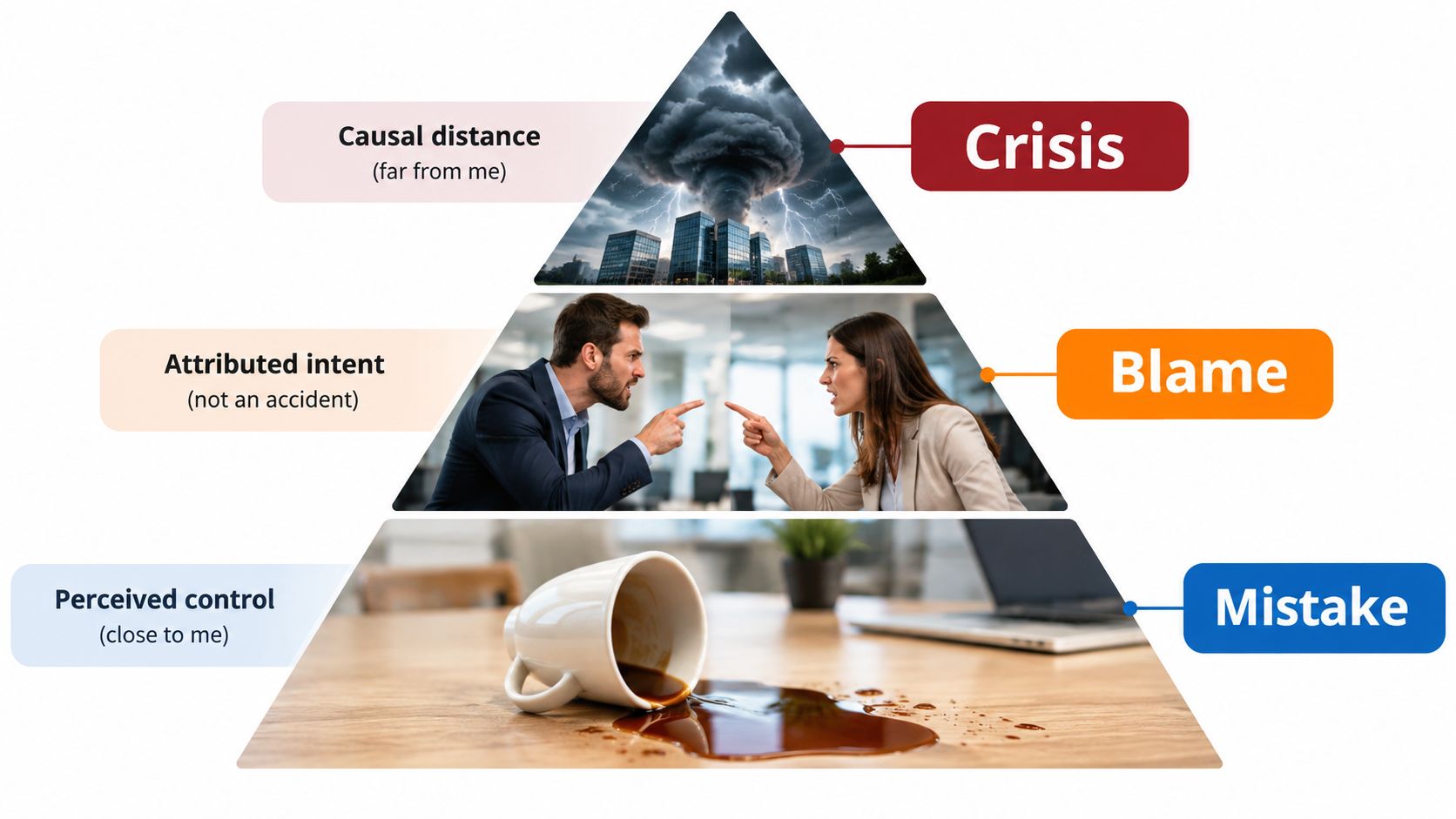
Blame often sounds like certainty, but it usually begins as discomfort looking for a safer place to land.
Three Drivers That Turn Mistakes Into Blame
Not every mistake becomes a blame event. Three judgments usually decide whether a team stays in problem-solving mode or slides into accusation, control, intent, and causal distance. Once those judgments line up, blame feels almost automatic.
Control Changes Who Gets the Heat
People blame the actor they think had authority over the outcome. A manager, vendor lead, or system owner gets more heat than the junior employee who physically clicked the wrong button, because the higher-level role implies responsibility for conditions and decisions. That's why the same lapse can look minor at one level and unforgivable at another.
Intent Raises the Emotional Charge
An accidental miss reads differently from a deliberate one. If a deadline slips because someone misread a dependency, the reaction may stay practical. If the same delay looks like indifference, concealment, or disregard, blame intensifies fast because the event is now judged as preventable in a moral sense, not just a technical one.
Causal Distance Pushes Blame Toward the Nearest Person
When the chain is messy, diffuse, or hidden, people often blame the most visible person in the room. That's why a system failure can be rewritten as an individual failure, especially in post-mortems that don't map the chain carefully. The person closest to the last visible step becomes the story, even if the actual cause started much earlier.
The three drivers often reinforce each other. A leader with authority, an outcome that appears avoidable, and a visible mistake at the end of a chain can create an almost irresistible blame target. Once that happens, teams stop learning from the event and start protecting themselves from the social fallout.
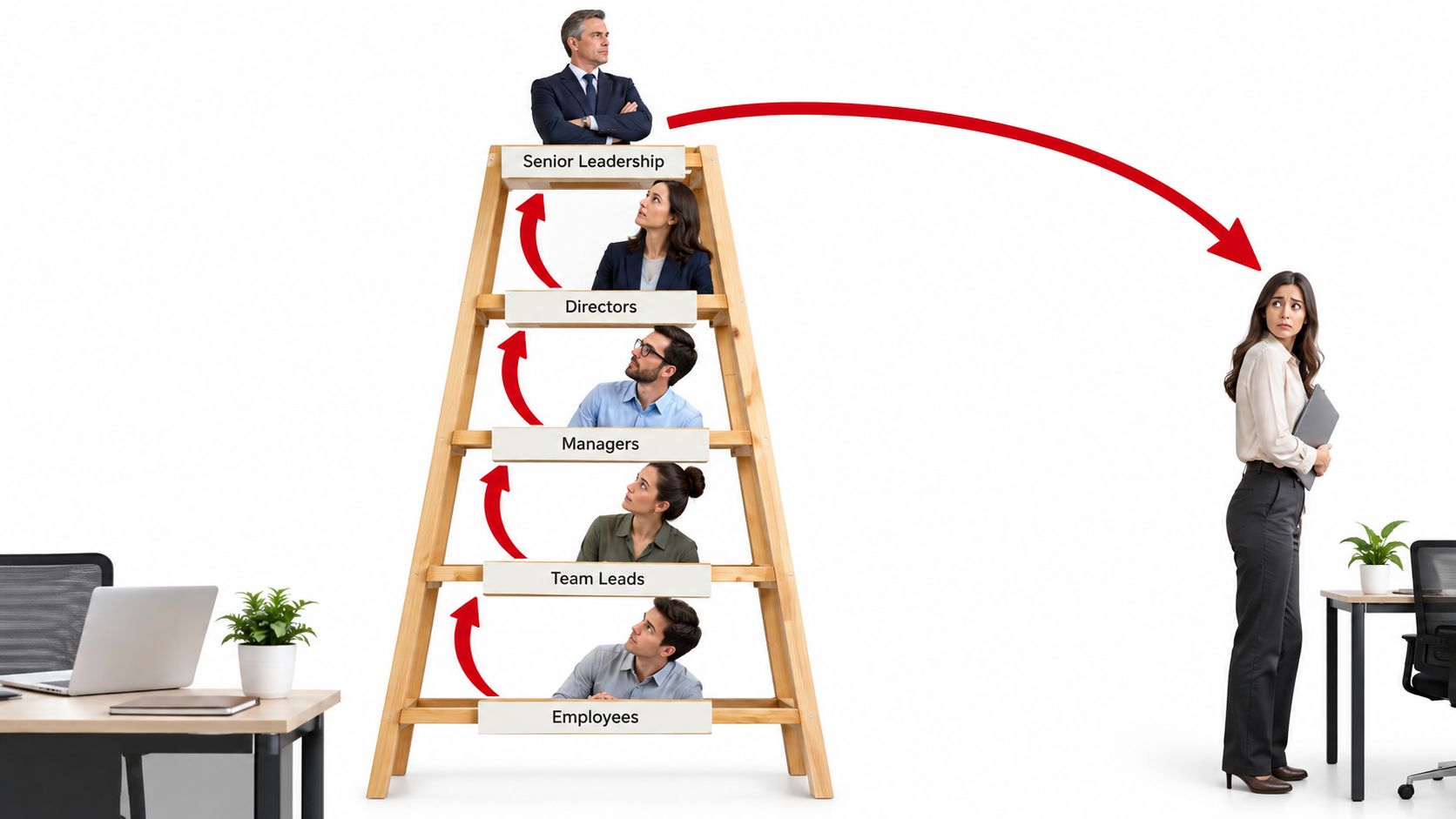
The fastest way to misread a failure is to confuse the nearest person with the true cause.
Why Organizations Blame the Wrong People
Organizations don't just replay individual psychology at scale, they distort it. Power gradients, reporting lines, and governance structures shape who looks responsible, which means blame travels upward toward perceived control and sideways toward whoever appears easiest to name. That is why senior leaders and external vendors often carry more blame than the people closest to the broken step.
A system-level failure is especially vulnerable to this rewrite. If the decision rights were unclear, the audit trail was incomplete, or the handoff process was brittle, the organization may still assign fault to a single person because that's simpler than tracing the chain. The result is a familiar pattern, a process problem becomes a character problem.
This is one reason blame can be so misleading in cross-functional work. The team with visibility gets pressure, the team with authority gets suspicion, and the team with the most complicated inputs can hide behind distance. The actual failure path gets blurred by hierarchy.
If you're trying to design a better response, a useful companion is proven roadmap for team accountability, especially when your goal is to separate ownership from scapegoating.
What Gets Lost When Attribution Is Wrong
The cost is not abstract. Once the wrong person carries the story, root causes stay buried. The organization learns the wrong lesson, repeats the same mistake, and trains people to manage appearances instead of risks. That's how a governance issue becomes a personnel issue, and then becomes a culture issue.

The Real Cost of a Blame Culture
I've watched teams become more careful in all the wrong ways after a few public blame moments. People documented everything defensively, avoided early warnings, and waited too long to raise issues because they didn't want their names attached to the problem. The culture didn't become more accountable, it became more guarded.
That shift changes performance in slow, expensive ways. Decisions take longer because everyone wants cover. Experimentation shrinks because no one wants to own a failed test. Strong people leave because they can usually find a place where bad news doesn't come with a public trial.
A blame culture also changes how information moves. Instead of surfacing issues early, people hoard context until they're sure they can survive the conversation. By the time the problem is visible, the fix is harder and the trust is thinner.
If you need a way to compare the two mindsets, use this lens.
| Metric | Blame Culture | Accountability Culture |
|---|---|---|
| Early issue reporting | Delayed, selective, fearful | Early, direct, routine |
| Decision speed | Slower because people seek cover | Faster because ownership is clear |
| Learning after failure | Defensive, personal, fragmented | Systemic, specific, actionable |
| Trust in management | Fragile and situational | More durable over time |
| Experimentation | Narrow and cautious | More open and disciplined |
| Team communication | Information hoarding | Clear escalation and candor |
The difference isn't softness versus rigor. It's whether people can tell the truth without fearing that honesty will be treated as evidence against them.
For leaders who want a practical structure, define ownership as a leader is a useful framing, because ownership only works when it creates clarity instead of fear.
Building Accountability Through Emotion Regulation
The hardest accountability conversations fail for a predictable reason, the leader reacts before the facts are clear. When the body is activated, tone sharpens, assumptions harden, and the conversation becomes about threat management rather than learning. Emotion regulation matters because it gives the leader enough space to stay accurate.
A simple framework helps, pause, name, choose. First, pause long enough to calm the initial surge. Then name the causal chain instead of the person. Finally, choose a response that improves the next decision, handoff, or safeguard.
Practical rule: if your first sentence is an accusation, you're probably leading with arousal, not judgment.
A different conversation sounds like this.
“Why did you miss this?”
Instead, try, “Walk me through the steps from the first signal to the miss. Where did the process break, and what did we not see soon enough?”
The second version doesn't remove accountability. It makes accountability usable. It also matches what leaders need in practice, because a review ritual that shames people usually produces performance theater, while a structured inquiry surfaces the actual failure path.
A Checklist for This Week
- Pause before speaking when you feel the urge to assign fault.
- Name your own contribution first, even if it's partial.
- Ask for the causal chain, not just the latest visible mistake.
- Reward the messenger who raised the issue early.
- End with one next action, not a lingering moral verdict.
How Meditation Reshapes the Blame Response
Meditation matters here because blame often starts as a reflex, not a reasoned choice. When a leader notices the body tightening, the urge to protect status or discharge frustration gets louder. Meditation gives that reaction a little space, and that space is where better judgment can enter.
Evidence from compassion-related meditation programs points in the same direction. A systematic review and meta-analysis found that meditation-based programs increase empathy, compassion, and pro-social behavior, and a separate randomized intervention study found that greater altruistic orientation was associated with meditation time, lower perceived stress, and higher self-compassion and mindfulness (meditation-based compassion findings). For leaders, that matters because blame is often a stress response dressed up as certainty.
What Different Practices Do in a Blame Moment
Focused attention helps when your mind is racing after a bad meeting. Open monitoring helps when you need to notice the story your mind is constructing before you send the email. Loving-kindness helps when the impulse is to make someone else carry your anger.
Those practices don't make you passive. They make you less reactive. A leader who can breathe, notice the narrative, and return to the facts is harder to provoke and easier to trust.
That's also why meditation pairs so well with transformational thinking. It interrupts the instant jump from discomfort to accusation. Instead of broadcasting the first story that appears, you get a chance to ask whether the story is true, useful, and fair.
For a practical starting point, the guided material at Gamayaa's meditation resource can be used as a simple entry into daily practice.
A one-minute reset is enough to start.
- Notice the sensation in your body.
- Label the emotion without argument.
- Name the story you're about to tell.
- Choose the next response with more care than instinct.
That small pause won't solve every conflict. It will, however, change the quality of the next sentence you speak.
A Leaders Path Forward
Blame will always be available. It's quick, socially understandable, and emotionally satisfying for a moment. The better move is to treat it as a signal, not a verdict, and to ask what the team is really trying to protect when it reaches for a culprit.
My own standard is simple now, pause before pointing, name my own part first, and reward the person who brings bad news early. That habit changes the tone of the room faster than any speech about accountability. It also makes it safer for other people to speak up, which is where real learning begins.
At the team level, the commitment has to be just as concrete. Replace post-mortems that hunt for culprits with reviews that trace the process, document the chain, and protect the person who surfaced the issue. When that happens, accountability stops being a threat and starts becoming a shared discipline.
That's the reframing. Why human blame others is not just about bad character, it's about control, distance, emotion, and the stories organizations reward. Once leaders understand that, they can stop feeding the reflex and start redesigning the response.
If your team is ready to move from finger-pointing to real ownership, Kushan Business Solutions LLC can help you build the habits, language, and operating rhythm that make accountability feel safe enough to work.