
Your software development team structure is the organizational DNA that dictates how people work together, communicate, and ultimately, ship code. It defines reporting lines, individual roles, and the entire flow of work. Getting this right is one of the most critical strategic decisions you’ll make—it’s not just an operational detail.
Choosing the Right Blueprint for Your Team

Think of your team structure as an architectural blueprint. The plans for a sprawling corporate campus look nothing like the drawings for a cozy single-family home. Each is designed for a completely different purpose, and trying to build a skyscraper with a house plan guarantees nothing but chaos, delays, and blown budgets. The same logic applies to software development; a one-size-fits-all approach to team design is a recipe for failure.
The structure you choose will shape everything from your team’s daily stand-ups to your long-term product roadmap. It’s what determines how quickly you can pivot in response to market shifts, how well your engineers can untangle complex technical knots, and how much autonomy they feel in their day-to-day work.
Why Your Team Structure Is a Strategic Asset
A well-designed team structure is far more than just a tidy org chart—it’s a powerful competitive advantage. When you organize your talent in a way that amplifies their impact, you’ll see the results everywhere. The right model can speed up delivery, spark genuine innovation, and dramatically improve product quality.
On the other hand, a poorly aligned structure just creates friction. It’s the sand in the gears that leads to frustrating, and familiar, problems:
- Communication Silos: Information gets trapped within specialized groups, bogging down every decision.
- Reduced Ownership: When no single team truly owns a feature from concept to launch, accountability slips and quality suffers.
- Slow Delivery Cycles: Dependencies between teams create constant bottlenecks, which means value gets to your customers much later than it should.
When you’re thinking about the core ideas behind effective team design, it’s vital to understand what makes a team more than just a group of individuals. As experts in the field note, the goal is to design high-performance teams that operate as cohesive, goal-oriented units. This is precisely where a skilled USA-based outsourcing partner can be invaluable, providing professionals who already grasp the cultural and operational nuances needed to integrate seamlessly into these high-performing structures.
Selecting a team structure is not a one-time decision. As your company grows, your products mature, and your market evolves, your team structure must adapt. What works for a five-person startup will cripple a 500-person enterprise.
The following sections will walk you through the most common models used today. We’ll get into their unique strengths and weaknesses, helping you align your organizational design with your real-world strategic goals. As you look through these options, think about how each framework would impact your team’s ability to bring your company’s vision to life. For a closer look at aligning your organization with core business objectives, learn more about our technology strategy consulting services.
Ready to build a high-performance team? Reach out to us at (310) 800-1398 / (949) 861-1804 or email info@ninearchs.com.
The 5 Ways to Structure a Development Team
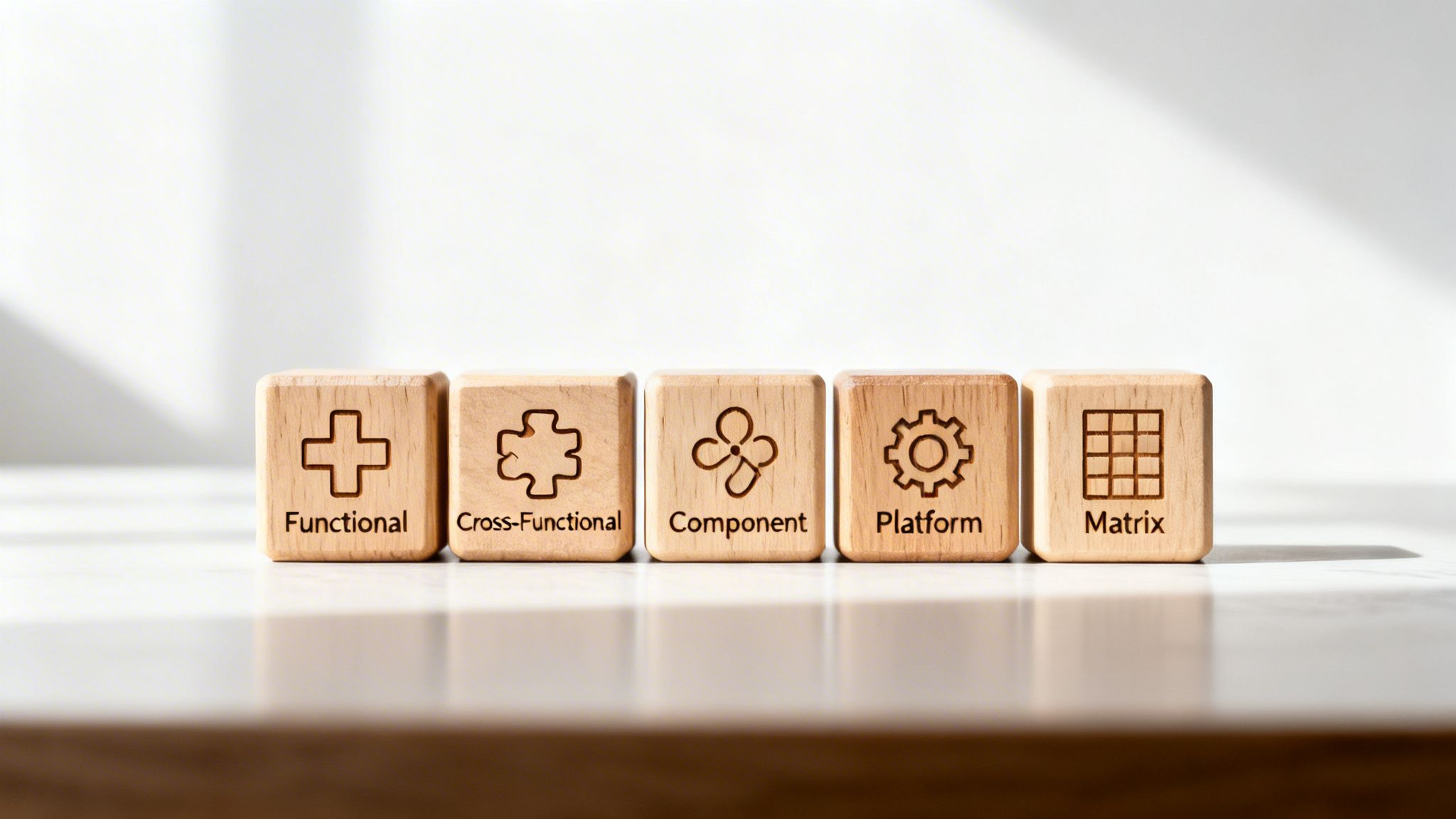
Choosing how to structure your development team is one of the most consequential decisions you’ll make. It’s not just an org chart—it’s the blueprint for how work gets done, how fast you can innovate, and what your company culture feels like day-to-day. Get it right, and you create flow. Get it wrong, and you create friction.
There isn't a single "best" model; there's only the one that best fits your company's size, goals, and culture right now. Let's walk through the five core models I’ve seen in the wild, from startups to enterprise giants, so you can make a clear-eyed decision.
The Functional Team Model
Imagine a traditional workshop with masters of every craft. The woodworkers are in one corner, the metalworkers in another, and the finishers have their own space. Each group is a hub of deep expertise, sharing tools and perfecting their specific trade. This is the essence of a functional team structure.
In the software world, this means all your backend engineers are on one team, all your frontend engineers are on another, and your QA specialists are grouped together. It’s a classic model that prioritizes technical depth and standardization, often found in more established organizations.
-
Pros of Functional Teams:
- Deep Expertise: This is the best environment for creating true specialists. Junior developers learn directly from senior experts, creating a clear mentorship path and fostering technical mastery.
- Standardized Practices: When all the specialists are in one place, it's far easier to enforce coding standards, select a common toolset, and maintain consistent quality.
- Resource Efficiency: A manager can easily pull a specialist from the "pool" and assign them to a project where they're needed most, which feels efficient on paper.
-
Cons of Functional Teams:
- Communication Silos: This is the model's Achilles' heel. Building even a simple feature requires a series of handoffs—from backend to frontend to QA. Each handoff is a potential point of failure, delay, and miscommunication.
- Reduced Ownership: When everyone only owns a piece of the puzzle, no one owns the final product. This can lead to a "that's not my problem" culture where accountability gets lost between teams.
- Slow Delivery: The entire system moves at the speed of its slowest handoff. If the frontend team is waiting for the backend team, work grinds to a halt. This creates bottlenecks that are incredibly frustrating for everyone.
The Cross-Functional Team Model
Now, picture an emergency room trauma unit. When a patient comes in, a dedicated team—surgeon, anesthesiologist, nurses, and technicians—swarms the case. They have every skill needed to see the mission through from start to finish, right there in the room. This is the cross-functional team.
This structure assembles a small, self-sufficient squad with all the necessary skills: backend, frontend, QA, design, and product. This single team is given a mission—like "build the new checkout flow"—and is fully responsible for delivering it. It's the bedrock of modern Agile and Scrum practices for a reason.
Because the team has everything it needs, there are no external dependencies or handoffs. They can operate with incredible autonomy and speed, which is why this model is the default for most high-growth startups and product-led companies.
One key study revealed that high-performing organizations are 2.6 times more likely to use cross-functional product teams. Why? Because eliminating dependencies and empowering teams directly leads to faster delivery and better-quality software.
Strengths:
- Rapid Delivery: With no one to wait on, teams can move from idea to deployment in a fraction of the time.
- Strong Ownership: The team owns the feature end-to-end. This fosters immense pride and accountability for the quality of their work.
- Improved Communication: All the critical conversations happen within the team, drastically reducing misunderstandings and delays.
Weaknesses:
- Skill Gaps: The team is only as capable as its weakest link. If you're missing a critical skill (or the person with that skill is a bottleneck), the whole team can get stuck.
- Potential for Inconsistency: Without strong central guidance (often from a "platform" team, which we'll get to), you risk having different teams build features in wildly different ways, creating a messy user experience or tech stack over time.
The Component Team Model
Think of a high-end car manufacturer. One specialized factory might only produce engines. Another builds transmissions. They are masters of their specific component, and their job is to design, build, and perfect it. This is exactly how a component team works.
Instead of owning a user-facing feature, a component team owns a specific piece of the technology—like the search API, the payment processing service, or the internal design system. They are the go-to experts for that part of the stack, responsible for its performance, stability, and evolution. Other teams, typically cross-functional ones, then use that component to build their products.
This model becomes necessary in larger organizations where a single service, like an authentication system, might be used by dozens of different product teams.
The Platform or Tribe Model
Taking the component idea a step further, a platform team (also called a "pod" or "tribe") builds and maintains the core infrastructure that enables all the other product teams. Think of them as the city planners who lay the roads, power grid, and water lines.
They don't build the actual houses (the features), but they provide the foundational services that let the builders work fast and efficiently. In a software context, this means managing things like CI/CD pipelines, cloud infrastructure, monitoring tools, and core shared APIs. The ultimate goal of a platform team is to reduce the cognitive load on feature teams so they can focus on what they do best: delivering value to users.
The Matrix Team Model
The matrix team structure is a hybrid where people have two bosses. An engineer reports to their functional manager (like the Head of Frontend Engineering) for career growth and technical standards, but they also report to a product manager for their day-to-day project work.
In theory, this gives you the best of both worlds: deep functional expertise and focused product delivery. In practice, it's notoriously difficult to get right.
- Primary Challenge: The dual-reporting structure is a recipe for conflicting priorities. An engineer can get one set of instructions from their functional lead and a completely different set from their product manager, leaving them caught in the middle.
While the matrix model can offer flexibility, it requires exceptional communication and strong, aligned leadership to prevent it from dissolving into internal politics and confusion.
For businesses looking to stand up these structures without the long lead time and overhead of direct hiring, partnering with a USA-based outsourcing provider like NineArchs is a powerful shortcut. You can launch a dedicated cross-functional team for a new product or augment your existing teams with specialized talent, all while maintaining time-zone and cultural alignment.
To figure out which software development team structure makes the most sense for your goals, contact us today. Call (310) 800-1398 / (949) 861-1804 or email info@ninearchs.com.
How to Size and Scale Your Team for Optimal Performance

Getting team size right is a constant balancing act. Add too few people, and you risk burnout and missed deadlines. Add too many, and you hit the law of diminishing returns, where adding more people actually slows everyone down. It’s a classic scaling trap.
The secret isn’t a magic number but a matter of communication, autonomy, and focus. This is where the famous "two-pizza rule" comes in handy. The idea is simple: a team should never be so large that two pizzas can’t feed everyone.
This isn’t about being frugal with lunch money. It’s a brilliant metaphor for keeping communication lines short and effective. In our experience, a team of 5 to 9 members is the sweet spot for genuine agility. In a group this size, everyone knows what everyone else is working on, decisions happen fast, and a powerful sense of shared ownership takes hold.
When a team grows beyond this point, communication overhead explodes. The number of potential communication pathways increases exponentially with each new member, leading to more meetings, more misunderstandings, and slower decision-making.
Scaling Frameworks for Company Growth
The team structure that works for a five-person startup will cripple a 500-person enterprise. As your business evolves, your teams must evolve with it.
For Startups (Flexibility is Key)
Early-stage startups live and die by their ability to move fast and pivot. A single, small cross-functional team is almost always the best fit. This model prioritizes rapid iteration over deep specialization, empowering the team to build, test, and learn without bureaucratic friction. The entire focus is on shipping a minimum viable product (MVP) and reacting to user feedback instantly.
For SMEs (Balancing Specialization)
As a company grows into a small or medium-sized enterprise (SME), it’s usually juggling multiple products or more complex features. This is the natural point to split into several cross-functional teams. You might also introduce your first component teams to manage shared services—like authentication or a design system—which prevents duplicated effort and ensures consistency across your product lines.
For Enterprises (Managing Governance)
Large enterprises have to manage complexity at scale. They typically deploy a hybrid model, using cross-functional teams for new initiatives, component teams for core services, and platform teams to provide the underlying infrastructure. A strong governance layer becomes absolutely crucial here to ensure dozens, or even hundreds, of teams are all working in a coordinated, secure, and efficient way.
The Power of Distributed Teams
The modern workforce is global and remote, a reality that opens up incredible opportunities for companies willing to adapt their team structure. Forget being limited to your local talent pool; the world is your hiring ground.
Recent data paints a clear picture: there’s a vast, worldwide talent pool of an estimated 20.8 million developers. Their work preferences have also shifted dramatically, with 33% working fully remotely and another 37.1% in hybrid roles. This global distribution doesn’t just give you access to specialized skills; it builds resilience into your organization. And with global IT spending projected to exceed $6 trillion by 2026, as noted in recent software development statistics, investing in a robust, global team is a strategic move.
This is where partnering with a US-based outsourcing firm like NineArchs gives you a distinct advantage. We help you tap into this global talent pool while maintaining perfect alignment on business hours, work culture, and communication. It’s the ideal blend of worldwide talent and local synergy, driving innovation without the friction of major time-zone or cultural gaps.
Ready to build a team that scales with your business? Contact us to discuss your goals. Call (310) 800-1398 / (949) 861-1804 or email info@ninearchs.com.
The Impact of AI on Future Team Structures

For decades, we’ve organized software development around human capabilities. We built teams, created processes, and set deadlines based on what people could realistically accomplish. Now, artificial intelligence is walking into the room and fundamentally changing that equation. It's not just another tool; it's a force multiplier paving the way for smaller, more powerful teams that deliver value at a speed we're only beginning to understand.
This isn't some far-off prediction; it's happening today. The traditional model of staffing large engineering departments with junior developers to handle routine work is becoming a relic. AI-powered assistants are taking over much of the boilerplate code generation, bug hunting, and even deployment pipelines. A single senior engineer, armed with these tools, can now accomplish what used to require a whole squad.
The Rise of the AI-Augmented Team
The emerging software development team looks less like a large infantry unit and more like a small, elite special forces team. Every member is a seasoned expert, and their individual effectiveness is amplified by their AI toolkit.
This shift is creating entirely new roles—not just tweaked versions of old jobs, but specializations born from the need to manage AI’s power and its potential risks.
- AI Governance Specialists: Think of them as the guardians of responsible innovation. These experts make sure AI systems are used ethically, securely, and in line with ever-changing regulations.
- Prompt Engineers: These are the master communicators who know how to talk to AI. They craft the precise instructions needed to get high-quality code, analysis, and insights from generative models.
- Domain-Specific AI Engineers: These professionals are a hybrid of deep industry knowledge and AI expertise. They build highly contextual solutions that solve real-world business problems in a specific field.
To lead a team through this transition, it's essential to grasp the underlying technologies. Understanding advances in AI chat completions is no longer optional; these engines are what’s driving this productivity shift.
A Strategic Shift Driven by Data
This isn't just a gut feeling; the industry forecasts are clear. Major analysts predict that by 2030, 80% of organizations will have moved away from large software teams toward these smaller, AI-augmented units. The same research points to productivity gains of 30-35% across the software development lifecycle, all thanks to AI agents helping with coding, testing, and deployment.
While developer education is still vital—with 42.1% holding a bachelor’s and 26.2% a master's—this trend puts a premium on experienced leaders who can effectively manage an AI-driven workflow, a point echoed in recent software industry outlooks.
The takeaway is simple: The future belongs to companies that build teams around a core of senior human experts amplified by AI. The focus is shifting from managing people to managing a sophisticated, AI-powered system of work.
For small to mid-sized businesses, this is a massive opportunity. It helps level the playing field, enabling smaller players to match the speed and innovation of much larger enterprises. This makes partnering with a skilled USA-based outsourcing provider an even smarter strategy. You get immediate access to specialized AI talent and experienced engineers without the long-term overhead of hiring. It's a direct line to the productivity gains that will define the next generation of software development. You can learn more about how artificial intelligence is transforming business operations in our related article.
Ready to build your AI-augmented team? Contact NineArchs today for a strategic consultation. Call us at (310) 800-1398 / (949) 861-1804 or email info@ninearchs.com.
Integrating Outsourced Teams for Seamless Collaboration
Software development today isn't about finding talent in a single building or even a single city. The smartest companies know that outsourcing has evolved from a simple cost-cutting trick to a strategic necessity for finding specialized skills, hitting aggressive deadlines, and building a more resilient organization. But just hiring an external team isn't the finish line—it’s the starting block.
True success comes from deep integration. The goal is to make your outsourced partners a genuine extension of your in-house staff, where everyone, no matter their location or employer, is aligned on the same mission. Without this, you risk creating the very friction and silos you were trying to escape in the first place.
The Advantage of a US-Based Outsourcing Partner
While the global talent pool is vast, there's a strong case for partnering with a USA-based outsourcing provider. The benefits go far beyond convenience; they are about dramatically reducing operational friction and risk. The most obvious win is aligned business hours, which erases the logistical nightmare of coordinating meetings across wildly different time zones.
There's also a shared cultural context that just makes things run smoother. Nuances in communication, business etiquette, and work expectations are already understood, which means fewer misunderstandings and a faster path to building real trust. On top of that, operating under the same legal and data security frameworks adds a crucial layer of protection and simplifies compliance.
A Playbook for Successful Integration
Making an outsourced team feel like your own involves more than a welcome email and a Slack invite. It demands a structured plan that zeroes in on three key areas: onboarding, communication, and governance.
- Onboarding for Immediate Impact: Your onboarding process needs to be a well-oiled machine. The goal is to get new partners productive from day one. This means immediate access to all tools (code repos, project management software, communication channels) and crystal-clear documentation on everything from coding standards to architectural guidelines.
- Standardizing Communication: You have to set clear "rules of engagement" for how everyone talks to each other. Define which channels are used for what—maybe Slack for quick questions, Jira for tracking tasks, and scheduled video calls for daily stand-ups. This gets rid of ambiguity and makes sure information flows where it needs to.
- Unifying the Toolchain: This is non-negotiable. Both in-house and external teams absolutely must work from the same set of tools. A shared tech stack, from IDEs and CI/CD pipelines to monitoring platforms, creates a single source of truth. This technical alignment is the bedrock of efficient collaboration.
The real goal of integration is to completely blur the lines between "us" and "them." When an outsourced developer can jump on a feature with an in-house engineer as if they were sitting at the next desk, you’ve achieved a true partnership.
Establishing Governance and Measuring Success
Clear governance is the framework that keeps everyone pulling in the same direction. Start by defining roles and responsibilities so there's zero confusion about who owns what. Regular, structured check-ins—like weekly syncs and quarterly business reviews—are vital for tracking progress against Key Performance Indicators (KPIs) and realigning on strategy.
Your metrics should focus on shared outcomes, reinforcing the idea of a single, unified team. Track metrics like:
- Cycle Time: The total time it takes to get a feature from the first line of code to deployment.
- Deployment Frequency: How often the integrated team successfully ships code to production.
- Change Fail Rate: The percentage of deployments that end up causing a failure in production.
For a much deeper dive into the nuts and bolts of working with external partners, check out our comprehensive software development outsourcing guide.
By investing in a smart integration strategy, you turn outsourcing from a simple transaction into a powerful engine for growth. Building a high-performance extended team is entirely within reach.
To start your journey, contact NineArchs for a consultation.
Call us at (310) 800-1398 / (949) 861-1804 or email info@ninearchs.com.
Frequently Asked Questions About Team Structures
Choosing the right team structure feels like a high-stakes decision, because it is. You’re trying to balance the need for speed against long-term stability and expertise. It’s a puzzle every leader has to solve.
Let's tackle some of the most common questions I hear from founders and managers as they design their teams.
What Is the Best Team Structure for a Startup?
For almost any early-stage startup, the answer is a cross-functional team. Don't overthink it. This model puts everyone you need—frontend, backend, QA, design—into a single, self-sufficient squad. Their only job? To take an idea from a sketch to a live feature.
This is all about maximizing speed and agility, which are a startup's lifeblood. It breaks down the communication walls that cause frustrating delays and gives the entire team a powerful sense of ownership over the final product. For a young company that needs to ship, get feedback, and pivot fast, there’s no better way to work.
How Do I Choose Between a Feature Team and a Component Team?
This choice really comes down to a single question: what are you trying to optimize for?
-
Choose a feature team when your main goal is getting value into your customers' hands as quickly as possible. These teams (which are just another name for cross-functional teams) are built for end-to-end delivery and are laser-focused on the user.
-
Choose a component team when you're building something highly technical and reusable that needs deep, specialized knowledge. Think of a team creating a sophisticated payment engine that multiple products across the company will rely on.
Component teams are masters of building robust, scalable infrastructure, but they can be a bottleneck if you need to ship a complete feature quickly. As companies get bigger, a hybrid model often works best, where component teams act as internal service providers for several feature teams.
Ask yourself: is this a core, reusable piece of technology that gives us a competitive edge? If so, a component team ensures that asset gets the dedicated, expert attention it deserves.
How Do You Measure the Success of a Team Structure?
You can't measure success with a single yardstick. The metrics that matter for a fast-moving feature team are completely different from those for a foundational platform team. Success isn't just about output; it's about whether the team is achieving the outcomes it was designed for.
Here’s how to think about it:
- For Cross-Functional/Feature Teams: Your focus should be on speed and customer happiness. Track metrics like lead time for changes, deployment frequency, and customer satisfaction scores. These numbers tell you how fast you're shipping value and whether customers actually care.
- For Component/Platform Teams: Here, you're looking at adoption and rock-solid stability. Measure the adoption rate of their service by other internal teams, the overall system reliability (uptime), and whether they're successfully reducing the cognitive load for other developers.
- For All Structures: Never, ever forget to track employee satisfaction and retention. A great team structure should empower developers and prevent burnout, not create frustration. At the end of the day, happy, stable teams build better products.
Ready to find the perfect team structure for your business goals? The experts at NineArchs can help you design and staff a high-performance team tailored to your needs. By partnering with a USA-based outsourcing provider, you gain access to top-tier global talent while maintaining perfect alignment on time zones and business culture.
Contact us today for a consultation. Call us at (310) 800-1398 / (949) 861-1804 or email: info@ninearchs.com.