

Your finance lead wants cleaner reporting. Your operations team wants fewer support tickets. Your customer-facing staff just want the portal, CRM, or internal workflow app to stop freezing at the worst possible time.
Meanwhile, your internal IT team keeps getting pulled into small fires. A failed integration. A slow dashboard. A patch that broke something else. A login issue that turns into a half-day investigation. The software you bought to improve execution starts consuming the very time and budget it was supposed to save.
That is the moment many business leaders start looking seriously at application management services. Not because they want another vendor. Because they need a better operating model for the software their business already depends on.
Beyond Break-Fix The Strategic Shift to Application Management
A common pattern shows up in growing companies. At first, the application stack is manageable. One or two internal systems, a customer portal, maybe Microsoft 365, an accounting platform, and a few workflows held together by integrations.
Then growth adds complexity.
A sales app stops syncing cleanly. The reporting dashboard slows down after a product launch. A compliance update gets delayed because the team is tied up resolving user tickets. Nobody is ignoring strategy. They are just trapped in maintenance.
Application management services changes the conversation by addressing this.
Traditional support often works like a repair shop. Something breaks, someone opens a ticket, and IT reacts. AMS works more like an operations partner. The provider monitors the applications, maintains them, tunes performance, handles incidents, applies updates, and helps plan improvements before small issues become business disruptions.
For a non-technical leader, the simplest way to think about AMS is this: it turns software operations from a stream of interruptions into a managed service with clear ownership.
That shift matters because software is no longer a side system. It is the front door for customers, the workflow engine for staff, and the data source for decisions. A business cannot scale well if its core applications are unstable, slow, or neglected.
The broader market reflects that change. The global application management services market was valued at USD 38.2 billion in 2026 and is projected to reach USD 145.3 billion by 2035, growing at a 15.8% CAGR, according to Business Research Insights on the AMS market.
That kind of growth tells you something important. Businesses are no longer treating application support as a back-office chore. They are treating it as an operating priority.
If your team is already wrestling with recurring software issues, broader managed operations can help restore order. This overview of managed services infrastructure is useful context because applications rarely fail in isolation. They sit inside a larger support environment.
Key takeaway: Break-fix support restores yesterday’s state. Strategic AMS protects today’s operations while preparing the application portfolio for tomorrow’s growth.
What Are Application Management Services Really
Application management services are the ongoing management, support, optimization, and improvement of business software across its usable life.
That definition sounds broad because it is. AMS covers more than fixing bugs. It includes watching application health, helping users, handling updates, reducing performance issues, managing security tasks, and deciding when an older application should be improved, integrated, or retired.
A practical analogy helps.
Think of your business applications as a portfolio of commercial properties. Owning the buildings is not the hard part. Running them is. Someone has to handle maintenance, tenant issues, safety, inspections, upgrades, and emergency response. If nobody does that well, the buildings still exist, but their value drops and complaints rise.
An AMS provider plays a similar role for software.
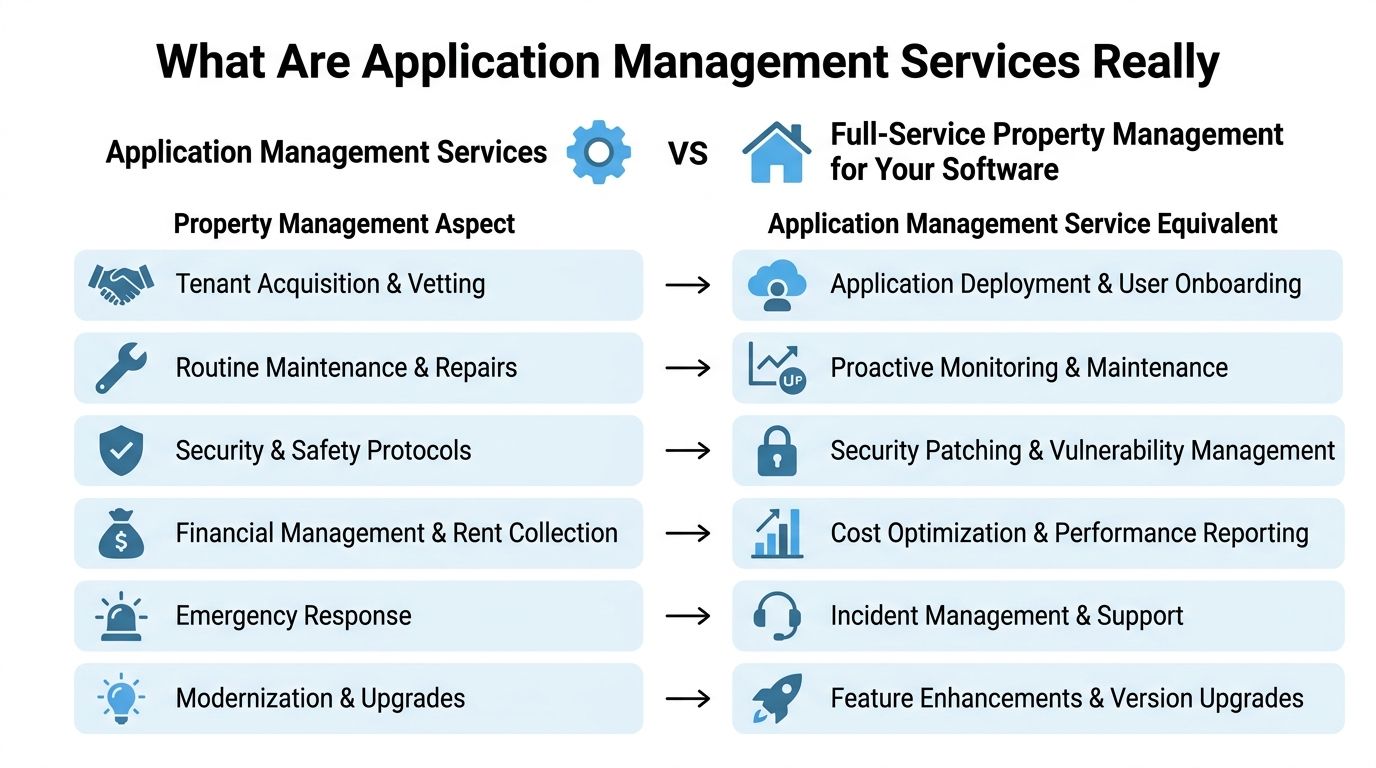
The property manager analogy in business terms
A good property manager does not wait for the roof to cave in. They inspect, schedule, repair, and improve. A good AMS team does not wait for users to complain before paying attention.
They typically handle things like:
- Daily operations: User support, incident response, access issues, and workflow disruptions.
- Preventive maintenance: Patches, updates, version checks, and dependency reviews.
- Performance care: Monitoring load times, investigating bottlenecks, and tuning systems.
- Security oversight: Applying fixes, reviewing vulnerabilities, and supporting policy compliance.
- Upgrade planning: Improving old modules, refining integrations, and introducing better workflows.
That is why AMS is different from traditional help desk support. The help desk often sees the symptom. AMS is responsible for the condition of the application itself.
Where readers often get confused
Many leaders assume AMS only applies to large enterprise platforms like SAP, Oracle, or Salesforce. It can. But the same operating model also matters for a custom customer portal, an internal HR workflow app, a mobile app, a Microsoft 365-connected process, or a cloud-based reporting tool.
Another confusion point is legacy systems. Businesses rarely replace everything at once. They usually run a mixed environment for years. That means the AMS provider has to support older systems while helping the business move toward cloud architectures.
That transition is not simple. As SmartDev’s discussion of modern AMS evolution notes, a key challenge is structuring contracts so the provider is rewarded for modernization, not for keeping outdated systems alive forever.
That detail matters more than many buyers realize. If your provider earns steady revenue from maintaining old systems, but has no incentive to simplify or modernize them, you can end up funding stagnation.
For a broader practical primer on support responsibilities and service expectations, this guide to Application Maintenance & Support adds helpful context.
What modern AMS should feel like
From a business leader’s seat, strong AMS should feel like:
- Less chaos
- Fewer repeated issues
- Clearer accountability
- Better visibility into risk
- Steadier application performance
- A roadmap, not just a ticket queue
If your current software support model only answers “who fixes this,” you are still in reactive mode. AMS should also answer “how do we stop this from happening again” and “what should this application become next.”
The Core Business Benefits of Strategic AMS Partnership
A business does not buy application management services because monitoring dashboards look impressive. It buys AMS because unmanaged applications create real costs.
Those costs show up as delayed orders, slower staff workflows, rising ticket volume, poor customer experience, and management time spent chasing technical updates instead of business priorities.

Better performance means better business flow
Speed matters more than many non-technical teams expect.
When an application takes too long to load, users do not experience that as a technical problem. They experience it as friction. Sales staff re-enter data. Customers abandon forms. Managers distrust dashboards that lag.
According to Kellton’s discussion of application managed services, providers that continuously monitor and apply targeted optimizations like code enhancements and server configuration changes can deliver up to 30 to 50% improvements in application response times.
That is not just an IT metric. Faster response times mean employees move through workflows with less waiting and customers encounter fewer moments that make them hesitate or leave.
Predictable support beats constant firefighting
When internal teams manage every application issue themselves, the work pattern becomes expensive in a hidden way. Senior people get pulled into routine problems. Planned projects get delayed. Documentation becomes patchy because everyone is solving the next urgent issue.
Strategic AMS helps by moving repeatable application operations into a defined service model.
Three business benefits tend to follow:
- Internal focus improves: Your core team can spend more time on product, growth, finance systems, or customer initiatives.
- Issue handling becomes structured: Ticket routing, escalation, and ownership stop living in scattered emails and Slack threads.
- Budgeting gets easier: Leaders can compare a service scope against expected outcomes instead of absorbing scattered labor costs inside multiple departments.
Small businesses gain strategic advantage, not just labor
SMEs often assume AMS is mainly for very large enterprises. In practice, smaller firms may benefit more because they have less room for distraction.
A growing company with a lean IT team cannot afford to have its best people stuck maintaining aging workflows and chasing recurring bugs. Outsourced application management gives smaller organizations access to broader support capacity without building every specialty in-house.
Practical lens: If your application problems repeatedly interrupt finance, operations, customer service, or compliance work, AMS is no longer just a technical purchase. It is an operational control decision.
Risk reduction shows up in ordinary work
One of the biggest advantages of a strategic AMS partnership is that risk gets handled in the background instead of through crisis.
That includes:
- Routine patching and maintenance
- Monitoring for performance degradation
- Escalation paths for critical incidents
- Support for change management and releases
- Ongoing review of weak points before users feel them
You do not need every application to be cutting-edge. You need the important ones to be dependable.
A useful test is simple. Ask whether your current support model gives you confidence before a high-demand day, a reporting deadline, or a major customer event. If the honest answer is “we hope nothing breaks,” your applications are being tolerated, not managed.
Choosing Your Engagement Model for Application Management
Not every company should buy application management services the same way.
The right model depends on how much internal capability you want to keep, how complex your application environment is, how comfortable you are with external ownership, and how much communication friction your business can tolerate.
Comparison of AMS engagement models
| Model | Best For | Cost | Control | Communication |
|---|---|---|---|---|
| Fully outsourced | Companies with limited internal IT capacity and a need for end-to-end coverage | Often more predictable | Lower day-to-day internal control | Clear if governance is strong |
| Co-managed hybrid | Businesses that want outside expertise but want to retain key internal ownership | Moderate and flexible | Shared control | Usually strong because both teams stay involved |
| Nearshore or offshore | Firms prioritizing broader talent access or budget flexibility | Often cost-focused | Varies by vendor model | Can be strong, but depends heavily on overlap and process discipline |
| Onshore | Organizations that prioritize alignment, security comfort, and easier collaboration | Often premium relative to offshore options | High visibility and easier governance | Usually the smoothest for real-time coordination |
Fully outsourced when ownership needs to be simple
This model works well when the internal team is already overloaded or the business does not want to run a deep application support function.
The provider becomes the main operating team for support, maintenance, performance work, and enhancement planning. That can simplify accountability because there is less ambiguity over who owns what.
The tradeoff is that leadership must choose the partner carefully and govern the relationship well. A vague scope creates disappointment fast.
Co-managed hybrid when internal context is valuable
This is often the best fit for SMEs.
Your internal team keeps business context, architecture knowledge, or stakeholder relationships. The AMS partner handles routine support, monitoring, maintenance, and specialist tasks that are hard to staff consistently.
A hybrid model works especially well when:
- Your product team has a thorough understanding of the application
- Your business users need close internal coordination
- You want external depth without losing internal visibility
It is also useful during modernization, where internal leaders want influence over priorities while the partner supplies delivery muscle.
Nearshore or offshore when scale and flexibility matter
These models can work well if the provider has mature process discipline, strong documentation, and good overlap with your working hours.
But communication quality matters more than rate cards. If an application issue affects finance close, customer support, or a regulatory workflow, the true cost of delay can outweigh labor savings.
That is why many buyers underestimate governance. Service quality in these models depends heavily on escalation design, handoff clarity, and who is assigned to the account.
Onshore and the case for a USA-based partner
A USA-based outsourcing partner offers benefits that are easy to overlook until something urgent happens.
Real-time meetings are easier. Escalations move faster. Business language and stakeholder expectations are often more closely aligned. Security reviews and compliance conversations can also feel more straightforward for organizations that prefer mature operating environments.
North America holds a 30% market share as of 2024, supported by advanced IT infrastructure, strong data center capacity, and mature service providers, according to this AMS global market report summary from GlobeNewswire. For businesses that care more about reliability, security, and smooth coordination than pure cost arbitrage, that maturity matters.
For leaders weighing broader sourcing decisions, this guide to software development outsourcing can help frame how engagement structure affects delivery quality.
Decision tip: Choose the model that reduces management drag, not just the one that appears cheapest on paper.
The Full Scope of Modern Application Management Services
When leaders hear “application management,” they often picture a support desk answering user complaints.
That is only one slice of the work.
A modern AMS engagement should cover the operational health of the application, the improvement backlog around it, and the business risk tied to it. If you only buy ticket handling, you are not really buying full application management services.
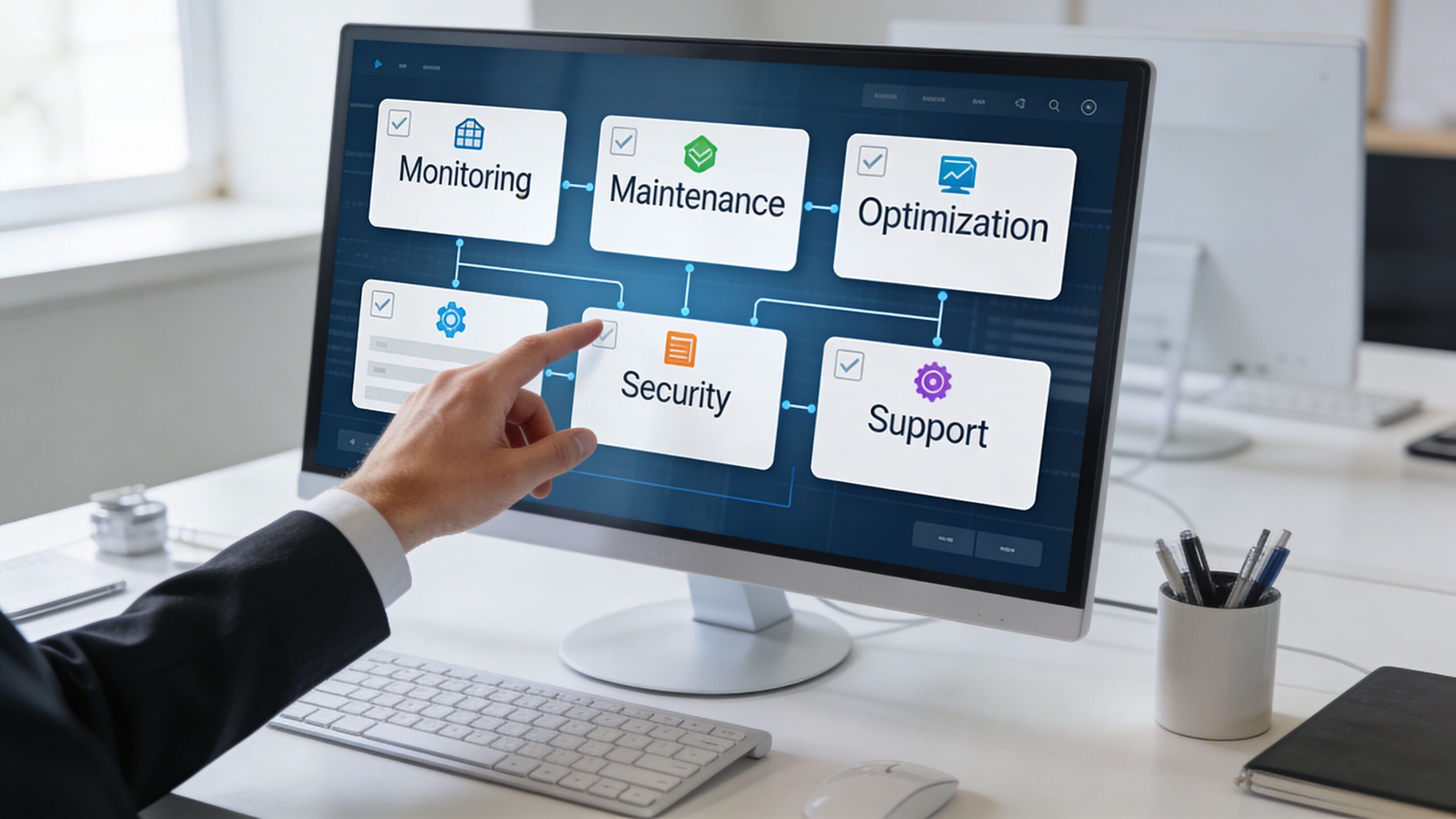
Support and maintenance that keeps work moving
This is the foundation.
It includes handling user-reported issues, troubleshooting defects, restoring failed services, and managing application incidents across different levels of complexity. In practical terms, these situations involve login failures, workflow errors, reporting glitches, and broken integrations being investigated and resolved.
A mature provider should also document recurring issues and reduce repeat incidents over time, not just close tickets.
Enhancements and modernization that prevent stagnation
Applications drift if no one improves them.
That drift shows up as clumsy user interfaces, outdated workflows, duplicate manual steps, and brittle customizations. AMS should include small enhancements, workflow refinements, version updates, and code improvements that keep the software useful.
This becomes especially important in mixed environments where some applications are old, some are cloud-based, and some are custom-built. In those situations, rationalizing what to keep, improve, replace, or retire becomes part of the management discipline. For a good strategic lens on that topic, Application Portfolio Rationalization is a useful read.
Monitoring and performance tuning that catches issues early
Good application management services include active monitoring of health, performance, and reliability.
That means checking whether critical jobs complete properly, whether integrations are failing unannounced, whether system resources are strained, and whether user-facing pages are slowing down at certain times.
The value here is not technical elegance. It is business continuity.
A provider should be able to answer questions like:
- Which applications are most fragile
- Which recurring bottlenecks create the most user friction
- Which performance issues are likely to become business issues next
Security and compliance work that reduces exposure
Security in AMS is usually less dramatic than executives expect, but far more important.
Most application risk management is routine discipline. Patch known issues. review user access. monitor vulnerabilities. support audit requirements. document changes. verify backup and recovery practices. coordinate with internal security or compliance owners.
This work is easy to neglect because the benefits are invisible when done well. But that is precisely the point.
Key takeaway: Security maturity in AMS is usually the result of consistency, not heroics.
Cloud operations that connect cost and resilience
Many applications now sit partly or fully in cloud environments such as AWS or Azure. Managing the app means managing the operational side of that environment too.
That can include capacity planning, release coordination, environment hygiene, scaling decisions, and cost review. Businesses often discover they are paying for unnecessary cloud complexity or carrying duplicate environments that no one revisits.
Legacy modernization also intersects here. If your applications are still partly tied to older systems, this guide on how to modernize legacy applications helps frame the transition choices.
A strong AMS scope gives you more than support. It gives you a practical operating model for keeping applications stable, useful, secure, and economically sensible.
How to Choose the Right AMS Partner and Measure Success
Choosing an AMS partner is not the same as buying extra hands.
You are choosing who will influence the reliability, speed, cost, and future direction of systems your business depends on. That decision deserves more scrutiny than a simple rate comparison.
Start with team quality, not price
A major risk for SMEs is getting drawn to a low monthly number without understanding how the provider staffs the account.
As Synoptek’s analysis of AMS adoption challenges notes, a critical gap in the market is the lack of ROI frameworks for SMEs, and many buyers get trapped by providers that underprice services using “low-cost, inexperienced, high-turnover resources.”
That phrase should stay with you.
Cheap support can become expensive if the assigned team lacks architecture understanding, business judgment, or continuity. Every handoff, every repeated explanation, and every weak root-cause analysis adds hidden cost.
Ask direct questions:
- Who will work on our applications
- How long do people typically stay on accounts
- What skills are in-house versus subcontracted
- How are escalations handled when the primary team is stuck
- How do you preserve knowledge when staff changes
If a provider gives vague answers, that is already an answer.
Use a practical SME ROI framework
Most smaller organizations do not need a complex financial model. They need a decision structure.
Assess the partner across five lenses:
Operational relief
Will this reduce the amount of interruption hitting your internal team?Application stability
Will recurring incidents decline because someone owns prevention, not just repair?Management overhead
Will leaders spend less time chasing updates across departments?Improvement capacity
Will the provider help the application get better, or only keep it alive?Risk posture
Will patching, access review, incident handling, and documentation become more disciplined?
If the answer is weak on most of these, the engagement may be outsourcing activity without outsourcing responsibility.
Match pricing model to the work
Different AMS relationships fit different pricing models.
A fixed-fee model often works for stable environments with clear scope. It makes budgeting easier, but only if responsibilities are defined well.
A time-and-materials model can work when the application environment changes often or enhancement work is fluid. It offers flexibility, but it demands stronger oversight.
A value-oriented structure can make sense when the provider is significantly involved in application outcomes and ongoing optimization. But it only works if both sides define success clearly.
The right question is not “which pricing model is best.” It is “which model matches the type of work we need.”
Put SLAs and KPIs in plain business language
Many service agreements look detailed but fail where it matters. They list response windows, support hours, and severity labels, yet leave key expectations fuzzy.
Your SLA should define:
- Which applications are covered
- Which incidents count as critical
- Who approves changes
- What escalation path applies after hours
- What reporting is delivered and how often
Your KPIs should be understandable to both IT and business leaders.
Good examples include:
- Resolution speed for important incidents
- Application availability
- Backlog aging for unresolved issues
- Repeat incident rate
- Release quality
- User satisfaction themes from support patterns
Expect a structured onboarding period
The first phase of AMS often determines whether the relationship will succeed.
A strong onboarding plan usually includes application discovery, access review, documentation collection, stakeholder interviews, support process setup, monitoring configuration, and issue triage. The provider should learn not only how the software works, but how the business depends on it.
Practical tip: Ask the provider what they need from your team in the first weeks. Good partners have a clear answer. Weak ones “figure it out” while billing you for confusion.
Watch for modernization intent
If you run both legacy and cloud-based systems, ask how the partner supports transition.
Do they have a clear view on what should be stabilized, what should be improved, and what should be phased out? Or are they content to keep everything running indefinitely?
That answer reveals whether they think like operators or caretakers of technical debt.
The best AMS partnerships create a visible chain from daily support to long-term simplification. That is how businesses measure success. Not by the number of tickets closed, but by whether software becomes easier to trust, easier to manage, and more useful to the business over time.
From Chaos to Clarity A NineArchs AMS Case Study
Consider a fictional healthcare technology company called InnovateHealth Tech.
The company had grown quickly around a patient portal used for appointment scheduling, secure document exchange, and billing communication. On paper, the platform was central to growth. In practice, it had become a source of friction.
Support tickets arrived daily. Patients reported slow page loads and failed form submissions. Internal staff spent hours escalating issues between developers, infrastructure contacts, and operations managers. Security updates were handled unevenly because everyone was focused on restoring service first. Product work on a new AI-enabled diagnostic feature kept slipping because the same engineers were repeatedly dragged into maintenance.
An AMS model changed the operating picture in this scenario.
NineArchs stepped in as an outsourcing partner to provide structured application support, ongoing monitoring, and a clearer service workflow around the portal. Instead of treating each issue as a separate emergency, the team organized support around ownership, triage, root-cause review, patch discipline, and planned enhancement work.
The immediate value was not flashy. It was clarity.
Incidents stopped bouncing between teams without accountability. Maintenance windows became planned instead of improvised. Security checks became part of routine operations rather than a delayed task. The internal product team regained protected time to focus on roadmap work.
For a business leader, that is the core ROI story of application management services. Better software operations are not just about cleaner systems. They protect executive attention, preserve staff focus, and reduce the drag that unstable applications place on the whole company.
A case like this also highlights why many organizations prefer a USA-based outsourcing partner for AMS. When applications affect customer service, operations, and regulated workflows, easier communication, aligned business hours, and mature delivery discipline can matter just as much as technical skill.
The main lesson is simple. AMS works best when it is treated as an operating model, not a ticket queue.
If your applications are consuming too much management time, creating recurring user frustration, or slowing strategic initiatives, the right partner should help you restore control, build a better support rhythm, and create a path from maintenance toward modernization.
If your business needs a dependable outsourcing partner for application management, cloud operations, software support, Microsoft 365 environments, or broader back-office delivery, connect with NineArchs LLC. Call (310)800-1398 or (949) 861-1804, or email info@ninearchs.com to discuss a practical support model that fits your team and growth plans.